


Event security management starts before the first guest reaches the gate. A sold-out festival may look calm during the afternoon, but queues build quickly when several coaches arrive together, a bar opens, or a performer changes the running order. At a busy hotel function, the same pressure can appear around registration, lifts, parking areas and alcohol service.
The guests won't see most of the work. They'll notice that entry feels orderly, staff know where to send questions, and an incident is handled without panic. That calm depends on decisions made earlier, including the risk assessment, staffing plan, radio channels, emergency options and compliance documents.
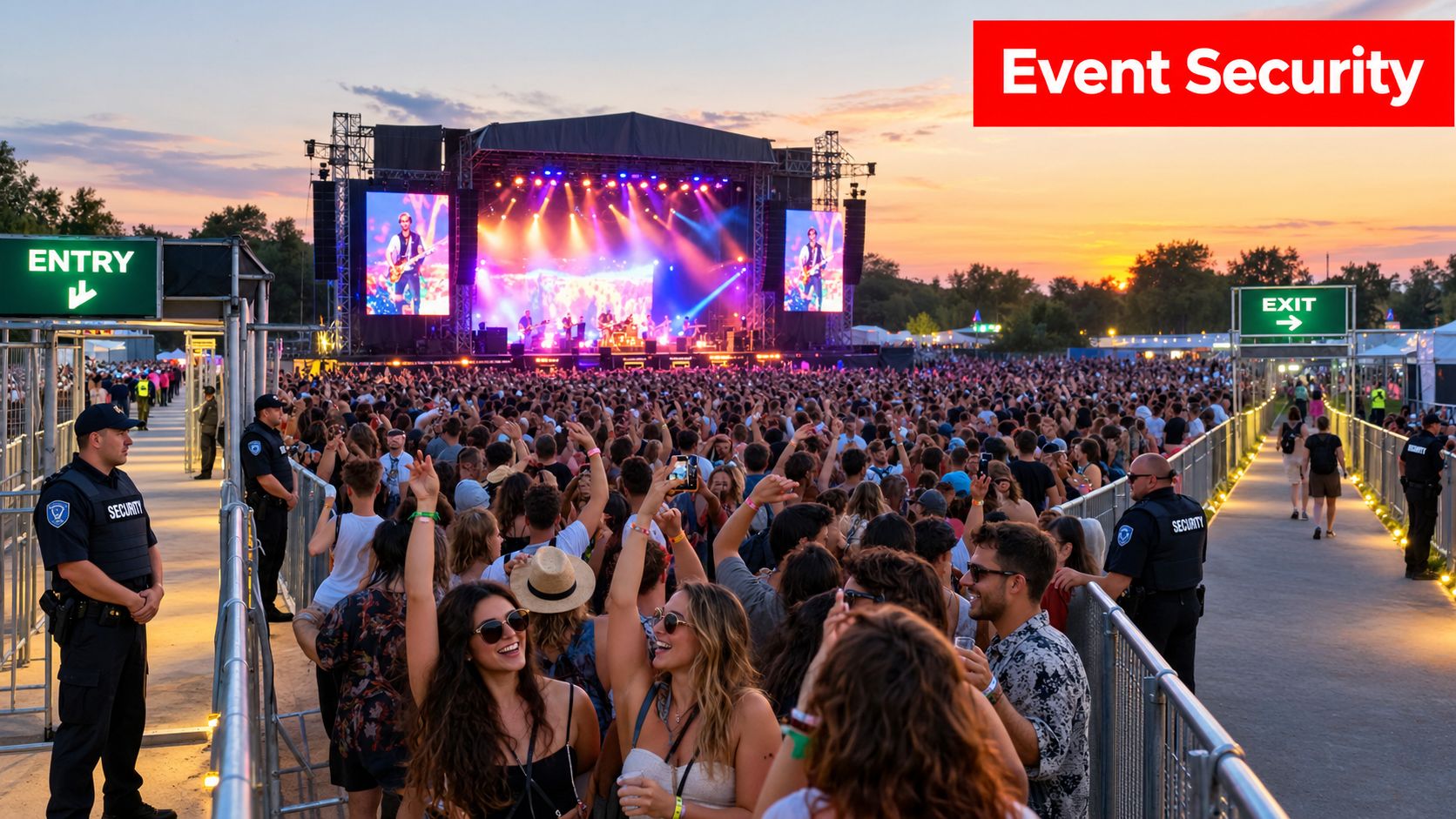

A safe event should feel welcoming, not fortified. Good event security management protects people while allowing the organiser's experience, schedule and reputation to work as intended.
This guide gives first-time organisers a practical way to plan events across NSW, Victoria, Queensland and the ACT. It covers the legal foundations, attendance thresholds, staffing choices, venue operations, emergency planning and post-event improvement. The aim isn't to place guards at random points. It's to match each control to a realistic risk.
Introduction to Event Security Management That Keeps People Safe
Event security management is an invisible system that lets people enjoy a concert, festival, conference, wedding or hospitality venue without thinking about every possible problem. At a music festival, that system may include ticket checks, queue lanes, barriers, roving teams, a supervisor, radio communications and a clear method for pausing the show. At a hotel function, it may focus more on guest access, alcohol-related behaviour, lifts, loading areas and protecting private rooms.
The important decisions happen before the doors open. Organisers need to understand the crowd, inspect the site, identify pressure points and decide who has authority to act. A guard at an entrance can't compensate for a poorly placed barrier, unclear signage or an evacuation route that staff haven't discussed.
Why reactive guarding creates avoidable pressure
Reactive guarding means waiting for a visible incident before deciding what to do. That approach can leave staff trying to solve several problems at once, such as a growing queue, an intoxicated guest and an unauthorised person near a restricted area.
Proactive planning gives each person a defined role. One team may manage access, another may monitor crowd movement, while a supervisor maintains contact with the organiser and emergency services. The plan should also protect the visitor experience. A calm explanation at a bag-search point usually works better than an abrupt refusal that creates frustration and slows the queue.
Security also affects the event's brand. Guests remember whether staff were respectful, whether help was easy to find and whether the organiser appeared in control. A well-run security operation supports those outcomes without turning the venue into an intimidating space.
What this guide will help you decide
Before booking personnel, write down:
- The event profile: Identify the venue type, expected attendance, audience characteristics, alcohol service, performers, VIP arrangements and operating hours.
- The physical risks: Mark entrances, exits, bottlenecks, stages, bars, toilets, transport approaches, staff-only areas and emergency access routes.
- The operational controls: Set out staffing posts, radio procedures, incident reporting, escalation authority and emergency options.
- The compliance evidence: Keep licences, approvals, insurance documents, rosters, briefings and plans together so the organiser can demonstrate preparation.
A practical security plan should be clear enough for a supervisor to brief a new team member and specific enough for the organiser to check whether every important risk has an owner.
What Event Security Management Really Means in Practice
Think of an event as a house with several safety layers. The front door discourages unwanted access, lights help people see movement, an alarm identifies trouble and a response plan tells the occupants what to do next. Removing one layer doesn't always cause an immediate incident, but it leaves the remaining controls carrying more pressure.
Event security management works in much the same way. Deterrence can include visible uniformed personnel, lighting, signs and controlled entrances. Detection can include ticket checks, patrols, supervision, CCTV observation and reliable incident reports. Delay can come from barriers, locked staff areas, controlled vehicle access and separation between crowd zones. Response includes trained personnel, emergency communications, first-aid coordination and decisions about evacuation, shelter, lockdown or pausing the show.

Layered protection means no single guard, camera, barrier or procedure carries the whole security burden.
The system behind the uniform
A guard is one part of the operation, not the operation itself. The wider system includes:
- Risk assessment: What could happen, where could it happen and how quickly could it affect people?
- Communications: Who uses each radio channel, who receives urgent reports and who can authorise a change?
- Emergency planning: How will the venue manage evacuation, shelter, lockdown, a show pause or a search?
- Documentation: Can the organiser show the venue, staff and relevant authorities how the plan was formed?
- Review: What did the team observe, record and improve after the event?
Australian guidance treats major gatherings as crowded places requiring formal preparation. The national terrorism threat level changed to PROBABLE on 5 August 2024, and government guidance directs organisers of major events towards dedicated crowded-places advice through Australian national security guidance for crowded places. The practical message is simple. Security planning belongs alongside operations, safety and emergency management.
Public liability insurance can also form part of event approval. NSW guidance says a number of government agencies and venues require it, and it's usually a condition of approval to hold an event. That makes insurance and security documentation part of the same organiser conversation, rather than separate paperwork handled at the last minute.
Why other operational systems matter
Security decisions often touch scheduling, staffing and access systems. A restaurant or hotel managing shift coverage may find a resource such as security for restaurant scheduling useful when coordinating staff movements, restricted areas and service periods. It doesn't replace an event plan, but it can help teams think about security as part of normal venue operations.
Legal and Compliance Foundations Across NSW VIC QLD and ACT
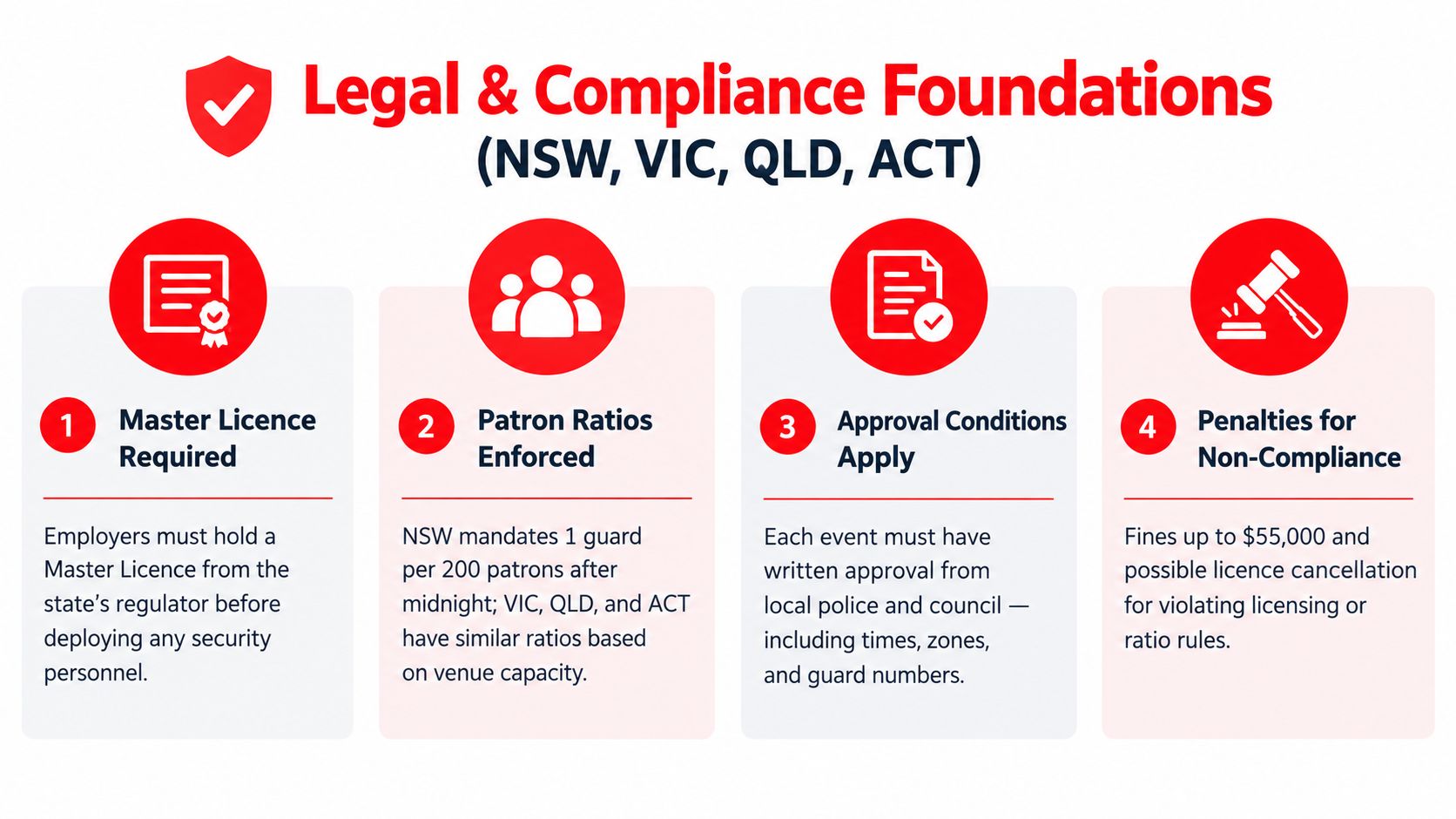
State rules don't produce one universal roster. They create a starting point that the organiser must test against the venue, crowd, licence conditions, event approval and actual risks. Confirm current requirements with the relevant regulator, council, police and venue before finalising the plan.
NSW planning thresholds
In NSW, crowd management is explicitly required for an event with 100 or more people, according to NSW event management guidance. If the event closes public roads, the organiser must employ a professional consultant to manage crowd security and traffic-control issues and develop a crowd management plan.
That threshold should influence planning from the first venue conversation. A community gathering, product launch or hospitality function may look modest, but once attendance reaches the stated level, the organiser needs to treat crowd management as a formal obligation rather than an optional staffing choice.
Victorian access control ratios
Victorian event access-control guidance uses a fixed formula of two licensed crowd controllers for the first 100 customers, followed by one additional crowd controller for every extra 100 customers or part thereof. The formula is described in Victorian event security requirements.
Use the formula as a deployment baseline, then test it against the site. A venue with one wide entrance may need a different post arrangement from a venue with several narrow access points, even where the attendance is similar. The organiser should also check whether the venue, licence or approval imposes stricter conditions.
The Australian benchmark and licensing
A long-standing Australian benchmark uses two crowd controllers for the first 100 patrons, then one additional controller for each extra 100 patrons or part thereof. The Australian Institute of Criminology publication on crowd-controller ratios explains that this rule of thumb has been common across many Australian states and describes stricter licensed-venue rules in some jurisdictions.
The calculation isn't permission to ignore risk. It connects staffing to attendance thresholds, venue class and local licensing conditions. A high-density concert, a club with alcohol service and a daytime conference may require different supervision despite similar guest numbers.
Licensing must also be checked across borders. The Australian Security Industry Association licensing guidance states that ACT security employers must hold a Master Licence and that security-industry employees must hold licences when conducting security activities. It also states that in NSW only Master Licence holders can employ licensed security personnel.
For a cross-border roster, verify each worker's licence status, the employer's authority, the venue conditions, approval documents, insurance requirements and any RSA-related responsibilities before the event is promoted.
Planning and Risk Assessment That Prevents Problems Early
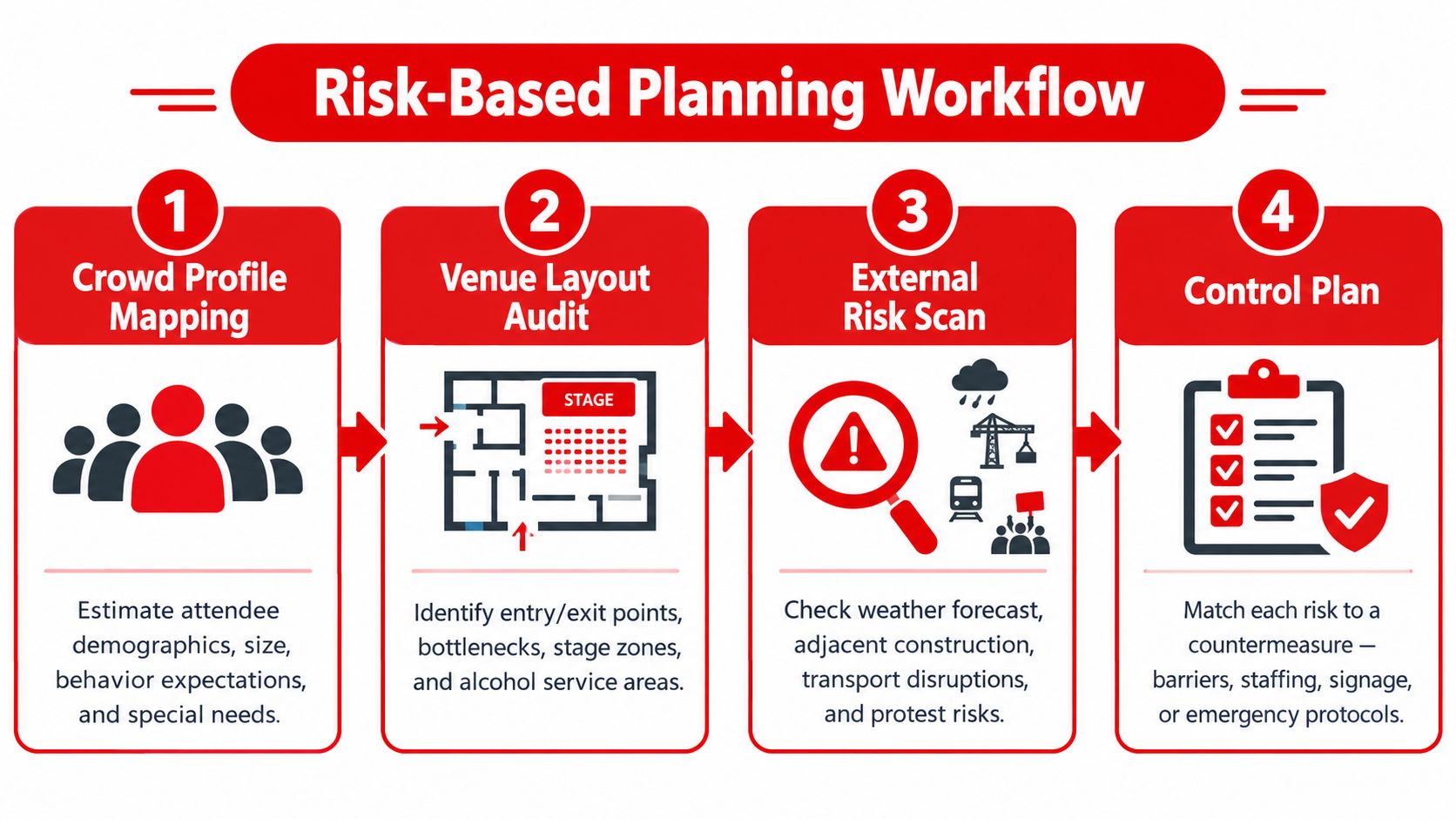
A sound risk assessment starts with the crowd, not the guard count. Ask who is likely to attend, what they expect, how they'll arrive, where they'll gather and which groups may need additional support. A festival audience, nightclub crowd, corporate delegates and wedding guests create different movement and behaviour patterns.
Build the risk picture
Walk the venue as an attendee, then walk it as an emergency responder. Mark ticket gates, bag-search points, alcohol service areas, toilets, stage barriers, backstage routes, vehicle entrances, staff rooms and locations where a queue could block an emergency path.
Check external conditions as well. Weather, adjacent construction, transport disruptions and nearby protests can change the risk picture even when the venue itself hasn't changed. Record each issue, its likely consequence, the existing control and the person responsible for monitoring it.
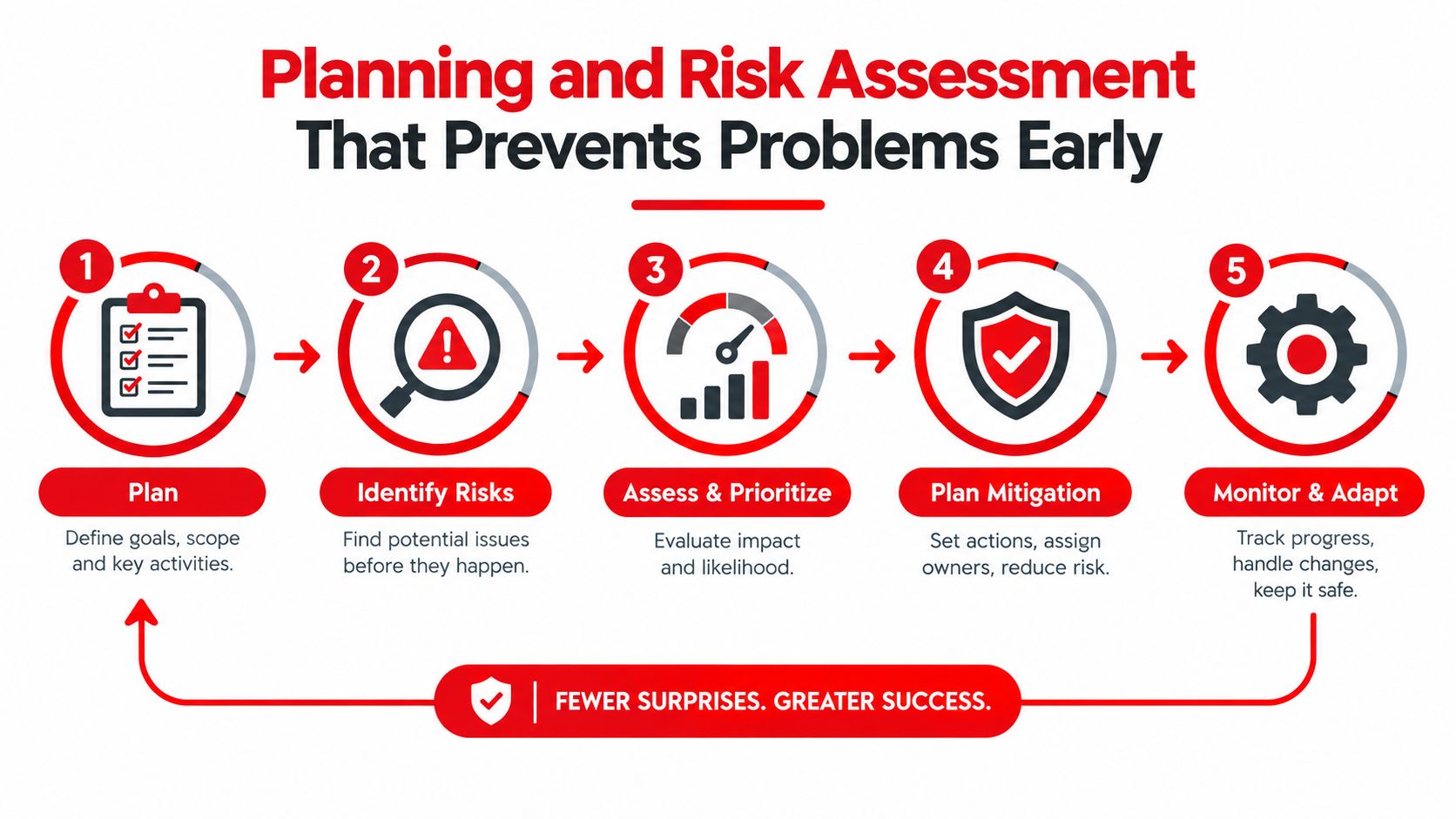
The deter, detect, delay and respond model keeps the assessment practical. For example, signs and visible staff may deter unauthorised access, ticket validation can detect it, a controlled doorway can delay movement into a restricted area and a supervisor can coordinate the response.
Document emergency choices
Australian government event guidance expects planners to consider options such as evacuation, shelter, lockdown, show pause or stop, and search. Don't leave those decisions as vague statements in a plan. Name the decision-maker, the communication route, the staff action and the audience message for each scenario.
A show pause illustrates the point. The production manager may control the stage, the security supervisor may manage crowd movement, venue management may contact emergency services and the organiser may approve public messaging. If those roles aren't agreed beforehand, the first minutes of an incident can become a negotiation.
Cover digital and physical signals
Event security increasingly depends on digital systems, including ticketing, radios, access control, CCTV and incident logs. Guidance from the Australian Cyber Security Centre on event logging and threat detection emphasises an approved logging policy, centralised access and correlation, secure storage and integrity, and a detection strategy.
For a small event, this may mean a controlled incident log and a named person checking reports. For a larger venue, it may involve back-to-base monitoring and a process for correlating a failed access attempt with a physical observation. Organisers considering lone staff in car parks, loading areas or remote venue zones can also review resources on live monitoring for lone employees when selecting an appropriate reporting method.
Limit sensitive details in public promotion materials. Publish what guests need to know, but don't advertise precise guard positions, restricted routes or response arrangements.
Choosing the Right Staffing Model for Your Event
The right team depends on the risk, not on a fashionable service label. Static guards suit predictable posts, while roving patrols help supervisors identify changing conditions. A K9 team, covert operative or bodyguard has a more specialised purpose and shouldn't be added to make a roster look substantial.
Use the attendance ratio as a starting calculation where it applies, then adjust for entrances, alcohol, operating hours, crowd behaviour, site complexity and emergency access. The supervisor should be able to explain why each post exists and what would trigger a change.
Event Security Staffing Model Selector
| Staffing Model | Best For | When to Deploy |
|---|---|---|
| Static guards | Entrances, restricted rooms, stage edges and staff-only areas | Use where a post needs continuous, visible coverage |
| Roving patrols | Festivals, hotels, shopping areas and spread-out venues | Deploy where conditions change across several zones |
| K9 units and handlers | Specialist deterrence and searches where authorised and suitable | Use after checking venue rules, event purpose and required approvals |
| VIP and bodyguard protection | High-profile guests, performers and sensitive movements | Deploy when an individual's movement or privacy creates a distinct risk |
| Covert operatives | Loss prevention and discreet observation | Use where visible deployment could compromise the objective |
| Gatehouse and vehicle patrols | Construction sites, loading areas and vehicle-controlled venues | Deploy when deliveries, contractor access or perimeter movement need supervision |
A concert may need visible entrance teams, stage-side coverage, a roving supervisor and a separate plan for performers. A corporate conference may need fewer visible posts but stronger access control around meeting rooms and back-of-house areas. A bar or club may place greater emphasis on de-escalation, patron welfare, refusal of entry and coordination with venue management.
Supervision matters as much as headcount. Every officer should know the post, shift handover method, radio channel, escalation path and incident-recording standard. The organiser should brief the provider on attendance, timetable, alcohol service, VIP movements, contractor access, venue restrictions and budget boundaries.
GM GROUP Services is one provider that offers static guards, K9 units and handlers, VIP and bodyguard protection, covert operations, vehicle patrols, gatehouse control, back-to-base monitoring, emergency response and risk assessments across NSW, Victoria, Queensland and the ACT. Its model illustrates the central principle: choose capabilities for the event's actual exposure, then document the reason for each deployment.
Running Secure Operations on Event Day
An event plan becomes useful when every person can act on it without searching through a long document. Start with a face-to-face briefing covering the site map, posts, entry sequence, prohibited items, welfare concerns, radio language, emergency routes and the authority to escalate.
Control the first contact
Entry should move in a predictable sequence. Place signs before the queue begins, separate ticket issues from security questions where possible and keep bag-search points from obstructing emergency routes. Staff should explain refusals calmly and call a supervisor when a guest disputes a decision.
Access control is more than checking a ticket. It may include wristbands, staff credentials, contractor registers, vehicle permits, room lists or restricted-zone checks. Organisers comparing digital and physical options can use this overview of Networking2000 access control as background when discussing system requirements with a venue or integrator.
Manage movement, not just incidents
A crowd can become unsafe without a fight or medical emergency. Watch for compression at a barrier, queues spilling into vehicle routes, guests moving against the intended flow or people gathering near a closed gate. A supervisor should have authority to open an additional route, pause entry, reposition a barrier or request venue staff support.
Radio messages should be brief and identifiable. Use agreed location names, state what has happened, say what assistance is required and confirm when the issue is resolved. Record incidents promptly, including time, location, people involved, action taken and any follow-up.
De-escalate and coordinate
Uniformed staff should combine control with customer service. A respectful greeting, clear direction and early intervention can prevent a disagreement from becoming a confrontation. Intoxicated guests may need venue management, welfare staff or emergency services rather than a purely enforcement-based response.
Emergency decisions must avoid creating a second hazard. Don't send everyone towards one exit if another route is available, and don't announce an evacuation before staff understand the movement plan. Coordinate with venue management, police, fire and ambulance services as required, while keeping the organiser informed through the agreed command structure.
Training Supervision and Checklists for Continuous Improvement
A repeatable event security management system depends on the quality of the briefing, supervision and review. Select personnel for the environment, not for availability. A festival needs people who can manage queues and communicate with diverse guests, while a corporate venue may need stronger discretion around access and VIP movement.
Training should cover site procedures, de-escalation, customer service, RSA awareness where relevant, emergency roles, radio discipline, incident reporting and the limits of each licence. Supervisors should inspect posts, test communications, confirm breaks and check that staff remain alert throughout the event.
A practical organiser checklist
Before the event
- Confirm venue approval, insurance, licences and any local conditions.
- Map entrances, exits, barriers, alcohol areas, restricted zones and emergency routes.
- Match the roster to attendance, venue layout and identified risks.
- Brief the organiser, venue team, security supervisor, production staff and emergency contacts.
- Agree the process for evacuation, shelter, lockdown, show pause and search.
During the event
- Record incidents consistently and escalate patterns, not only individual events.
- Monitor queues, crowd density, access points, vehicle routes and staff-only areas.
- Rebrief teams when the timetable, weather, attendance or venue layout changes.
- Keep emergency access clear and maintain contact with the event controller.
After the event
- Hold a debrief while observations remain fresh.
- Compare planned posts with actual pressure points.
- Review incidents, response times qualitatively, communication failures and guest feedback.
- Update the risk assessment and retain the documents for the next approval process.
This loop turns one event into better preparation for the next. The organiser gets a clearer record, the provider receives useful feedback and the venue can address recurring weaknesses rather than repeatedly treating symptoms.
GM GROUP Services provides event security, crowd control, access control, risk assessments, licensed personnel and ongoing supervision across NSW, Victoria, Queensland and the ACT. Discuss your venue, attendance, timetable and risk profile with GM GROUP Services to build a practical security plan before your next event.