


In Australia, a security risk assessment is a structured process for identifying hazards, estimating the likelihood and consequences of incidents, and selecting proportionate controls. If your venue has guards and cameras but nobody knows who responds when a staff member is threatened, how complete is your security plan?
The practical test isn't whether you have a document. It's whether your team can recognise a developing problem, act within clear responsibilities and adjust when conditions change.
What Is Security Risk Assessment and Why It Matters
Think of an assessment as a pre-flight check. A pilot doesn't skip checks because the aircraft flew safely yesterday. Similarly, a venue manager shouldn't assume yesterday's staffing, entrance layout and emergency arrangements will suit tonight's crowd.
Say you manage a function venue. Guests enter through a well-lit foyer, but staff leave through a dark loading area. An assessment examines both experiences, rather than treating the public entrance as the whole security picture.
Separate the hazard from the risk
These terms describe different parts of the decision:
- Hazard: Something that can cause harm, such as an unlit car park.
- Risk: The likelihood that someone will be harmed and how serious that harm could be.
- Control: A measure that reduces the likelihood or consequences, such as lighting, controlled access or an escorted departure procedure.
The scale of exposure matters. The Personal Safety Survey figures presented in Safe Work Australia's workplace violence report estimated that 8 million Australians, or 41% of people aged 15 and over, had experienced violence during their lifetime, with more than 1 million incidents classified as work-related.
Recorded incidents alone won't reveal every exposure. Ask staff about intimidation, unreported confrontations and near misses, then walk the site during the activities you're assessing.

For venues, festivals, construction sites and retailers, the purpose is straightforward: identify what could go wrong and decide who will prevent or manage it. The finished work should support decisions about access, patrols, staffing, communication and emergency response.
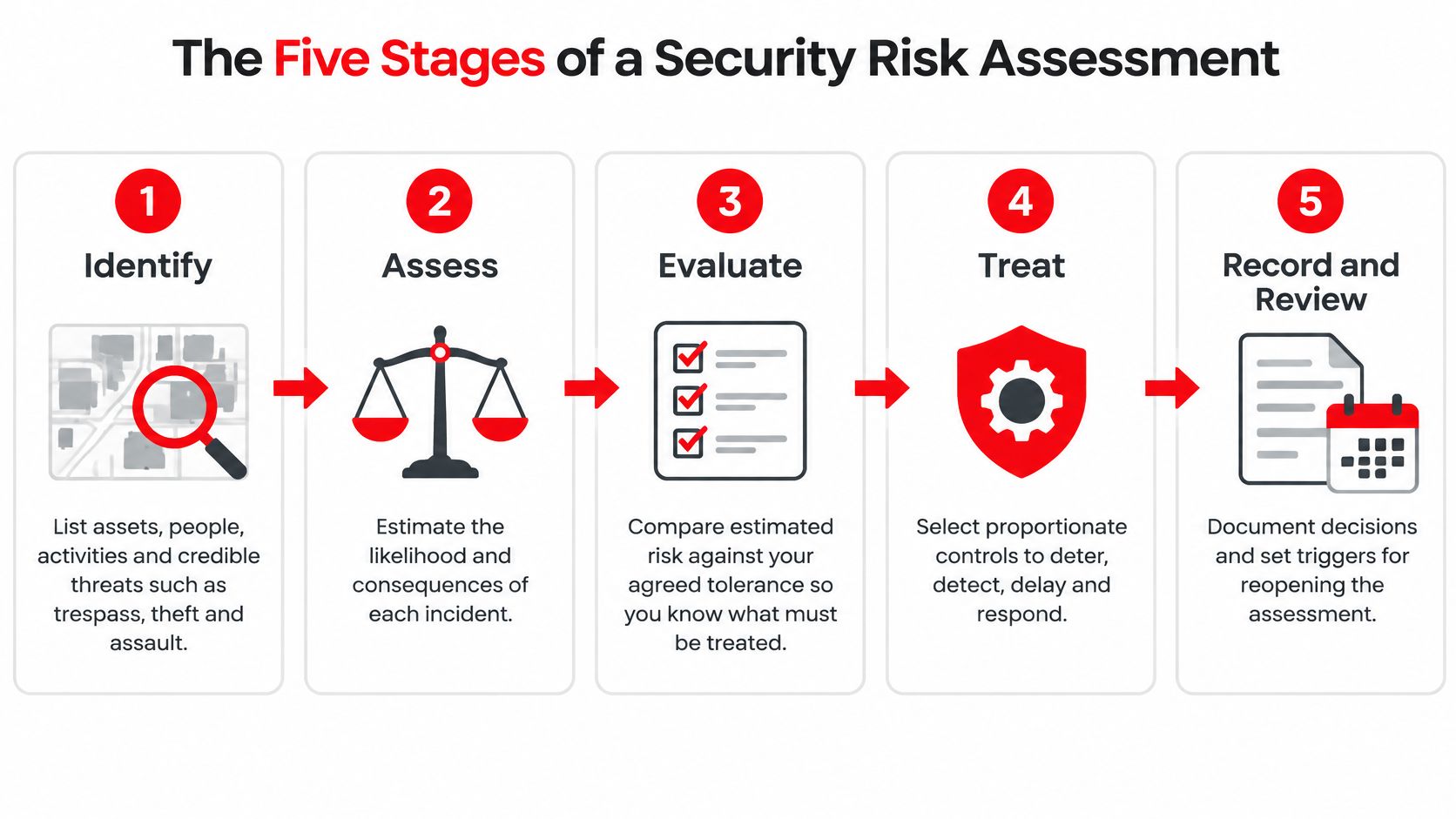
The Five Stages of a Security Risk Assessment
A useful assessment produces operational records, not just descriptions of things that might go wrong. Each stage should leave the manager with something they can check, assign or update.
For events, the NSW Government's risk assessment and management guidance directs organisers to analyse and rate risks, develop controls, connect the plan to emergency management and continue monitoring before and during delivery.
Follow the decision sequence
| Stage | What you do | What it produces |
|---|---|---|
| Identify | Map people, assets, activities and credible threats | Asset and threat register |
| Analyse | Estimate likelihood and consequence and record existing controls | Inherent risk ratings |
| Evaluate | Assess remaining exposure and compare it with agreed acceptance criteria | Ranked risk list |
| Treat | Select additional controls and allocate responsibility | Control plan with named owners and escalation triggers |
| Monitor and review | Check implementation and reassess changed conditions | Review log |
Identify means being specific about the incident. Unauthorised access to a backstage area is more useful than a broad entry labelled security, because the manager can locate the exposure and identify who could be affected.
During analysis, distinguish inherent risk, the exposure before controls, from the measures already operating. A locked gate belongs in the controls column, not in the description of the threat.
Evaluation asks whether the remaining, or residual, risk is acceptable. Don't lower a rating merely because someone has purchased equipment; confirm that people use it and that it addresses the incident you identified.
Turn treatment into instructions
A treatment entry should tell a person what to do and when. For example, assign the entrance supervisor responsibility for keeping an emergency access route clear, with an escalation trigger when queues begin encroaching on it.
Then verify the arrangement through briefings, inspections and incident reports. If a contractor relocates fencing, reopen the affected entries instead of assuming the original assessment still applies.
Practical test: Can the person named in the control plan explain their task without asking the author what it means?
The stages repeat. Monitoring may reveal a threat you missed, an ineffective control or an operating condition that needs a different response.
Check your own records for the outputs in the table. A missing review log suggests nobody can demonstrate when assumptions were last tested; a missing control owner suggests an agreed action may never reach the person expected to perform it.
The Four Security Areas Every Assessment Should Cover
Security isn't confined to fences and guards. A site can have a strong perimeter while leaving access codes exposed, staff poorly briefed or incident escalation unclear.
The Australian Government's security risk assessment and risk management plan template provides a useful scope across physical environment, personnel, sensitive information and incident management, supporting the identification, assessment and management of security risks and threats.
Examine the whole operation
| Security area | What to examine | Festival example |
|---|---|---|
| Physical environment | Fencing, entry points, lighting and temporary structures | Fencing and gate queues |
| Personnel | Staff vetting, rostering, training and licence checks | Crowd controller rostering and licence verification |
| Sensitive information | Ticketing data, floor plans, staff rosters and access codes | Floor plans and ticketing exports |
| Incident management | Escalation paths, communications, emergency contacts and recovery | Radio channels and handover to first aid |
Physical environment checks should follow actual movement. Walk from the transport drop-off to the entrance, through public spaces and out to assembly areas, noting where people could enter unauthorised zones or obstruct others.
Personnel assessment asks whether the right people have the right duties. A roster can appear complete while leaving a supervisor responsible for locations they can't reasonably oversee.
For sensitive information, consider who can obtain, change or share operational details. Keep contractor access codes separate from public information, restrict ticketing exports and remove access when a person's role ends.
Guest connectivity also deserves attention where visitors and operational teams use connected systems. Purple's guide to how to protect guest WiFi is a useful resource when reviewing guest network arrangements alongside staff and business access.
Incident management examines what happens after someone notices a problem. Identify who receives the report, who takes command and how the team hands over to first aid or emergency services.
Use the same working method in each area:
- List: Record assets, activities and credible hazards.
- Assess: Note existing controls and rate likelihood and consequence.
- Allocate: Give each action an owner and review date.
An office might focus on visitor credentials and confidential floor plans. A construction site might prioritise gatehouse access and contractor changes. The useful question is whether every area has an accountable owner, not whether every site uses an identical checklist.
Scoring Risks With a Likelihood and Consequence Matrix
A hazard list tells you what needs attention. A risk matrix helps you decide what deserves attention first.
Keep the scales understandable. In this illustrative matrix, likelihood runs from Rare to Possible to Likely, while consequence runs from Minor to Moderate to Major. These labels aren't universal legal thresholds; your organisation needs consistent definitions suited to its activities.
Use a consistent rating method
- Rate likelihood. Consider incident history, near misses, staff observations and operating patterns. Explain why the scenario is plausible at this location, rather than relying on a general impression.
- Rate consequence. Consider harm to people, property, operations and reputation. Use the worst credible outcome, not an implausible chain of disasters.
- Read the matrix. Match the likelihood row with the consequence column.
- Record the reason. Keep enough explanation for another manager to check the decision later.
| Likelihood | Minor | Moderate | Major |
|---|---|---|---|
| Rare | Low | Low | Medium |
| Possible | Low | Medium | High |
| Likely | Medium | High | High |
Suppose a bar has late-night alcohol service and dense crowds at its entrance. For this hypothetical assessment, the manager rates aggressive customer behaviour as Likely, and a credible staff injury as Major. That combination produces a High rating.
The useful information isn't just the word High. It's the reasoning: staff handle refusals beside a compressed queue, with limited room to step away and delayed supervisor assistance.
Reassess after applying controls
The manager might separate the refusal area from the queue, improve supervisor access and establish a clear assistance call. The team then uses the same matrix to assess the remaining exposure.
If the controls reduce the likelihood but not the potential injury severity, record that distinction. Don't automatically reduce both dimensions.
A lower residual rating is an estimate to verify, not proof that the control works.
Define what happens at each rating. A high-priority entry might require management approval and treatment before the activity proceeds, while a lower-priority entry may remain under routine monitoring.
Avoid false precision. Two managers can choose different labels when they're using different assumptions, so resolve the disagreement by examining the scenario and evidence. Practise on a small selection of your site's risks, then rank them and check whether the proposed priorities make operational sense.
Matching Controls to Risks With Deter, Detect, Delay and Respond
Choose controls by the job they need to perform. A camera, fence or guard is useful only when it addresses an identified exposure and fits the response arrangements.
Victoria Police's risk management guidance for security services supports layered protective measures and highlights site indicators including poor lighting, stairs, roads, railways, waterways, known people of concern and antisocial behaviour during the previous 12 months.
Build complementary layers
- Deter: Visible security, clear signage and controlled entry can discourage opportunistic behaviour. At a construction gate, a visible check-in point makes authorised access obvious.
- Detect: CCTV, attentive staff and accessible reporting channels help the team recognise a developing incident. Detection needs someone responsible for receiving and interpreting the information.
- Delay: Fencing, locked zones, barriers and separation slow unauthorised movement. Design these controls without obstructing emergency access or trapping people.
- Respond: Radios, supervision and emergency coordination allow staff to act. Define who attends, who supports them and when external assistance is needed.
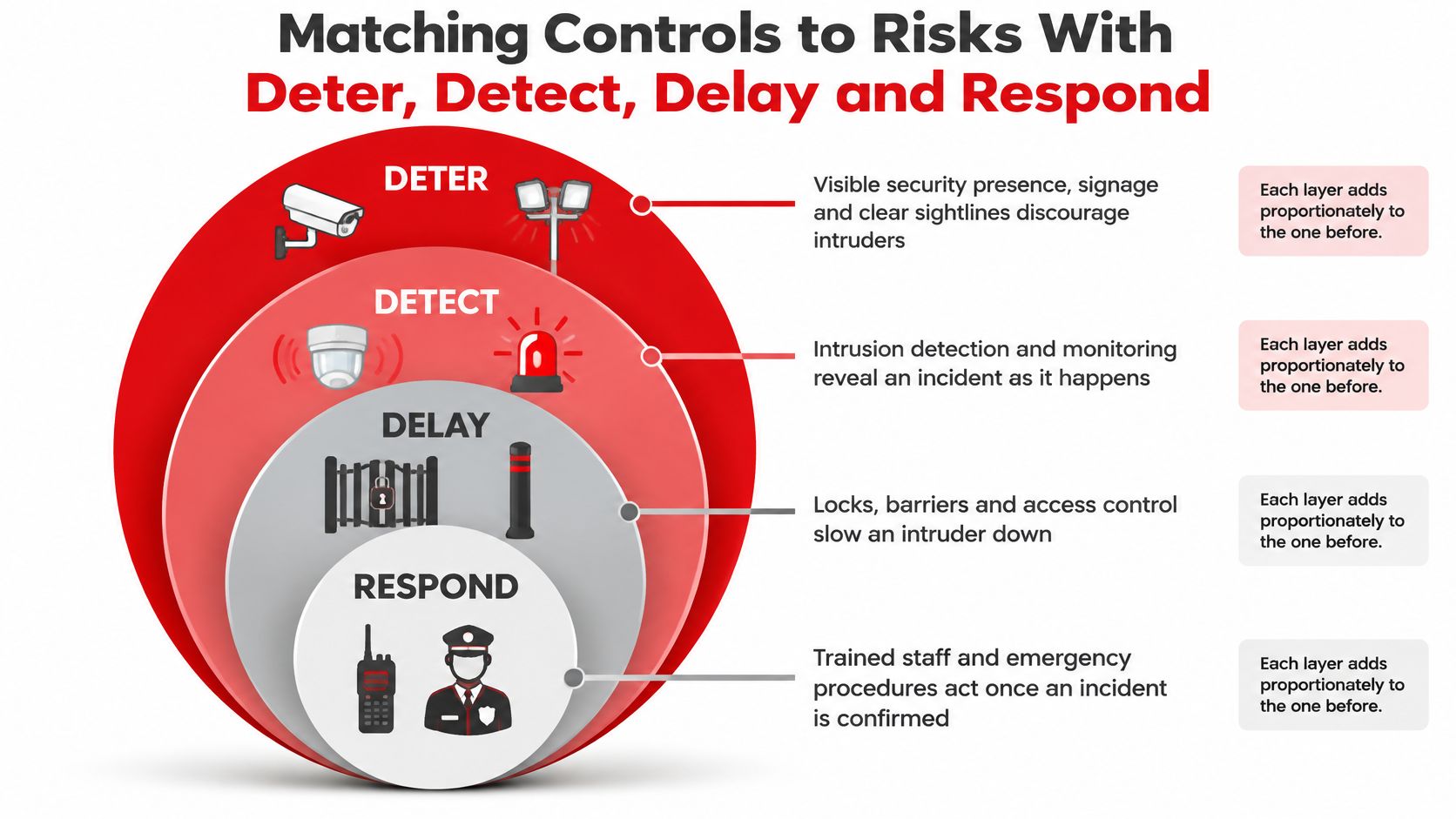
The layers should support one another. A camera may reveal someone entering a restricted area, but without monitoring and a response procedure, the team may discover the footage only after the incident.
Let the environment shape the design
Consider a venue beside a poorly lit walkway leading towards a waterway. Extra entrance screening won't address the departure risk. Lighting, clear directions, observation of the exit route and a defined assistance procedure may deserve greater attention.
Stairs create a different problem: a confrontation can expose bystanders to falls. Separate conflict management from changes in level and preserve space for people to move away.
Known people of concern require clear reporting and escalation instructions. Staff need observable information and role boundaries, not permission to improvise confrontations.
Deployment rule: Match staff locations and duties to exposure, then test whether they can communicate and assist one another.
Before opening, test radios from the actual work locations, including loading docks and service corridors. Confirm who covers a post when its assigned officer assists elsewhere. A nominal headcount won't reveal that temporary gap, but a practical deployment check will.
Five Costly Mistakes That Undo a Good Assessment
Relying only on recorded incidents leaves managers assessing what reached the form, rather than everything staff encountered. Add confidential staff consultation and a simple near-miss reporting route, especially for repeated intimidation that employees may have normalised.
Find the gap behind the paperwork
- Ignoring psychosocial and behavioural risk. Abuse and threats deserve assessment in their own right, not only as warning signs of assault. Safe Work Australia's workplace violence announcement reports a 56% increase in serious workers' compensation claims for assault and exposure to workplace violence over the previous five years. Map reporting pathways, de-escalation capability and post-incident support.
- Leaving actions without owners or triggers. Replace improve supervision with an assigned supervisor, a defined location and a condition requiring intervention.
- Deploying by headcount instead of risk. Check where staff stand, what they observe and how quickly support can reach them. A quiet internal post shouldn't remain fully staffed while the entrance team struggles.
- Copying a generic checklist. Rewrite scenarios around the actual layout, hours, alcohol service, contractor activity and crowd movement. A template is a prompt, not a substitute for a site walk.
Together with incident-record dependence, these are five ways a completed form can conceal unfinished decisions. None is solved just by adding more pages.
Run a short self-check
- Evidence: Have staff described problems that never became incident reports?
- Behaviour: Does the assessment address abuse and intimidation before physical contact?
- Accountability: Can you name the person who acts when each trigger occurs?
- Deployment: Do post locations reflect the highest-ranked exposures?
- Site fit: Would the document still make sense if someone replaced your venue's name with another?
If the answer to the last question is yes, inspect the assessment for generic entries. Replace them with locations, activities and decisions that your team can recognise.
Frequently Asked Questions About Security Risk Assessment
What is the difference between an assessment and a risk register?
The risk register is the record. The assessment is the process of identifying scenarios, considering likelihood and consequence, deciding controls and checking the result. A spreadsheet with hazard names but no reasoning or responsibility is an incomplete record of that process.
How often should it be reviewed?
Use scheduled reviews as a backstop, not your only safeguard. Reopen affected entries whenever an operational change or incident makes the existing assumptions unreliable; there's no benefit in waiting for an anniversary to correct a known gap.
Who should carry out the assessment?
A site or event manager should coordinate input from staff, contractors and relevant security specialists. Licensing also matters: NSW Police's security licensing guidance states that businesses employing or subcontracting people for security activities must hold a Master Licence.
In Queensland, the security firm licensing guidance requires a security firm licence for covered services and requires supplied staff to hold licences for their work. Check the applicable jurisdiction and duties rather than assuming an interstate arrangement is sufficient.
Does it cover behaviour or only physical threats?
It should cover both. Include customer aggression, staff vulnerability and access to assistance alongside intrusion, theft and physical site hazards. Give staff a workable reporting route and a response they can rely on.
What does a finished assessment look like?
It contains an asset and threat register, inherent and residual ratings, prioritised risks, assigned controls and a review log. A manager should be able to select an entry and identify the scenario, decision, responsible person and evidence used to check implementation.
Set Review Triggers Before Your Next Event
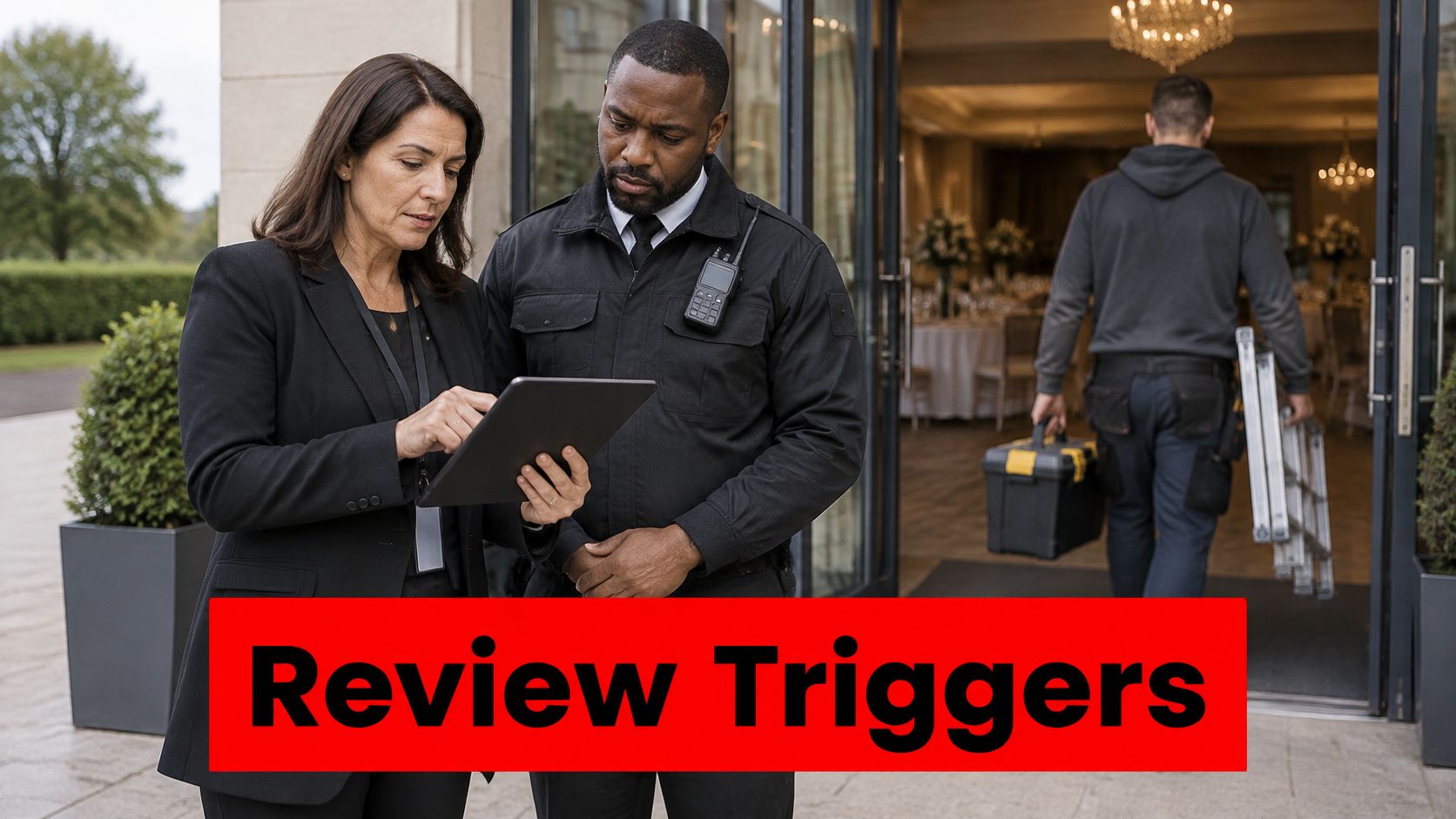
Decide what will reopen the assessment before operations begin. Don't leave that decision to whoever happens to be managing an incident.
Location matters as well as activity. Safe Work Australia's Evidence Matters guidance identifies differences in serious injury and fatality patterns between urban, regional and rural areas, supporting location-specific safety strategies rather than identical controls everywhere.
Specify the trigger and the evidence
Reopen relevant entries after:
- A serious incident: Reassess the scenario, response and remaining exposure.
- A layout change: Check access, sightlines, queues and emergency routes.
- A new contractor: Confirm responsibilities, permissions and communication.
- Changed licence conditions: Adjust the operational plan to match.
- Repeated near misses: Investigate the pattern instead of treating each report separately.
- A major attendance increase: Reconsider capacity assumptions, deployment and crowd movement.
Record what changed, who reviewed it and what decision followed. Brief the people whose duties are affected, rather than saving the revised document without telling them.
Measure whether the controls remain useful. Track response times, queue conflicts, refusals of entry, patrol findings, missing assets, near misses, incident recurrence and staff observations, with enough context to interpret them.
A rise in reports might reflect better reporting rather than deteriorating conditions. Read the accounts and compare locations, activities and shifts before changing deployment.
Make the next review operational
More personnel aren't automatically better security. If staff can't hear the radio, identify the incident location or leave an obstructed post, better communication, supervision or site design may address the exposure more directly.
Take these actions before your next event or operating change:
- Write down the security areas for your site. Identify an accountable person for each.
- Score every credible risk with your matrix. Keep the reasons beside the ratings.
- Assign owners and review triggers. Confirm how staff will report a changed condition.
Our incident records at GM GROUP Services support communication, follow-up and review of security-related incidents. The practical aim is to turn that information into decisions your team can use, rather than a file nobody reopens.
GM GROUP Services offers a confidential discussion about your security needs, working closely with you to understand your site, customers and requirements. Visit GM GROUP Services to request a quote, or call 1300 14 14 41 or 0499 020 304 to discuss how a site-specific assessment can guide your security arrangements.