


Corporate security starts before an incident occurs. In a Sydney corporate tower, a concierge guard may be checking a maintenance contractor while employees move through the lobby. In Melbourne, a venue manager may be briefing crowd controllers before a Friday night event. In Brisbane, a construction supervisor may be reviewing an overnight incident log before workers arrive. Each situation involves a different risk, but all require the same discipline: identify what could go wrong, apply proportionate controls, and make sure people know how to respond.
What Is Corporate Security and Why Australian Businesses Need It
Corporate security is an integrated risk-management system that protects people, premises, operations, information and reputation. It can include licensed guards, access control, visitor management, CCTV monitoring, patrols, cyber readiness, incident response and documented workplace safety procedures. A guard at a door is one control within that system, not the complete definition.
The practical question isn't just, “Do we need security?” It's, “Which risks could interrupt this site, event or business, and which controls will manage them?” A corporate office may need concierge-style guarding, visitor screening and after-hours alarm response. A festival may need crowd controllers, egress monitoring, emergency coordination and a clear escalation chain. A construction site may depend on perimeter protection, sign-in procedures, plant security and overnight patrols.
Australian corporate security also sits within work health and safety responsibilities. A business must protect workers and other people, including customers and visitors, so far as is reasonably practicable. Safe Work Australia explains the relationship between WHS duties and Australian Standards, including the important point that a standard isn't automatically mandatory unless legislation requires compliance.
Security protects more than property
A useful security risk assessment separates assets into clear groups:
- People: Employees, contractors, visitors, customers, performers and members of the public.
- Premises: Entrances, loading docks, car parks, restricted rooms, plant areas and emergency exits.
- Operations: Deliveries, events, production, trading, construction work and business continuity.
- Information: Access records, CCTV footage, staff details, plans, credentials and commercial data.
- Reputation: Customer confidence, brand trust and the organisation's ability to operate responsibly.
These categories overlap. A poorly managed contractor entrance can create a physical access problem, a WHS concern and an information-security exposure if the visitor receives access to sensitive areas. A crowd-flow decision can affect emergency egress, customer safety and the venue's licence obligations at the same time.
Practical rule: If a security control could affect how people enter, move through or work in a site, document its safety impact as well as its protective purpose.
The Australian Government's approach separates security into governance, personnel security, physical security and information security, using the Protective Security Policy Framework and the Australian Government Information Security Manual as important reference points. For commercial organisations, these frameworks can provide a useful structure even when a specific government obligation doesn't apply.
The Layered Risk Management Model Behind Corporate Security
At a busy events venue, a guard may stop an unauthorised person at a staff entrance, while a supervisor checks the roster and the venue team manages a safe evacuation route. Corporate security works when those actions support one another rather than operating as separate tasks.
Governance provides the operating framework. It sets the security policy, approves acceptable levels of risk, assigns decision-makers and records how incidents are escalated. It also connects security decisions with WHS duties, business operations and emergency arrangements. Without this layer, guards and technology can be active without a shared purpose.
The personnel layer covers the people who apply the controls. In Australia, that can include checking the required state or territory security licence, confirming identity, completing site induction, setting supervision arrangements and providing role-specific training. A licensed guard still needs clear post orders, knowledge of the site and an understanding of the limits of their authority.
Physical security creates barriers that deter, delay and detect unwanted activity. A construction site may use controlled gates, lighting, patrols and secure storage. A retail site may rely on access controls, CCTV, alarms and trained floor staff. Information security protects the records and systems supporting those measures, including access databases, monitoring platforms and incident reports.

Defence in depth in daily operations
The four layers form one control environment:
- Governance sets the rules, ownership and escalation path.
- Personnel security confirms that authorised people can apply those rules.
- Physical security deters, delays and detects unauthorised activity.
- Information security protects the data and systems behind the controls.
A weakness in one layer increases pressure on the others. Inaccurate visitor records leave guards working with unreliable information. Access that remains active after a contractor leaves can allow entry despite effective cameras. An incident plan that does not identify who contacts police, facilities and IT can waste time during a fast-moving event.
The Commonwealth Cyber Security Posture 2025 report indicates that Australian public-sector security programs are becoming more integrated. 82% of federal government entities had a cyber security strategy, up from 75% in 2024, while 90% had an incident response plan, up from 86%. Annual cyber security training reached 87%, up from 78%, and supply-chain risk assessments reached 70%. The Commonwealth cyber security posture reporting is available through the Australian Cyber Security Centre.
These figures are not a template for every private business. They illustrate the working principle: policy, licensed people, suppliers, technology, WHS controls and response arrangements need to function together.
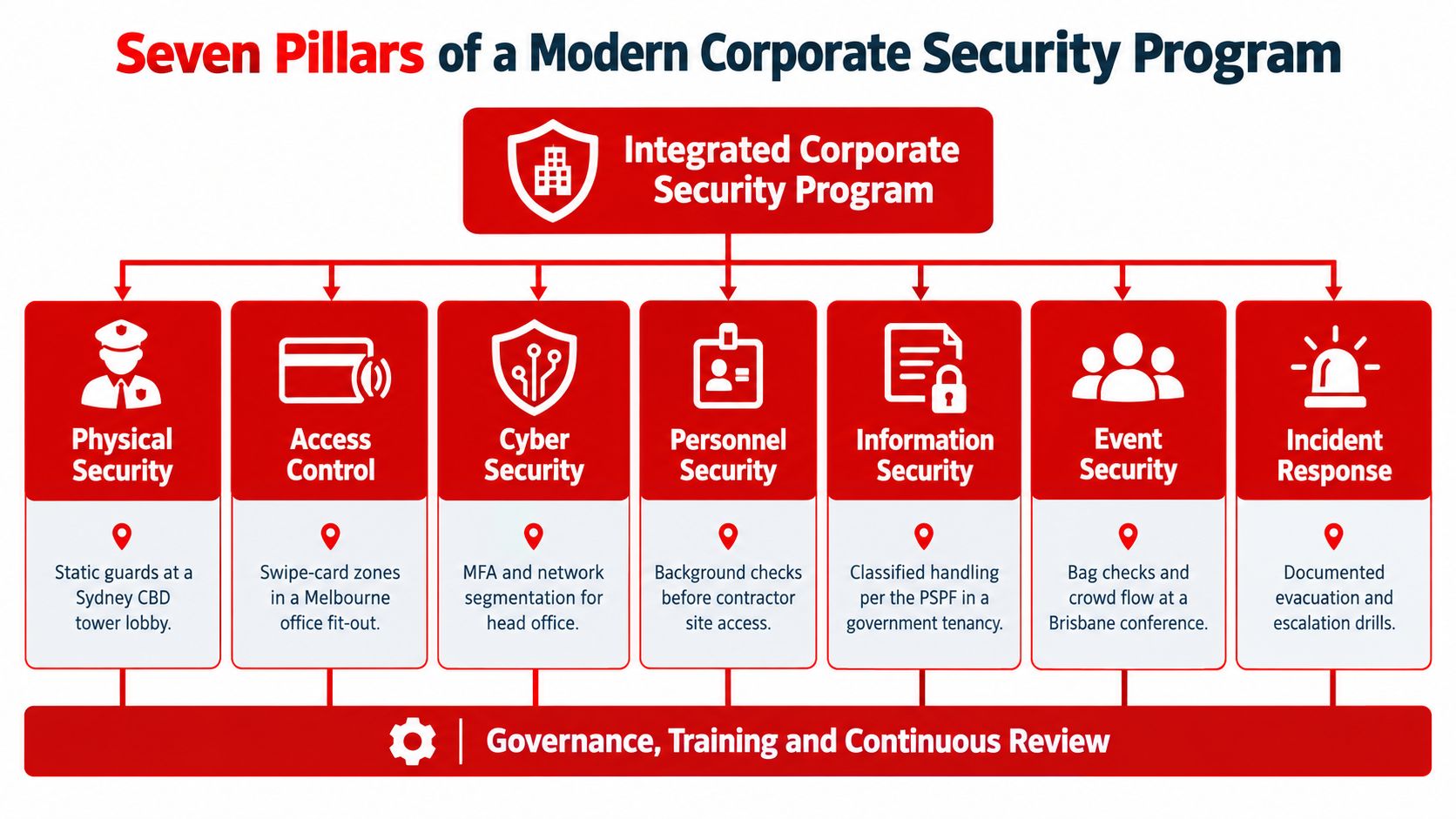
Seven Pillars of a Modern Corporate Security Program
A seven-pillar view helps managers translate the layered model into site operations. The pillars overlap, but each answers a different question about protection.
Physical security asks how the site will deter and detect unauthorised activity. At a Parramatta office tower, that might mean a static guard at the lobby, monitored CCTV, secure lift access and a patrol of service areas. At a Western Sydney logistics estate, a mobile patrol or K9 team may add a different level of perimeter deterrence. The correct choice depends on the threat, layout, operating hours and consequences of disruption.
Personnel security asks whether the people receiving access are suitable, licensed and prepared. Check the required licence, working rights where relevant, induction completion, assignment and supervision arrangements. Contractor management should include who approved the person, which areas they can enter and when that access expires.
Asset protection focuses on what the business needs to keep secure. In a Brisbane retail precinct, loss prevention may involve floor presence, stockroom controls, incident analysis and liaison with centre management. For a touring production, it could include controlled access to instruments, staging equipment and technical areas. Managers responsible for valuable touring equipment may also benefit from reviewing protective storage for band gear as part of a broader asset-protection plan.
Access control decides who can enter, where they can go and how the organisation records that movement. A Melbourne corporate lobby might combine swipe cards for staff, temporary visitor passes, mobile credentials for approved contractors and a reception process for guests. Access isn't effective if permissions remain active after a person changes role or leaves the project.
Incident response gives staff a repeatable way to act. Define who receives the first call, who attends the location, when police or emergency services are contacted, how evidence is preserved and who communicates with affected stakeholders. A good report records facts, times, actions and witnesses without speculation.
Risk assessment connects controls to actual conditions. A site survey should examine entrances, blind spots, lighting, delivery routes, emergency exits, public interfaces and high-value assets. An event plan should rate risks by likelihood and impact, then specify controls, owners and review points.
Governance and compliance keeps the program accountable. Policies should connect with applicable state licensing rules, WHS duties, privacy expectations, contractual requirements and, where relevant, government security frameworks. Managers should review incidents, audit findings, complaints, near misses and operational changes, then adjust the program rather than allowing outdated procedures to continue.
A security program is only as strong as its least understood handover. Write the procedure, brief the person responsible and check that the control works in practice.
Where Cyber Security Meets Physical Corporate Security
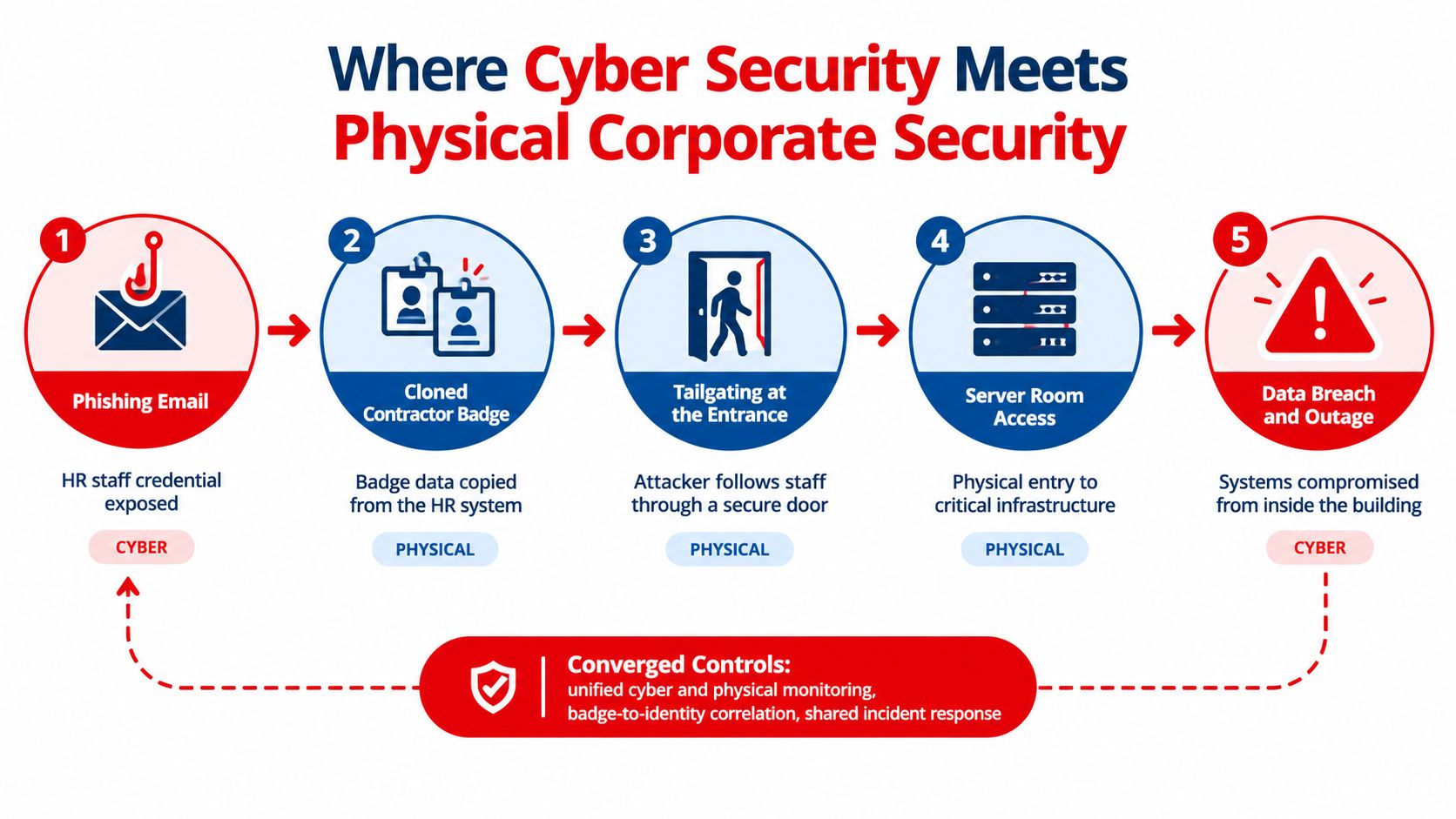
A contractor's access can start with a compromised inbox. A phishing email exposes an HR credential, someone copies badge data from the personnel system, and a cloned card allows an intruder to follow staff through a secure entrance. If the person reaches a server room, a cyber incident has become a physical intrusion, with possible effects on systems and operations.
The response must join the teams that control each part of the risk. The access team checks whether the contractor is still approved. IT examines unusual badge activity, such as a credential used at an unexpected location or time. Facilities, security operations and incident management then follow one escalation path, rather than treating each alert as an unrelated problem.
This connection works like a chain. Weak identity records can affect doors, while a door event can provide evidence during a cyber investigation. Australian public-sector reporting shows why cyber readiness belongs in the corporate security program. The Commonwealth report recorded 87% of federal government entities providing annual cyber security training, 70% performing supply-chain risk assessments for applications, IT equipment and services, and 35% reporting at least half of observed cyber incidents to the Australian Signals Directorate. The Commonwealth posture report provides the underlying figures and context.
Controls that join the two disciplines
A security operations lead should establish practical connections:
- Identity-linked access: Connect HR rosters, contractor approvals and physical badge permissions, then remove or change access when a role changes.
- Correlated monitoring: Review CCTV, door events, intrusion alarms and security information and event management alerts together when activity appears suspicious.
- Shared runbooks: Give facilities, security, IT and senior managers the same sequence for reporting, containment, evidence preservation and escalation.
- Secure procurement: Assess the cyber and physical dependencies of cameras, readers, intercoms, alarms and cloud-managed platforms before purchase.
- Combined exercises: Test a digital compromise that affects physical access, evacuation, communications or business continuity.
The same discipline applies to operational suppliers. A manager bidding commercial cleaning contracts should assess more than service quality. Cleaning staff may receive keys, access cards, alarm codes or after-hours entry. Procurement documents should define identity checks, access limits, supervision, lost-credential reporting and the process for removing access when the contract or assignment ends.
Corporate security therefore places cyber controls alongside doors, licensed guards and patrols in one risk picture. In Australia, the program should also reflect applicable state licensing and WHS duties. Government-related environments may need to consider the PSPF and ISM, while critical infrastructure operators may face further obligations under applicable regulation.
How Corporate Security Looks Across Events Venues and Worksites
A fit-for-purpose program changes with the environment. An event promoter doesn't need the same deployment as a construction manager, and a hotel lobby shouldn't be managed like a restricted industrial compound.
| Environment | Primary Controls | Typical Guard Profile | Reporting Cadence |
|---|---|---|---|
| Event | Crowd management, bag checks, egress monitoring, emergency coordination and access zones | Licensed crowd controllers, supervisors and response personnel | Pre-event briefing, live incident updates and post-event report |
| Venue | Concierge presence, VIP and back-of-house separation, incident logging and front-of-house support | Concierge officers, crowd controllers, patrol staff and, where justified, VIP protection | Shift handover, incident log review and manager summary |
| Construction site | Fencing, induction, sign-in, traffic management, plant protection and after-hours patrols | Gatehouse officers, patrol officers and site supervisors | Daily site report, exception alerts and scheduled review |
| Office | Visitor management, mail screening, access control, car park patrols and alarm response | Static concierge guards, mobile patrols and control-room support | Shift report, immediate escalation and periodic trend review |
Events and festivals
Event security must manage movement as well as threat. The plan should identify entrances, exits, emergency egress, restricted areas, queues, bag-check locations, alcohol service interfaces and the points where crowds may compress. Licensed crowd controllers need clear instructions on communication, refusal of entry, medical assistance and escalation.
For NSW events, government guidance says risks should be analysed and rated by likelihood and impact, controls developed, and the risk plan embedded in emergency management. The plan should be monitored and updated during planning and the event, with terrorism risks developed in partnership with the NSW Police Force Area Command where applicable. The NSW event risk assessment guidance sets out this planning approach.
Hospitality, construction and offices
A hotel, nightclub or stadium corporate box needs a welcoming front-of-house presence without losing control of staff-only areas. Incident logging, VIP movement, service corridors and alcohol-related risks require coordination between security, venue management and RSA-trained staff where licensed-premises duties apply.
Construction and industrial sites require a different emphasis. Gatehouse control, worker induction, vehicle separation, plant protection, hot-work controls and overnight checks should fit the site's WHS risk assessment. Corporate offices usually need a professional lobby presence, reliable visitor records, contractor controls and a clear alarm response process.
Licensing and Compliance Rules Across NSW VIC and QLD
Licensing is the minimum legal floor, not proof that a provider is suitable for your site. The manager engaging security remains responsible for checking that the service, personnel and operating method match the activity and location.
New South Wales
In NSW, a security employer must hold a Master Licence, and only a Master Licence holder can employ licensed security personnel. Employees need the relevant Class 1 or Class 2 licence, depending on the work they perform. Activities can include guarding, patrols, crowd control and other regulated functions, so confirm the exact activity rather than accepting a generic statement that a person is “licensed”. ASIAL's NSW licensing guidance explains the Master Licence and employee licensing relationship.
Victoria
Victoria's private security licensing system covers roles including security guard, crowd controller, bodyguard, investigator, trainer and security equipment installer. Applicants must meet requirements that include being at least 18, having Australian residency or current working rights, providing fingerprints and passing fit-and-proper checks. Interstate licence holders seeking to work in Victoria must apply through mutual recognition and provide supporting documents, including a certified copy of the current interstate licence. Victoria Police provides the application and mutual recognition requirements.
Queensland and other jurisdictions
Queensland maintains a free public register of licensed security industry employees and firms. Use it to verify the person or provider before deployment, and remember that role-specific licensing also applies to security equipment installers. The Queensland licence-checking service explains how businesses can verify licences.
Across NSW, Victoria, Queensland, the ACT and other jurisdictions, check:
- Licence details: Confirm the activity, holder and currency.
- Business authority: Verify that the contracting entity can lawfully provide the service.
- Insurance: Request current certificates and confirm they suit the work.
- Training evidence: Check induction, role training, emergency procedures and supervision.
- Incident reporting: Agree on the escalation line, report format and response expectations.
WHS duties still apply alongside licensing. For government-related work, ask whether PSPF controls or other contractual security requirements apply. For venues, also review privacy, liquor, gaming, fire and emergency-management obligations relevant to the operation.
Building a Fit-for-Purpose Corporate Security Program Step by Step
A practical program begins with the site, not a catalogue of products. The controls should be reasonably practicable for the identified risks and should work within the way people use the premises.
Step one maps the risk profile
Walk the site during normal operations and, where relevant, after hours. Record entrances, exits, loading areas, blind spots, valuable assets, restricted rooms, public interfaces, staff routes and emergency equipment. Add the incident history, contractor profile, operating schedule and any planned changes to the asset register.
Step two turns risks into controls
Create a controls map that links each risk to an owner and a response. A loading-dock intrusion might require lighting, a camera view, access restrictions, a patrol point and an escalation instruction. An event crowd risk might require a supervisor, queue barriers, egress monitoring and a police liaison process.
Separate controls into preventive, detective and responsive categories. A swipe card can restrict entry, CCTV can help detect unusual activity, and an incident runbook can guide the response. This makes gaps easier to identify than a single list of equipment.
Step three tests the provider
Check licences, insurance, references relevant to the environment, training records, supervision arrangements and reporting capability. Ask whether personnel are employed by the provider or engaged through another contractor, and identify who carries responsibility for rostering, conduct, performance and replacement coverage.
Technology needs the same scrutiny. If you're budgeting for cameras, readers or alarms, a CCTV installation cost guide can help you frame questions about equipment, installation and ongoing support. Don't choose equipment before confirming what the risk assessment requires.
Step four deploy with control
Give every officer a site induction, written post orders, contact list, emergency procedure and clear boundaries. Agree on reporting fields, response priorities and the measures used to review performance. During the initial operating period, compare the planned deployment with actual queues, blind spots, alarms, incidents and client feedback.
Step five review and improve
Schedule reviews after incidents, material site changes and significant events. Examine recurring issues, missed checks, access exceptions, response times as recorded in reports, complaints and training needs. An ISO 31000-aligned approach can provide a useful structure for reviewing risks and treatment decisions, but the essential test is simpler: can the organisation show why its controls are suitable, supervised and maintained?
Corporate Security FAQs for Facility and Event Managers
What's the difference between corporate security and event security?
Corporate security is the wider risk-management discipline. Event security is a specialised deployment within it, focused on temporary crowds, access zones, egress, performers, contractors, alcohol-related risks and emergency coordination. An event may use corporate security principles without operating like a permanent office.
What does a static guard do compared with a patrol officer?
A static guard remains at an assigned post such as a lobby, gatehouse or reception area. The role may include access checks, visitor handling, observations, incident reporting and customer assistance. A patrol officer moves between locations to inspect perimeters, car parks, doors, plant areas or other designated points. The post orders should state the difference clearly.
When does a K9 or concierge-officer role make sense?
A K9 deployment may suit a site where deterrence, perimeter coverage or targeted searches form part of the risk treatment. A concierge officer suits a corporate lobby or hotel where security and customer service must operate together. Neither role should be added because it sounds impressive. Match it to the site layout, threat assessment, operating hours and required licence or handling arrangements.
How should a new contract be onboarded?
Start with a site walk, document review, induction, post orders, contact list and escalation test. Allow the provider and manager to compare the planned service with real operating conditions, then review early reports, access issues and staff feedback before treating the deployment as settled.
What evidence should a manager request?
Ask for the applicable business and individual licence details, expiry information, insurance, training records, supervision arrangements and incident-reporting process. In Queensland, use the public register. In NSW and Victoria, use the relevant state licensing information and confirm that the licence covers the actual duties.
How do bodyguard services and retail loss prevention fit in?
Bodyguard or VIP protection is a targeted personnel-security control for people facing a specific exposure. Retail loss prevention protects stock, staff and customers through observation, access management, reporting and investigation support. Both sit inside the wider corporate security framework when their risks, authority and reporting connect with the organisation's overall governance.
Which KPIs should appear in reports?
Choose measures that show whether controls are being performed and whether risks are changing. Examples include completed patrols, access exceptions, incident categories, response actions, training completion, unresolved hazards and corrective actions. Avoid measuring activity alone. A large number of patrols doesn't prove that the patrol route covers the right risk.
For an Australian business, corporate security should connect licensed personnel, physical protection, cyber readiness, incident response and WHS-aligned risk management. GM GROUP Services offers security risk assessments and services including static guards, patrols, K9 units, VIP protection, gatehouse control, loss prevention, monitoring and emergency response across NSW, Victoria, Queensland and the ACT. To discuss a fit-for-purpose program for your venue, site, event or office, visit GM GROUP Services.