



VIP Protection Services become urgent when a touring artist, executive or high-profile guest is already on the event schedule, the venue map is changing, and someone asks whether the existing security guards can “cover the VIP”. That assumption creates problems quickly. A crowd controller may be valuable at an entrance, while a close-protection operative needs the right licence, competencies, briefing and movement plan for work beside the principal.
For a multi-state tour, the practical question isn't whether a provider can supply uniforms. It's whether the team can lawfully operate in each jurisdiction, move discreetly through real venues, coordinate with event security and respond when the timetable changes. The following framework is designed for promoters, venue managers and corporate organisers planning work across New South Wales, Victoria, Queensland and the ACT.
Why VIP Protection Services Need a Proper Assessment
A promoter once reaches the final planning meeting for a regional festival and discovers that the proposed “bodyguard” is licensed for general security work, but the provider hasn't demonstrated the competency or state approval required for close personal protection. The artist's hotel arrival is already public, media access is being negotiated and the venue has only one practical route from the loading dock to the stage. Replacing the team at that point is expensive, disruptive and difficult to explain to the client.
The problem began before anyone checked a licence. The organiser treated VIP protection services as an extra guard at a door instead of a distinct operational function. In Australia, bodyguard work is a recognised licence category in NSW and Queensland, while Victoria includes bodyguard work within its licensed private security framework. The national security workforce is substantial, with ASIAL reporting 153,526 licensed security personnel after an increase of 5,797 in one year, and NSW representing 36% of individual licence holders, Victoria 24.4% and Queensland 15.7%. ASIAL's sector information is available through its Australian security industry research and statistics.

Start with the principal, not the uniform
A proper assessment identifies who needs protection, what exposure they face and how they'll move. Ask:
- Principal profile: Is the person a touring artist, executive, public figure, family member or guest with a known concern?
- Movement pattern: Will they travel between an airport, hotel, vehicle, green room, stage and hospitality area?
- Public exposure: Will arrival times, accommodation or appearance details be published?
- Venue conditions: Is access controlled, partially public, alcohol-focused, media-heavy or spread across multiple buildings?
- Operational consequence: What happens if the principal is delayed, separated from the team or unable to use the planned exit?
Static venue security protects fixed locations. Mobile close protection stays with the person and adapts as they move. Situational protection may be discreet, but it still requires officers who understand observation, positioning, communication and escalation.
Practical rule: Don't ask a provider for “a bodyguard”. Give them the principal's movements, exposure points and venue constraints, then ask for a protection model.
A fit-for-purpose plan also separates protection from transport. Where the journey is a significant part of the exposure, organisers may assess specialist chauffeur options from Max's Luxury Rides alongside the licensed security detail. The transport provider and protection provider should agree on collection points, communications, loading access and contingency arrangements before the day.
Assessing Threat Levels and Event Environments
A protection plan earns its place when it changes what the team does on the day. Start with the principal profile, then test that profile against the venue, crowd and event programme. A touring artist with repeated unwanted approaches may need a different posture from a CEO at a private conference, even when both move between a vehicle and an entrance.
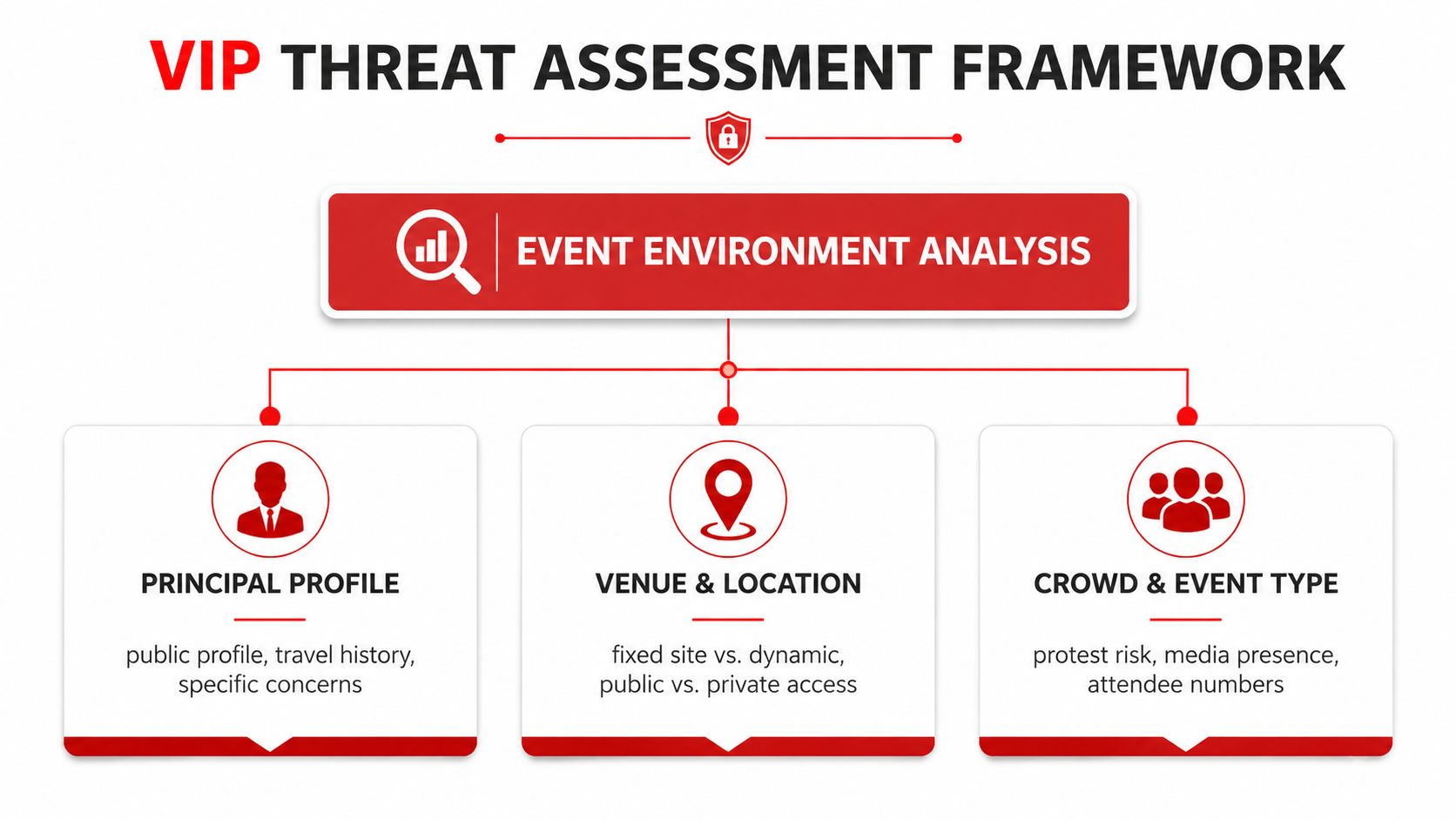
Use three questions before choosing a team
First, examine the person. Record public visibility, travel history, current disputes, online exposure and any specific concern supplied by the client. Keep the information relevant to safety, movement and lawful planning. A provider should receive enough detail to assess exposure, without being invited to investigate private matters casually.
Second, inspect the location. A private function room may offer controlled access, while a festival combines gates, vehicle routes, backstage corridors, staff areas and public crowd flows. Hotel arrivals can create greater pressure than a stage appearance because guests, media, contractors and vehicles converge in a confined space.
Third, analyse the crowd and event type. Alcohol service, protest potential, media presence, public ticketing, changing schedules and transport congestion shape the operating plan. NSW guidance states that licensed security with crowd-control capability and event experience can provide valuable expertise, and that licensed security is mandatory for security activities at events. Include the NSW event safety and security guidance in the organiser's planning record.
Compare the operating environments
A headline artist at a regional festival usually needs advance work around the hotel, arrival route, backstage access and stage-side movement. The visible team must stay close enough to act while venue security retains responsibility for gates, crowd pressure and general venue control.
A CEO at a multi-day conference may require a lower-profile arrangement. The principal could cross a public lobby, attend a boardroom meeting and join a dinner where overt security would affect the guest experience. A close-protection lead, venue liaison and briefed staff may provide suitable coverage while keeping the team's profile proportionate to the assessed risk.
A high-profile guest at a hospitality venue creates another set of pressures. Queues, alcohol, narrow corridors, deliveries and spontaneous approaches can produce friction. The protection team should understand the venue's responsible service of alcohol controls and coordinate with management, allowing venue staff to manage the broader room.
Classify the assignment by complexity:
- Lower complexity: Controlled venue, limited public exposure, predictable movements and no identified concern.
- Moderate complexity: Public movement, media interest, alcohol service, several access points or schedule changes.
- Higher complexity: Credible concern, large public exposure, protest potential, complex travel or multiple jurisdictions.
The classification should set the scope of the advance inspection, team composition, visibility and contingency planning. It remains a planning aid, not a replacement for operational judgement. Conditions can change on the day, so the supervisor needs authority to adjust routes, positions and timing.
For tours crossing NSW, VIC, QLD and the ACT, record the assessed environment separately for each venue. Licensing and compliance checks belong in the deployment plan, because a sound threat assessment still fails if the assigned officers cannot lawfully perform the required duties. Where travel forms a substantial part of exposure, organisers can assess Max's Luxury Rides chauffeur options from Max's Luxury Rides alongside the licensed security detail. Both providers should agree on collection points, communications, loading access and contingencies before the event.
Navigating State Licensing for VIP Protection Services
A touring provider can hold a valid security credential in one state and still need separate approval before an operative works at the next venue. For organisers running events across NSW, Victoria, Queensland and the ACT, licensing should be checked venue by venue, before contracts and rosters are finalised.
In NSW, the 1B bodyguard subclass aligns with CPP31418 Certificate III in Close Protection Operations. The NSW course structure lists CPP20218 Certificate II as a prior qualification, advanced first aid HLTAID014, and a pre-enrolment language, literacy and numeracy assessment, as set out in the NSW Security Licence Course structure. NSW legislation defines a class 1B licence as authority to work as a bodyguard or in a similar capacity.
Victoria uses activity and classification controls that require closer examination. A Victorian regulatory impact statement recorded nearly 42,000 private security providers at 31 December 2023, including more than 35,000 individual licence holders and nearly 900 business licence holders. It identified 835 holders with the combined classification “bodyguard, crowd controller, security guard”, alongside 31,517 with “crowd controller, security guard”. The Victorian Private Security Regulations regulatory impact statement supports checking the proposed duties and exact classification rather than accepting a general assurance.
Queensland expressly defines a bodyguard as a person providing close personal protection for reward and provides a distinct Queensland bodyguard licence application pathway. ACT deployments also require territory-specific checking. A national marketing statement does not confirm that every assigned operative may lawfully perform the required duties at the local venue.
| State | Licence Category | Key Requirement | Typical Event Use |
|---|---|---|---|
| NSW | Class 1B bodyguard | Close-protection course pathway, eligibility checks and approved training | Artist movements, executive travel and public appearances |
| Victoria | Private security licence covering bodyguard activity | Appropriate activity approval, identity checks and state processing | Corporate events, venues and layered crowd operations |
| Queensland | Bodyguard licence | Confirm the distinct bodyguard category before work begins | Touring artists, hospitality and executive protection |
| ACT | Territory-specific security approval | Verify local requirements for each operative and assignment | Government, corporate and event deployments |
Victoria may require fingerprints and may direct applicants to arrange payment and a photograph at an approved VicRoads location. The state also made all private security activities licensed activities from 19 June 2025, with further requirements for existing licence holders, according to the Victorian draft private security regulations.
Compliance check: Require the provider to identify the licence category, licence number, expiry date and employing or contracting entity for every operative before the first shift.
Specifying Roles, Ratios and Specialist Support
A vague scope produces vague deployment. “Provide VIP security for the event” doesn't tell a provider whether the principal is stationary, moving through a crowd, crossing a public lobby or travelling between sites. Write the assignment around people, movements and decision points.
Define the core roles
The lead close-protection officer owns the immediate protective relationship and principal contact. A second operator provides coverage during movement, manages separation risk and supports handovers. An advance officer checks entrances, routes, holding areas and exits before the principal arrives.
A protective driver has a different responsibility from a standard chauffeur. The role may include route familiarity, secure stopping points, communication with the detail and response to changes. The venue liaison coordinates with the event controller, stage manager, venue manager and access-control staff so the protection team isn't making independent decisions in a crowded operational environment.
Set a reasoned ratio
There is no universal staffing ratio that replaces an assessment. As a planning guide, the required visual specification can use a 1:1 to 1:3 ratio based on threat level, with the ratio adjusted for movement, public exposure, venue design and the number of simultaneous tasks.
A 1:1 arrangement may suit a low-complexity corporate appearance where one officer remains with the executive and venue staff control the room. A 1:2 or 1:3 arrangement may suit movement through a public environment, where one officer stays close, another watches the forward or rear space and an additional operator supports access or vehicle coordination. These are planning benchmarks, not promises of safety or fixed legal requirements.
Add specialists only when they solve a defined problem
For a festival artist travelling from a hotel to a stage, an advance party and protective driver may add more value than a K9 unit positioned near the principal. A K9 team can be appropriate where the broader event plan requires screening or search capability, but adding one for appearance alone may increase congestion and visibility without improving the close-protection task.
A corporate executive attending a gala dinner may need discreet coverage, a controlled entry route and a venue liaison. A VIP table in a busy nightclub may require close protection integrated with crowd controllers, a clear exit path and a supervisor who understands venue behaviour. Covert operatives can help where visible security would undermine the guest experience, but covert deployment still needs clear identification and communication with the control team.
Your scope should specify:
- Movement windows: Collection, arrival, event attendance, departure and handover.
- Locations: Hotel, vehicle route, loading dock, green room, stage, dining room and exit.
- Staffing: Primary officer, secondary operator, advance role, driver and supervisor.
- Medical readiness: Advanced first aid coverage for movement-heavy assignments.
- Contingencies: Delays, changed entrances, schedule extensions and lost communications.
- Reporting: Shift brief, incident log, handover record and post-event debrief.
Integrating VIP Protection with Crowd and Venue Operations
VIP protection works inside the event plan. Even competent, properly licensed teams can create bottlenecks by stopping a principal at the same gate used by thousands of guests or blocking a backstage corridor needed by production staff.
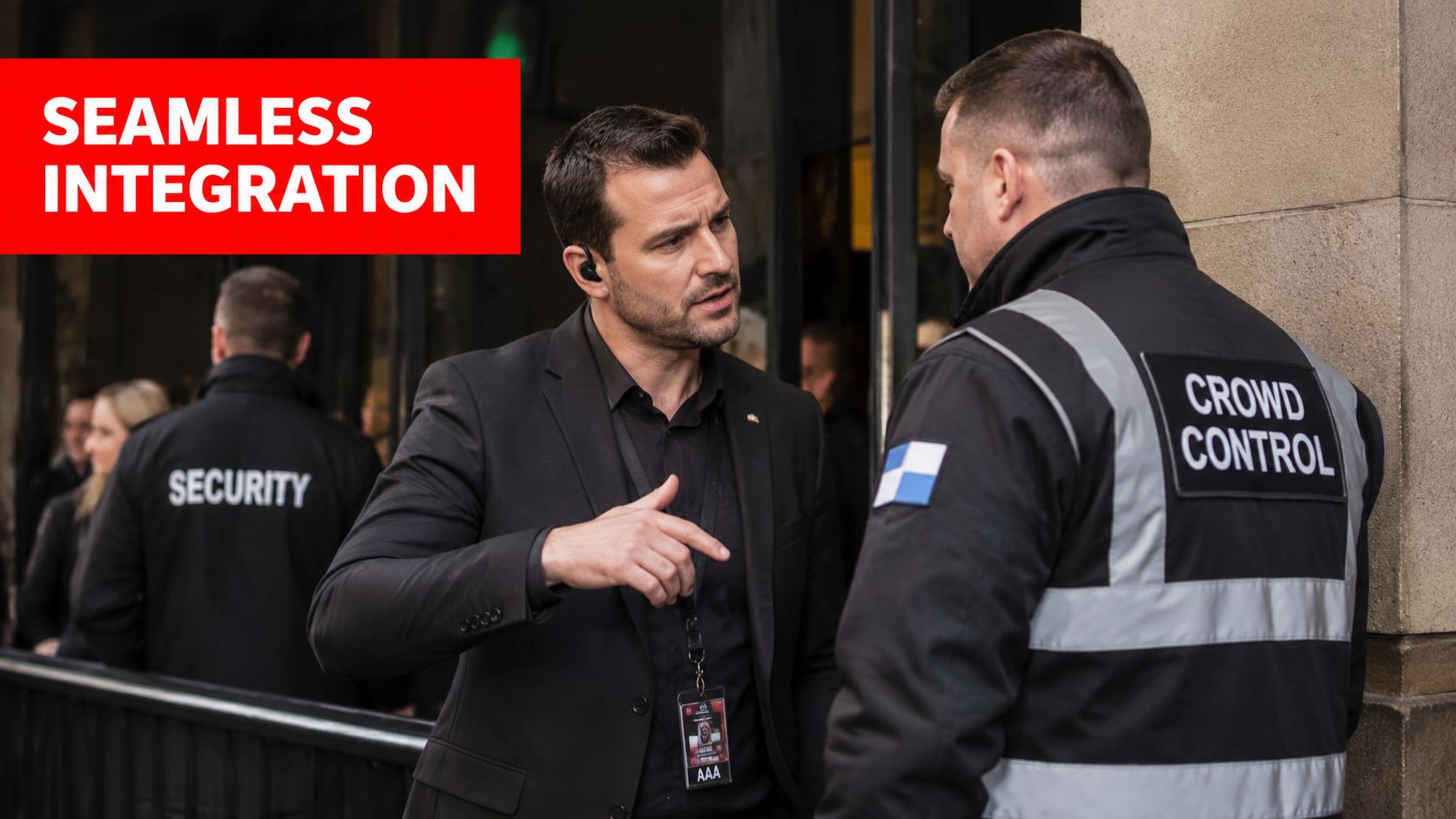
At a festival, an artist's arrival may coincide with peak ingress. The protection supervisor should agree on the arrival window with the event controller, select a route clear of active queues and brief crowd controllers on the movement they are supporting. Gate staff, crowd management and venue control retain their own responsibilities.
Build a shared operating picture
Hold a pre-event briefing with the protection lead, event security supervisor, venue manager, production representative and relevant hospitality staff. Confirm:
- Radio discipline: Which channel carries protection coordination, which handles general event traffic and who can authorise a movement change.
- Escalation: Who pauses an arrival, closes a corridor, calls emergency services or changes the exit.
- Access control: Which credentials apply to the principal, team, vehicle, backstage area and loading dock.
- Venue conduct: How crowd controllers, RSA-trained staff and protection officers respond to intoxication, harassment or an unwanted approach.
- Emergency movement: Safe rooms, alternate routes, vehicle positioning and reunification points.
A corporate VIP moving through a public hotel lobby may need discretion instead of a visible cordon. Venue staff can manage ordinary guest flow while the protection lead chooses the quietest route and keeps the principal's timetable confidential. At a nightclub, the team should understand alcohol service controls and avoid turning a routine approach into a confrontation.
Rehearse the points where plans usually break
Joint site walks expose faults that a written plan can miss. The lift may not fit the equipment, the “private” exit may open onto a public car park, or the loading dock may be occupied by a supplier at the planned departure time.
These checks matter across NSW, VIC, QLD and the ACT, where venue procedures, event staffing and licensing arrangements may differ between tour stops. A protection plan that works at one venue can obstruct another unless the supervisor confirms local access rules and control-room procedures before deployment.
Crowd-control concerns at Bluesfest, including matters investigated by SafeWork NSW around security, crowd control, traffic management and venue access, show why protection planning must connect with wider event operations. The reported SafeWork NSW investigation context supports joined-up planning, while organisers should confirm the current position directly with relevant authorities.
Good integration is quiet. Guests should experience an organised venue, with security staff controlling movement without creating a dispute over who owns a corridor.
Contracting and Onboarding Your Protection Provider
A provider should be able to show how its people, licences and supervision fit the assignment before the contract is signed. Don't accept “all staff are trained” as a substitute for checking the actual operative allocated to the shift.
Put compliance in the contract
Require the provider to supply:
- Licence evidence: State-specific licence category, number, expiry date and activity approval for each deployed person.
- Business authority: Confirmation that the employing or contracting business holds the required master licence where applicable.
- Competency records: Close-protection qualification pathway, first aid currency and documented role checks.
- Supervision: Named operational supervisor, escalation contact and replacement process.
- Insurance: Current certificates relevant to the work, venue and contractual responsibilities.
- Deployment records: Roster, location, shift times, handovers and any subcontracting disclosure.
In NSW, a person must be at least 18, meet citizenship or visa and criminal-eligibility requirements, and complete the Security Licence Course through a SLED-approved organisation before performing close-protection work. The NSW class 1 licence guidance explains the eligibility and licensing framework. Businesses should verify both the operative and the business arrangement, because using an unlicensed or partly qualified person can undermine the whole deployment.
NSW legislation states that a licence remains in force for 5 years from the day it comes into force unless surrendered, revoked or otherwise ceases earlier. That fixed period makes a licence register essential for a touring operation. Track expiry dates, but still confirm current status before each deployment because a licence can cease earlier under the legislation. The NSW Security Industry Act 1997 sets out the statutory validity rule.
Make performance measurable
The onboarding pack should include a principal profile, venue map, movement plan, contact tree, radio procedure, emergency arrangements and confidentiality expectations. For movement-heavy work, require advanced first aid coverage as a risk-control layer, consistent with the NSW close-protection competency pathway.
After every shift, capture incidents, near misses, schedule changes, access problems and client feedback. A supervisor should conduct a short debrief and record corrective actions. For a season of events, this creates a usable performance history. Without it, each new venue repeats the same avoidable mistakes.
Practical VIP Protection Services Checklist and FAQs
Before deployment, confirm the following:
- Assessment: Principal profile, exposure, venue, routes, crowd conditions and contingencies are documented.
- Licensing: Every operative holds the correct approval for the state and activity.
- Roles: Lead, second operator, advance, driver, liaison and supervisor responsibilities are clear.
- Integration: The protection team has briefed event control, venue management, crowd controllers and relevant hospitality staff.
- Medical cover: Advanced first aid capability is assigned where movement and exposure justify it.
- Monitoring: Licence records, incident logs, handovers and post-shift reviews are maintained.
Frequently asked questions
What happens if a tour adds an interstate date at short notice?
Pause deployment planning and check the destination state's licence category first. Don't assume an existing NSW, Victorian or Queensland credential transfers automatically.
What should I do if a provider can't produce current licence evidence?
Don't deploy the operative in a security role until the provider supplies verifiable evidence and confirms the business arrangement. Replace the person or escalate to the relevant state regulator if the gap remains unresolved.
How can protection stay discreet?
Use the least visible model that still manages the assessed risk. Coordinate routes, access and staff behaviour so the team doesn't create unnecessary attention or obstruct ordinary venue operations.
Should I hire bodyguards separately from event security?
Only when responsibilities are clear. A close-protection team and crowd-control team can work well together, but they need one command structure, shared communications and agreed escalation rules.
What does a credible provider offer?
A credible provider explains the licence pathway, assigns named roles, inspects the venue, documents contingencies and reports what happened after the shift. Those controls matter more than a generic promise of “high-level security”.
GM GROUP Services provides licensed protection across NSW, Victoria, Queensland and the ACT, including VIP and bodyguard protection, event security, K9 capability, vehicle patrols, risk assessments, supervision and reporting. If you're planning a festival, corporate programme, hotel appearance or hospitality event, visit GM GROUP Services to discuss a compliant protection plan built around your principal, venue and touring schedule.