


A touring artist is due at a Brisbane venue this evening. The promoter has booked close-protection officers, but the airport transfer is still being confirmed, the hotel hasn't approved the access route, and nobody has checked whether the agency's licences cover every duty. That's where VIP protection requirements begin, well before the first officer arrives.
In Australia, effective VIP protection combines licensing, protective intelligence, route planning, transport, venue access, staffing, communication and supervision. A visible bodyguard presence may be part of the plan, but it isn't the plan itself. This guide gives event organisers, venue managers, corporate hosts and promoters a practical way to assess requirements across NSW, Victoria, Queensland and the ACT, then convert them into vendor checks and operational run-sheets.
Introduction to VIP Protection Requirements in Australia
A high-profile arrival creates several linked movements. The principal may travel from an airport to a hotel, from the hotel to a venue, through a media entrance, onto a stage and back to accommodation. Each movement introduces different access points, people, vehicles, timings and fallback decisions.
Australian close-protection planning formally starts with understanding the principal's requirements, gathering and verifying protective intelligence, assessing threats and vulnerabilities, and selecting and reconnoitring routes. Those activities are identified in the nationally recognised CPPSEC3122 unit, which specifically covers celebrities, political figures, VIPs and other principals requiring close protection services. The Australian close-protection training unit therefore treats the work as a risk-assessed operational discipline, not a generic guard post.
That distinction matters to a venue manager. Static guards may control a door, crowd controllers may manage patron behaviour, and a close-protection operative may remain close to the principal while moving through a changing environment. Those roles can support one another, but they aren't interchangeable.
Practical rule: If the principal's movement, access, route and fallback arrangements haven't been planned, the protection booking is incomplete.
The scale of the work is also clear from Australian government reporting. Between 1 July 2017 and 30 June 2018, the Australian Federal Police Close Protection operations team coordinated security responses for 293 foreign visits to Australia. Earlier AFP reporting recorded close personal protection activity as 21% preventive and 79% response work in 2011–12, alongside an avoidable-incidents KPI of 0.037 per 5,000 hours. These figures appear in the CPPSEC3122 training material and show why planning, response capability and performance monitoring belong in the same operational picture.
The sections ahead move from the meaning of VIP protection to jurisdiction checks, personnel verification, airport-to-venue coordination, staffing controls and copy-ready organiser templates.
What VIP Protection Really Means Beyond Bodyguards
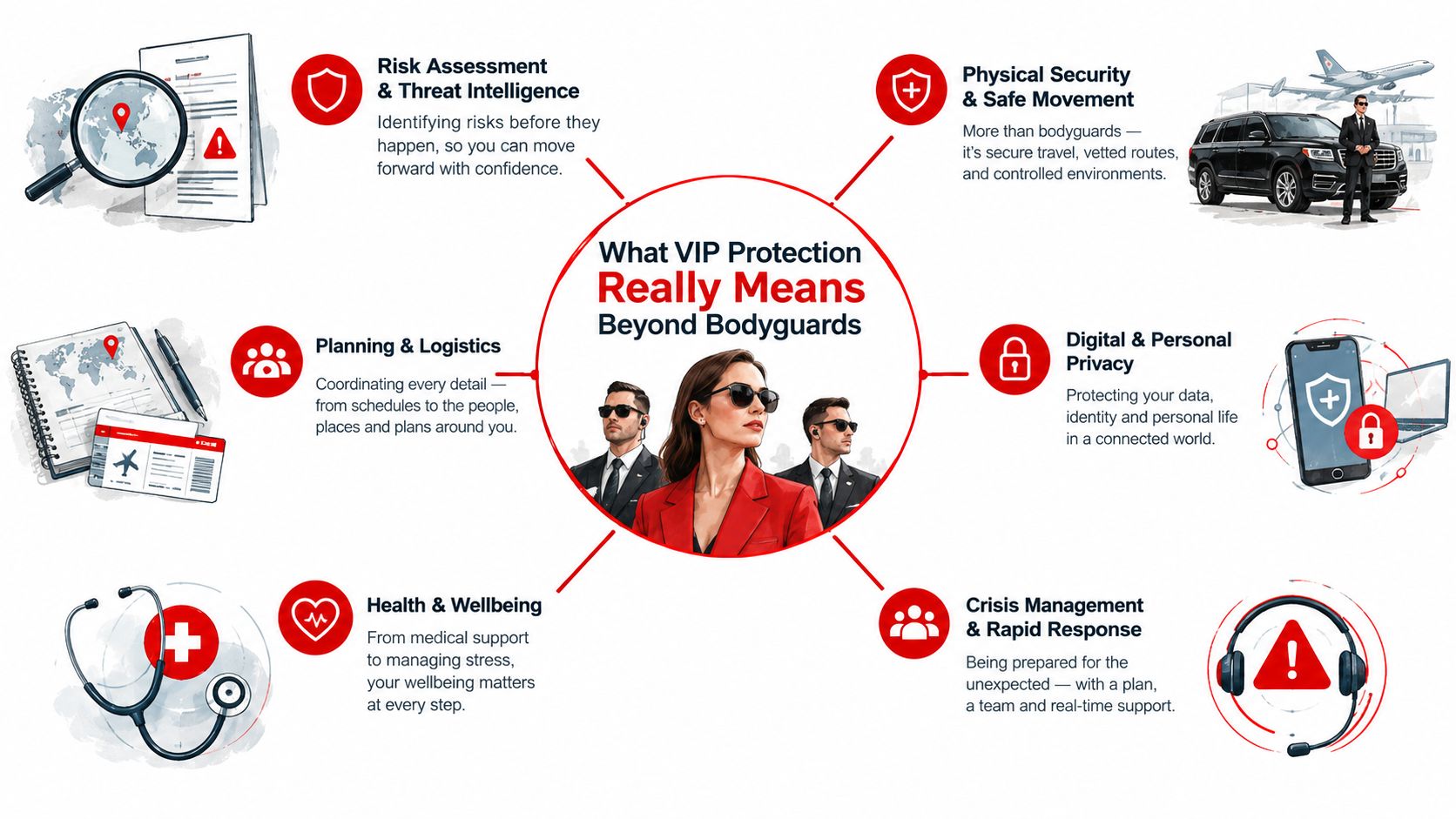

A VIP arrives at an airport, transfers to a hotel, attends a private function and later enters a crowded venue. Each movement creates different access, transport and communication needs. VIP protection is therefore a coordinated movement and risk-management service, with close protection forming only one part of the arrangement. Other elements may include intelligence gathering, threat assessment, route selection, venue access control, accommodation planning, transport coordination and contact with the event team.
Australian training requirements direct close-protection operatives to clarify the principal's needs, gather and verify protective intelligence, assess threats and vulnerabilities, then select or reconnoitre routes before deployment. The sequence works like an event production run-sheet. A concert manager confirms crew entry, access authority and fault procedures before the artist reaches the stage. Protection planning applies the same discipline to people, vehicles, venues and fallback arrangements.
Identify the principal and the exposure
The principal may be a celebrity, political figure, visiting dignitary, corporate executive, performer or another person whose role and visibility create a particular risk profile. The required service depends on the person, event, location, itinerary and likely points of exposure.
A hotel movement calls for different controls from a red-carpet arrival. A corporate executive attending a closed meeting may need discreet access control and transport coordination. A touring artist may require a managed airport-to-hotel-to-venue route, with separate arrangements for fans, media and contractors.
Separate protection roles clearly
Close protection addresses the principal's immediate safety while moving or appearing in public. Static security protects a fixed position, such as an entrance, loading dock or accommodation floor. Crowd control manages patron behaviour, capacity, queuing and dispersal. The plan should assign each duty to appropriately licensed personnel, with clear handovers between roles.
Visible guards cannot replace a planned movement route, and close-protection officers should not be expected to manage every venue-wide crowd issue. Treating separate duties as interchangeable creates gaps in coverage and accountability.
VIP protection means the right people, approvals, information and movement controls working together, rather than simply adding guards.
Record the principal's movements, public exposure, access points, transport arrangements, alternate routes, venue contacts and escalation process. This shared operating picture lets organisers brief the venue, hotel, transport provider and event control room consistently. It also turns a broad security request into a practical, jurisdiction-ready logistics checklist.
Legal and Licensing Requirements Across NSW VIC QLD and ACT
A protection team may be properly licensed in Sydney yet unauthorised for the same assignment in Melbourne or Brisbane. Licensing follows the jurisdiction and the activity, so organisers should verify the individual credential and the business approval before accepting a proposal. Treat the process like a route plan: each state is a checkpoint, and deployment should not proceed until every checkpoint is cleared.
In NSW, close-protection work is a distinct activity. The operative must hold the correct Class 1B approval, be at least 18 years old, meet fit-and-proper requirements and complete training through a SLED-approved organisation, as set out by Service NSW security-operative licensing guidance. The employer must also hold a Master Licence, and a private-security business supplying bodyguard services needs the relevant business approval. The ASIAL licensing guidance supports checking the agency's business licence alongside each worker's card.
Victoria treats bodyguard work as a private-security activity. Applicants must be 18 or over, have Australian residency or current working rights, provide fingerprints, provide overseas police checks where relevant and satisfy fit-and-proper-person requirements under Victoria Police private-security licensing information. An armed assignment requires a current firearms licence in addition to the private-security licence.
Queensland requires bodyguard personnel to hold a current class 1 security licence, be at least 18, submit fingerprints, pass a criminal-history check and complete the required training. A recorded conviction for a disqualifying offence in the previous 10 years can make an applicant ineligible, according to the Queensland Government bodyguard licensing requirements. Confirm the provider's authority as well as the individual licence before rostering the team.
Comparison table
| Requirement | NSW | VIC | QLD |
|---|---|---|---|
| Individual authority | Class 1B approval for close protection | Private-security licence for defined security activities | Current class 1 security licence |
| Age | At least 18 | 18 or over | At least 18 |
| Background assessment | Fit-and-proper requirements and licensing checks | Fit-and-proper requirements, fingerprints and relevant overseas checks | Criminal-history check and fingerprints |
| Business approval | Master Licence or relevant private-security business approval | Check the provider's applicable business authority | Verify the provider and each operative before deployment |
| Armed duties | Confirm the separate authority required for the duty | Firearms licence required in addition to private-security licence | Confirm the specific legal authority before assigning any armed duty |
The ACT needs its own verification step rather than a national assumption. Ask the provider to identify the current ACT approval for the proposed activity, confirm the operative's training and check whether interstate personnel need additional authorisation. Record the licence class, issuing jurisdiction, expiry and verification date in the event file. That record gives the organiser a clear go or no-go decision before airport collection, venue entry or any public movement begins.
Personnel Qualifications Vetting and Training You Must Verify
A supplier's uniform and experience don't prove eligibility. Before the pre-start briefing, the organiser should receive enough documentation to confirm that every operative is authorised for the actual duties and location.
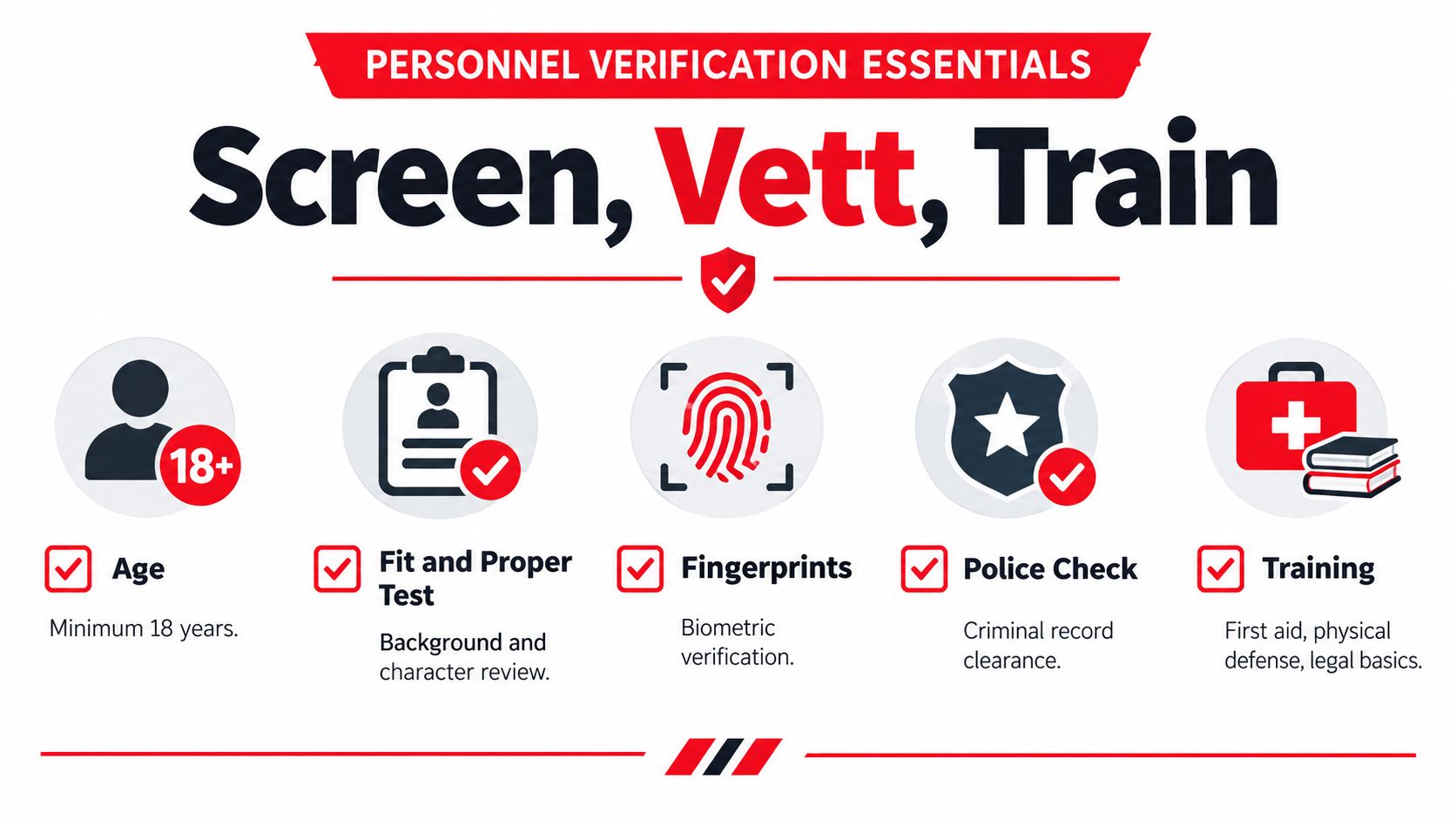
Start with identity, age and licensing. NSW and Queensland require operatives to be at least 18, while Victoria requires applicants to be 18 or over. Check the licence number, class, expiry, issuing jurisdiction and permitted activity. Record the verification date in the event file so a last-minute substitution receives the same scrutiny.
Use a pre-start audit for every operative
- Identity: Match the operative's name and photograph to the supplied licence record and roster.
- Jurisdiction: Confirm that the credential applies to the state where the duty will occur.
- Activity: Check that the approval covers close protection, bodyguard work or the specific assigned function.
- Training: Request evidence of the relevant training, including the close-protection competency where it forms part of the assignment.
- Character checks: Confirm fit-and-proper assessment, fingerprints and police checks where the jurisdiction requires them.
- Residency and work rights: For Victorian applicants, confirm Australian residency or current working rights.
- Firearms status: For any proposed armed duty in Victoria, verify the separate firearms licence as well as the private-security licence.
- Substitutions: Repeat the audit when an agency changes an operative after the original roster is approved.
The nationally recognised CPPSEC3122 unit is important because it frames VIP protection around requirements clarification, protective intelligence, threat and vulnerability assessment, and route selection. It gives organisers a practical training reference when asking a provider how the team prepares for an assignment.
Watch for disqualifying or incomplete information
In Queensland, a disqualifying offence recorded within the previous 10 years affects eligibility. In Victoria, missing overseas police checks where relevant or failing the fit-and-proper assessment creates a licensing problem. In NSW, the wrong class of approval can make an operative unsuitable even if the person has prior security experience.
Training also needs an operational dimension. Ask who supervises the detail, who controls communications, how incidents are reported and how the team will coordinate with venue security. A capable operative still needs a clear brief, current site information and a defined escalation path.
A licence check confirms eligibility. A proper briefing confirms suitability for this assignment.
Equipment Transport and Venue Coordination Essentials
Protection often fails at the handover points. The airport may control screening and access, the hotel may control loading areas and lifts, the venue may control doors and backstage corridors, and the transport provider may control vehicle timing. The close-protection team can't resolve those dependencies alone.
DFAT airport facilitation guidance shows that official movements depend on separate airline approvals, while airport access and security screening remain subject to operational requirements on the day. The Australian Government also uses close-protection police officers alongside transport, accommodation and venue-security arrangements for protected visitors. Foreign security personnel aren't permitted to carry firearms during visits to Australia.
Build one movement workflow
For an artist arriving in Melbourne, the organiser should coordinate the following before arrival:
- Airport contact: Identify the airline, airport liaison and approved meeting point. Don't assume a private team can enter an airside area or bypass screening.
- Vehicle plan: Confirm the vehicle, driver, pickup timing, loading location, passenger access and alternate arrangements if the primary pickup point becomes unavailable.
- Route control: Have the protection team assess the primary route and practical alternatives, then share only the necessary information with authorised contacts.
- Hotel handover: Confirm the entry, lift, room-floor access, staff contact and emergency communication process with hotel management.
- Venue access: Lock in the principal's entrance, backstage route, holding room, stage access, exit route and vehicle position.
- Event control: Establish radio channels, call signs, check-in points and the person who can authorise a change to the movement plan.
Equipment should be matched to the duty and carried in accordance with applicable law and venue policy. Avoid giving staff equipment that creates a legal or operational problem, particularly where a foreign protection team is involved.
Make access timing part of the security plan
A venue sweep, vehicle arrival and principal movement all require time and cooperation from other departments. Ask the venue to nominate one manager for access decisions, one transport contact and one emergency contact. Keep the brief concise, protect sensitive itinerary information and update the team when timings change.
Coordination point: The question isn't only “Who is guarding the VIP?” It's also “Who controls every door, route and handover the VIP will use?”
Operational Planning Staffing Ratios and Risk Controls in Action
Close protection must sit inside the event's wider staffing plan. A principal may need a dedicated escort, but the route still depends on entrance control, crowd management, emergency access and post-event dispersal.
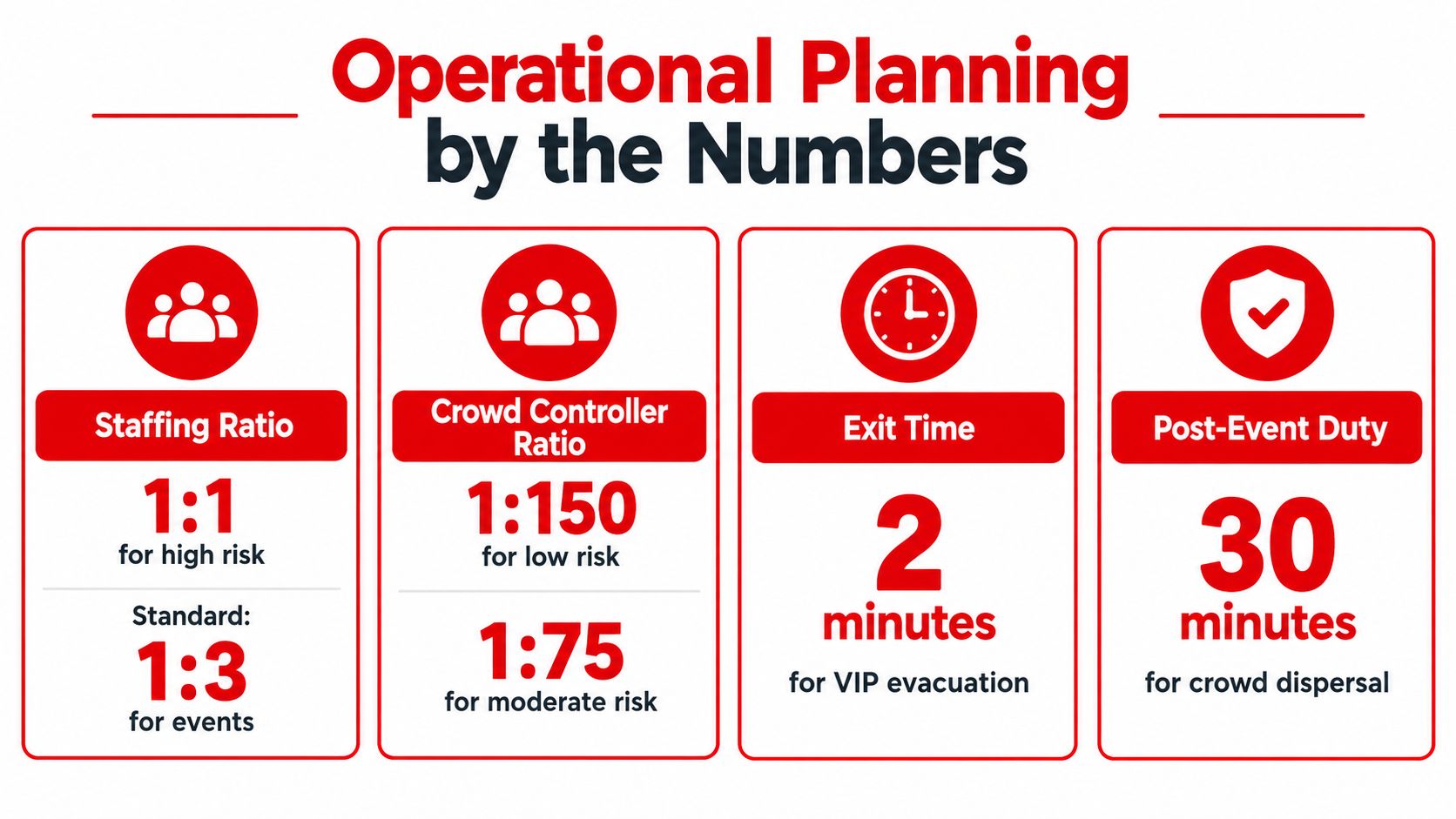
Queensland provides a clear example of compliance-driven staffing for licensed premises. The required crowd-controller numbers range from 1 for 1 to 100 patrons, up to 5 for 401 to 500 patrons, with at least 1 additional crowd controller for every 250 patrons over 500, according to Queensland security staffing requirements. These figures address crowd-controller staffing. They don't automatically determine the number of close-protection operatives, which must be assessed against the principal's movements and risk profile.
Queensland's high-risk event guideline also requires 7 crowd controllers for 1,000 patrons or part thereof, plus at least 1 crowd controller for every 250 patrons or part thereof as otherwise determined. At least 2 crowd controllers must remain outside the event area for 1 hour after the event ends or until patrons leave the vicinity.
Worked example for a Brisbane afterparty
Take a festival afterparty with 1,200 attendees. The organiser should calculate the applicable high-risk event crowd-controller requirement, then confirm any additional determination that applies to the event. The run-sheet must also reserve at least two staff for the outside area after closure, continuing for the required post-event period or until patrons have left the vicinity.
The VIP movement plan then overlays:
- Arrival coverage: A protected route from vehicle access to the controlled entrance.
- Internal coverage: Staff at the holding room, backstage corridor and stage access points.
- Crowd interface: Crowd controllers positioned so the principal doesn't have to move through an unmanaged queue or dispersal area.
- Exit coverage: A clear departure route that remains available during post-event movement.
- Supervision: One nominated manager who can stop, delay or redirect the movement.
Monitor controls during the event
The supervisor should record briefing attendance, licence substitutions, route changes, access issues, incidents and handovers. The earlier AFP figures on preventive and response work, including performance monitoring, demonstrate why a protection operation needs records rather than relying on memory.
A staffing calculator belongs in the event run-sheet. It should show patron capacity, applicable crowd-controller obligations, close-protection assignments, venue posts, transport contacts and post-event duties. That approach prevents the common mistake of treating VIP protection as an isolated escort while the surrounding event remains under-resourced.
Practical Checklists Templates and Next Steps for Organisers
A good plan should be usable by the promoter, venue manager, security supervisor and transport contact. Keep the documents short enough to use under pressure, but specific enough to expose missing approvals.
Vendor onboarding checklist
- Business authority: Verify the agency's NSW Master Licence or relevant private-security business approval where the work is in NSW.
- Jurisdiction coverage: Ask the provider to identify the approval applying in NSW, Victoria, Queensland or the ACT.
- Service scope: Confirm whether the booking covers close protection, static security, crowd control, transport support or venue coordination.
- Roster control: Require named operatives and approval before substitutions.
- Reporting: Confirm incident reporting, supervisor contact and escalation arrangements.
- Insurance and operating documents: Request the provider's current business documentation relevant to the engagement.
Operative pre-start checklist
Record the operative's identity, licence class, issuing jurisdiction, expiry, training evidence, police-check status and assigned duty. For Queensland, check the class 1 licence and disqualifying-offence eligibility. For Victoria, check residency or working rights, relevant overseas police checks and any separate firearms licence for armed duties.
Movement coordination template
Write the principal's arrival point, vehicle contact, primary route, alternate route, hotel entry, venue entry, holding room, stage route, departure route and emergency contact into one controlled document. Add the airport or airline approval status, screening requirements and the person authorised to change the plan.
Frequently asked questions
Does one Australian security licence cover every state?
No. Close-protection work is regulated by jurisdiction, so verify the local approval before an interstate deployment.
Can a NSW event hire bodyguards from an unlicensed provider?
The provider must hold the proper NSW business licence for bodyguard services. Check the agency approval as well as each operative's credential.
What makes someone ineligible for a Queensland bodyguard licence?
A recorded conviction for a disqualifying offence within the previous 10 years can make the applicant ineligible under the Queensland application requirements. The provider should complete the required checks before rostering the person.
Is a Victorian private-security licence enough for armed VIP protection?
No. Armed guard duties require a current firearms licence in addition to the private-security licence.
What must be arranged beyond the guard team?
Plan airport and airline coordination, screening, transport, route control, hotel access, venue entry and communication. Protection works best when those handovers are owned by named people.
For events across NSW, Victoria, Queensland and the ACT, VIP protection requirements should be managed as a compliance and logistics workflow. Use the checklists before contracting, brief every department involved in the movement and keep the close-protection detail integrated with the wider event-security plan.
GM GROUP Services provides licensed security support for VIP movements, events, venues and business operations across NSW, VIC, QLD and the ACT, including risk assessments, close protection, venue coordination and supervised deployment. Visit GM GROUP Services to discuss your event schedule, jurisdiction requirements and airport-to-venue protection plan.