


Venue security manager decisions should start with an uncomfortable fact: in historical Australian Institute of Criminology research, 12% of inner Sydney hotels accounted for almost 60% of assaults on hotel premises, while 8% of Newcastle licensed premises accounted for nearly 80% of on-premises assaults (Australian Institute of Criminology research on violence at licensed premises). Risk wasn't spread evenly, so spreading security resources evenly wouldn't have addressed the problem.
That reframes the job. A capable manager doesn't put guards beside doors. They identify where harm could occur, organise people and controls around that risk, and check whether those decisions protect patrons without making the venue unnecessarily hostile.
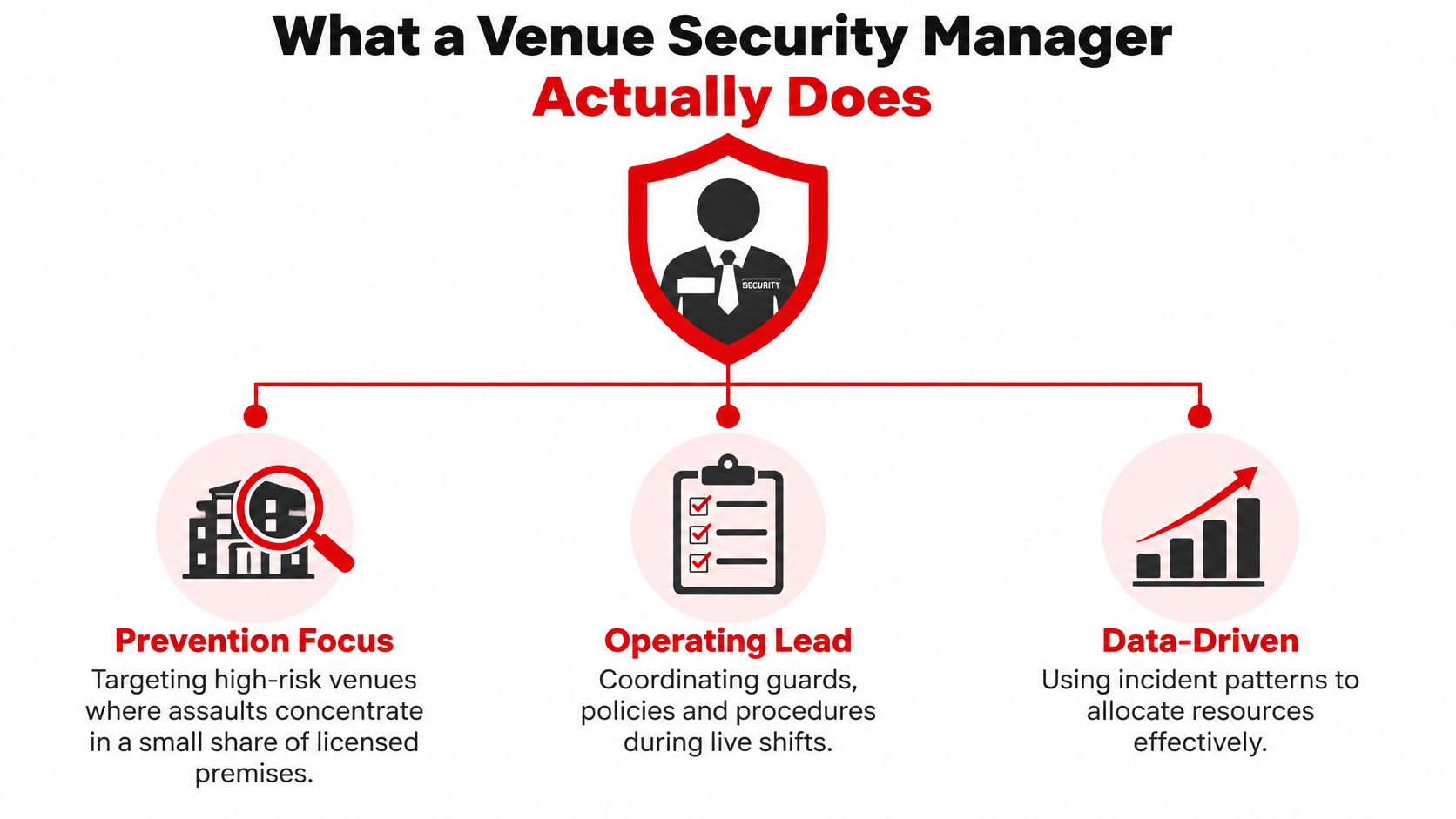
What a Venue Security Manager Actually Does
A venue security manager turns safety expectations into an operating system people can follow under pressure. That includes deployment, communication, escalation, documentation and coordination with the venue's wider management team.
Think of the role as the conductor rather than the loudest instrument. Entry staff, floor guards, bar managers and supervisors have different responsibilities, but someone must make sure they're working from the same plan.
Own the operating model, not just the roster
A frontline supervisor usually directs an assigned team during a shift. The manager decides how that team should operate, what resources it needs and how its performance will be assessed. In smaller venues, someone may perform both roles, but the responsibilities remain distinct.
A useful position-description statement is:
Role definition: The venue security manager plans, coordinates and reviews security operations to protect people, support lawful venue operations and maintain a safe, welcoming environment.
That definition deliberately includes the patron experience. An orderly entry process that humiliates legitimate customers isn't a complete success. Neither is a friendly door team that ignores escalating aggression.

Four lenses a venue security manager owns
The following framework is a practical way to organise the job. It separates what you need to manage from the evidence that shows you've managed it.
| Lens | What it Covers | Example Output |
|---|---|---|
| People | Credentials, supervision, communication and welfare | Verified deployment roster |
| Process | Entry decisions, escalation and incident handling | Briefing sheet and response procedures |
| Place | Entrances, queues, internal zones and dispersal areas | Annotated deployment map |
| Proof | Records, performance measures and corrective actions | Reviewed incident dashboard |
For example, repeated disputes beside a collection counter shouldn't automatically trigger another permanent guard position. First examine queue direction, collection delays, communication and whether customers are blocking a circulation route. A layout change might address the cause, while targeted supervision covers the remaining risk.
For managers developing delegation and judgement, Synopsix's Competency of Manager provides a complementary management resource. Technical security knowledge matters, but so does making responsibilities clear and checking that people can carry them out.
The management principle is simple: allocate attention according to risk, not habit. A familiar roster is a starting point, not proof that the venue has the right coverage.
Risk Assessment and Planning for Venues and Events
A risk assessment is like a weather forecast for venue operations. You're not claiming to predict every incident. You're identifying conditions that could cause trouble and deciding what to do before those conditions develop.
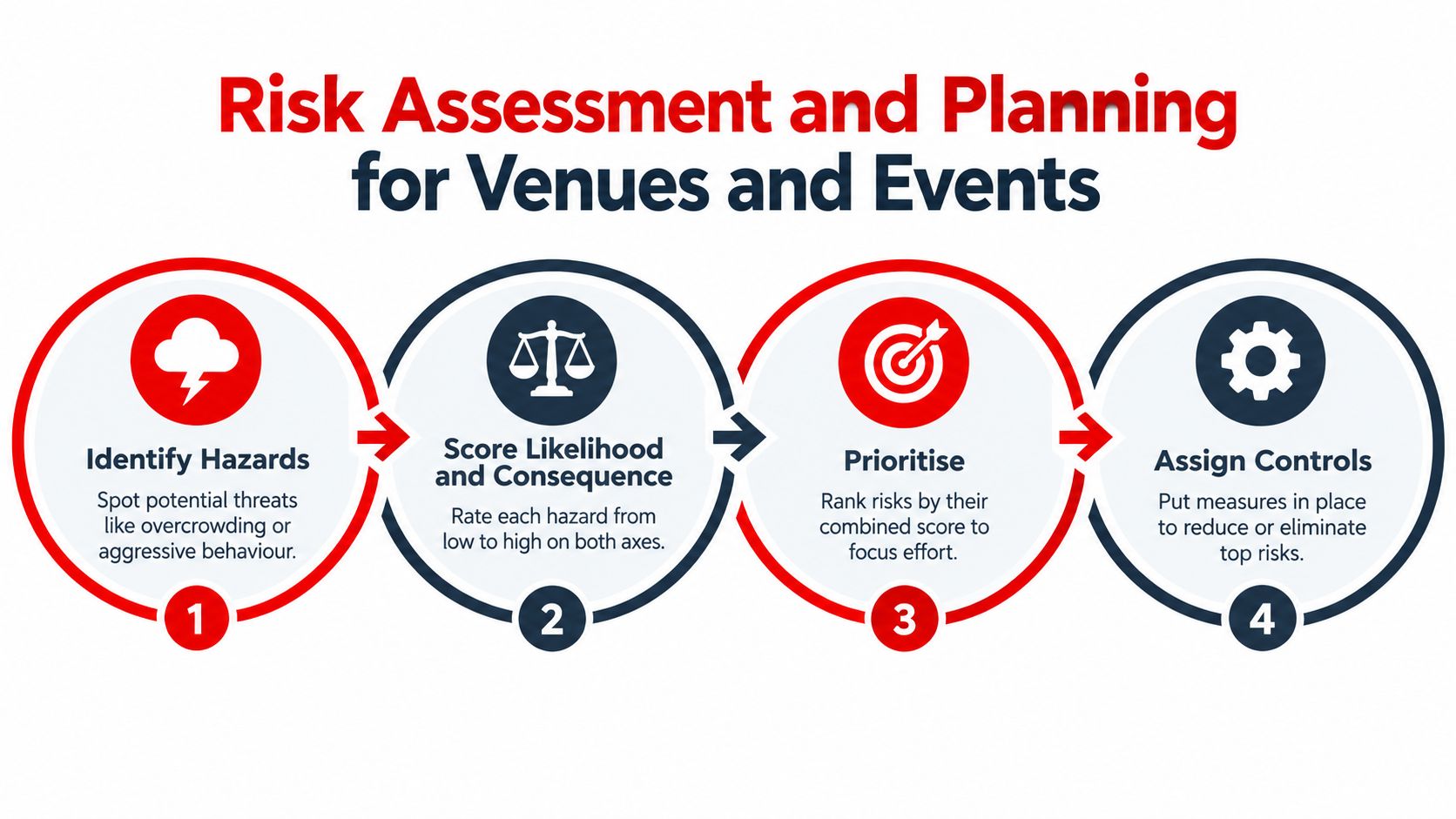
The NSW Government requires event hazards to be analysed and rated by likelihood and impact, with controls intended to reduce their likelihood and a risk-management plan connected to emergency management (NSW event risk assessment and management guidance). The practical task is to turn that process into decisions staff can use.
Work through the site as a patron would
For an illustrative outdoor festival, start at the transport arrival point rather than the ticket scanner. Follow the patron journey through queueing, screening, alcohol service, viewing areas, toilets and departure.
Then walk the same site as a worker, performer and emergency responder. Backstage shortcuts, delivery movements and restricted gates can create risks that aren't obvious from the public entrance.
- Ingress: Check whether screening delays could push queues into pedestrian or vehicle routes.
- Alcohol service: Identify where service queues, intoxication concerns and circulation routes overlap.
- Backstage access: Define who can authorise access and how staff handle a disputed credential.
- Weather and ground conditions: Identify exposed areas, slippery surfaces and places where temporary equipment could obstruct movement.
- Egress and evacuation: Check that departure routes remain usable when patrons leave together.
Use the risk matrix adopted for the event. Describe likelihood and consequence consistently, then prioritise the hazards that require action before opening. Don't assign a reassuring rating merely because a control has been written down.
Convert a hazard into a verified control
Suppose the festival's entry queue could obstruct an emergency access route. The hazard isn't “crowds”. It's an identifiable conflict between waiting patrons and a route that must remain available.
A practical register entry might look like this:
| Hazard | Proposed Control | Owner | Verification |
|---|---|---|---|
| Entry queue obstructs emergency access | Redesign queue alignment and nominate an overflow area | Entry supervisor | Walk-through before opening and live checks |
| Disputes develop near alcohol service | Establish a welfare referral point and a clear escalation route | Bar manager and floor supervisor | Joint briefing and observed operation |
| Patrons enter a restricted work area | Use controlled access and an authorised-person list | Backstage supervisor | Credential test before admission |
| Wet ground affects an exit route | Inspect the route and arrange an approved alternative where required | Site operations lead | Inspection recorded before use |
The venue security manager should challenge vague entries such as “staff to monitor”. Which staff, from where, and what should trigger intervention?
A control isn't ready because someone entered it into a spreadsheet. It's ready when its owner understands it and someone has checked that it works.
Reassess when conditions change. A relocated bar, closed gate or unexpected arrival pattern can invalidate an otherwise sensible plan.
Leading the Security Team on Shift
On an illustrative Friday night, the entry queue starts building while the floor team reports a disagreement near the bar. A guard is due for a break, and a replacement worker has arrived at the staff entrance.
The manager's task isn't to race towards whichever problem sounds loudest. It's to establish priorities, preserve coverage and make sure each issue has an accountable owner.
Begin with a briefing people can remember
Before deployment, the venue security manager uses the site map to explain positions, relief arrangements and escalation responsibilities. Staff should know who controls admission, who coordinates with bar management, who contacts emergency services and who can authorise a deployment change.
Keep the briefing specific to that shift. A generic instruction to “stay alert” is less useful than identifying a temporary obstruction, a changed exit arrangement or a known queue pinch point.
The replacement worker's credentials must be checked before a role is assigned. In Queensland, someone working while training needs a restricted licence and supervision by a fully licensed provider, so the roster must distinguish supervised trainees from fully licensed personnel (Queensland crowd-controller duties and licensing guidance).
That distinction needs to remain visible during relief and handover. Moving a supervisor elsewhere without reviewing a trainee's arrangement can undermine the original deployment plan.
Keep communication short and decisions explicit
Back on the floor, the supervisor reports the disagreement using location, observed behaviour, immediate risk and assistance needed. That gives the manager something actionable without filling the radio channel with speculation.
For example, a report that patrons are arguing but remain separated supports a different response from a report of active violence. Staff should describe what they can see, not diagnose motives or use inflammatory labels.
- Entry team: Maintain occupancy information and report queue pressure before it becomes unmanageable.
- Floor supervisor: Coordinate the immediate response and confirm whether additional assistance is needed.
- Bar management: Address service decisions and share relevant observations.
- Relief personnel: Take over a defined position with a proper handover, rather than assuming coverage informally.
- Manager: Track the overall picture and authorise changes without stripping another area of necessary coverage.
There isn't a universal supervisor-to-guard ratio that can be responsibly applied to every site. Set supervisory coverage according to layout, visibility, task complexity, experience and applicable conditions.
Finish with a short debrief while details are fresh. Ask what changed, where communication failed and which controls staff couldn't apply. Brief, deploy, monitor, debrief and log is a repeatable routine, not an invitation to repeat the same briefing regardless of conditions.
Multi-State Licensing, Ratios and Compliance
A staffing formula isn't a national operating licence. A venue security manager working across NSW, Victoria, Queensland and the ACT needs a common verification process, supported by a separate compliance schedule for each jurisdiction and site.
The most dangerous shortcut is copying a familiar interstate roster and assuming the paperwork can follow. Establish the applicable licence conditions and worker requirements before committing to deployment.
Compare the requirements without flattening the differences
In Victoria, the standard ratio is two crowd controllers for the first 100 customers, then another for every further 100 customers or part thereof. The Victorian Government's example requires four controllers for 240 customers, while individual liquor-licence conditions may modify the arrangement; operators must also verify licences and maintain a controller register (Victorian security requirements for licensed venues).
For a Melbourne venue using that example, the calculation establishes a minimum staffing requirement under the applicable arrangement. It doesn't tell the manager where those controllers should stand or whether additional coverage is justified by the site's risks.
Queensland's specified Brisbane City Council requirements apply to licensed premises trading after 1 am. The listed minimum is one controller for 1–100 patrons, two for 101–200, three for 201–300, four for 301–400 and five for 401–500, with another required for each additional 250 patrons or part thereof; surveillance begins at 11 pm and continues until at least one hour after closing, and controllers must be licensed, distinguishable from patrons and RSA-trained in the Brisbane area (Queensland late-trading security staffing requirements).
That additional-patron rule means a hypothetical Brisbane venue above the listed bands needs its manager to calculate the next band, not just copy the Victorian formula. The finish time also needs to account for dispersal, rather than ending every security shift when service stops.
Crowd-Controller Ratios Compared Across Three States
| Patron Count | NSW Guidance | Victoria Ratio | Queensland (After 1am) |
|---|---|---|---|
| Within the initial patron band | Confirm the event's liquor-licence arrangements and conditions | Apply the initial staffing requirement stated above | Apply the relevant Brisbane patron band stated above |
| Above the initial band | Don't import another state's formula | Add coverage for each further band or part thereof | Continue through the listed bands, then apply the additional-patron rule |
| Changing live occupancy | Review against applicable conditions and the deployment plan | Track the count against the controlling licence | Track the count and maintain the required operating coverage |
NSW event guidance identifies crowd control, venue control, bouncing and guarding cash or valuables as security activities requiring the appropriate licence. Alcohol-service arrangements also need RSA verification and coordination with the event's licensing process. Don't treat a large festival's security requirement as a headcount you can infer from attendance alone.
Build an auditable responsibility chain
Queensland requires a register of controllers and incidents, with controllers signing in and out, allowing the manager to reconcile planned staffing with actual attendance (Queensland crowd-controller register requirements).
Use the same accountability structure across states, while changing the jurisdiction-specific checks.
| Responsibility | Accountable Role | Evidence to Retain |
|---|---|---|
| Verify security credentials | Designated credential checker | Licence details, status check and approved role |
| Confirm RSA obligations | Venue or event licence representative | Required training evidence |
| Approve minimum deployment | Venue security manager and licence representative | Applicable conditions and staffing calculation |
| Record live substitutions | Shift supervisor | Updated roster and handover record |
| Review compliance gaps | Operations lead | Corrective-action record |
For ACT operations, build a dedicated verification schedule against current local requirements and the event's conditions. No ACT-specific ratio is established here, so neither a Victorian nor a Queensland formula should be presented as an ACT rule.
Compliance boundary: A minimum ratio answers a legal staffing question. It doesn't, by itself, answer whether a particular layout and operating model are safe.
KPIs and Reporting That Prove the Program Works
Counting removals tells you how often staff removed people. It doesn't tell you whether patrons were safer, whether decisions were proportionate or whether earlier intervention could have avoided the removal.
Historical Australian evaluation provides a useful reason to measure outcomes. In Queensland licensed venues, physical assaults fell from 4.0 to 0.9 incidents per 100 observation-hours, an 81.2% reduction, while a broader physical-assault measure fell 75.1% (Australian Institute of Criminology evaluation of licensed-venue interventions). These are historical evaluation findings, not a promised result for a new security contract.
Separate activity from outcomes
A venue security manager needs both enforcement measures and harm measures. Otherwise, increased activity can be mistaken for improved performance.
The dashboard categories below are useful, but any numerical values shown in the illustration should be treated as illustrative, not as verified study findings or operating targets.
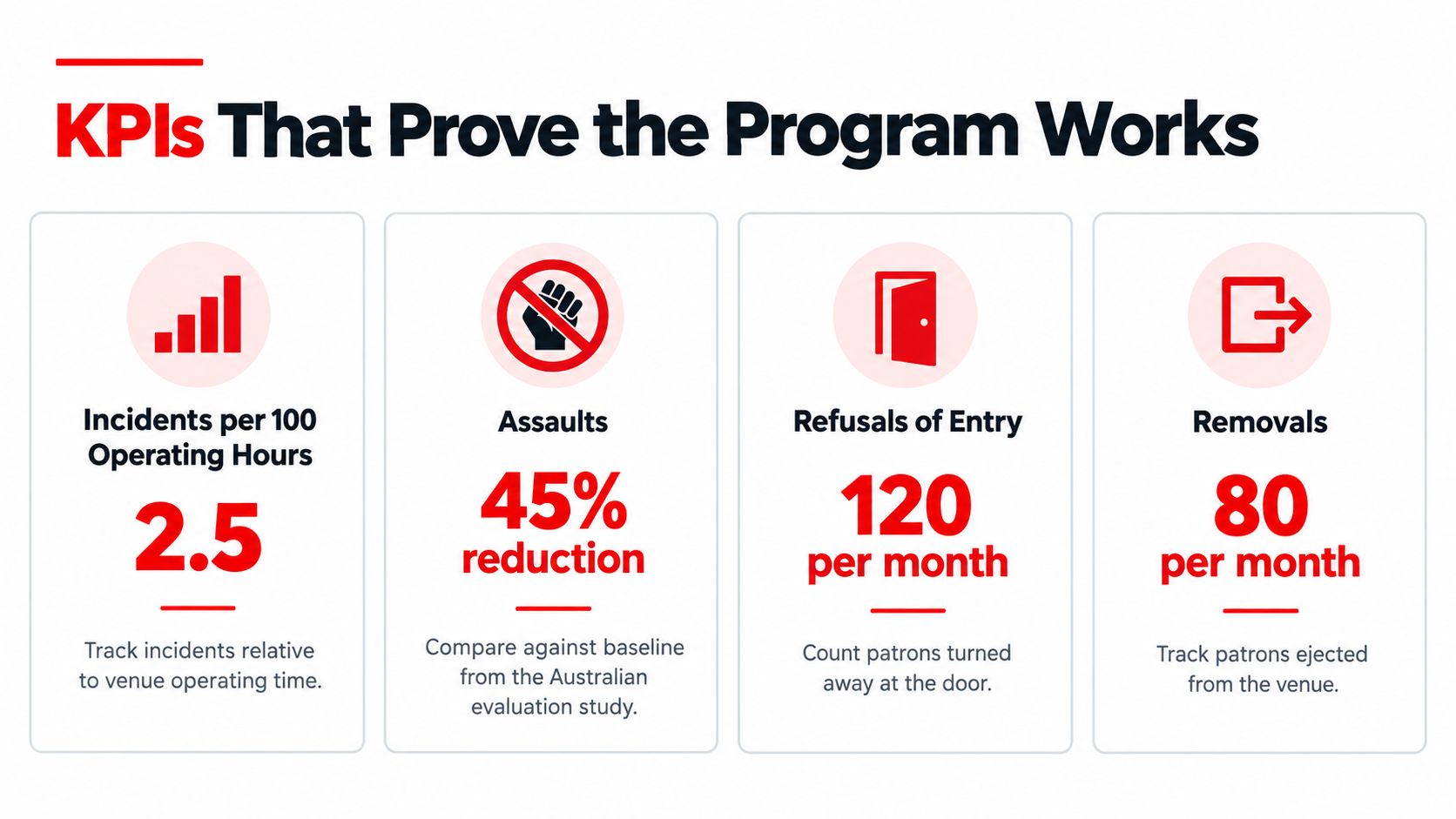
| Measure | What to Record | What to Ask |
|---|---|---|
| Assaults and aggression | Behaviour, location, time and severity | Did harm decrease, or did reporting change? |
| Refusals of entry | Reason, decision-maker and circumstances | Were decisions consistent and justified? |
| Removals | Trigger, intervention and outcome | Could an earlier welfare response have helped? |
| Medical events | Assistance requested and handover | Were help and access available promptly? |
| Patron complaints | Concern, evidence reviewed and resolution | Did staff apply controls fairly? |
| Control failures | Uncovered posts, blocked routes or missed checks | Which part of the operating model needs repair? |
To normalise incident counts, divide incidents by the relevant operating hours and express the result on a consistent reporting basis. The historical study used observation-hours, so don't label your venue's ordinary operating-hour figures as directly equivalent research measurements.
Test a new entry-screening process
Suppose a venue introduces clearer queue signage and a revised screening process. Define what success would look like before reviewing the results: fewer queue disputes, consistent refusal decisions and no deterioration in other safety indicators.
The first quarterly report should explain what changed and compare like-for-like trading periods. Include attendance context, event type, opening patterns, incident definitions and any reporting changes that could affect interpretation.
- Describe the intervention: Record when the revised process began and what staff were trained to do differently.
- Compare outcomes: Examine aggression, injuries and complaints alongside refusals and removals.
- Inspect the mechanism: Check whether staff used the revised process.
- Record the decision: Retain, adjust or discontinue the change, with reasons and an accountable owner.
Don't invent a performance improvement because the new process feels smoother. A fall in recorded incidents could reflect reduced attendance, incomplete reports or changed definitions.
The manager's strongest report is candid about uncertainty. Show what the evidence supports, explain what it doesn't, and identify the next action.
Balancing Enforcement With Patron Experience
More visible enforcement isn't automatically a better operating model. A venue can look heavily guarded while staff miss vulnerable patrons, apply inconsistent entry decisions or allow service-related problems to develop.
The customer-experience stakes are substantial: 42% of Australian adults reported alcohol-related harm from a stranger in 2021, including feeling unsafe, being threatened or being affected by another person's behaviour (Alcohol and Drug Foundation analysis of harm to others). For a venue security manager, that means assessing the experience of people around an incident, not only the person drawing attention.
Distinguish welfare from enforcement
Consider a patron who appears confused and unsteady. An immediate removal decision might overlook illness, injury or another welfare concern; leaving the person unsupported could also be unsafe.
Staff should assess observable behaviour, seek appropriate assistance and involve venue management or medical support as circumstances require. Security shouldn't diagnose a medical condition, but it shouldn't assume every unusual presentation is deliberate misconduct either.
Contrast that with a patron making credible threats towards another person. A welfare-first approach doesn't mean delaying protective action when someone faces immediate danger.
Good customer service isn't permission to ignore risk. Firm intervention isn't permission to abandon dignity.
A useful decision pathway gives staff options without forcing every incident through every stage:
- Observation: Monitor concerning behaviour and establish what is happening.
- Approach: Introduce yourself, explain the concern and listen.
- De-escalation: Reduce the audience, offer reasonable choices and coordinate with RSA staff.
- Removal: Follow lawful authority, venue procedures and a proportionate response when continued presence is unsafe or impermissible.
- Emergency or police handover: Escalate according to urgency, the circumstances and the venue's procedures.
The pathway isn't a ladder staff must climb slowly. Immediate danger may require immediate escalation.
Review the decision, not just the outcome
A removal that ends without injury can still reveal poor communication or an avoidable escalation. Equally, a patron complaint doesn't automatically establish that a refusal was wrong.
Review the evidence: what staff observed, what they said, what options were offered and whether the response matched the behaviour. Record the patron's account where practical, rather than treating the security report as the only relevant perspective.
Security also needs a functioning relationship with alcohol-service staff. Guards shouldn't become a substitute for responsible service decisions, and bar staff shouldn't be left to manage threatening behaviour without support.
For the venue security manager, calibration is the skill: intervene early enough to prevent harm, but avoid turning uncertainty into automatic confrontation. Consistent explanations, respectful language and clear boundaries are compatible with decisive protection.
Practical Checklist and Frequently Asked Questions
Large deployments make accountability visible, but the same discipline matters at smaller venues. A 2026 NSW festival planning example anticipated more than 250 guards, supported by an event security manager, zone supervisors and administrative staff, illustrating the scale a manager may need to coordinate (NSW event safety and security guidance).
The practical lesson isn't to build a large hierarchy everywhere. It's to ensure every important check has an owner and evidence of completion.
Venue Security Manager Pre-Event Readiness Checklist
| Step | Owner | Verified By |
|---|---|---|
| Confirm applicable conditions and approved operating arrangements | Licence representative | Current conditions and event documents |
| Approve the risk controls and deployment | Venue security manager | Signed plan and site walk-through |
| Check credentials and role restrictions | Credential checker | Verified personnel register |
| Confirm required RSA evidence | Venue management | Training records matched to duties |
| Reconcile staffing with expected occupancy | Security manager | Deployment calculation and relief plan |
| Complete the site-specific briefing | Shift supervisor | Attendance and briefing record |
| Check communications and escalation contacts | Communications lead | Radio test and contact confirmation |
| Record live substitutions and handovers | Zone supervisor | Updated roster and handover log |
| Review incidents and outstanding actions | Operations lead | Debrief and corrective-action register |
During trading, concentrate on changes: occupancy, queue pressure, unavailable personnel, altered access and emerging welfare concerns. At close, keep responsibility explicit until the required coverage and handover obligations are complete.
How does the role differ from a supervisor?
A supervisor directs the assigned team in real time. The venue security manager is accountable for the operating arrangements behind that team, including planning, resourcing and review. If someone performs both jobs, allocate time for management work rather than assuming it will happen between incidents.
What licensing does the manager need?
Check the security activities the person will perform and the jurisdiction where they'll work. A management title isn't a substitute for the appropriate licence, and a worker's credentials don't automatically establish that the provider or deployment arrangement meets every requirement.
How should KPIs be reported?
Use a stable incident taxonomy, explain the reporting period and distinguish activity from harm. Give the client the operational decision behind each significant finding, not just a dashboard of totals.
How do you manage operations across states?
Keep a common operating framework with separate jurisdictional schedules. Assign someone to verify current requirements before each deployment, maintain version control and record who approved changes.
Your most useful immediate action is to test the checklist against the next event. Any item without an owner or a verification record is a gap to resolve before doors open.
For venue and event security support, GM GROUP Services offers licensed personnel, risk assessments, site supervision and incident reporting across NSW, Victoria, Queensland and the ACT. Visit the team to discuss your venue layout, trading conditions and patron profile, and ask how a customised deployment can support documented compliance and a welcoming patron experience.