


Two-way radio communication is usually the last thing an event manager sets up and the first thing that gets blamed when an incident goes sideways. You've locked in the venue, approved the run sheet, briefed suppliers, and booked guards. Then bump-in starts, the crowd builds, and someone asks a basic question that should've been answered weeks earlier: what's the channel plan, who's on command, and what happens when mobiles drop out?
That problem shows up at festivals, pubs, clubs, hotels, retail centres, and construction sites alike. The difference between a smooth operation and a messy one often comes down to whether your team can talk instantly, clearly, and on the right channel without relying on public networks.
In Australia, a good radio setup isn't just about buying handsets. It means choosing fit-for-purpose hardware, using the right frequencies, keeping communications compliant with ACMA requirements, and training staff so they don't block the channel when something urgent happens. If you're building a system from scratch, this is the practical version of how to do it properly.
Why Mobile Phones Fail at Critical Moments
A peak-time festival incident exposes the weakness of mobile-first security plans fast. One patron goes down near the bar queue. A static guard tries calling the supervisor. The call doesn't connect. Another team member sends a text. It sits unread. Meanwhile, medical, gate, and crowd control are all working off partial information.
That's why professional two-way radio communication remains the safer operating model for live events. It's immediate, it doesn't require dialling, and one transmission can alert an entire team at once.
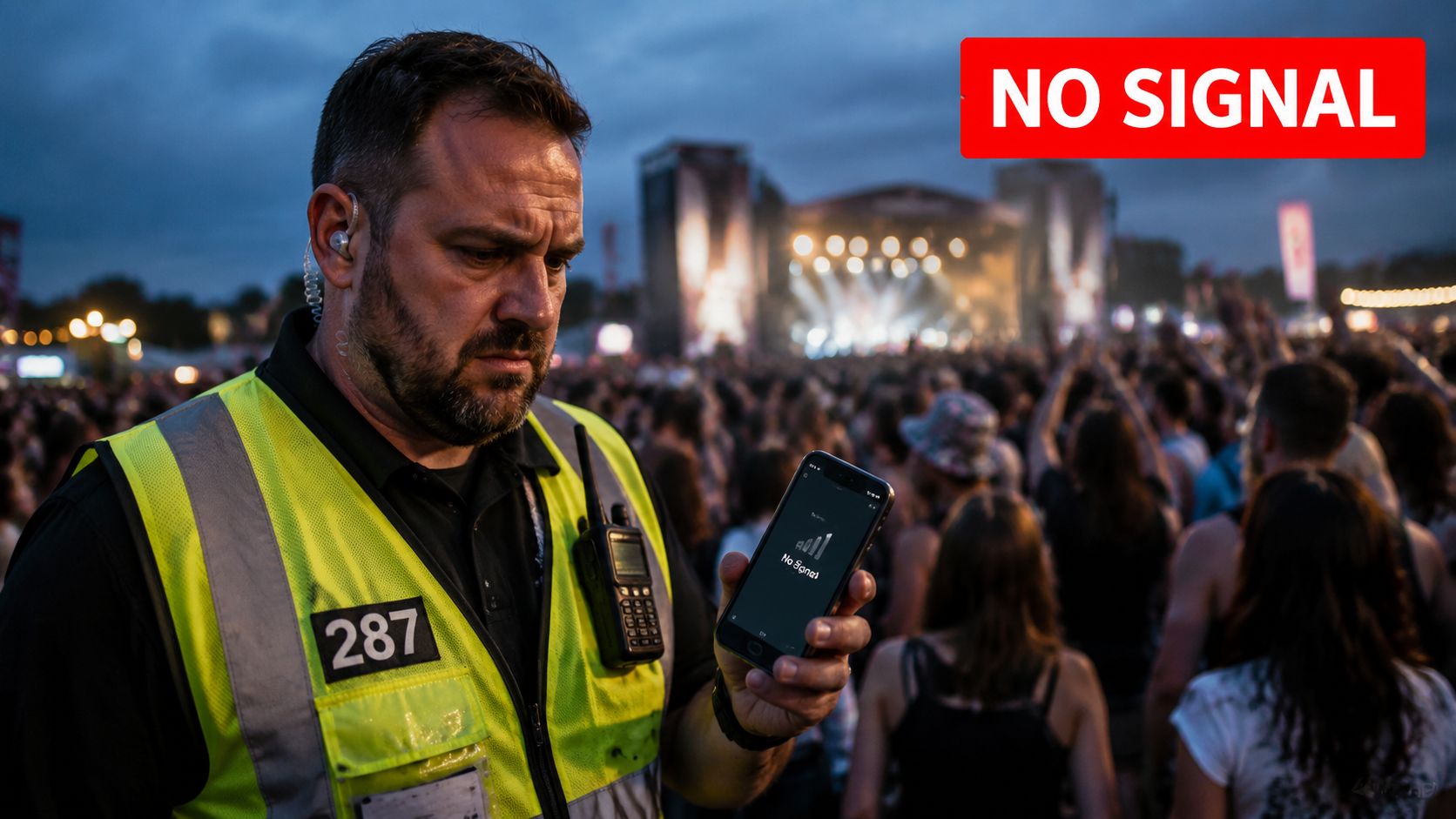

At Australian events and festivals, two-way radio communication can reduce response times by up to 60% compared to mobile phone-based systems, and security teams at the Sydney Festival reported a 45% faster incident resolution rate according to GM GROUP Services event communication guidance.
What usually goes wrong with phones
Mobile phones are fine for admin traffic. They're weak for operational control in crowded environments.
- Network congestion: Thousands of patrons hit the same towers at once.
- Call setup delay: Even when signal is present, you still need to access the device, dial, and wait.
- One-to-one limitation: A phone call reaches one person. Security operations often need one-to-many updates.
- Poor discipline: Staff tend to over-explain on calls when a short broadcast would do.
Practical rule: Use phones for follow-up, reporting, and non-urgent liaison. Use radios for active operations, incident response, and command.
Why radios hold up better
A radio gives your team a shared operating picture. If a supervisor calls for medical to Stage B, nearby guards, roaming patrols, and command all hear the same instruction at the same time. That matters when you're coordinating entry queues, VIP movement, intoxication management, and emergency access.
In real operations, the benefit isn't just speed. It's control. A disciplined radio network stops the “who already knows?” problem that slows down decisions and causes duplicate deployment.
If you're running security in NSW, VIC, QLD, or the ACT, that kind of clarity also supports cleaner incident handling under venue procedures and state-based obligations around supervision and response.
Selecting Your Two-Way Radio Communication Hardware
Most radio problems start before the first transmission. They start when a venue buys generic handsets without thinking about noise levels, building layout, shift length, or whether the team needs private channels, earpieces, or indoor location visibility.
The right two-way radio communication hardware depends on where your people work and how they move.
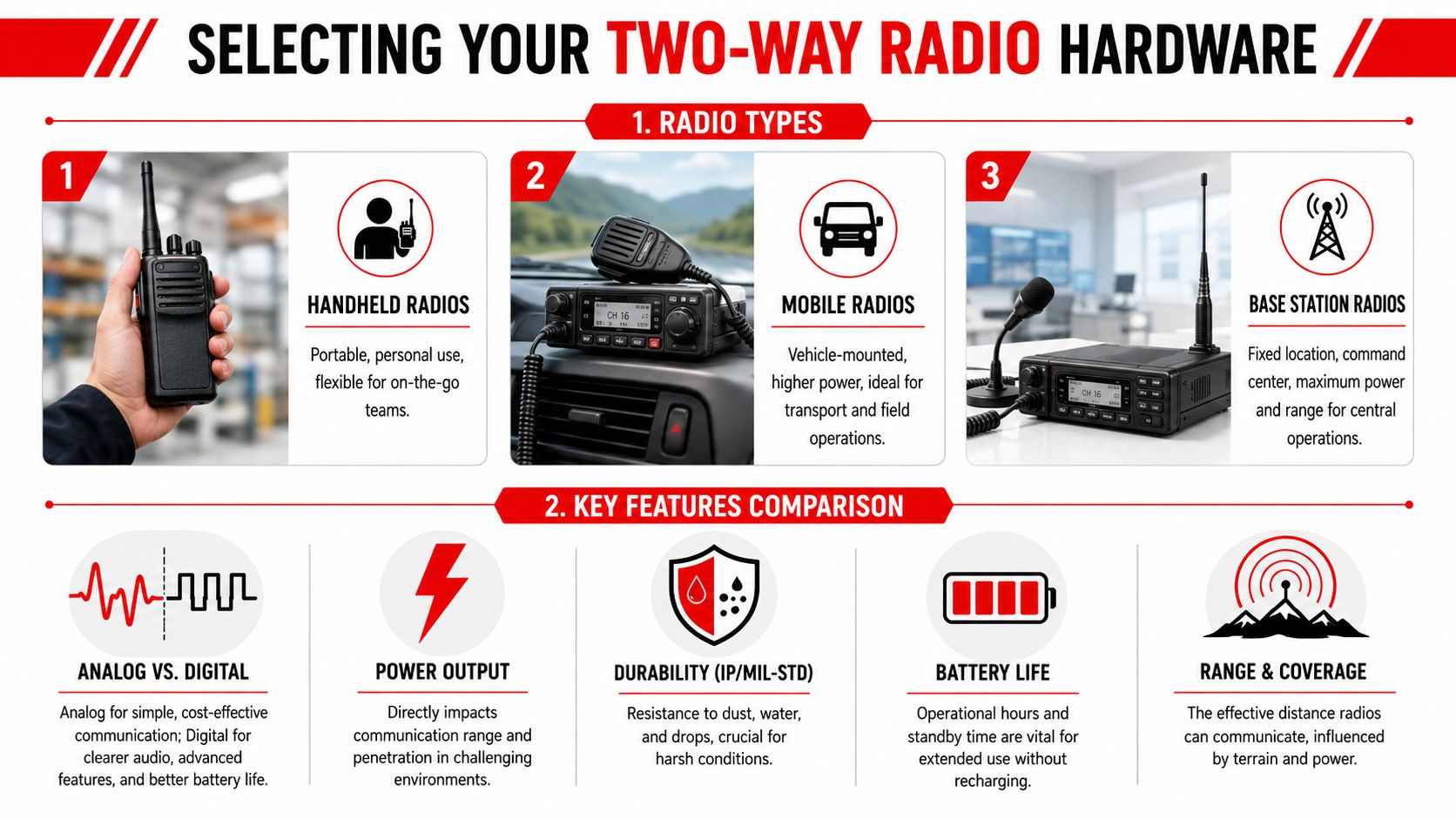
Start with the radio type
You don't need the same device for every role.
| Radio type | Best use | Typical placement |
|---|---|---|
| Handheld radios | Patrols, static guards, supervisors, RSA floor teams | On person |
| Mobile radios | Vehicle patrols, transport control, perimeter movements | In vehicles |
| Base station radios | Control room, gatehouse, operations desk | Fixed command point |
A music festival usually needs all three. Handhelds cover field staff, a base station anchors command, and mobile units suit patrol vehicles or outer-perimeter response.
Digital or analogue
For most event and venue work, I'd choose digital radios unless there's a specific legacy reason not to.
Analogue still works for simple, low-complexity jobs. It's familiar and can be cost-effective. The trade-off is fewer features and less flexibility for larger operations.
Digital hardware is stronger where security teams need clearer audio, better channel management, privacy features, text capability, or location-aware workflows. That matters in clubs, shopping centres, exhibition halls, and multi-zone events where several teams need separation without losing command oversight.
Buy hardware for the noisiest, busiest part of the site, not the quietest.
VHF or UHF
This decision should match the environment.
VHF for open ground
VHF is usually the better fit for open-air spaces such as festival fields, car parks, agricultural events, and some construction sites. If your team is spread across open terrain with fewer structural barriers, VHF often performs more predictably.
UHF for built environments
UHF is generally the stronger option inside hotels, bars, clubs, retail centres, and multi-level venues where walls, plant rooms, loading docks, and concrete interfere with clean signal paths.
If you're securing a hotel with lifts, back-of-house corridors, and function rooms across multiple floors, start with UHF. If you're covering a large paddock event with gate lanes and vehicle access tracks, test VHF first.
Features that are worth paying for
Don't get distracted by marketing extras. Focus on operational value.
- Earpiece compatibility: Essential for crowd work, VIP protection, and front-of-house roles where open speaker audio isn't appropriate.
- Durability rating: Dust, rain, drops, and rough handling are standard on event and construction sites.
- Battery endurance: Your radios need to last the full shift with margin, especially for double-header events.
- Emergency button options: Useful for lone or exposed roles.
- Repeater compatibility: Important on large or obstructed sites.
- Indoor positioning capability: Valuable in larger venues.
Modern systems can also support Integrated Positioning System functionality using Bluetooth beacons, and in Melbourne hospitality venues this approach reduced incident response times by 50% with guard location visibility down to 2-metre accuracy, as noted in the verified GM GROUP Services source already referenced earlier.
A practical hardware mix
For a standard metropolitan event, a workable baseline usually looks like this:
- Command: Base station radio with external antenna
- Supervisors: Higher-tier handhelds with earpieces
- General guards: Durable handhelds with simple channel layout
- Vehicle patrol: Mobile radio with stronger output
- Medical and specialist teams: Dedicated handhelds on separate talkgroups
What doesn't work is buying one radio model, one accessory set, and expecting it to suit gate staff, rovers, VIP, K9, and control room equally well. Good systems are matched to role.
Navigating Australian Frequency Licensing with ACMA
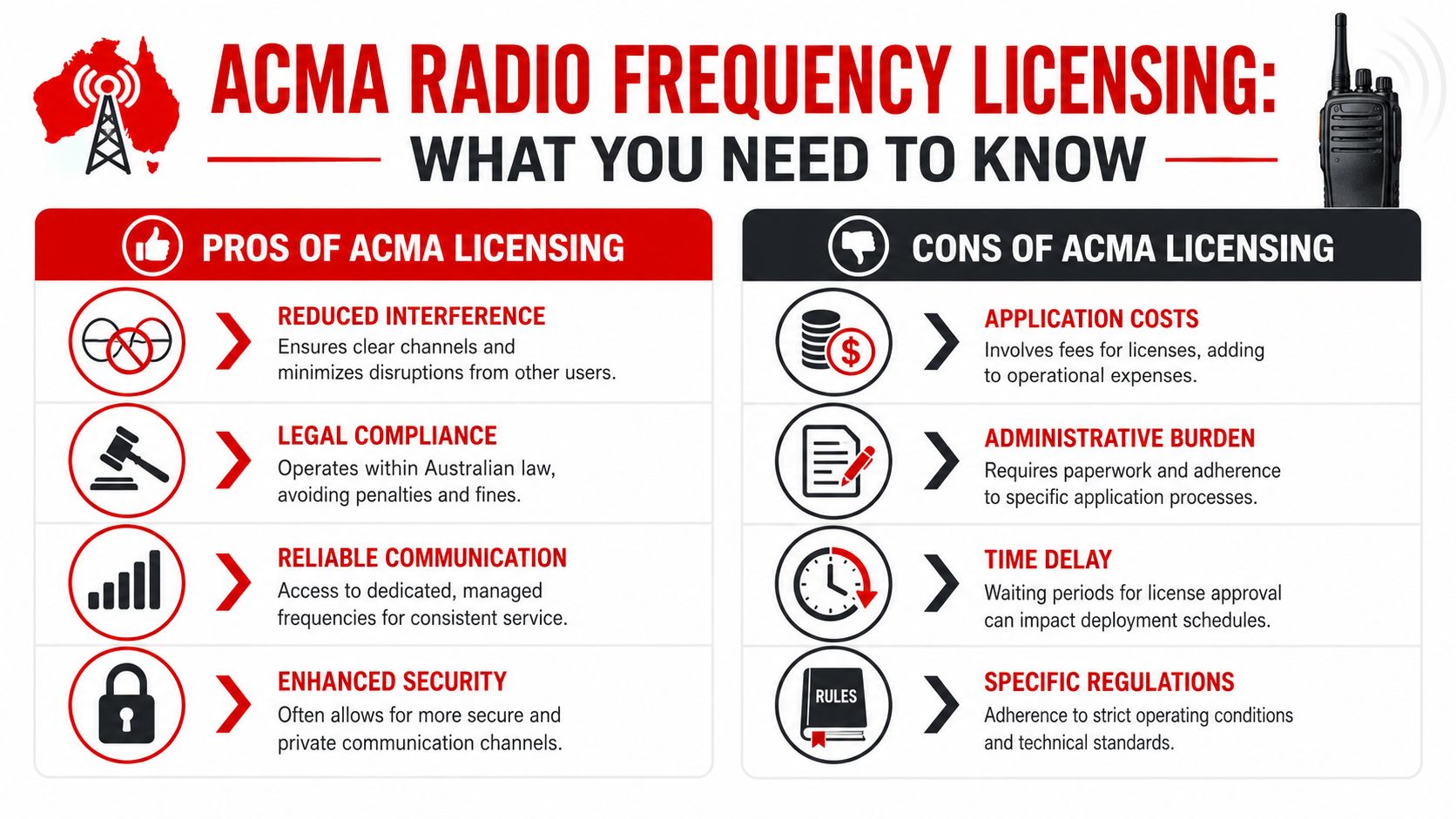
A professional radio network sits inside a legal framework. In Australia, that means treating frequency use as an operational compliance issue, not just a technical one. If you put security teams onto whatever public channel seems convenient, you're accepting interference, weak privacy, and a higher chance of missed traffic when the site gets busy.
That's where ACMA matters. The authority oversees the radio spectrum, and for security work the main practical question is simple: are you using a public-access channel, or a licensed private frequency that suits the risk profile of the job?
Public channels versus private licensed channels
Public or class-licensed options can be acceptable for low-risk, low-density activity. They're not where I'd place event security, crowd control, VIP protection, or sensitive incident response.
The risk is channel saturation. During peak festival periods, public channels can become overloaded, causing a 25% increase in message loss, while licensed private channels reduce unauthorised monitoring to less than 0.1%, based on the verified ACMA-related data cited by the earlier GM GROUP Services source.
That operational difference is why private channels are usually the right call for serious event work.
What licensing changes in practice
A licensed setup gives you more than compliance paperwork. It gives you cleaner operations.
- Reduced interference: Less chance of another user stepping on active traffic.
- Better privacy: Important for patron removals, medical incidents, and VIP movement.
- More predictable channel planning: Easier to assign command, sector, and specialist talkgroups.
- Stronger platform for encryption-capable equipment: Useful where discretion matters.
If you're also planning site Wi-Fi, cashless terminals, streaming infrastructure, or temporary networking for an event village, it helps to understand how different wireless systems can crowd each other operationally. A useful companion read is 2026 Wi-Fi frequency insights, which gives non-radio specialists a clearer view of spectrum pressure in busy environments.
A private radio channel won't fix poor procedures, but poor procedures are much easier to fix on a clean channel than on a noisy public one.
A sensible approval workflow
Managers often overcomplicate licensing. Keep it practical.
- Define the site footprint. Indoor, outdoor, multi-level, remote, or mixed.
- List the user groups. Security, medical, logistics, production, transport.
- Separate sensitive traffic. Command and VIP operations shouldn't share with general chatter.
- Match hardware to the planned frequency use.
- Document who controls programming and issue.
What doesn't work is leaving radios in default programming from a prior job. That's how teams end up on the wrong channel set, with no privacy and no clear escalation path.
Designing a Strategic Channel and Talkgroup Plan
A strong two-way radio communication system isn't one big conversation. It's a controlled set of conversations with a clear hierarchy. If everyone shares one busy channel, command gets buried under routine updates, medical traffic competes with gate issues, and supervisors start missing important calls.
The easiest way to think about channel planning is like traffic management inside the venue. You need major roads, side streets, and emergency lanes.
Build around functions, not personalities
Don't assign channels based on who's loudest or most senior on the day. Assign them based on job function.
A typical event structure often needs:
- Command channel: For operations manager, security manager, and control
- Security sectors: Split by zone so each area can work without clogging command
- Medical channel: Dedicated path for patient response and welfare coordination
- Logistics channel: For access, stock, barricades, waste, and contractor movement
That structure keeps routine traffic where it belongs and protects the command layer for decisions that affect the whole site.
Sample Festival Communication Plan
| Channel Number | Talkgroup Name | Assigned Team(s) | Primary Use |
|---|---|---|---|
| 1 | Command | Event control, security manager, duty manager | Critical decisions, escalations, whole-site direction |
| 2 | Security North | Static guards, rovers, supervisor for northern zone | Patron management, entry issues, local incidents |
| 3 | Security South | Static guards, rovers, supervisor for southern zone | Crowd movement, removals, queue control |
| 4 | Medical | First aid, response team, command liaison | Medical calls, welfare response, ambulance access |
| 5 | Logistics | Site ops, cleaners, production runner, gate support | Deliveries, equipment movement, facilities issues |
| 6 | VIP and Escort | Close protection, escort staff, command | Discreet movement and controlled access |
| 7 | Overflow | Spare or contingency team | Backup traffic during incidents |
This is a starting point, not a template to copy blindly. A nightclub with one entry and several internal floors needs a tighter structure. A regional festival with camping, car parks, and shuttle zones needs more separation.
What works on busy sites
The best channel plans do three things well.
First, they keep command sparse. If a guard can solve an issue inside their own sector, they should. Command shouldn't hear every minor refusal at a bar line.
Second, they define who may jump channels. Supervisors, control, and selected leads usually need scan or dual-watch capability. General staff usually don't.
Third, they set an escalation path. A static guard reports to sector. Sector escalates to command if thresholds are met. Medical gets patched in when required. That prevents six people calling the same incident from different positions.
If your command channel sounds busy all night, the plan is wrong or the discipline is weak.
Common mistakes in talkgroup design
- Too few channels: Everyone crowds one talk path.
- Too many channels: Staff get lost and miss calls.
- No specialist separation: Medical and logistics drown each other out.
- No fallback channel: There's nowhere to move if a talkgroup becomes unusable.
For most venues, simplicity beats cleverness. Staff should be able to remember the layout under pressure. If they need a printed legend every time they change channel, the system is too complicated.
Implementing Radio Etiquette and Standard Procedures
Good hardware on a clean frequency still fails if the users talk badly. Most radio breakdowns aren't technical. They're human. People ramble, interrupt, forget call signs, or hold the transmit button too long and block the reply.
That's why two-way radio communication needs standard operating procedures, not just issued devices.
The core PTT rule
Every operator should follow the same sequence: press, pause, speak, release.
The pause matters because some radios clip the first word if the speaker starts too fast. The release matters because the other side can't answer while you're still transmitting.
A common problem is PTT holdover, where users don't release the button straight after speaking. That causes a 15 to 20% delay in critical voice relay, while teams that follow a release-and-listen protocol reduce emergency response latency by 35% according to the verified GM GROUP Services source already cited earlier.
Keep transmissions short and structured
A useful event format is:
- Call sign of who you want
- Your call sign
- Location
- Issue
- Action needed
Example: “Command, this is South Two at Gate C. One intoxicated refusal becoming argumentative. Require supervisor attendance.”
That's better than a long, emotional explanation with no location and no request.
Practical prowords your team should use
You don't need military theatre. You need plain, repeatable language.
- Roger means message received.
- Copy means understood.
- Stand by means wait.
- Say again means repeat the message.
- Go ahead means transmit your message.
- Negative means no.
- Affirm means yes.
Avoid slang that changes from team to team. If one supervisor says “received”, another says “yeah”, and another says “all good”, your radio standard isn't standard.
Clear radio traffic sounds slightly formal on purpose. Structure beats personality when the site is loud.
Set call signs before the shift starts
Use call signs by function and zone, not by first name.
| Role | Better call sign example |
|---|---|
| Security manager | Command |
| North zone supervisor | North One |
| Patrol guard in south zone | South Two |
| Gate lead | Gate One |
| Medical lead | Medical One |
What doesn't work is having three staff called “mate” and two more called “bro” on the same channel. During an incident, ambiguity wastes time.
Non-negotiable etiquette rules
- Listen before transmitting
- Don't interrupt active priority traffic
- Move extended problem-solving off the command channel
- Repeat critical locations clearly
- Acknowledge instructions promptly
If your operation includes RSA enforcement, patron removals, or VIP movement, disciplined radio procedure supports cleaner reporting and supervision later.
Creating Your Team Training Checklist
Training is where the radio plan becomes usable. You can have good hardware, legal frequencies, and a neat channel chart, but if the team hasn't practised with the actual devices on the actual site, the first live incident becomes the training session. That's too late.
In NSW, VIC, QLD, and the ACT, over 78% of licensed security guards use two-way radios as their primary communication tool, which is why standardised training matters for both rapid response and regulatory consistency according to industry adoption data on radio use in Australia.
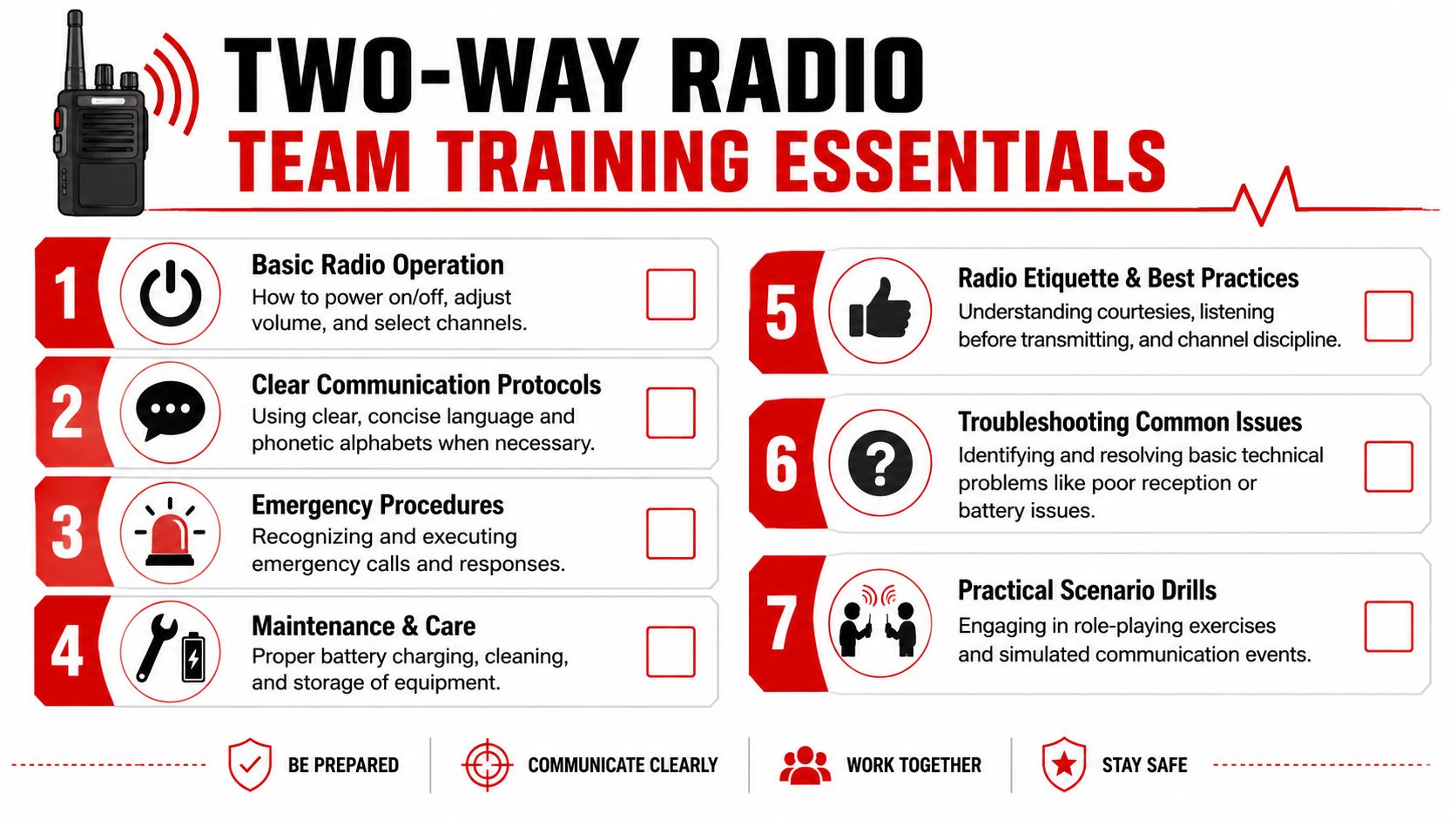
Pre-event training checklist
Run this before doors, not after the first issue.
Basic radio operation
Confirm power on, volume, channel selection, lock status, and accessory fit.Call sign allocation
Every staff member should know their own call sign, their supervisor's call sign, and the command channel.Radio check procedure
Do a live check from each operating zone, including problem spots such as loading docks, stairwells, and external queue lines.Emergency traffic wording
Staff should know how to report medical, fire, aggression, unauthorised access, and evacuation-related issues.Channel discipline
Reinforce when to stay on sector, when to escalate, and who may move to command.Battery and spare control
Confirm issued battery status and who holds spares.Scenario drills
Rehearse one medical job, one patron removal, and one lost-child or welfare scenario.
What to test during the briefing
Use short live drills, not just verbal explanation.
Ask one guard to report an intoxication refusal from a bar line. Ask another to call in a slipped patron in a toilet corridor. Then correct wording, pacing, and channel use on the spot. Staff remember practical corrections much better than lecture-style briefings.
A final point. Training should include the venue client or duty manager where relevant. Security, operations, and venue leadership need the same language for escalation, otherwise the radio network stays technically sound but operationally fragmented.
Frequently Asked Questions About Two-Way Radios
How do I extend coverage across a large site?
Use a repeater-capable setup and test the site before go-live. Repeaters are especially useful on large, obstructed, or spread-out venues where line of sight becomes an issue. They're a planning item, not a last-minute fix.
Are licensed channels private?
They're more secure than public channels, especially when paired with suitable equipment and proper programming. They're the better choice for sensitive operational traffic, VIP movement, and incident coordination.
Can radios work with phones or other systems?
Many modern systems support voice and text features, and some models can interface with phone-based workflows. The practical question isn't whether integration exists. It's whether you need it for the site.
Will batteries last a long event shift?
That depends on the handset, battery condition, accessory load, and how much the team transmits. For long events, issue fully charged units, hold labelled spares at control, and nominate who swaps batteries during the shift.
Should every team share one channel?
No. Command, sector security, medical, and logistics should usually have separation. One shared channel becomes noisy fast and makes serious traffic easier to miss.
If you need help building a compliant, site-specific radio plan for an event, venue, or security operation, GM GROUP Services can help assess your risks, structure your communications workflow, and align deployment with real operational conditions across NSW, VIC, QLD, and the ACT.