

Static security officers are often the first thing that comes to mind when you think of security—a professional assigned to one specific location to provide a constant, visible security presence. Unlike mobile patrols that cover multiple sites, a static officer becomes an integral part of your environment. They are your dedicated first line of defence, whether that's protecting a corporate lobby, a bustling construction site, or the front gate of a major event. This guide provides actionable insights into their critical role.
Understanding the Core Role of Static Security Officers
At its heart, the role of a static security officer is all about proactive deterrence and immediate response. Let’s be honest, the sight of a professional, uniformed officer is often the most powerful tool for discouraging theft, vandalism, or unauthorised access. Think of them as a dedicated goalkeeper for your business—always in position and ready to act instantly to protect your property, your people, and your reputation.
Because they are always on-site, these officers develop an intimate knowledge of the daily rhythms of your location. They get to know the regulars, understand the normal flow of traffic, and can spot something—or someone—out of place in a heartbeat. This deep familiarity is the secret sauce to maintaining a secure and orderly environment. For instance, an officer at a residential complex quickly learns which cars belong to residents and can instantly identify a suspicious vehicle, preventing a potential break-in before it happens.
More Than Just a Uniformed Presence
While their presence is a powerful deterrent, the job of a static security officer goes way beyond just standing guard. They are actively involved in the safety and operational flow of your site. The exact responsibilities are always shaped by the location’s specific needs, but they almost always involve a mix of key duties.
For example, an officer stationed in a corporate high-rise isn't just watching the door. They’re managing access control, verifying IDs, issuing visitor passes, and often acting as a professional first point of contact. This is an actionable step in corporate security, turning a guard into a customer service ambassador. On the other hand, an officer at a noisy construction site is focused on something entirely different: logging heavy vehicle movements, ensuring safety protocols are followed, and protecting millions of dollars in equipment from theft after hours.
The true value of a static officer lies in their integration into your daily operations. They transition from being just a security measure to becoming a fundamental part of a safe, efficient, and welcoming environment.
The Direct Benefits of a Dedicated Officer
Putting a dedicated officer on your site brings clear, tangible benefits that you can see in your operational stability and even your bottom line. By stopping incidents before they escalate, these professionals cut down on costs tied to theft, property damage, and potential liability claims.
To give you a clearer picture, here's a quick summary of what a static security officer brings to the table.
Static Security At A Glance
| Key Function | What It Means | Direct Business Benefit |
|---|---|---|
| Deterrence | Maintaining a constant, visible presence to discourage potential offenders. | Reduces incidents of theft, vandalism, and trespassing, saving on repair and replacement costs. |
| Access Control | Managing all entry and exit points for people and vehicles. | Prevents unauthorised individuals from entering restricted areas, protecting sensitive information and assets. |
| Immediate Response | Being on-site to act swiftly during a security breach, conflict, or medical emergency. | Minimises harm and disruption, ensuring a faster return to normal operations and reducing potential liability. |
| Site Ambassador | Serving as a professional point of contact for staff, visitors, and contractors. | Creates a positive and secure first impression, enhancing the customer and employee experience. |
Ultimately, having skilled static security officers on deck fosters a sense of safety and order. This lets you and your team get on with your core business, knowing a vigilant professional is focused solely on keeping your site secure.
The Proactive Role of Static Security Officers
Think of a static security officer, and you might picture someone simply standing watch at a door. The reality is a world away from that. Today’s professional static officer is an active risk manager, a dynamic presence whose job is to keep your environment safe and stable. Their effectiveness isn’t about just being there; it’s about a constant, proactive cycle of observation, engagement, and reporting to stop issues before they even start.
Real security is about prevention, not just reaction. Take a construction site, for instance. An officer there isn’t just guarding a gate. They’re meticulously verifying credentials for every single person who enters, logging vehicle movements to prevent theft, and making sure crucial safety rules—like wearing the right personal protective equipment (PPE)—are followed. It’s a hands-on role that makes the entire worksite safer and more compliant.
Or consider a high-end retail store. Here, the officer expertly blends loss prevention with a concierge-style service. Their visible presence is enough to deter most shoplifters, but their welcoming and helpful attitude also elevates the customer experience. Suddenly, the security role becomes part of the brand itself.
The Day-to-Day of a Modern Static Security Officer
So, what does a static security officer actually do all day? While the specifics change from site to site, their duties are designed to create layers of protection around your operations. These core tasks show how an officer becomes a vital part of your team, not just a contractor.
- Systematic Patrols and Inspections: Officers don't just stay put. They conduct both scheduled and random patrols on foot, actively looking for vulnerabilities like an unlocked door, a broken fence, or a blind spot in your CCTV coverage.
- Active Monitoring: They’re the eyes on your CCTV feeds, watching in real-time for suspicious behaviour or safety risks. This means they can respond instantly, rather than just reviewing footage after something has already gone wrong.
- Access and Egress Control: Managing the flow of people is fundamental. This involves everything from checking appointments and issuing visitor badges to ensuring only authorised staff can enter sensitive areas.
- Incident Reporting and Logging: Every patrol, observation, and incident is carefully logged. This creates a detailed, accurate record that’s absolutely essential for any future investigation or legal follow-up.
- Emergency Response Coordination: As the first person on the scene, they are trained to take control during an emergency. Whether it's a medical issue or a fire alarm, they coordinate with emergency services and ensure everyone evacuates safely.
From Passive Observer to Active Guardian
The role of a static security officer has changed dramatically. They are no longer just passive observers but have become active contributors to the success of your business. Because they get to know the normal rhythm of your site so well, they can spot tiny anomalies that everyone else would miss—a strange vehicle, someone loitering near a restricted area—and deal with it immediately.
A proactive static officer doesn't wait for the alarm to sound. They are trained to spot the subtle signs that often precede a security breach, effectively stopping trouble in its tracks.
This evolution turns them into a central hub for safety and communication. Your staff knows exactly who to go to with a concern, and visitors have a clear, professional point of contact for help. By becoming part of the daily fabric of your business, a great static security officer is a trusted guardian who helps create a genuinely secure and productive atmosphere.
Choosing the Right Security Solution for Your Site
Static security officers deliver an incredible level of focused protection, but picking the right security setup isn’t a one-size-fits-all affair. The best choice always comes down to your site’s specific risks, its physical layout, and how you operate day-to-day. Get this wrong, and you could be left with serious security gaps or just burning cash for no good reason.
It really boils down to matching the type of security to your actual threat level and the area you need to cover. A single, high-risk spot—like a festival gate, a busy construction site, or a corporate lobby—demands a constant set of eyes and an immediate physical presence. That’s where a static security officer is unbeatable.
Mobile patrols, on the other hand, are built for a completely different job. They’re a smart, cost-effective way to cover a lot of ground where risks are lower, like an industrial park after hours or a strip of retail shops overnight. Their random and unpredictable visits create a powerful deterrent effect over a wide area.
Comparing Security Options For Your Business
To make a smart call, you need to see how each option stacks up in the real world. First, think about the nature of your risk. Is it a constant, concentrated threat, or is it spread out and only likely to happen now and then? That simple question is the first step in building a security plan that actually works.
This decision tree gives you a great visual for how to think through the process.
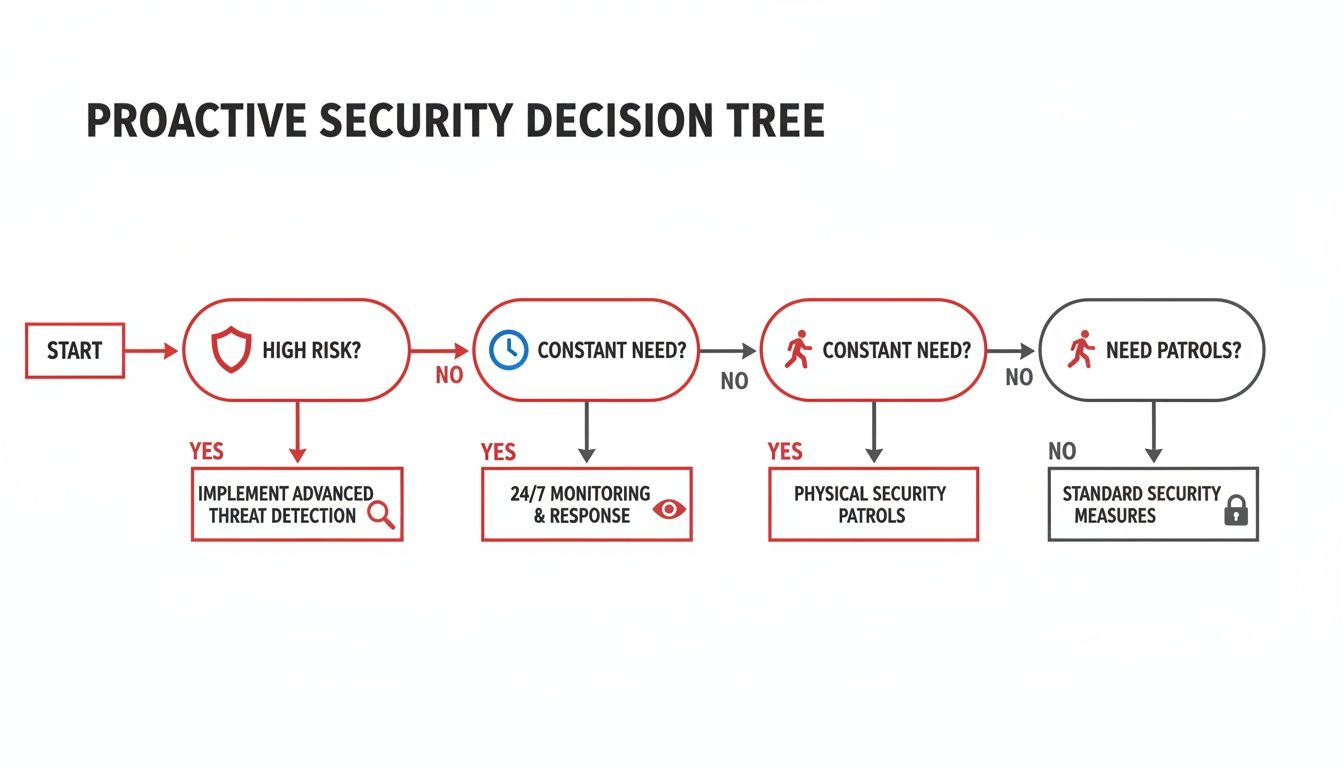

As you can see, for any site with high-value assets, constant foot traffic, or a known risk profile, the path logically leads to having static security officers on the ground.
To put it even more simply, here’s a table breaking down your main choices.
Comparing Security Options For Your Business
This table gives you a direct comparison to help you select the right security solution for your specific environment and risk profile.
| Security Type | Best For | Deterrence Level | Response Time | Typical Cost Structure |
|---|---|---|---|---|
| Static Security Officers | Single high-traffic or high-risk sites (events, venues, construction, corporate lobbies). | High (Constant visible presence). | Immediate (Already on-site). | Hourly rate per officer. |
| Mobile Patrols | Multiple sites over a large area (industrial parks, retail strips, gated communities). | Moderate (Random, periodic presence). | Delayed (Travel time to site required). | Per visit or monthly contract. |
| K9 Security Units | Crowd control, drug/explosive detection, large open areas, high-threat environments. | Very High (Psychological and physical). | Immediate (When deployed on-site). | Premium hourly rate. |
This comparison makes it clear that you're not just buying a service; you're investing in a specific outcome, whether that's immediate response or broad deterrence.
When Specialised Solutions Are Required
Sometimes, you need to bring in the heavy hitters. K9 units are a prime example, offering a specialised and high-impact solution that goes beyond what a person alone can do. They are an absolute game-changer for managing large crowds, detecting contraband, or securing vast open spaces against very specific threats.
And don’t forget technology. A modern security plan often layers human expertise with tech. For instance, looking into the best security camera systems for small business can add another powerful layer of oversight that complements your on-site team perfectly. When people and tech work together, the result is always stronger.
Ultimately, the most effective security strategy often layers different solutions. A business might use static security officers at its main headquarters, mobile patrols for its warehouses, and CCTV monitoring across all locations.
This kind of layered strategy is about being smart with your resources. You focus your most robust protection where the risks are highest, creating a security posture that is both tough and flexible enough to handle whatever comes your way.
Getting to Grips with Security Licensing and Compliance
Hiring a static security officer is a lot more involved than just putting someone in a uniform at your front door. Here in Australia, the security industry is heavily regulated, and for very good reason. An unlicensed or poorly trained officer isn't just a risk—they're a significant legal and financial liability for your business. Getting this wrong can lead to crippling fines and put your people, property, and reputation on the line.
Each state and territory has its own governing body and a strict rulebook that every security professional must live by. This isn't just bureaucratic red tape; it’s a framework built to ensure the person protecting your assets is competent, trustworthy, and ready to handle their duties with professionalism and safety. Think of it as a quality guarantee baked into the system.
For you, the client, this makes one thing crystal clear: partnering with a reputable security provider is non-negotiable. A compliant company like GM GROUP takes the burden off your shoulders, guaranteeing every officer on your site is fully licensed, insured, and trained up to the latest state laws. It’s about shielding your business from risk you shouldn’t have to carry.
The Must-Haves: Core Licensing for Static Security Officers
Before any static security officer can even think about starting a shift, they have to clear several non-negotiable hurdles. These are the absolute fundamentals of the profession across Australia, though the finer details can change a little from state to state.
The journey always starts with mandatory training. The industry benchmark is a Certificate II in Security Operations, which is where they learn the essential skills of the trade:
- Responding to security risks and threats.
- Controlling access to and from a property.
- Defusing conflict through smart negotiation.
- Running patrols and inspections methodically.
On top of the initial qualification, every single applicant has to go through a thorough criminal history check. This is a critical step to weed out anyone with disqualifying offences from holding a position of trust. And, of course, a current First Aid and CPR certificate is a legal must-have, making sure your officer can be a capable first responder if a medical emergency happens.
State Rules and Site-Specific Credentials
While those core requirements are universal, compliance gets much more specific when you drill down to the state and even the individual site level. Each jurisdiction has its own authority—like the Security Licensing & Enforcement Directorate (SLED) in NSW or Victoria Police's Licensing & Regulation Division—and they all have their own local rules to enforce.
In Australia, static security officers really are the backbone of private security. New South Wales has the largest share, with 27.0% of the country's 42,200 employed security officers, just ahead of Victoria (25.3%) and Queensland (18.9%). But here's the catch: even with nearly 150,000 licensed individuals nationwide in 2023, there was a 3.7% drop in licences from the previous year. This points to industry-wide shortages, pushing firms like GM GROUP to double down on first-class training and compliance to keep standards high. You can dig deeper into the security industry landscape in Australia to see the trends.
It doesn’t stop there. Often, officers need extra tickets just to work on certain types of sites. For example:
- Licensed Venues: An officer working the door at a pub, bar, or club must hold a valid Responsible Service of Alcohol (RSA) certificate.
- Construction Sites: Anyone setting foot on a construction site, security included, absolutely needs a "White Card" (the general construction induction training).
For static security officers, understanding and following compliance training best practices isn't just about ticking boxes. It's what ensures they're truly prepared for the unique challenges each different environment throws at them.
Partnering with a professional provider eliminates the compliance guesswork. It’s their job to make sure every officer has the right licences and site-specific qualifications, giving you complete peace of mind.
An Actionable Checklist for Hiring Static Security
Hiring the right static security officers is one of the most important calls you'll make to protect your business. Let's be frank: choosing the wrong provider doesn't just waste money. It can leave your assets, your people, and your reputation dangerously exposed. The only way to get it right is with a structured, methodical approach that ensures you partner with a security firm that actually gets what you need and has the horsepower to deliver.
To cut through the noise, we've put together a practical, four-step checklist. Following these steps will help you move from a place of uncertainty to one of confidence, making sure you select a security partner that’s a perfect fit for your specific world.


Think of this as your roadmap for making a well-informed decision, covering everything from figuring out what you need in the first place to the final handover.
Step 1: Define Your Exact Needs
Before you even think about picking up the phone, you have to get crystal clear on what you actually need protecting. Security isn't a one-size-fits-all service; it has to be precisely matched to your operational realities and risk profile. If your requirements are vague, you're guaranteed to get a mismatched solution.
Start by getting the specifics down on paper. This initial homework is easily the most critical part of the entire process.
- Operating Hours: When do you need boots on the ground? Are we talking 24/7 protection, or just during high-risk windows like overnight, weekends, or public holidays?
- Key Risks: What are you actually trying to prevent? Is it after-hours theft at a construction site? Unauthorised access at a corporate head office? Or maybe crowd control at a packed music festival? Be specific.
- Location Challenges: Every site has its weak spots. Think about poorly lit perimeters, multiple entry points that are hard to track, or public access routes that need careful, constant monitoring.
Step 2: Vet Provider Credentials
Once you know exactly what you’re looking for, it’s time to find a provider who can deliver. Not all security companies are created equal—not by a long shot. You have to rigorously check their credentials to make sure they are a legitimate, compliant, and reputable organisation.
This step is all about doing your due diligence. It's about protecting your business from any potential liability down the track.
Never just take credentials at face value. A truly professional provider will be transparent and have no problem showing you documentation to prove their compliance and experience. This is what separates the pretenders from the real partners in static security.
Make sure you ask for and verify these non-negotiables:
- Master Security Licence: Confirm the company holds a current master licence for the state you're in (e.g., NSW, VIC, QLD). This is the absolute baseline.
- Public Liability Insurance: Ensure they have adequate coverage—you should be looking for $20 million as a minimum—to protect you if an incident occurs.
- Industry Reputation: Do some digging. Check online reviews, ask for client testimonials, and look at case studies from businesses in the same boat as you.
Step 3: Assess Officer Suitability
The company might tick all the boxes, but it’s the specific static security officers assigned to your site who really matter on the day. The ideal officer for a quiet corporate lobby is a world away from the one you need on a noisy, bustling construction site. Look for a provider who genuinely demonstrates a "fit-for-purpose" approach, not just sending you the next person on their roster.
Get into the details of their process for selecting and training their people. You need to feel confident they’re matching the right skills to your environment. A few key questions to ask are:
- Do the officers have direct, hands-on experience in your industry (e.g., events, retail, construction)?
- What are their interpersonal and communication skills like? Remember, an officer is often the first and last person your clients or staff see—they're an ambassador for your brand.
- What ongoing training and performance checks do they have in place?
Step 4: Create a Comprehensive Brief
Finally, a successful security deployment all comes down to clear communication. A detailed brief, often called "post orders" in the industry, is essentially the instruction manual for your security team. It eliminates guesswork and ensures the officers know precisely what’s expected of them from the moment they clock on.
This document should be a joint effort between you and your security provider. It absolutely must include:
- Site Maps: Clearly mark out key areas, patrol routes, emergency exits, and any known trouble spots.
- Emergency Contacts: Create a clear list of all key site personnel, emergency services, and the security provider's 24/7 operations line.
- A Precise List of Duties: Don't leave anything to chance. Outline every single task, from logging visitors and conducting patrols to monitoring CCTV and responding to alarms.
By following this checklist, you can move forward with confidence, knowing you’re selecting a partner and deploying static security officers who will genuinely and effectively safeguard your business.
Frequently Asked Questions About Static Security Officers
Hiring a static security officer is a big decision, and it’s smart to have questions before you commit. Getting the right answers is the first step toward finding a security partner who genuinely protects your people and property. We get asked a lot of questions, so we’ve put together straight answers to the most common ones.
Let's dive into the details that matter most when you're considering professional security.
How Much Does a Static Security Officer Cost?
There's no simple, one-size-fits-all price tag for a static security officer. The cost really depends on a few key things: the risk level of your site, the specific jobs you need them to do, and when you need them. Nights, weekends, and public holidays naturally come at a higher rate. It makes sense that securing a high-value construction site with millions in equipment will have a different price point than monitoring a quiet corporate lobby during office hours.
A word of caution: be wary of quotes that seem too good to be true. While everyone has a budget, an unusually low price can be a red flag. It often means corners are being cut on critical things like proper insurance, comprehensive training, or state licensing. The aim shouldn't be to find the cheapest hourly rate, but to invest in a reliable service that delivers real protection and peace of mind. Any reputable provider will insist on a proper site assessment before giving you a tailored quote.
Can They Do More Than Just Stand at a Door?
Absolutely. The role of a modern static security officer has evolved way beyond the old-school image of someone just watching a door. They are a versatile asset, and their duties can be shaped to fit exactly what your business needs.
A professional static officer is a multi-skilled team member. They are trained to integrate seamlessly into your environment, adding value well beyond traditional security tasks.
Think of them as a flexible part of your team. Their responsibilities can easily be expanded to include:
- Concierge Duties: Creating a professional and welcoming first impression for all your visitors and staff.
- CCTV Monitoring: Not just having cameras, but having a trained professional actively watching them to spot and react to issues as they happen.
- Safety Patrols: Routinely walking the site to identify potential hazards, like fire risks or WHS breaches, before they become problems.
- Logistics Management: Keeping track of visitor logs, handling contractor sign-ins, and even managing vehicle movements on a busy site.
On a construction site, for instance, our officers often help with logistics and make sure crucial safety rules are followed. In a retail setting, they're trained in subtle loss prevention tactics while also making sure customers have a positive, safe experience.
What Happens If Our Regular Officer Is Sick?
Security has to be constant; a gap in coverage is a gap in your protection. Any professional security company worth its salt has a deep bench of fully trained, licensed officers who are ready to step in. This ensures your site is never left vulnerable.
If your assigned officer is unexpectedly unavailable, we deploy a replacement who is already familiar with your site's specific rules and procedures. Our 24/7 operations team handles this behind the scenes, so you won’t experience any disruption. This system guarantees your security posture remains solid, and your business keeps running smoothly.
Are Your Officers Trained for Medical Emergencies?
Yes, and this is completely non-negotiable. In Australia, every licensed security officer is legally required to hold a current first aid and CPR certificate. This training means they can act as a capable first responder in those crucial first minutes before paramedics arrive.
On top of that, many of our static security officers have advanced training to meet specific client needs, like Advanced First Aid or mental health first aid. When we first assess your site, we'll work with you to identify potential risks and can assign officers with the right skills to manage those situations effectively. It's all about making sure your people are in safe, capable hands at all times.
What's the difference between static security officers and mobile patrols?
The main difference is dedication and response time. A static security officer is permanently assigned to your site for their entire shift, providing a constant presence and immediate response. Mobile patrols, by contrast, visit multiple sites on a randomized schedule, which is more cost-effective for lower-risk locations but means response time is delayed by travel.
How do I determine the right number of officers for my site?
This is determined through a professional security risk assessment. A provider will analyze your site's size, layout, access points, asset value, and specific threats. For a large event, you might need multiple officers for crowd control, access points, and patrols. For a corporate building, one or two might be sufficient for lobby management and monitoring. The goal is to provide comprehensive coverage without unnecessary costs.
Ready to secure your event, venue, or business with reliable, professional static security officers? The team at GM GROUP Services provides licensed, fit-for-purpose security solutions across NSW, VIC, QLD, and the ACT. https://www.gmgroupservices.com.au