


Stakeholder Communication starts the moment a festival crowd shifts near a gate, a contractor misses a delivery window, or a venue manager gets three different versions of the same incident. In security, the message that lands late is often the message that creates the problem, because people start making their own decisions before the facts are aligned. Good stakeholder communication keeps managers, frontline staff, contractors, clients, and regulators working from the same picture, especially when the site is noisy, time-poor, and under pressure.

The Australian evidence base treats communication as part of operational control, not just good manners. In the Australian Public Service, engagement data and leadership practice have been tied to stronger performance outcomes, and the State of the Service report recorded an employee engagement score of 74% in 2022–23 (Zoetalent Solutions). That same logic carries straight into event security, hospitality, and construction, where communication quality affects adoption, alignment, safety, and service delivery.
For a useful practical reference on modern team coordination, modern SMB communication tools show how structured channels and faster feedback loops can support busy operations. The point isn't more messages, it's fewer misunderstandings.
Why Stakeholder Communication Is a Security Control
A festival site can look calm and still lose control for ten minutes if the wrong people hear the wrong version of an incident first. One supervisor tells a client rep the issue is contained, another says the crowd line is holding, and a third never hears that gates have been rerouted. By the time the venue manager asks for confirmation, the response team has already spent precious minutes reconciling contradictions instead of acting.
Communication failure shows up as operational delay
Stakeholder communication behaves like a security control because it shapes how quickly decisions are made, how accurately risks are understood, and whether the right people can act without waiting for clarification. Clear, repeated, two-way communication reduces implementation risk and keeps safety, compliance, and customer experience aligned in regulated environments (Zoetalent Solutions).
Practical rule: if a message changes what someone should do on site, it needs to be clear, recorded, and confirmed back.
A weak message does not stay local. It can spread across large workforces and customer groups, especially where multiple sites, shifts, and contractors are involved. The problem is not just confusion, it is delay, and delay is what turns a manageable issue into a wider operational one.
What good looks like under pressure
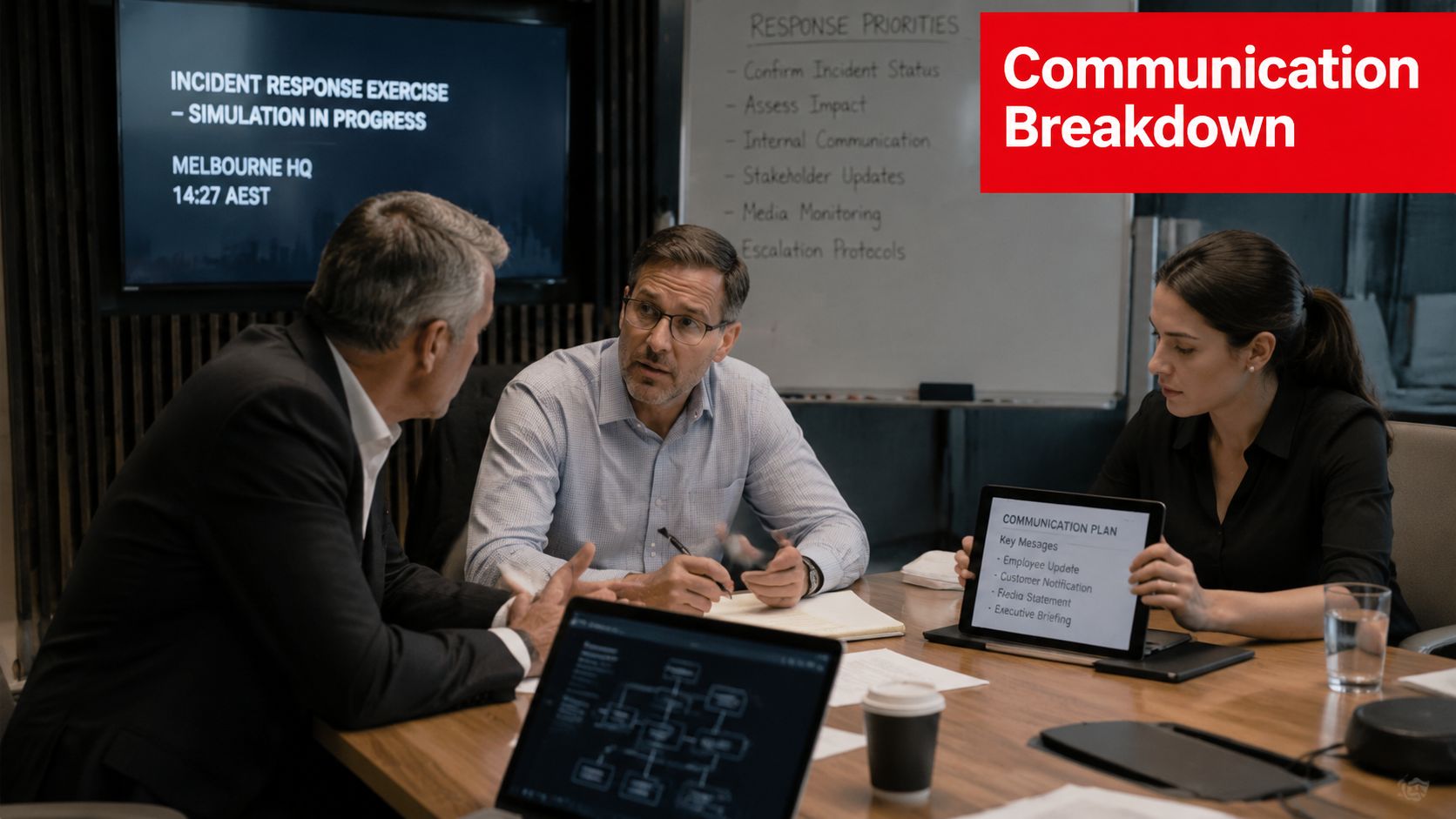
The better operations I've worked on treat communication as part of the incident workflow. The comms lead knows who gets the first update, the site supervisor knows what must be escalated, and the client only receives confirmed information, not speculation. That discipline matters more than volume. It is also where modern SMB communication tools earn their place, because structured channels and faster feedback loops help teams keep one version of the truth when the site is busy.
Closed-loop feedback, written records, and defined channels make it possible to audit decisions later and repeat the same approach across multiple sites (Quorum). In practice, that means fewer radio checks, fewer contradictory texts, and less time spent untangling who said what.
The risk in fast-moving environments is over-broad messaging. If everyone gets the same detail level, nobody gets the right one. A construction foreman needs access-control implications, a festival promoter needs crowd-risk summaries, and a venue manager needs operational impact, not a copy-paste update. The same split applies across hospitality and event work, where a contractor needs a decision, front-of-house needs a simple instruction, and the control room needs a status line it can trust.
Stakeholder communication becomes most valuable when the business is juggling safety, service, and reputation at once. I treat it the same way I treat radios, access lists, and incident logs, as a working control that either helps the team move or slows the entire site down.
Identifying and Segmenting Your Stakeholders
Start with the people who can block, shape, or carry the decision. In security operations, that usually means the client, the site lead, the control room, contractors, venue management, front-of-house staff, and sometimes regulators or emergency services. On a live site, those groups do not all need the same message, and they do not all need it at the same speed. If you cannot name each group and say what it owns, your communication plan is still too vague to hold up under pressure.
Segment by power, interest, and message need
A proper map does not stop at job titles. Stakeholders should be segmented by power, participation, interest, support or opposition, and influence (World Bank). That makes it easier to decide who needs detail, who needs a decision, and who only needs a concise update.
For a festival, the organiser may need crowd-risk summaries, incident status, and any change to ingress or egress. For a construction client, the focus is more likely to be access control, safety compliance, and any issue that changes the program. Venue managers usually sit in the middle. They need enough detail to coordinate staff and manage patrons, but not a flood of technical noise.
A useful way to sort this is to ask three questions for every group, what do they need to decide, what do they need to know, and what channel do they check under pressure? That last question matters more than people admit. A hard-to-reach contractor will not improve just because you sent a polished email, and a busy promoter will not read a paragraph when a two-line brief will do.
Build the stakeholder map early
Identify and map stakeholders early, then keep the communication plan live as conditions change (APM). In practice, that means the map should be drafted before the event opens or the first slab is poured, not after the first issue lands. It also means the plan has to change when staffing, risk, or timing changes, because the right recipient list in the morning can be wrong by afternoon.
A working stakeholder map should show who needs a briefing, who needs a decision, who needs a heads-up, and who only needs a record copy. That matters in security because the escalation path is part of the message. If a control room sees an access breach, the site supervisor may need the first call, the client may need confirmation, and venue management may only need a concise impact note until the situation is contained.
| Stakeholder Group | Primary Interest | Communication Preference | Decision Authority |
|---|---|---|---|
| Event promoter | Crowd movement, incident status, reputational risk | Concise briefings, immediate escalation for material changes | Approves public-facing actions and major operational changes |
| Venue manager | Patron safety, trading continuity, staff coordination | Short updates, direct phone contact for urgent issues | Directs venue response and internal staffing |
| Site supervisor | Access control, safety compliance, work progress | Operational notes, checklist-based updates | Implements site-level controls |
| Client representative | Service reliability, schedule, issue resolution | Written summaries, milestone updates | Signs off on scope or remediation |
| Contractor lead | Task allocation, site conditions, timing | Direct messages, issue-specific instructions | Owns task execution within their area |
A stakeholder map is only useful if someone owns the next action after the message goes out.
That is the difference between communication as admin and communication as operations. The first produces inbox clutter. The second changes what happens on the ground.
Defining Objectives, Messages and Channel Strategy
A pile-up at the gate, a contractor missing induction, or a patron flow problem at a festival all create the same test. Who needs to know, what do they need to do, and how fast does the message have to move? In security, those answers are part of the control system, not a courtesy note. If the objective is only to “inform,” the message usually lands as background noise. If the objective is to approve, act, or escalate, the wording, timing, and channel have to match that job.
Start with the decision, then build the message
Lead with the outcome, then give the detail that supports it. A venue general manager needs the operational effect first. A site lead needs the facts that help them correct the issue on the ground. That difference matters because executives need a concise summary, while technical owners need enough context to verify what happened and record the action taken.
The message also has to connect to the business priority sitting behind it. A security update that says “patrols completed” is weak unless the reader can see why it matters. If patrol completion affects coverage, access points, or incident detection, say that plainly. If a delay changes patron flow, trading continuity, or compliance timing, state that too. During one event handover, I learned fast that a short note about a gate closure meant nothing until I added the effect on vehicle movement and the workaround for the loading dock. That is the kind of detail that stops avoidable escalation.
Match cadence to criticality
Cadence should be planned before the shift starts, not improvised after the first call-out. For Australian security operations, that usually means scheduled incident reports for routine visibility, pre-event briefings so risks and responsibilities are clear before doors open, and post-event debriefs while the details are still fresh. A written brief can also hold a deepfake video verification workflow for the rare cases where a suspicious clip or image needs checking before it is escalated. That sort of control keeps the message tied to the event, not to rumour.
If a stakeholder is hard to reach, use the channel they respond to under pressure. That may be the site shed, the loading dock, the control room, a contractor call, or a face-to-face handover before shift start. The best channel is the one the person will use when things are moving fast, not the one that looks tidy on a plan.
Rule of thumb: if the message affects safety or public movement, do not leave it buried in a thread that only one person checks.
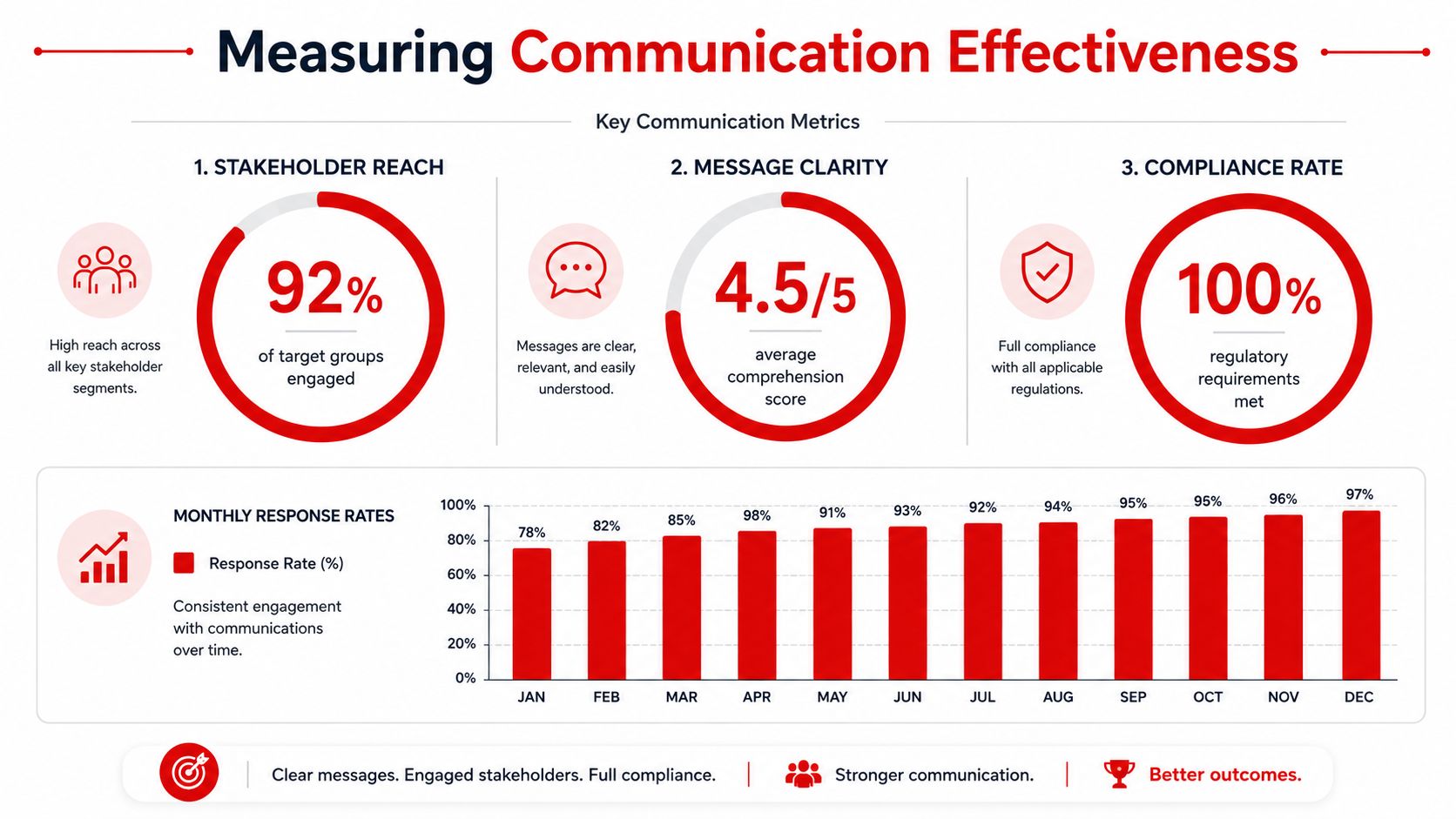
Measuring whether the message worked matters as well. Response rates and completion rates show whether the update was received and acted on. Attendance and issue-resolution times show whether the communication changed what happened next. Those checks are more useful than assuming everyone stayed across the situation.
Use channel strategy with purpose
The channel mix should fit the job in front of you. Phone calls suit urgent escalation. Written briefings suit instructions that need to be remembered and audited. Live meetings work for pre-event alignment and decisions that carry trade-offs. Follow-up notes close the loop, confirm accountability, and leave a record for later review.
For groups that are easy to overlook, the approach has to be deliberate. Research on underserved audiences says communicators should not assume needs, should go where people already are, and should co-create communication rather than rely on generic outreach (RETHINK). In security work, that is not a theory exercise. A disengaged stakeholder often becomes visible only when the incident has already escalated, so the message design has to reach them before that point.
Roles, Responsibilities and Escalation Procedures
A site can have the right message and still fail if nobody knows who sends it, who checks it, and who can green-light the next move. Under pressure, stakeholder communication has to be run like any other control on site, with clear ownership, fast checks, and a named decision-maker for escalation. On a festival gate, a construction compound, or a late-night venue floor, that clarity stops the team from arguing about process while the problem keeps growing.
Define who does what before the shift starts
The setup should be simple and written down. One person owns the message, one confirms the facts, one sends the update, and one has authority to approve the next action. That division supports closed-loop feedback and creates a record the team can return to after the incident, which matches controlled communication practice (APM).
A practical split looks like this:
- Communication Lead: owns the stakeholder list, timing, and final message flow.
- Content Owner: checks accuracy, confirms facts, and prevents drift.
- Channel Manager: posts or sends updates through the agreed platform.
- Escalation Point: approves urgent decisions and resolves blockers.
Short chains work. Once approvals start stacking up, the message falls behind the site.
Escalate fast when the news is bad
Material risks or milestone slippage should be communicated within 24 hours, with the impact stated clearly and the next step set out. Delay makes trade-offs harder to settle and weakens the quality of the decision. In the field, I have seen a slow bad-news call do more damage than the issue itself, because the client felt the team was protecting perception instead of handling the problem.
Escalation triggers should be defined before the shift starts. Loss of access control, crowd-flow problems, a compliance miss, a contractor delay that affects opening time, or any incident that changes the agreed risk position all justify escalation. The point is to remove guesswork when the pressure is already on.
If the incident involves sensitive media or manipulated footage, verify it before you escalate. The discipline behind a deepfake video verification workflow fits the same operational standard, confirm what is real, document what changed, then escalate with context instead of reaction.
Use templates that force clarity
Templates stop people from improvising under pressure. A briefing note should state what happened, what is affected, who owns the next action, and when the next update is due. An incident alert should cover the issue, the operational impact, the control in place, and the escalation point. A post-event report should record what was done, what still needs follow-up, and where communication broke down.
That is what makes stakeholder communication repeatable on fast-moving sites. It stops depending on the mood or experience of whoever happens to be on shift, and it starts depending on a process the whole team can use under load.
Measuring Success and Maintaining Compliance
A stakeholder message only counts if it changes what happens on the ground. In a festival, construction site, or hospitality venue, that might mean a supervisor changes a roster, a contractor holds at the gate, or a client stops pushing ahead until the risk is cleared. If the update did not reduce confusion, speed up a decision, or close a gap in the plan, it is just noise.
Track the right operational indicators
The practical indicators are attendance, response rates, issue-resolution times, and satisfaction scores. In security operations, I would also watch incident counts, patrol completion rates, response times, and how quickly an escalation reaches the right person. Those numbers show whether the communication is helping the job move or slowing it down.
The useful measure is not volume, it is effect. A message that reaches everyone but leaves supervisors uncertain has failed in practice. A short update that gets a contractor to stand down, gets the client informed, and gets control measures in place has done real work.
Keep compliance evidence ready
Communication also carries compliance weight. Keep the briefing note, the meeting record, the issue log, and the sign-off trail together so you can show what was decided and who accepted it. In Australian security settings, that written record matters when RSA duties, venue rules, and site controls overlap.
Documented communication also makes audits and incident reviews less painful. If a regulator, client, or venue manager asks who knew what and when, memory is a weak answer. A clear trail shows the decision path, the control that was used, and whether the follow-up happened.
Compliance takeaway: if it wasn't written down, it is hard to defend later.
Use data to bring people with you
Data helps secure buy-in when a site is under pressure. The strongest updates replace vague language with information people can verify, and they put the main point up front so the reader knows why the message matters (Sigma Computing). In practice, that means a client sees the incident count, the response time, and the action taken, instead of a line saying everything was managed.
That approach also fits communication discipline already used in the field, as noted by Zoetalent Solutions. When the team can show that a message was sent, received, and acted on, the conversation becomes easier to audit and harder to dispute. It gives managers something concrete to compare against the next job, instead of relying on impressions.
Your Stakeholder Communication Implementation Checklist
Start with a live stakeholder map, then assign each group an owner, a message need, and a preferred channel. Keep the plan active across the full lifecycle, because stakeholder feedback and site conditions change faster than most documents do. If a risk, delay, or compliance issue changes the job, escalate it fast and attach the impact plus the fix.
Use this as your working checklist
- Map early: identify power, interest, influence, and decision authority before the job starts.
- Segment tightly: don't send identical messages to promoters, supervisors, clients, and contractors.
- Define cadence: decide in advance when updates go out, and through which channel.
- Set escalation triggers: name the issues that require immediate notification.
- Record everything: keep written notes, confirmations, and action logs.
- Measure response: track attendance, response rates, resolution time, and completion.
- Review after each job: update the communication plan based on what changed and what worked.
That approach keeps stakeholder communication practical instead of theoretical. It gives the team a repeatable way to spot gaps, confirm understanding, and adjust before small issues become bigger ones.
GM GROUP Services works with Australian venues, events, construction sites, and businesses that need security teams who can communicate clearly under pressure. If you want a provider that understands stakeholder communication, site reporting, escalation discipline, and compliance-focused delivery, visit GM GROUP Services and see how their team supports safer, better-run operations across NSW, VIC, QLD, and the ACT.