


Effective shopping mall security procedures are your first and best line of defense for protecting people, assets, and your retail environment's reputation. The primary goal is not merely to react to incidents but to foster a secure yet inviting atmosphere. This is achieved through a proactive, intelligent strategy designed to prevent problems before they begin. By implementing actionable insights and practical examples, you can transform your security from a cost center into a powerful asset.
Establishing Your Security Blueprint
The foundation of a safe shopping centre isn’t just cameras and guards; it's a meticulously crafted security plan. A modern strategy moves well beyond simply reacting to incidents. Instead, it focuses on a blend of visible deterrents and behind-the-scenes intelligence to pre-emptively tackle threats. It’s all about being proactive, not reactive.
A truly robust plan will always include a few key components:
- Visible Deterrents: Uniformed guards at key entrances and continuous patrols send a strong message. This visible presence is often enough to discourage opportunistic crime. Actionable Insight: Station guards not just at main entrances but also near high-value stores and food court perimeters during peak hours to maximize their deterrent effect.
- Covert Operations: Plain-clothes officers are your eyes and ears on the ground. They can blend in with shoppers to gather intelligence and discreetly handle sophisticated threats, like organised retail crime, without causing alarm or disrupting the customer experience.
- Emergency Protocols: You absolutely must have well-defined and regularly rehearsed plans for fire, medical emergencies, active threats, and other crises. A rapid, coordinated response is non-negotiable. Practical Example: Conduct a quarterly "walk-through drill" where security staff verbally guide tenant managers through the evacuation route for their zone.
At its core, a successful security blueprint is built on a thorough risk assessment. This is the most critical first step. It shows you exactly where your vulnerabilities lie, allowing you to direct resources for the biggest impact and ensure every dollar is spent wisely.
This infographic breaks down the foundational stages of building out your security strategy.
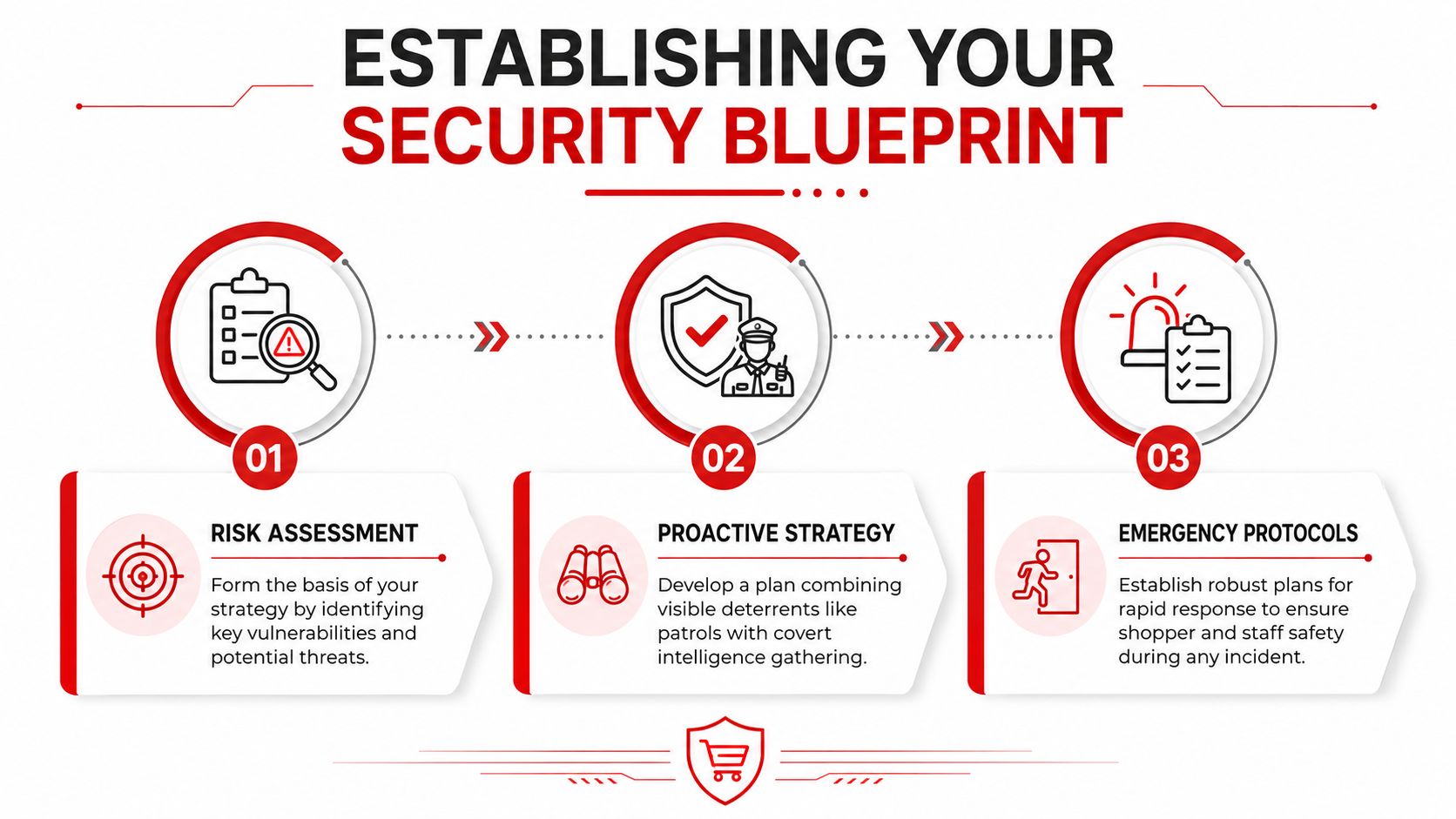

As you can see, a proactive mindset centred on prevention and rapid response is essential for tackling the unique challenges of any retail environment. This is the posture that transforms security from a simple cost centre into a genuine asset that protects shoppers, staff, and your bottom line.
Conducting a Thorough Security Risk Assessment
Before you even think about hiring a guard or installing a single camera, the real work begins. The foundation of any effective shopping mall security procedures isn't the technology or the team—it's the risk assessment. This is what separates a truly secure centre from one that’s just going through the motions.
Getting this right moves your security from a reactive, "put-out-the-fire" model to a proactive one. It’s a systematic process of walking your property and identifying every potential threat, analysing how likely it is to happen, and understanding the damage it could do to your centre, tenants, and customers. This isn't just about theft; it covers a whole spectrum of potential issues.
Identifying Key Vulnerabilities
You need to walk your property with a critical eye, almost like you're trying to find a way to break in yourself. Scrutinise every corner for weaknesses. From my experience, some areas always need extra attention:
- Parking Structures and Car Parks: These are often the number one source of incident reports. We see everything from vehicle break-ins and personal theft to issues stemming from poor lighting that simply makes patrons feel unsafe after dark.
- Loading Docks and Service Corridors: An unsecured "back of house" is an open invitation. It’s a major risk for unauthorised entry, internal theft by staff or contractors, and even disruptions to your tenants' supply chains.
- Food Courts and High-Traffic Common Areas: The sheer density of people makes these zones magnets for public disturbances, arguments, lost children, and medical emergencies.
- High-Value Storefronts: This one’s a given. Retailers selling jewellery, high-end electronics, or luxury fashion are always going to be targets for everyone from opportunistic shoplifters to organised retail crime syndicates.
A common mistake I see is focusing only on the obvious criminal threats. You have to think bigger. A slip-and-fall in a poorly maintained area with a wet floor and no sign is a risk. So is the potential for a large-scale public disturbance during the Boxing Day sales. Each one is a liability that your plan must account for.
Once you’ve got a comprehensive list of all these potential risks, the next step is to start classifying them. This is where you bring order to the chaos and figure out where to spend your money and time.
To do this effectively, we can use a simple tool to map out every risk we've identified.
Security Risk Prioritization Matrix
Use this matrix to classify identified risks by their likelihood and potential impact, helping you allocate resources effectively.
| Risk Type | Likelihood (Low/Medium/High) | Impact (Low/Medium/High) | Priority Level |
|---|---|---|---|
| Example: Organised Retail Theft | High | High | CRITICAL |
| Example: Slip and Fall in Food Court | Medium | Medium | HIGH |
| Example: Vandalism in Car Park | Medium | Low | MEDIUM |
| Example: Power Failure | Low | High | MEDIUM |
| Example: Minor Shoplifting | High | Low | LOW |
By evaluating both the likelihood of an incident and the impact it would have, you create a clear roadmap. This lets you implement targeted and defensible shopping mall security procedures, focusing on the most severe threats first. This foundational analysis is what separates a truly effective security plan from one that just ticks a box.
Deploying Security Personnel for Maximum Impact
When it comes to your shopping mall security procedures, it’s easy to get caught up in the latest tech. But an effective plan starts with your people. While technology is a fantastic tool, it’s the strategic deployment of well-trained security personnel that provides the visible deterrence and rapid response shoppers notice. It's what truly makes them feel safe.
Ultimately, it’s about putting the right people, with the right skills, in the right places.
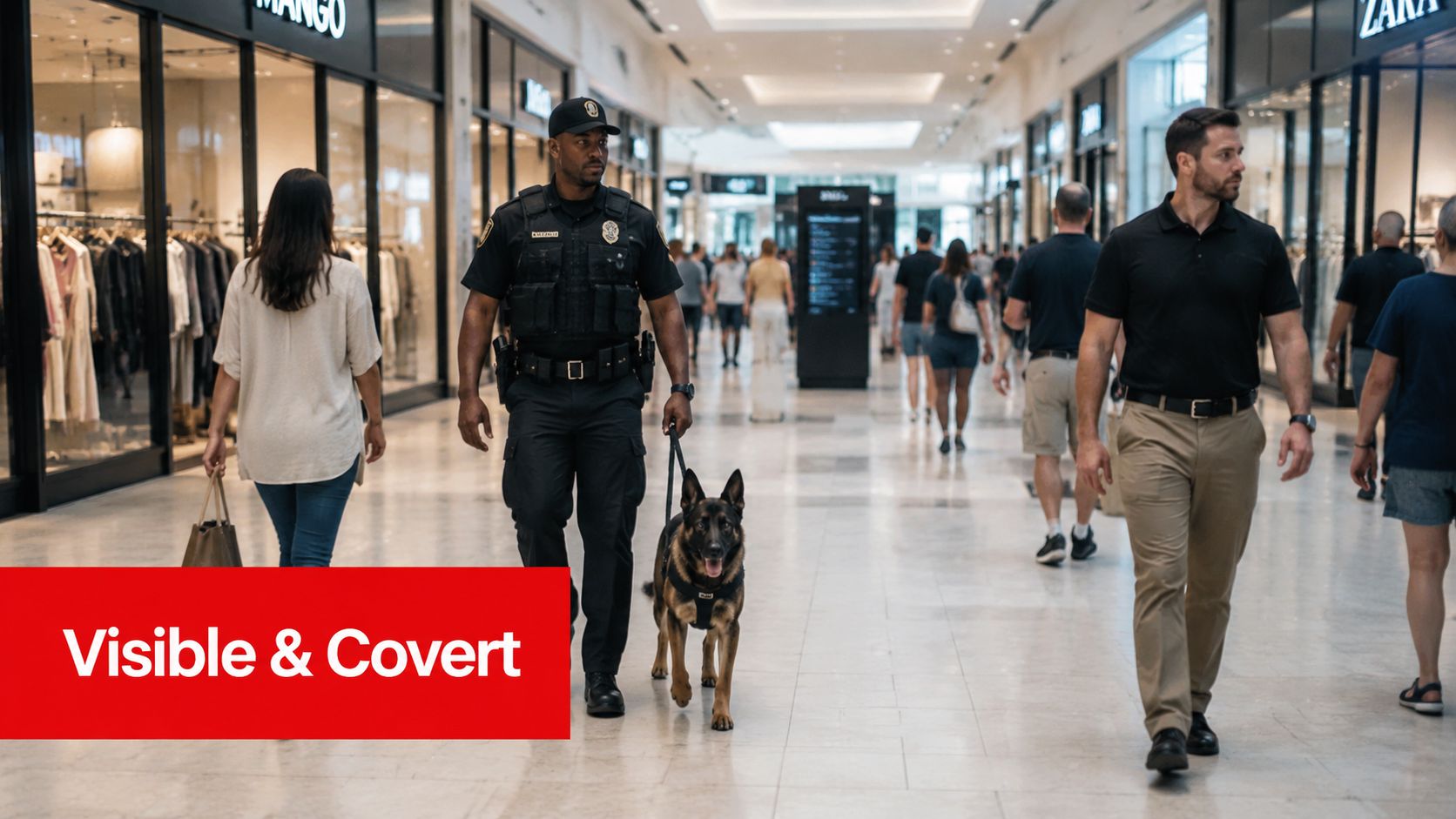
Think of the different roles like layers of your overall strategy. Uniformed static guards at main entrances and other key access points are your front line. Their very presence is often enough to deter opportunistic crime and set a tone of order and control from the moment a person walks in.
Then you have your roving patrols. These guards are your eyes and ears on the move, covering everything from car parks and food courts to quiet service corridors. Their constant movement ensures no part of the centre is left unmonitored for long, allowing them to spot potential hazards or suspicious behaviour before things escalate.
Advanced Security Deployment Strategies
Sometimes, a standard patrol just isn't enough. For high-traffic periods like the Christmas rush or major sales events, K-9 units are an invaluable asset. A dog and handler team offers exceptional crowd management and threat detection, and their presence alone can de-escalate tense situations.
Another critical layer involves covert loss prevention officers. These plain-clothes operatives blend in with shoppers to spot and intercept sophisticated shoplifters, return fraud schemes, and even internal theft. They protect your tenants' bottom line without making legitimate customers feel like they're being watched.
The data backs this up. Shopping centres that deploy a mix of uniformed guards at entrances and active patrols see retail theft incidents drop by as much as 35%. It's no surprise that over 60% of major Australian shopping centres now require at least two on-site security officers per 10,000 square metres during peak hours. You can read more about Australian retail security challenges from MGS Security.
As you build out your team with specialised roles like drone operators, don't forget about compliance. Proper licensing is non-negotiable. If you're exploring aerial surveillance, you can use a drone pilot qualification finder to see what's required. In the end, a smart blend of visible, mobile, and covert personnel creates the most robust and effective security posture.
Integrating Technology for Smarter Surveillance
In this day and age, your shopping mall security procedures are only as good as the technology backing them up. A well-thought-out tech system is a massive force multiplier for your on-the-ground team, giving them a bird’s-eye view and helping them stay ahead of potential problems. It all comes down to smart integration.
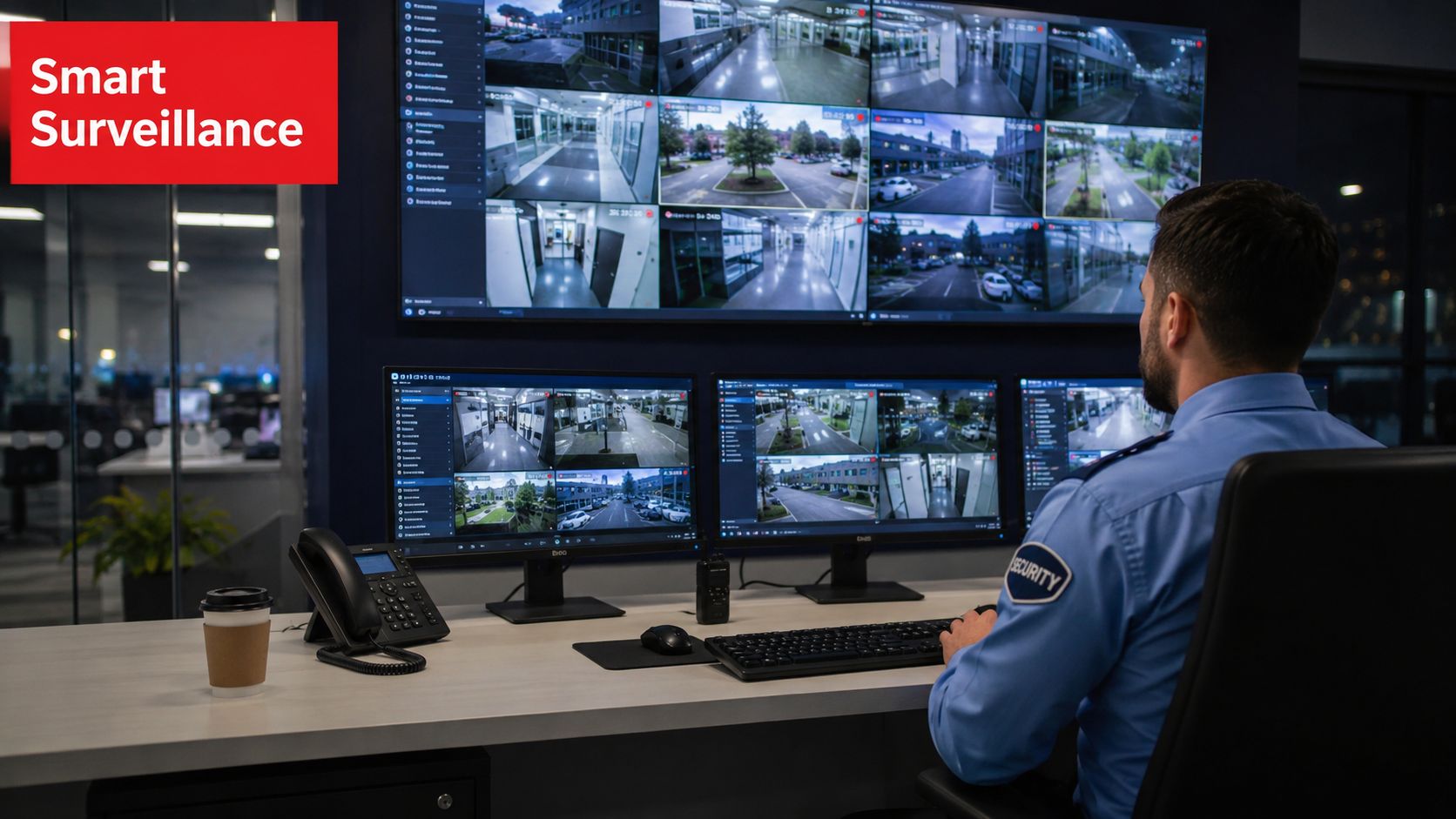
Advanced CCTV systems are the backbone of any modern security plan. It’s not just about having cameras; it’s about where you put them. You absolutely need them covering all your high-risk zones—entrances and exits, car parks, food courts, and especially the loading docks. These feeds should all stream back to a central control room where trained operators can watch for trouble in real time and dispatch guards exactly where they're needed.
Beyond Watching: Access Control and Analytics
Just watching isn't enough. Your technology needs to be an active part of your defence. Access control systems are non-negotiable for securing your back-of-house areas. By restricting service corridors and stock rooms to authorised staff only, you put a simple but incredibly effective barrier in place against theft and unauthorised entry.
But the real leap forward has been AI-powered video analytics. These clever systems can automatically flag suspicious behaviour for your team—think someone loitering near a restricted doorway, a car left too long in a drop-off zone, or a bag left unattended. This lets your guards focus on responding to genuine alerts, not just staring at screens all day.
This tech-forward approach is paying off across Australia. Current data shows that over 90% of large shopping centres now have full surveillance at all entries and in high-traffic areas. More importantly, centres using a combination of CCTV and access control have seen a 30% drop in unauthorised access incidents.
Of course, these systems are only as good as their setup. You can discover the insights about retail security from R Group Security to better understand the hurdles. For a deeper dive into effective camera placement, this guide for Brisbane home security installation has some great principles that apply to commercial spaces, too.
A security plan's real test doesn't happen on a quiet Tuesday morning. Its true strength is revealed when things go sideways. Your everyday shopping mall security procedures need to be backed by solid protocols for when a crisis hits, ensuring your team can act with purpose, not panic. This is what separates a controlled response from utter chaos.
Your reaction to any emergency, whether it's a medical incident or a full-scale fire evacuation, all comes down to your Emergency Action Plan (EAP). This can't be some document collecting dust in a file cabinet; it has to be a live playbook that your entire team knows inside and out. It must be practical, spelling out every critical step in a way that’s easy to follow under pressure.
Key Elements of Your Emergency Action Plan
For an EAP to work, it has to clearly define several key components. If even one of these is fuzzy, the whole response can be compromised.
- Designated Evacuation Routes: You need to map out the fastest and safest ways out from every corner of the centre. Think about potential chokepoints and how to avoid them.
- Clear Assembly Points: Where does everyone go? Assign specific, safe locations well away from the building for staff, tenants, and the public to gather after an evacuation.
- Defined Staff Roles: Who's on communications? Who's clearing which zone? Every single guard must know their exact responsibility to prevent confusion when every second counts.
The entire point is to remove guesswork when stress levels are through the roof. A security officer shouldn't be left wondering what to do next. Their training and the EAP should kick in automatically, guiding their actions. This clarity saves time, and in our line of work, saving time saves lives.
Big events like Black Friday or Boxing Day sales are a different beast entirely. They demand specific crowd management strategies to prevent dangerous surges and keep things orderly. This means using barriers to direct the flow of people and posting extra staff just to monitor crowd density.
It’s also why comprehensive training for workplace first aid and emergency response is non-negotiable for security staff, giving them the confidence to handle these high-pressure situations. Running regular drills—and getting tenants and local emergency services involved—is the only way to ensure your response is a coordinated, well-oiled machine when it matters most.
Using Covert Loss Prevention to Protect Your Bottom Line
While uniformed security guards are a fantastic visual deterrent for casual crime, they can't be everywhere at once. A significant slice of a shopping centre's financial losses doesn't come from brazen smash-and-grabs but from far more subtle and calculated threats. This is exactly where covert loss prevention becomes an essential part of your shopping mall security procedures.
These plain-clothes operatives, known in the industry as Loss Prevention Officers (LPOs), are your eyes and ears on the ground. They move through the centre just like any other shopper, which allows them to spot potential threats that a uniformed guard, by their very nature, would scare off. Their job is to identify and deal with sophisticated theft without causing a scene or disrupting the experience for genuine customers.
The Role of Plain-Clothes Operatives
An LPO is trained to see what others miss. They aren't just looking for simple shoplifting; they're spotting behavioural patterns that point to organised retail crime. This could involve teams of people working together to distract staff, or the use of "booster bags" designed to block security tag sensors. Their work is a careful mix of quiet observation, intelligence gathering, and swift, discreet action when needed.
It's a common mistake to think loss prevention is only about catching shoplifters. A skilled LPO is also on the lookout for internal theft, identifying return fraud schemes, and feeding crucial intelligence back to the uniformed team and centre management. They provide a vital layer of security that directly protects your profitability.
This two-pronged approach—visible deterrence and covert surveillance—is fast becoming the industry standard for good reason. In fact, data from 2026 shows that centres using this blended security model experience a 28% lower rate of shrinkage compared to those relying only on uniformed guards.
One industry report notes that covert operatives are now active in over 40% of major Australian shopping centres to fight both internal and external threats. You can read more insights on retail security from Xtreme Services Group. By bringing covert officers into your security plan, you’re not just catching criminals; you're actively dismantling the systems they rely on to target your centre and its tenants.
Frequently Asked Questions About Shopping Mall Security Procedures
When we work with centre operators and retail managers, a few key questions about shopping mall security procedures always come up. Getting these fundamentals right is the difference between a plan that just looks good on paper and one that actually keeps your centre safe. Let’s tackle some of the most common queries I hear.
How many security guards does a shopping mall need?
This is easily the most frequent question, and the honest answer is: it depends. There’s no magic formula, but a good starting point for many centres is at least two officers per 10,000 square metres during your busiest hours. Of course, the final number is driven entirely by your specific risk assessment. A small community centre has different needs than a sprawling urban complex. Factors like layout, foot traffic, local crime statistics, and tenant mix all influence the ideal staffing level.
What is the most important training for mall security staff?
While technical skills and licensing are foundational, the most critical training revolves around communication, de-escalation, and customer service. Your security team is a powerful extension of your centre's brand. The ability to handle tense situations with calm authority is paramount. Training must cover conflict resolution, identifying signs of distress, and communicating clearly during an emergency. A guard who can defuse a situation is infinitely more valuable than one who only knows how to react afterwards.
How often should we update our shopping mall security procedures?
Your security plan should be a living document, not a "set and forget" file. A comprehensive review should be conducted at least once a year. However, certain events should trigger an immediate review, such as a significant security incident, changes in the local threat landscape, major centre renovations, or a new anchor tenant moving in. Regularly analyzing incident reports is also key to spotting emerging trends and ensuring your plan stays relevant.
Are K-9 units effective for mall security?
Yes, extremely. K-9 units are a powerful psychological deterrent and are highly effective for crowd control during peak sales events. Dogs have a superior sense of smell for detecting illicit substances or explosives and their presence alone can de-escalate potentially violent confrontations. They are a valuable, specialized component of a multi-layered security strategy.
What is the biggest security mistake malls make?
The biggest mistake is being reactive instead of proactive. Many centers wait for an incident to happen before they update their security measures. An effective security posture is built on a forward-looking risk assessment that identifies and mitigates vulnerabilities before they can be exploited. Simply having cameras and guards isn't enough; you need a dynamic strategy that anticipates threats.
At GM GROUP Services, we specialise in creating and implementing security plans that keep people, property, and reputations safe. To discuss your centre's specific needs, visit us at https://www.gmgroupservices.com.au.