


Shift handover process failures usually show up at the worst possible time, when the venue is half shut, one guard is still dealing with a patron issue, and the incoming supervisor is trying to work out what's live, what's closed, and what's already been escalated. In that moment, a sloppy handover doesn't just waste time. It leaves the next shift guessing about risks, incomplete tasks, permits, equipment, and who owns the next move.
That's why the shift handover process has to be treated as a safety-critical control, not a casual chat at the door. The best operations teams I've worked with in security, hospitality, events, and construction don't rely on memory or mood. They use a short, disciplined exchange that transfers live risk, preserves incident traceability, and gives the incoming team enough certainty to take over without re-litigating the last shift.
What a Reliable Shift Handover Process Looks Like
A reliable handover starts before the new shift walks in. The outgoing supervisor has the incident log open, the unresolved issues are visible, and the next team can see what's still active instead of hearing a vague summary over background noise. That matters because the UK Health and Safety Executive treats effective handover as a three-part process, preparation, face-to-face exchange, and cross-checking by the incoming team, and says it should use both verbal and written communication with as much time and resource as necessary in the circumstances. That guidance isn't Australia-specific, but the logic fits exactly with how security, hospitality, and site operations work here, where continuity of supervision and incident traceability are essential. HSE shift handover guidance
Why a casual briefing fails
A quick yarn at the gate might feel efficient, but it usually skips the details that matter when pressure hits. If the outgoing team doesn't name the current risks, unfinished tasks, equipment issues, and control measures, the incoming team spends the first part of the shift reconstructing reality instead of managing it.
Practical rule: if the handover can't survive a noisy foyer, a late runner, or a supervisor being interrupted, it's not reliable enough yet.
The reliable version keeps accountability clear. The outgoing person remains responsible for accurately passing on what's known, while the incoming person takes ownership by checking, questioning, and confirming what they've heard. That shared discipline is what stops a handover from becoming a box-tick exercise.
What weak handovers cost
In a venue, a weak handover can mean a patron ban not being passed on, a payment issue resurfacing, or a security post being left unstaffed because someone assumed the next shift knew. On a construction site, it can mean permits, plant status, or exclusion zones being missed. On a hotel or bar floor, it can mean staffing gaps, refusal incidents, or VIP movements not being carried forward.
The measurable point is simple. The quality of information transfer changes how the next shift performs. A study reviewed in a Honeywell white paper found that second-shift operators given a more structured handover recalled more key situational items immediately after the changeover and answered a higher percentage of probe questions correctly during the shift. That's a strong reminder that a better handover changes live performance, not just paperwork. Honeywell white paper on effective shift handover
The Three Structural Pillars of a Strong Handover
A strong handover holds up because the structure is disciplined, not because the people involved are naturally good communicators. In a noisy venue, on a late-night site, or across a hybrid team, the minimum reliable handover still needs three things. The outgoing shift prepares the facts, the exchange happens in a defined window, and the incoming team cross-checks before taking control. Miss one of those and the handover becomes a memory contest.

Preparation comes first
Preparation means the outgoing supervisor has already sorted the facts into usable form. The right question is, “What does the incoming team need to know to keep the site safe and moving?”
That includes open incidents, unfinished tasks, resource gaps, site status, equipment issues, and any control measures already in place. If the outgoing shift has to think aloud while the incoming shift waits, the handover is already weaker than it should be. On busy Australian sites, that delay usually means someone is guessing under pressure.
The exchange needs two channels
The HSE recommends both verbal and written communication. Verbal exchange catches nuance, tone, and urgency. Written record preserves the exact details that get lost when someone is interrupted by a phone call or a patron issue. HSE shift handover guidance
The same logic applies in a control room, a gatehouse, or a remote team spread across sites. WHO's patient safety guidance on handovers says standardised communication needs time for questions, and electronic systems should be interactive rather than one-way message dumps. That fits Australian operations where the handover happens in noise, under time pressure, or between people who are not standing in the same room. WHO communication during patient handovers
Cross-checking closes the loop
Cross-checking is the part many teams skip. The incoming supervisor should restate the critical points, ask what is unclear, and verify the items that affect safety, access, staffing, and continuity. That step is what converts a briefing into ownership.
If you use a knowledge base or AI-supported workflow to manage handovers across sites, the same principle still applies. The system only helps if the information is structured enough to be checked and acted on, which is why a guide to AI-driven support success is useful background for teams trying to keep handovers clear, searchable, and accountable.
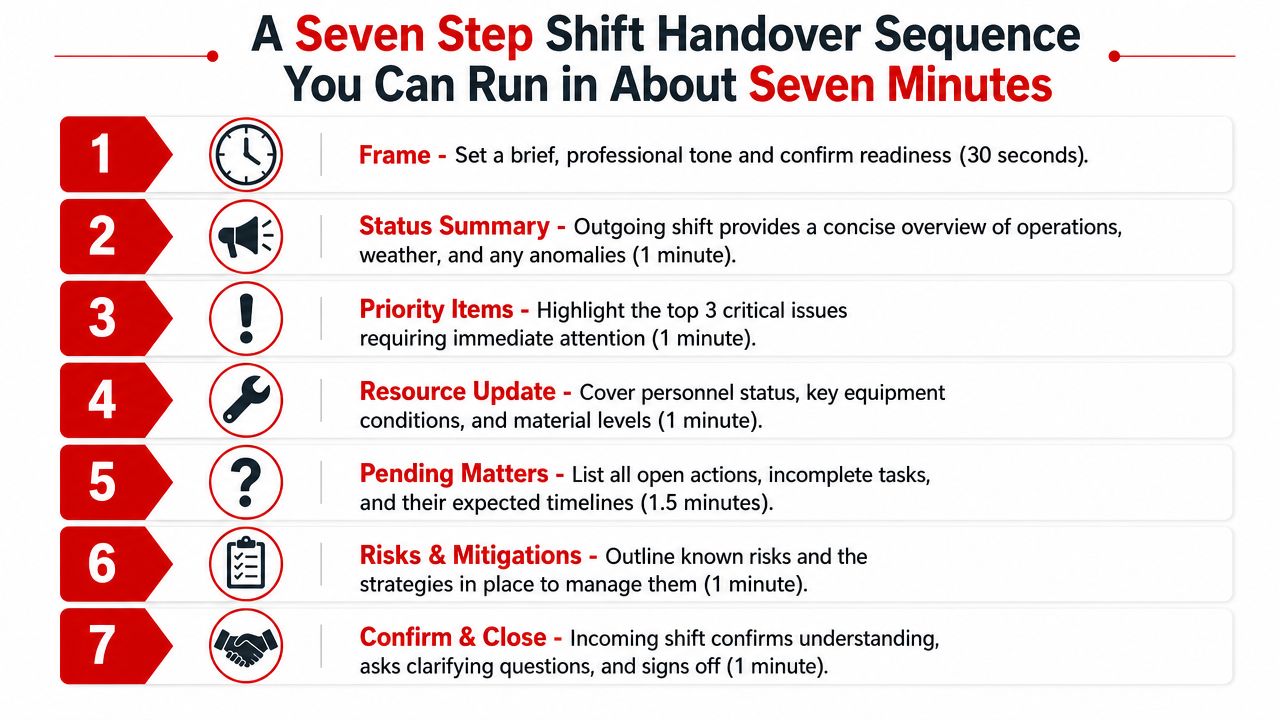
A Seven Step Shift Handover Sequence You Can Run in About Seven Minutes
The best fast handovers don't rush. They compress the right information into a predictable rhythm, so nobody wastes time deciding what to say next. A frontline framework that works in practice breaks the handover into five timed blocks inside about 7 minutes, then adds an assessment phase, staff training, and pilot testing before rollout. It also recommends a one-page checklist, timestamped ownership, and a visible red, amber, green board so unresolved issues stand out immediately. MyShyft seven-minute shift handover
Frame the exchange
Start by setting the tone and confirming that both people are ready. In a noisy venue or control room, that can be as simple as, “You've got a clean minute to take this properly?”
That opening matters because it forces attention. If the incoming person is still dealing with another call, a patron, or a site query, the handover needs a pause before the details start flying.
Give the status summary
The outgoing supervisor gives the operational snapshot, not a story. Weather, crowd conditions, site movements, staffing position, and any anomalies belong here. Keep it factual and short.
A useful script is, “This is the state of play right now.” That wording keeps the focus on what the next shift is inheriting, not on how difficult the last hour felt.
Call out priority items
Only the top issues go here. If everything is urgent, nothing is. I've seen teams overload this part with ten concerns and then wonder why the risk gets buried.
The cleanest version is three critical items, each with an owner and an immediate next step. That might be a refusal issue, a faulty access point, or a contractor still on site after hours.
Update resources and pending matters
Personnel, equipment, and open actions get checked. If the radio battery pool is low, the boom gate is playing up, or a task is half done, the incoming shift needs that clearly stated, not hinted at.
The fastest handovers are the ones where no one has to ask, “Who's doing that?” after the handover ends.
Close with risks and confirmation
Finish with the risks that still exist and the controls still active. Then the incoming supervisor repeats back the key points, asks for clarification, and confirms acceptance of the handover. That closing step is what stops assumptions from becoming incidents.
On-Site Versus Remote and Hybrid Shift Handovers
A handover in a quiet office is one thing. A handover at a noisy loading dock, in a packed venue, or during a late-night construction changeover is another. The process has to hold up when people are tired, the site is loud, and the next supervisor may be standing on the floor, joining by phone, or covering more than one location.
Face-to-face works best when the site allows it
If both supervisors can stand together, look at the same board, check the same log, and hear the same issue, use face-to-face handover. It is faster to clarify, easier to challenge, and better for catching missing detail before it turns into the next shift's problem.
The trade-off is simple. Face-to-face gives you the best chance of a clean transfer, but only if the setting supports it. A crowded festival exit, a busy gatehouse, or a loading area with forklifts moving through can break a conversation into fragments. In those conditions, I keep the verbal exchange tight and use the written record to carry the detail.
Hybrid handovers need extra discipline
Hybrid handovers sit between the ideal and the practical. One supervisor may be on site while the other joins remotely, or one person may hand over to a supervisor covering several locations at once. The written log has to do more work, and the verbal part has to be sharper, because no one has the benefit of full shared context.
The best version is a shared digital log, a short live call, read-back of the critical points, and photo evidence where it matters. That keeps the handover active, rather than turning it into a one-way dump of notes. It also gives the incoming supervisor something concrete to act on when the site is busy and attention is split.
Remote handovers need the strongest controls
Remote handovers are where drift shows up first. Context drops away when the shift change happens across sites, across time zones, or across a poor connection, so the minimum reliable process needs structure. A live written log, a short call, and a clear rule that no critical item is handed over until the incoming person repeats it back all help keep the transfer real, not assumed.
For frontline teams trying to coordinate across dispersed sites, task management for frontline teams is a useful example of how visible ownership and follow-up reduce the chance of tasks being missed between shifts.
WHO guidance on patient handovers still maps well to this setting, because the point is the same. Electronic handover should still allow questions and read-back, not just passive receipt. That is the standard to aim for when face-to-face time is not available, and it fits the control mindset Australian sites need when they are managing handover as a live risk check, not a paperwork ritual.
Incident Briefing Formats and Handover Log Templates
A good incident briefing gets the next shift moving within minutes. It tells them what happened, who was involved, what's still active, what action is underway, and what they need to do next. If the briefing doesn't answer those questions, the incoming team ends up digging through half-finished notes and lost context.
A usable incident briefing format
Keep the incident briefing in the same order every time. Start with the event itself, then cover the people involved, the current status, the actions already taken, and the next required step. That sequence works because it moves from fact to action without forcing the reader to hunt.
A simple working structure looks like this.
- What happened: brief factual summary, no opinions.
- Who was involved: patrons, staff, contractors, or visitors who matter to the response.
- Current status: whether the issue is contained, ongoing, escalated, or awaiting follow-up.
- Actions in progress: what's already been done and by whom.
- Incoming shift action: the one or two steps that must happen next.
If the incoming person can't act on the briefing without calling back for clarification, the briefing is not finished.
What the handover log should contain
Australian handover practice should record the date and time of handover, the names of outgoing and incoming personnel, the task list with completed and pending items, ongoing tasks, issues and delays, special instructions or risk warnings, and work permits and equipment status where relevant. That's a specific documentation set, not a generic status note. Shiftbase shift handover glossary
Five Categories Every Handover Log Should Capture
| Category | What It Captures | Why It Matters |
|---|---|---|
| Production | Actual output versus plan, and any deviation | Shows whether the shift is on track or drifting |
| Equipment | Machines running, down, degraded, or under maintenance | Prevents avoidable downtime and unsafe assumptions |
| Quality | Holds, deviations, in-process inspection results | Stops defects or rework from being missed |
| Safety and Environment | Incidents, near misses, hazard observations, environmental conditions | Keeps live risk visible to the next shift |
| Open Actions | Unfinished tasks, pending decisions, escalated items | Creates ownership and prevents drift |
A well-structured template should also capture the same categories every time, especially safety, equipment, and open actions. ProBeYa's framework is a useful reference here, because it treats the handover as an essential event between shifts and says every handover should be documented for accountability and analysis. ProBeYa shift handover framework
Measuring Handover Quality and Meeting Australian Compliance Duties
A handover is only useful if it changes what the next shift knows and does. If nobody measures that, teams usually fall back to “the form was completed” and call it done. That's too soft for high-risk Australian operations, especially when Safe Work Australia reports 200 workers were fatally injured at work in 2023, and there were 139,000 serious workers' compensation claims in 2021–22. Those figures are a reminder that risk control has to be active, visible, and defensible. Safe Work Australia fatality and claims data

What to measure
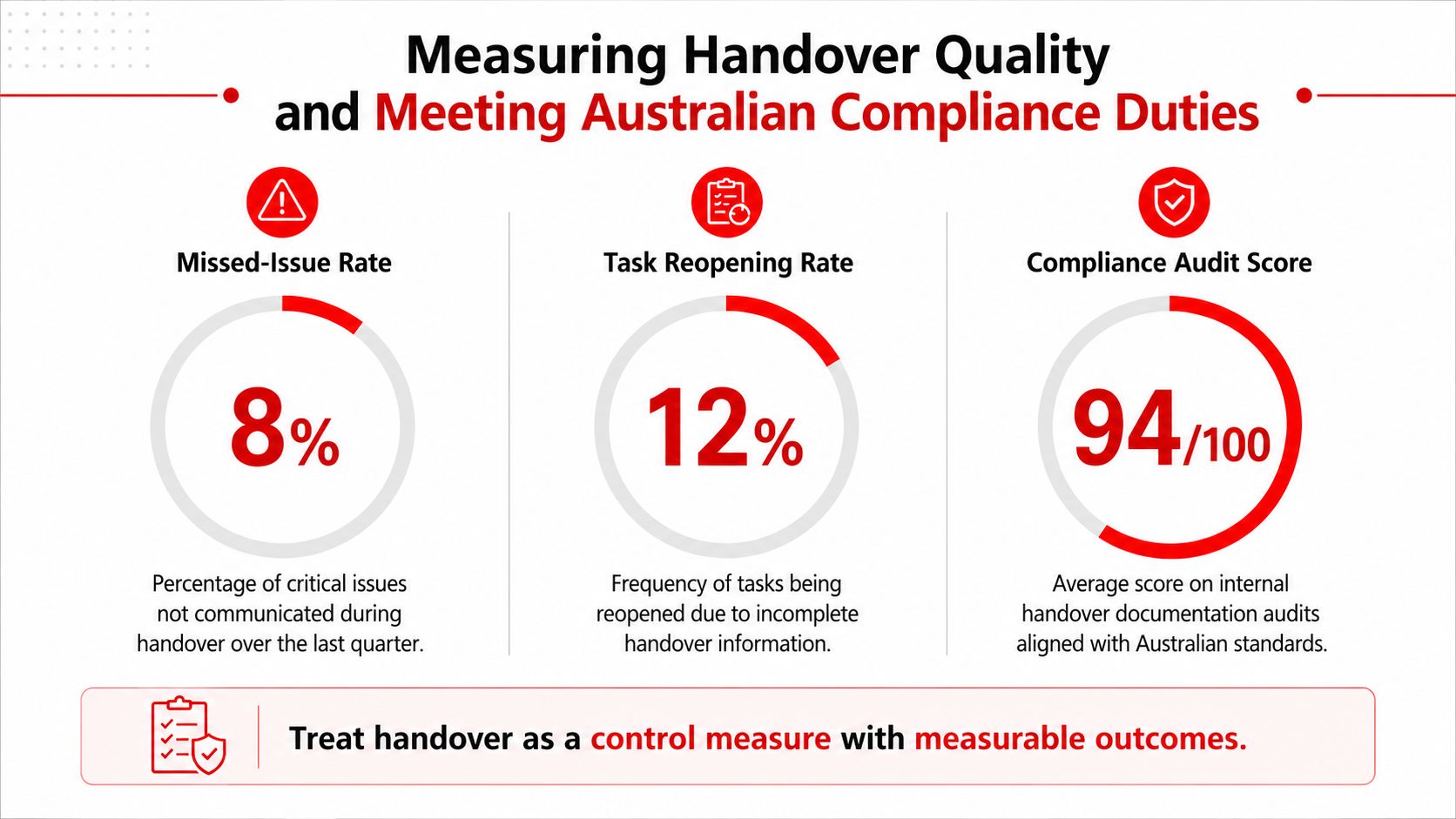
The handover itself should be audited like a control measure. Useful indicators include missed-issue rate, reopening of previous-shift incidents, time-to-closure on action items, and read-back confirmation. Those measures tell you whether the handover reduced risk or merely documented that it happened.
Practical rule: if a recurring issue keeps reopening after shift change, the handover is leaking information, not controlling it.
How this fits Australian duties
In Australian security, hospitality, and construction environments, the handover sits inside broader obligations around work health and safety, licensing, and venue responsibility. If a risk warning is known before the shift starts, and the outgoing team fails to pass it on clearly, that's not just a communication issue. It's a control failure.
That's especially important in licensed venues, where compliance expectations often extend to RSA-related procedures, incident logging, and maintaining orderly control of the floor. The strongest defence in an audit is a clear record showing what was known, who owned it, and how the next shift confirmed it.
A simple audit stance
The question to ask isn't, “Did the handover happen?” It's, “Did the handover reduce uncertainty?” If the answer is yes, the process is working. If the answer is no, the log may look tidy while the risk stays live.
Common Pitfalls, Mitigation Strategies and Training Habits
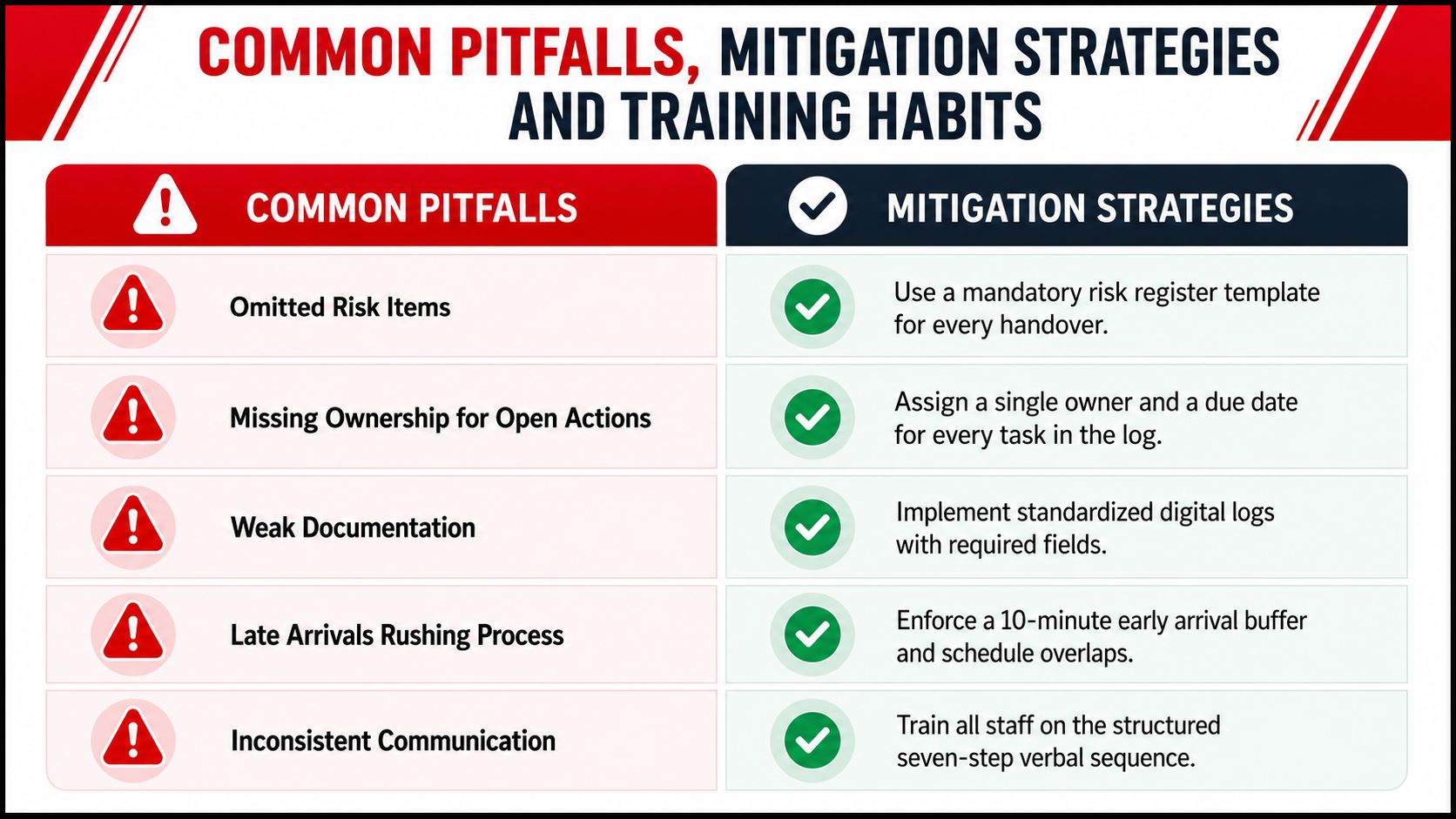
The failures are usually boring and predictable. Risk items get left out, open actions have no owner, documentation is weak, late arrivals force a rushed sign-off, and the whole thing slips back into a chat at the gate. The fix is a short discipline routine, not a motivational speech.
The strongest controls are simple
- Use a mandatory risk register: make sure every handover names current hazards, not just tasks.
- Assign one owner per action: open items need a single person and a due date.
- Standardise the log: required fields beat free-text wandering every time.
- Build overlap into rosters: a buffer protects the process when the previous shift runs late.
- Train the sequence: everyone should know the same seven-step verbal rhythm.
Training is where reliability gets protected
Supervisors should coach the handover during onboarding, then refresh it in monthly toolbox talks or site briefings. The point isn't to memorise a script. It's to make the standard easy enough that people still use it when the venue is loud, the phone is ringing, and the next shift is already waiting.
For operations leaders who want a broader continuity mindset, the idea aligns well with support for business continuity in London, because continuity only holds when the transfer between people is managed with the same care as the process itself.
A reliable shift handover process is never flashy. It's short, structured, and repeatable, and it gives the next shift the one thing they need most, a clean start with clear ownership. If your operation needs tighter handovers across venues, events, hospitality, or construction sites, visit GM GROUP Services to see how a disciplined security team can support safer supervision, clearer reporting, and better continuity between shifts.