


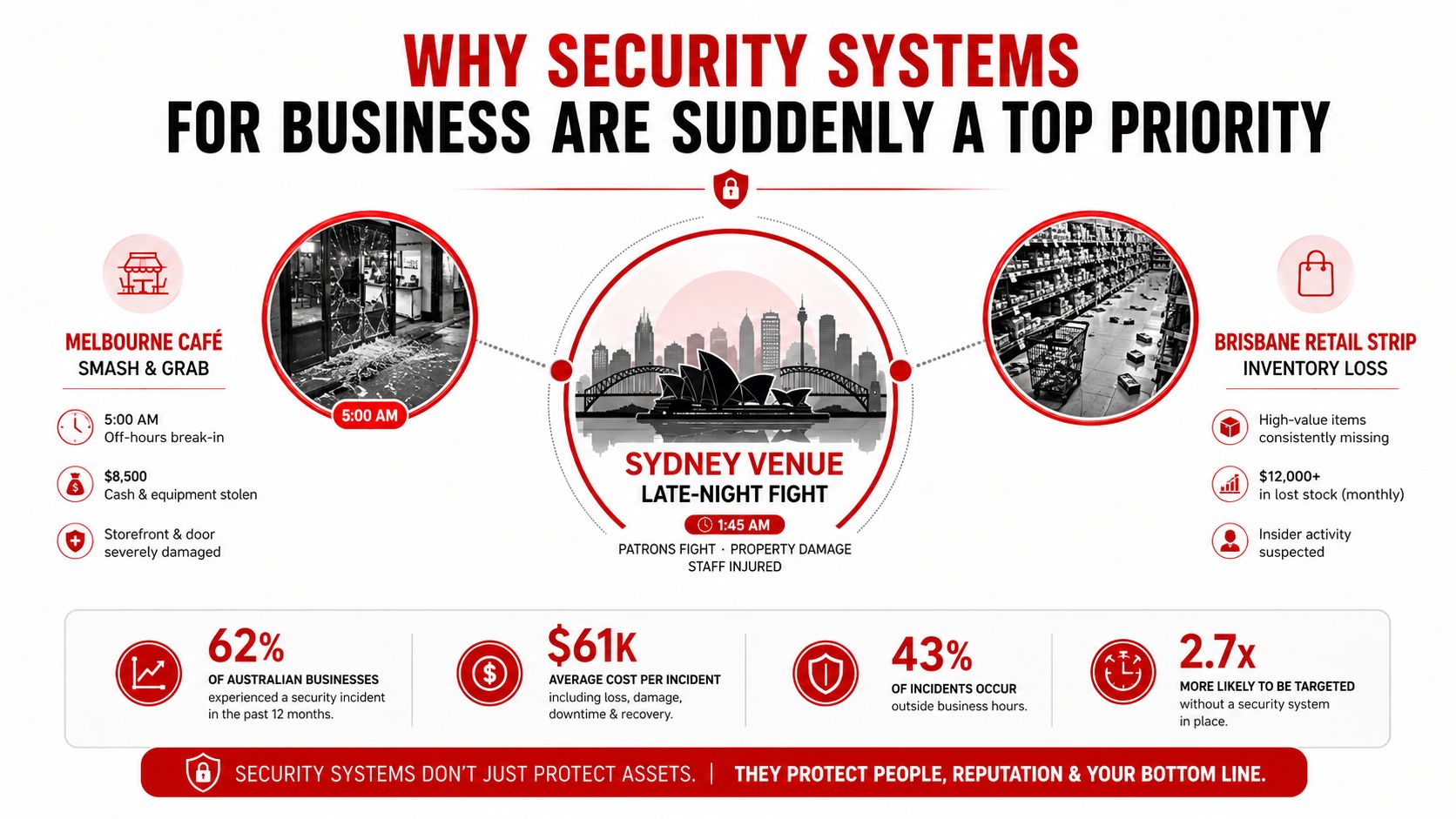
Security systems for business are usually inherited after something has already gone wrong. A Saturday-night venue in Sydney has a fight spill onto the footpath. A café in inner Melbourne finds smashed glass at 5am. A Brisbane retailer discovers stock missing again, while a Canberra construction manager starts a Monday handover with copper gone from the site. The manager then faces more than repairs. There are staff and public safety questions, insurance scrutiny, operational delays and reputational damage.
The right response isn't a catalogue of cameras and guards. It's a cyber-physical operating model that connects deterrence, detection, verification, access control, response and review. The architecture should match the site, trading hours, threat profile and budget, then expand when the risk changes.
Why Security Systems for Business Are Suddenly a Top Priority
The theft environment alone makes business protection a board-level concern. The Australian Bureau of Statistics theft release recorded 595,660 victims of theft excluding motor vehicles in 2024, a 6% increase on the previous year and the highest level since 2003. Almost half of those incidents, 45%, or 268,666 cases, occurred in retail settings, which explains why retailers and customer-facing venues need more than a basic alarm.
A venue manager dealing with an altercation must control the immediate risk, preserve evidence, manage staff welfare and demonstrate that reasonable controls were in place. A retail manager needs to understand whether a loss came through a blind spot, an access failure, internal theft or repeat offending. A construction manager needs perimeter detection, secure storage and a response process that works after the last worker leaves.
Operational rule: A camera that records an incident without triggering a useful response is evidence equipment, not a complete security system.
The commercial market reflects that demand. IBISWorld estimates the Australian Security System Installation and Monitoring industry at A$2.5 billion in 2026, with 1,763 businesses operating in the sector and industry growth of 1.2% CAGR from 2021 to 2026. Its Australian industry profile also reflects the established role of CCTV and other electronic controls in business planning.

Build the system around the incident you need to manage. For a late-night venue, that may mean visible entry control, competent crowd management, monitored alarms and rapid guard escalation. For a small office, it may mean controlled access, visitor records and a dependable after-hours alarm. The cheapest quote rarely solves the actual failure point.
The Layered Security Model Explained
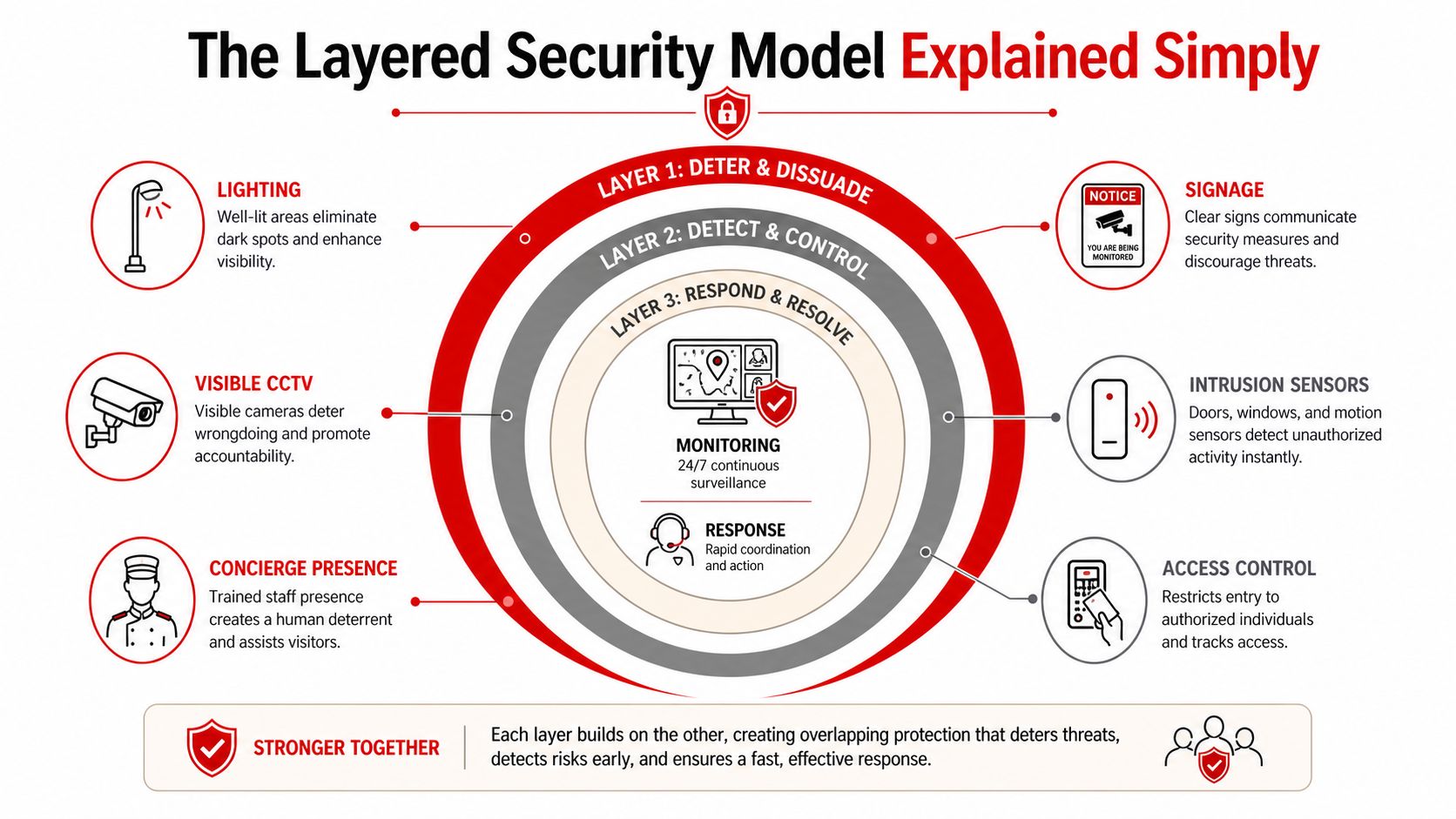
Security works as a layered operating model, not a shopping list of cameras, alarms and guards. Each layer should reduce opportunity, identify abnormal activity, support a clear decision and protect the people or assets at risk. If one layer fails, the others still need to function.
Start with visible deterrence
The outer layer signals that the site is observed and managed. Use effective lighting, clear signage, visible CCTV, and a staffed reception or concierge point where the environment justifies it. At a venue entrance, trained door staff can identify escalating behaviour before it becomes a physical incident. At a construction site, lighting and visible perimeter cameras can discourage casual trespass.
Deterrence reduces opportunity and sets clear behavioural boundaries. It does not replace detection or response.
Detect movement and abnormal activity
The next layer identifies activity that deterrence has not prevented. Intrusion sensors, door contacts, perimeter beams and analytics-enabled cameras can flag movement, forced entry or activity in a restricted zone. Configure analytics for the site rather than accepting default settings. Crowds, reflections, deliveries and changing light can generate false alerts at busy hospitality venues.
Every alert needs an assigned workflow. Set out who receives it, what they verify, how quickly they respond and what happens if the first person does not acknowledge it. A detection device without an owner creates noise rather than control.
Verify, respond and protect the core
Verification converts an alert into an incident decision. Operators can use live video, two-way audio, a monitored back-to-base service or an on-site guard to establish whether an event is genuine. The core layer then protects sensitive areas through access control, secure rooms, restricted plant areas, cash storage and controlled server spaces.
For the Sydney venue, lighting and visible staff may deter an incident. Cameras can record a fight, while a monitoring operator or supervisor verifies its location. Door staff can separate people, secure exits and request escalation. Access controls can keep staff-only areas protected while the incident is managed.
Australian reviews do not support treating CCTV as a universal prevention tool. The Victoria Law Reform Commission surveillance report describes the overall evidence as largely inconclusive. Australian criminology material indicates that CCTV can be more valuable for evidence collection and works best alongside other measures.
Design the layers together, document the response path, and test whether each layer can be observed and acted upon. If the site cannot verify an alert or reach the person responsible, the architecture is incomplete.
Main Types of Security Systems Worth Considering
Business operators usually buy from seven broad categories. The correct choice depends on what must be protected and who will respond.
Seven Security System Categories at a Glance
| System Type | Primary Function | Best-Fit Environment | Key Strength | Main Limitation |
|---|---|---|---|---|
| Monitored CCTV and video analytics | Observe, record and identify activity | Retail, venues, construction and offices | Strong situational awareness and evidence | Blind spots, privacy management and false analytics alerts |
| Intruder alarm with back-to-base monitoring | Detect unauthorised entry and raise an alert | Offices, retail, warehouses and vacant sites | Fast notification outside operating hours | False alarms and response costs |
| Access control, including mobile credentials | Restrict and record entry | Offices, plant rooms, staff areas and venues | Individual permissions and audit trails | Credentials need active administration |
| Intercoms and video door entry | Verify visitors before access | Offices, apartments, warehouses and gatehouses | Supports remote decisions | Weak if staff routinely release doors without verification |
| Perimeter detection and beams | Identify movement before entry | Construction, industrial and large external sites | Extends the detection boundary | Weather, animals and site conditions can create nuisance alerts |
| Lone-worker and duress wearables | Summon help for exposed workers | Hospitality, healthcare, construction and isolated work | Direct emergency escalation | Requires charging, testing and a response procedure |
| Integrated guard patrols with electronic tour management | Provide physical presence and documented checks | Multi-site, high-risk or after-hours operations | Human judgement and visible intervention | Ongoing labour and supervision costs |
Cloud-managed systems offer remote administration and easier multi-site visibility. On-premises NVRs can provide local control and may suit sites with connectivity or data-retention constraints. Neither approach is automatically safer. Review identity management, network separation, footage ownership, outage procedures and maintenance before selecting the platform.
Analytics are useful when they identify a defined event, such as movement through a closed gate. They become expensive when operators receive constant nuisance alerts and stop treating notifications seriously. In NSW and VIC, false alarms can also create operational and financial consequences where police levies apply, so configure detection with the response model in mind.
A business with volunteers, contractors or community programs may also need a reliable screening process. A nonprofit background check company can be a useful resource when the people entering a site aren't all direct employees.
The value sits in integration. A camera should support the alarm decision. An access event should help explain the footage. A guard patrol should produce a usable record. A duress alert should reach a person who knows what to do.
Choosing the Right Stack by Industry
A venue, retailer, construction site and corporate office don't need the same architecture. Start with the operating pattern, then remove controls that don't earn their place.
| Industry | CCTV + Analytics | Access Control | Alarm Monitoring | Mobile Patrols | On-site Staff | Visitor Management |
|---|---|---|---|---|---|---|
| Events | High, focused on entries, crowd zones and exits | Medium, for staff and production areas | Medium, mainly after-hours | Medium to high for dispersed sites | High during public operation | High for contractors, artists and guests |
| Hospitality | High, focused on entry, bar, cash and external areas | Medium to high for staff-only zones | High outside trading | Medium | High where late-night trading or crowd risk exists | Medium |
| Retail | High, including stock areas and service counters | Medium for back-of-house | High | Medium, particularly across a retail strip | Medium, with trained loss prevention where justified | Low to medium |
| Construction | High, focused on gates, plant and materials | Medium for compounds and stores | High | High for remote or exposed sites | Low to medium, depending on shift activity | Medium to high |
| Corporate | Medium, with analytics used selectively | High | High | Low to medium | Medium, often reception or concierge | High |
Match the controls to the pressure points
Events and venues need entry control, crowd observation, duress escalation and clear ejection procedures. Queensland venues with late trading hours need a response model that remains effective after normal office coverage ends. Victorian operators should align entry procedures with venue rules and liquor licence obligations.
Retail usually benefits from targeted cameras, monitored alarms and access records around stockrooms, loading areas and cash-handling points. NSW retailers facing repeat offending shouldn't cover every metre equally. Protect the locations where stock, staff and money intersect, then use patrols or response visits where the exposure extends beyond the shopfront.
Construction sites need perimeter detection, gate control, camera coverage of plant and materials, and mobile patrols where the site is remote or changes frequently. A system designed for a finished building often fails during construction because access routes, lighting and asset locations keep moving.
Corporate offices should prioritise identity-based access, visitor management, intercoms and an incident process that meets internal service expectations. In ACT government precincts, documentation, response time expectations and evidence handling can matter as much as visible deterrence.
Start with the smallest stack that closes the main risk. Add controls when incident patterns, operating hours, site expansion or audit requirements justify them.
Australian Compliance and Licensing Essentials
Treat compliance as a deployment task, not paperwork added after installation. The first question is whether every person and provider has the correct authority for the work being performed.
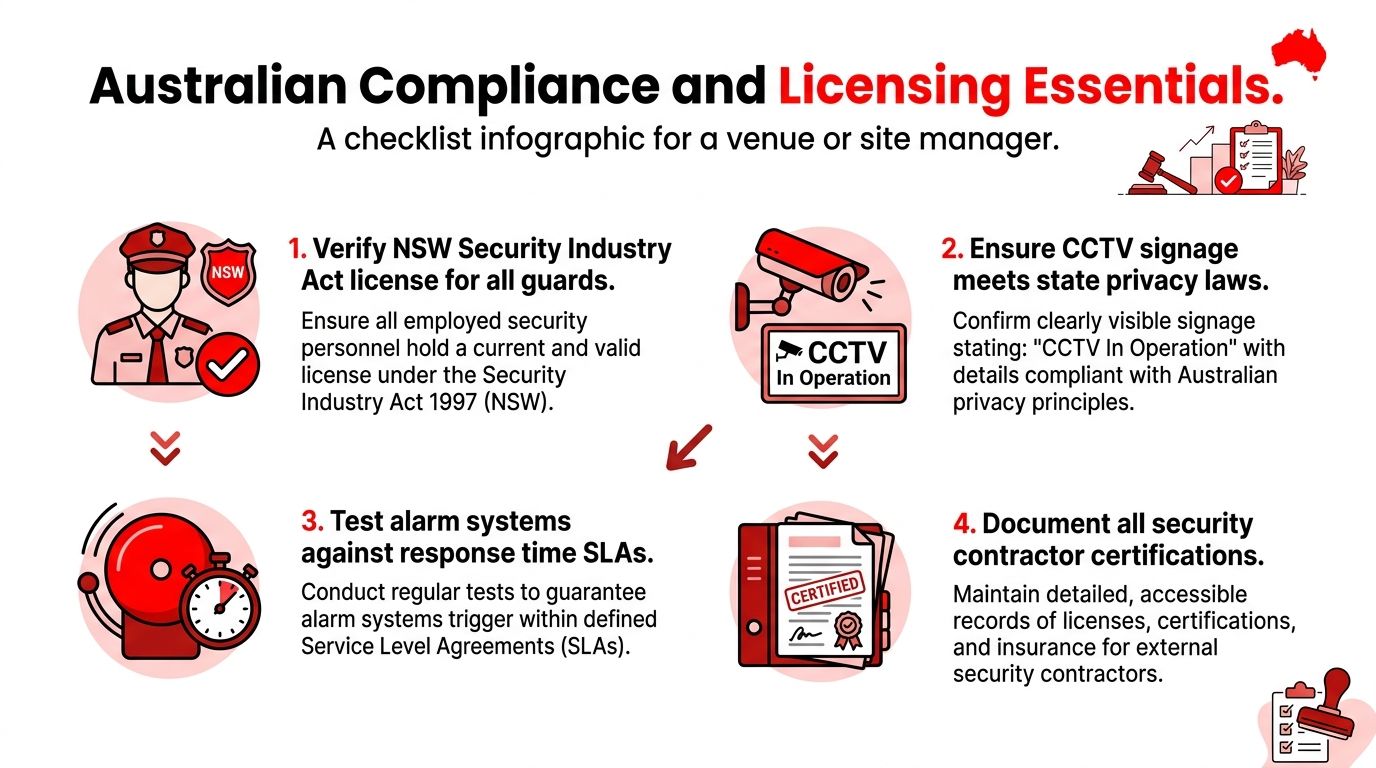
In NSW, security employers must hold a Master Licence, and only Master Licence holders can employ licensed security personnel. The Australian Security Industry Association licensing guidance explains that the framework covers roles including crowd controllers, security officers, bodyguards, private investigators, security advisers and security equipment installers. Confirm the licence category, expiry and employer relationship before an event or site handover.
For Victoria, check the applicable Private Security Act requirements and the Licensing Victoria process. In Queensland, verify the relevant authority under the Security Providers Act through the Office of Fair Trading. In the ACT, use Access Canberra's licensing pathway. Keep copies of contractor certifications, role authorisations and training records in an organised register.
Build a file a manager can use
Australia's Model Work Health and Safety Regulations require a person conducting a business or undertaking to ensure a risk assessment is conducted by a competent person and recorded in writing. The Model WHS Regulations support a four-step process: identify hazards, assess risks, control risks, then review hazards and controls.
Apply that process to crowd movement, aggressive behaviour, isolated work, cash handling, trespass, vehicle access and alarm response. Maintain an incident register, escalation path, post-incident review and evidence-handling procedure.

Events may require crowd-controller licensing. Retail operators should confirm cash-in-transit arrangements and contractor responsibilities. For evidence, use consistent timestamps, export controls, access logs and retention rules aligned with applicable Australian standards and legal advice, including records practices relevant to AS/NZS 22063.
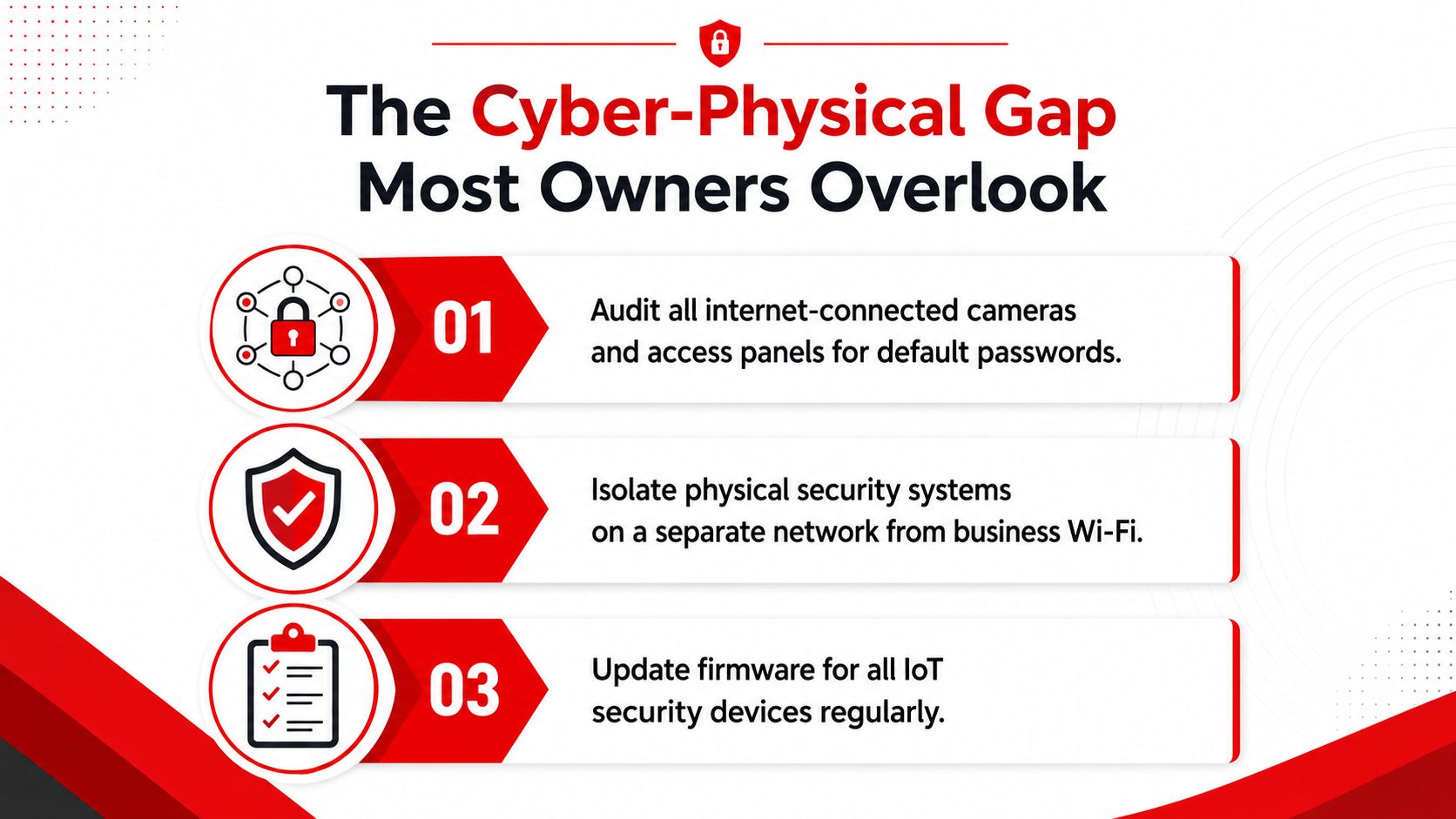
The Cyber-Physical Gap Most Owners Overlook
Your NVR, intercom and access controller are now part of the business technology estate. They hold sensitive footage, control entry and connect to networks, so a physical security installation without cyber governance leaves an obvious gap.
Standards Australia says AS ISO 22340 aligns with the Australian Government's Protective Security Policy Framework across personnel, information, physical security and governance. The Standards Australia security standard overview also sits alongside an important compliance lesson from Australian Government reporting. The Australian Signals Directorate reported that 92% of Australian Government entities achieved an overall Effective compliance rating, but only 22% reached Maturity Level 2 when compensating controls were considered. Compliance status alone doesn't prove resilience.
The exposure is growing alongside broader security spending. Gartner forecasts Australian information security and risk management spending will reach almost AU$6.2 billion in 2025, with security services the largest category at almost AU$2.9 billion. The Australian Signals Directorate also reported more than 1,700 notifications of potentially malicious cyber activity in FY2024–25, an 83% year-on-year increase, and confirmed network compromise in more than 12% of proactive engagements, as reported in the Annual Cyber Threat Report factsheet.
Controls to put in place
- Separate networks: Place cameras, NVRs, intercoms and access controllers on segmented networks rather than the general business Wi-Fi.
- Individual identities: Remove shared operator accounts. Use strong credentials, multi-factor authentication where supported, role-based permissions and logging.
- Patch and review cycles: Maintain firmware, disable unused services and remote access paths, and document compensating controls for legacy devices.
- Incident reporting: Decide who reports a suspected compromise, who preserves logs and footage, and how the physical response connects to the cyber response.
When a Specialist Provider Beats Going In-House
In-house security can work for a single, low-throughput site with stable risks and predictable hours. It starts to crack when the business needs continuous monitoring, coordinated response across locations, formal audit evidence or rapid escalation between NSW, VIC, QLD and the ACT.
Rostering staff to watch cameras overnight creates a difficult cost and quality problem. Fatigue reduces attention, while a person who lacks a graded response protocol may either ignore a genuine alert or escalate every nuisance event. A specialist provider brings licensed operators, documented procedures, supervision and chain-of-custody practices that can support insurance, regulatory and legal requirements.
| Trigger | In-House Risk | Specialist Provider Advantage |
|---|---|---|
| More than two sites | Inconsistent procedures and fragmented reporting | Central coordination and standardised escalation |
| Recurring after-hours incidents | Fatigue, slow verification and missed alerts | Dedicated monitoring and response protocols |
| Tender requiring ISO-aligned documentation | Internal team may lack controlled records | Established governance, reporting and audit support |
| Rapidly changing event or construction conditions | Staff may not have suitable deployment experience | Flexible guards, patrols and site-specific planning |
Three triggers should force a review. If you operate more than two sites, if incidents recur after hours, or if a tender requires ISO-aligned security documentation, DIY control is no longer automatically the economical option.
GM GROUP Services is one fit-for-purpose option for organisations that have outgrown informal arrangements but don't need a national integrator. Its Australian services include static guards, K9 units and handlers, vehicle patrols, gatehouse control, loss prevention, back-to-base monitoring, emergency response and risk assessments across NSW, VIC, QLD and the ACT. Compare its scope with other licensed providers, then select the operating model that matches your actual risk.
Implementation Checklist and ROI Considerations
Start with the site risk assessment, then map threats to locations, people, operating hours and response owners. Design the system around measurable outcomes such as faster verification, fewer unresolved alerts, better footage availability, controlled access to sensitive areas and reduced disruption after an incident.
Use a staged rollout:
- Assess and map: Record hazards, entry points, blind spots, assets and escalation contacts.
- Design the response: Define what each alert means, who verifies it and who attends.
- Procure in stages: Prioritise perimeter, entry, cash, stock, plant and staff-safety controls before secondary coverage.
- Commission and test: Check camera views, alarm paths, credentials, outage handling and reporting.
- Train operators: Make staff practise duress, visitor, lockdown and evidence procedures.
- Review performance: Track shrinkage, incident response time, insurance premium movement and avoided business interruption after trespass or break-ins.
For cyber-connected equipment, use a practical secure development checklist from DevArmor as a prompt for disciplined implementation thinking. Adapt the principle to cameras, access platforms and monitoring integrations.
Schedule quarterly camera and NVR checks, an annual access-control credential review and firmware patch windows during low-operating periods. Before signing, clarify contract length, footage ownership, export rights, data retention, equipment ownership, service levels and exit clauses.
FAQ
Should I buy a complete system immediately?
Usually not. Stage the controls around the highest-risk exposure, then expand after testing alert quality and response performance.
Who owns the footage?
The contract should say. Confirm ownership, retention, access rights, export format and what happens when the provider relationship ends.
Is cloud or on-premises better?
Neither is universally better. Choose based on connectivity, governance, cyber controls, outage tolerance, administration and evidence requirements.
What should I measure after installation?
Measure response time, unresolved alerts, incident recurrence, shrinkage, access exceptions and business interruption. A system is an operating model, not a capital purchase, and the lowest quote rarely survives first contact with a real incident.
GM GROUP Services can assess your site, design a fit-for-purpose mix of licensed personnel, monitoring, patrols, access control and risk procedures, and support operations across NSW, VIC, QLD and the ACT. Visit GM GROUP Services to discuss the specific risks, response requirements and rollout priorities your business needs.