


Security risk assessment methodology is the repeatable process that turns concerns about a site, event or worksite into decisions people can carry out. If you're planning a festival, managing a licensed venue or preparing a construction site, you may already be weighing practical questions: where to place staff, how to manage queues and what happens if a key system fails. A consistent method helps you answer those questions with evidence rather than habit.
The goal isn't to produce a document that sits untouched in a folder. It's to connect each risk to a control, an owner and a way to check that the control works, then update the assessment when conditions change. The steps below show how to build that process from the ground up.
Security Risk Assessment Methodology at a Glance
A security risk assessment methodology is a repeatable cycle for identifying, rating, treating and reviewing security risks so teams can make defensible operational decisions.
| Stage | Core question | Output | Festival example |
|---|---|---|---|
| 1. Establish context | Where and under what conditions do we operate? | Scope, stakeholders and legal duties | 2,000 people, two gates, a licensed bar, and named organiser and venue roles |
| 2. Identify hazards and threats | What could go wrong here, and where? | Hazard register by location | Queue crush at Gate B, unauthorised vehicle near the stage |
| 3. Analyse likelihood and consequence | How likely is it, and how severe would it be? | Likelihood and consequence scores | Gate B crush rated likely at peak arrival and severe |
| 4. Evaluate against criteria | Which risks exceed our tolerance? | Ranked list of priority risks | Gate B ranks above lost property |
| 5. Treat and assign controls | What will we do, and who owns it? | Controls, owner, trigger and verification method | Second gate opened at 80% capacity, duty manager owns the trigger |
| 6. Monitor, review and report | Are controls working, and has anything changed? | Residual risk and review log | Re-rate after each layout or schedule change and report to the organiser |
The stages are linked, but each produces a distinct decision. Establishing context defines the boundaries of the assessment. Identifying hazards turns those boundaries into specific scenarios, such as a bottleneck near a bar or a vehicle entering through a service gate. Analysis and evaluation show which scenarios need action first.
Treatment is more than writing “add security” beside a risk. Specify what will change, who is responsible, what event triggers escalation and how someone will verify the control. For example, a supervisor might open a second entry lane when an agreed capacity threshold is reached, then confirm the queue is moving without compressing at the barrier.
Monitoring keeps the security risk assessment methodology useful after planning ends. Re-rate risks if attendance, layout, operating hours or event schedules change. For organisers aligning physical controls with cyber-insurance questions, this guide to pentest requirements for cyber insurance can help frame what technical testing evidence may sit alongside an operational assessment.
Aligning the Security Risk Assessment Methodology With AS ISO 31000 and State Rules
Australian security risk management developed from general enterprise risk management into a dedicated security discipline. Standards Australia's general risk management standard, AS/NZS 4360, was followed by the security-specific Handbook AS/NZS HB167:2006. The handbook set out a cycle of identifying assets and stakeholders, analysing threats and vulnerabilities, evaluating likelihood and consequences, selecting controls, and monitoring residual risk. An account of this Australian standards development explains how that foundation informs the current Australian adoption, AS ISO 31000:2018.
At a festival, the standard's practical value is clearest when management uses assessment findings to guide decisions on staffing, access control, patrols, emergency response and incident reporting. AS ISO 31000:2018 emphasises senior-management involvement and embedding risk management in organisational processes. Management should approve the criteria used to rate risks, and the assessment should inform operational decisions rather than sit unused as a completed form.
State requirements also shape the assessment before security work begins. In Victoria, Victoria Police guidance on risk-management plans says a plan must be completed before licensed security activity starts. It should address interior hazards, such as stairs and poor lighting, and exterior hazards, such as main roads, railway lines and waterways. It should also define each licence holder's roles and responsibilities. For a venue or construction site, map posts, patrol routes and response duties against those hazards, then check that assigned work fits each guard's licensed role.
For NSW events, government event risk-assessment guidance calls for rating risks by likelihood and impact, then choosing controls to reduce either or both. Consultation with venue or land managers and coordination with emergency management also belong in the process.
Keep four items accessible before deployment: scope, legal basis, risk criteria and named owners. Revisit them when attendance, layout, licensing, operating hours or intelligence changes. For cyber-enabled failures of physical controls, include relevant system and access-control dependencies in the evidence reviewed, alongside site and incident information.
How to Identify Hazards and Analyse Likelihood Step by Step
At a festival, a gate can work smoothly during setup and become a bottleneck when arrivals meet bar service or a performance changeover. A useful hazard register captures what happens at the site, at different times, before anyone assigns scores.
Walk the site at quiet and peak times. Check entrances, exits, lighting, blind spots, queue paths and service areas. Note where people, vehicles and staff move, and how those patterns change as the site fills.
Review incident records and look for gaps. Compare available venue and police information with workplace incident records. Safe Work Australia's analysis of Australian Bureau of Statistics Personal Safety Survey data found that only about 46%, or 80,900 workplace-violence incidents, were formally reported as workplace or on-the-job incidents over the survey period. Incident logs may therefore understate exposure (Safe Work Australia's workplace-violence analysis). Ask staff about events that were handled informally or never entered into a report.
Use local crime information to shape site-specific questions. Check available place-based information for the area around the site, then relate it to the layout and operation. A retailer should examine stockroom access and whether staff can observe the relevant areas. At a venue, inspect the boundary between the entrance, footpath and dispersal route. The information guides what to check; the site walk shows how exposure may arise there.
List hazards by location and activity. Include aggression, assault, harassment, intoxication, disputes, crowd density, lone work, vehicle movement, fire and overheating. Record who may be exposed, including staff who serve customers alone or witness incidents.
Test existing controls in place. Walk the full footprint and check radio coverage, lighting and CCTV views. Confirm how detection and escalation work, and whether a camera can provide a usable identification view rather than showing that someone was present.
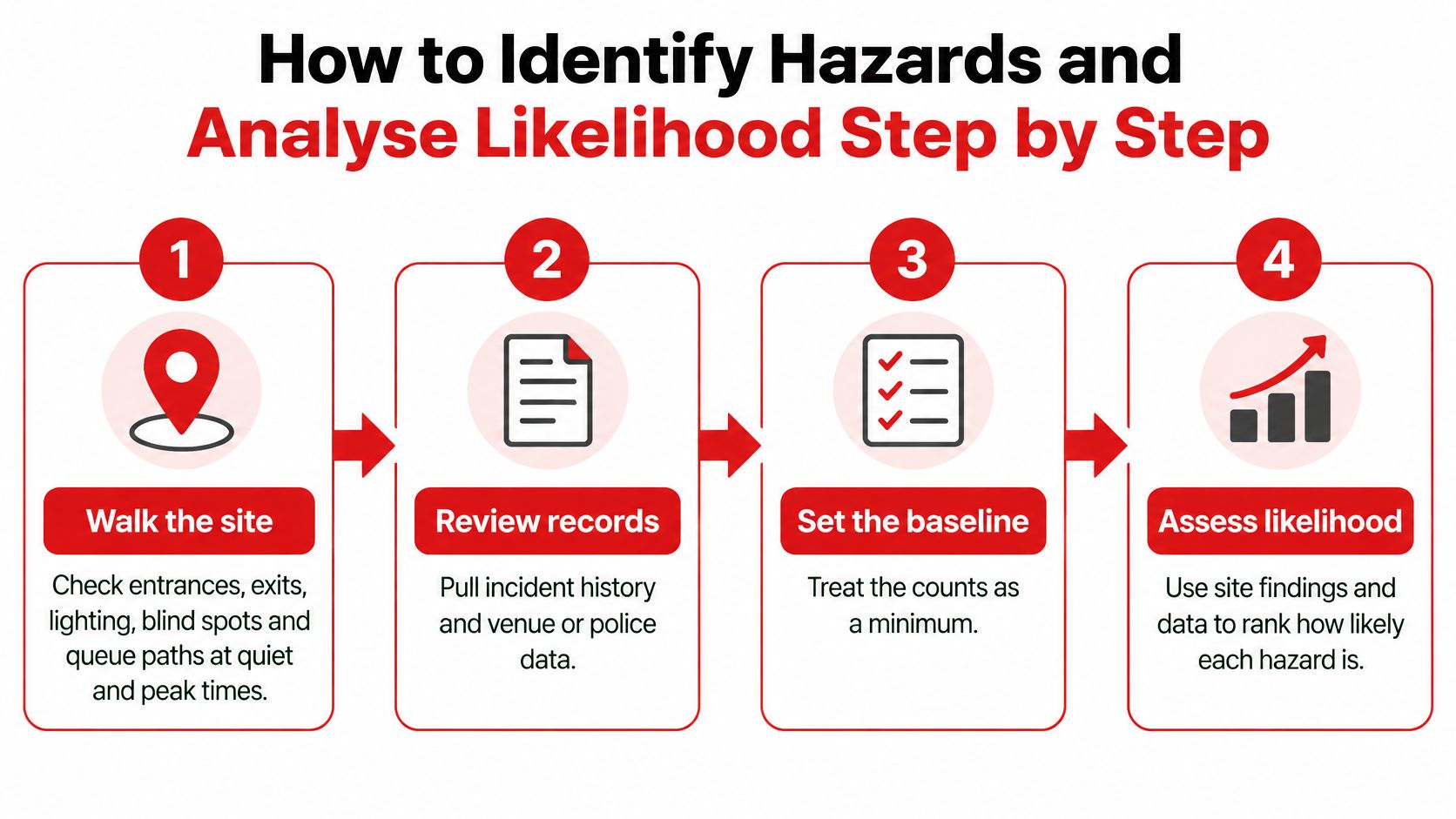

Estimate likelihood with a written scale. A one-to-five scale can help teams compare scenarios, provided each level has a plain-language definition. Base ratings on incident history, occupancy and operating conditions. A peak-arrival queue and a quiet service corridor at the same venue do not have the same exposure.
Consider consequences beyond injury. Assess evacuation complexity, service disruption, reputational damage and regulatory exposure, as well as potential harm to people. For each scenario, record its location, cause, current controls and the staff member who confirmed the site conditions.
Treat cyber-enabled failures of physical controls as site hazards too. For example, check whether a failure affecting access control, communications or CCTV could leave a post, entrance or response process without its intended protection. Record the system dependency and what evidence confirms how it operates.
A gate rating without crowd or arrival information is a guess dressed up as a score. Record missing evidence and gather it before relying on the likelihood estimate.
Building a Security Risk Assessment Matrix and Rating Each Risk
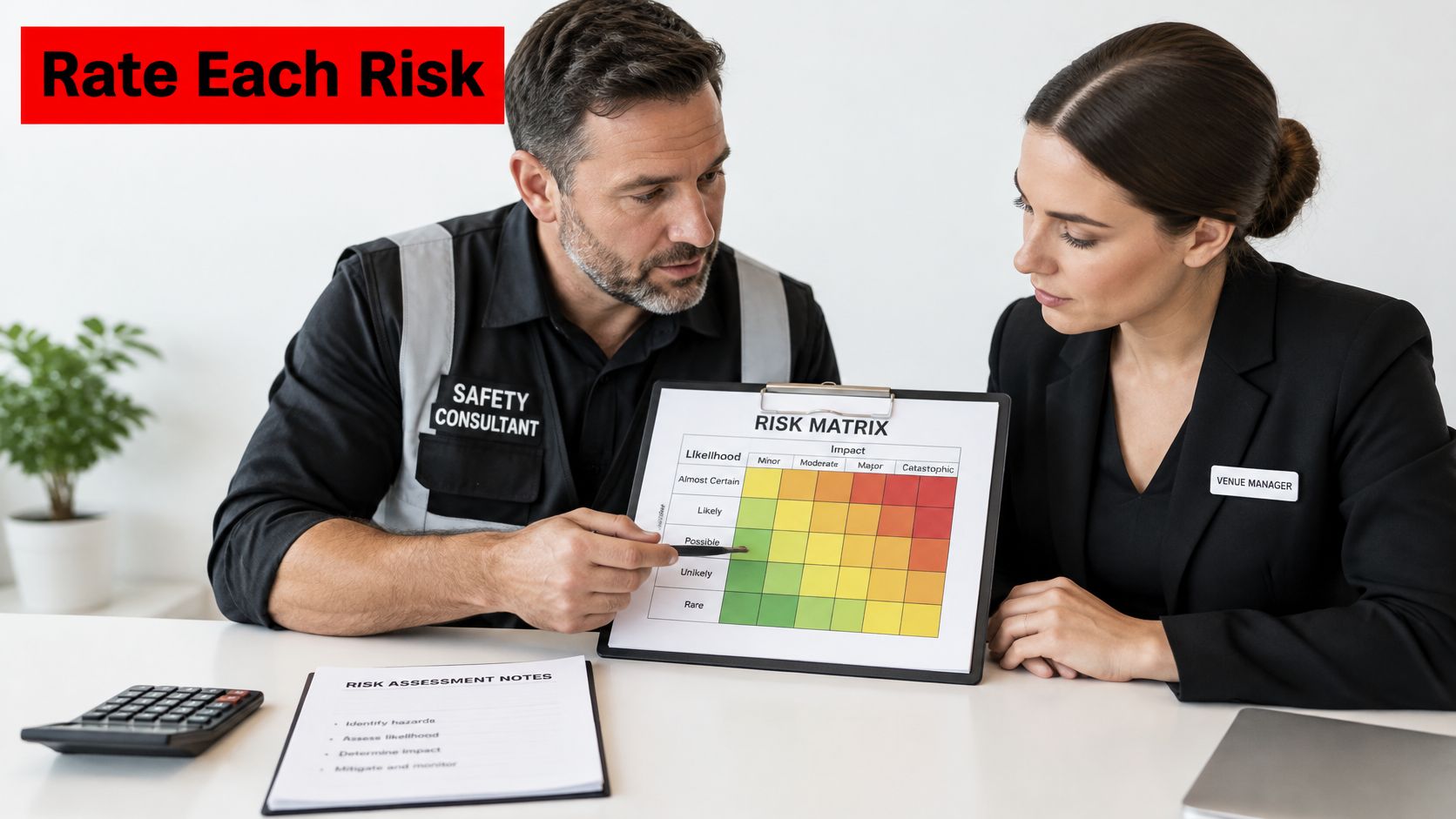
A festival gate can look controlled on paper and still become dangerous when a queue builds, a scanner fails or staff cannot communicate. A matrix makes these scenarios easier to compare, provided assessors use the same definitions and record the evidence behind each rating. The Australian government security-risk guidance sets out a sequence: assess existing controls, estimate likelihood and consequence, then decide how to treat the risk.
| Rating | Score range (1-25) | Required response | Example |
|---|---|---|---|
| Low | 1 to 4 | Accept and monitor | Minor litter spill near the bar |
| Medium | 5 to 9 | Treat within the normal roster cycle | Intermittent gap in a temporary fence |
| High | 10 to 16 | Treat before the event with owner sign-off | Gate B queue crush at peak arrival |
| High | 17 to 19 | Treat promptly, assign an owner and set a review point | Repeated access-control faults at a construction site |
| Extreme | 20 to 25 | Stop or redesign until controls reduce the rating | Unscreened entry during high alcohol service |
Set the organisation's response thresholds before scoring. The added 17 to 19 band closes the gap between High and Extreme, so every possible score has a clear response. The example descriptions are prompts, not fixed ratings: assessors must use site evidence, including incident records, crowd patterns and control performance.
Apply the matrix to Gate B
Suppose Gate B has a likelihood score of 4 and a consequence score of 5. Multiplying them gives a baseline score of 20, rated Extreme. The organiser adds a third entry lane, staggers ticket scanning and checks radios at each opening. With those controls operating, likelihood falls to 2, while consequence remains 5. The residual score is 10, rated High.
A High residual rating needs active management. Name the owner, specify what live monitoring should look for, and define the condition that triggers escalation. Record both baseline and residual scores, along with evidence that the added controls are in place. If radio checks fail or the queue begins to compress, the assumptions behind the residual score no longer hold.
Use site-specific evidence to test whether the score reflects actual conditions. A festival assessment might draw on arrival patterns and place-based crime data around access routes. At a construction site, check access records, incident reports and whether a cyber-enabled fault could disable a gate or camera. A digital control can fail in a physical setting, so assessors should record the dependency and its consequences alongside the site hazard.
Controls work in layers: deterrence, detection, delay, response and recovery. A guard may deter unauthorised entry, a barrier may delay it, and a radio call may trigger a response. A documented reopening process supports recovery. The Forge Reliability's guide to RPN explains a different scoring approach used for ranking failure modes; keep the security matrix's likelihood and consequence definitions clear rather than treating unlike scores as interchangeable. A higher score is a prioritisation aid, not a precise measure of how many times more dangerous one risk is.
A Worked Example
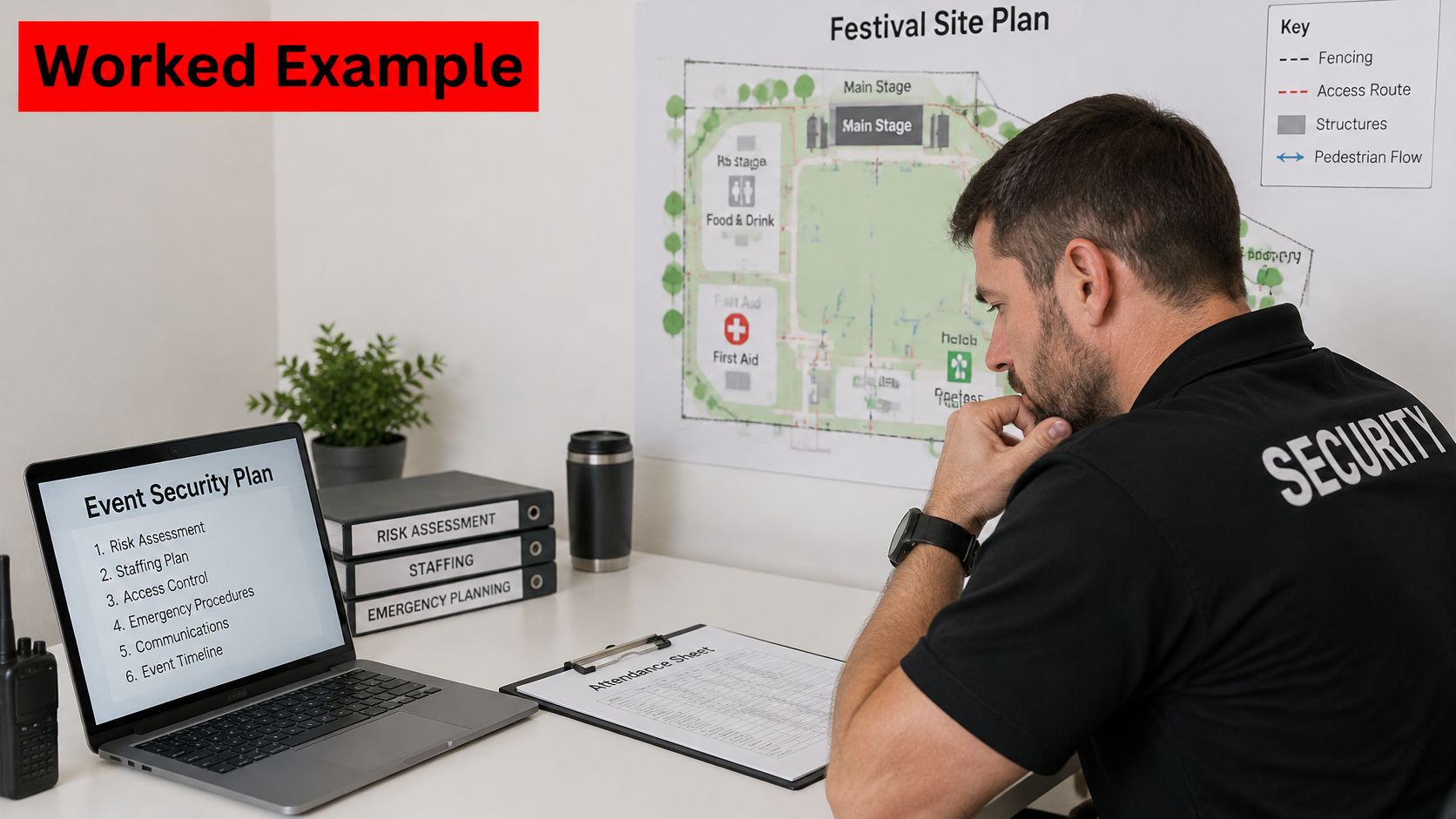
Consider a festival expecting 2,000 attendees, with two entry gates, a stage and a licensed bar. In NSW, crowd management is required for an event involving 100 or more people, according to NSW event-management guidance. Start by recording expected and peak attendance, how site capacity was calculated, crowd-flow rates and movement diagrams. These records help connect the planned roster and controls to actual operating conditions.
Walk the site with the event manager and venue representative. Check entrances and exits, lighting, mass-exit capacity, stage and barricade design, accessible facilities, water access, and crowd density near bars and gates. Record hazards such as overheating, crush and fire. Ask where arrivals will queue, which exit could become obstructed, and who can halt entry if a queue begins to compress.
The NSW major-events planning example lists one security person per 100 people as a planning benchmark, not an automatic roster. It also says there is no single standard approach to crowd safety, and identifies peak times, capacity management, crowd behaviour, infrastructure, roster roles, flow diagrams and agency coordination as assessment inputs (NSW major-events planning example). Adjust staffing to the event's risks. Alcohol service, layout, entry screening, barriers, dispersal routes, audience behaviour and threat information all affect what the plan needs to cover.
| Event hazard | Assessment question | Control | Owner |
|---|---|---|---|
| Entry gate crush | What is the peak arrival rate? | Staggered entry and a second lane | Gate supervisor |
| Stage barricade | Does crowd density exceed barrier design? | Barrier inspection and density checks | Site manager |
| Evacuation exits | Can every exit support a mass exit? | Exit capacity map and clear signage | Event manager |
| Alcohol service | Where does intoxication cluster? | Responsible service, ID checks and dispersal plan | Bar and security lead |
| Road closure interface | Who manages traffic and the crowd at the boundary? | Confirm applicable arrangements with the council and traffic authority | Organiser |
If the organiser closes public roads, confirm with the relevant council and traffic authority which traffic-control and crowd-management arrangements apply, then build them into the crowd-management plan. Treat each table row as a risk-register entry: record its location, baseline rating, control, owner, communication method and escalation action. Include the relevant peak time so roster planning and live monitoring reflect when the hazard is most likely.
GM GROUP Services works closely with clients to understand their sites, their customers and their security requirements. For a festival, this site-specific understanding helps keep the assessment grounded in the event's layout and operating needs, rather than relying on a generic staffing ratio.
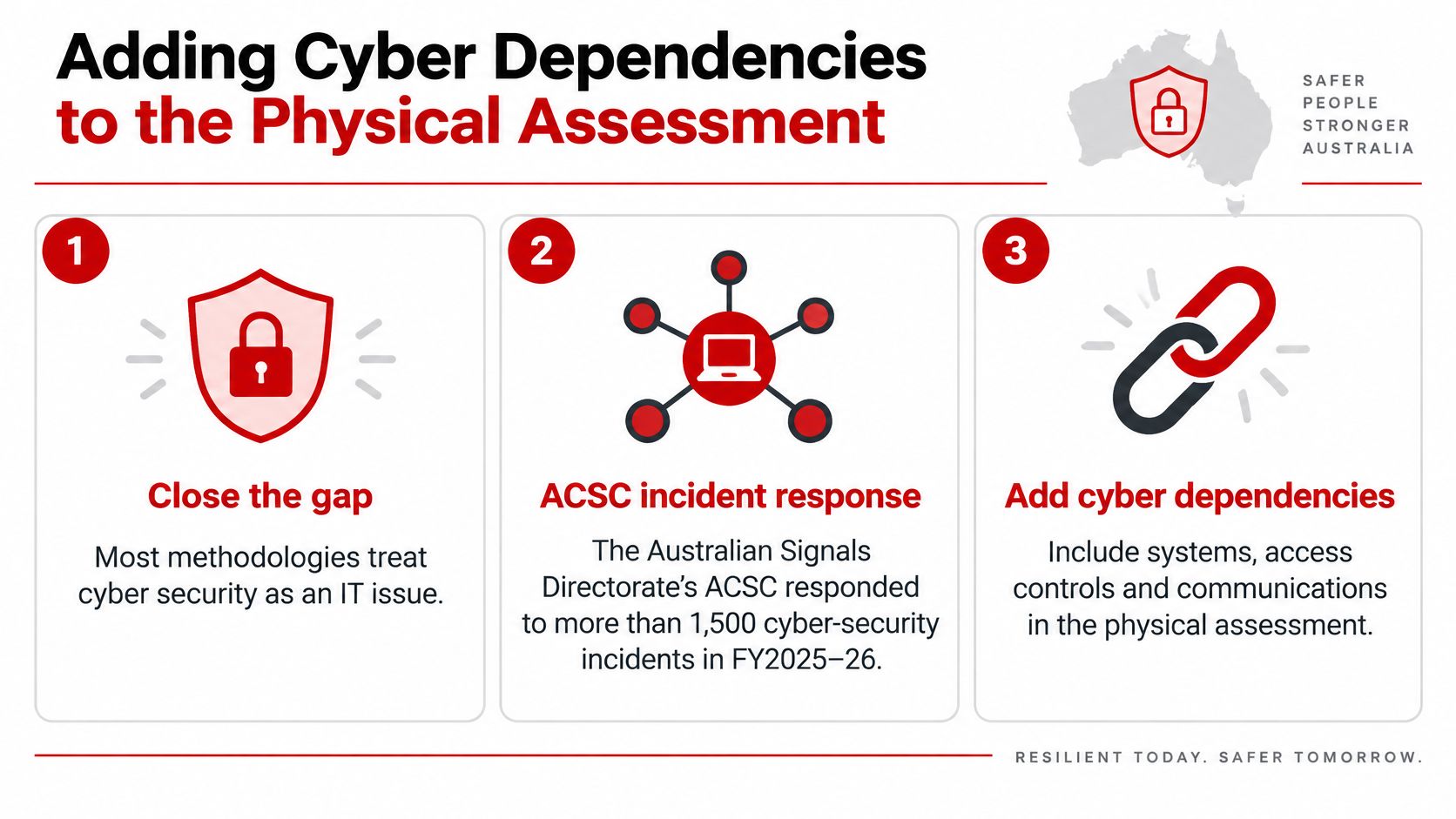
Adding Cyber Dependencies to the Physical Assessment
A physical security plan can fail because a digital system fails. Treating cyber security as an IT-only concern leaves out scenarios such as compromised access control, stolen staff credentials, disrupted CCTV, ransomware affecting ticketing or payments, and malicious changes to event announcements. Those failures can disable controls that guards and venue teams rely on.
The Australian Signals Directorate's ACSC reported responding to more than 1,500 cyber-security incidents in FY2025–26, a rise of more than 20% year on year, and notified entities of potentially malicious activity more than 4,400 times, an increase of almost 80%, according to its cyber security incident reporting. For event operations, the practical question is: if a system is unavailable or untrusted, what happens to entry, detection and emergency communication?
Map the dependencies before opening
List the systems the physical operation relies on: guards, radios, ticketing, CCTV, alarms, access control, payment systems and emergency communications. For each one, write down what fails operationally if it goes offline, who can authorise a change in operating mode and what manual fallback staff will use.
| Dependency | Failure question | Manual fallback to test |
|---|---|---|
| Ticketing | Can staff verify entry if scanning stops? | Printed guest list and manual count |
| Radios | Can teams communicate across the site? | Backup radio and agreed runner route |
| CCTV | Can staff observe entrances and vulnerable areas? | Physical patrol and staffed observation point |
| Access control | Can authorised staff enter without the system? | Verified paper access list and controlled key process |
| Emergency messages | Can organisers communicate if the platform is compromised? | Pre-agreed message approval and direct radio relay |
Test the fallback before gates open, not during an outage. For example, ask a supervisor to switch to the printed list, record who approved the change and confirm how duplicate entries will be prevented. Multi-site operators in NSW, Victoria, Queensland and the ACT should map each venue separately because systems, layouts and fallback options may differ. For a practical SME-focused companion, Networking2000's guide to assessing your SME's cyber security risks can help teams frame the digital side of the review.
Security Risk Assessment Methodology Register and Reporting Template
The risk register is where assessment findings become trackable work. Give every risk a unique ID tied to its location and activity, such as “Gate B, peak entry”. That reference should remain stable through planning, live operations and review, even if the control changes.
For each line, record the risk scenario and baseline likelihood and consequence before treatment. List existing controls and the evidence used to test them: a radio check across the footprint, for example, or a CCTV test that confirms the camera captures usable identification views. Then record the residual scores after treatment. This makes it possible to compare the original exposure with what remains.
Record the decision, not just the hazard
A useful register line includes:
- Risk ID and scenario: location, activity, cause and possible consequence.
- Baseline and residual ratings: likelihood, consequence and combined score before and after treatment.
- Control and evidence: what is in place, how it was tested and the result.
- Owner and trigger: one accountable person and the condition that requires escalation.
- Review details: next review date and the event or change that would bring it forward.
Suppose the risk is “Gate B queue compresses during peak arrival”. Record the baseline score, the extra entry lane and staggered scanning, then the residual score after the controls are tested. Name the gate supervisor as owner, specify the queue condition that triggers escalation and state how the duty manager will verify that the lane is operating safely.
Report to management in three parts. First, list High and Extreme risks with their owners. Second, identify risks whose residual scores didn't fall as planned. Third, state what changed since the previous report, such as a revised roster, new gate or altered schedule. Keep the register live during the event, and re-rate affected entries before the next operating period.
Common Failures and How to Fix Them
An assessment can look complete and still fail to guide anyone. Watch for these beliefs, then correct them in the same working document:
- “We only need to write this once.” Set an annual minimum review in your governance, then reassess after incidents, layout changes, new intelligence or contractor changes.
- “The right guard number solves the problem.” Tie each post to a specific rated risk, so staffing addresses actual hazards rather than relying on a generic figure.
- “A listed control is a tested control.” Check radio coverage at the furthest point and confirm CCTV provides a usable view before treating either as effective.
- “Our incident log shows the whole picture.” Treat recorded incidents as a floor, and create a way for workers and contractors to report concerns they might otherwise leave undocumented.
- “Someone will take care of the treatment.” Name one owner, an escalation trigger and a verification method for every control.
- “We keep records, so we learn from them.” Schedule a review of each incident against the relevant risk-register entry, then update the control or rating if the record shows a gap.
- “The plan still applies after a change.” Re-rate affected risks before the next operating period whenever layout, schedule, occupancy or access arrangements shift.
Incident records support decisions only when people use them. GM GROUP Services' security incident records support communication, follow-up and review of security-related incidents. Build that same discipline into your process: record what happened, assign follow-up and check whether the event changes an existing risk rating.
Frequently Asked Questions About Security Risk Assessments
How often should a security risk assessment be reviewed?
Set an annual minimum in your organisation's governance, then reassess sooner after incidents, layout or operating changes, new intelligence, or changes to occupancy and access. For a live event, review affected risks before the next operating period.
Who signs off the assessment?
Give every treatment a named owner, and have senior management approve the overall plan in line with AS ISO 31000:2018. The owner monitors the assigned action; management accepts or escalates the remaining risk.
Is an assessment the same as a risk-management plan?
No. In Victoria, the risk-management plan is a legal document required before licensed security work starts. The assessment is the analysis that informs that plan.
Do I need outside help?
If you close public roads in NSW, a professional consultant is required for crowd-security and traffic-control issues. Otherwise, consider your team's competence and any licence requirements. Book a review of your next event within 30 days and use the six stages in this guide as your checklist.
GM GROUP Services offers security risk assessments for events, venues, businesses and construction sites, connecting identified hazards with practical controls and review actions. To discuss your requirements confidentially or request a quote, visit GM GROUP Services.