



Security patrols Perth is usually a search people make when something is already keeping them awake. You've got a warehouse that sits empty after dark, a retail site with repeated after-hours issues, a construction project full of portable assets, or a venue team that can't be the last line of defence once staff go home.
That's where patrols help, but only when they're used properly. A patrol car driving past a gate isn't a strategy on its own. Real value comes from matching the patrol model to the site, setting clear instructions, and making sure every attendance creates a record you can act on later.
In Perth, that approach isn't limited to private business. The City of Belmont Community Watch patrol program uses 24/7 mobile patrol coverage, operates three Belmont Community Watch vehicles throughout the year, and offers residents a Holiday Watch Patrol for up to one month. That matters because it shows patrol-based security is already part of routine community safety thinking in the Perth metro area, not just a private add-on.
Your Complete Guide to Security Patrols Perth
If you leave a site unattended overnight, the question isn't whether you need security presence. It's what kind of presence gives you the most control for the money you're spending.
For many Perth businesses, security patrols Perth makes sense because the city's layout rewards mobility. Industrial areas, suburban retail strips, car parks, schools, hospitality precincts, and construction sites often need checks across multiple entry points rather than one officer standing at one fixed post all night. A patrol model can handle that well when the route, timing, and response instructions are thought through in advance.
Why patrols matter in real operations
A good patrol service does three jobs at once:
- Deters unwanted behaviour: Marked vehicles, visible checks, torchlight inspections, and officer presence can change how a site looks to opportunistic offenders.
- Detects problems early: Patrols pick up open gates, broken fences, suspicious vehicles, damaged locks, lighting failures, and signs of attempted entry.
- Triggers response: Once an issue is found, the officer can escalate, verify alarms, secure access points where possible, and document what happened.
That last point is where buyers often get it wrong. They buy presence, but they really need a risk-control process.
Practical rule: If your patrol provider can't explain what happens from observation to escalation to reporting, you're buying visibility, not a security system.
What works in Perth and what doesn't
Patrols work well when the site risk is spread across space and time. They're useful for after-hours lock-ups, alarm attendance, perimeter inspections, vacant property checks, and visible presence across several assets.
They work poorly when a site needs constant access control, immediate hands-on intervention at a single point, or continuous supervision of staff and visitors. In those cases, a static guard, concierge-style officer, or integrated control model is often the better fit.
The practical standard is simple. Use patrols when mobility is the advantage. Don't use them as a cheap substitute for a fixed presence that your site requires.
What Are Mobile Security Patrols and How Do They Work
Think of mobile patrols as a professional neighbourhood watch for commercial property. The difference is that the service is structured, task-based, and tied to response procedures rather than casual observation.
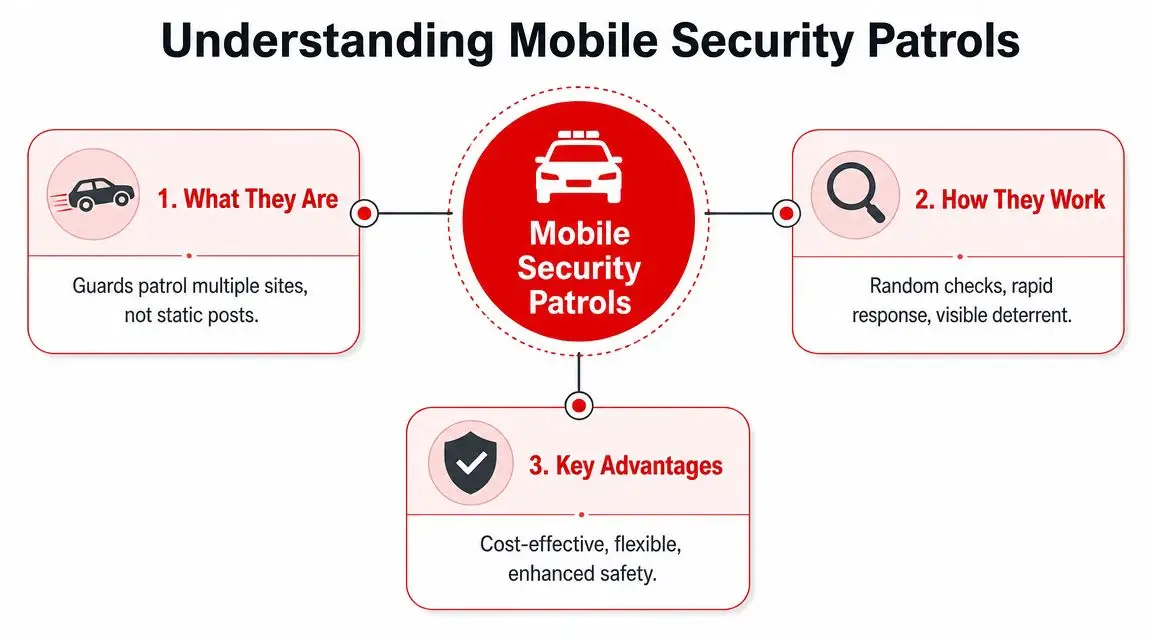

A mobile patrol officer doesn't stay at one doorway all shift. The officer travels between designated sites, attends at agreed intervals or randomised times, checks access points, looks for irregularities, and responds to alarms or suspicious activity. That model suits Perth because many businesses operate in low-density suburban or industrial areas where several properties can be covered by one route. Perth providers describe patrols as regular vehicle checks of designated properties, with marked vehicles and trained officers used to protect assets and respond quickly to suspicious activity or alarm events, as outlined by Taskforce Security's Perth mobile patrol overview.
The three operating functions
Most patrol programs come down to three operational functions.
Visible deterrence is the one people notice first. A marked vehicle entering a lot, stopping at a gate, or checking the rear of a building tells anyone watching that the site isn't unobserved.
Detection is the core task. The officer checks things that often change before a serious incident develops, such as an unsecured roller door, fresh vehicle tracks near a compound, or a side gate that should be locked.
Response is what gives the service operational value. An officer may verify an alarm, contact the nominated manager, wait for police where required, isolate an access point, or document a defect for repair the next morning.
How mobile patrols differ from a static guard
A static guard gives continuity at one location. A mobile patrol gives coverage across multiple locations or multiple vulnerable points within a larger area.
That means each model solves a different problem.
| Security need | Better fit |
|---|---|
| One entrance needs continuous control | Static guard |
| Several sites need regular after-hours checks | Mobile patrol |
| Alarm activations need attendance | Mobile patrol |
| A venue needs active supervision of people flow | Static guard or roaming on-foot team |
Mobile patrols are strongest when the risk is distributed, not concentrated in one doorway.
Where the model usually fits best
In Perth, mobile patrols are commonly suited to:
- Industrial sites: Perimeter checks, gate security, plant compound inspections
- Retail and offices: Lock-up verification, after-hours attendance, car park sweeps
- Construction projects: Fence-line checks, material storage inspections, alarm response
- Community and education settings: External patrols, access checks, incident reporting
The model is efficient, but it depends on route design and site instructions. If the patrol only “shows presence” and doesn't inspect the places where incidents begin, the service quickly turns into theatre.
Common Patrol Types and Their Best Use-Cases
The most common mistake buyers make is asking for “a patrol” as if it's one standard service. It isn't. Patrol work can mean very different things depending on the site, the shift, and the outcome you need.
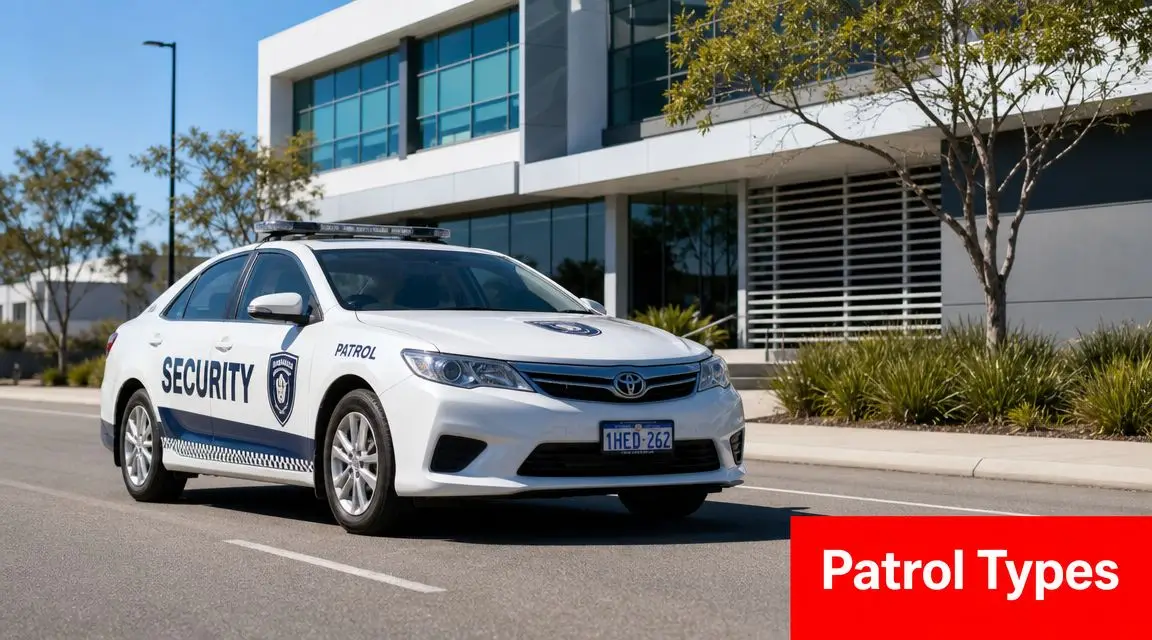
Vehicle patrols for broad after-hours coverage
A construction manager in Perth's outer industrial belt usually doesn't need an officer sitting in one spot all night. What they need is a patrol car arriving unpredictably, checking the fence line, inspecting material laydown areas, and confirming that site sheds and gates are secure.
That's where vehicle patrols fit best. They cover space efficiently and create visible uncertainty for anyone testing the site. If theft risk is spread across multiple compounds, parking areas, or entry points, a mobile route is often more useful than a fixed guard staring at one gate.
Lock-up and unlock services for routine control
A suburban retail manager has a different problem. Staff want to close up and leave without carrying the burden of final perimeter checks, rear-lane inspections, and making sure the premises is secure.
A lock-up service handles that task properly. The officer attends, checks doors, gates, windows, alarms, lights, and agreed shutdown points, then records completion. In the morning, the same model can support an opening procedure that reduces the risk of a lone staff member entering a site that may have been tampered with overnight.
This type of service is particularly useful when the risk isn't dramatic but the routine is easy to get wrong.
Alarm response for fast verification
A monitored alarm is only as useful as the process that follows activation. If an office manager gets an alert at night, someone still has to verify whether it's a false activation, a fault, or a genuine issue.
Alarm response patrols are built for that. The officer attends, checks the exterior, looks for signs of forced entry, follows escalation instructions, and documents the result. That prevents senior staff from driving to site at odd hours without training, context, or support.
If your alarm response plan relies on a tired manager attending alone, that's not a plan. It's risk transfer.
Foot patrols for people-heavy environments
A hospitality venue, event site, or shopping complex often needs something a vehicle can't provide. The issue isn't just perimeter exposure. It's behaviour, access, blind spots, amenities, loading zones, and crowd movement.
In those settings, on-foot patrols are more useful because officers can inspect internal areas, engage with people, and stay visible in the exact places where issues start. The patrol pattern may still be mobile in concept, but the delivery is different.
Matching the patrol type to the problem
The right fit usually comes down to one question. Are you trying to secure a point, a route, or a pattern of risk?
- Point risk: Use a static presence.
- Route risk: Use vehicle patrols or foot patrol loops.
- Pattern risk: Combine lock-ups, random attendances, and alarm response.
That's the mindset that turns security from a generic service request into a practical operating model.
The Measurable Benefits of Security Patrols for Perth Businesses
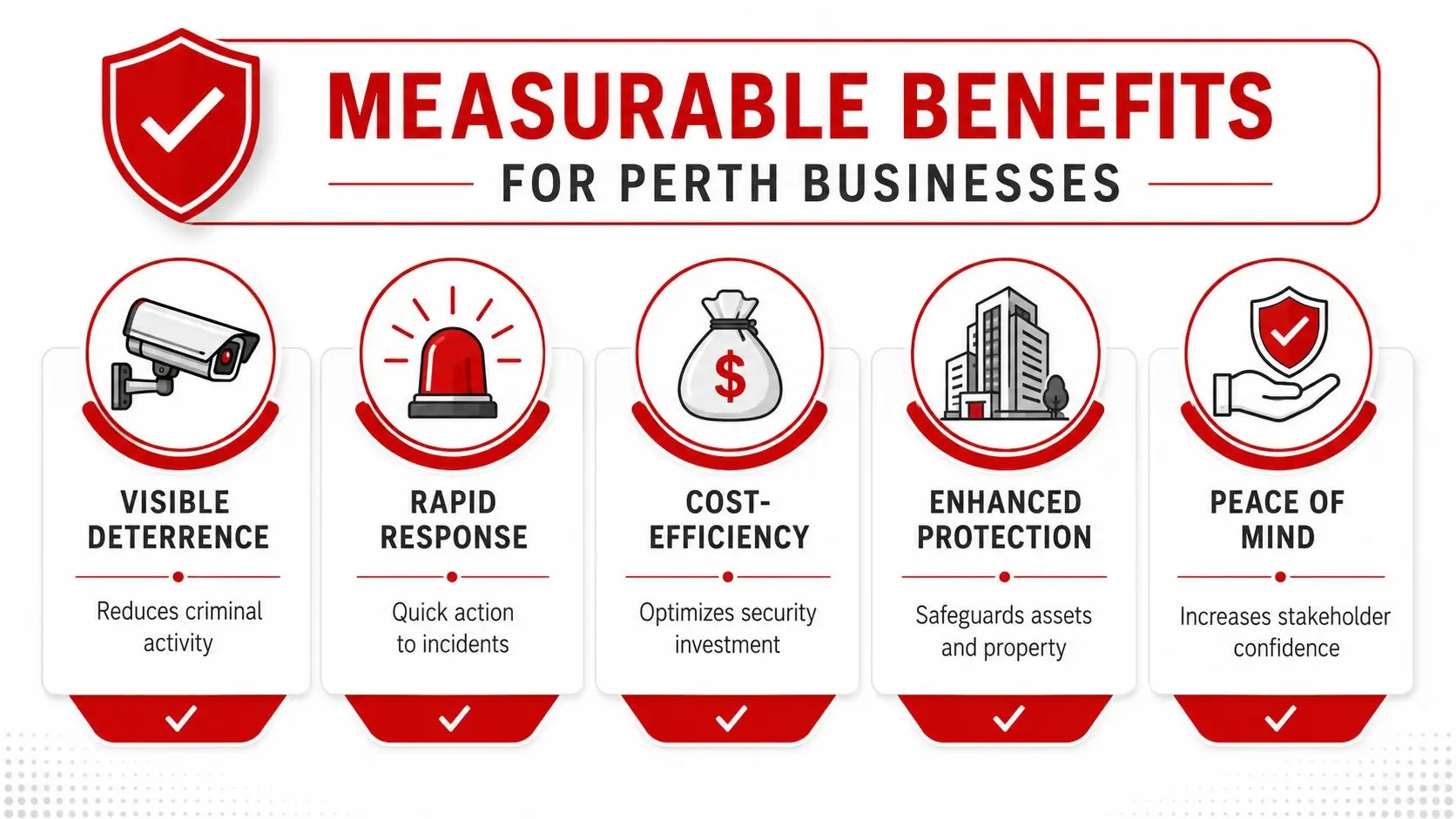
Patrols are often sold on deterrence alone. That undersells them. The better reason to use them is that they create repeatable checks, visible intervention, and documented exceptions across times when managers aren't on site.

One commercial benchmark helps frame the scale of the service model. Southern Cross Protection states that it conducts over 16,000 security patrols each night nationally and that its Perth branch offers patrol-related services including campus patrols, lock-up, access control, CCTV, and emergency planning. It also states it has over 90 years' experience. You can review those claims on Southern Cross Protection's Perth security company page. The point isn't that volume guarantees quality. It shows patrol security sits within a mature operating model, not a niche service.
Benefit one is deterrence with purpose
A marked patrol vehicle changes the feel of a site. For a hospitality venue with repeated loitering near the rear entrance, visible attendance can push unwanted activity away from staff exit points and delivery areas.
But deterrence isn't magic. It works best where people can see the patrol and where the site has basic supporting controls, such as working lights, functioning locks, and clear boundaries. A dark, poorly maintained site with no access discipline won't become low-risk just because a patrol car visits it.
Benefit two is earlier detection of minor failures
Many overnight losses don't begin with a major breach. They begin with a side gate left unsecured, a service door that didn't latch, or a fence panel loosened over time.
A patrol program catches those smaller failures before they stack into a larger incident. On a commercial site, that can mean identifying signs of tampering before the next night's attempt. On a retail premises, it can mean finding an access point that staff assumed was secure.
Benefit three is a faster chain of action
Patrol attendance gives you a practical bridge between an alert and a decision. The officer can confirm conditions on the ground, contact the right person, and apply the site instructions already agreed.
That's much more useful than a generic notification landing in someone's inbox after midnight.
Good patrols don't just observe incidents. They shorten the time between discovery and action.
Benefit four is stronger reporting and accountability
The strongest patrol programs leave an audit trail. You should know when the officer attended, what was checked, what was found, and what happened next.
That record matters for internal reviews, landlord disputes, contractor follow-up, and insurance conversations. It also matters for recurring issues. If the same blind spot keeps appearing in reports, the right fix may be lighting, gate automation, or access control rather than “more patrols”.
Benefit five is better use of security spend
For sites that need coverage across several assets or after-hours windows rather than continuous guarding, patrols can be a smarter deployment model. The value isn't that they're cheap. The value is that they can be targeted.
Use them for the hours, points, and triggers that matter most. Don't pay for full-time static coverage if the requirement is lock-up integrity, alarm verification, and a visible check at vulnerable times.
Setting Service Level Expectations Technology and Reporting
Average patrol providers talk about presence. Good providers talk about verification, escalation, and records.
In practice, the gap comes down to technology and reporting discipline. Securitas describes mobile patrol services as using “state of the art technology,” “digital report recording,” and “real-time communication” in its mobile patrol services overview. That combination matters because it reduces the delay between what the officer sees, what the control function knows, and what the client receives.
What good reporting should look like
You shouldn't have to guess whether a patrol occurred. A professional service should be able to show:
- Time-stamped attendance records: So you can verify that the patrol happened when expected
- Incident-based notes: Not vague comments, but clear observations tied to the site instruction
- Photo evidence where appropriate: Especially for damage, forced entry indicators, graffiti, or unsecured access points
- Real-time escalation: If the issue needs immediate client awareness, the message shouldn't wait until the next morning
If your site has gates, loading access, or recurring perimeter issues, it also makes sense to upgrade your gate access so patrol officers and authorised users can work within a cleaner access process instead of relying on ad hoc key handling.
The standards worth asking for
Ask direct questions before signing anything. How are patrols recorded? How are exceptions escalated? What reaches the control room live, and what only appears in an end-of-shift report?
Then ask one more. What evidence will I receive when something goes wrong?
That answer tells you whether the provider is operating a measurable system or just sending cars around a route.
Why communications matter during an incident
Real-time communications are especially important on multi-site portfolios. If one patrol officer finds forced entry at a tenancy or suspicious activity near a compound, the provider needs a reliable way to trigger instructions, update the client, and keep the response coherent.
That's also where some providers fall short. They can attend, but they can't coordinate. In live operations, attendance without communication creates delay, confusion, and weak documentation.
How to Choose and Brief Your Perth Security Patrol Provider
At 2:15 am, a patrol officer reaches your site after an alarm. The true test starts in the next few minutes. Can the officer get in without delay, verify whether the event is genuine, protect the scene if there is an offence, and escalate to the right contact under WA requirements? That outcome depends less on the quote and more on the provider's operating standard.
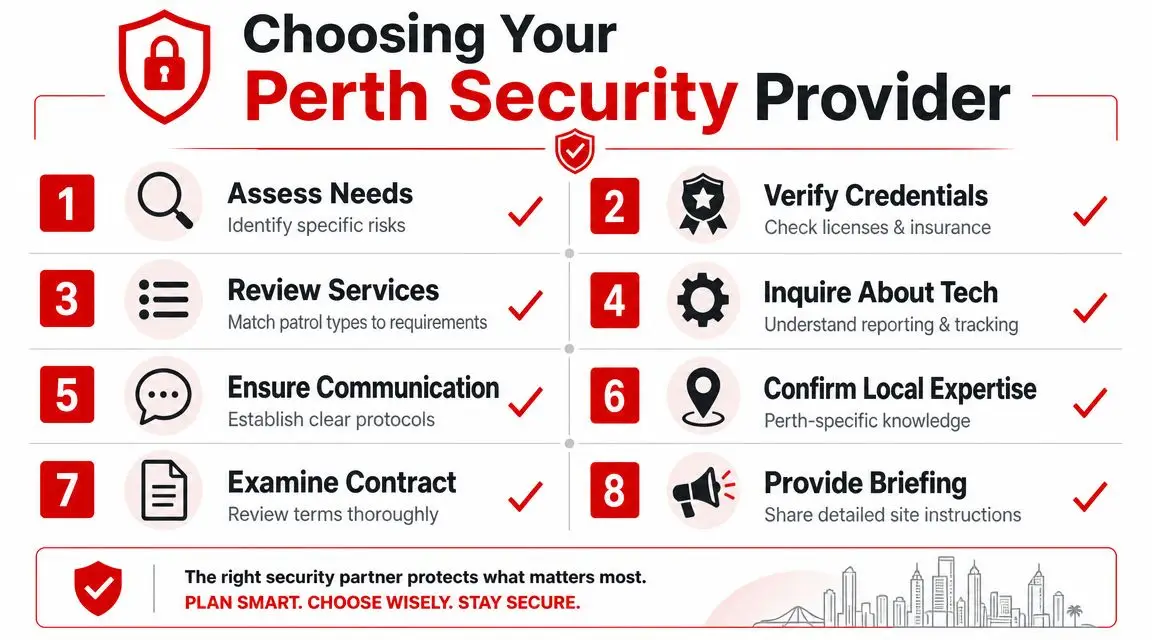
A patrol provider should fit into your broader risk controls, not just drive past the property. That means asking how patrols are planned, how exceptions are handled, and how performance is checked over time. Earlier industry guidance from Wilson Security framed mobile patrols as one layer in a wider protection model, not a stand-alone fix, in its mobile patrol threat prevention article.
Questions that show how the provider actually operates
Price matters, but it should come after the operating model is clear.
Ask questions that expose how the service will perform on a live site:
- How do you decide between scheduled and random patrols? The answer should refer to site risk, offender behaviour, access patterns, and whether timing or unpredictability matters more.
- What does an officer do when conditions on site do not match the brief? Look for a defined escalation path with decision limits, not improvised judgement.
- How are officers supervised after hours? A provider needs active control room oversight, welfare checks, and review of patrol completion and incident handling.
- How do you work with existing alarms, CCTV, and access control? Patrols should support the systems already on site and close gaps those systems cannot cover.
- How is performance measured? Useful answers include attendance windows, missed checkpoint review, incident closure times, and report quality.
Those questions separate a provider with a managed patrol system from one that is only filling shifts.
WA compliance and service quality checks
In Western Australia, patrol work sits inside a regulated environment. Licensing is only the starting point. Buyers should also check induction quality, site instructions, record keeping, and how the provider handles incidents that may require police attendance or preservation of evidence.
Use this quick assessment:
| What to check | Why it matters |
|---|---|
| Current security licensing | Confirms the provider and officers are authorised to perform the work |
| Site-specific instructions | Reduces inconsistent decisions across shifts and officers |
| Reporting process | Gives you a usable record for audits, claims, and incident follow-up |
| Supervision model | Improves consistency on nights, weekends, and public holidays |
| Continuity planning | Reduces service drop-off when staff or rosters change |
A low rate can hide expensive weaknesses. If patrols are missed, reports are vague, or incident handling is poor, the client carries the operational and legal risk.
How to brief a provider properly
Even a good patrol team will struggle with a weak handover. The brief should tell officers what matters on your site, what authority they have, and what must be escalated without delay.
Include:
- Site map and access points: Gates, rear entries, plant areas, roof access, blind spots
- Priority risks: Theft-prone stock, copper, tools, fuel, staff exit routes, vulnerable tenancies
- Escalation matrix: Who gets called, in what order, for which event type
- Authority limits: What officers can lock, isolate, challenge, photograph, or wait on
- Known nuisance patterns: Recurring loitering, delivery conflicts, false alarm zones, contractor issues
The best briefs also set measurable expectations. Define whether you need lock-up confirmation by a certain time, alarm attendance within an agreed window, checkpoint verification on high-risk assets, or photo evidence for specific defects and breaches. If those standards are not written down, they are hard to enforce.
A capable provider will test your brief before service starts. They should ask about key control, after-hours contacts, safe entry points, police call criteria, and any site conditions that change by day of week or tenant use. If they do not ask, they are likely preparing a generic patrol run rather than a site-specific risk control.
Frequently Asked Questions About Security Patrols
How much do security patrols in Perth cost
Costs vary because patrols are usually priced around task load, travel, timing, and risk. A single lock-up visit with clear access instructions is a different job from multiple overnight checks, alarm attendance, and welfare inspections across a larger site. In practice, the price only means something once the provider has looked at site layout, access constraints, reporting requirements, and response time expectations.
Cheap patrol pricing often hides the true trade-off. You may get fewer checkpoints, weaker incident notes, slower alarm attendance, or a patrol run built for driver efficiency rather than site risk.
Should I choose random or scheduled patrols
Choose the pattern that matches the problem you are trying to control.
Scheduled patrols suit duties with a fixed time requirement, such as lock-ups, openings, contractor arrivals, and compliance checks. Random patrols are better for sites dealing with trespass, theft from yards, or repeat nuisance activity, because predictable attendance is easy to watch and work around.
Many Perth sites need both. A retail precinct may need a fixed lock-up patrol, then irregular after-hours drive-throughs. A construction site may need timed perimeter checks early in the project, then more random coverage once valuable plant, tools, and copper are on site. The right model is the one you can measure against incident patterns, not the one that sounds more active on paper.
What should I give a new patrol provider on day one
Provide enough information for the patrol team to act correctly under pressure. That includes keys or access instructions, alarm codes and response procedures, after-hours contacts, site hazards, areas that need photo verification, and a clear escalation path for different incident types.
WA compliance matters here as much as site knowledge. Your provider should be deploying properly licensed officers and running a control process that supports accurate records, lawful conduct, and consistent supervision. If a patrol officer attends an incident and the reporting is weak, the service has little value when you need to review what happened later.
Service quality is also easy to overestimate at the buying stage. A useful external overview on that point is Citiguard's guide to types of security patrols, which raises the practical difference between attending a site and running a patrol service with training, supervision, and reporting discipline behind it.
Are mobile patrols enough on their own
Sometimes yes. Sometimes no.
Mobile patrols work well for dispersed assets, low to moderate risk sites, after-hours checks, and businesses that need visible coverage without paying for a static guard all night. They are less effective where there is constant public traffic, high confrontation risk, or a need for immediate on-site intervention at all times.
For higher-risk sites, patrols usually work best as one layer in a broader control plan. That can include alarms, CCTV, access control, lighting, site hardening, and a clear incident escalation process. Patrols should support those controls, verify that they are working, and close obvious gaps.
What should I expect in patrol reports
Expect reports that help you manage risk, not just confirm attendance. Good reports record arrival and departure times, patrol route or checkpoints, exceptions found, actions taken, photos where needed, and who was notified. If an officer finds an unsecured gate, vehicle damage, fence breach, or signs of attempted entry, the report should make the event clear enough for a manager, insurer, or investigator to follow without guesswork.
If reports are vague, you cannot measure patrol quality properly. You also cannot tell whether recurring issues are getting worse, staying static, or being controlled.