


Security Guard License NSW becomes a practical issue the moment a venue manager needs to fill a late shift, an event organiser receives a replacement guard, or a new applicant pays for training without checking the correct licence pathway. The immediate temptation is to confirm that someone has “a licence” and move on. That shortcut is where many compliance problems begin.
In NSW, licensing covers more than the initial application. The individual needs the right class and activity authority, while the business engaging or subcontracting security personnel needs the appropriate master licence. The NSW Security Industry Act 1997 sets the legal framework, and Service NSW's security operative licence guidance explains the application pathway. The operational lesson is straightforward: check the person, the task, and the employer before the first shift.
Eligibility Requirements Before You Apply
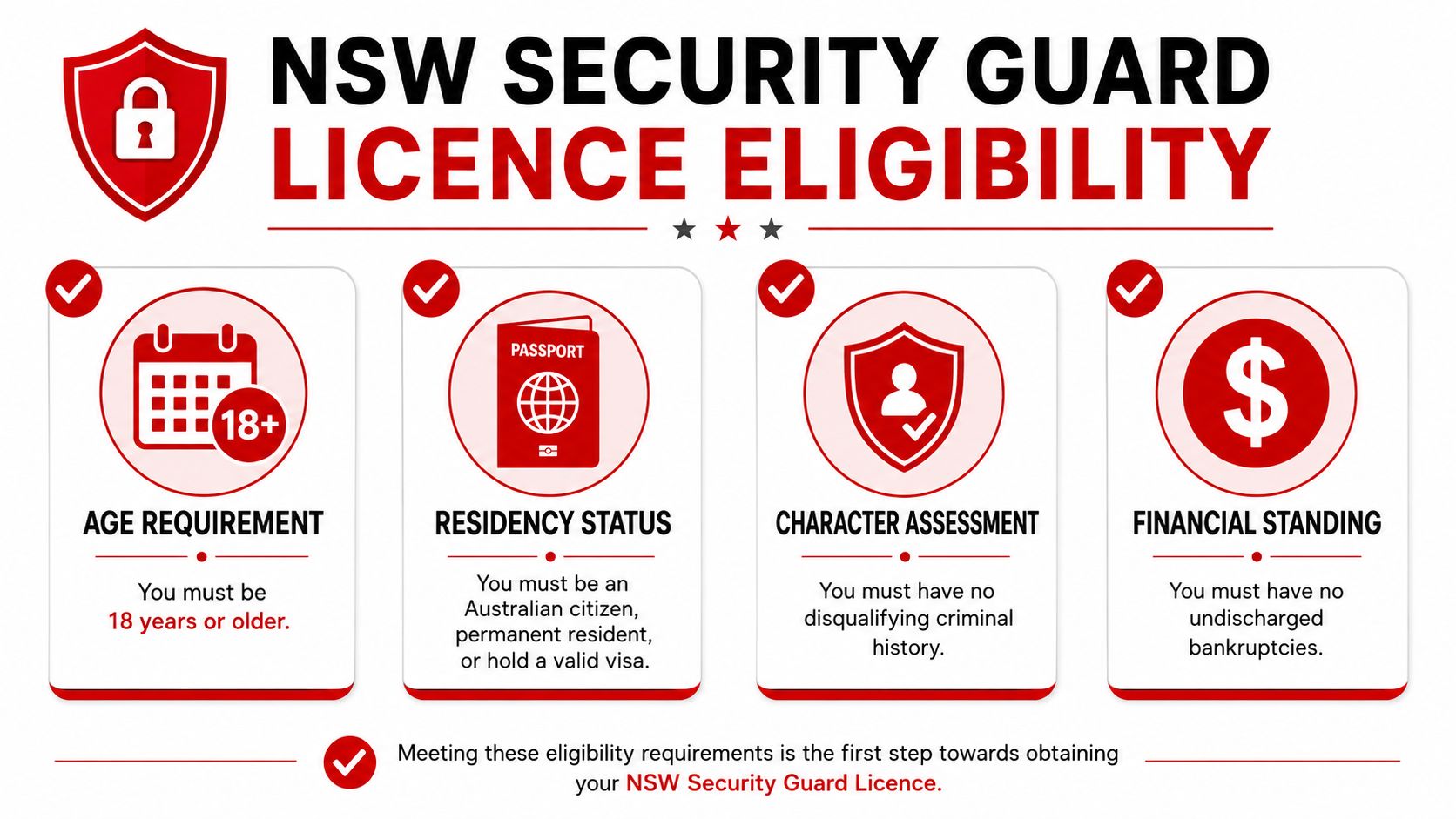
A prospective guard often starts with the wrong question, usually, “Which course should I book?” The better starting point is whether you meet the basic requirements for a security guard license NSW applicants must satisfy. NSW licensing is regulated under the Security Industry Act 1997, and applicants apply to the Commissioner in the approved form, pay the prescribed fee, and provide the required information.
The baseline is clear. You must be at least 18 years old, and the regulator assesses fitness, character, training, and identity before approving a licence. The process is designed as a probity assessment, not a simple registration exercise. That matters if your background includes interstate or overseas addresses, identity documents with inconsistent details, or matters that need explanation.
Get your evidence organised first
Before enrolling, prepare the information the application will require. Use consistent names across identity documents, training records, and the application. If your documents show different addresses or spelling, resolve the discrepancy or obtain supporting evidence before submission rather than waiting for SLED to ask questions.
The character assessment also deserves an honest review. A past offence doesn't automatically answer the outcome by itself, but relevant criminal history can affect whether an applicant satisfies the regulator's fitness and character requirements. Don't conceal information or assume an old matter will be ignored. Give the regulator a complete, accurate picture.
Identity verification forms part of the process. NSW licensing includes probity checks, and master licence applicants may also face fingerprints and other verification requirements under the NSW framework. An applicant with overseas or interstate history should allow extra attention to document quality and disclosure.

Practical rule: Don't pay for a course until you've confirmed your identity documents, work rights, age, and character position with the training provider and the relevant NSW licensing guidance.
Approved Training and Certificate Pathways
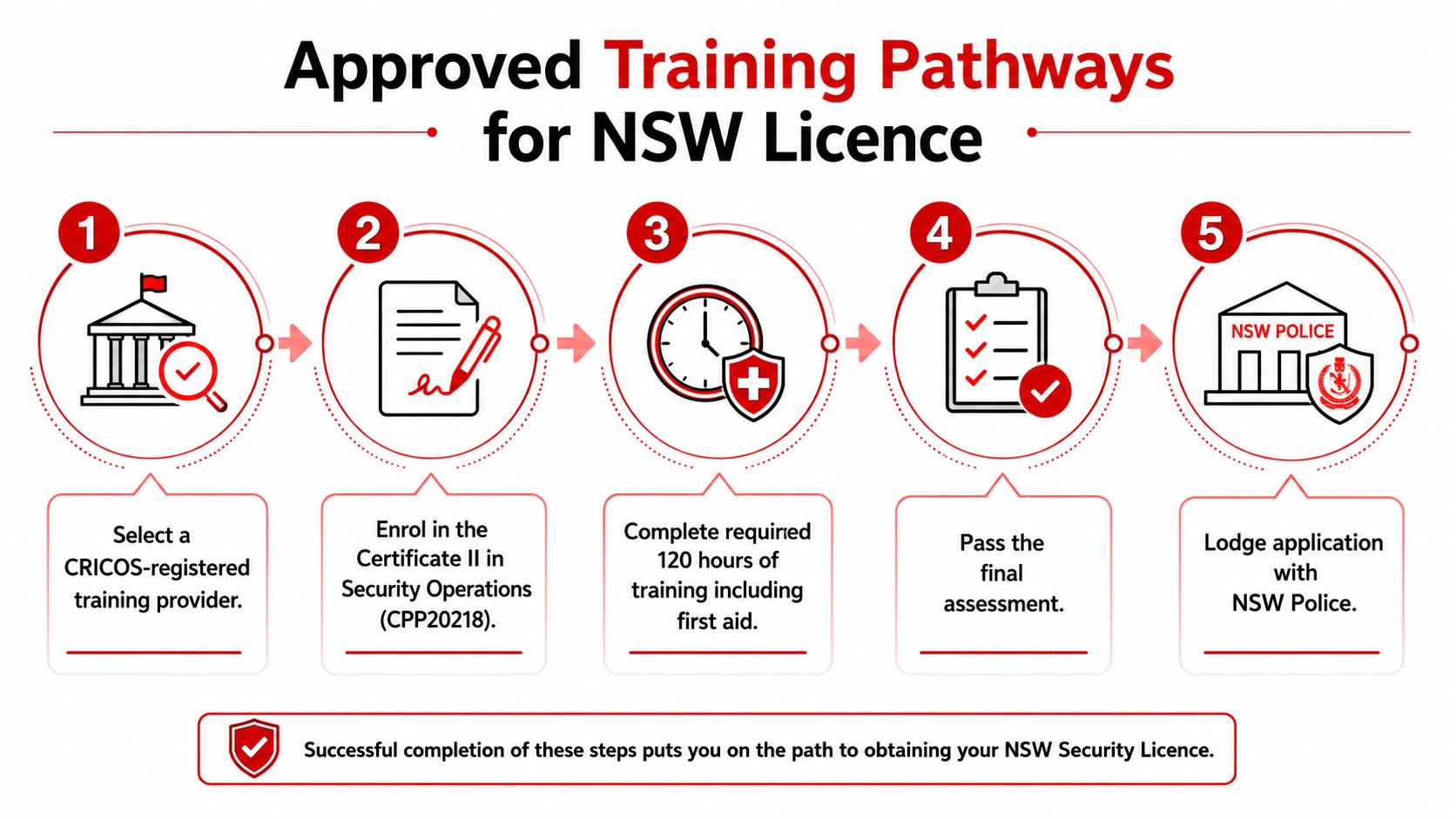
Training must match the work you intend to perform. For most front-line unarmed guard and crowd controller applicants, the recognised entry pathway is CPP20218 Certificate II in Security Operations. This qualification supports the Class 1A security operative pathway, but completing a course doesn't give you permission to work by itself. You still need to apply for and receive the appropriate NSW licence.
Service NSW confirms that applicants must have enrolled in or completed SLED-approved training. That wording is important. A provider may advertise a security course, but you should confirm that its delivery and evidence align with the regulator's requirements before paying an enrolment fee.
Match training to the intended role
A crowd controller at a licensed venue, a static guard at a retail centre, and a mobile patrol worker may share core security skills, but their operational duties aren't identical. Start with the site task, then check the licence class and any required training units.
For example, an applicant targeting festival entry control should focus on the Class 1A pathway and the practical skills required for lawful crowd control. Someone planning to handle a guard dog needs the relevant subclass-specific training and approval. A person moving into armed guarding needs the additional pathway required for that higher-risk activity. A basic qualification should never be treated as a blanket authorisation for specialist work.
Check the provider before enrolling
Ask the registered training organisation to identify:
- Recognition: Confirm that the course is nationally recognised and built around CPP20218 Certificate II in Security Operations where that is the applicable pathway.
- Regulatory alignment: Ask how the provider confirms its training is accepted for the relevant SLED licence application.
- Role coverage: Check whether the course supports the exact Class 1 or Class 2 activity you're targeting.
- Assessment evidence: Keep enrolment, completion, and assessment records together for the application.
The most expensive mistake isn't always choosing a costly course. It's completing training that doesn't support the work you later accept. Licence class and task scope should guide the course decision from the beginning.
Submitting Your Security Guard Licence NSW Application
Once your eligibility and training evidence are ready, submit the application through the NSW licensing process. Service NSW is the practical starting point for an individual security operative application. Have your identity information, training evidence, and the details requested in the approved form ready before you begin.
The common delays are usually avoidable. Names must match across documents, training evidence must relate to the selected licence activity, and the applicant must choose the class that reflects the work they intend to perform. A guard trained for standard unarmed duties shouldn't select a specialist activity just because it appears to offer broader work.
Budget against the correct licence category
NSW licences may be issued for a one-year or five-year term. The fee depends heavily on the licence subclass, particularly for master licences. The NSW Police fee information gives the following examples:
| Licence Type | 1-Year Fee | 5-Year Fee | Common Use Case |
|---|---|---|---|
| MA | $160 | $640 | Lower-volume master licence category |
| ME | $5,225 | $20,900 | Higher-risk or higher-cost master licence category |
These are master licence examples, not a universal individual operative fee. The NSW Police master licence guidance and fee information should be checked before budgeting or quoting compliance costs. The gap between categories can materially change the decision between a shorter and longer licence term.
Submit clean evidence
Use a simple document check before lodging:
- Identity consistency: Confirm names, dates, and personal details match.
- Training evidence: Attach the evidence requested for the selected activity.
- Probity readiness: Be prepared for identity verification and any required checks.
- Licence selection: Map the job duties to the relevant subclass before submitting.
Late renewal fees apply where renewal is lodged after expiry but within the permitted window. Don't build renewal around the last possible day. A venue roster can't safely depend on an application that has become uncertain because the licence was allowed to lapse.
Understanding Class 1 and Class 2 Licence Differences
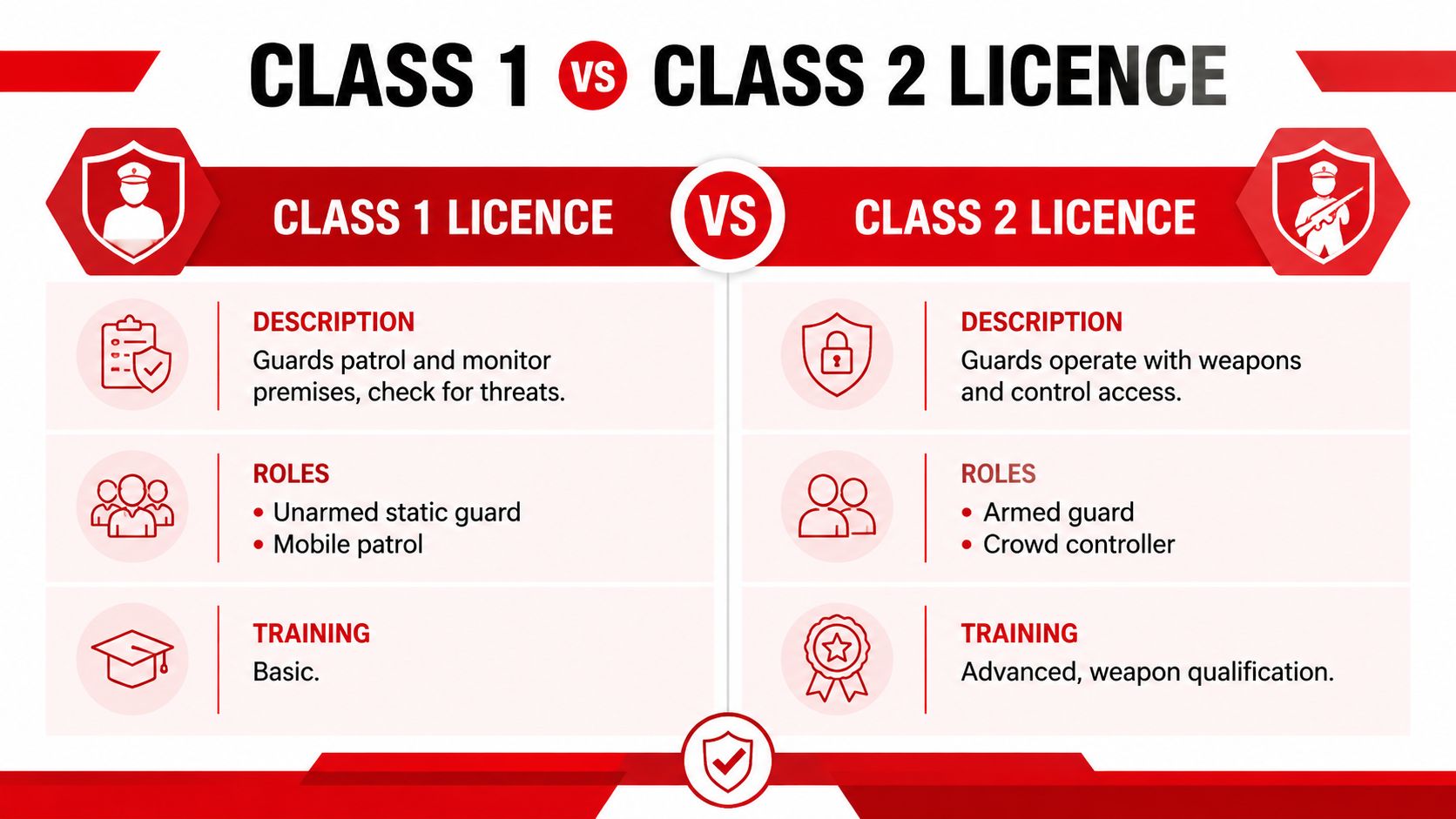
The Class 1 and Class 2 split changed the way NSW operators should think about deployment. A worker may hold a valid security licence and still be unsuitable for a particular task if the licence class doesn't authorise that activity. NSW Police's Class 2 licence guidance distinguishes standard guard activity from specialist security fields.
Class 1 generally covers standard security work. In practical terms, that can include unarmed static guarding, monitoring premises, and other duties within the relevant Class 1 subclass. A guard checking access at a corporate office or monitoring a retail site still needs the task mapped against the precise authority, but the work usually sits within the standard guarding pathway.
Class 2 is used for specialist security fields. That distinction becomes important when the roster includes specialist functions rather than ordinary unarmed presence.
Use the site task as the decision point
Consider these deployment examples:
| Site or task | Operational question | Roster decision |
|---|---|---|
| Music festival entry | Is the worker controlling or managing a crowd? | Confirm the relevant crowd-control authority before rostering. |
| Retail centre | Is the role static guarding, monitoring, or patrol? | Verify the Class 1 subclass matches the assigned duties. |
| Construction site | Will the worker remain at a gatehouse or conduct mobile patrols? | Map both duties, rather than assuming one licence covers every activity. |
| Venue with a dog unit | Is the worker handling a guard dog? | Confirm the specialist dog-handling authority and evidence. |
| Armed assignment | Will the worker perform armed guarding? | Confirm the applicable specialist licence, training, and approvals. |
The common failure occurs during a busy shift change. A supervisor sees that a guard is licensed, then moves that person from ordinary guarding into dog handling or armed duties. That creates exposure for the individual and employer, even though the worker holds a current licence.
Rostering principle: A licence check answers “is this person licensed?” A deployment check answers “is this person licensed for this task?”
Ongoing Compliance and Licence Conditions
Approval is not the finish line. The most frequent operational errors happen after a guard has already been hired, particularly when staff move between sites, change personal details, or lose a licence card during a busy event period.
NSW security operatives must display their licence visibly while working. They must notify SLED of changes to personal details within 14 days, and report a lost, stolen, damaged, or destroyed licence within seven days, as set out in NSW Police SLED security licence guidance. Some breaches carry penalties reaching $5,500, so these are not minor administrative preferences.
Apply the rules to real shifts
A guard between addresses should keep personal details current rather than treating temporary accommodation as irrelevant. A guard waiting for a replacement card should not assume that a missing card removes the need to prove licensing status. The licence must be produced on demand, and carrying out security activity without the correct licence is an offence.
Moving between venues adds another layer. A worker may be assigned at one venue in the afternoon and another at night under different master licence holders. Each employer or contractor should verify the operative's current status and activity authority before the shift. A verbal assurance from the guard is not a substitute for a record check.
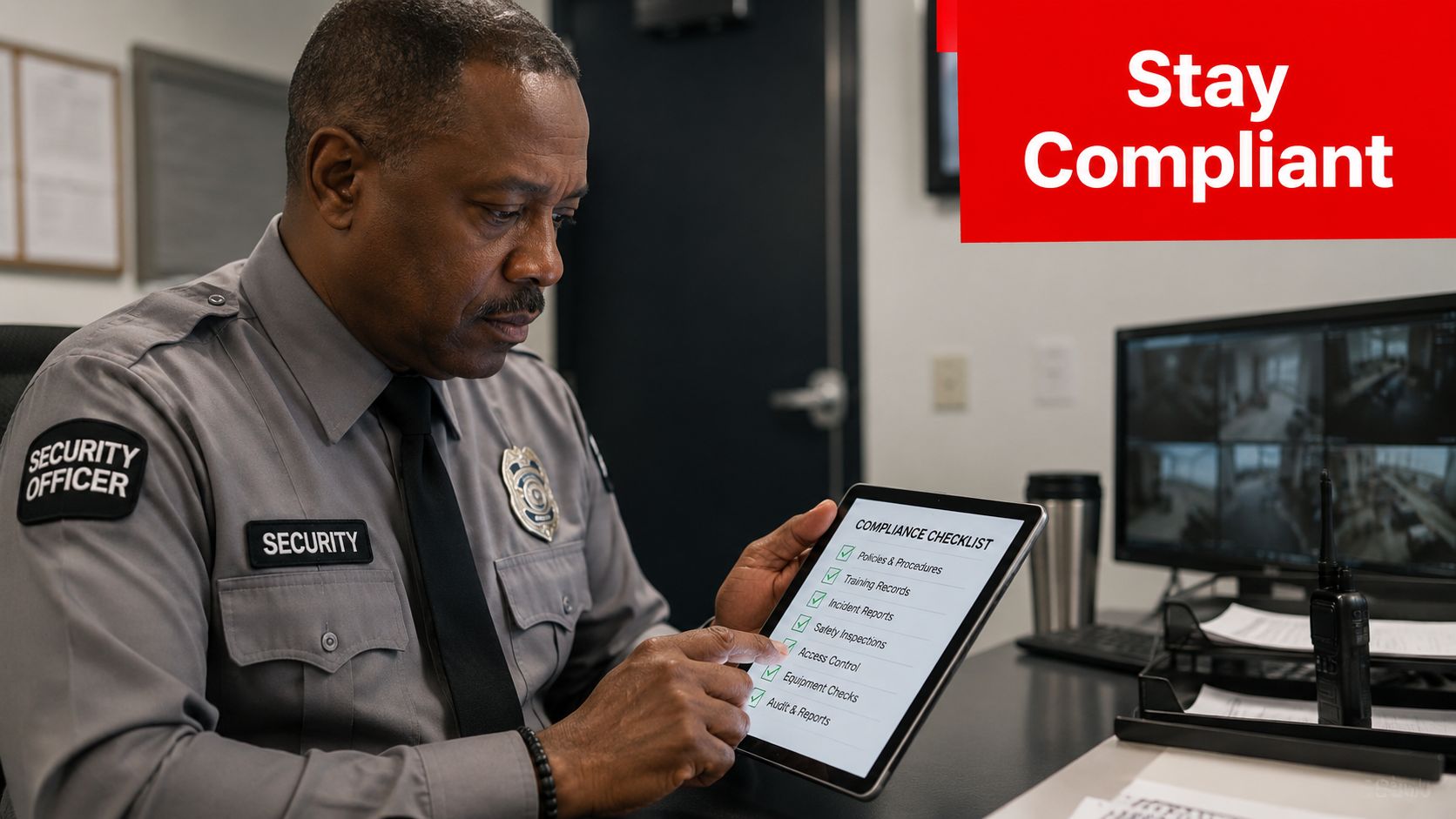
Use a written compliance routine:
- Before the shift: Check licence status, class, expiry, and task fit.
- At the venue: Confirm visible display and brief the guard on site duties.
- After a change: Update personal details through the proper process.
- After an incident: Record any licence issue and escalate it promptly.
- After loss or damage: Report the card within the required timeframe and follow replacement guidance.
The practical mistake is treating the plastic card as the licence. The compliance question is whether the person remains authorised for the activity being performed at that moment.
Employer Master Licence and Rostering Responsibilities
The largest risk often sits with the employer, not the applicant. Under the NSW framework, a security employer must hold a Master Licence, and a business that employs or subcontracts people for defined security activities needs the appropriate authority to do so. Advertising security services without a master licence can also create compliance exposure.
A venue manager should not accept a supplier's licence number without checking what it authorises. The business needs to confirm its own structure, the provider's master licence, and each worker's individual authority. Insurance and employment arrangements also need attention. For businesses reviewing workers comp for security guards, the insurance structure should sit alongside licensing checks rather than being treated as a separate administrative exercise.
Build verification into the roster
Use the NSW public verification tools before a worker starts:
- Business check: Confirm the provider holds the appropriate master licence.
- Individual check: Verify the guard's current licence status.
- Task check: Match the licence class and subclass to the assignment.
- Evidence check: Confirm training and specialist approvals where required.
- Record check: Keep a dated verification record with the roster or shift file.
This approach works across a festival, a hotel, a shopping centre, and a construction gatehouse. A festival may need crowd-control coverage, a hotel may combine reception support with patrols, and a construction site may need gatehouse control plus mobile checks. Each task should be mapped before a name is placed on the roster.
NSW's public verification and data tools support more active checking than a once-only onboarding process. For a multi-site operator, that means the compliance team should verify staff when circumstances change, not only when a worker first joins the database.
Frequently Asked Questions About NSW Security Licensing
Can I work while waiting for a replacement card?
Don't assume you can. NSW guidance requires the licence to be produced on demand, and security activity without the correct licence is an offence. Report a lost, stolen, damaged, or destroyed licence within seven days, then confirm your lawful position before accepting a shift.
Can I move between sites under different master licence holders?
You may be rostered across sites only when the relevant employer arrangements, master licences, and individual activity authority are valid. Each operator should verify your status before deployment.
What happens when my personal details change?
Notify SLED within 14 days. Keep your employer informed so roster records and licence verification details remain accurate.
Are licence status checks available publicly?
NSW provides public verification and digital data tools, allowing employers to check status rather than relying solely on a photocopy or verbal confirmation.
What if my licence expires?
Stop and confirm your authority before working. Renewal may attract a late fee when lodged after expiry but within the permitted window, and a roster should never rely on an unverified renewal.
GM GROUP Services can help NSW event, venue, retail, and construction operators align licensed personnel with the correct duties, verification checks, supervision, and reporting requirements. Review your current roster and compliance process, then visit GM GROUP Services to discuss a fit-for-purpose security arrangement.