


SEO Title: 7 Smart Security for Parties Steps for a Safer Australian Event
URL: /security-for-parties-australia-guide
SEO Meta Description: Security for parties in Australia starts with the right risk assessment, guard ratios, RSA planning, and crowd control. Learn practical steps for NSW, VIC, QLD, and ACT events.
Security for parties starts long before the first guest arrives. If you're organising your first major event, you're probably juggling the fun parts with the uncomfortable questions. Who checks the door? What happens if someone turns up already intoxicated? How do you keep the night relaxed without making it feel over-policed?
That tension is normal. A well-run event should feel easy for guests and tightly controlled behind the scenes. The organiser's job is to protect people, protect the venue, and protect the licence conditions without turning the place into a fortress.
Your Essential Guide to Party Security
A common first-time mistake is assuming security only matters if you're hosting a massive crowd. In practice, smaller parties often carry the same pressure points. One side entrance left open, one guest bringing extra friends, one argument near the bar, and the tone of the night changes fast.
That's why security for parties works best when it's planned as part of the event experience, not added at the last minute. The security team should know who belongs on site, where conflict is most likely to start, how to support RSA decisions, and who takes charge if something goes wrong.


For organisers who want to see how premium hospitality venues approach guest protection without ruining atmosphere, Amax Fire & Security's high-end solutions are a useful reference point. The lesson is simple. Good security should be visible where deterrence matters and discreet where guest comfort matters more.
What a protected event actually feels like
Guests usually won't comment on a strong security plan because the evening runs smoothly. They move through entry without confusion. Staff know who to call. The bar team isn't left alone to manage intoxication issues. Exits stay clear. Problems get handled early.
Practical rule: If your security presence only becomes active after a problem starts, you're already behind.
A wedding in Melbourne, a birthday in Sydney, a pub function in Canberra, and an outdoor activation in Brisbane all need different treatment. The core principle stays the same. Match security posture to event risk, venue layout, guest behaviour, and alcohol service.
Laying the Groundwork with Risk Assessment
At 9:30 pm, the bar is three deep, a side gate has been left unsecured, and a guest who was fine an hour ago is now arguing with staff about being served again. That is the point where organisers discover whether they planned security properly or just booked guards and hoped for the best.
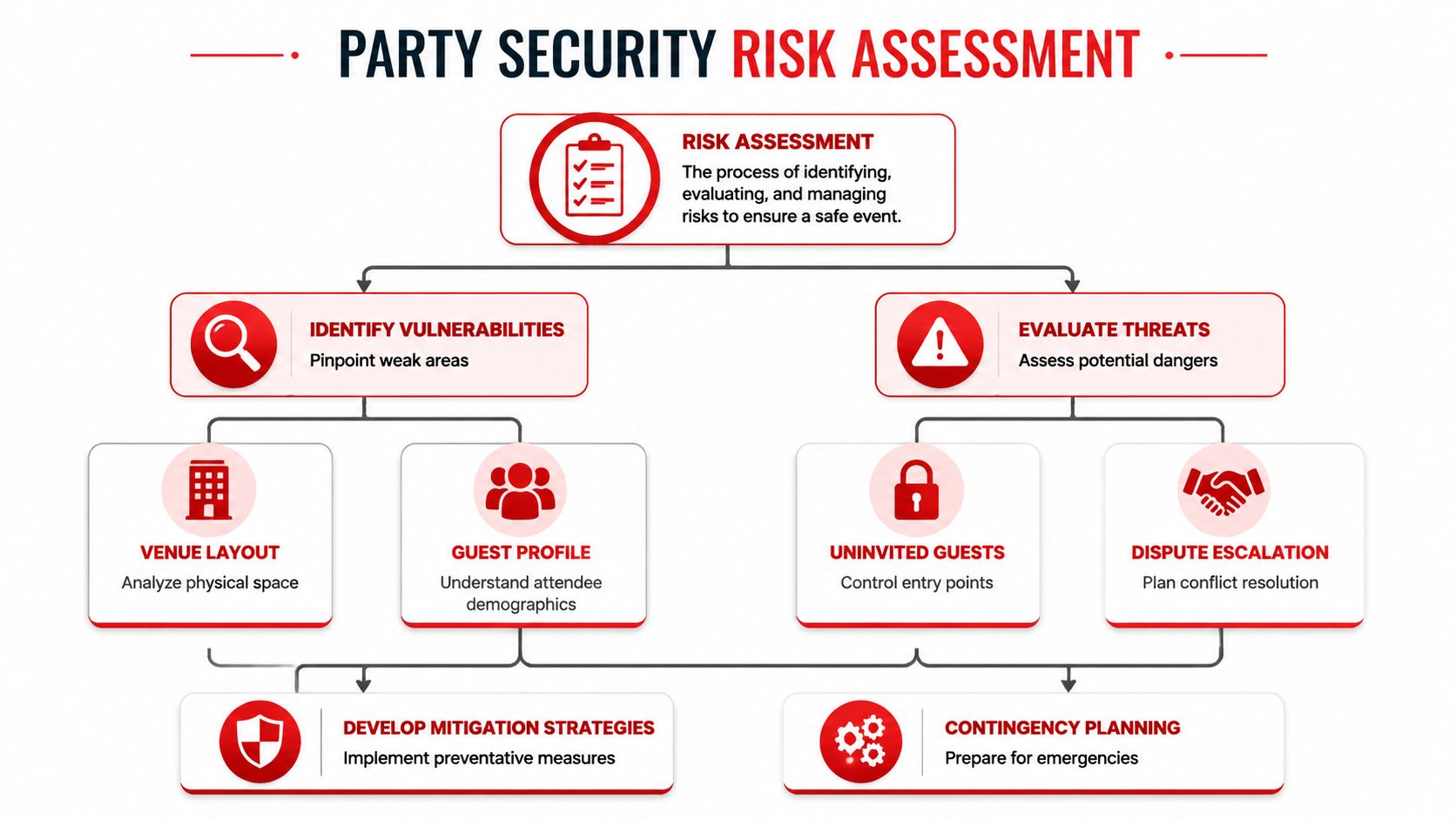
A risk assessment sets the operating picture before the first guest arrives. It shows where trouble is most likely to start, who is expected to deal with it, and what support the venue team needs if alcohol service, access control, or guest behaviour starts to shift.
What to assess first
Start with the event profile, not the staffing quote.
A private birthday in a hired hall, a corporate function in a licensed Sydney venue, and a wedding at a Melbourne winery can all have the same headcount and completely different risk. The difference usually comes down to alcohol, guest control, venue design, finish time, and how much public access the site allows.
Assess these points together:
- Guest mix: Invite-only events with a clear list are easier to control than parties with plus-ones, door sales, or loosely managed arrivals.
- Alcohol service: Once liquor is involved, security planning has to support RSA decisions, refusals of service, and safe removals if a guest becomes aggressive or heavily intoxicated.
- Venue layout: Secondary doors, loading areas, smoking zones, car parks, stairwells, and dark pedestrian paths all affect where incidents are likely to occur.
- Timing: Risk changes across the night. Entry, peak service, entertainment breaks, and close-down all need different coverage.
- Guest profile: VIPs, family conflict, previous incidents, or social media exposure can change privacy, screening, and response requirements.
State rules matter here as well. In NSW, crowd controllers working licensed premises need to understand venue obligations under liquor laws and how their role supports the licensee. In Victoria, private security licensing and venue conditions can shape who can perform crowd control duties. In Queensland, licensed crowd controllers are common where alcohol-related risk is higher, particularly for late trading environments. In the ACT, organisers should still check venue-specific licensing conditions and local requirements before assuming a standard private party setup is enough.
Compare the event, not just the headcount
New organisers often ask for a guard ratio before anyone has looked at the floorplan, drinks service, or guest behaviour history. That sequence causes problems.
Headcount is only one input. A 120-person engagement party with free-flowing alcohol, two entry points, and a 12:30 am finish can be harder to manage than a 250-person corporate dinner with assigned seating and a controlled guest list. General industry guidance often uses ratios such as one guard per 100 guests for lower-risk functions and more coverage for alcohol-heavy or higher-friction events, but those are starting points only. The actual requirement should come from the event conditions on the ground and any venue or licensing obligations that apply in your state.
That matters most where RSA is likely to be tested. If the bar team may need to cut someone off, security should already be positioned to back that decision calmly and lawfully. Waiting until a patron is yelling at staff is poor planning.
A good risk assessment identifies failure points early. Entry bottlenecks, blind spots, unmanaged smoking areas, weak close-down control, and no clear backup for RSA refusals are common ones.
The practical output
A usable assessment should end in operating decisions, not vague notes in a planning folder.
It should set out:
- The entry model for guests, contractors, performers, and staff
- Control points at doors, bars, corridors, lifts, smoking areas, and external boundaries
- Response procedures for refusal of entry, intoxication, medical issues, assaults, and ejections
- Decision-making authority so the venue manager, organiser, bar staff, and security team know who calls what
- Close-down arrangements for guest dispersal, transport pickup points, and final checks of the site
If the venue is licensed or the footprint is complicated, a formal Threat, Vulnerability, and Risk Assessment from a provider such as GM GROUP Services can help document those decisions clearly. The point is not paperwork for its own sake. The point is giving the team a plan they can run on the night.
Deploying the Right Security Team for Your Party
Once the risk is clear, staffing becomes a fit-for-purpose exercise. Consequently, many organisers overspend in the wrong areas or cut the wrong corners. One impressive-looking guard at the front won't solve crowd issues at the bar, and a team that's great with nightlife may be the wrong fit for a polished corporate event.
For Australian events, a practical baseline is one guard per 100 attendees for low-risk parties and one guard per 50 attendees for high-risk events with alcohol or larger crowds, as outlined by MEC Security's event guard guidance. The same guidance gives a useful real-world example. A wedding with 200 guests in Melbourne typically needs 2 to 3 guards, while a 1,000-person festival concert in Sydney could require up to 20 guards.
Fit-for-purpose guard selection
Different roles solve different problems. This is the comparison organisers should make before locking in a roster.
| Event Type | Primary Risk | Recommended Guard Type |
|---|---|---|
| Corporate function | Unauthorised access, reputation-sensitive incidents | Corporate-attired access control guards |
| Wedding or private social event | Gatecrashers, alcohol-related disputes | Discreet licensed guards with strong guest service skills |
| Bar or pub event | Intoxication, RSA intervention, close-down issues | Uniformed venue security with RSA awareness |
| Outdoor party | Perimeter breaches, movement across open space | Visible roaming guards and entry-point control |
| VIP event | Privacy, targeted disruption | Close protection or low-visibility specialist staff |
| Festival or high-density function | Crowd surges, line pressure, emergency coordination | Visible crowd management team with a clear supervisor |
What works and what doesn't
What works is matching demeanour and training to the room.
For a black-tie event, guards should look polished, communicate well, and resolve issues discreetly. For a louder outdoor event, deterrence matters more. Guests should immediately see where the authority sits.
What doesn't work is choosing everyone from the same mould. A front gate guard, a roaming floor operative, and a team leader handling incidents all need different strengths.
Consider these trade-offs:
- Visible guards: Strong deterrent value, but too many can change the atmosphere.
- Plain-clothes staff: Better for spotting behaviour early, but they don't provide the same visible reassurance.
- Static door staff: Excellent for access control, but limited if the internal floor is left unsupported.
- Roaming guards: Better for hotspot management, though they can't replace a disciplined perimeter.
State-by-state practical thinking
In NSW and VIC, organisers need to be particularly careful when alcohol service and crowd density overlap. In QLD and the ACT, the same operational logic applies even when the event feels informal. If there's a licensed environment, professional security should support the venue's RSA obligations, not operate separately from them.
Don't roster guards like furniture. Each position should have a purpose, an area of responsibility, and a clear escalation path.
If you're unsure where to start, ask the provider to justify every post. If they can't explain why one guard is at the smoking area and another is near the bar, the deployment plan probably isn't mature enough.
Managing Access Control and Crowd Flow
Most event trouble walks in through an unmanaged entrance or starts where people bunch up without supervision. Access control isn't only about saying no. It's about setting the tone from the first interaction and keeping movement smooth once guests are inside.
Build the perimeter before the crowd arrives
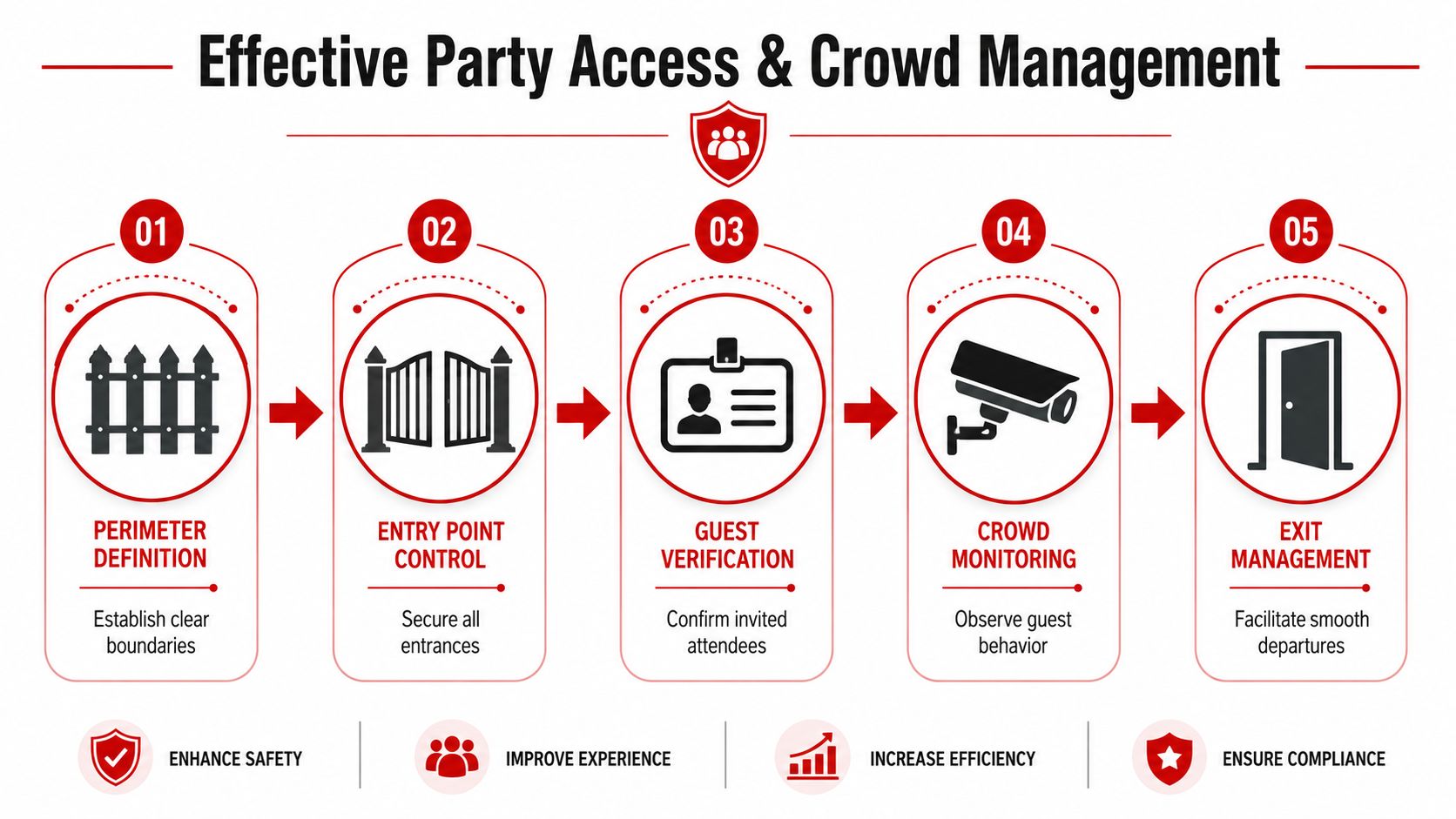
If your venue has multiple entry points, decide which ones are active and which are closed before bump-in finishes. Too many organisers leave this fuzzy, then try to control access with verbal instructions once guests arrive. That rarely holds.
A clean access plan usually includes:
- One primary entry: Guests should know exactly where to arrive.
- A separate service route: Suppliers and performers shouldn't mix with general guest intake.
- A controlled re-entry rule: Especially important once alcohol service is underway.
- A designated smoking or external area path: So guests aren't crossing operational zones.
Keep the welcome warm and the checks firm
Entry staff should be friendly, but they can't be casual. Guest list checks, ID verification where needed, and bag inspections if the risk profile calls for them should be handled consistently.
If you're using digital admission, Creventa's event ticketing is one example of a system that can help tighten guest verification and reduce bottlenecks at the door. Its primary value isn't the software itself. It's the reduction in arguments about names, duplicate entries, and last-minute list confusion.
Crowd flow inside the venue
Once guests are in, poor internal movement can create more problems than the perimeter.
Watch these pressure points closely:
- Bar queues: Frustration rises quickly if service is slow and the space is tight.
- Amenities corridors: People stop, chat, and block passage without realising it.
- Stage or dancefloor edges: Small pushes become larger movement if nobody resets the space early.
- Exit routes near closing: Guests often stall at the door, which creates a choke point behind them.
A roaming guard near each hotspot is often more useful than adding extra people at the main entry once the peak arrival wave is over.
The best crowd control is quiet. Guests keep moving, staff stay calm, and nobody feels herded.
Maintaining RSA and Regulatory Compliance
At 10:30 pm, the bar manager cuts off a guest who has had enough. The guest argues, friends pile in, and the mood around the bar shifts in seconds. That moment is where RSA compliance is either backed by a clear security plan or left to bar staff to carry alone.
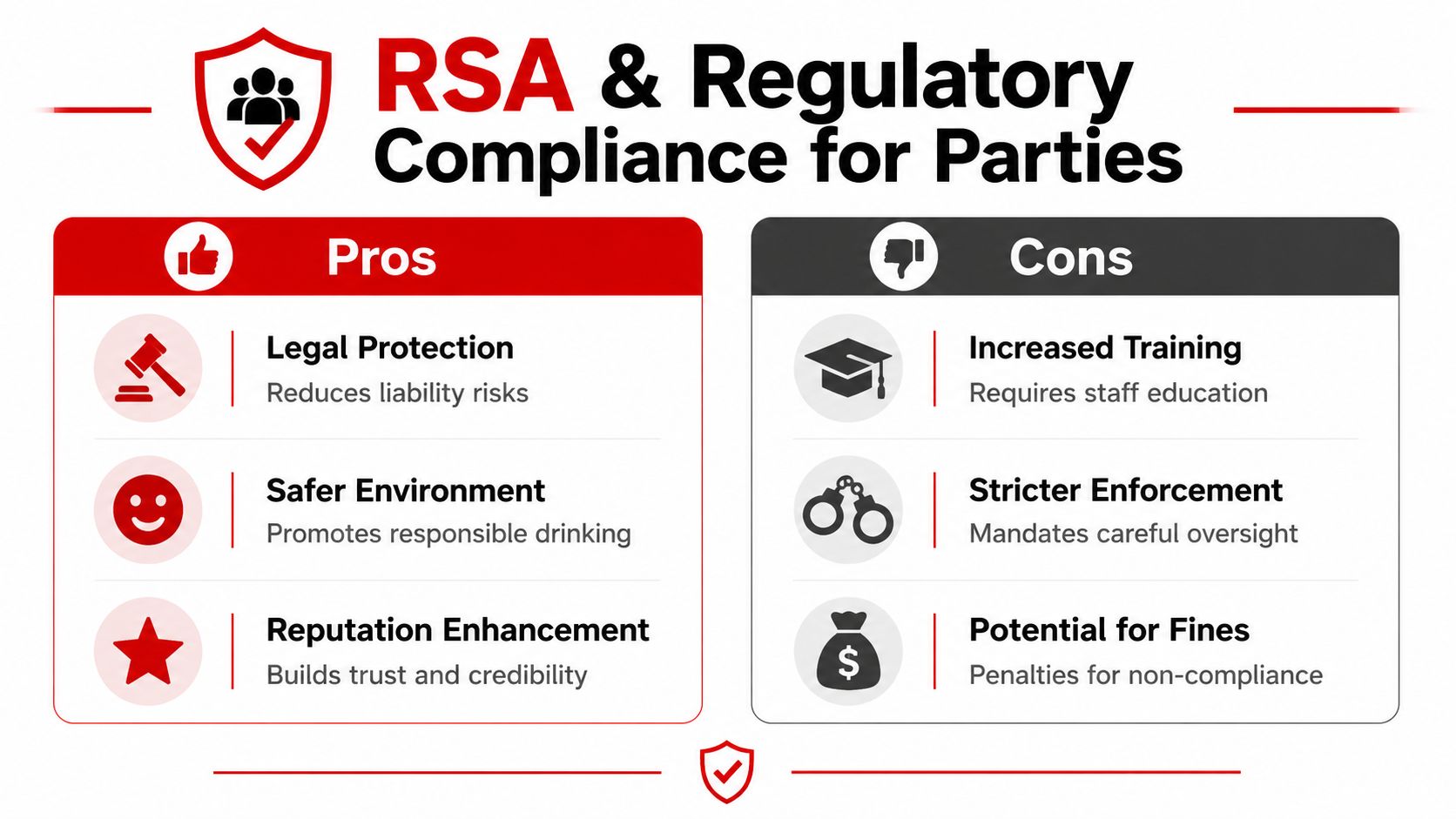
If alcohol is being served, organisers need one operating rule from the start. RSA is shared work between bar staff, venue management, and security. In NSW, Victoria, Queensland, and the ACT, that matters because intoxication management, refusals of service, and removals can all affect licensing risk as well as safety on the floor.
Where organisers get caught out
The common mistake is treating RSA as a bar-only issue. In practice, the bar makes the service decision, but security often determines whether that decision holds without an argument turning into a disturbance.
State rules change the detail. In NSW and the ACT, staff need to be disciplined about identifying intoxication early and documenting incidents properly if service is refused or a patron is removed. In Victoria, crowd controllers need to understand the venue's liquor licence conditions and house policy so they do not undercut staff with mixed messages at the bar. In Queensland, licensed venues also need clear coordination between approved managers, RSA-trained staff, and security so refusals are consistent and defensible if a complaint follows.
There is also a quieter compliance issue. Limit access to incident logs, guest details, and security reports to staff who require them. Event teams often hand out too much operational information in the rush of setup, and that creates avoidable privacy and reporting problems later.
Security's job in an RSA environment
Fit-for-purpose guard selection matters here more than sheer numbers. A corporate cocktail function, an 18th birthday, and a licensed warehouse party do not need the same profile of guard, even if the headcount is similar.
For alcohol-led events, brief security around four specific tasks:
- Entry screening: refuse or delay entry for guests who arrive already intoxicated
- Early intervention: spot changes in behaviour before they become refusals, arguments, or fights
- Bar support: stand close enough to support staff after a refusal, without crowding the interaction too early
- End-of-night management: move people out calmly and keep disputes from carrying into the street, rideshare zone, or car park
Good guards know the difference between presence and provocation. A calm, experienced guard near the bar can prevent a scene. The wrong guard, or an under-briefed one, can turn a routine refusal into the incident everyone remembers.
The trade-off organisers need to understand
Loose RSA enforcement usually feels easier in the moment. It keeps the line moving, avoids complaints, and protects sales for another round. It also raises the chance of injury, property damage, staff intimidation, and licensing scrutiny if something goes wrong.
Heavy-handed enforcement has its own cost. Guests feel targeted, staff lose confidence, and minor issues become personal confrontations.
The practical answer is consistency. Set one threshold for service refusals. Make sure bar staff know who to call, security knows when to step in, and the duty manager is prepared to back the decision. If a patron is refused service in front of friends, the script and the response need to be settled before doors open, not invented on the floor.
A venue rarely gets into trouble because the team acted too early on an intoxication issue. Trouble starts when staff hesitate, disagree in front of patrons, or hope the problem will sort itself out.
Coordinating Emergency Response and Post-Event Duties
At 11:40 pm, the event can still look under control while the highest-risk period is starting. A guest collapses near the toilets. Two friends drag an intoxicated patron toward the rideshare zone. Someone in the crowd is distressed, confused, and no longer responding well to directions. If roles are unclear at that point, small problems turn into ambulance callouts, police attendance, or a licensing issue the next morning.
Emergency response starts before doors open, with one question answered properly. Who is in charge of what?
For a private party, licensed venue event, or temporary function in NSW, VIC, QLD, or the ACT, the chain of command should be written into the brief, not left to assumption. The security supervisor runs guard deployment and incident control. The venue or event manager decides whether service pauses, an area is closed, or the event winds down early. One nominated contact speaks with police, ambulance, or fire crews so instructions stay consistent. Floor staff report up the line and keep doing their own job unless directed otherwise.
That structure matters because state compliance obligations do not disappear during an incident. In a licensed setting, RSA still applies while staff deal with the emergency. If an intoxicated guest is injured after service failures or poor supervision at exit, regulators will look at what staff and security did, who made the call, and whether the response matched the risk.
Psychological distress also needs a different response from aggression. Security teams that work hospitality and event jobs across Australia see this often. A patron may be overwhelmed, separated from friends, affected by alcohol or drugs, or having a panic response in a noisy environment. Treating that person like a physical threat can make the incident worse in seconds.
The better approach is controlled and quiet:
- move the person away from noise, lights, and crowd pressure where safe
- use one calm communicator, not three people talking at once
- keep instructions short and plain
- call first aid or paramedics early if there is any doubt about medical risk
- record what staff observed before the person was moved, especially if alcohol service is relevant
Guard selection matters here. A static crowd-control guard who is fine on a gate is not always the right fit for welfare-based intervention. For events with alcohol service, mixed-age attendance, or dense crowding, organisers should ask for guards with hospitality experience, de-escalation judgment, and a current licence for the state where the event is held. In NSW, that means checking the class of licence is appropriate to the role. In VIC, QLD, and the ACT, the same principle applies. Use guards who are properly licensed and suited to the task, not just available on the roster.
Closing time brings its own set of problems. The incident you avoided inside can restart at the front door, in the smoking area, at the taxi rank, or in the car park. Good post-event security is controlled wind-down, not standing at the exit and hoping the crowd thins out cleanly.
A proper close includes final patrols of internal and external areas, a check for stragglers, hazards, damage, and lost property, then securing access points once the site is clear. Reports should be written before the team leaves site. If there was an ejection, injury, refusal of entry, service refusal linked to RSA, or attendance by police or ambulance, the report needs times, names or descriptions, actions taken, and who was notified. That record protects the organiser if a complaint, insurer query, or regulator question comes later.
Memory fades fast after midnight. Written notes do not.
Frequently Asked Questions About Security for Parties
How much security do I need for a small party?
Start with risk, not ego. A modest private function with known guests may only need light coverage. If alcohol, late trading, open invite sharing, or a difficult layout are involved, the requirement changes quickly. Ask for a site-specific recommendation rather than a generic headcount.
Can security be low-key and still effective?
Yes. For smaller hospitality venues in VIC and NSW facing budget pressure, community-integrated security can be a practical, low-intrusion approach. It addresses a real need for the 85% of operators who report that traditional services are financially unsustainable, while helping maintain the guest experience.
Do I need security if the venue already has staff?
Usually, yes, if the event carries any meaningful risk. Venue staff handle service. Security handles access control, incident response, support for RSA, and guest removal when needed. Combining those roles often leads to hesitation and inconsistent decisions.
What should I ask a security provider before booking?
Ask these five questions:
- Licensing and state coverage: Can they legally operate in your event state?
- RSA experience: Have their staff worked in licensed hospitality environments?
- Deployment rationale: Why is each guard placed where they're placed?
- Incident reporting: How are issues recorded and handed over?
- Supervision model: Who manages the team on the night?
What's the biggest planning mistake?
Leaving security until the final week. By then, the guest count is moving, suppliers are locked in, and the organiser is making rushed decisions. Security works best when it's part of the event design from the start.
If you need a practical security plan for an upcoming event, GM GROUP Services provides licensed support across NSW, VIC, QLD, and the ACT for parties, venues, festivals, and corporate functions. The key is getting the right mix of guard selection, RSA support, access control, and incident planning before doors open.