

Effective security for a construction site is more than just throwing up a fence and hoping for the best. It’s a complete strategy, carefully layered to protect your valuable assets, keep your people safe, and prevent the kinds of project delays that bleed money. A proactive approach is crucial; I’ve seen time and time again that reacting after a theft or incident is a recipe for financial disaster. Real security means blending thorough risk assessment, smart technology, and well-trained professionals into a single, seamless plan.
I’ve seen it time and time again: a reactive approach is a recipe for disaster. Real security means blending thorough risk assessment, smart technology, and well-trained professionals into a single, seamless plan.
Why You Can't Afford to Skip a Security Framework
Think of security as a critical investment, not just another line item on the budget. Construction theft costs the industry hundreds of millions every year, so waiting for something to go wrong is a costly gamble. A solid, organised framework lets you get ahead of the threats instead of just cleaning up the mess afterwards.
This isn't about guesswork. It's a systematic approach built on a few core pillars:
- Initial Risk Assessment: Before you spend a dollar, you need to know exactly where your weak points are. Actionable Insight: Walk your site at dusk. Areas that feel unsafe or have poor visibility are prime targets for thieves.
- Layered Defences: You can't rely on one thing. It's the combination of physical barriers, surveillance tech, and boots on the ground that truly works.
- Clear Policies: Everyone on site, from your top foreman to the newest delivery driver, needs to know the rules. Practical Example: Implement a strict "last person out" checklist that includes locking tool containers and securing the main gate.
- Incident Response: When a breach does happen—and it might—you need a clear plan to shut it down fast and minimise the damage.
The Building Blocks of Site Security
A big piece of the puzzle is having effective tool and equipment storage solutions to stop opportunistic theft. But that’s just the start. The real goal is to create an environment where theft and vandalism are just too hard and the risk of getting caught is too high.
It boils down to a simple, three-step process: assess, integrate, and protect.
This flow shows you exactly how a security strategy should be built from the ground up, starting with a clear understanding of your site.
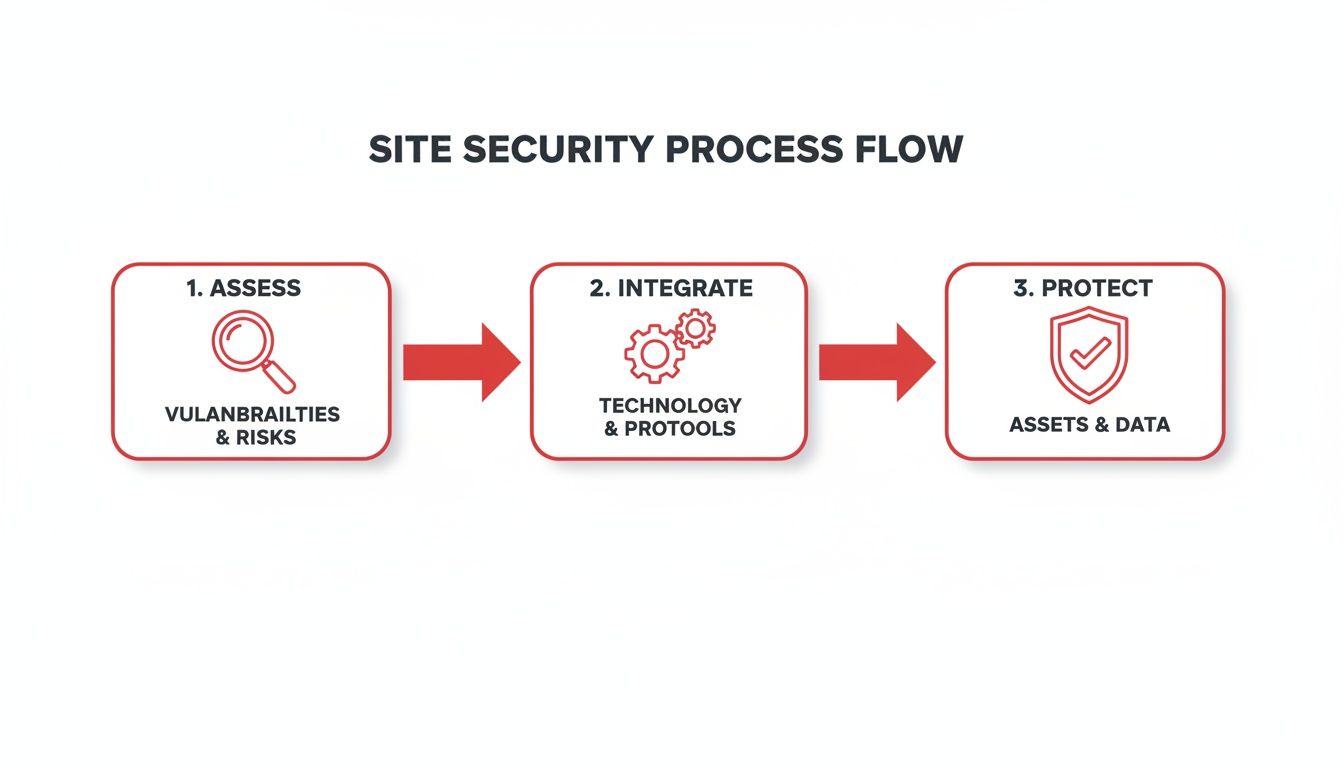

As you can see, genuine protection is the final result of doing your homework upfront and then intelligently combining the right security elements for your specific project.
By building a structured security plan, you're not just buying cameras or hiring guards; you're developing a resilient system that adapts to your site's unique challenges and safeguards your entire project lifecycle from start to finish.
In the next sections, we'll dive into each of these components in detail, giving you the practical, actionable advice you need to lock down your next project. This guide is your roadmap to building a tough defence against the everyday threats construction sites face.
Getting to Grips with Your Site’s Unique Security Risks
Before you even think about cameras or guards, the first, most crucial step in securing your construction site is a proper risk assessment. You can't build a solid defence until you know exactly what you're defending against. Every site is different, with its own unique risk profile shaped by its location, the gear you've got, and even the layout.
Jumping straight into security measures without this groundwork is like building a house without a blueprint. You’re just guessing, and those guesses can be costly. A thorough assessment shifts you from being reactive to proactive, ensuring every dollar in your security budget is spent where it will have the biggest impact.
Mapping Out Your Weak Spots
Grab a clipboard, put on your boots, and walk the site. But this time, you're looking at it through the eyes of an opportunistic thief. Your goal is to spot every weakness, every easy target. And think beyond the front gate.
Are there dark, unlit corners behind a stack of materials? That’s a perfect hiding spot. Does that back fence line a quiet laneway? That's an invitation for someone to peel it back after dark.
Keep an eye out for these classic vulnerabilities:
- Poor Lighting: Darkness is a criminal's best friend. Pay close attention to the areas around your storage containers and where you park heavy machinery.
- Unsecured Materials: Copper wiring, power tools, plumbing fixtures—these are like cash sitting out in the open. If they aren't locked down, they'll walk.
- Gaps in the Perimeter: Look for damaged fence panels, spots where someone could easily climb over, or even gaps under gates just big enough to crawl through.
- Unmonitored Entry Points: Besides the main gate, where else can people get in? Think service entrances, unfinished doorways, or even second-storey openings accessible by scaffolding.
Zeroing In on High-Value Targets and Safety
Let's be realistic—not all assets are created equal. A pile of scrap timber isn't nearly as tempting as a brand-new skid steer or a pallet of copper pipe. The secret to smart security is figuring out what your most valuable and "walkable" items are, and protecting them first.
But this isn't just about stopping theft and financial loss. Solid security for a construction site is fundamentally tied to worker safety. The construction industry is notorious for workplace incidents, accounting for 14% of all serious workers' compensation claims in Australia, with fractures and joint injuries leading the pack. When you've got uncontrolled access, you have unauthorised people wandering onto a hazardous site. That’s a recipe for a serious accident and a massive liability headache. You can discover more insights about construction site safety and risks to see just how deeply these two issues are connected.
A secure site is a safe site. When you control who comes and goes, you’re not just protecting your assets—you’re upholding your duty of care to every single person working there.
Make a quick list of your most expensive or easily stolen gear. This simple inventory will become the backbone of your security plan, telling you exactly where you need to point a camera or direct a patrol.
Putting Together a Simple Risk Matrix
Now, let's turn those observations into a real, actionable plan. A risk matrix is a straightforward tool that helps you visualise and prioritise threats based on how likely they are to happen and how much damage they'd cause.
It doesn’t need to be complicated:
| Risk Level | Likelihood | Impact on Project | Real-World Example |
|---|---|---|---|
| High | Very Likely | Major delay & cost | Theft of a key piece of machinery like an excavator. |
| Medium | Possible | Moderate delay & cost | Theft of copper wiring from a nearly finished section. |
| Low | Unlikely | Minor inconvenience | Vandalism or graffiti on temporary fencing. |
This simple chart instantly shows you where to focus your energy. A high-risk threat, like losing your only excavator right before a big pour, needs your immediate attention and your best security measures. By sorting your risks this way, you make sure your security for a construction site is both effective and efficient. It’s this practical, data-driven approach that forms the bedrock of a security plan that actually works.
Establishing a Secure Perimeter and Access Control
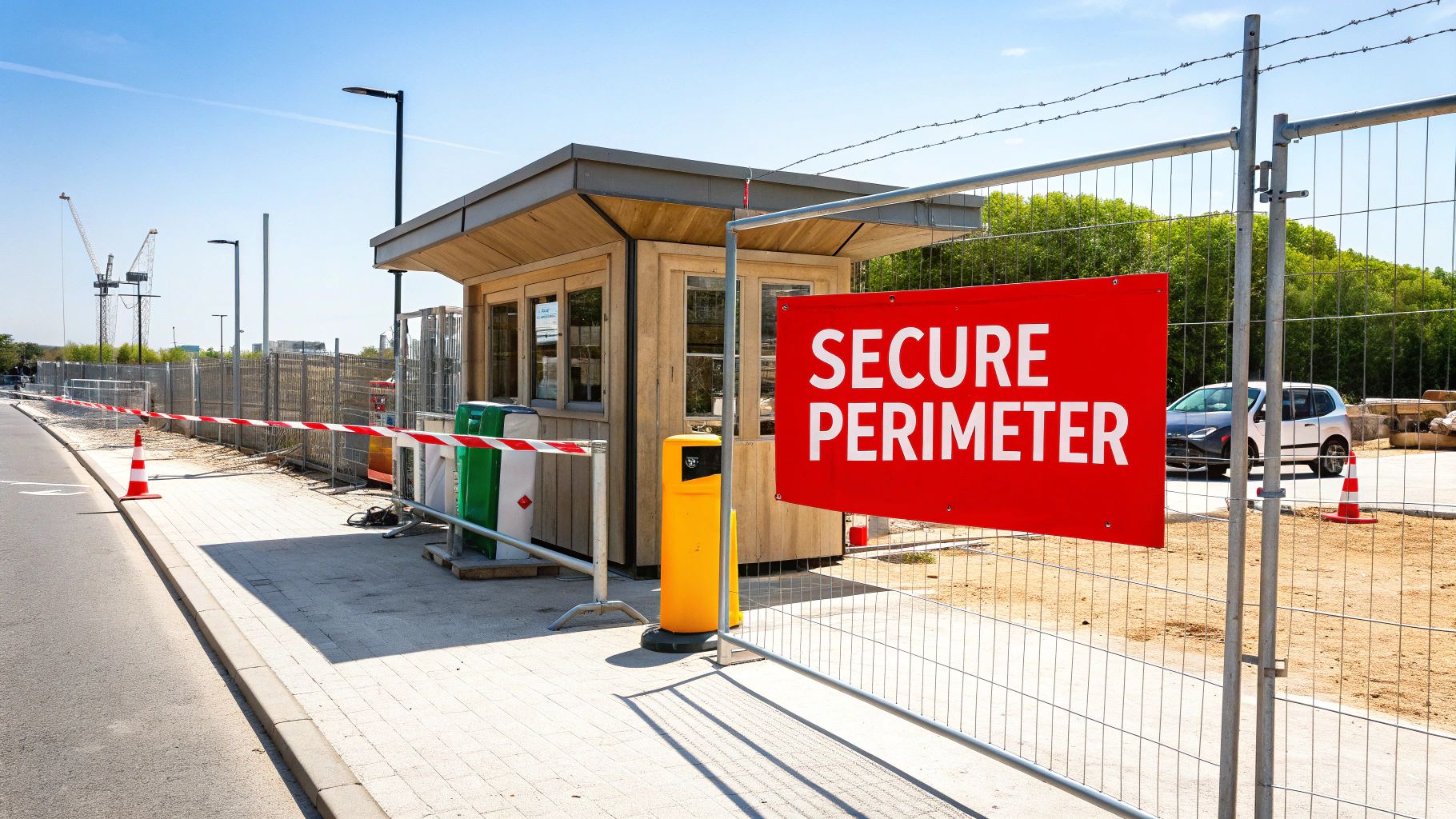
Your first, and most important, line of defence is always the boundary. Solid security for a construction site starts right at the fenceline. Think of it as creating a strong physical and psychological barrier that makes opportunistic thieves think twice before they even try to get in.
A perimeter isn't just a fence; it's a controlled environment. Every centimetre needs to be locked down, and every single person or vehicle that comes through has to be accounted for. If you don't get this foundational layer right, all the other fancy security measures like CCTV or patrols become far less effective.

Reinforcing Your Fencing and Gates
Let’s be honest, standard temporary fencing is often seen as more of a suggestion than a real obstacle by a determined thief. Those flimsy chain-link panels can be cut, climbed, or even just lifted out of the way with minimal effort. Reinforcing your perimeter isn't just a good idea—it's non-negotiable.
Here are a few practical ways to beef up your boundary:
- Add anti-climb features: Angled extensions topped with barbed or razor wire make scaling a fence a much tougher and more dangerous proposition.
- Anchor it down properly: Make sure your fence panels are properly weighted or staked firmly into the ground. I’ve seen countless sites where intruders just slip under a gap at the bottom.
- Use heavy-duty locks: Don't skimp here. Invest in high-quality, shrouded padlocks for every gate.
The numbers don't lie. Forced entry is behind a shocking 48% of all construction site thefts, with another 20% of incidents involving cut padlocks. When you consider that less than a quarter of stolen gear is ever recovered, it's clear that a weak perimeter leads directly to permanent financial losses.
Implementing Smart Access Control Strategies for Construction Site Security
Once your physical perimeter is solid, the next step is managing who gets through it. A smart access control plan is about more than just keeping bad guys out; it's about ensuring only authorised people get in, which helps manage internal risks like subcontractor theft, too.
A manned gatehouse is one of the most powerful deterrents you can have. Just the presence of a professional guard logging vehicles, checking credentials, and watching the comings and goings creates an immediate sense of control. It sends a very clear message: this site is being actively monitored.
Pro Tip: On large, complex projects, I always recommend a zoned access system. Use keycards or fobs to restrict entry into high-value spots like material storage containers or nearly-finished floors. This compartmentalises the risk by making sure workers can only get into the areas they absolutely need to be in.
When setting up these systems, it’s not just about the hardware. Finding the right partner to get it installed and running smoothly is crucial, which is why it's always best to work with a certified access control installer.
Perimeter and Access Control Options Comparison
Choosing the right mix of perimeter and access controls depends heavily on your site's specific risks, duration, and budget. Below is a quick comparison of common methods to help you decide what’s best for your project.
| Security Method | Best For | Pros | Cons |
|---|---|---|---|
| Standard Chain-Link Fencing | Low-risk, short-term sites with other security layers. | – Cheap and fast to install. – Provides a basic visual boundary. |
– Easily cut, climbed, or lifted. – Offers minimal real security. |
| Anti-Climb Mesh Fencing | High-risk sites, long-term projects, or areas storing valuable assets. | – Very difficult to climb or cut. – Strong physical and visual deterrent. |
– Higher upfront cost. – Can be slower to install. |
| Manned Gatehouse | Large sites with high traffic volume of workers and deliveries. | – Powerful visual deterrent. – Can vet all personnel and vehicles. – Provides a human response capability. |
– Highest ongoing operational cost. – Effectiveness depends on guard quality. |
| Electronic Access Control | Sites requiring detailed entry/exit logs or zoned security. | – Creates an indisputable digital record. – Allows for granular access permissions. – Keycards can be deactivated if lost. |
– Can be a significant initial investment. – Requires training for all personnel. |
Ultimately, the most secure sites often use a combination of these methods—for example, pairing robust anti-climb fencing with a manned gatehouse or an electronic system to create a truly layered defence.
Putting Technology to Work for 24/7 Site Surveillance
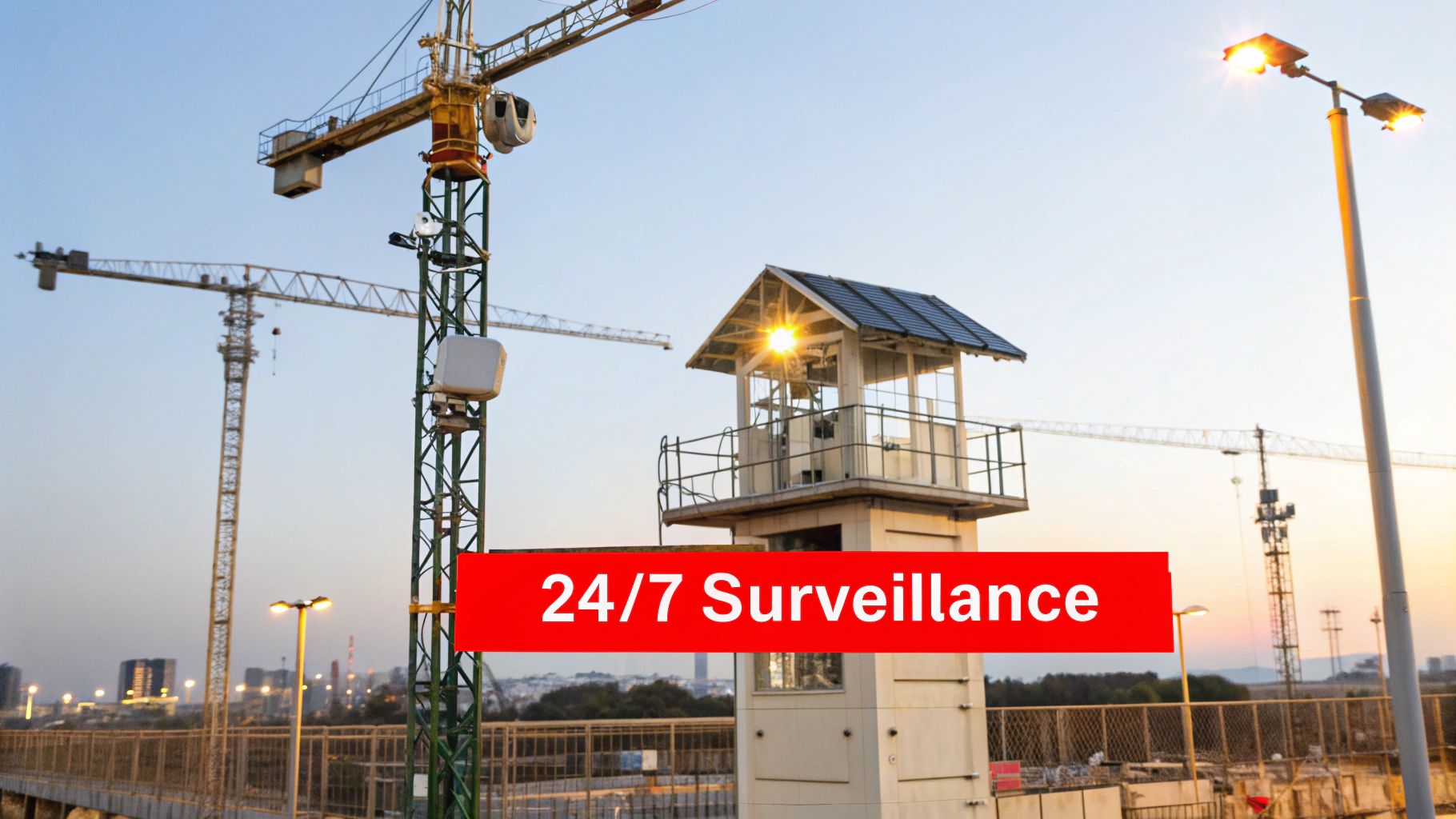
When your crew clocks off for the day, your security can’t. This is where smart technology steps in, acting as a digital watchdog that never sleeps. We're not talking about simply throwing up a few cameras and calling it a day. A truly effective setup involves creating an intelligent, layered surveillance network that makes your site a hard target and gives you irrefutable proof if someone does try their luck.
The first step is thinking like a thief. Where are the weak spots? The dark corners? You need to design a system with overlapping fields of view, ensuring there are absolutely no blind spots where an intruder could slip past unnoticed. Map out the likely paths to your high-value assets—like the main equipment storage or the partially built structure—and make sure every angle is covered. This is the difference between security theatre and a genuinely secure perimeter.
Going Beyond Basic CCTV with Intelligent Surveillance
The real game-changer in modern surveillance isn't just recording footage; it's integrating smart features that actively respond to threats. A standard camera is passive—it just records what happens. An intelligent system reacts in real-time, a critical distinction for a robust security for construction site plan.
Here are a few advanced options I’ve seen work wonders on site:
- Thermal Cameras: These are worth their weight in gold for after-hours security. By detecting heat signatures, they can easily spot a person skulking in the dark, no matter what they're wearing or how bad the weather is.
- Motion-Activated Lighting and Alerts: Nothing says "you've been seen" like a set of high-intensity floodlights suddenly blasting on. Linking these to your camera's motion sensors is a fantastic deterrent. It spooks intruders and guarantees you get a crystal-clear image, all while sending an instant alert straight to your phone or a monitoring centre.
- AI Analytics: Let's face it, nobody has time to sort through hours of footage of a stray cat or a tree branch swaying in the wind. Modern systems use AI to tell the difference between an animal and a person, which cuts down on false alarms dramatically.
Real-World Example: Securing a Remote Site
Picture a remote civil works project, kilometres from the nearest town with no reliable mains power. This is where a solar-powered CCTV tower becomes your best mate. Kitted out with a 4G connection, high-definition cameras, and AI analytics, it can keep watch over the entire site completely on its own.
If the AI spots a person on site after hours, it can kick off a pre-programmed response:
- A loud, automated voice warning booms out from a speaker on the tower.
- High-power strobe lights flash, disorienting the trespasser.
- An instant alert, complete with a video clip, is sent to the project manager and the mobile patrol unit.
More often than not, this active response is enough to send thieves running before they can cause any damage, proving how technology can provide a powerful, immediate line of defence.
Quick Answers to Common Surveillance Tech Questions
What’s the most cost-effective camera setup for a small site?
For smaller projects, a handful of strategically placed 4G cellular cameras with built-in motion detection and solar panels can be incredibly effective. You get excellent coverage of key areas like the main gate and tool containers without the hassle and cost of running cables everywhere.
How do I stop getting false alarms all the time?
Using cameras with AI-powered analytics is your best bet. You can also fine-tune the motion detection sensitivity and draw specific "detection zones" within the camera's view. This tells the system to ignore movement in non-critical areas, like a public footpath that runs along your site boundary.
Are cameras enough, or do I still need guards?
While cameras are brilliant for monitoring and gathering evidence, they can’t physically stop someone. I've always found that the best security for construction site strategies combine technology with a human presence. The cameras act as a force multiplier, allowing a single guard or a remote team to keep an eye on a massive area far more effectively.
Putting Boots on the Ground: Deploying On-Site Security Professionals Effectively
While cameras are great for recording what happened, it’s the on-site security professionals who prevent things from happening in the first place. This human element is what transforms a passive monitoring system into an active defence, providing a powerful deterrent and the ability to respond instantly. Getting the right people into the right roles is the cornerstone of protecting your assets and keeping control of your site.
Let's be blunt: technology is an incredible tool, but a camera has never physically stopped a thief or challenged someone trying to sneak in. That's where trained security personnel make all the difference. Their visible presence alone tells opportunistic criminals that your site isn't the easy target they're looking for.
Matching the Right Guard to the Right Role
Not all security roles are created equal. A smart security strategy isn't just about having guards; it's about deploying different types of professionals to tackle specific vulnerabilities. Understanding these distinctions is how you get the most bang for your buck.
There are three main roles you'll see on a construction site:
- Static Guards: Think of these officers as dedicated guardians. They’re assigned to a fixed post, like a high-value storage container or the main equipment yard. Their job is to maintain a constant, unwavering watch over a critical asset, preventing theft and damage through their sheer presence.
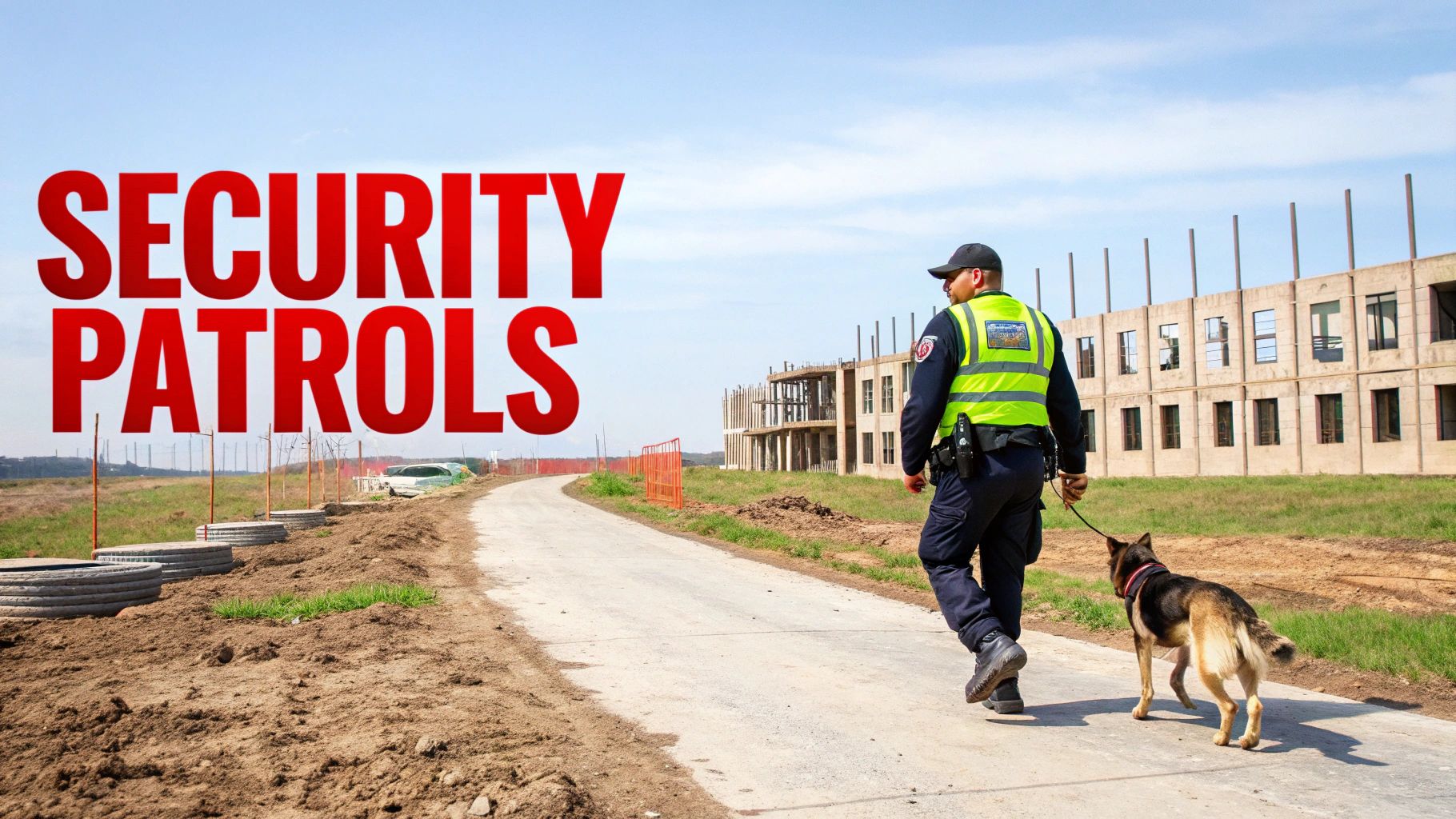
- Mobile Patrols: For sprawling sites with long fence lines, mobile patrols are a game-changer. These guards cover a lot of ground, performing regular but randomised checks on fences, secondary gates, and those quiet, hidden corners. Their unpredictable routes are a nightmare for anyone trying to plan a break-in.
- Gatehouse Officers: Positioned at your main entrance, these professionals are your front line for access control. They are responsible for logging all vehicles, verifying credentials, issuing visitor passes, and making absolutely sure only authorised people get onto the site.
The K9 Unit Advantage in Complex Environments
When you need the absolute best in detection and deterrence, nothing comes close to a specialised K9 unit. A dog's hearing and sense of smell are lightyears ahead of ours, allowing them to pinpoint an intruder hiding in a dark, half-finished building or behind a stack of materials.
The psychological impact is massive. The sound of a security dog barking is often enough to send trespassers running before they can even think about grabbing a tool. They are incredibly effective for clearing large, complex areas quickly and, most importantly, safely.
A single, well-trained K9 unit can cover the same ground as three or four human guards in a fraction of the time. This makes them an incredibly efficient tool for securing large or intricate construction sites after hours.
Real-World Scenario: Blending Human and Canine Security
I once worked with a large residential development that was getting hammered by after-hours theft and vandalism. Their initial plan—a single static guard at the front gate—was useless. Thieves were just cutting through the back fence.
The solution was a blended, strategic approach:
- Daytime: We kept a gatehouse officer at the main entrance to manage the constant flow of contractors and deliveries, maintaining strict access control when the site was busiest.
- After-Hours: The static guard was swapped out for a mobile patrol team partnered with a K9 unit. This team conducted unpredictable patrols along the entire perimeter and swept through the unfinished buildings.
The results were immediate and dramatic. The combination of the mobile patrol's visibility and the dog's superior detection skills stopped the incidents cold. Thieves could no longer count on finding a quiet, unmonitored spot to breach. This is a perfect example of how deploying the right personnel for the right situation is fundamental to effective security for a construction site.
FAQs on Using Security Professionals
Are security guards worth the cost compared to just cameras?
Absolutely. It's a significant investment, but guards provide active intervention that cameras simply can't. A guard can challenge an intruder, put out a small fire, or provide immediate first aid. They are a proactive measure, whereas cameras are a reactive tool used to gather evidence after the fact.
How do I ensure the guards I hire are reliable?
Always partner with a reputable, licensed security provider. A professional firm will handle all the vetting, training, and licensing, ensuring the guards on your site are qualified and dependable. They should also have clear supervision and reporting structures in place so you know what's happening.
When is a K9 unit the right choice for my site?
K9 units are a perfect fit for large, sprawling sites, projects with lots of unfinished structures, or any location with a history of determined intruders. If you need to clear big areas quickly and effectively, especially at night, a K9 patrol is one of the smartest security investments you can make.
Crafting Solid Security Policies and an Incident Response Playbook
All the fences, cameras, and guards in the world won't do much good without clear rules and a plan for when things go pear-shaped. Think of it this way: technology and people are your tools, but your policies and response plans are the instruction manual. Without that manual, you’re just reacting to chaos instead of controlling it.
A truly secure site is one where everyone, from the site manager down to the newest subbie, knows exactly what’s expected of them. These aren’t just abstract ideas; they're the daily habits that build a culture of security and actively protect your assets.
Setting Up Your Day-to-Day Security Protocols
These are the non-negotiables—the simple, enforceable rules that become second nature on a well-run site. They need to be practical and directly tackle the risks you've already identified.
Here are a few basics I always recommend starting with:
- Mandatory Tool Lock-Up: This one’s a no-brainer. At the end of every shift, all portable tools and high-value gear get locked away in a designated container or secure room. No exceptions.
- Airtight Visitor Protocol: Every single person who isn't on the payroll—delivery drivers, inspectors, clients—signs in and out. Issue them a temporary pass and make sure they’re escorted if they need to move around the site.
- Rigid Key Control: Keep a meticulous log of who has keys, fobs, or access codes. The moment someone’s contract is up, their access is revoked. Immediately.
These three simple habits alone can slash opportunistic theft and give you a clear picture of who is on your site at any given time.
Building Your Incident Response Plan
When a break-in happens, the last thing you want is panic. A good incident response plan is your step-by-step guide to turning a chaotic moment into a methodical process. It's about protecting evidence, minimising your losses, and getting back on track fast.
A well-rehearsed incident response plan is the difference between a minor setback and a major project disaster. It ensures a calm, coordinated response that protects your legal and insurance interests when you're most vulnerable.
Your plan needs to spell out the immediate actions to take once a breach is discovered:
- First Call: Before anything else, call the police. Don't touch a thing or enter the area.
- Secure the Scene: Cordon off the area immediately. You need to preserve any potential evidence, like footprints or tool marks, for the police.
- Notify Key People: Get the site manager, project manager, and your security provider on the phone straight away.
- Document Everything: Get your phone out and take photos and videos of any damage, how they got in, and what’s missing—do all this before you start cleaning up.
- Write It All Down: Start a detailed internal report. Note the time of discovery, who you called, a preliminary list of stolen gear, and every action you've taken.
This structured response is absolutely crucial for police investigations and, just as importantly, for your insurance claim. But it's not just about theft. The sad reality is that unsecured sites can have tragic consequences. In 2023, 45 construction workers died on-site in Australia. Horrific incidents, like the death of a child on a WA site in 2022, underscore the huge responsibility we have to secure our perimeters from unauthorised access. You can discover more about Australian construction site safety and risks to grasp the full scope. These protocols are the backbone of professional security for construction site management.
Frequently Asked Questions About Security for a Construction Site
When you're trying to lock down a construction site, a few key questions always seem to pop up around cost, legal headaches, and just how to manage it all. Getting straight answers is the first step to building a security plan that actually works without blowing your project budget. Let’s get into the questions I hear most often from project managers.
How Much Security Do I Really Need?
This is the big one, and the honest answer is: it depends entirely on your risk assessment. There's no magic formula. A small residential build in a quiet suburb might get by just fine with some solid temporary fencing and a couple of 4G cameras. But for a massive commercial project in the middle of the city, with millions of dollars in plant and materials on site? You’re looking at a completely different ball game. That means a multi-layered plan with guards, strict access control, and sophisticated surveillance. The trick is to match the solution to the risk. Figure out what's most valuable and easiest to steal—think copper wiring, power tools, and heavy machinery—and protect that first. Then, scale up from there. It’s about being smart, not just throwing money at the problem.
What Happens If Someone Gets Hurt on My Site After Hours?
Your duty of care doesn't end when the crew goes home. This is a crucial point many people miss. If a trespasser—even a kid who wanders in to play—gets injured because your site wasn't properly secured, you could be in a world of legal and financial trouble. This is exactly why your perimeter has to be your first line of defence. To show you’ve taken reasonable precautions, you need to have, at a minimum: sturdy, well-maintained fencing that’s genuinely difficult to climb or cut through, clear and visible "No Trespassing" and "Danger" signs posted right around the site, and gates that are properly locked and secured the second the workday is over.
Can We Just Handle Security Ourselves to Cut Costs?
Look, I get the temptation. On paper, managing security in-house seems like a way to save a few dollars. But in my experience, it almost always creates more problems than it solves. When you hire a professional security firm, they're the ones handling all the licensing, insurance, background checks, training, and rostering. That’s a huge weight off your shoulders, both administratively and legally. A professional provider makes sure their guards are not only vetted but are also trained specifically for the unique chaos of a construction environment. The construction industry already has a high rate of serious injury claims, sitting at 16.9 claims per 1,000 workers. Adding security management to your project manager's plate is asking for trouble. You can read more on the industry's challenges in the latest Queensland construction industry report.
Handing over security to specialists frees up your team to do what they do best: build. Plus, when an incident does happen, you have a professional response and clear accountability.
A secure site starts with the right partner. At GM GROUP Services, we supply licensed, experienced security personnel who are trained for the specific demands of construction sites. Contact us today for a proper risk assessment and a security plan that fits your project.