


When it comes to security crowd control, just putting guards at the door is a rookie mistake. Real security is proactive. It’s about careful planning and building a system that stops incidents before they even have a chance to start. The aim is to turn a potentially chaotic gathering into a safe, controlled, and enjoyable experience for everyone involved. An actionable plan means knowing where your choke points are before they form and having a response ready before an incident even occurs.
Building Your Security Crowd Control Foundation

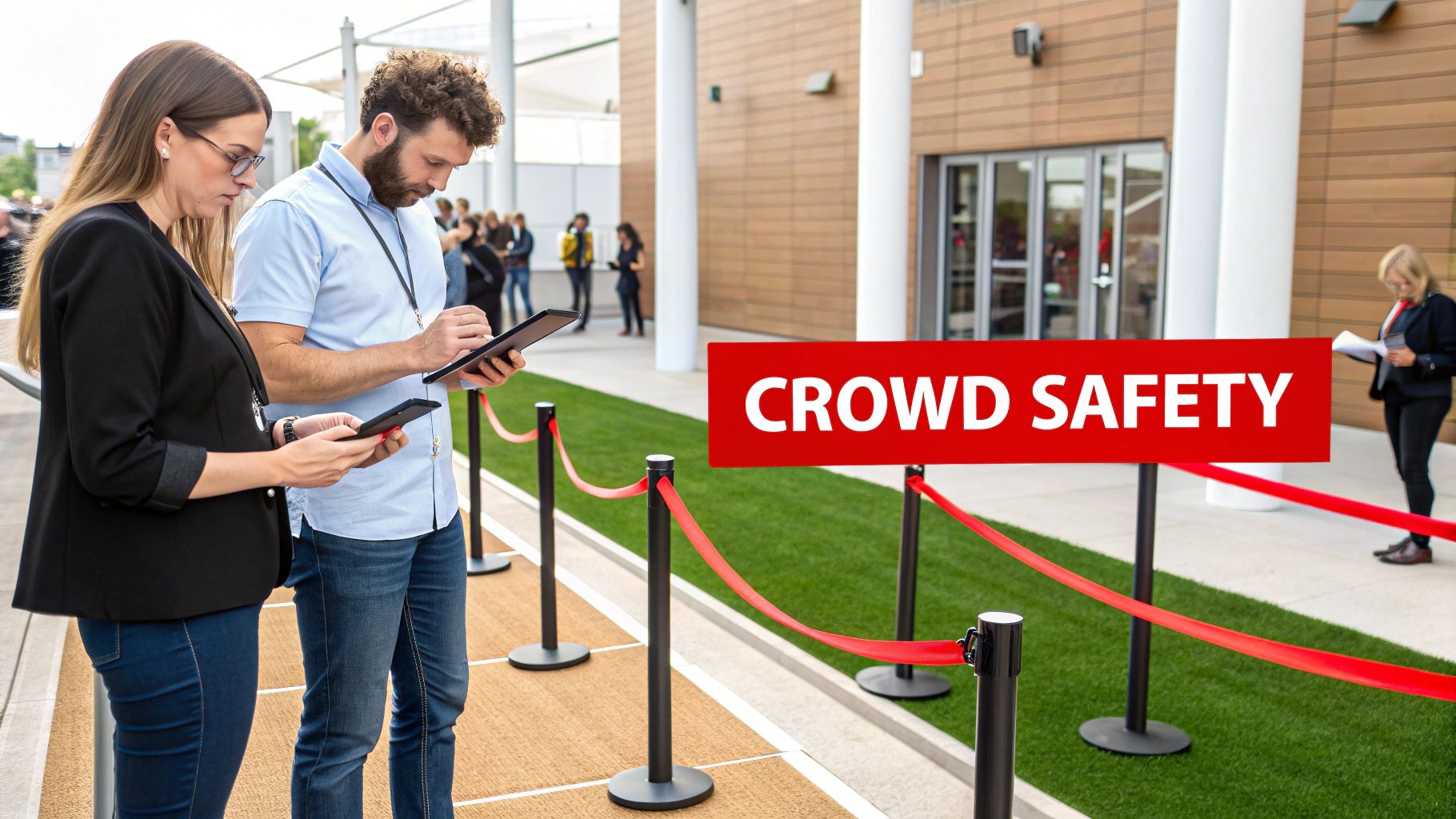
To properly manage crowds at Australian events, you need to move beyond generic checklists. A successful plan isn’t about reacting to problems; it’s about creating an environment where those problems are far less likely to happen in the first place. This foundation rests on a few key pillars that all work together.
Let’s say you’re organising an outdoor music festival in regional NSW. A strong foundation means you’ve already thought about what a sudden downpour would do to crowd movement. You’ve identified the blind spots in the venue’s layout and figured out how your team will communicate if the mobile reception dies. It’s all about foresight, not just force.
The Core Pillars of Your Plan
The real strength of any crowd control strategy is forged in the planning phase. Long before the first person arrives, your safety framework needs to be rock-solid. This requires a big-picture view that weaves risk analysis together with on-the-ground operational plans.
A truly robust plan must include:
- A Detailed Risk Assessment: This isn’t just about the obvious threats. It means walking the site yourself to spot uneven ground that could cause falls, noting nearby businesses that might get swamped by your queues, and genuinely considering the demographic of your attendees and how they might behave. Actionable insight: Take photos during your walk-through and annotate them with potential issues, then share this visual guide with your security supervisors.
- Precise Capacity Planning: The official venue capacity is only a number. Your plan needs to be based on usable space, which means subtracting the areas taken up by stages, vendor stalls, and toilets. This is what stops dangerous overcrowding in pinch points. Practical example: If a venue holds 5,000 but the main stage area only has 2,000 sqm of usable space, you can anticipate dangerous density if a headline act draws the whole crowd. Plan for staff to manage entry to that specific zone.
- Seamless Flow Management: The goal here is to kill bottlenecks before they’re born. Design clear, wide pathways for getting in, getting out, and moving between key areas like bars and amenities. Something as simple as a well-signed serpentine queue can make a huge difference during the initial entry rush.
A classic mistake is focusing only on the event’s peak hours. An effective plan covers the entire event lifecycle—from the first few people trickling in to the final mass exodus—ensuring safety protocols are rock-solid from start to finish.
From Blueprint to Action
Once you’ve defined these core pillars, your strategy really starts to take shape. This is where you turn those abstract plans into concrete actions, mapping out exactly how you’ll manage the physical space and the people within it.
Strategic deployment is everything. It’s not about how many guards you have, but where they are and what they’re doing. A single guard at a confusing intersection of pathways is worth more than three guards clumped together at a quiet entrance. Likewise, deploying specialised K9 units near entry points to screen for contraband is a targeted action that directly addresses a specific risk you found during your assessment.
Having this foundational knowledge ensures every decision you make—from where to place a barrier to how you brief a patrol team—is deliberate and helps build a safe, controlled environment that meets all Australian standards.
A solid crowd control plan is built on several interconnected components. Each one addresses a different aspect of event safety, working together to create a comprehensive strategy.
Core Pillars of Crowd Control Planning
| Pillar | Objective | Key Action |
|---|---|---|
| Risk Assessment | Identify and evaluate potential threats and hazards specific to the event. | Conduct a site walk-through and perform scenario-based planning. |
| Capacity Planning | Ensure attendee numbers remain within the venue’s safe operational limits. | Calculate usable floor space and establish firm entry thresholds. |
| Flow Management | Facilitate the smooth, continuous movement of people to prevent bottlenecks. | Map out clear ingress/egress routes and internal circulation paths. |
| Strategic Staffing | Position security personnel effectively to monitor, engage, and respond. | Develop a detailed deployment map with clear roles. |
| Emergency Response | Establish clear, actionable plans for worst-case scenarios. | Define evacuation routes and communication protocols. |
By building your plan around these pillars, you create a resilient framework that can adapt to the unique challenges of your event, ensuring safety and compliance are always the top priority.
It All Starts with the Pre-Event Risk Assessment
Every solid security plan kicks off with a risk assessment. But I’m not talking about a generic, tick-a-box form. A proper risk assessment is a living, breathing part of your event strategy, where you get ahead of potential problems long before the gates open. This is the bedrock of your entire operation, influencing everything from how many guards you need to where you place your barriers.
Let’s be real: the risks at a corporate conference in a Sydney CBD hotel are worlds apart from a three-day music festival on the Gold Coast. The conference might be focused on tight access control and making sure sensitive information stays in the room. The festival, on the other hand, is probably more concerned with things like crowd surges, dehydration, and people having a bit too much fun. You can’t use the same playbook for both.
Looking Beyond the Obvious Threats
Your first move should always be a detailed site walk-through, but you need to think bigger than just the venue itself. A genuinely thorough assessment digs into every little thing that could shape how your crowd behaves and how safe they are.
Start by brainstorming potential hazards and threats. I find it helps to group them into categories so nothing gets missed.
- Venue-Specific Risks: Walk the space with a critical eye. Are there poorly lit corners, trip hazards on uneven ground, or tight hallways that could become bottlenecks? What about back-of-house service doors or low fences that someone could easily bypass? You’re looking for the weak spots.
- Crowd-Related Risks: Who is coming to your event? A family-friendly crowd behaves very differently from one where heavy drinking is expected. Think about where friction might occur. At a footy match, it could be rival fans. At a festival, it might be frustration from long queues at the toilets or bars.
- External Factors: What’s going on outside your venue on the day? Is there major road construction nearby that will snarl up traffic? Is it a long weekend, meaning public transport will be packed? Even the weather forecast is crucial. A sudden downpour can turn a grassy field into a mud pit, creating slip hazards and forcing everyone into sheltered areas, which can quickly lead to dangerous overcrowding.
A mistake I see all too often is organisers failing to map out potential ‘black spots’ for medical emergencies. Pinpoint areas that are a long way from first aid stations or hard for paramedics to get to, like the middle of a packed dance floor. Planning extraction routes for these specific spots is a non-negotiable part of good crowd management.
Building Your Own Risk Matrix
Once you have a list of potential issues, you need to figure out what to tackle first. A risk matrix is a simple but incredibly effective tool for this. It helps you judge each threat on two simple scales: how likely it is to happen, and what the impact would be if it did.
This simple exercise takes a long, overwhelming list of “what-ifs” and turns it into a clear set of priorities. It means you can put your time, money, and people where they’ll make the biggest difference.
For instance, a ticket scanner glitching is pretty likely but has a fairly low impact – it’s an annoyance. A stage collapse, on the other hand, is extremely unlikely but would be catastrophic. The matrix helps you find that critical middle ground: the high-likelihood, high-impact risks that demand your immediate attention and a rock-solid plan.
Documenting and Dealing with the Risks
Writing all this down isn’t just for your own benefit; it’s a crucial part of your due diligence and compliance with Australian safety regulations. For every risk you identify, you need a clear strategy to manage it.
Here’s what that looks like in practice:
| Identified Risk | Likelihood | Impact | Mitigation Strategy |
|---|---|---|---|
| Unauthorised Access | High | Medium | Position static guards at all perimeter gaps. Use high-vis temporary fencing and clear signage. Run regular perimeter patrols. |
| Overcrowding at Main Bar | High | High | Set up a snake-like queuing system with barriers. Have security staff actively manage the flow. Work with the bar manager to pre-pour popular drinks during peak times. |
| Medical Emergency in Crowd | Medium | High | Pre-plan clear extraction routes for first aid teams. Train all security staff to spot patrons in distress and know who to call and how. |
This isn’t about creating problems; it’s about solving them before they happen. Your risk assessment becomes the playbook for your entire security and crowd control operation, protecting your guests, your team, and your event’s reputation. By taking this methodical approach from the very beginning, you’re building a resilient plan that’s ready for whatever the day throws at you.
2. Drawing Up Your Crowd Management Blueprint
Right, you’ve done your risk assessment. Now it’s time to get that knowledge off the page and into the real world. This is where you create a physical, working blueprint for your event, focusing on three key areas: how many people can actually fit, how they’ll move around, and where you’ll put your barriers.
Think of it less as “crowd control” and more as “crowd guidance.” A smart layout does the hard work for you. It naturally steers people along the safest, most efficient paths, dramatically cutting down on the need for your security team to step in.
This entire process is about turning your initial assessment into practical, on-the-ground action.

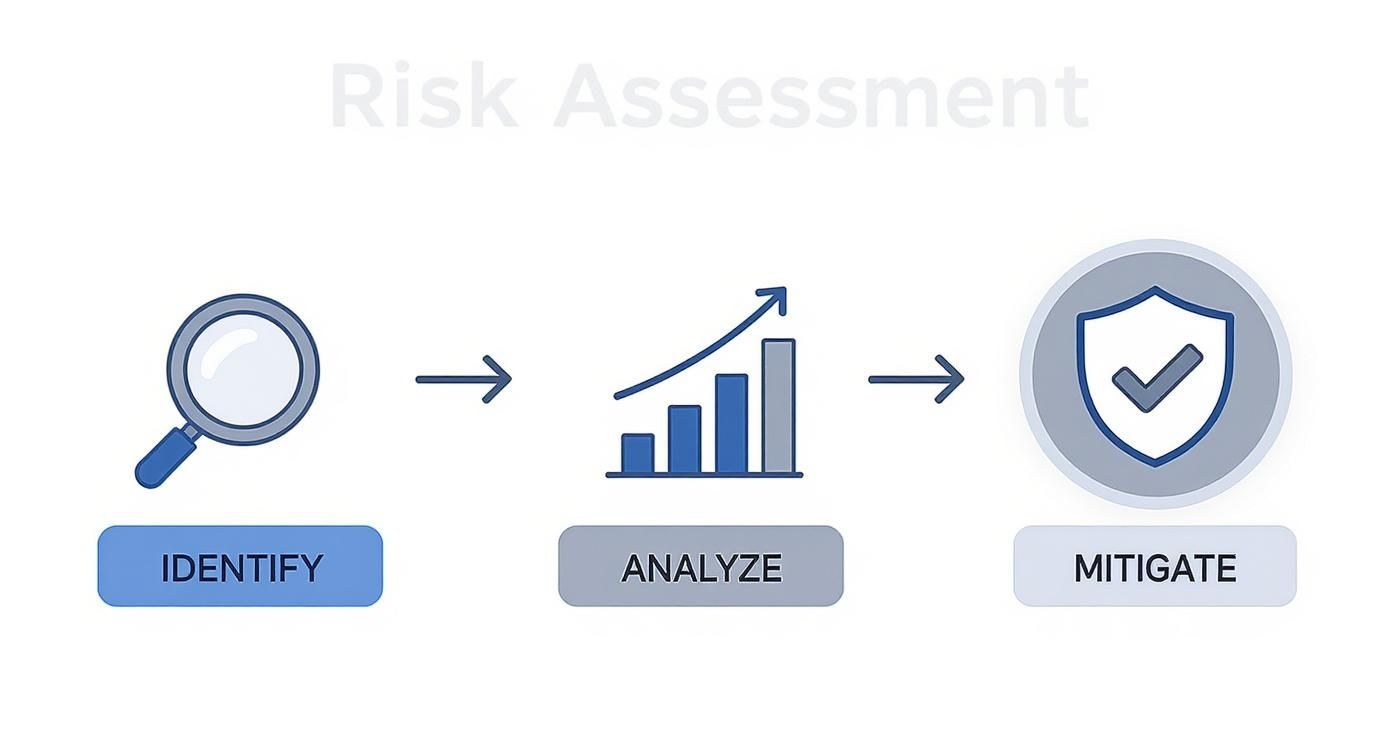
As you can see, every part of your blueprint—the mitigation—stems directly from what you identified and analysed. It ensures every decision is made for a damn good reason.
Calculating Your True Capacity
The official capacity number on your venue permit? That’s just the start. For proper crowd management, you need to figure out your realistic operational capacity. This is all about the actual usable space your attendees have.
It’s a simple process of subtraction. Start with the venue’s total square footage and then remove every single area people can’t stand:
- Stages and any back-of-house production areas
- Food trucks, vendor stalls, and merch tents
- Portable toilets and other amenity blocks
- Restricted zones and staff-only tents
- Any large art installations or decorative structures
The number you’re left with is your real-world space. From there, a solid rule of thumb for standing events is to allow at least 1.5 square metres per person. This prevents dangerous crowd density and gives you a much safer, more practical attendance number to aim for than the legal maximum.
Engineering Smooth Crowd Flow
How people get in, move about, and get out is absolutely critical to a safe event. Clunky, poorly designed flow creates friction and bottlenecks—the two main ingredients for frustration and trouble. Your goal should always be to create smooth, continuous movement from start to finish.
Getting People In (Ingress)
- Snake your queues. Forget long, straight lines. Use barriers to create a winding, serpentine queue. This simple trick stops people at the back from surging forward and creating a dangerous crush at the entry point.
- Create dedicated lanes. Don’t try to do everything at one chokepoint. Set up an assembly line: one lane for scanning tickets, another for bag checks, and a third for applying wristbands. It’s infinitely more efficient.
Getting People Out (Egress)
- Light it up. Your exits must be impossible to miss. This is non-negotiable. They need to be clearly signed, completely unobstructed, and well-lit, particularly for any event running after dark. Actionable insight: Have a staff member walk all exit routes from multiple points in the venue before gates open to ensure signage is visible from a distance and not blocked by any temporary structures.
- Stagger the departure. For a big concert or festival, a single mass exit is a recipe for disaster. Try to encourage a phased departure. Keep some food vendors open or have a DJ play a post-show set to prevent everyone rushing the gates at once.
Here’s the thing: your flow design isn’t truly tested when everything is running smoothly. The real test comes when something goes wrong. Your exit plan is your emergency evacuation plan, so it has to be simple enough for a panicked crowd to follow and wide enough to handle a sudden exodus.
Strategic Barrier Placement
Barriers are more than just fences; they’re the tools you use to bring your crowd flow plan to life. Their job isn’t just to keep people out of restricted areas—it’s to actively guide them within the event space.
You have to match the tool to the job. Using a flimsy rope stanchion to secure a main perimeter is like trying to put out a house fire with a garden hose. It’s just not going to work. Effective crowd management requires a much more considered approach.
This isn’t just theory; it’s a lesson learned in high-stakes environments all over the world. During civil unrest in Côte d’Ivoire, for instance, the UN had to bring in three entire police units just to reinforce their crowd control capabilities. It’s a powerful reminder that success hinges on having the right resources and the authority to deploy them. You can read more about these international security insights to see just how crucial strategic deployment is.
Getting Your Security Team on the Ground
You’ve got the floor plans and the operational run sheet sorted. But let’s be honest, those are just papers. The real test comes down to the people you put on the ground. Your security team is the living, breathing element of your crowd control strategy, and how you deploy them is everything.
It’s about being proactive, not just reactive. Putting the right people, in the right places, with the right instructions is how you stay ahead of the crowd, not just chase after problems.
A common mistake I see is organisers thinking more guards automatically means better security. It doesn’t. A smaller, well-drilled team of professionals will run rings around a large group of undertrained staff every single time. It’s always quality over quantity.
It’s More Than Just Guards; It’s About Specialists
A modern event security team isn’t just a sea of high-vis vests. It’s a coordinated unit of specialists, each with a distinct role designed to tackle the specific risks you’ve already identified. You need to think about your deployment in terms of layers and capabilities.
Here’s how a typical team breaks down:
- Static Guards: These are your anchors. You’ll post them at fixed, high-risk locations like entry gates, emergency exits, the front of the stage, and any VIP areas. Their job is primarily access control and to be a clear, visible deterrent.
- Roving Patrols: Your eyes and ears on the move. These teams patrol through the crowd and around the perimeter, actively looking for simmering issues, engaging with attendees, and giving you a mobile response. They are absolutely essential for nipping small problems in the bud before they blow up.
- Close Protection / VIP Details: If you’ve got high-profile guests, a dedicated close protection officer (CPO) or a small team isn’t a luxury; it’s a necessity. Their one and only focus is the safety of their designated person, managing their movements and creating a secure buffer from the general crowd.
A team that’s been led well understands they’re more than just security; they’re event ambassadors. A guard who helps someone find the toilets or a first-aid tent contributes just as much to a safe atmosphere as one breaking up a scuffle. It’s all part of the same job.
Getting Your Staffing Ratios Right
Working out how many staff you need is one of the most critical calculations you’ll make. People often throw around the one guard per 100 patrons ratio, but that’s just a starting point, not a hard-and-fast rule.
Your own risk assessment is the only thing that should guide this number. An all-ages festival with a big bar presence needs a completely different staff-to-patron ratio than a seated corporate awards night.
Don’t even think about cutting corners here. Australian research has proven that having too few security staff directly compromises health and safety. The same studies show that experienced, well-trained personnel handle complex situations far better than those with only basic qualifications. This drives home two key points: you need enough people, and they need to be the right people. You can learn more about these critical Australian staffing findings and see how they should influence your planning.
The Power of a Solid Pre-Event Briefing
Once your team is on-site, it’s strong leadership that turns them from a group of individuals into a cohesive unit. This all starts with the pre-event briefing. This is your one shot to get everyone on the same page, clarify the chain of command, and make sure every single person knows what’s expected of them.
Keep your briefing tight, clear, and focused on what matters:
- Chain of Command: Who’s the overall security manager? Who are the area supervisors? Everyone needs to know exactly who they report to and who to call when things get hairy.
- Key Risks & Hotspots: Quickly run through the biggest risks from your assessment. Get a map out and point to the areas needing extra eyes—bars, toilets, and any known bottlenecks.
- Comms Protocols: Go over radio etiquette, call signs, and code words for emergencies (medical, fire, evacuation). Make sure everyone knows the main channel and the backup.
- Emergency Procedures: Refresh everyone on the core action plans. What’s the signal to evacuate? Where are the assembly points? Who is clearing which zone?
And it doesn’t stop there. Active supervision throughout the event is just as crucial. A good manager is constantly on the move, checking in on their people, offering support, and making small adjustments as the crowd’s energy shifts. That visible leadership is what keeps your team sharp and your plan on track from start to finish.
Putting Your Emergency and Communication Plans into Action
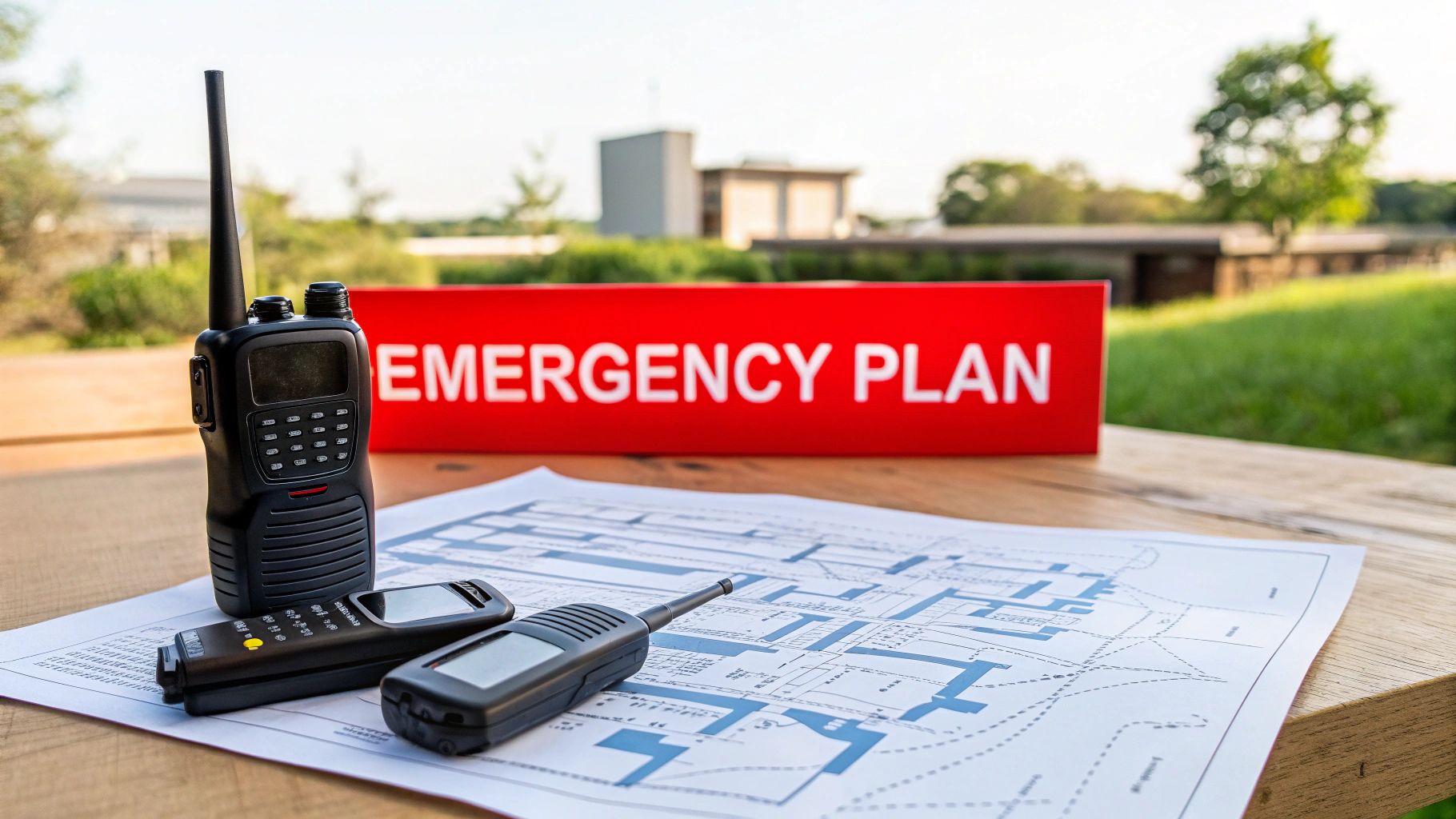
No matter how perfectly you’ve planned every detail, there will come a moment when that plan is put to the test. How your team performs in the first few minutes of a crisis—a medical emergency, a fire, a sudden fight—is what separates a close call from a catastrophe. This is where a well-drilled Emergency Action Plan (EAP) becomes more than just paper; it becomes a life-saving tool.
An EAP isn’t some dense document you file and forget. It needs to be a set of clear, simple instructions that anyone can follow under extreme pressure. Every single person on your team, from the event supervisor to the guard at the back gate, must know their exact role when things go sideways.
Building Emergency Plans That Actually Work
Your EAP has to be tailored to the specific risks you identified earlier, with clear procedures for each one. A generic, off-the-shelf plan is worse than useless because it doesn’t account for your venue’s unique layout or your crowd’s specific energy.
Think about it: for a multi-stage music festival, you need a completely different response for a crowd crush near the main stage versus a fire at a food stall. The first situation demands a coordinated effort to create space and pull people out. The second requires an immediate evacuation of a specific zone and securing a clear path for fire services.
A truly robust EAP needs to cover off on:
- Medical Emergencies: Who makes the call for first aid? What’s the code word to avoid panic? What are the pre-planned routes for getting paramedics into a dense crowd and a patient out?
- Fire or Other Hazards: How is the alarm raised without causing a stampede? Who is responsible for clearing the immediate area and calmly guiding attendees to safety?
- Large-Scale Brawls: What’s the signal to bring in a rapid response team? How do guards contain the situation without escalating it and triggering wider panic?
- Full-Scale Evacuations: Who has the authority to give the evacuation order? What are the exact announcements to be made? Which staff members are assigned to clear specific zones and guide people to designated muster points?
A plan is only as good as the team executing it. I can’t stress this enough: run regular tabletop exercises. Walking your supervisors through a simulated crisis is where you find the holes in your strategy—before you’re dealing with a real one.
Establishing a Rock-Solid Communication System
When an incident kicks off, confusion is your worst enemy. A clear, streamlined communication plan is the central nervous system of your entire security operation. Without it, your team is flying blind.
It all starts with a central command post. This is your mission control—the single point of contact for coordinating the response, talking to emergency services, and relaying instructions to your people on the ground.
Your communication plan must clearly define:
- Primary Channels: This is almost always a dedicated two-way radio channel. All staff need to be trained on proper radio etiquette—keep it short, clear, and professional. No chatter.
- Backup Channels: What if the radios fail? Mobile phones on a group chat can work in a pinch, but you have to plan for network congestion, which is a real problem at large events.
- Simple Code Words: Use pre-determined, simple language for common incidents. “Code Red at main bar” is faster, clearer, and far less alarming to the public than someone yelling “Fire! There’s a fire at the main bar!” over the radio.
This kind of proactive planning mirrors strategies used in much larger security contexts. For instance, the African Union’s “Silencing the Guns” initiative is built on understanding potential triggers and having clear protocols to prevent escalation. That same principle applies directly to event security. By identifying flashpoints and having a solid communication plan to manage them, you maintain control. You can explore more about these large-scale security approaches to see how the core ideas translate.
The Critical Role of Post-Incident Reporting
The job isn’t done when the emergency is over. Meticulous post-incident reporting is absolutely essential, both for liability protection and for getting better at what you do. Every single incident, no matter how minor, needs to be logged.
A solid report captures the key details:
- Time and location of the incident.
- Personnel involved and the actions they took.
- The outcome and how the situation was resolved.
- Contact details for any witnesses or involved parties.
This documentation creates a verifiable record that protects your client, your company, and your team. But just as importantly, it gives you priceless data for refining your crowd control strategies for the next event. It’s how you ensure your operation gets smarter, safer, and more effective every time.
Got Questions About Crowd Control? We’ve Got Answers
Running an event is complex, and navigating the ins and outs of crowd control security can feel like a minefield, especially with Australia’s patchwork of state-based regulations. Let’s tackle some of the most common questions event organisers ask, so you can move forward with confidence.
What Are the Legal Requirements for Crowd Controllers in Australia?
Here’s the first thing to know: in Australia, crowd control is a licensed and heavily regulated field. The rules aren’t the same everywhere; they shift depending on which state or territory you’re in.
Each jurisdiction—be it New South Wales, Victoria, or Queensland—has its own legislation, like the Security Industry Act, and its own governing body. This means any person performing crowd control duties must hold a current, valid personal security licence for that specific activity, in that specific state.
On top of that, the company providing the security guards also needs to hold a master licence. To get a personal licence, an individual typically has to:
- Complete a nationally recognised training course, like a Certificate II in Security Operations.
- Be at least 18 years old.
- Pass a thorough criminal history and fingerprint check.
- Meet other state-specific requirements, which might include having a first aid certificate.
It’s absolutely crucial to check the specific regulations in the state or territory where your event is happening. Things like uniform policies, how licence numbers are displayed, and mandatory incident reporting can vary wildly. Getting this wrong can lead to serious fines and legal headaches.
How Do I Figure Out the Right Number of Security Staff for My Event?
There’s no magic number here. The right amount of security staff is always dictated by a thorough risk assessment, not some generic formula you find online.
You might hear a ratio like 1 guard per 100 patrons thrown around as a starting point, but it’s just that—a start. You have to adjust it based on the specific risks of your event. For example, a high-energy music festival serving alcohol across multiple bars needs a much denser security presence than a seated corporate conference.
The key factors that will drive your staffing numbers are:
- Crowd Size and Venue: How many people are you expecting, and what’s the layout of the space?
- Event Type and Vibe: Is it a family-friendly fair or a late-night concert with a rowdier crowd?
- Alcohol Service: This is a huge one. Serving alcohol is a major risk multiplier and always calls for more staff.
- High-Risk Zones: You need to pinpoint areas like entry gates, stage barriers, and packed bar queues that will need more eyes on them.
Always talk to the local council and police. For certain events or licensed venues, they might have their own staffing mandates that you’re legally obliged to follow.
What’s the Single Most Important Part of an Effective Crowd Control Plan?
If I had to pick one thing, it’s this: the pre-event risk assessment and planning phase is, without a doubt, the most critical component. A proactive strategy that anticipates problems before they happen will always beat a reactive one.
Your risk assessment is the bedrock of your entire security operation. It informs every other decision you make—where to place barriers, how many guards to hire, what your emergency procedures look like. It’s the difference between controlling a situation and being completely overwhelmed by it.
Without that careful, forward-thinking planning, your team will spend the whole night just putting out fires instead of preventing them in the first place. This is also where you establish your communication protocols, which are the glue that holds everything together when the event goes live.
What Are Some Common Mistakes to Avoid in Crowd Management?
One of the biggest and most dangerous mistakes I see is inadequate staff training and pre-event briefings. Just assuming a licensed guard knows your specific venue, the unique risks of your event, or your emergency plan is a recipe for disaster. Practical example: A guard who doesn’t know the specific code word for a medical emergency might cause a panic by using plain language over the radio.
Another classic error is poorly designed entry and exit flows. This is how you get dangerous bottlenecks and pinch points—the very things that cause crowd-related injuries. Every part of people movement, from the queueing system to the emergency exits, needs to be meticulously planned for a smooth, clear path.
Other common slip-ups include:
- Ignoring External Factors: Failing to plan for a sudden downpour or public transport delays can throw a wrench in even the best-laid plans.
- Not Testing Your Comms: If you haven’t tested your communication system—including your backup channels—a small incident can escalate into a major crisis in seconds.
The takeaway? Plan for everything, brief your team relentlessly, and test every part of your strategy. That’s how you build a crowd control plan that’s both effective and resilient.
A well-executed security plan is the foundation of any successful event. For a proactive, experienced team that understands the complexities of security crowd control in Australia, partner with GM GROUP Services. We provide licensed, professional security solutions tailored to safeguard your people, property, and reputation. Get in touch with us today to discuss your event security needs.
Article created using Outrank