


Security and monitoring only work when an alert turns into an action someone owns. Most sites already have the hardware: cameras over the till and the back gate, a back-to-base alarm panel, guards rostered for Friday and Saturday, and a logbook that lives on a clipboard behind the bar.
Then the rear door sensor trips at 11:20 pm on a Tuesday and nobody can say who is meant to look at the screen, who calls the guard, or where that decision gets written down. The equipment didn't fail. The chain between the alert and the person acting on it did.
That chain has five links: a sensor or a pair of eyes, someone watching, a verified decision, a response on the ground, and a record that survives the shift. Break one and you're paying for detection that never becomes protection. This is the part of security and monitoring that most plans skip, and it's the part that decides whether a bad night stays small.
How Security and Monitoring Work Together
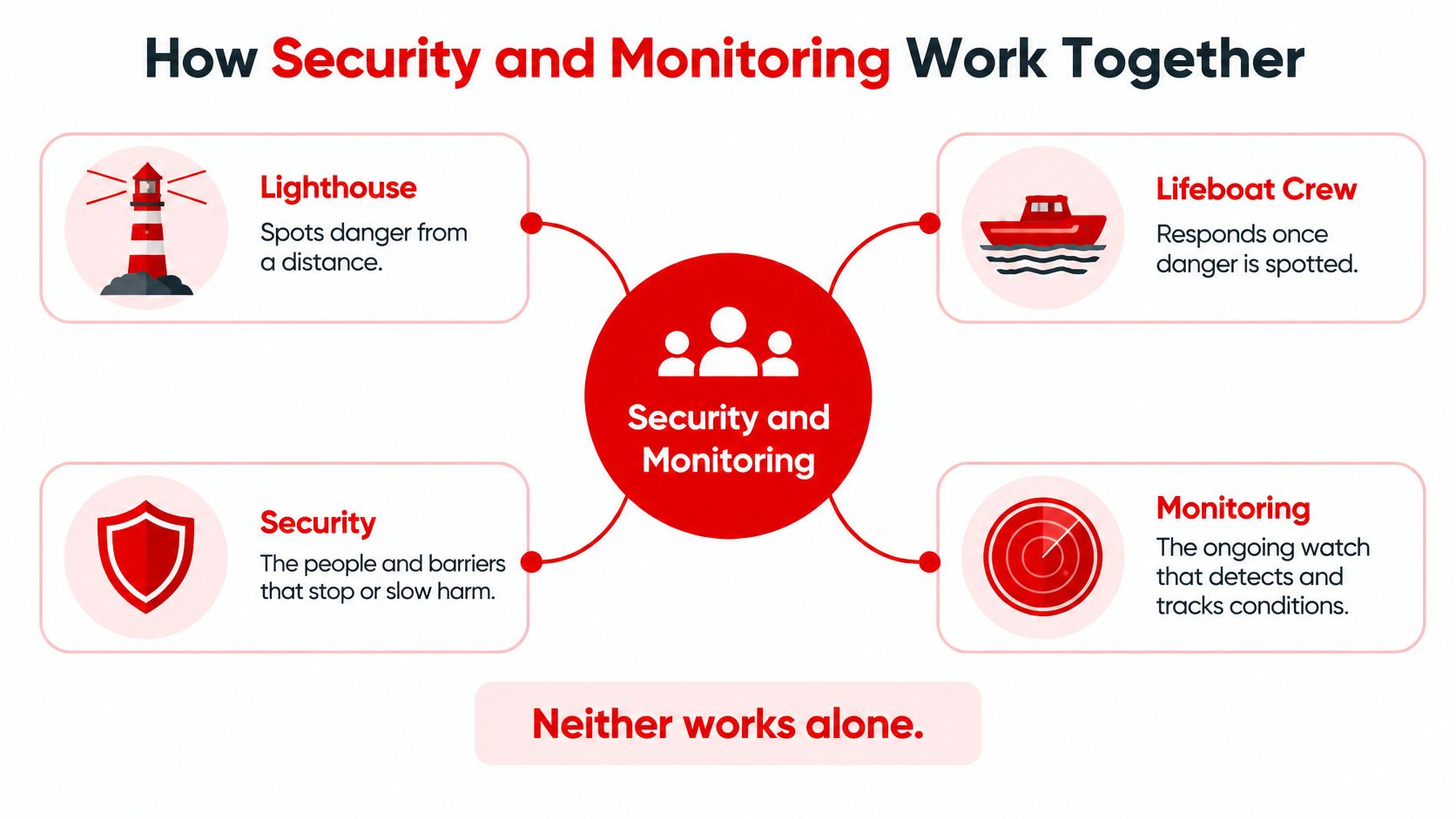
A lighthouse keeper spots a ship in trouble and raises the alarm. The lifeboat crew launches because someone told them where to go and what they were heading into. Neither half of that story saves anyone alone.
Security is everything that stops or slows harm: a guard at the gate, a locked staff door, a bollard line, a licensed crowd controller standing where a crush would start. Monitoring is the continuous watch that tells a person when to act. Security is the barrier. Monitoring is the trigger. Split them and you get cameras nobody watches, or a guard posted where nothing has been reported for six months.
The watch has to run all day because the risks do. The Australian Signals Directorate's Australian Cyber Security Centre received more than 87,000 cybercrime reports in 2023-24, an average of roughly one every six minutes, and responded to more than 1,100 cyber security incidents, with 11 percent of those incidents involving ransomware, according to its 2023-24 cyber threat trends report. Some of those incidents land on access-control systems, payment platforms and customer databases, which is why the physical and digital sides belong in the same plan rather than two separate ones.
Physical risk keeps the same hours. The ABS recorded 40,087 victims of sexual assault in 2024, a 10 percent rise on 2023 and the highest victimisation rate in the available time series, per its recorded crime victims release. Late-night venues answer that with lighting, sightlines, staff positioning and camera coverage at queues and car parks, not only at the till.
The Four Layers and What Each One Does

| Layer | Main job | Typical example | Main limit |
|---|---|---|---|
| Guards on site | Verify people and respond in person | Gate staff checking entry at a bar | Cannot see the whole site at once |
| CCTV cameras | Record activity and support alerts | Camera on a car park entry | Blind spots and poor night lighting |
| Monitoring centre | Watch alarms and dispatch responders | Operator checking a back-to-base alarm | Depends on accurate sensor settings |
| Access control | Limit who can enter restricted areas | Swipe card on a staff door | Can be bypassed by tailgating |
Each layer has a limit the layer above it can't fix. Guards verify people one at a time, so a single gate officer at a 3,000-person event becomes a queue, and a queue becomes a crowd. Cameras record faithfully and see nothing outside their sightlines or under a blown-out floodlight. A monitoring centre is only as good as the settings feeding it, so a motion sensor aimed at a tree generates the same 2 am alert as a person at the back door. Access control stops the person without a card and does nothing about the person who walks in behind them.
Cameras earn their place as one component, not as a replacement for trained response. The Australian Institute of Criminology's work summarised in Victoria's crowded places guidance finds CCTV reduces some property crime in particular settings such as car parks, and is more effective combined with other initiatives, with the guidance describing layered protection built on four principles: deter, detect, delay and respond.
Where Security and Monitoring Overlap
Run one test across your site this week. For each risk you worry about, name the layer that covers it and the person who owns that layer. Theft from the loading dock maps to cameras plus a patrol. A crowd surge maps to gate staff and a supervisor with a radio. After-hours intrusion maps to the monitoring centre and the on-call guard.
Then flag any two layers that cover the same risk with no clear owner between them. That overlap is where alerts get acknowledged by nobody, and it's the cheapest thing on this page to fix.
Roles of Guards, Cameras and Monitoring Staff in Security and Monitoring
A bottle shop's rear door sensor trips at 12:40 am, twenty minutes after close. The alert matters only if someone verifies it, owns it and records what happened. In practice, the chain runs through four roles.
- The monitoring operator pulls up the camera covering the back lot, sees the gate swinging in wind rather than a person, and logs the alarm time. Verification comes before dispatch.
- The on-call guard attends, secures the gate and confirms the site is clear, while the camera has already preserved the footage.
- The supervisor decides whether police need to attend at all, and records who made that call.
- The venue contact gets the report at opening, not a rumour from the barista who saw a torch.
The sequence works because each role has a limit. A guard must not detain a person without a defined procedure behind them. An operator must not dispatch a responder where the threshold requires verification first. A camera is evidence and support, never the response itself.
Hand-off rule: every alert needs a name against it before the shift starts, not after it's been missed.
Australia's national crowded places framework puts primary responsibility for protecting people from foreseeable threats on owners and operators, and expects those arrangements to align with emergency services, as set out in Australia's strategy for protecting crowded places. That creates a more useful question than which camera to buy: who watches what, what triggers action, and how information moves from the person watching to the person deciding.
Selection matters as much as headcount. GM GROUP Services selects security officers who communicate clearly, present professionally and take a customer-service-focused approach. Clear speech at a gate can settle a queue before it turns into a dispute, while vague instructions leave guards guessing about when to observe, report or escalate.
Write three sentences for each role on your site:
- What it does, in one line, in plain language.
- Who it reports to, with a name and a phone number.
- What it must never do alone, whether that's detaining, dispatching or escalating.
Keep the same discipline beyond the main perimeter. If stock, equipment or records move into a self-storage unit after an incident or during a refit, compare storage unit costs and insurance before you commit, because a facility without access logging is another blind spot in the same chain.
Licensing Checks for Security and Monitoring Providers
A festival gate can look organised at 6pm and still fail the licence check at 9pm, when the queue grows and the provider adds officers. The practical test is whether the paperwork matches the deployment on site. Treat the licence class, the officer credentials and the action log as one chain. If one link is loose, an alert can become a conversation with no owner and no record.
Before you sign anything, work through six checks on the provider and the deployment:
- Worker licence category. Every person carrying out a security activity needs the right licence class for that activity, not just a company name on an invoice.
- Company master-licence class. Ask for the class and read the limit, not the sales brochure.
- Headcount against the limit. Compare the planned deployment to the class maximum before the roster is locked.
- RSA training. For events where alcohol is served, confirm responsible service of alcohol training for the officers on site.
- Any temporary approval. If the deployment exceeds the class limit, ask for evidence of the permit, in writing.
- Current credentials. Confirm the licence is active and matches the entity you're contracting.
NSW master licences set ceilings on how many operatives a business may provide, under the NSW Police Security Licensing and Enforcement Directorate rules:
| Master licence class | Maximum operatives | If you need more |
|---|---|---|
| Class MB | 3 | Apply for a Temporary Excess Provision of Services permit |
| Class MC | 14 | Apply for a Temporary Excess Provision of Services permit |
| Class MD | 49 | Apply for a Temporary Excess Provision of Services permit |
| Class ME | Unlimited | Not required |
Read that table against the roster, not against the proposal. A provider holding an MC licence cannot be treated as authorised to supply 20 crowd controllers for a festival gate without resolving the licensing position first, either through a temporary permit or through a provider whose class covers the number. Peak-period surges are where this gets tested. The same discipline applies to static guards, mobile patrols, gatehouse security, crowd management, personal protection and K9 security, because each activity needs the right people, instructions and reporting path.
Requirements differ by jurisdiction, so an organiser running dates across NSW, Victoria, Queensland and the ACT checks each one separately. Approved industry organisation requirements, security licensing for CCTV installation or maintenance, and electrical licensing for high-voltage work to power camera equipment can all affect the plan, depending on the state and the work involved. Processing arrangements also vary by jurisdiction, so build time into the procurement schedule rather than assuming one approval will cover another. GM Group is a member of the Australian Security Industry Association Limited and is a Security Master Licence Holder, as required by law in NSW. GM GROUP Services holds security licence numbers NSW 000105362, QLD 4824061, VIC Z63-250-905 and ACT 1750266.
Use this trigger rule this week: if an alert, roster change or site expansion adds a security task, stop and match it to the licence class, the officer category and the logged owner before the change goes live.
The one question worth asking every provider before signature: which master-licence class covers this exact deployment, and what happens if I add ten officers next week?
How Security and Monitoring Respond to a Live Incident
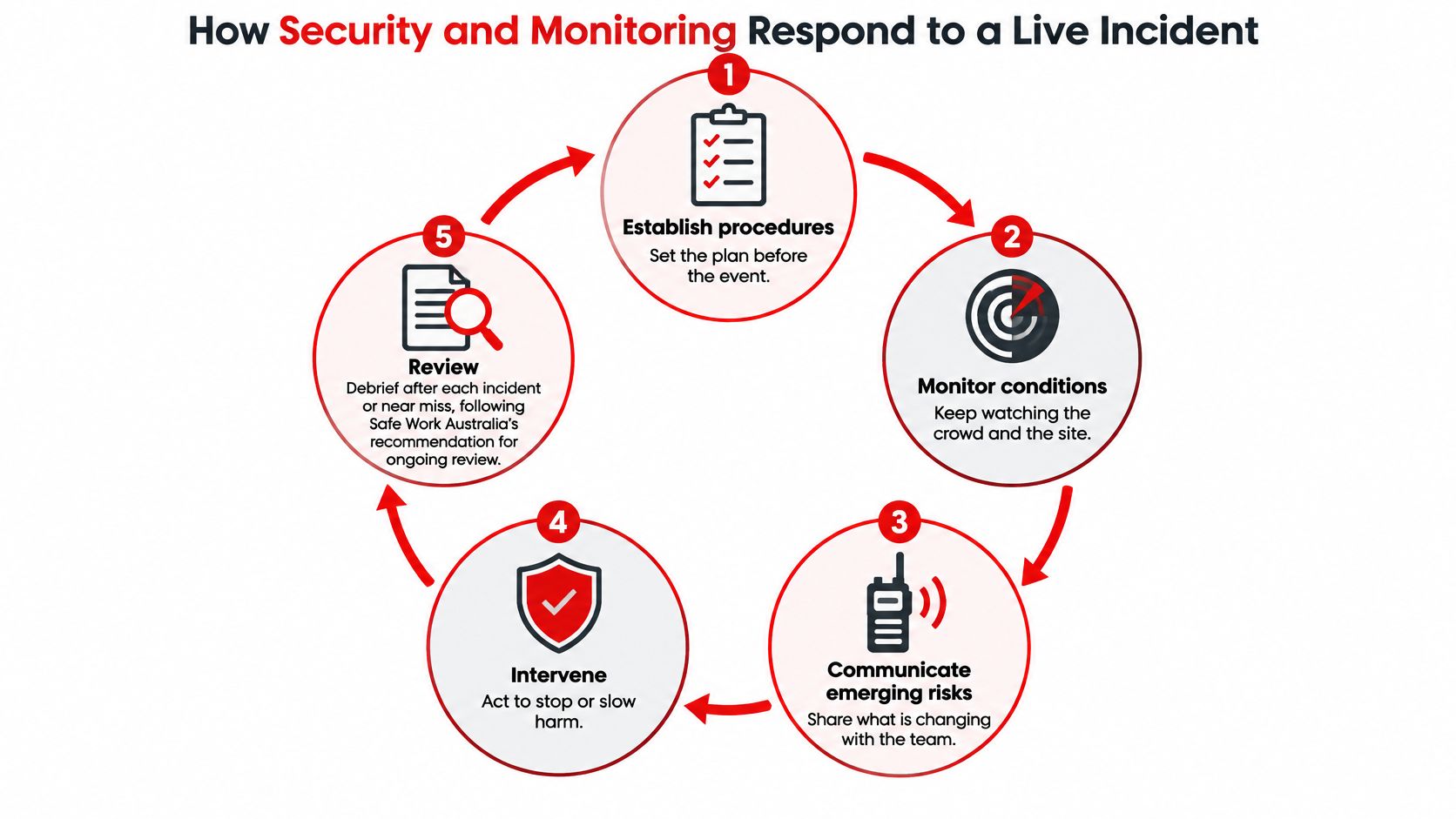
Monitoring during an event is a closed loop, not a viewing exercise: set crowd, traffic and incident procedures, watch conditions, communicate emerging risks, intervene, then review after every incident and near miss. Safe Work Australia recommends that loop for event traffic management, including efficient control of entry and exit points so queues don't obstruct traffic or create crowding, in its traffic management guide for events. The same shape holds for a venue.
Here's the loop as a working process:
Why Congestion Becomes a Security Trigger
Congestion shrinks the separation between people and vehicles. It delays emergency access, and it lets one local bottleneck spread into a wider crowd-safety problem while everyone assumes somebody else is watching the queue. NSW event guidance also requires systems for recording incidents, accidents and near misses, with crowd plans covering illuminated and adequately sized entrances and exits, stage-area crowd behaviour, overheating, crush and fire risks.
Six Steps From Alert to Logged Action
- Detect the trigger. A threshold is crossed, or someone radios it in.
- Verify. Confirm on camera or by a second pair of eyes. Verification prevents half the unnecessary responses.
- Escalate to the supervisor. The supervisor owns the decision, not the person closest to the problem.
- Act on the defined response. Open a gate, pause entry, redirect patrons, request medical support, call police.
- Record the time, the decision and the outcome. Who approved it, and when.
- Review after the event. Logs exist to be read, not archived.
Set the threshold values before the gates open, not during the queue. Queue length, crowd density, alarm-to-verification time and aggressive-behaviour triggers get argued about in the moment if they were never written down.
Escalation Triggers and Who Acts
| Trigger | First action | Who acts | Record kept |
|---|---|---|---|
| Queue backing onto the road | Open an extra gate and redirect entry | Gate supervisor | Time-stamped log entry |
| Aggressive behaviour in a crowd | Observe, call supervisor and de-escalate | Guard team lead | Incident report and saved footage |
| Door alarm after hours | Verify on camera before dispatch | Monitoring operator | Alarm-to-verification time |
| Suspected theft | Keep distance and call police if needed | Store security | Preserved footage and statement |
| Medical emergency | Call emergency services and clear the route | Venue manager | Incident record and timings |
Records carry weight beyond compliance. The ABS recorded 581,209 victims of non-motor-vehicle theft in 2025, with 43 percent of them, or 247,425 victims, at retail locations, per its recorded crime victims data. On the workplace side, of 176,100 incidents recorded by the ABS Personal Safety Survey over the previous 10 years, only about 46 percent were formally reported as workplace incidents, according to Safe Work Australia's work-related violence data. Under-reporting is the norm, which is why every logged record supports follow-up and review rather than sitting in a folder.
GM GROUP Services' security incident records support communication, follow-up and review of security-related incidents, so the loop has something to close on.
Are your triggers written down, and does every alert on the list have a named owner for each shift?
Security and Monitoring at a Festival Gate
Take an outdoor festival of about 3,000 patrons in NSW, used here as an illustration rather than a real site. Before doors open, the organiser assigns zone owners for the entry gates, the stage area and the car park, and sets a queue-length threshold that triggers a second gate. Every person carrying out a security activity, including a bouncer or crowd controller, must hold the appropriate security licence, and most large events where alcohol is served must meet a minimum number of security officers trained in responsible service of alcohol, as the NSW Event Starter Guide sets out.
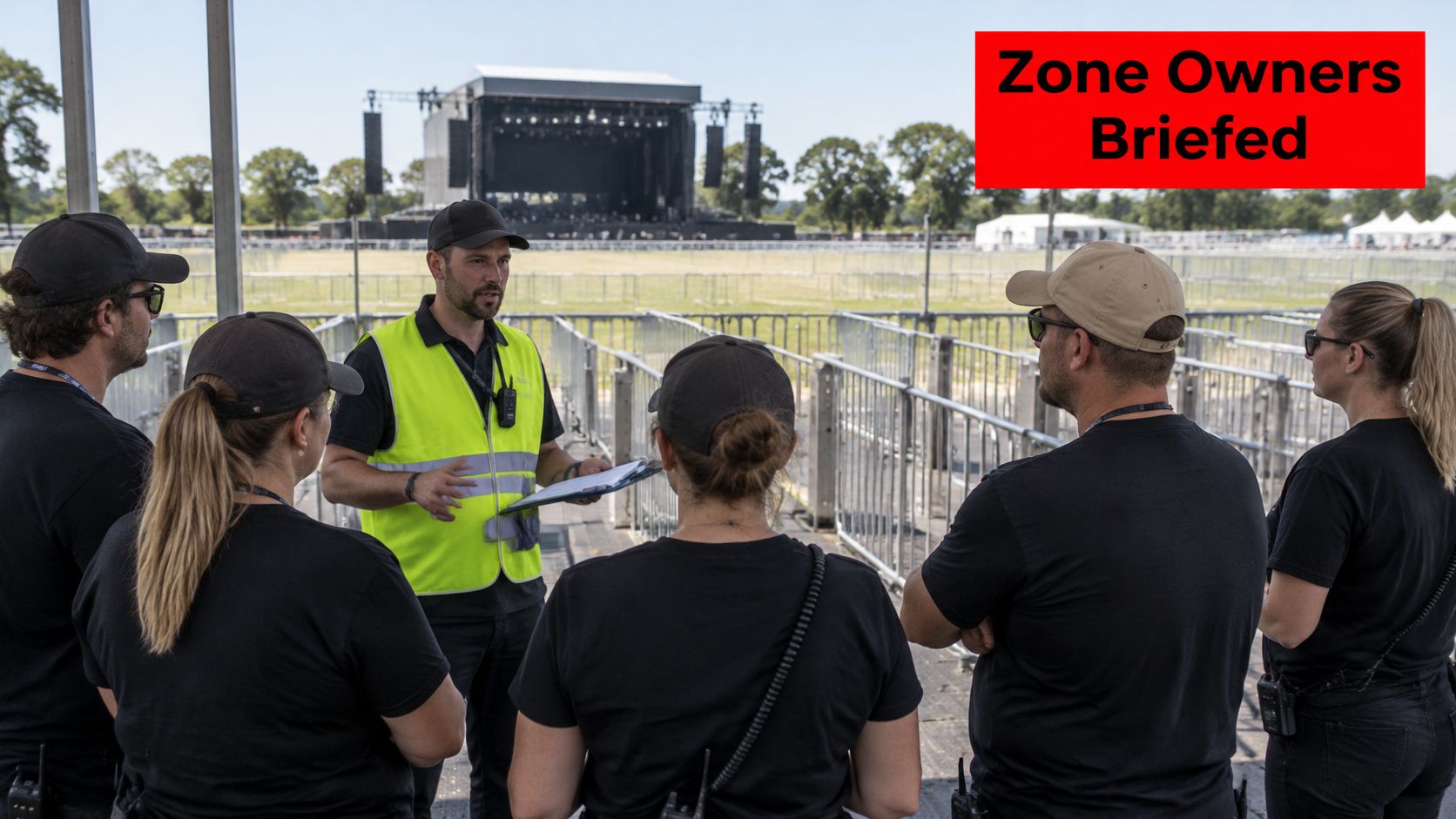
Crowd controllers and venue staff are confirmed against the licence and headcount checks, and one supervisor holds the radio channel and the incident log. Cameras cover the gate lanes, and the monitoring team watches density at the main entry rather than the whole perimeter at once.
At 9:40 pm the headline act starts. The queue doubles and reaches the road.
- The supervisor opens the second gate.
- The operator logs the time and the new queue length.
- Entry pauses for 12 minutes until the lane clears and the road is free again.
Nobody debates the decision at the gate, because the threshold was agreed at 4 pm. After the event, the team reads the log, notes which threshold was reached, records how long the pause lasted and updates the plan for the next date. The review takes twenty minutes and changes the next show.
This is the part most organisers skip. They buy the cameras, brief the guards, and never write down the number that tells a supervisor to act. A queue threshold, a density limit and a named decision-maker are free. They're also the difference between a plan and a hope.
Which thresholds would your event need, and who on your team has the authority to act on them at 9:40 pm?
Digital Monitoring Gaps in Security and Monitoring Plans
Venue managers and site operators tend to treat monitoring as watching for intruders. The breach notifications point to a quieter problem: insiders and compromised accounts.
The Office of the Australian Information Commissioner received 527 notifications under the Notifiable Data Breaches scheme in the first half of 2024, up from 485 in the previous half, and cyber security incidents accounted for 201 of them, or 38 percent of all reported breaches, according to its Notifiable Data Breaches report for January to June 2024. Those incidents made up 57 percent of breaches caused by malicious or criminal attacks.
The Warning Signs the OAIC Names
The OAIC points to monitoring that can detect high-volume record searches, extensive copying and pasting, and uploads to external services. Those are the behaviours that precede a lot of the notifications in that count.
An alert only counts if it becomes a logged, owned action. The gaps show up in four predictable places:
- Alarms with no named owner. A panel that texts a group chat broadcasts an alert. Monitoring means one named person owns the response.
- Cameras with unsynchronised clocks. Footage that can't be aligned to a payment record or an access log is hard to use later.
- Access logs nobody reviews. A log with no review date is just a file.
- Rosters that don't match who was on site. If the roster and the access log disagree, one of them is wrong.
That last one is testable in an afternoon. Say a corporate office notices a staff login pulling large customer files at 11 pm. The manager checks the roster, finds no shift for that account holder, and escalates to IT the same day, with a time, a username and a file list. The alert became an owned action because someone had already decided who checks the roster and when. GM GROUP Services' rostering and attendance records support management oversight and communication with its guards and clients, which is the same principle applied to physical staffing.
Digital exposure reaches further than the office. An estimated 3.2 million Australians, about one in seven people, experienced personal fraud in 2024-25, according to the ABS. A venue that takes card payments and holds booking details is part of that surface, whether it thinks of itself as a technology business or not.
The consequences land on real people. Some of the cyber incidents behind those notifications affected many thousands of individuals, so even a small operator's breach can carry a large tail.
Practical rule: if you can't say who reviews a log and how often, the log is decoration.
Confirm Your Security and Monitoring Plan Before You Act
You can complete this in one sitting with the site manager, the guard supervisor and whoever handles IT.
- Map each risk to a layer. Theft to cameras and patrols, crowd surges to gate staff, after-hours intrusion to the monitoring centre.
- Name one owner and one review date for every alarm, camera and log.
- Write the escalation triggers and thresholds, including queue length, density and aggressive behaviour.
- Check every guard and provider licence, and match the master-licence class to the planned headcount.
- Confirm camera clocks are synchronised, with sightlines and blind spots documented.
- Test the backup radio or phone channel on a normal day, so you're not discovering it's flat during an evacuation.
- Book the post-event review and log its date before the event runs.
A plan that passes those seven checks leaves an auditable trail: staffing, licences, decisions and timings that stand up months later. Informal arrangements don't survive a staff change or a police request.
Construction and retail sites often carry the worst version of this gap, because temporary buildings and stored materials sit outside anyone's monitoring routine. If that's your exposure, this guide on how to reduce theft at jobsite offices covers layout and access in more detail than a general site plan does.
If you want a second opinion, GM GROUP Services offers a confidential discussion about your security needs. You can request a quote or call 1300 14 14 41 or 0499 020 304 to discuss a site, a festival or a roster. GM Group is a Security Master Licence Holder, as required by law in NSW, and holds licences across NSW, Queensland, Victoria and the ACT.
I'd start with the cheapest fix of all: pick the one risk that worries you most, write the trigger and the owner's name for it, and test that single layer this week. Add the second layer next week.
Security and Monitoring Questions Answered
Is CCTV enough on its own
No. Cameras record and support a response, and they work best combined with trained people and clear response procedures. A camera that nobody is watching, and no one is dispatched from, produces footage for an insurer rather than protection for a person.
Who may carry out security work at an event in NSW
Every person doing a security activity, including crowd controllers and bouncers, must hold the appropriate licence, and alcohol-serving events also carry a minimum staffing requirement with RSA-trained officers. Confirm each worker's licence category and the provider's master-licence class before the roster is locked.
How often should monitoring logs be reviewed
Set a fixed schedule and record the review date. Venues trading late benefit from a daily review of alarms and access exceptions, while events need a documented post-event review after each incident and near miss.
What's the first sign a monitoring plan is failing
Alerts that get logged but never acted on, or alarms that routinely take longer to verify than the threshold allows. Both mean the chain between the alert and the action has broken, usually because no single person owns the step in between.
GM GROUP Services provides licensed static guards, crowd controllers for festivals and venues, back-to-base monitoring, vehicle patrols and risk assessments across NSW, Victoria, Queensland and the ACT, matched to the site and the environment rather than dropped in from a template. If this article raised a gap at your venue, event or construction site, we'll walk the site with you and tell you which layer needs fixing first. Visit GM GROUP Services to start a confidential conversation about your security and monitoring arrangements.