

Effective risk management and consulting is the critical first step to safeguarding your business. It's not about reacting to disasters; it's about proactively identifying, analysing, and neutralising threats before they can cause real harm to your people, assets, or reputation. This strategic approach transforms security from a reactive cost into a powerful advantage.
Think of it as the expert navigation system for your event or venue. It helps you steer clear of hidden dangers, whether that’s a security breach at a festival or a safety hazard on a construction site. Done right, it transforms security from a reactive cost into a genuine strategic advantage. A practical example is a retail store using consulting to identify high-theft areas and then implementing a combination of CCTV placement and staff training, cutting shrinkage by 25% in six months.
What Strategic Risk Management and Consulting Really Means
Imagine trying to captain a ship through a storm without a map or a lookout. That’s precisely what running a business is like without a solid risk management plan. It’s a structured process designed to protect your people, your property, and your reputation by anticipating problems instead of just cleaning up the mess afterwards.
This proactive mindset moves far beyond the outdated "one-size-fits-all" security model. Let's be honest, a generic plan just doesn't cut it. The risks facing a corporate office are worlds apart from those at a bustling music festival or an active construction site. That's where expert consulting comes in; we dive deep into your specific world to build a defence that's made just for you.
From Reactive Expense to Strategic Asset
For years, security was just seen as a necessary evil—a cost centre you only really thought about when something went wrong. Modern risk management and consulting completely flips that script.
By proactively identifying and neutralising threats, you aren’t just preventing loss; you're building a secure, confident, and compliant environment. That stability becomes a competitive edge, fostering trust with clients, staff, and stakeholders.
A key piece of this proactive puzzle is having a solid plan for operational continuity. To get ready for potential disruptions, many organisations find it helpful to start with a business continuity plan template as a foundational guide.
Core Goals of a Customised Strategy
At the end of the day, the goal is to create an operation that’s both secure and efficient. A well-designed, tailored strategy is laser-focused on a few key outcomes:
- Protecting People: First and foremost, ensuring the safety and wellbeing of every single employee, guest, and contractor is non-negotiable.
- Safeguarding Assets: This is about stopping theft, vandalism, and damage to both physical property and intellectual assets before they happen.
- Ensuring Compliance: You need to be on top of all relevant state and federal regulations, including RSA requirements, to steer clear of fines and legal headaches.
- Enhancing Reputation: A strong safety record helps build a brand known for reliability and professionalism, which is priceless.
This kind of structured approach means your organisation isn't just prepared for the worst-case scenario—it's actively working to create the best possible one.
The Four Stages of Proactive Risk Management and Consulting
When we talk about proper risk management and consulting, we're really talking about a fundamental shift in mindset. It’s about moving away from just reacting when things go wrong and stepping into a proactive stance where you're always one step ahead. This isn't a one-and-done checklist; it’s a living, breathing cycle that adapts to new information and evolving threats.
Let's break down this continuous loop into four clear stages. Thinking about it this way makes the entire process much more manageable for any event organiser or site manager.
The goal is to move from simply putting out fires to preventing them from ever starting.
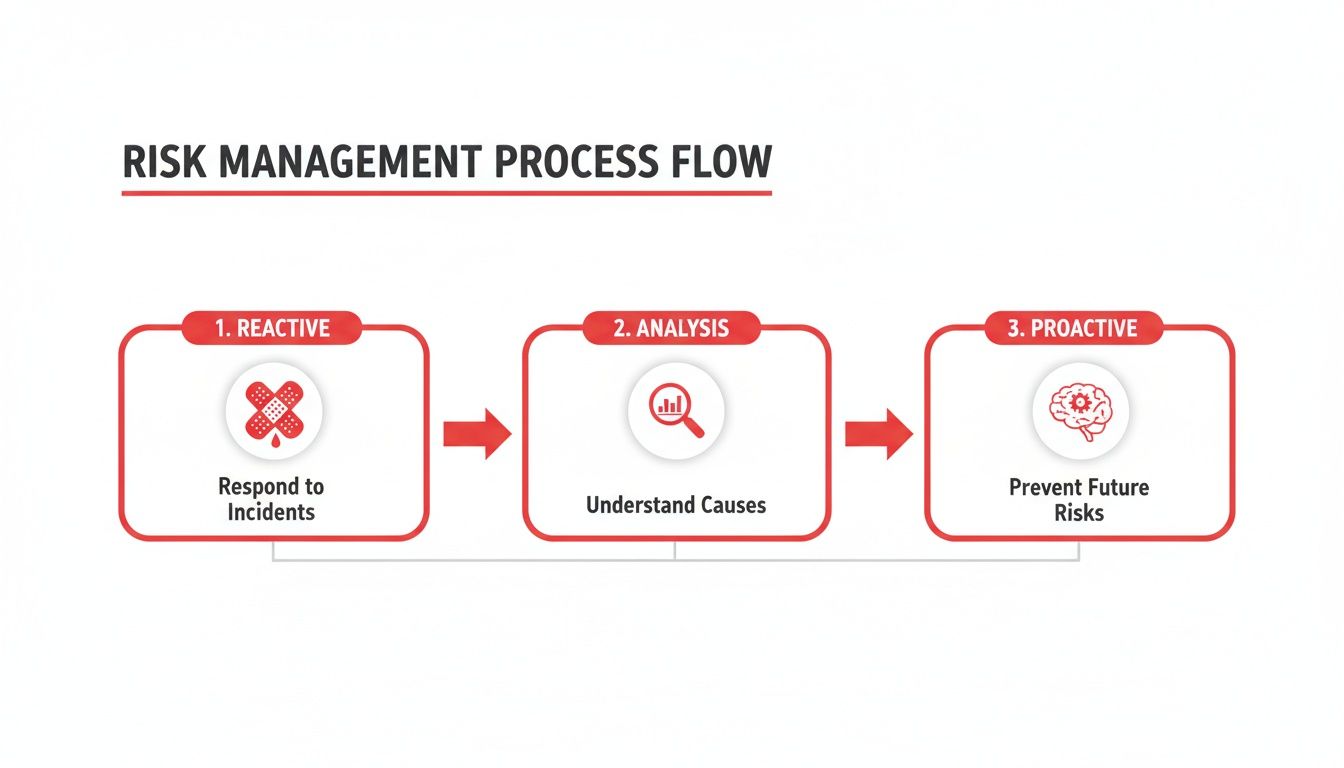

This image really gets to the heart of the matter. Mature, effective security is born from strategic planning, not just scrambling after an incident has already occurred. These next four stages are the cornerstones of building that proactive defence.
Stage 1: Identification
First things first, you can't manage a risk you haven't identified. This initial stage is all about playing the "what if?" game and being brutally honest about what could possibly go wrong. It’s a mix of formal walkthroughs, digging through old incident reports, and—crucially—talking to the people on the ground who see the day-to-day reality of your venue or site.
For a music festival, this goes way beyond just worrying about gatecrashers. We need to think bigger.
- Medical Emergencies: What's our plan for mass heatstroke on a 35-degree day? What about crush injuries near the main stage?
- Technical Failures: What happens if the point-of-sale network crashes or the main stage lighting rig fails mid-performance?
- Weather Events: A sudden, violent thunderstorm rolls in. How do you safely manage 10,000 people in an open field?
Actionable Insight: Create a "Risk Register" spreadsheet. Dedicate columns for Risk Description, Category (e.g., safety, financial), Potential Impact, and Initial Thoughts on Mitigation. Involve department heads in a brainstorming session to populate it.
Stage 2: Assessment
Okay, now you have a long list of potential problems. The next step is to figure out which ones actually keep you up at night. Not all risks are created equal, so we assess each one based on two simple but powerful questions: how likely is it to happen, and what's the impact if it does?
This is where you separate the minor headaches from the major disasters, allowing you to focus your energy and budget where they’ll make the biggest difference.
A food vendor's card machine failing is an annoyance—a low-impact risk. But a crowd barrier collapsing? That’s a catastrophic, high-impact event that needs your immediate attention, even if the chances of it happening are slim. Getting this prioritisation right is the secret to smart risk management.
Stage 3: Mitigation
With your risks identified and prioritised, it’s time to get your hands dirty. Mitigation is all about putting practical controls in place to either stop a risk from happening in the first place or soften the blow if it does. This is where your risk management and consulting strategy becomes real and visible.
Some hands-on mitigation strategies might look like:
- Bringing in K9 units to screen for illicit substances or explosives at entry points.
- Mapping out, signposting, and properly lighting all emergency evacuation routes.
- Using a dynamic staffing model that floods high-traffic zones like bars and entry gates with security during peak periods.
Actionable Insight: For each high-priority risk, assign a clear "owner"—a person responsible for overseeing the mitigation strategy. This ensures accountability and follow-through.
Stage 4: Monitoring and Review
Let's be clear: risk management is never "set and forget." The final stage is a constant loop of monitoring the controls you’ve put in place, reviewing how well they’re actually working, and tweaking your plan based on what you’re seeing on the ground.
This means fostering open communication with your team, demanding detailed incident reports for even minor issues, and regularly revisiting your risk plan. If a control measure isn't pulling its weight, you have to adjust it. This ongoing cycle is what keeps your security sharp, relevant, and ready for anything.
The Risk Management Lifecycle in Action
| Lifecycle Stage | Objective | Example for a Music Festival | Example for a Construction Site |
|---|---|---|---|
| Identification | To uncover all potential threats, vulnerabilities, and hazards. | Spotting risks like overcrowding near stages, unauthorised entry points, and potential for drug-related medical issues. | Identifying hazards such as unsecured scaffolding, trip hazards from cables, theft of expensive tools, and unauthorised site access. |
| Assessment | To analyse the likelihood and potential impact of each identified risk. | A fight breaking out (high likelihood, medium impact) vs. a stage collapse (low likelihood, catastrophic impact). | A minor tool theft (medium likelihood, low impact) vs. a crane failure (very low likelihood, catastrophic impact). |
| Mitigation | To implement controls to reduce or eliminate the risk. | Implementing clear bag policies, deploying crowd management teams, and having on-site medical tents with trained staff. | Enforcing a strict hard-hat policy, conducting daily safety briefings, installing perimeter fencing with CCTV, and securing tool lock-ups. |
| Monitoring | To continuously review the effectiveness of controls and adapt the plan. | Using CCTV and radio comms to watch crowd density in real-time and redeploying guards as needed. | Performing regular site safety audits, reviewing near-miss reports, and updating safety procedures based on findings. |
As the table shows, the core principles are universal. Whether you’re managing a festival crowd or a building site, this structured approach gives you the clarity and control needed to protect your people, property, and reputation effectively.
Building Your Custom Security Blueprint
Effective risk management and consulting isn't about ticking boxes on a generic checklist. It's about moving from theory to practical, on-the-ground solutions that actually work for your specific environment. Think of it less like a single document and more like a collection of specialised services working in concert. You're building a layered defence where every single component has a clear purpose.
It all starts with a professional Risk Assessment. This is far more than a quick walkthrough; it's a deep-dive investigation to uncover the hidden weaknesses in your physical layout, your operational security, and even your day-to-day procedures. Consider it a diagnostic tool that spots not just the obvious problems, but the subtle gaps that often lead to the biggest incidents.

From Assessment to Action Plan
The insights you gain from the assessment directly shape your Site-Specific Security Plan. This isn’t just a guard roster; it’s a living strategy that maps out everything from access control points and patrol routes to incident response protocols and communication chains. It’s designed to ensure everyone, from management to the newest hire on the front line, knows exactly what to do during business-as-usual and, more importantly, during a crisis.
This plan then determines your Staffing Model. A smart, dynamic model makes sure you have the right people with the right skills in the right place at the right time. For instance, a corporate lobby needs guards with outstanding customer service and diplomacy, whereas a festival gate demands a team skilled in crowd management and conflict de-escalation. The two are not interchangeable.
A truly effective security blueprint is adaptable. It scales resources up for peak periods and deploys specialised assets only when needed, delivering maximum protection without unnecessary costs.
That ability to flex is what makes a plan resilient in the real world.
Specialised Services for Unique Threats
Sometimes, standard patrols just aren't enough. A versatile risk management and consulting partner will have a toolkit of specialised services ready to deploy against specific, high-level threats. These aren't everyday solutions; they're precision instruments used to manage unique challenges.
Here are a few key examples:
- Emergency Response Planning: We’re talking about developing and drilling clear, actionable plans for scenarios like medical emergencies, fires, or security breaches. When seconds count, a rehearsed response ensures a calm, coordinated reaction.
- K9 Units: Highly trained dogs and their handlers are an incredible asset for detecting explosives or narcotics. They provide a powerful, visible deterrent that’s hard to ignore at large events or high-security sites.
- VIP Protection: For high-profile guests or executives, discreet and professional close protection is essential. The goal is to ensure their safety without disrupting their schedule, managing everything from secure transport to pre-emptive venue sweeps.
- Covert Operations: Plain-clothes operatives can blend into a crowd to spot suspicious behaviour or identify internal theft issues. They gather crucial intelligence without alerting potential offenders.
By weaving these elements together, your security approach evolves. It goes from a simple guard presence to a multi-faceted, intelligent system. This framework ensures that every potential risk is met with a calculated and effective response, building a genuine protective shield around your people, your assets, and your reputation.
Navigating Australia's Complex Regulatory Landscape
Good risk management isn't just about putting guards on a gate. It's about building a bulletproof shield against the very real and costly consequences of getting compliance wrong.
Here in Australia, the rules aren't always straightforward. We have a patchwork of state-specific acts, national standards, and industry codes. Missing a detail isn't a small oversight—it can trigger hefty fines, put your operating license at risk, and do serious, long-term damage to your reputation.
Think of a professional security consultant as your expert guide through this territory. It’s their business to know the law inside and out, keeping track of changes so you don't have to. They weave this legal know-how directly into your security plan, ensuring everything you do is not just effective but also 100% above board.
The High Stakes of Getting It Right
The pressure to manage every kind of operational risk is mounting, no matter what industry you're in.
Take a look at the finance world. The Australian Prudential Regulation Authority (APRA), which oversees entities holding a staggering $9.8 trillion in assets, has rolled out tough new standards like CPS 230 to make sure businesses can withstand major disruptions. While it’s aimed at banks and insurers, the message is loud and clear for everyone: regulators expect you to have your act together on all fronts, including site security and emergency readiness. You can read about APRA's system risk outlook to see where the official focus is heading.
This top-down pressure proves a critical point. Whether you manage a pub, a music festival, or a construction site, the expectation is the same: you need to have a solid, compliant plan.
Weaving Compliance into Your Security Strategy
Expert risk management and consulting isn't about ticking boxes after the fact. It’s about building compliance into the DNA of your security operations from day one.
This means your security plan must directly address some key legal obligations.
- State Security Industry Acts: Are your security personnel properly licensed and trained for the state they’re working in? The rules in NSW are different from those in VIC or QLD, and you need to get it right.
- Responsible Service of Alcohol (RSA): For any licensed venue, RSA isn't just for bar staff. Your security team is on the front line of managing intoxicated patrons and must be an integral part of your RSA strategy.
- Work Health and Safety (WHS) Regulations: Your security plan has to protect everyone on site—your staff, contractors, and the public—from physical hazards.
A solid grasp of Australian workplace safety standards is non-negotiable. It’s the bedrock of a safe, legally sound operation.
When you make compliance a core pillar of your security, you turn it from a chore into a real asset. It shows you’re a professional operator, builds trust with authorities and the community, and gives you the confidence to focus on what you do best: running your business.
This integrated approach is what separates the amateurs from the true professionals.
How to Choose the Right Security Consulting Partner
Picking a partner for your risk management and consulting is a serious decision, one that has a far bigger impact than just the numbers on a price list. The right firm feels like a natural extension of your own team, working proactively to protect your people and your reputation. Get it wrong, and you could be creating more problems than you solve, leaving your business exposed to all sorts of risks.
The need for expert security guidance is exploding. The Australian risk management market, currently valued at around USD 270 million, is forecast to skyrocket to USD 782.48 million by 2033. This isn't surprising when you consider the new and complex threats that businesses in events, hospitality, and construction face every single day. You can read the full market analysis on imarcgroup.com to see the trends driving this growth.

Key Evaluation Criteria for Your Next Partner
To make the right call, you need a solid checklist of what really matters. This isn't about being impressed by a flashy presentation; it's about digging into a provider's true capability and reliability.
Your evaluation should really zero in on three key areas:
- Licensing and Insurance: This is non-negotiable. Always ask to see their current, state-specific security master licences and proof of comprehensive public liability insurance. A certificate of currency should be easy for them to provide.
- Proven Industry Experience: A firm that’s brilliant at corporate events might be completely out of its depth at a music festival or on a construction site. Look for case studies and client testimonials that are specific to your industry—it proves they know the unique challenges you face.
- Transparent Communication: How will you know what’s going on? A professional partner will have clear, established procedures for everything from incident reports to regular client updates. If they’re vague about communication, consider it a massive red flag.
Remember, choosing a security partner is about finding the right cultural fit, not just filling a roster. Their team will be the face of your event or venue, interacting with your customers and staff, so they absolutely must align with your service standards and brand values.
Questions to Ask Potential Providers
Go into those initial meetings armed with questions that get straight to the point. Don’t hesitate to dig deep—their answers (or lack thereof) will tell you everything you need to know about their professionalism and approach to risk management and consulting.
Essential Questions Checklist:
- Can you provide copies of your current state-specific licences and public liability insurance?
- What does your process for recruiting, screening, and training security personnel actually involve?
- How do you ensure your team stays compliant with all relevant legislation, including RSA and WHS?
- Can you walk me through an example of how you’ve managed a major security incident for a client in a similar situation to ours?
Finding a partner who can answer these questions with confidence and clarity is the first step in putting your safety in the hands of genuine professionals.
Image Alt Text: Expert explaining the value of risk management and consulting.
Frequently Asked Questions about Risk Management and Consulting
Deciding to bring in a professional security team is a big step, and naturally, you’ll have questions about how it all works in practice. Getting clear answers is the best way to build confidence and make sure you’re making the right call. Here, we tackle some of the most common queries we get about expert risk management and consulting.
Our aim is to give you direct, no-nonsense information that helps you see the real value in getting ahead of security issues.
How Much Does Risk Management and Consulting Cost?
There's no one-size-fits-all answer here; the cost really comes down to the scale and complexity of what you need. A one-off risk assessment for a small boutique is going to look very different from designing and implementing a year-round security strategy for a major music festival. That’s why we only provide quotes after a proper chat. It’s far more helpful to think of it not as a cost, but as an investment. A smart plan prevents far more expensive problems down the track, like major theft, significant property damage, or crippling fines for non-compliance.
Is My Small Business Big Enough for Risk Consulting?
Absolutely. Risk doesn’t care how big your business is. In fact, smaller businesses are often more exposed because a single major incident can hit them much harder. Professional risk management and consulting is designed to scale. It might mean a straightforward site assessment or just a couple of highly trained guards for a one-off event. For example, a local café might consult on cash handling procedures and installing a panic button, a low-cost but high-impact solution.
What Does a Great Security Plan Look Like?
A great security plan is a living, breathing document, not some generic template you download and forget about. For it to actually work, it has to be a genuine collaboration between your team and your security partner. A solid plan is always:
- Site-Specific: It’s built from the ground up, based on a deep-dive risk assessment of your specific venue or site.
- Comprehensive: It covers everything from day-to-day access control to what to do in a full-blown emergency.
- Actionable: It’s written in plain English, with clear roles so everyone knows exactly what they need to do.
- Compliant: It’s aligned with all current state and federal regulations, keeping you on the right side of the law.
How Is the ROI of Security Consulting Measured?
The return on your investment in security comes in two forms: the things you can count, and the things you can feel. The tangible returns are the most obvious. You’ll see measurable drops in theft, vandalism, and workplace incidents, and you’ll avoid costly fines. But the intangible ROI is just as powerful. It’s the boost to your brand’s reputation, the confidence it gives your staff and customers, and the creation of a safe, welcoming atmosphere that keeps people coming back. We provide detailed incident reports that help you track these trends and see the value clearly.
Ready to build a security strategy that protects your people, property, and reputation? The team at GM GROUP Services provides expert risk management and consulting tailored to your unique needs. Contact us today for a confidential consultation.