


Retail security procedures start mattering most on the day your team realises nobody is fully sure what to do. A shelf is empty, a refund looks wrong, a staff member saw something suspicious near the exit, and the CCTV footage hasn't been tagged or exported. The loss itself hurts, but the confusion after it is what usually exposes the bigger problem.
That's where many Australian retailers are sitting now. Theft pressure is rising, organised groups are more deliberate, and stores that still rely on unwritten habits are exposed. Retail theft in Australia has escalated from 31.6% of all theft locations in 2010 to 45.1% in 2024, making retail sites the dominant crime target, according to Australian retail theft trend reporting.
A practical security procedure doesn't need to be complicated. It needs to be clear, trainable, and usable during a busy trade period when people are under pressure. The strongest retail venues combine floor design, staffing, technology, reporting discipline, and digital controls into one operating routine. That's what keeps shrinkage, staff risk, and evidence failures from becoming a normal cost of doing business.
Introduction to Retail Security Procedures
Friday trade is building, two juniors are tied up at the service desk, and a pair comes through the front entrance separately, then starts working the same aisle from opposite ends. One keeps staff busy with product questions. The other lifts boxed stock, strips packaging in a blind spot, and heads for the exit just as an online refund request lands for the same product line. If the store treats those events as separate issues, it misses the pattern.
Retail security procedures need to cover more than floor theft. In Australian stores, the primary gap often sits between physical controls and digital controls. A venue may have CCTV, EAS gates, and decent staff presence, but still lose money through weak refund approvals, poor footage handling, shared logins, unverified click-and-collect pickups, or inconsistent incident notes. Organised retail crime groups look for exactly that gap because it lets them test the store twice, once on the floor and once through the POS or online channel.
Good procedures give each team member a defined response under pressure. Staff should know who acknowledges an alarm, who observes and records behaviour, who secures the product area, who checks transaction history, and who preserves footage before it is overwritten. That structure reduces bad stops, weak evidence, and the all-too-common problem of three different versions of the same event by end of shift.
Australian compliance also changes the practical settings. CCTV use, staff monitoring, and audio recording need to be checked against the state or territory rules that apply to the venue, not copied from a head office template written for another jurisdiction. Privacy, workplace surveillance, and incident-reporting expectations are not identical in New South Wales, Victoria, Queensland, or Western Australia, so store procedures should match local legal settings before managers ask staff to collect footage, monitor team conduct, or share incident material externally.
The stores that hold up best usually run security as an operating routine, not a one-off loss prevention project. They connect floor coverage, POS permissions, returns controls, stock access, and reporting discipline into one process. Insurance should sit in that same planning cycle, especially for owners reviewing coverage for Florida retail businesses alongside local theft, liability, and business interruption exposure.
A workable procedure is simple enough to use during peak trade and specific enough to stand up after an incident. That is the standard.
Risk Assessment and Policy Creation
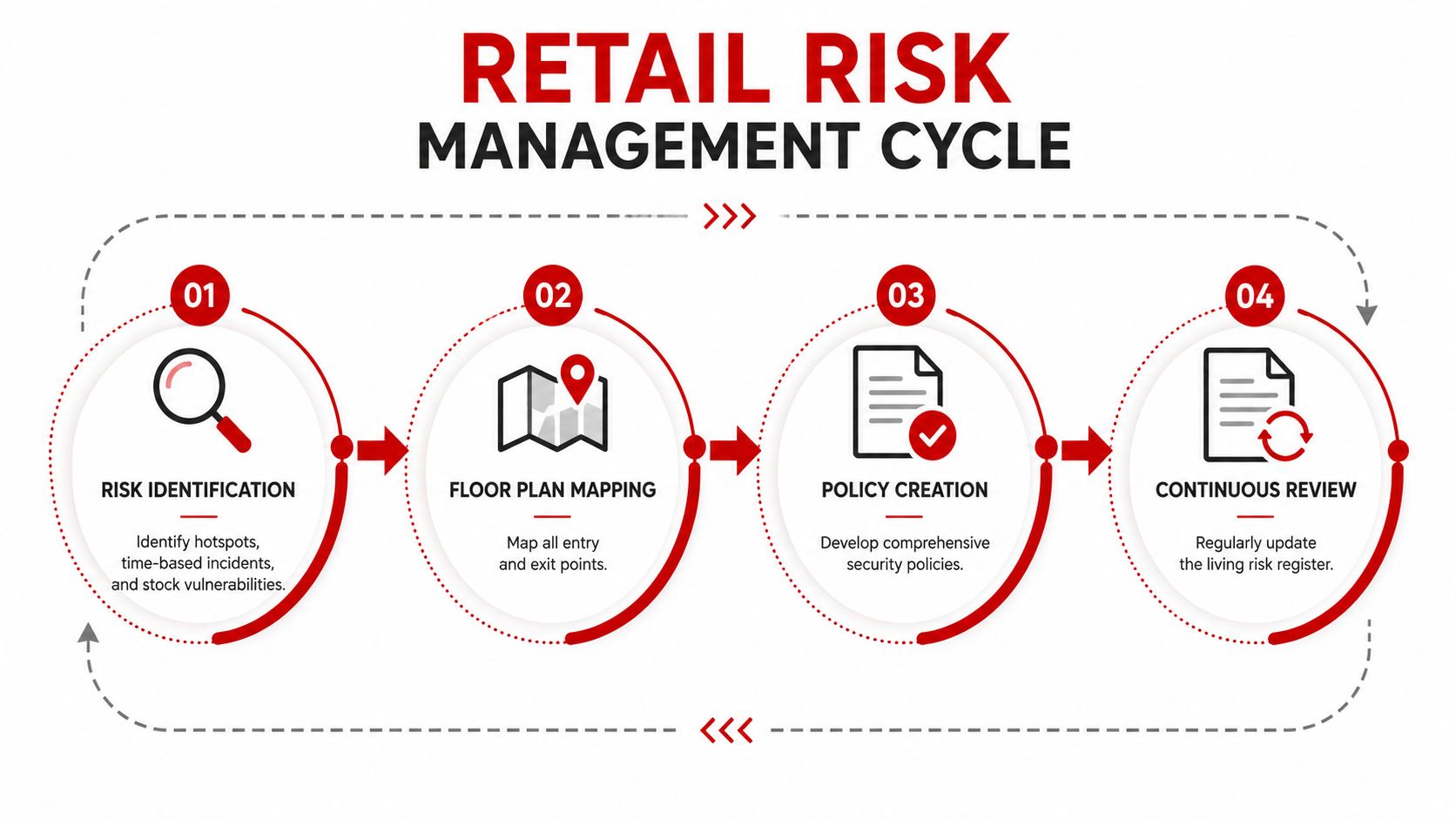
Good retail security procedures begin with a written risk register. If it isn't documented, it usually isn't being reviewed properly. The register should track hotspot zones, vulnerable product lines, time-based patterns, blind spots, refund abuse points, delivery access, and any recurring behaviour near entrances or fitting rooms.
The most useful version is a live document tied to the floor plan. Mark the front door, service desk, POS, stockroom, loading area, emergency exits, and every aisle where high-concealment products sit. Then note what can happen there, how staff are meant to respond, and what evidence should be captured.

Build policy around the four-layer model
The most practical framework for physical loss prevention in Australian retail is the Four-Layer Integrated Control method, covering perimeter hardening, internal visibility mapping, EAS tagging, and post-event audit discipline, outlined by the Australian Institute of Criminology's loss prevention guidance.
Use that framework to write policy in plain language:
Perimeter hardening
Define entry and exit flow. If your layout allows, reduce casual side access and make front-door observation an intentional task, not a background assumption.Internal visibility mapping
Identify racks, displays, mirrors, and camera views that either help or hinder line of sight. Lower displays often do more for prevention than adding another sign.EAS tagging discipline
Tagging only works when teams apply it consistently to the right products. Partial tagging creates predictable gaps that experienced offenders quickly learn.Post-event audit discipline
Every incident should feed back into the register. If one aisle, one time block, or one product category keeps recurring, the procedure needs adjusting.
Turn observations into checklists
A policy manual should include short operational checklists, not just long narrative statements. That's what makes compliance realistic on a busy day.
Opening checklist
Confirm camera status: Make sure critical views are active.
Walk hotspot zones: Check high-risk displays, exits, and stock access points.
Assign watch points: Nominate who owns entrance observation and supervisor escalation.Trade period checklist
Log irregular behaviour: Record suspicious returns, repeated loitering, and alarm events.
Protect evidence early: Flag relevant time windows before footage cycles out.
Escalate patterns, not just incidents: Repetition matters more than a single odd moment.Review checklist
Update the risk register: Add new hotspots and remove stale assumptions.
Separate customer-floor and loading-dock risks: They need different controls.
Test whether policy matches reality: If staff skip a step every week, rewrite the process.
Retailers with cross-border operations or broader insurance comparisons sometimes find it useful to compare local procedures with resources on coverage for Florida retail businesses to see how insurance expectations and store controls often align around documentation, access control, and incident records.
Staffing and Rostering Procedures
Saturday at 3 pm is where weak rosters show up fast. One staff member is tied to the counter, a junior team member is covering fitting rooms without clear authority, a delivery is waiting at the rear door, and two people walk out through self-checkout before anyone is sure who was meant to respond. The problem is rarely headcount alone. It is placement, timing, and role clarity.
Match people to pressure points
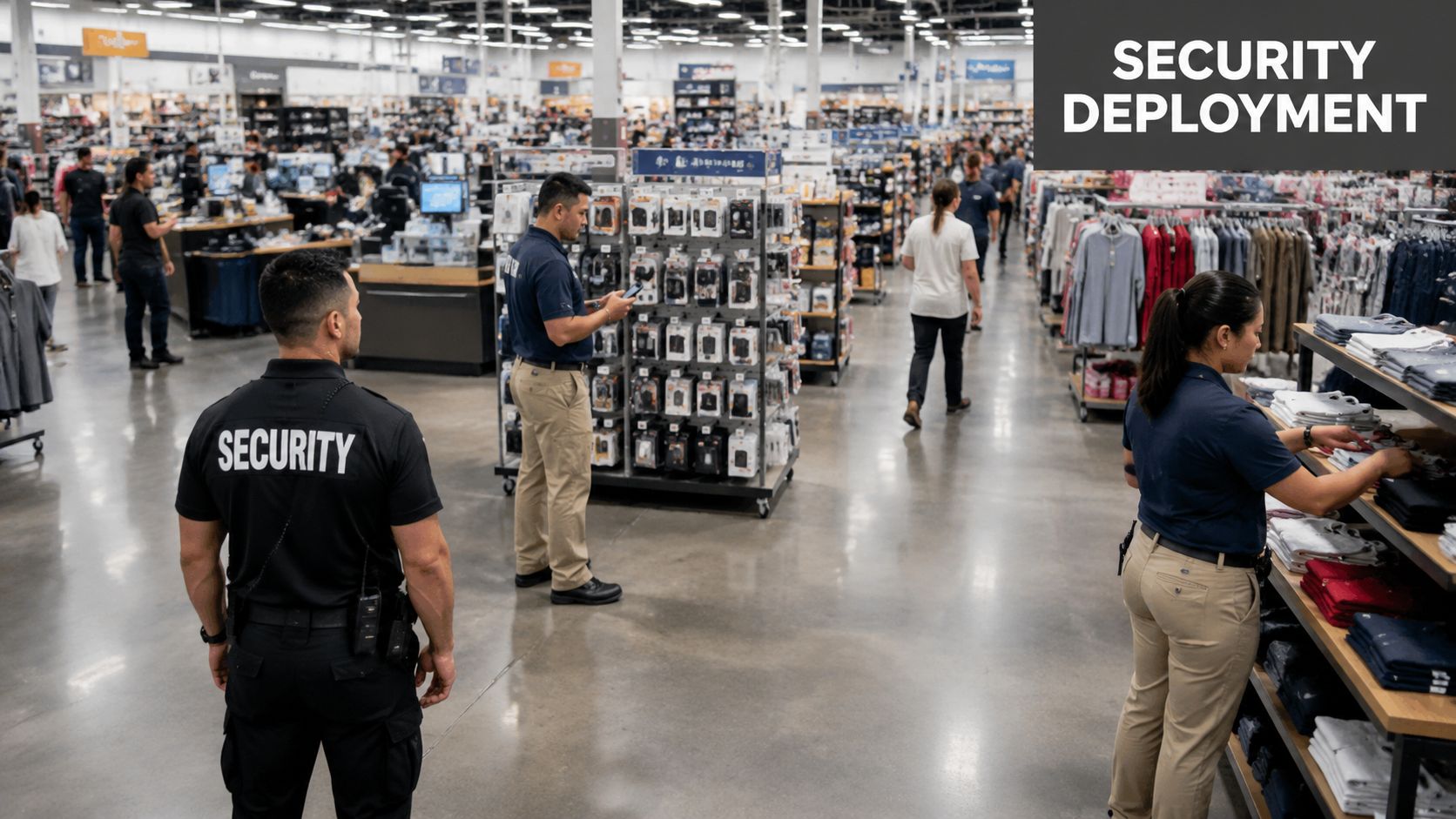
Rosters should be built around risk windows and loss points, not only labour budget and service coverage. In Australian stores, those pressure points often sit at self-checkout, fitting rooms, refund counters, click-and-collect handover, stockroom access, and the path between the sales floor and the nearest exit. If organised retail crime is active in your area, watch for repeat group entries, distraction tactics near service desks, and the same vehicle or individuals appearing across nearby stores.
A workable roster usually includes these assignments:
Entry and exit coverage during known risk periods
Place a staff member or guard where they can observe arrivals, exits, EAS activations, and hand-offs between offenders.Mobile floor coverage
Assign one person to move through high-loss zones instead of anchoring every experienced staff member to a register or service point.Supervisor overlap at shift change
Handover periods create gaps in decision-making. Keep a senior person on both sides of the overlap so incidents, refusals, and suspect descriptions are not lost.Back-of-house control
Deliveries, stock transfers, and contractor access need named oversight. Customer theft and internal theft follow different patterns, so the same control will not cover both.
Good rostering also connects physical and digital procedures. If one person is expected to review suspicious refunds, monitor a fitting-room queue, and respond to an alarm, the store has created a blind spot. Assign who checks POS exceptions, who preserves footage times, and who approves access to restricted areas.
Reduce fatigue and role confusion
Fatigue changes judgement before it changes effort. After a long stretch on a door, fitting-room post, or self-checkout lane, staff still look present but miss the small cues that matter, repeated entries, tag tampering, abandoned packaging, or a customer pairing a return with a quick shelf concealment.
Role clarity matters just as much. Each shift should name four responsibilities: zone owner, first responder, evidence and notes lead, and manager escalation point. That structure is stronger than broad instructions to stay alert because it removes hesitation when something happens.
I have found that the best supervisor is not always the person you place at the front. Put that person where judgement calls stack up, refunds, repeat offender recognition, and staff support during a stop or refusal. That is usually where report quality improves.
State rules also affect staffing decisions. In NSW, Queensland, Victoria and the ACT, any contracted guard on site must hold the licence required in that jurisdiction, and store procedures should reflect what employees can do versus what licensed security personnel can do. Retail teams should know the threshold for observation, verbal engagement, police contact, and evidence preservation before the shift starts, not while an incident is unfolding.
Some retailers bring in external guard providers for surge trading, new store openings, school holiday periods, or repeat theft activity linked across several sites. GM GROUP Services is one Australian provider that offers licensed guards, patrols, loss prevention support, and access control coverage across NSW, VIC, QLD and the ACT. The practical test is simple. Any external coverage should be briefed to your store layout, incident categories, escalation chain, and reporting standard before deployment starts.
Integrating Technology and Surveillance
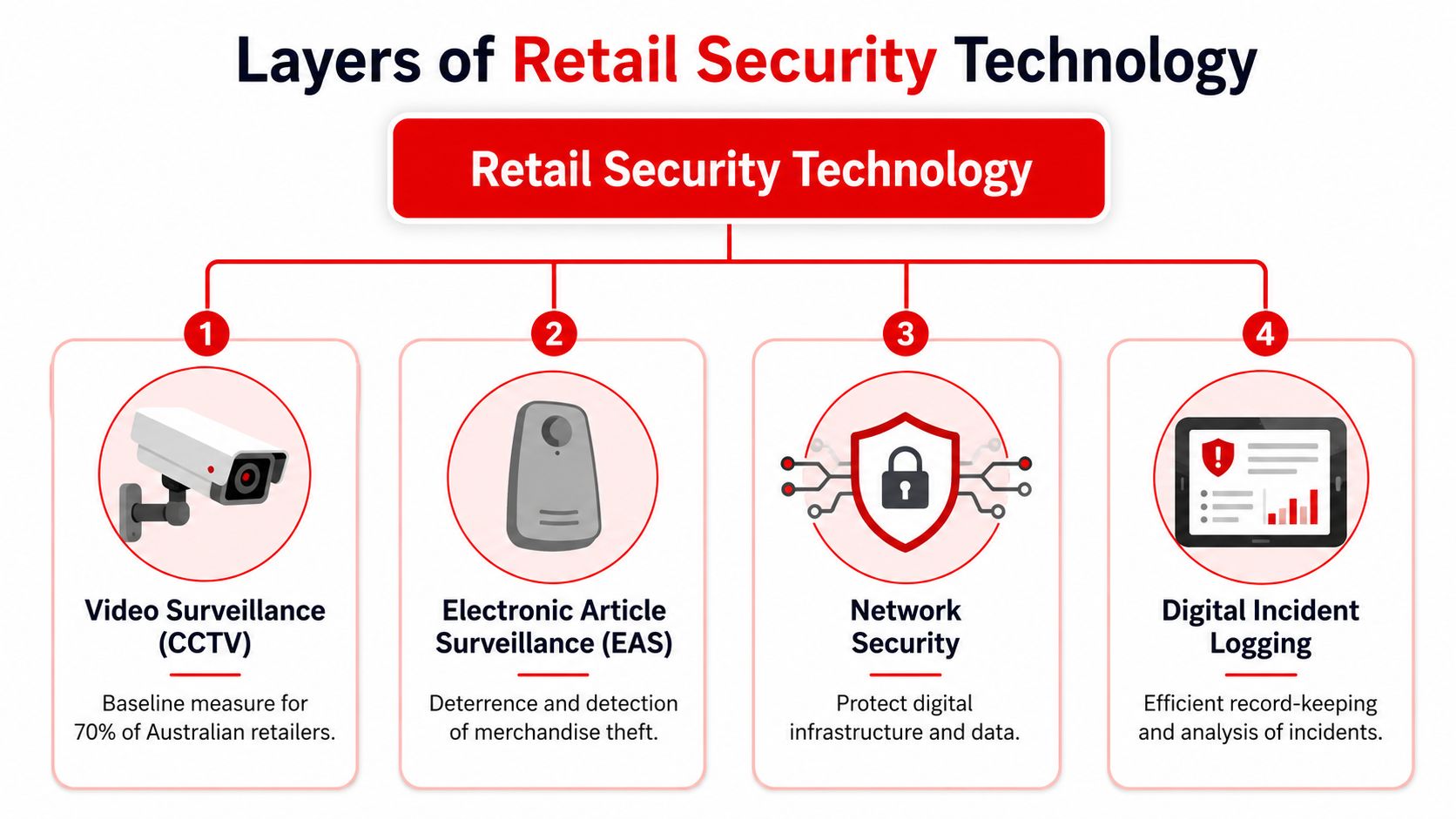
Technology works when each layer has a job. It fails when stores install devices without deciding who monitors them, what triggers a response, and how physical events connect to digital evidence. In retail, that means CCTV, EAS, POS protection, network controls, and incident logging should operate as one procedure.
In Australia and New Zealand, 65% of retail workers identify video security cameras as their top choice for safety, and 70% of stores already deploy CCTV systems as a baseline measure, according to the 2024 ANZ retail worker safety report from Motorola Solutions. That tells you two things. CCTV is now baseline, and staff trust it when it's deployed properly.
Place cameras where decisions happen
Many stores over-cover aisles and under-cover transition points. The priority views are usually entrance face capture, exits, POS, refund counters, stock transfer points, and any area where staff-customer interaction determines what happened next.
Poor placement usually creates one of two failures:
| Camera issue | What goes wrong on review |
|---|---|
| Entrance view too wide | You see movement but not identity |
| POS angle too high | You miss item handling and hand movements |
| Exit blind spot | You lose continuity between concealment and departure |
Good CCTV should support operations, not just post-incident review. If the team can't quickly identify a relevant time window and export the footage cleanly, the system isn't fully integrated into procedure.
Combine physical and digital controls
Most retail guides still separate theft prevention from cyber protection. That's outdated. Stores now need physical-digital alignment because incidents often touch both environments. A suspicious refund, POS tampering, unauthorised remote access, and stock loss can be parts of the same event.
A stronger stack includes:
EAS for merchandise movement
Best used on high-risk items with consistent tagging rules and a documented alarm response.Encrypted payment data
Protects customer information if a device or network is compromised.Multi-factor authentication for remote access
Stops casual credential misuse from becoming a store-wide incident.Segmented store networks
Keeps payment systems, admin tools, and guest-facing traffic separated.Digital incident logging
Gives supervisors one record of theft events, refund anomalies, access issues, and follow-up action.
A camera records what happened. A secure incident log records what the team did next. You need both.
The trade-off is cost and complexity. More tools create more alerts, and more alerts create more ignored alerts unless ownership is clear. Start with your highest-risk points and build from there.
Incident Response and Reporting Procedures
When an incident starts, speed matters. So does restraint. Staff shouldn't improvise confrontation, and they shouldn't treat every theft the same. A solo opportunist, a refund fraud attempt, and an organised group working in coordination require different escalation.
Most guides still miss the digital side of this. The Australian Institute of Criminology has noted that organised retail crime increasingly exploits both physical and network vulnerabilities, and many retail security procedures still fail to connect those layers in one response model, as discussed in this Australian organised retail crime overview.
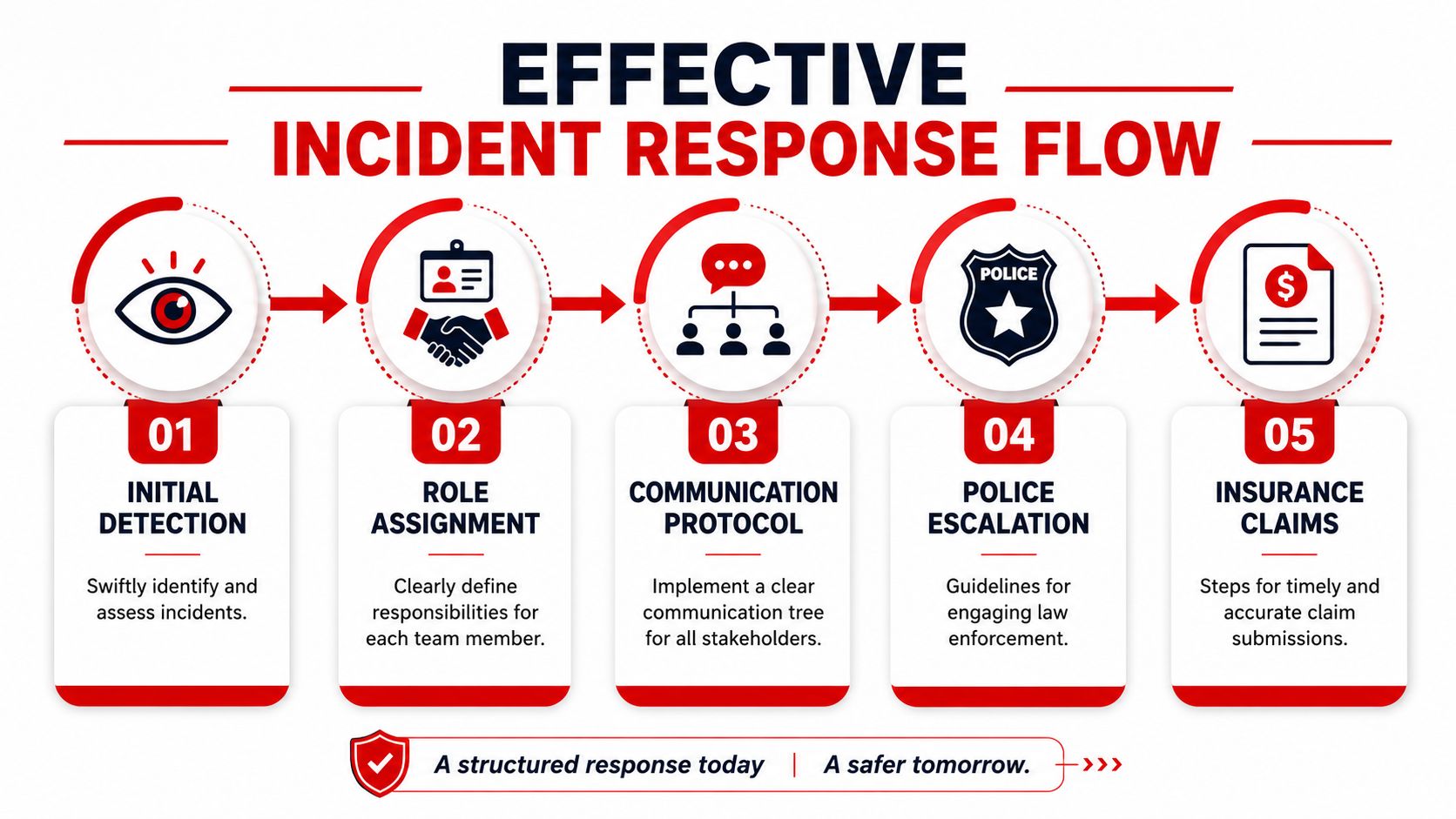
Use a fixed response chain
The cleanest incident flow is simple and repeatable:
Detect and assess
Confirm what was seen, heard, or triggered. Don't let assumptions become facts in the report.Assign one lead
One supervisor owns the incident. Everyone else feeds observations to that person.Preserve evidence
Save the relevant CCTV window, register receipts, access logs, and staff notes immediately.Escalate appropriately
If there's violence risk, coordinated offender behaviour, or serious fraud indicators, move quickly to police and management escalation.Complete reporting before memory fades
Good reports are specific about time, direction of movement, items, staff actions, and any digital systems involved.
Distinguish shoplifting from organised patterns
Not every incident is organised retail crime, but some signs should push the matter beyond normal floor handling:
Coordinated distraction
One person draws staff into a long interaction while another works the product zone.Repeat return activity
Similar items, repeated stores, weak proof of purchase, or pressure for fast cash-style outcomes.Multi-point movement
Entry, concealment, hand-off, and exit happening across different people.Digital overlap
Suspicious refund activity, POS irregularities, or account access concerns tied to the physical event.
Australian retailers also need to align reporting with the Privacy Act 1988 and PCI DSS obligations, particularly when footage, payment information, or customer data may form part of the evidence set. The practical rule is straightforward. Keep reports factual, limit access to evidence, and preserve only what the investigation requires.
Training and Ongoing Compliance Audits
The best written procedures collapse fast if supervisors don't enforce them. That's why training has to focus less on theory and more on what people do during a live event, a rushed refund, an EAS alarm, or a police request for footage.
Australian retail loss prevention guidance is clear on two points. Retailers that skip documented risk assessments experience higher shrinkage, and loss prevention specialists identify supervisor training as the top step for improving reporting accuracy, as outlined in this Australian retail crime white paper. In practice, that means your strongest investment isn't another policy PDF. It's better judgement at supervisor level.
Train by role, not by generic induction
Floor staff, supervisors, and managers need different drills.
Floor staff should practise observation, customer service intervention, alarm awareness, and safe escalation. They need to know what to record and what not to do physically.
Supervisors should train harder on incident command, evidence preservation, privacy handling, and report quality. They also need pattern recognition for organised retail crime, especially repeated returns, multi-person distraction, and cross-store behaviour.
Managers should focus on audit discipline, police liaison, compliance oversight, and whether procedures still match actual site conditions.
Strong retail security procedures depend on what supervisors notice, what they document, and whether they correct drift before it becomes a loss pattern.
Audit what staff actually follow
Quarterly audits work best when they test behaviour, not just paperwork. Review whether EAS alarms were acted on, whether reports were complete, whether hotspot maps were updated, and whether digital incidents were logged with the same discipline as physical theft.
A short audit sheet should ask:
Was the risk register updated?
Hotspots, stock risks, and time-based patterns should be current.Were alarms responded to consistently?
An alarm that nobody owns is just background noise.Did supervisors complete reports properly?
Missing time stamps and vague descriptions weaken every next step.Were privacy and payment obligations respected?
CCTV handling and payment-related evidence must be controlled.
Key security regulations by state
Because licensing and security obligations vary, multi-site retailers should keep a state-by-state compliance table in the audit pack.
| State | Licensing Body | Key Security Requirement |
|---|---|---|
| NSW | NSW Police Force Security Licensing & Enforcement Directorate | Use properly licensed security personnel and maintain procedures aligned to site duties |
| VIC | Victoria Police Licensing & Regulation Division | Ensure licensed security staff are used for contracted guarding and relevant activities |
| QLD | Office of Fair Trading Queensland | Confirm security providers and officers hold the appropriate class of licence |
| ACT | Access Canberra | Verify licensing status and role suitability for security functions performed on site |
The point of this table isn't legal theory. It's operational discipline. Every venue should know who can lawfully perform which security role, and every audit should confirm the site is using licensed personnel where required.
Conclusion and Next Steps
Retailers don't need more generic advice. They need retail security procedures that hold up during a busy Saturday, an aggressive return, a staff handover, or a suspected organised theft pattern. The stores that perform best usually have the same foundations in place: a current risk register, clear roster ownership, working surveillance, disciplined incident reporting, and supervisor-led audits.
That approach does more than reduce loss. It helps staff feel safer, keeps customer interactions more controlled, and gives management a usable chain of evidence when something goes wrong. It also closes the gap that too many venues still leave open between physical security and digital response.
If your retail operation spans NSW, VIC, QLD or the ACT, it's worth reviewing whether your current procedures are documented, tested, and matched to local licensing and compliance requirements. Security only becomes reliable when the process is repeatable.
A practical review should look at your floor layout, access points, reporting flow, CCTV use, refund controls, stock vulnerabilities, and how your team currently handles suspicious behaviour. If those pieces don't connect, your procedure isn't finished yet.
If you need retail security procedures reviewed and implemented with site-specific guard deployment, risk assessments, reporting support, and 24/7 operational coverage, GM GROUP Services can help across NSW, VIC, QLD and the ACT with licensed personnel and customized venue security support.
SEO title: 7 Retail Security Procedures That Safeguard Your Store in 2026
SEO meta description: Retail security procedures for Australian stores, including risk assessment, staffing, CCTV, incident response, compliance, and organised retail crime prevention.
Suggested URL: /retail-security-procedures
FAQs
What are retail security procedures
Retail security procedures are the written steps a store uses to prevent theft, manage suspicious behaviour, protect staff, preserve evidence, and escalate incidents properly. They usually cover floor risk, access control, surveillance, reporting, and compliance.
How often should a retailer review security procedures
Review them whenever store layout, product mix, staffing patterns, or incident trends change. A formal scheduled audit also helps keep the risk register and reporting standards current.
What's the biggest mistake retailers make
The most common problem is inconsistency. Stores install cameras, tags, or alarms, but staff aren't trained on who responds, what gets documented, or how evidence is preserved.
Do retail security procedures need to include cyber security
Yes. Modern retail incidents often overlap with POS risk, refund abuse, account misuse, or network exposure. Physical and digital response should sit in the same procedure set.
How should staff respond to suspected organised retail crime
Staff should prioritise observation, safety, evidence, and escalation. Coordinated distraction, repeated returns, hand-offs, and suspicious digital activity should all be reported through a supervisor-led incident process rather than handled casually on the floor.