


Regional Security Services usually get bought as if they're a commodity. A venue manager has a Friday roster to fill, a construction lead has a gatehouse to staff, or an event promoter needs bodies on site by doors open, and the quote sheet starts looking like the whole decision. That's where things go wrong, because the job isn't buying guards, it's matching the right mix of people, supervision and local compliance to the site in front of you.
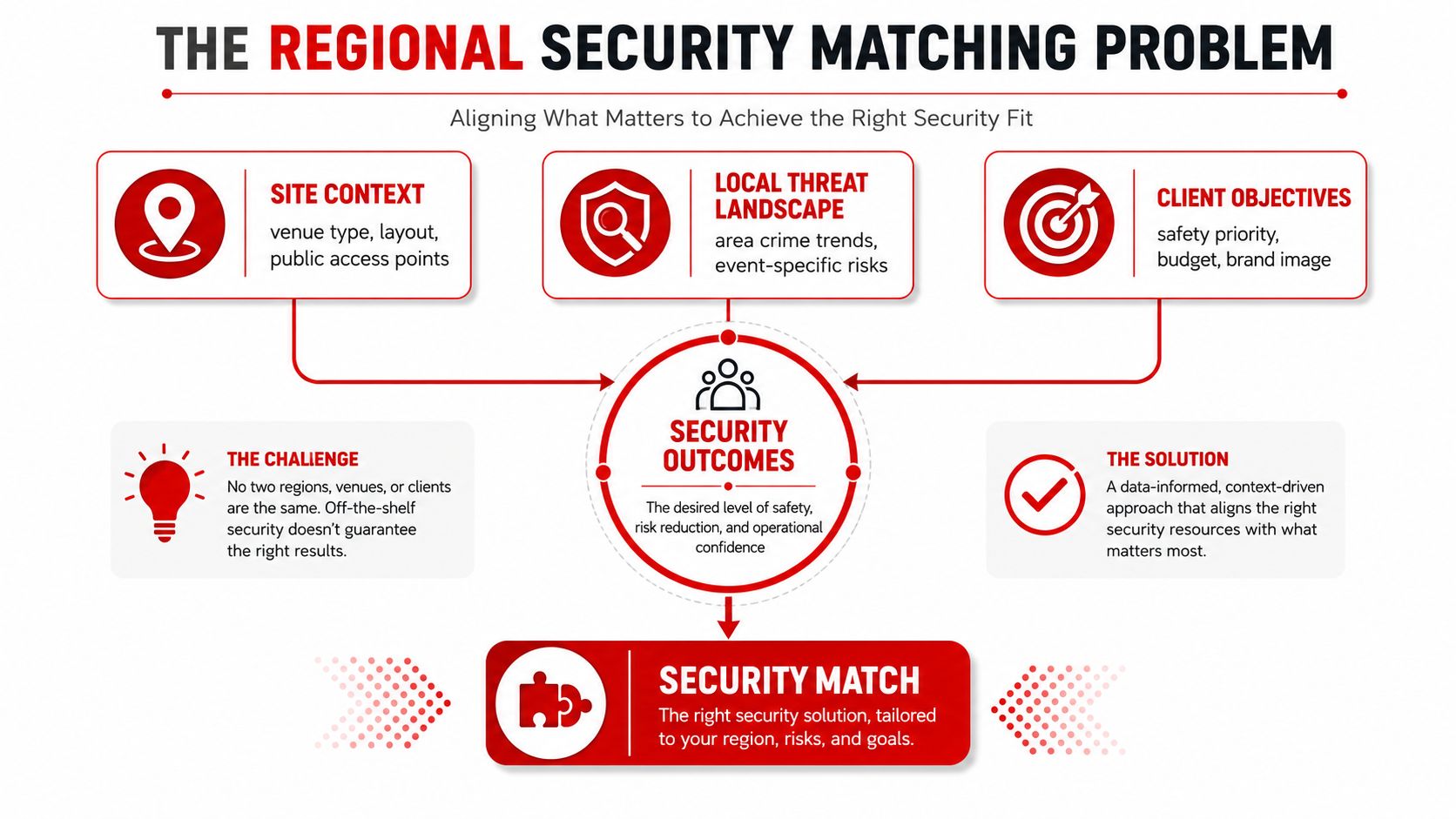

In NSW, VIC, QLD and the ACT, the same uniform can produce very different outcomes depending on the crowd, the licence conditions, the site layout and the way the team is supervised. A static guard on the wrong post can slow a problem down but still fail to stop it. A smaller, better-matched deployment can do more with less because it fits the site instead of forcing the site to fit the roster.
Practical rule: if the provider can't explain why each role is on site, you're not buying a solution, you're buying headcount.
Why Regional Security Services Are a Matching Problem, Not a Product
Saturday night at a regional venue is when the mismatch shows up fast. The entry line is moving, the bar is busy, one guest is already loud, and the team you've hired looks impressive from the car park but isn't set up for the actual choke points inside. A generic guard deployment can make the floor feel fuller, yet still miss the pressure point that turns a minor disagreement into an escort, an ejection or a complaint.
The smarter way to think about regional security services is as a matching exercise between site context, local threat environment and client objectives. A festival, a hotel, a retail strip and a construction site all need different mixes of static presence, patrol coverage, monitoring and escalation control. The same headline service can work brilliantly in one place and badly in another, because the task isn't “have security”, it's “control this risk in this environment”.
What the wrong match looks like
The usual failure pattern is simple. The team is visible, but nobody has aligned the post orders to the site flow, the patron profile or the likely incident path. A venue ends up with too much deterrence in the front-of-house areas and not enough response depth near exits, loading zones or back-of-house access.
That's why a regionally specific deployment matters. The provider needs to understand the venue type, the crowd behaviour, the local council environment and the approval conditions, then build the roster around those realities. If the same quote package is offered everywhere with only the logo changed, the service is probably too generic to hold up under pressure.
The language that matters on the ground
Static security is fixed-position control. Mobile patrols cover wider ground. Covert work is about observation and intervention without making the whole site feel like a checkpoint. Monitoring is useful, but only when someone can respond.
Those distinctions matter because the best security outcome is usually not “more security”, it's a better security match. Australia's private security sector is large, estimated at A$11.6 billion in annual revenue with more than 160,000 licensed workers nationwide, and industry projections cited for the country point to about 4.2% annual growth from 2024 to 2029 (Australian security industry statistics). That scale tells you the market is deep, but it doesn't remove the need to choose the right mix for each site.
What Regional Security Services Cover
Regional security services are a fit-for-purpose mix of guarding, patrols, access control, monitoring, close protection and, where the site calls for it, covert observation or specialised detection support. The right mix depends on the jurisdiction, the operating hours and the risk profile, because each site has a different pressure point and a different way of failing.
Start with the operating model
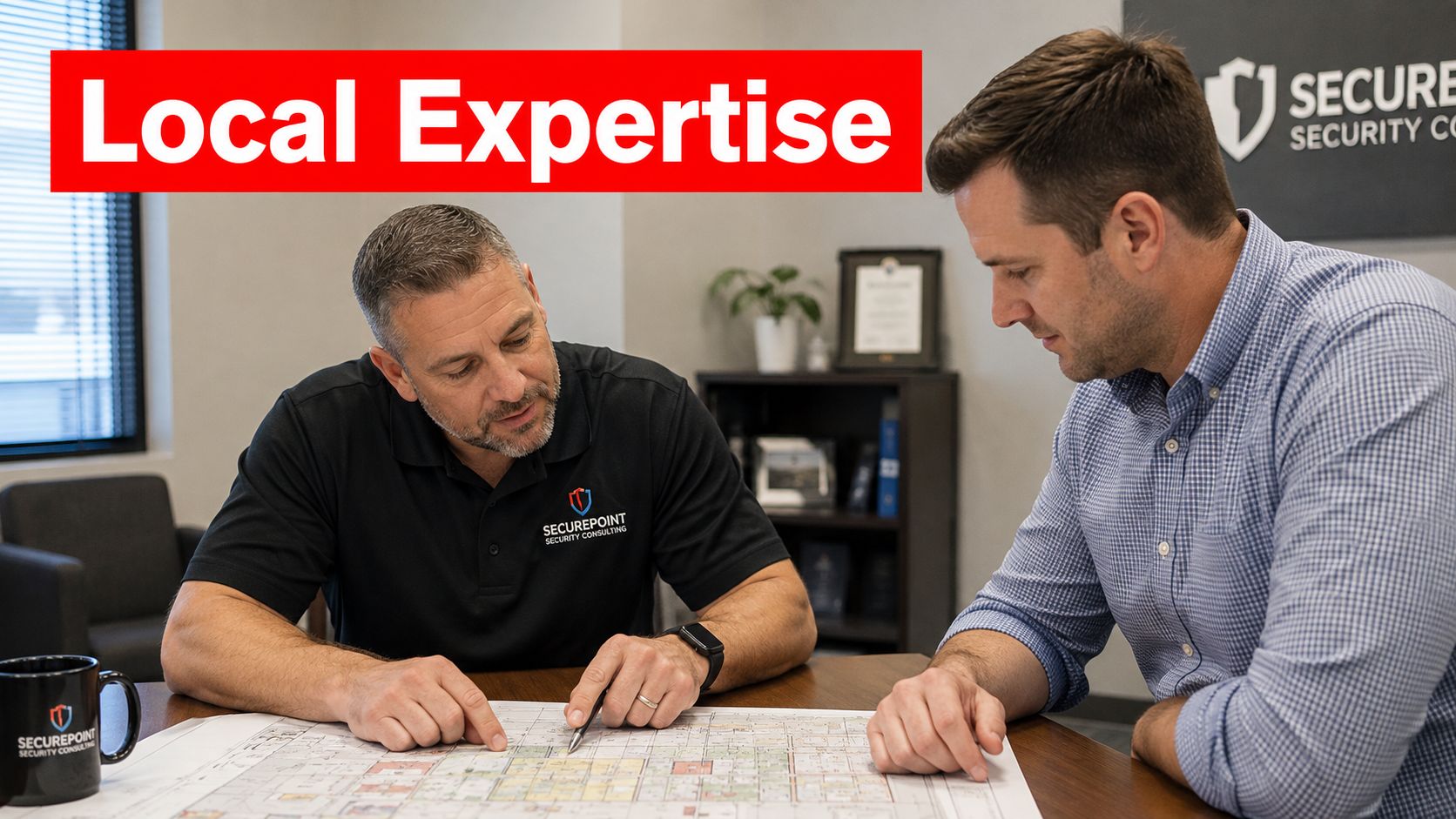
A national brand can place standard guards on a site and still miss the local operating reality. A regionally rooted provider usually knows which venue types need firmer entry management, which sites need more patrol depth after close, and which sites need staff who can talk to patrons without sounding like they are running a checkpoint. That local knowledge sits at the centre of the deployment, because it reduces guesswork and keeps the roster tied to what the site needs.
This matters in advanced security markets too. The manned security services market in Europe, often used as a comparator, shows how people-based security remains a major part of the sector, with service, compliance and incident response still doing the heavy lifting. The largest revenue-generating segment in 2024 was security guards, which reinforces a practical point. The people-based model is still the base layer in regional work, even when the site also relies on technology.
Match service to the site, not the brochure
A bar or club usually needs a different mix from a warehouse or a regional conference. Static guards suit sites where access control, guest contact and visible deterrence matter. Patrols fit larger perimeters, uneven operating hours and after-hours risk.
Covert options suit places where overt pressure changes behaviour in the wrong way, such as loss-prone retail settings or busy hospitality venues where staff need intelligence without making patrons feel policed. Back-to-base monitoring helps when cameras and sensors are already in place but still need a clear human response plan. For larger outdoor sites, some operators also use patrol golf cart options to cover ground without putting a bulky vehicle presence into the site.
Why the local provider usually performs better
A provider with real regional depth usually understands the council contacts, the permit path, the normal crowd pattern and the escalation chain. That does not guarantee a clean job, but it does cut avoidable friction. In practice, that is the difference between a team that turns up and a team that supports the site.
Service Types You Can Match to Each Site
The cleanest way to buy regional security services is to start with the task, then choose the service type that fits. A Friday-night bar doesn't need the same deployment as a regional festival, and a construction gatehouse doesn't need the same posture as a corporate awards night. The service itself is only half the story, the other half is how it behaves in front of the people using the site.
Static guards, patrols and close protection
Static guards are the right tool when access control, welcome points and visible deterrence are central. They underperform when the site is too large, the entry points keep moving or the incident risk sits away from the front door. A hotel, club entry line or retail entrance is where static presence earns its keep.
Mobile patrols suit broad sites, multiple buildings and places where risk spikes after hours. They're useful for construction, industrial and multi-tenant sites because they let you move the security presence to where it's needed rather than leaving it parked at one post. Close protection is different again, it's for VIPs, executives or high-profile personnel where the risk sits around proximity, movement and public exposure.
K9, covert and monitoring
K9 units add detection and deterrence value, but they aren't a default hospitality solution. In a nightclub or family venue, the visual impact can be too heavy unless the risk justifies it. They're better when the site needs a stronger physical presence, searched access points or a high-risk screening function.
Covert operations can be very effective, but they demand more supervision and better tasking. If the brief is vague, covert staff just become expensive observers. Back-to-base monitoring is useful when the site already has cameras, alarms or sensor coverage, but monitoring on its own doesn't stop an incident, it only tells you one is happening.
A strong provider can tell you exactly which layer detects, which layer intervenes, and which layer documents the event for later review.
Site examples that actually make sense
A Friday bar usually needs static front-of-house cover plus a supervisor who can de-escalate. A regional festival often needs entry control, roaming patrols and a separate post order for intoxication, ejection and lost-child issues. A construction site needs gatehouse discipline, vehicle checks and after-hours patrols. A corporate function usually needs guest-facing security that looks calm, not confrontational.
That's the decision point. If the provider can't explain which service covers access, which one covers movement, and which one covers escalation, the package is too blunt.
State Compliance Across NSW, VIC, QLD and ACT
Security work in Australia isn't regulated like a single national hobby. It's state-based, task-based and, in hospitality settings, often tied to alcohol rules as well. That means the same job can trigger different licence and supervision needs depending on where the site sits and what the team is doing.
NSW is not the same as Victoria, Queensland or the ACT
In New South Wales, private security work sits under the Security Industry Act 1997 and the Security Industry Regulation 2016, and the NSW Government states that anyone carrying out security activities such as guarding, patrols, crowd control, bodyguard work or cash-in-transit work must hold the correct security operative licence class, while the business may also need the correct master licence. That distinction matters because the company can't rely on a properly licensed guard if the contracting entity itself isn't licensed for the work.
Other states and territories have their own licensing structures, and the operational lesson is the same, don't assume one licence class or one interstate setup covers every task. A crowd controller at a festival, a mobile patrol operator and a close protection officer are not interchangeable roles just because they all wear black uniforms. Ask the provider which state licence applies, who supervises it, and what happens if the site changes from one task to another mid-deployment.
RSA overlap is where many clients get caught
Security staff near bars, bottle-necks and entry lines often sit close to RSA obligations, even if they're not the ones serving alcohol. In licensed venues, the security team needs to recognise intoxication indicators, manage patron flow and escalate problems without breaching venue conditions. That's where poor training shows up, not in theory, but at the door when a guest is already annoyed.
The practical question is simple. Does the provider place RSA-aware staff in roles that interact with licensed areas, and can they explain the handover between venue staff and security? If the answer is fuzzy, you'll feel it later in complaints, delays and avoidable removals.
Crowd plans need to match the attendance reality
Event approvals often get stricter as attendance rises, and the security plan should scale with the forecast rather than with wishful thinking. Gate screening, evacuation routes, incident response and police or council coordination all become more important as the site gets denser and alcohol exposure increases. The point is not to memorise a universal ratio, because there isn't one, it's to make the deployment follow the actual risk.
If the site changes, the licence, the RSA coverage and the post orders may need to change too.
Running a Risk Assessment and Deployment Plan
A good deployment starts before the roster is written. The manager should be asking what the crowd looks like, where the alcohol is, what assets need protection, what happens after hours, how public the site is and what's already happened there before. Those inputs decide whether the job needs more presence, more patrols, more monitoring or more supervision.
Build the brief from the site, not the quote
First, profile the crowd. A family event, a licensed nightclub and a high-pressure retail activation don't need the same tone or posture. Second, map the threat vectors. Theft, trespass, intoxication, gate-crashing, aggression and after-hours access all play differently depending on the site.
Third, choose the control measures. If the risk sits at the door, use strong entry control. If it sits in the perimeter, use patrols. If it sits in the blind spots, use monitoring and tasking that lead to response.
Put the deployment on the floor plan
A proper provider should be able to show guard posts, patrol paths, radio coverage and escalation points on a site plan. That's the point where you separate a real operator from a body-shop. A real operator discusses post orders, supervision and reporting before anyone turns up for shift.
For small venue event planning, a useful outside reference is how to prepare a small venue gig, because the logistics and entry flow issues are often the same even when the security label changes.
Good brief, good deployment: if the provider can't tell you who calls whom, when, and on what trigger, the plan isn't ready.
Briefing and supervision are part of the service
The roster is not the service. The service includes briefing, equipment, escalation contacts and ongoing supervision. That's especially important in multi-site runs, where one weak site can become the source of repeated complaints, turnover and handover gaps.
A regional model also works better when the provider is checking performance as the job runs, not just collecting signatures at the start of the shift. That's what keeps the deployment fit-for-purpose instead of static.
Pricing Drivers and the Hidden Cost of the Cheapest Quote
A cheap quote often looks clean because it leaves out the parts clients do not see on the invoice. The first things stripped back are usually supervision, briefing depth, and the quality of the people sent to site. A lower hourly rate is easy to achieve if the provider cuts the controls that stop small incidents from becoming expensive ones.
| Pricing driver | What it funds | Hidden risk if cut |
|---|---|---|
| Licence class and compliant staffing | Correctly authorised operatives for the task | Illegal or unfit deployment |
| Training depth | Better judgement, de-escalation and site behaviour | More incidents and poor patron handling |
| Supervision and site visits | Oversight, correction and accountability | Drift, inconsistency and weak handovers |
| Uniform and equipment standards | Professional presence and functional response tools | Lower deterrence and slower intervention |
| After-hours and weekend coverage | Real coverage during peak risk windows | Gaps when problems usually happen |
| Travel across regional footprints | Reliable attendance and local response | Late starts, fatigue and cancellation risk |
| Monitoring or K9 capability | Integrated response options | Blind spots and less effective screening |
The trade-off is straightforward. The cheapest provider can become the most expensive if undertrained or poorly supervised staff escalate incidents, trigger complaints, or churn out after a few shifts. Those costs land on the venue, the event organiser, or the site manager, not on the quote.
Australia's security market is big enough to encourage buyers to treat guards like interchangeable labour, but the outcome still depends on fit. In the European comparator market, security guards were the largest segment in 2024, which shows how central the people layer still is in mature markets (European manned security services market). For buyers, the useful lesson is simple, buy the model that stops problems costing more later.
A Selection Checklist and Two Quick Case Examples
Use this checklist when you're comparing providers. It's short on purpose, because the point is to separate real operators from glossy quotes.
- Licensing: Are the operatives licensed for the exact task and state?
- RSA overlap: Are staff assigned to licensed areas trained to manage patron-flow issues properly?
- Supervision: Who checks the site, how often, and what happens if standards slip?
- Reporting: Do you get incident logs, post orders and follow-up notes that are useful?
- Training: Can the provider show site-specific training, not just generic induction?
- Mixed-model coverage: Can they combine static, patrol, monitoring and, where needed, covert or K9 support?
- Incident response: Is there a clear escalation chain for intoxication, violence, theft or evacuation?
Two short examples from the field
A regional festival I've seen handled badly had a generic deployment that looked busy but didn't control the gate flow or the back-of-house pressure. When the team switched to static entry control, roaming patrols and a covert loss-prevention layer, the site got better at stopping gate-crashing and contained a serious intoxication problem before it spread into the crowd. The difference wasn't more bodies, it was better tasking.
A multi-site retail and hospitality operator moved from a rotating national roster to a regionally supervised team. The operator didn't need more paper, it needed better accountability after hours and stronger local familiarity at the sites. Once the deployment was supervised regionally, the business saw fewer after-hours incidents and fewer patron complaints because the staff on shift understood the site and the regular patterns.
The best checklist question is still this, what problem does each person on site solve?
FAQs and How GM GROUP Services Delivers in Your Region
Clients usually ask the same practical questions once the planning gets serious. Do you need a master licence contractor for the work, or just licensed guards. The answer depends on the task and the state, so the first call should be about licensing scope, not price.
Another common question is how RSA overlaps with security duties. If your staff are working near licensed areas, entry queues or drink service pinch points, they need to understand the venue rules and the signs of escalation. If you're unsure how to frame the training side, a practical directory like find instructor booking answers can help you think through the training logistics before you scope the deployment.
People also ask about guard-to-attendee ratios. There isn't a universal answer that works across NSW, VIC, QLD and the ACT, because the right number depends on the venue layout, alcohol exposure, patron profile and the kind of incidents you've seen before. Ask the provider how they set ratios from risk, not from habit.
GM GROUP Services operates across NSW, VIC, QLD and the ACT with licensed, fit-for-purpose deployments for events, venues, retail, construction and corporate sites. It offers static guards, K9 units and handlers, VIP and bodyguard protection, covert operations, vehicle patrols, gatehouse control, loss prevention, back-to-base monitoring and emergency response, backed by 24/7 supervision and ongoing performance monitoring.
If you need regional security services that are matched to the site instead of forced onto it, GM GROUP Services can scope the right deployment across NSW, VIC, QLD and the ACT. Visit GM GROUP Services to discuss licensing, RSA overlap, supervision and the service mix that fits your venue, event or site.