



Property protection services are rarely a simple question of putting a guard at the front door. A Sydney pub may need crowd control only during late trading, a construction site may need patrols after the workforce leaves, and a retail centre may need discreet loss prevention while shops are open. The right plan depends on what happens at the property, when it happens, and which state licensing rules apply.

Why Property Protection Services Matter for Modern Australian Venues
It's a busy Saturday night at a Sydney pub. The queue is moving, the bar is full, and the manager is watching two pressure points at once: a group arguing near the entrance and a staff member reporting missing stock. The second crowd controller costs money, but so can an unmanaged confrontation, an unauthorised entry, or a delayed response to theft.
That's the practical purpose of property protection services. They help venue operators control access, deter theft, manage crowds, protect stock and equipment, and create a clear response when an incident occurs. The question isn't, “Do we need a guard?” It's, “Which combination matches our risk?”
Australian operators are working with a substantial and regulated security workforce. The Australian Security Industry Licensing Report for 2024 recorded 162,535 individual security licence holders at 31 December 2023, an increase of 10,145 nationally from the prior year. NSW remained the largest licensing base with 57,812 individual licence holders, Victoria reached 39,875 after rising by 4,087, Queensland increased by 2,815, and the ACT recorded 4,668.
The risk is broader than forced entry
The Australian Institute of Criminology's national analysis estimated the annual cost of crime at nearly $32 billion, including about $19 billion in direct costs and almost $13 billion in additional costs such as policing, prisons and security. It estimated average losses of $1,100 for residential burglary and $2,400 for non-residential burglary, while residential burglary accounted for about $0.9 billion in losses and shoplifting about $0.7 billion. These figures provide historical context for why prevention, monitoring and rapid response remain commercial decisions, not cosmetic extras. (Australian Institute of Criminology)
A festival organiser also has to manage transport arrivals, pedestrian movement and vehicle access. Detailed coach minibus travel arrangements can support a wider traffic-management plan, particularly where passenger drop-off points, service lanes and emergency access need to remain clear.
Practical rule: Don't buy “24/7 security” until you've identified the hours, locations and behaviours that actually create exposure.
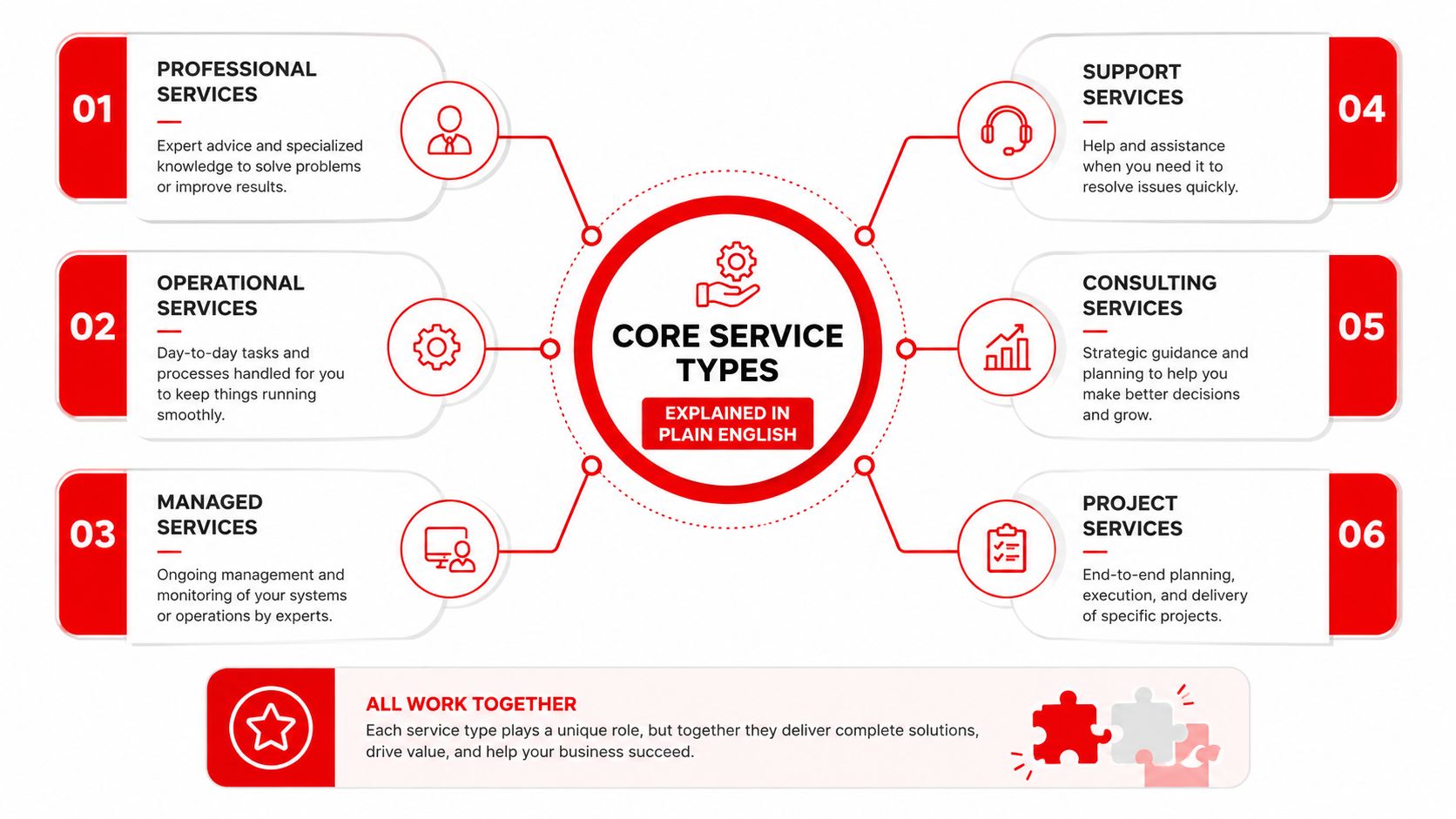
The Core Service Types Explained in Plain English
A provider might describe a roster using specialist terminology, but the operating choices are straightforward.
Static guards are the visible front-of-house presence. They check access, monitor behaviour, support staff and respond to incidents. They earn their cost at busy entrances, public-facing sites and locations where a visible deterrent changes behaviour. They underperform when they're left isolated without radio contact, clear authority or a documented escalation path.
Mobile patrols are scheduled drive-bys and site checks. They suit multiple properties, vacant buildings, industrial compounds and construction sites where a permanent post would be excessive. A patrol only has value if the provider verifies attendance, records observations and defines what happens after an alarm or discovered breach.
K9 units pair a licensed handler with a trained dog. They're useful for large perimeters, car parks, event back-of-house areas and construction sites. They aren't a substitute for access control, and they need suitable deployment conditions, handler competence and a clear search brief.
Gatehouse officers control vehicle and contractor movement. On a construction or industrial site, the officer checks authorisations, records deliveries, manages keys and keeps an auditable entry trail. This is often more useful than a guard walking a site without knowing who should be there.
Covert loss-prevention officers work in plain clothes, usually in retail. They focus on theft patterns, suspicious behaviour and staff procedures without turning the trading floor into a visibly guarded environment. Their reporting must be factual, consistent and handled carefully.
Close protection supports principals, executives, performers or visiting talent. The work involves route planning, access coordination and discreet observation, not standing beside a client.
CCTV and alarm monitoring provides off-site eyes. Operators verify signals, assess camera information and escalate according to agreed instructions. Monitoring is weak when cameras have blind spots, alarms aren't zoned correctly or nobody can attend after an alert.
Emergency response and risk assessment complete the operational picture. Some sites need a documented risk review before any roster is written. For a broader household perspective, this homeowner protection services guide 2026 is useful context, although commercial sites require more formal controls, reporting and licensing checks.
The strongest plans layer services. A venue might use static guards at the entrance, covert staff during trading and monitored CCTV overnight. A construction site might combine gatehouse control, patrols and alarm response.
Matching Protection to Your Industry and Trading Hours
The same guard roster won't suit a festival, shopping centre, hotel and office. Trading pattern is a security variable. A venue with concentrated evening demand needs surge coverage, while a vacant site may need detection and verified intervention after workers leave.
The ABS recorded 595,660 victims of other theft in 2024–25, the highest level in 21 years, and reported that 45% of other theft occurred in retail locations. The same ABS release recorded 1.8% of households, or 196,600 households, experiencing a break-in, while 8.5% experienced at least one selected household crime. (Australian Bureau of Statistics, crime victimisation)
| Sector | Peak-hours priority | Overnight priority | Common add-on |
|---|---|---|---|
| Events and festivals | Crowd controllers, ingress checks, radio-linked teams | Perimeter checks and alarm response | K9 or VIP protection |
| Hospitality | Static entrance coverage and conflict support | Lock-up checks and monitored alarms | RSA-competent crowd controllers |
| Retail | Covert loss prevention and visible floor presence | CCTV and mobile patrols | Shrinkage reporting |
| Construction | Gatehouse, contractor checks and delivery control | Patrols, K9 sweeps and alarm response | Electronic access logs |
| Corporate offices | Visitor management and concierge-style guarding | Remote monitoring and scheduled patrols | Executive protection |
Events need short, intense coverage across gates, stages, car parks and service routes. Retail operators often need the most attention during trading hours because theft occurs where customers, staff and stock interact. Food and drink businesses have also been identified in recent business-theft reporting as the most targeted sector, with Victoria, Queensland and NSW accounting for the largest shares of claims. (business-theft reporting referenced by the ABS)
Construction sites present a different problem. Copper, tools, fuel and plant may be exposed when the site is empty, so a gatehouse officer during work hours and patrol or K9 coverage after hours can outperform a constant static post.
Equipment matters as well. Reliable radios, torches, barriers and access tools support the operating plan, and this practical discussion of protecting service with reliable gear offers useful hospitality context.
Licensing, RSA and Compliance Across NSW VIC QLD and the ACT
A uniform doesn't prove that a person is authorised for the task. Before deployment, the operator should verify the worker, the licence category, the provider and any venue-specific competency requirement.
In NSW, most Class 1 applicants must complete the NSW Security Licence Course through an approved organisation and maintain the required first aid certificate. Class 1A and 1C applicants need HLTAID011, while Class 1B, 1D and 1F applicants need HLTAID014. NSW licensees also carry continuing training obligations. Class 1 and Class 2 licences have a Tier 2 condition requiring approved training, assessment and instruction, while some newly authorised Class 1 licensees may face a Tier 3 training condition within 6 months. (NSW Police security training requirements)
Specialist work has its own pathway. NSW Class 2A requires at least 5 years of relevant experience and CPP41519 Certificate IV in Security Risk Analysis. Class 2E requires CPP30619 Certificate III in Investigative Services, and Class 1D guard dog handlers must complete CPPSEC3112 and CPPSEC3113. (NSW Class 2 licence requirements)
State checks before the shift
| State/Territory | Regulator | Key licence classes | RSA requirement | Min. public liability |
|---|---|---|---|---|
| NSW | NSW Police SLED | Class 1, Class 2 and related subclasses | Confirm competency where alcohol and crowd-control duties apply | Confirm provider policy and contract |
| VIC | Licensing Victoria | Relevant private security registration and licence categories | Confirm venue and role requirements | Confirm provider policy and contract |
| QLD | Office of Fair Trading | Security provider and security officer licences | Confirm licensed-venue requirements | Confirm provider policy and contract |
| ACT | Access Canberra | Master and Individual licences | Confirm role and venue requirements | Confirm provider policy and contract |
For every state, sight the photo, match the person to the card, check the class, expiry and conditions, and record the provider's master licence details. For licensed venues, verify RSA evidence before rostering anyone whose duties require it. Also confirm police checks, right-to-work status, training records and insurance. A $20 million public liability policy is commonly requested in commercial contracts, but the client should verify the actual certificate and policy terms rather than assume cover exists.
Writing a Risk Brief and Choosing the Right Provider
“Send us two guards” isn't a usable scope. A provider can't price or roster intelligently without knowing the site, the people, the assets and the time windows that matter.
Start with a one-page risk brief. Record the address, operating hours, entry points, asset locations, alcohol service, cash handling, crowd profile, contractor movements, previous break-ins and known incident patterns. Mark where people queue, where stock leaves the building, where vehicles enter and where a guard can safely observe without obstructing operations.
Turn observations into a service plan
Map each risk to a control:
- Access problems: Use static guards, visitor management or gatehouse control.
- After-hours exposure: Use monitored alarms, verified patrols or K9 sweeps.
- Retail shrinkage: Use covert loss prevention, CCTV review and staff reporting.
- Large perimeters: Use vehicle patrols, electronic checkpoints and response procedures.
- High-profile visitors: Add close protection and controlled movements.
The brief should state what the provider will do, what it won't do, who receives an escalation call and how reports are delivered. Include the roster window, post instructions, radio requirements, emergency contacts and the expected handover between shifts.
A useful tender question: “Show us how each proposed hour connects to a documented risk.”
Shortlist providers that answer in operational terms. Ask for licence-class confirmation, supervisor-to-guard ratios, training records, incident-response arrangements, backup-cover procedures, report samples and the proposed escalation tree. Ask how patrol attendance is verified and who reviews incidents after the shift.
Red flags during procurement
A quote without a site visit may indicate that the provider is selling hours rather than solving a risk. Be cautious if an invoice omits the master licence number, if guards arrive without photo identification, or if no signed attendance log exists. A low hourly rate can also conceal minimum shift lengths, travel charges, limited supervision or no replacement cover when a worker calls in sick.
Request written answers from at least two licensed providers, then compare the service design before comparing price.
Pricing Models SLAs and KPIs That Prove the Service Works
Australian property protection services can be priced by hourly guard rate, fixed-fee event package, monthly patrol retainer, K9 uplift or monitoring subscription. The headline rate rarely tells the whole story. Minimum shift lengths, weekend and public holiday loadings, travel, uniforms, radios, reporting software and supervisor visits can change the total.
A fixed event package can suit a festival with a defined operating window. A patrol retainer may suit several vacant properties. Monitoring subscriptions work well when alarms and cameras are properly installed and someone can attend after verification. K9 pricing should identify whether the fee covers the handler, dog, travel, search scope and reporting.
| Service tier | Static guards | Patrols | K9 / specialist | Monitoring and KPIs |
|---|---|---|---|---|
| Budget | Targeted peak-hour post | Scheduled checks | Used only for defined exposure | Basic alarm escalation and attendance records |
| Mid-range | Multiple posts or split shifts | Verified patrol schedule | Planned sweeps or specialist coverage | Camera and alarm verification with monthly reporting |
| Premium | Supervisory structure and surge capacity | Multiple routes with documented response | Dedicated specialist deployment | Integrated monitoring, trend analysis and corrective-action review |
An SLA should be measurable. “Rapid response” is weak unless the contract defines acknowledgement, escalation and attendance expectations for the specific site. Patrol verification can use QR check-ins, RFID or another auditable system, while supervisor inspections should produce written findings.
Track a compact KPI set:
- Attendance: Did the rostered worker arrive, remain on post and complete handover?
- Alarm handling: How quickly did the monitoring team acknowledge and escalate a signal?
- Reporting: Were incident reports complete, factual and delivered within the agreed window?
- Corrective actions: Were identified issues closed and checked?
- Site outcome: For retail, did shrinkage patterns change? For construction, did access records remain complete?
Numbers only help when managers act on them. A monthly meeting should identify recurring locations, times, behaviours and unfinished actions.
Real-World Examples of Fit-for-Purpose Deployment
A single service can look adequate until the site exposes its weakness. The following deployment patterns show why the roster should follow the risk rather than the other way around.
At an inner-Sydney music festival, licensed static guards managed the gates and internal movement. Two ticketless breaches occurred at the back fence because the perimeter search pattern missed a vulnerable section. The correction was not to add guards everywhere. The organiser added a K9 handler team to the perimeter plan, linked the team to gate supervisors and documented how suspected breaches would be escalated.
A Melbourne CBD hospitality venue had relied on one overnight patrol. That arrangement looked economical, but it offered little visibility during weekend trading and no reliable way to review events after staff closed the premises. The venue moved to monitored CCTV overnight, a part-time covert loss-prevention officer during weekend trade and a defined response SLA with a local patrol firm. The layered model addressed both trading-hour theft and after-hours exposure.
On a Brisbane construction site, casual guards arrived without a consistent access process. The site replaced that arrangement with a gatehouse roster, electronic access logs and weekly supervisor walks. The improvement came from structure: authorised-entry rules, delivery records, documented inspections and a clear escalation route.
| Deployment | Service mix used | Main problem solved | Measurable outcome |
|---|---|---|---|
| Inner-Sydney festival | Static guards, gate supervisors and K9 perimeter support | Ticketless access and fence vulnerability | Breach points identified, assigned and reported |
| Melbourne CBD venue | Monitored CCTV, covert loss prevention and patrol SLA | Trading-hour theft and overnight visibility | Incident patterns recorded for management action |
| Brisbane construction site | Gatehouse, electronic logs and supervisor walks | Uncontrolled access and weak handover | Consistent entry records and inspection findings |
These are operational examples, not arguments for a universal package. A K9 team won't fix poor ticket scanning, and CCTV won't compensate for an unstaffed gate when contractors arrive. The provider has to explain the interaction between controls.
Your Next Steps and Common Questions Answered
Use a simple sequence. Scope the site, identify the risk windows, match services to the industry, confirm state licensing, then compare providers on supervision, reporting and SLA performance rather than hourly rate alone.
Three actions can start this week:
- Walk the property: Mark every entrance, asset, choke point, loading area, blind spot and emergency route.
- Request two written risk briefs: Ask licensed providers to explain the proposed posts, patrols, monitoring and escalation process.
- Test the roster against trading: Require each provider to map coverage to your actual event, retail, hospitality, construction or office hours.
Frequently asked questions
How do I verify a guard's licence?
Match the photo to the worker, check the state-issued licence class, expiry date and conditions, and confirm that the duties match the authorisation. In NSW, verify first aid and any continuing training conditions relevant to the licence.
What does RSA mean for a licensed venue?
RSA means Responsible Service of Alcohol. Where the role and venue require it, sight current RSA evidence before deployment and keep the verification process in the venue's compliance records.
How quickly should an incident report arrive?
Set the turnaround in the SLA. The important point is that the report should be factual, legible, time-stamped and delivered quickly enough for management to preserve evidence and correct the control.
Does insurance come standard?
Don't assume. Request the certificate of currency, check the policy limit and confirm that the work, locations and activities are covered. Commercial clients commonly request $20 million public liability, but the contract should state the actual requirement.
How are K9 and covert services billed?
They're usually priced around specialist labour, deployment conditions, travel, search scope, shift minimums and reporting. Ask for those components separately so you can compare like with like.
The practical test is simple: can the proposed team show who acts, where they act, when they act and what evidence they produce?
GM GROUP Services provides static guarding, K9 handling, vehicle patrols, gatehouse control, covert loss prevention, alarm and CCTV monitoring, emergency response and risk assessments across NSW, VIC, QLD and the ACT. To discuss a site-specific mix matched to your trading hours and compliance needs, visit GM GROUP Services.