


Private Security Guards are often sold as a simple fix. Add more uniforms, place them at the door, and safety will improve. That's the lazy version of the job, and on the ground it usually fails because deployment quality, escalation discipline, and supervision matter more than raw headcount.
For venue owners and event promoters, the question is not whether to hire private security guards. It's whether the provider can place the right people in the right positions, under the right licence conditions, with a clear handoff to venue management, CCTV operators, and police when the situation changes. In Australia, that distinction matters because security is regulated state by state, not by one national system, and the work itself depends on training, reporting, and coordination as much as physical presence.
Why More Private Security Guards Does Not Always Mean More Safety
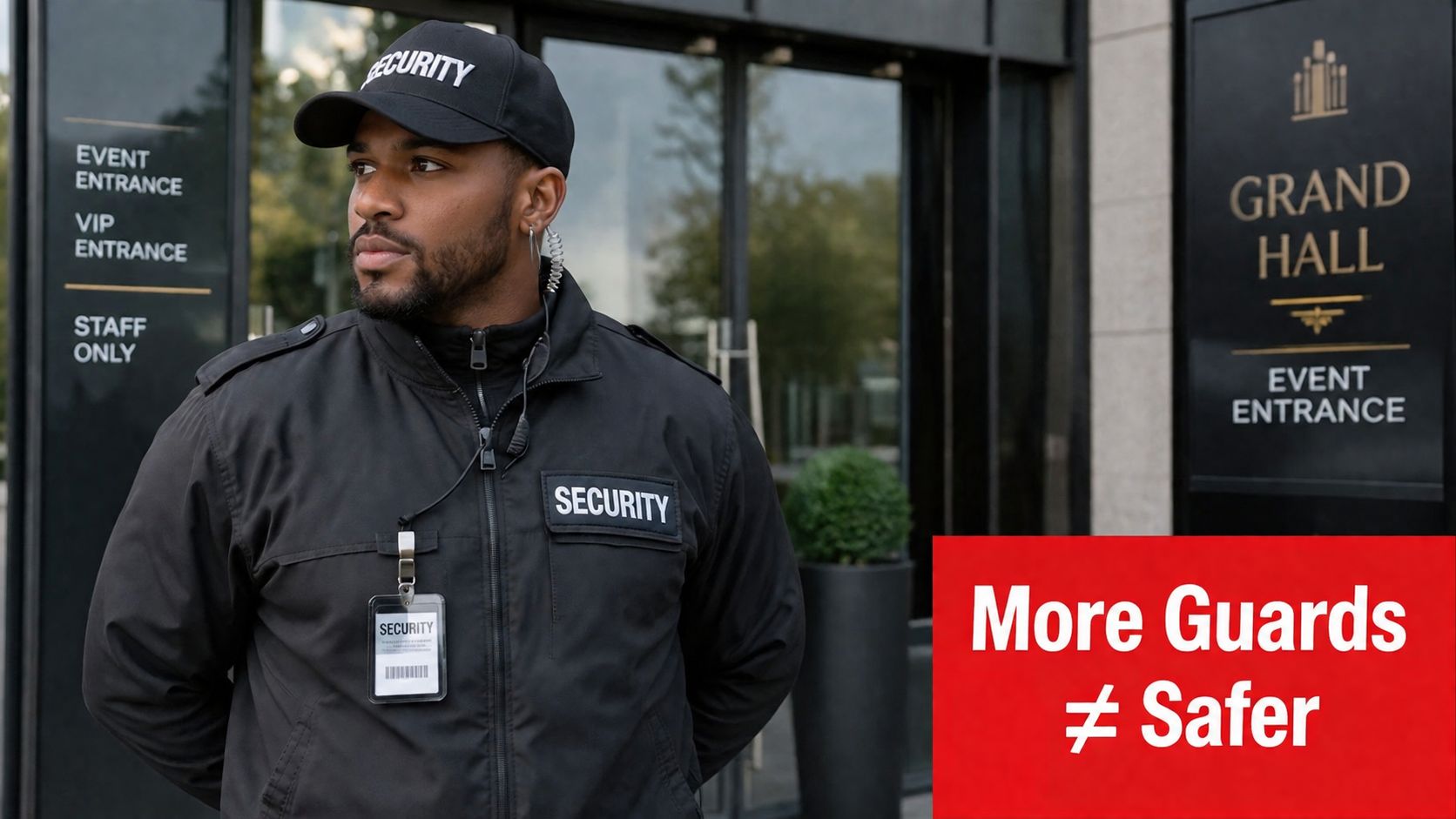
More guards can create a false sense of control. A crowded entrance with too many people standing around can look reassuring, but it can also produce confusion, mixed messages, and slow reactions when something kicks off. The better metric is whether the team knows who is watching, who is moving, and who is escalating.
The Australian security workforce has long been large enough to rival public policing, with one estimate putting 52,768 full-time private security officers in 2006 versus 44,898 police officers at the time, and a later estimate cited in the same source putting the total licensed security workforce at about 120,000 nationally, including 54,753 employed full-time Security guard. That scale shows how embedded guarding is in everyday protection, especially across NSW, VIC, QLD and the ACT, but it doesn't mean bigger rosters automatically produce better outcomes.
Deployment beats headcount
A strong deployment puts guards where problems form, entry points, smoking areas, loading docks, car parks, and choke points near bars or stages. A weak deployment spreads people too thin or stacks them in visible spots for optics. The first looks busy, the second works.
Practical rule: if a guard can't say what they're watching, what they'll do first, and when they'll hand off to police, the post is under-designed.
That's why good operators build coverage around observation, incident flow, and response lanes, not just standing bodies. A team with fewer people can outperform a larger one when the venue manager, CCTV operator, and security supervisor are aligned on escalation. That alignment is also what protects the venue from the opposite problem, overreaction. Guards are there to observe, deter, and support, not to improvise enforcement.

The real value sits in the handoff
The most important moment often comes after the first contact, not before it. If a patron is intoxicated, aggressive, or refusing directions, the guard's job is usually to stabilise, document, and escalate through the correct channel. Poor providers make that sequence ad hoc. Better providers write it down and drill it.
When security is designed this way, the venue gets more than a visible presence. It gets a working control layer that can absorb pressure without turning every issue into a confrontation.
Core Duties and the Detect Deter Observe Report Model
The core job design for private security guards in Australia is simple to state and easy to miss in practice, detect, deter, observe, and report. The model only works when the guard understands the site, follows the SOP, and records the incident in a way another supervisor can use later.
What the model looks like in practice
On a festival gate, detect means spotting bag concealment, queue tension, or a guest moving against the flow. Deter is the visible uniform, the stance, the tone, and the presence of a clear authority path. Observe means noting facts, who, what, where, when, and how. Report means passing that information quickly enough for the next decision.
At a bar or club, the same model looks different. A guard may watch for repeated returns from the smoking area, minor disorder at the bar rail, or a patron trying to bypass entry checks. On a construction site, detection often means noticing unauthorised vehicles, after-hours movement, or signs of trespass before a loss occurs. The duty stays the same, the pattern recognition changes.
A useful companion resource for CCTV planning is the CCTV installation guide for UK businesses, because camera placement, coverage gaps, and monitoring logic all affect how a guard can observe and report effectively.
The most important moment often comes after the first contact, not before it. If a patron is intoxicated, aggressive, or refusing directions, the guard's job is usually to stabilise, document, and escalate through the correct channel. Poor providers make that sequence ad hoc. Better providers write it down and drill it.
Why training quality changes outcomes
The occupational standard in this field is not just presence. It includes risk assessment, SOP discipline, documentation, and coordination across sites. That is why documented vetting, recurrent training, and refresher coaching matter so much. They reduce the gap between the guard who knows the site and the replacement who is covering a shift for the first time.
Guards who write clean reports and escalate early save managers time later. Guards who guess at the incident story create avoidable gaps in the record.
That is the operational distinction buyers should look for. The question is not whether a provider can send a body to site, but whether that person is trained to identify risk, communicate clearly, and leave behind usable information. A team with strong supervision, consistent escalation protocols, and low churn will usually outperform a larger roster with weak oversight.
Types of Private Security Guard Services Explained
Different environments need different guard profiles. A concert organiser, a retail manager, and a warehouse supervisor are not buying the same thing, even if they all use the term private security guards. The right mix depends on whether the main issue is crowd control, perimeter protection, deterrence, access control, or high-visibility reassurance.
Static, mobile, K9, and close protection
Static guards suit entrances, concierge points, gatehouses, loading docks, and liquor-licensed venues where access control is constant. They're most effective when the site needs a visible human checkpoint and a clear line for customer interaction. On a festival site, they work well at gates and restricted areas where the job is to slow people down and apply the rules consistently.
Mobile patrols fit construction sites, retail centres after hours, and dispersed properties. A patrol vehicle or roving officer creates uncertainty for trespassers and covers more ground than a fixed post. It's the right choice when risk is spread across a perimeter rather than concentrated at one doorway.
K9 teams add another layer where deterrence matters and the environment can support a handler-dog pair safely. They're often used when the client wants stronger visible presence and disciplined search capability around larger sites or event perimeters. VIP protection is different again. It's about proximity, discretion, route awareness, and controlled movement for high-profile people who can't be protected by a door post alone.
Matching service type to problem type
| Service type | Best fit | Typical use case |
|---|---|---|
| Static guards | Fixed access points | Clubs, hotels, festivals, gatehouses |
| Mobile patrols | Larger or dispersed sites | Construction, retail, industrial yards |
| K9 teams | Strong deterrence needs | High-risk venues and perimeter checks |
| VIP protection | Close personal security | Corporate events, talent arrivals, dignitary movement |
If a site needs loss prevention, covert operations, or vehicle patrols, those services should be scoped separately rather than assumed from a generic guard quote. The wrong deployment creates blind spots, and blind spots cost more than most hourly rate differences.
State Licensing and Regulatory Requirements Across Australia
Australia does not use one national licensing system for private security. Licensing sits with state and territory regulators, so a guard's authority in New South Wales, Victoria, Queensland, or the ACT depends on where the work happens, not on a single countrywide licence model private security agencies regulation act. That fragmentation is an operating constraint. It shapes how you roster staff, where you can send them, and how quickly you can cover a shift.
Minimum entry requirements commonly include identity checks, criminal history screening, and approved training before deployment annex a detailed technical specification. A provider cannot treat cross-border work as a simple roster change. Different licence classes, renewal rules, and local conditions can stop a guard from working at a site the client assumed was already covered.
Private Security Guard Licensing by Australian State and Territory
| State or Territory | Regulatory Body | Key Licensing Considerations |
|---|---|---|
| New South Wales | State regulator | Licence class must match the guarding function, training and renewals matter |
| Victoria | State regulator | Site work depends on the relevant class and compliance conditions |
| Queensland | State regulator | Deployment must align with local licensing and entry requirements |
| ACT | Territory regulator | Licence status and task scope need checking before assignment |
Compliance is a deployment constraint, not just an HR formality. If a venue runs multiple sites or stages events across borders, the provider has to sort out those differences before the shift starts, or it risks unlawful work allocation and avoidable downtime.
For volunteer-heavy organisations or event teams that still need screening discipline, the background checks for nonprofits resource is useful for understanding how vetting logic works even outside the security sector. The same discipline applies here, verify first, deploy second.
How to Assess Risk and Choose the Right Guard Deployment
The best guard plan starts with risk, not with a quote. A strong provider will ask about site layout, crowd profile, alcohol service, historical incidents, transport access, and local crime patterns before suggesting numbers or coverage. If that conversation doesn't happen, the roster is probably being built from habit.
Build the deployment around the site, not the brochure
A nightclub on a main strip needs a different posture from a conference centre or a construction compound. The nightclub may need strong entry discipline, patron flow management, and support for RSA-related issues. The conference centre may need discreet access control and visitor verification. The construction compound may need perimeter checks, after-hours patrols, and reporting that can stand up in a claim or investigation.
Useful standard: a good site brief tells a guard where the risk starts, who owns the decision, and how the incident gets escalated.
That brief should also include camera locations, key contacts, police liaison details, and any venue rules that affect response. A guard who can't reach the right manager quickly is forced to improvise, and improvisation is where consistency breaks down.
A simple decision filter
- Assess the site type. A venue with open public access needs different control points from a fenced yard or ticketed event.
- Match the threat level. A known problem area or alcohol-heavy environment usually needs tighter supervision.
- Set the duration. Short events, overnight posts, and ongoing coverage all require different staffing patterns.
- Fit the guard skill to the task. Customer-facing posts need communication skills, while patrol work needs discipline and attention.
- Decide how visible the presence should be. Some sites need a strong uniformed deterrent, others need quiet observation.
If you're comparing providers, ask how they coordinate guards with CCTV, venue management, and police contact points. The best answer won't sound theatrical. It will sound organised, specific, and testable.
The Hidden Workforce Problem Behind Guard Quality and Pricing
Hourly rate is the easiest number to compare, and the least useful one if you care about service quality. The guard in front of the venue might be well briefed, or they might be covering a shift in a system that burns through staff and relies on replacement hiring. Buyers usually see the uniform. They don't see the churn behind it.
Recent research on the wider security-guard workforce shows the sector is structurally dependent on contract labour and replacement hiring, with about 60% of guards working for contract firms and roughly 162,300 openings a year largely because workers leave Underpaid, Undervalued, and Essential. While that research is from the United States, the underlying point travels well. If the business model depends on constant backfilling, quality will vary unless supervision is tight.
What buyers should ask before signing
- Who supervises the shift? A roster without active oversight usually drifts.
- How often are guards retrained? Refresher coaching keeps procedures consistent across sites.
- What happens when someone calls in sick? Replacement hiring is where standards often slip.
- How are incident reports checked? Good reporting is a control, not a formality.
- What's the screening process for new guards? Better screening usually means fewer surprises on site.
Low pay, long hours, limited benefits, and weak training standards are common reasons service quality swings from excellent to poor. That's why smarter buyers now purchase supervision, screening, and ongoing training as part of the contract, not just bodies with radios. A provider can be cheap and still expensive if staff turnover causes missed incidents, poor handovers, or reputational damage.
The Australian market rewards operators who treat security as a managed service, not a labour dump. That's where a provider like GM GROUP Services fits in the discussion, because its model is built around licensed deployment, ongoing training, supervision, and site-specific planning rather than generic coverage.
Real World Deployment Examples for Venues Events and Sites
A music festival is a layered operation, not a single guard line. Static guards handle entry and restricted zones, mobile teams cover car parks and perimeter checks, and a supervisor manages handovers and incident flow. If the event includes VIP arrivals, close protection needs a separate plan so crowd-facing staff don't improvise a personal escort.
At a bar or club, the most effective setup is usually a front-of-house team that can control entry, de-escalate early, and keep records tight. Guards need strong customer service, especially where RSA compliance and patron behaviour intersect. The aim isn't to look hard. It's to keep the venue moving without creating friction at the door.
A retail centre or construction site uses a different mix. Retail needs loss-prevention awareness, camera support, and a visible deterrent near known pressure points. Construction needs after-hours patrols, gatehouse control, and incident reports that are detailed enough for site managers to follow up the next morning.
For larger stadium-style operations, the Arena Stadium Security Systems resource is useful context because stadium security depends on control layers, not isolated guards. The same logic applies to venue planning here, nobody should rely on one post to solve a complex site.
Pre-shift checklist for managers
- Brief the team early. Don't wait until doors open to explain the site.
- Confirm who owns escalation. Guards need one clear decision chain.
- Check handover notes. The outgoing shift should pass on live issues, not assumptions.
- Verify reporting expectations. If the report is weak, the operational memory is weak.
- Review the post-event debrief. Small issues repeated across events become big problems.
The best deployments feel calm because the planning happened before the crowd arrived. That calm is not luck. It's structure.
Frequently Asked Questions About Private Security Guards
How far in advance should security be booked? For larger events, book early enough to lock in the right licence class, supervisor, and shift cover. The more complex the site, the earlier you should start, because good providers need time to brief staff and verify jurisdiction-specific requirements.
What insurance should a provider carry? Ask for proof of cover that matches the service being delivered, then check that the scope, dates, and named entity are correct. If the provider can't show that clearly, keep looking.
How do guards handle intoxicated patrons? They should follow the venue's escalation path, use calm language, document the interaction, and hand off to management or police when needed. Guards are there to stabilise the situation, not to freelance enforcement.
What reporting standard should I expect? Reports should be factual, time-stamped, and specific enough for another manager to act on them. Vague incident notes help nobody.
Should I ask about uniform, radios, and CCTV access? Yes. Those basics affect whether the guard can see, communicate, and respond without delay.
If you want a security partner that plans around licensing, escalation, supervision, and the realities of live venues, talk to GM GROUP Services. They work across events, venues, and business sites with a focus on fit-for-purpose deployment and consistent reporting, and you can visit GM GROUP Services to discuss a security plan that matches your site.