


Post-event reporting gets messy fast when the site is already packed down, the radios are back in the locker, and the incident log sits half-finished in someone's inbox. That's when security teams end up rebuilding the story from memory, which is exactly how details get lost, compliance gaps appear, and useful lessons disappear. In Australian event operations, post-event reporting works best when it's treated like part of the job, not a tidy-up task after the job.

The strongest reports don't just describe what happened. They capture what the team saw, what the client needs to know, what regulators may ask for later, and what the next event should change. That's why the best post-event reporting process starts before gates open, runs while the event is live, and finishes with a handover plan that names owners and deadlines.
Getting Started with Post-Event Reporting
A festival security supervisor once told me the report was “fine” until someone asked why three incident logs didn't match the radio transcripts. By then, the detail had already gone cold. Guards had moved on, contractors had left site, and no one could confidently explain which issues were handled, which were escalated, and which were never properly recorded.
That's the inherent cost of late post-event reporting. It turns a clean operational picture into a reconstruction exercise. In NSW, the major-event framework expects organisers to map objectives, capture operational risks, and document outcomes for government and stakeholders, which is why the report has to quantify attendance, crowd movement, transport impact, safety incidents, and service performance instead of relying on impressions alone. Sydney's New Year's Eve event, which regularly attracts more than 1 million people in a formal whole-of-government reporting environment, is a useful reminder of how much evidence large events generate and how quickly it can vanish if nobody owns the process. That same discipline matters across venues, festivals, hospitality, and construction sites where security decisions need to be defensible later.
Practical rule: if the event relied on guards, radios, CCTV, or contractor coordination, the reporting plan should already be in the operations pack.
The simplest way to think about post-event reporting is this, it protects safety memory. It records what happened, why it mattered, and what the business should do next. If the team can't point to a structured record, the next event starts from guesswork instead of evidence.
Planning Objectives and Report Structure
A report gains value when the objectives are fixed before the event starts. If the venue owner needs proof of service levels, the sponsor wants audience data, and the operations manager needs a clear incident summary, those requirements should already shape the outline. A strong post-event reporting structure is built around the decisions people will make later, not around whatever notes happened to survive the weekend.
A technically sound workflow locks the template before the event, defines the measures of effectiveness in advance, and assigns staff to capture data during the event and straight after it, as set out in the UK government's best-practice guide. That matters because completeness falls apart once the team starts reconstructing the day from memory. If supervisors wait until pack-down to decide what counts, attendance notes, patrol logs, and incident details will already be partial.
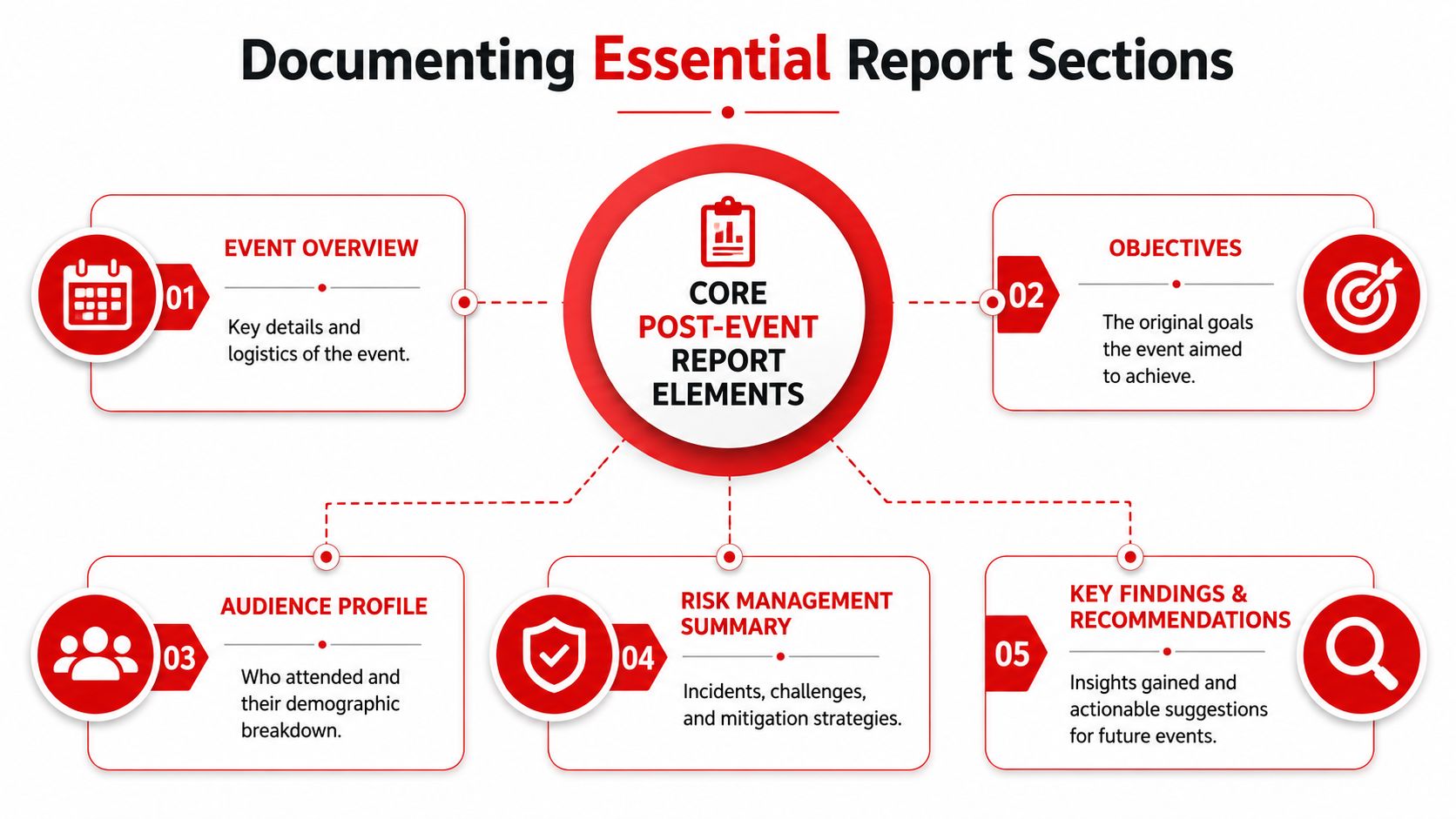
The NSW APEX Post-Event Report Template gives that planning a practical shape, with five core sections, overview, objectives, audience profile, event details, and analysis, plus summaries for financials and incident learnings. For Australian teams, it works as a useful benchmark because it is broad enough for events and specific enough for compliance-style reporting. It also keeps the report from becoming a loose collection of commentary.
A simple pre-event outline can look like this:
- Event overview, dates, venue, format, and operating context.
- Objectives, what success looks like for the organiser, client, and stakeholders.
- Audience profile, who attended and how the crowd behaved.
- Risk and incidents, what happened, what was resolved, and what needed escalation.
- Findings and recommendations, what should change before the next event.
Write the skeleton report before the event, then leave fillable spaces for live data. Supervisors then know exactly where to drop attendance counts, shift notes, and incident summaries when the event ends. If a team already uses an event planning checklist, the report outline should sit beside it, not after it.
Documenting Essential Report Sections
The best reports are not huge, they're complete where it matters. The APEX template's five-section structure is useful because it forces the writer to cover the event itself, the audience, the risk picture, and the evaluation in one place. In practice, post-event reporting works when each section answers a specific operational question instead of repeating the same story in different words.
Start with the event overview
The overview should identify the event, the operating environment, and the actual conditions on the ground. For a concert, that might mean the venue, set-up constraints, ingress points, and how the crowd arrived. For a festival, it might include weather pressure, vendor flow, and any schedule changes that shaped the site.
This section is where the report stops being generic. If a security team had to re-route foot traffic because a gate was blocked, that belongs here. If additional guards were placed near a bar or loading zone, record it here too, because that decision affects the rest of the evaluation.
Capture objectives and audience profile
Objectives should be written in plain operational language, not marketing language. If the purpose was crowd safety, gate control, or client confidence, say that clearly. New Zealand Major Events' post-event reporting guidelines also require teams to assess whether key objectives were met and to review economic, social, cultural, international exposure, and realized benefits, which is a useful reminder that a report can carry outcomes beyond attendance and revenue. Australian planners can borrow that mindset when the event's success depends on more than one audience or stakeholder group.
Audience profile matters because a report without crowd context is incomplete. It should note who attended, how the crowd behaved, and whether the event attracted the right mix of guests for the site and client. If the crowd was younger, more mobile, or more nightlife-focused than expected, that changes staffing, communications, and risk assumptions next time.
Don't skip risk, incidents, and learnings
Risk and incident notes should be operational, not dramatic. Write what happened, who responded, and what the outcome was. If a medical issue, intoxication, access breach, or equipment fault occurred, connect it to the control that worked or failed.
The report is strongest when it shows the link between the incident and the response, not just the incident itself.
The HeyKuno template is useful here because it asks for an outcome statement, evidence source, who reviewed it, uncertainty or alternative explanations, and the next verification point. That gives the report a verification mindset instead of a vague narrative. It also reinforces that issues and response, lessons and follow-up, and authorised financial context belong in the same document when you want the report to support future decisions.
Using Templates Checklists and KPIs
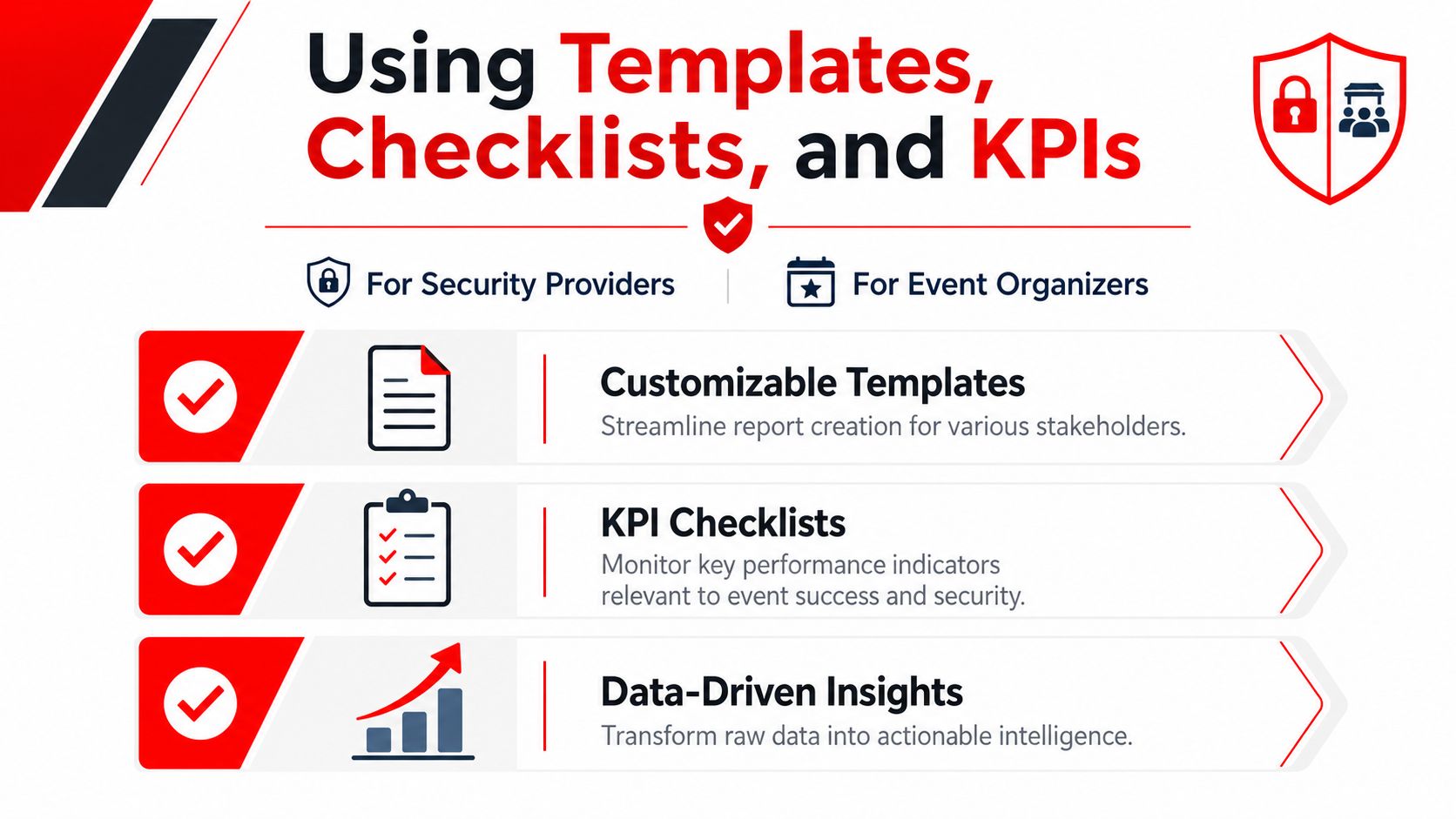
Templates and checklists keep post-event reporting from becoming a memory test. Australian event guidance commonly frames performance around attendance, engagement, budget variance, and lessons learned, which means the report should be built around a small set of repeatable indicators rather than a wall of commentary. The reason is simple, if the same metrics are used every time, the team can compare events without re-inventing the report.
A practical KPI set for security and event teams can include attendance variance, incident response speed, staffing adequacy, patron feedback, and budget variance. Keep it tight. If a metric doesn't help the client, the venue, or the next staffing plan, it's probably noise.
For teams looking for a working structure, use three tools together:
- Customisable templates, so each stakeholder version starts from the same core document.
- KPI checklists, so onsite staff capture the same data points every time.
- Debrief prompts, so supervisors don't forget the operational context behind the numbers.
A simple template table can help turn notes into a usable report.
| Report item | What to capture | Why it matters |
|---|---|---|
| Attendance | Actual crowd numbers and visible crowd movement | Confirms whether planning matched reality |
| Incidents | What happened, where, and who responded | Supports safety review and compliance |
| Staffing | Rostered vs actual deployment, gaps, redeployments | Shows whether coverage was adequate |
| Budget | Expected vs actual spend | Keeps decision-makers informed |
| Lessons learned | What should change next time | Drives repeatable improvement |
The timing still matters here. Best-practice guidance recommends circulating a draft post-event reporting summary within 24 to 48 hours and finalising it within two weeks to protect accuracy and stakeholder engagement, according to EvePaper. That's also why the report draft should sit close to the event close-out checklist, not behind it.
A useful operational habit is to run a short debrief against a fixed checklist while the event is still fresh. The most useful notes usually come from the supervisors who handled the busy entry point, the bar controls, or the late shift, because they saw the friction points first. If you want a planning resource that helps connect those handover notes to the event timeline, the event planning checklist from PlanSeats is a sensible companion.
Managing Timelines Handover and Compliance
Delayed post-event reporting is where small problems become permanent blind spots. The data fades, the radios go missing, and nobody remembers whether the crowd issue started at ingress, during peak trade, or near pack-down. Best-practice guidance recommends a draft within 24 to 48 hours and a final report within two weeks, because those deadlines preserve both data accuracy and stakeholder engagement, according to EvePaper.
Build the handover around action, not summary
Weakness in many reports is operational handoff. Teams write a good summary, then stop before anyone owns the follow-up. That's why a report should end with actions, names, and due dates, not just observations.
A clean handover sequence looks like this:
- Extract the live records immediately, including attendance, incident logs, shift notes, and technical issues.
- Run the debrief quickly, ideally while supervisors still remember why a decision was made.
- Assign each follow-up task, so the next event has a named owner for each fix.
- Set deadlines and check-in dates, because a recommendation without a date rarely gets done.
- Archive the final report, so compliance and planning teams can find it later.
The UTMStack guide for HIPAA compliance is useful here because it reinforces the broader point that reporting only has value when the record is complete, controlled, and accessible to the right people. The principle is the same in event operations, even though the subject matter is different.
Treat compliance as a record-keeping discipline
In NSW, VIC, QLD, and ACT, the report should support site governance, not just internal admin. That means retaining the facts that explain who was on site, what was observed, what was escalated, and what corrective action followed. If a venue later needs to justify a staffing change or explain a control decision, the report should already contain the evidence trail.
Practical rule: if a recommendation can't be handed to someone with a deadline, it isn't finished.
Where this becomes especially valuable is in multi-site operations. A venue, festival, or construction project may involve different contractors, different shift leads, and different compliance needs, but the handover logic stays the same. The report has to leave the event in a state where the next manager can act on it without re-interviewing everyone who was there.
Conclusion with Recommendations and Next Steps
A post-event report does more than record what happened. In practice, the useful report turns findings into a handover plan that names owners, sets deadlines, and makes the next round of work easy to start. That is the difference between a document that sits in a folder and a document that changes how the next event is run.
The common mistake is to stop at summary and recommendations. A stronger finish links the evidence to action, so each issue is attached to a person, a timeframe, and a clear follow-up point. That matters in live event operations, where staffing gaps, access issues, equipment faults, or compliance misses can repeat if no one is accountable for closing them out.
Keep the final report written for the people who have to use it. Operations teams need clear priorities, compliance teams need a clean record, and supervisors need enough detail to check whether corrective action was completed. The report should leave no ambiguity about what needs to happen next, who is responsible, and when the follow-up should be reviewed.
Strong post-event reporting is concise, decision-useful, and built for handover. Tailor the depth to the audience, keep the sections anchored to objectives and evidence, and finish with assigned owners and deadlines. The report that drives improvement is the one someone can act on next week, not the one that sounds impressive on the day it is written.
GM GROUP Services supports event, venue, and site operations with security reporting, supervision, and risk-focused deployment across NSW, Victoria, Queensland, and the ACT. If you want a practical partner for safer events and better operational records, visit GM GROUP Services and see how their services can fit into your next reporting and compliance workflow.