


Operational Efficiency starts on the floor, not in a boardroom. It shows up when two guards are trying to hold three entry points at a Saturday night venue, a radio is crackling with a missing patron report, and the client wants calm, not excuses. In that moment, operational efficiency is the difference between a controlled shift and a night full of rework, overtime, and avoidable risk.
For security operators across NSW, VIC, QLD and the ACT, the question isn't how to cut harder. It's how to turn every rostered hour into a safer, cleaner outcome without breaking award rules, drifting outside licensing conditions, or making the front line feel thinner than it already is. That's the practical version of efficiency, and it's the only version that survives contact with a live site.
Why Operational Efficiency Matters in Security
A busy venue on a Saturday night makes the point fast. One guard is pinned to the front door, another is dealing with a noisy group at the bar, and a third job has just landed through the radio because the back entrance is busy. If those roles aren't clearly assigned, the team doesn't just slow down, it starts missing details, doubling up on work, and reacting late.
That's why operational efficiency in security is never just a cost conversation. It's the discipline of getting the right result from the roster you already have, with less waste in movement, handover, reporting, and escalation. In a labour-heavy service, the margin is often won by better deployment, cleaner process, and tighter timing, not by squeezing people until they burn out.
The baseline is already tight
The Australian Bureau of Statistics reported 1,671 annual average hours worked per employed person in 2023 and 31.6 average actual hours worked per week, alongside 34.0 average usual hours in the same year, which shows there's often a gap between rostered capacity and productive time in practice (ABS-based operational efficiency metrics). In security, that gap is where scheduling, absenteeism, shift design, and demand matching either help you or hurt you.
The practical takeaway is simple. If the same workforce can spend a larger share of its time on billable, client-facing, or incident-resolving work, efficiency improves without adding headcount. That's a better outcome for venues, sites, and clients than pretending every problem is solved by more guards.
Practical rule: if a roster feels busy but the shift log is full of rework, delays, and handoffs, the issue is usually deployment quality, not just staffing volume.
What Operational Efficiency Means in Security
In security, operational efficiency is the ratio of safe, compliant outcomes delivered to the labour and operating input required to deliver them. That matters because security work is not a factory line. A shift can look busy all night and still be inefficient if the wrong officer is at the wrong gate, the incident report is incomplete, or a second dispatch is needed for something that should have been closed the first time.
A good comparison is a pit crew. Everyone has a role, handoffs are tight, and movement is deliberate. A venue security team works the same way when it is functioning well, each guard knows the site risk, the response sequence, the escalation threshold, and who owns the report at the end.
Efficiency is bounded by compliance
Australian security operators optimise within award rules, licensing requirements, and RSA obligations. That is the floor of the job. If a roster saves money by pushing the wrong person into the wrong post, the apparent efficiency can turn into a compliance issue, a service complaint, or a safety gap.
The ABS productivity picture reinforces why that discipline matters. Australia's market sector multifactor productivity fell by 0.9% in 2022–23 after a 1.2% decline in 2021–22, and long-run growth averaged only 0.1% per year between 1985–86 and 2022–23 (NetSuite summary of ABS productivity data). In a low-growth productivity environment, gains come from process control, better allocation, and fewer repeat mistakes.

A practical definition is simple. The best deployment gets the right licensed officer to the right site, at the right time, with the right instructions, and with enough margin to absorb the world's messiness that comes with absences, incident spikes, and client changes. In multi-site rosters across NSW, VIC, QLD and the ACT, that usually means accepting a trade-off somewhere, lower standby cover, tighter handovers, or more disciplined escalation, rather than pretending every site can run at minimum cost without consequence.
A roster that looks cheap on paper can become expensive in practice if it creates extra calls, client friction, or compliance risk. That is why operators who want a quick way to calculate restaurant labor costs can still use the same discipline here, because the question is always how much labour a service model really consumes, and what gets lost when you trim it too far.
Efficiency is not speed at any cost, and it is not a euphemism for understaffing. If a change makes the post look cheaper but the site less stable, it is the wrong change.
The Metrics That Move the Needle
The quickest way to improve operational efficiency is to stop measuring everything and focus on the few numbers that expose waste. A small security operator does not need a sprawling analytics stack to find value. Incident logs, radio timestamps, timesheets, and shift reports already contain enough signal to show where the roster is leaking time.
Start with the metrics that expose rework
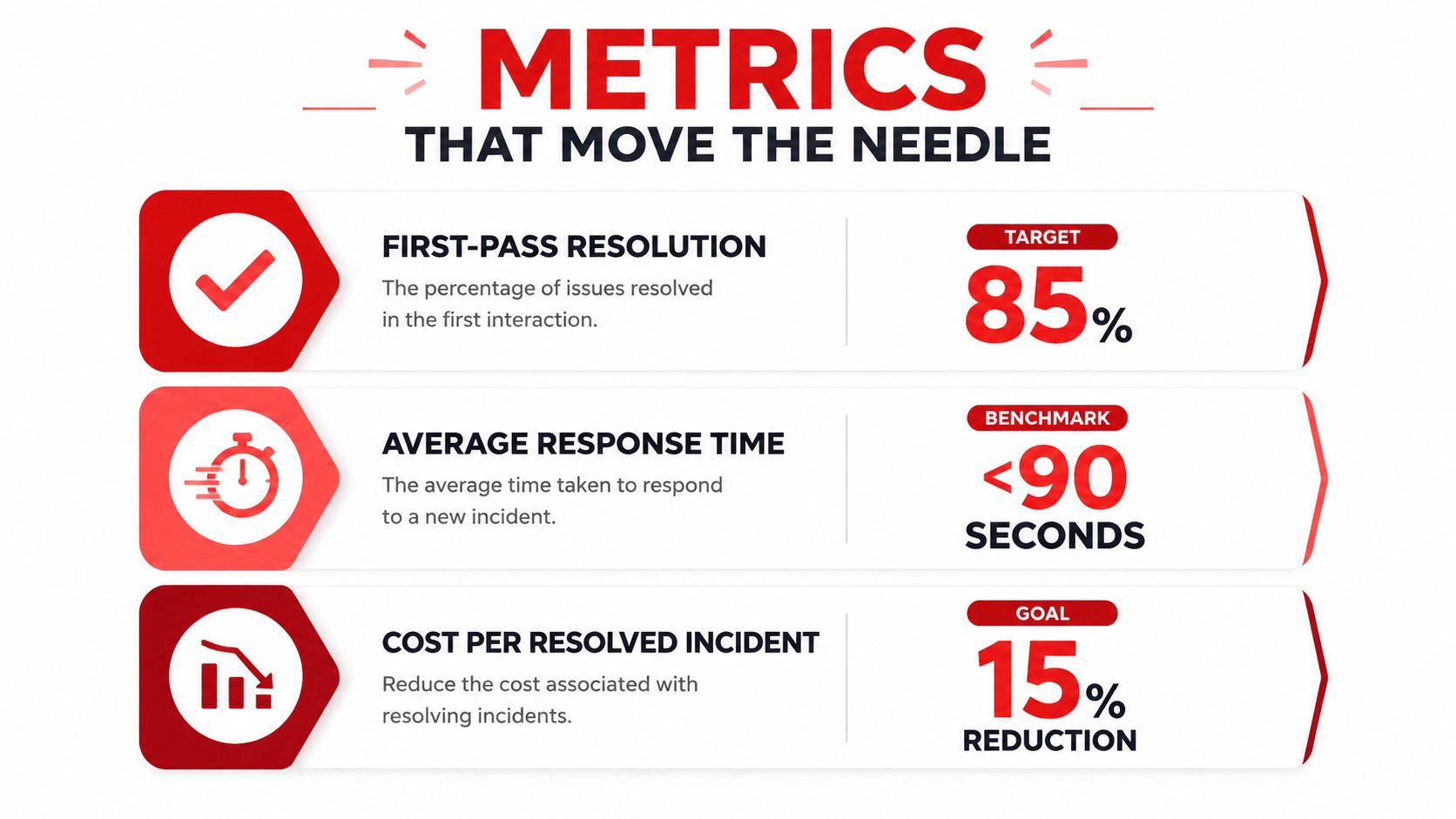
First-pass resolution is the share of incidents closed correctly on the first response. In security, that means the responding officer resolves the issue, documents it properly, and does not hand it off unnecessarily. It matters most where repeat dispatches are expensive, especially at construction sites, mixed-use properties, and complex venues. Higher first-pass resolution means fewer second callouts and less travel time, which lowers labour cost per intervention, as shown in Cloudvara operational efficiency metrics.
Average response time is how quickly the team moves from alert to arrival. It matters most at venues and events because customer experience and safety both move with the clock. If your incident log already records radio call times and arrival times, you already have the data.
Guard utilisation is the share of rostered time spent on productive, client-facing, or billable work. In practice, it shows whether the team is on task or stuck in idle coverage, poor handoff, or unnecessary duplication. Timesheets, patrol logs, and post orders usually give enough evidence to estimate it.
Cost per resolved incident is the clearest finance metric for security operations. It shows the labour and operating cost needed to close one incident, and it becomes more useful when paired with first-pass resolution rather than tracked in isolation. If the cost falls because incidents are being closed badly, that is not efficiency, it is hidden risk.
Incident documentation quality is often underweighted. Poor reporting creates rework, weakens handover, and makes it harder to defend decisions later. It is not glamorous, but it is often where efficiency starts leaking.
If you want a quick way to sense-check labour assumptions in another service-heavy setting, a tool such as calculate restaurant labor costs can help frame the same basic question, how much productive output you are getting from rostered time.
What good looks like in a security context
- First-pass resolution: a guard closes the issue without a second dispatch, and the report is complete the first time.
- Average response time: the officer gets there quickly enough to control the situation before it spreads.
- Guard utilisation: the roster spends less time on idle coverage and more time on actual post duties.
- Cost per resolved incident: the same shift closes more issues without adding labour waste.
- Documentation quality: reports are usable by the client, the supervisor, and management without rewriting.
The point is not to chase every metric equally. A retail centre cares more about coverage consistency and reporting quality. A live venue cares more about response time and clear escalation. A construction site cares more about first-pass resolution and patrol discipline.
Sector Snapshots Where Efficiency Plays Out Differently
A music festival punishes poor entry design. If the front gates, bag checks, and wristband checks aren't aligned with expected crowd flow, guards end up absorbing the same pressure twice. In that setting, operational efficiency depends on pre-planned entry lanes, clean comms, and supervisors who can move staff before the queue turns into a choke point.
A licensed venue is different. The problem there is usually not the sheer number of people, it's the speed and quality of incident response. If an officer can't de-escalate fast and document cleanly, the shift starts to bleed time into repeat explanations, extra checks, and avoidable customer friction.
Different sites punish different weak points
A construction site is where repeat patrols can eat the roster. If the same access issue, gate breach, or equipment concern keeps coming back, the team isn't getting ahead of the problem. That's where tighter patrol logic and stronger first-pass resolution matter most, because every repeat visit costs movement, fuel, and attention.
A retail centre stresses consistency. Loss-prevention coverage has to be predictable, visible enough to matter, and flexible enough to shift with trading patterns and tenant risk. A good centre supervisor knows that gaps in coverage are often more expensive than a small amount of over-coverage.
A corporate office or conference site punishes sloppy reporting. The incident itself may be minor, but the client still expects polished handover notes, accurate visitor control, and a clear trail of action. A team that writes well usually moves better too, because the reporting standard forces discipline.
For a deeper parallel in another regulated service context, there's useful thinking in improving patient care quality, especially where process consistency, documentation and service outcomes have to travel together.
The best site rule is the one that fits the environment. Don't copy a festival roster into a retail centre and expect the same efficiency outcome.
A useful rule of thumb is this, static posts should only stay static when the risk demands it. If the same guard can cover a wider area through disciplined patrol routing and clear escalation rules, the site usually gets better value from the same labour.
Five Practical Levers You Can Pull This Quarter
The easiest efficiency wins usually come from small changes that remove friction. You don't need a transformation programme to start improving operational efficiency. You need better deployment decisions, cleaner comms, and a tighter loop between the supervisor and the roster.
Staffing models and skill matching
The inefficiency here is simple, putting the wrong guard on the wrong task. A junior officer on a complex client-facing post can create more work than they save. The next 30 days should focus on matching experience, licensing, and temperament to post complexity, then checking whether first-pass resolution and report quality improve.
Patrol routing and geofenced check-ins
The waste here is travel time and duplicated movement. Rebuild patrol routes so the team covers risk, not habit, and use geofenced check-ins where they reduce arguments over presence. If routing improves, guard utilisation should move with it because less time is spent wandering, backtracking, or repeating the same loop.
K9 deployment where detection adds value
K9 is not a generic add-on. It makes sense when detection, deterrence, or search discipline changes outcomes, and when the site risk justifies the extra structure. In those cases, the question isn't whether K9 looks impressive, it's whether it reduces incidents, tightens sweeps, or shortens resolution time.
Technology integration
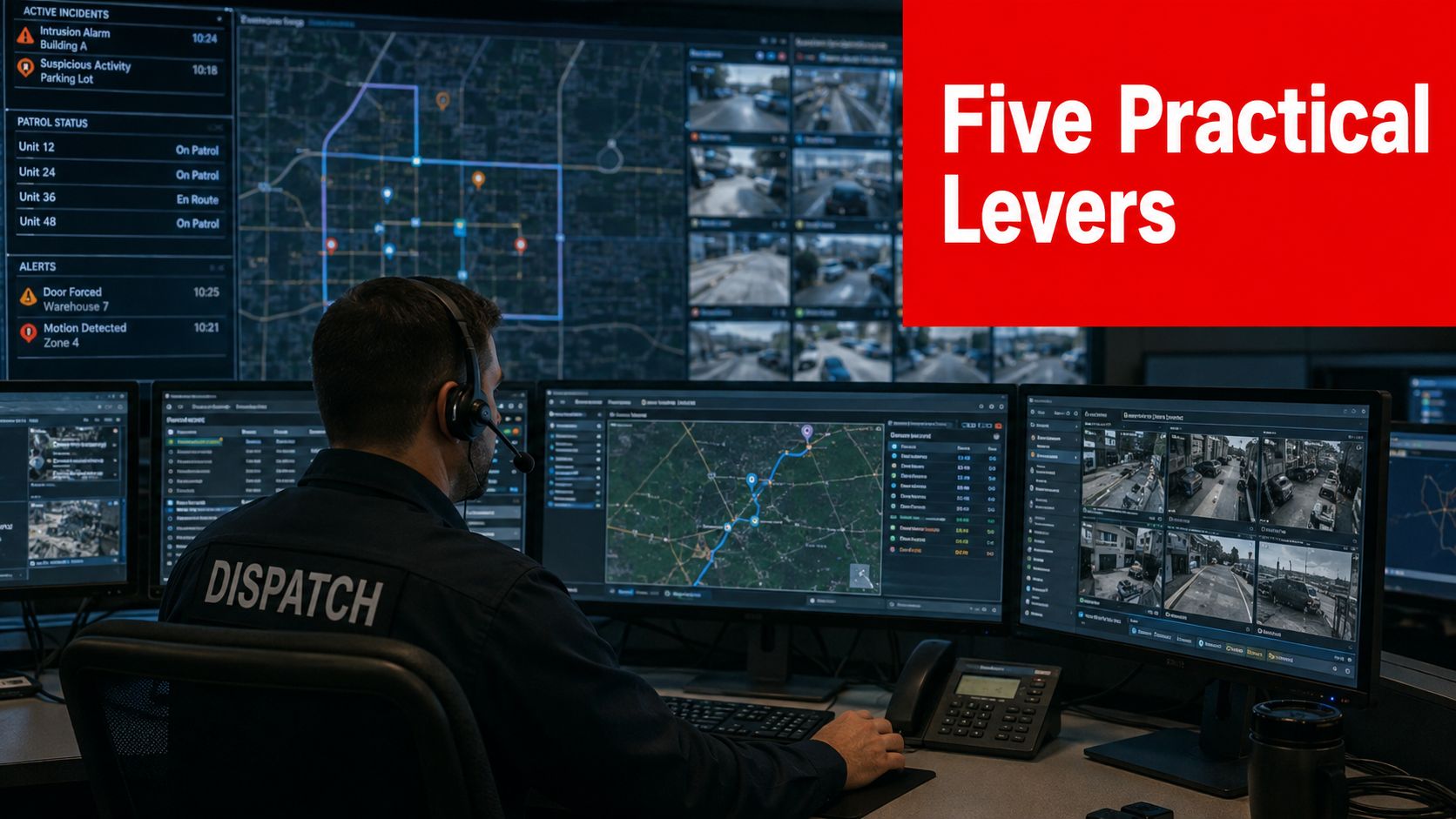
The biggest win often comes from getting radios, dispatch, and back-to-base monitoring to speak the same operational language. If one system says the job is closed and another still shows it open, the supervisor wastes time reconciling the truth. A cleaner workflow matters more than a shiny platform, and if you want a process lens on that, diagnose and automate workflows is a useful mindset to borrow.
Training, supervision, and reporting workflows
Many teams lose efficiency without noticing. If guards are trained to respond but not to document, the supervisor becomes the bottleneck. Tightening radio discipline, report templates, and handover standards should improve first-pass resolution and documentation quality at the same time.
Practical rule: if a change doesn't move at least one metric on the list, it's probably a preference, not an efficiency lever.
GM GROUP Services is one example of a provider that builds security guard hire, K9 units, patrols, back-to-base monitoring, and incident response into one operating model, which can reduce the need for a client to manage separate in-house security functions. That matters when the constraint is deployment fit, not the number of bodies available.
Estimating ROI Without Spreadsheets From Hell
A useful ROI model for operational efficiency doesn't need to be complicated. Start with labour cost per resolved incident, then compare the baseline against the post-change figure after you improve utilisation or first-pass resolution. The formula is simple enough to defend in a client meeting, and simple enough to use without a full finance system.
At baseline, calculate the rostered hours tied to a post, multiply by the award rate, then divide by the number of incidents resolved. After the change, use the same calculation, but adjust for lower rework, fewer repeat dispatches, and better utilisation. That shows whether the same labour is now producing more usable output.
A venue example
Take a 200-patron venue with one static guard on entry. If better radio discipline and clearer escalation cut repeat callouts, the guard spends less time leaving the door, less time re-explaining issues, and less time writing the same report twice. A modest improvement in first-pass resolution can lower the hours spent per resolved incident, even if the headcount stays unchanged.
The money case isn't the only case. Better deployment also protects brand perception, reduces the chance of messy RSA issues, and keeps the client from feeling like the roster is barely holding together. I'd count those as defensive value, not just ROI, because they stop costs from appearing later in a more expensive form.
| Efficiency lever | Primary metric | Typical impact |
|---|---|---|
| Skill matching | First-pass resolution | Fewer repeat dispatches and cleaner handovers |
| Patrol routing | Guard utilisation | Less idle movement and more productive coverage |
| Better radio discipline | Incident documentation quality | Fewer gaps, fewer clarifications |
| K9 deployment where justified | First-pass resolution | Faster search or detection outcomes |
| Dispatch workflow cleanup | Average response time | Faster coordination and fewer delays |
The point of the table isn't to overcomplicate the maths. It's to show clients and managers that efficiency improvements can be traced to a metric, not just described as a feeling.
A 30-60-90 Day Implementation Roadmap
The safest way to improve operational efficiency is to stage the changes. Start with measurement, then make one or two controlled adjustments, then lock them into a review cadence. That keeps the program realistic for a small operations team and helps avoid compliance mistakes caused by moving too many posts at once.
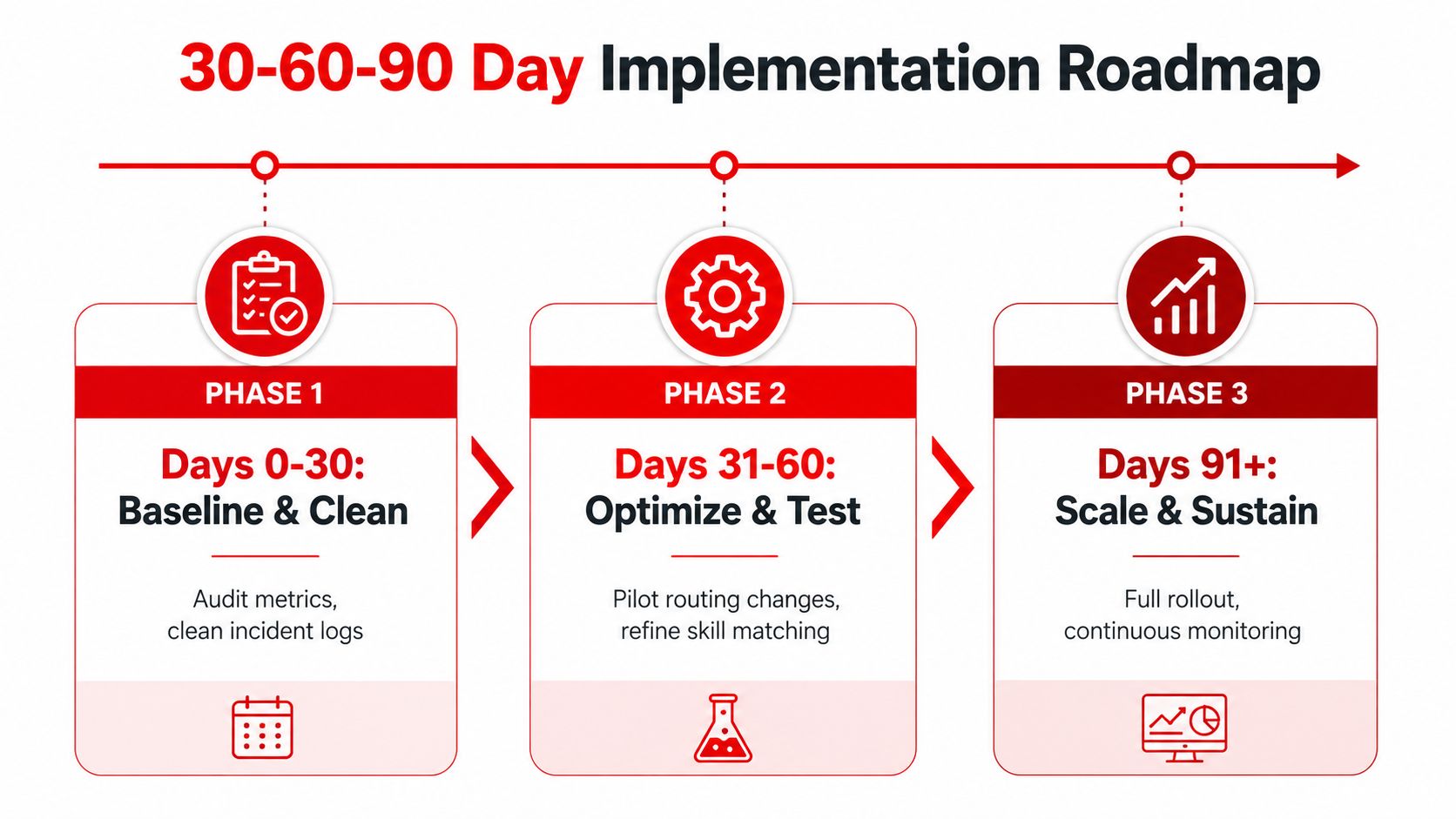
Days 0 to 30
Clean the incident log fields, confirm who owns each report, and get a baseline for the key metrics already discussed. Pull one month of current shift data, radio logs, and handover notes, then identify where rework or delays keep showing up. Definition of done: you can say, with confidence, what the site's current response time, first-pass resolution pattern, and documentation quality look like.
Days 31 to 60
Tighten patrol routes, fix radio etiquette, and adjust skill matching on the posts that create the most friction. Keep the changes small enough that supervisors can track the difference. If the metric doesn't move, roll the change back and try something else.
Days 61 to 90
Reinforce the new behaviours in toolbox talks, supervisor reviews, and end-of-shift debriefs. Hold a quarterly-style review meeting and compare the new numbers against the original baseline. Definition of done: the team can explain which change improved which metric, and the client can see the difference in service stability.
The sequencing matters because award and licensing constraints don't disappear just because a roster looks inefficient. Training and roster changes are easier to defend when they're tested outside peak windows and measured against the same baseline.
Frequently Asked Questions From Operators
How fast can first-pass resolution improve? Usually faster than people expect, once radio discipline and escalation rules are cleaned up. The biggest gains often come from making sure the first officer owns the close-out.
Is K9 always more efficient than static guards? No. K9 is efficient when detection, search, or deterrence changes the risk profile. If the site doesn't need that, a well-deployed static team may be the better fit.
How do you tighten rosters without breaking compliance? Start with deployment quality, not cuts. Match the guard to the task, then adjust routes, handovers, and post coverage inside the rules.
What if one client drags the numbers down? Isolate that site, compare it against the others, and fix the site logic before you judge the whole operation. A bad post can distort the picture if you treat all locations as the same.
GM GROUP Services works across events, venues, retail, construction and corporate sites with licensed guards, K9, patrols and monitoring built around fit-for-purpose deployment. If you want a roster that improves operational efficiency without losing compliance or service quality, visit GM GROUP Services and talk through the sites, risks and coverage model you're working with now.