


SEO Title: 7 Proven Ongoing Professional Development Strategies for Security
URL: /ongoing-professional-development-security
SEO Meta Description: Ongoing professional development helps Australian security teams stay compliant, capable and client-ready. Learn practical strategies, RSA-linked planning, audits and a sample programme.
Ongoing professional development often becomes urgent at the worst possible moment. A festival gate suddenly backs up. A crowd mood shifts faster than expected. A venue supervisor asks a guard about the latest compliance requirement, and the answer is hesitant. Most managers don't discover training gaps in a classroom. They discover them on shift.
That's why smart security leaders stop treating learning as a once-a-year task. In real operations, capability has to stay current. De-escalation needs practice. Situational awareness needs refreshing. Customer service standards need reinforcement. Compliance needs proof, not assumptions.
For managers in events, hospitality, retail, corporate sites and construction, ongoing professional development is the system that keeps staff ready while the job keeps changing. If you're also reviewing how learning fits into broader workforce planning, this primer on understanding corporate training for L&D gives useful context on how structured development supports business performance.
Introduction to Ongoing Professional Development
A security manager at a busy summer event usually sees the same pattern. The team is licensed. Rosters are full. Briefings are delivered. Yet small warning signs appear. One officer handles an intoxicated patron well, while another escalates the same kind of interaction. One supervisor records an incident clearly, while another leaves out key details. The issue isn't effort. It's consistency.
That gap is where ongoing professional development matters most. It keeps skills from fading between major incidents. It helps teams absorb changes in venue expectations, state requirements and threat patterns without waiting for a formal retraining cycle. For security work, that matters because performance is public. Guests, venue operators and regulators all see the result in real time.
Why managers get stuck
Teams don't resist learning. They resist disruption. Managers worry that training pulls guards off shift, adds paperwork or turns into generic content that doesn't match the site. Those concerns are fair. A useful programme has to fit actual operations, not an ideal calendar.
Practical rule: If a training topic can't be linked to a decision a guard makes on shift, it probably needs redesign.
What good practice looks like on the ground
A strong approach usually combines three things:
- Formal refreshers that cover licence-linked and legal requirements.
- Short learning bursts before or after shifts, such as scenario reviews or quick policy updates.
- Supervisor coaching that turns incidents, near misses and guest interactions into learning moments.
Managers who build those habits usually get a steadier team. Not because every guard becomes an expert overnight, but because the standard of practice becomes more predictable.
Understanding Key Concepts of Ongoing Professional Development
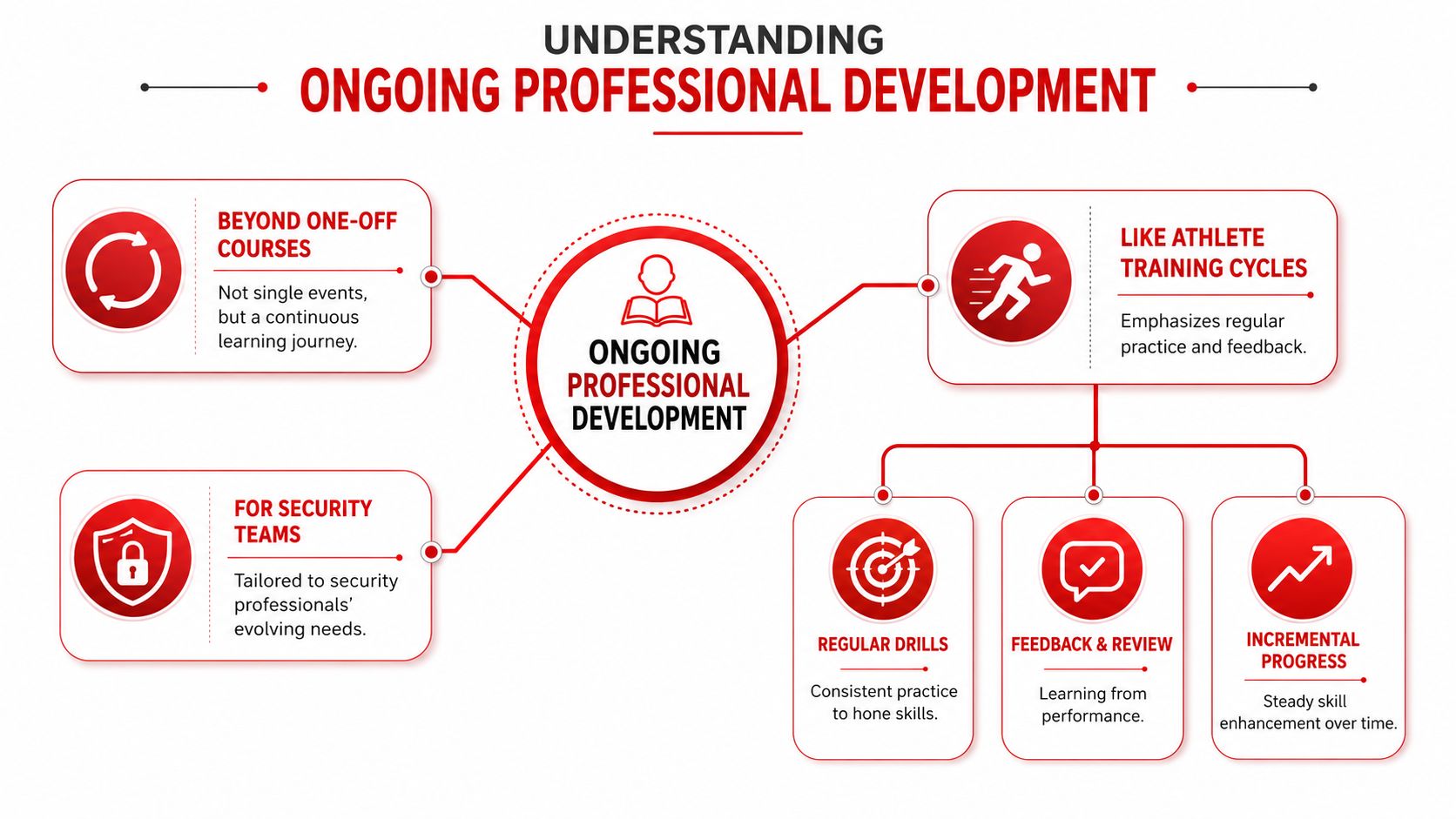
Ongoing professional development means planned, continuous learning that improves how people perform in their current role. It's not the same as sending someone to one course and assuming the job is done. Security teams need repetition, feedback and updates. The better analogy is sport, not school.
An athlete doesn't train once, earn a certificate and stop. They drill technique, review mistakes, build endurance and adjust to stronger competition. Security work follows the same pattern. Guards need regular exposure to crowd behaviour, communication practice, legal updates and site-specific scenarios so they can respond well under pressure.

Formal learning and micro-learning both matter
Managers sometimes assume professional development must mean long workshops. That's only part of the picture. A practical learning mix often includes:
- Formal training such as compliance refreshers, first aid updates or incident reporting workshops.
- Micro-learning such as a ten-minute toolbox talk on queue management or ID checking.
- On-the-job coaching where a supervisor observes an interaction and gives immediate feedback.
- Peer learning where teams review what worked at a recent event or venue shift.
This blended model matters because time is a real barrier. In Australia, participation in work-related training fell from 23% in 2020-21 to 19% in 2024-25, and 44% of respondents cited time pressure as a barrier, according to the Australian Bureau of Statistics data on work-related training and adult learning. For security managers, that points to a simple conclusion. If learning doesn't fit around operations, it often won't happen consistently.
What managers often misunderstand
The biggest confusion is thinking informal learning doesn't count. It does, if it's purposeful and linked to performance. A post-shift review of an aggressive patron incident is development. A short debrief on a bag-check failure is development. A supervisor walking a new guard through tone, positioning and escalation thresholds is development.
Ongoing professional development works best when managers stop separating “training” from “work” and start designing learning into the shift itself.
If you're shaping that kind of system, this guide to building an L&D strategy is a useful companion for turning scattered training activity into a deliberate plan.
Benefits of Ongoing Professional Development
The strongest argument for ongoing professional development isn't abstract. It shows up in daily operations. A better-prepared team usually responds more calmly, documents incidents more clearly and represents the venue more professionally. In security, those outcomes affect safety, compliance and reputation at the same time.
The commercial case is also getting stronger. The Australian security market is valued at AUD 11.82 billion in 2026 and is projected to reach AUD 19.43 billion by 2035, with projected growth linked to smart security adoption and infrastructure investment, according to Australia security market projections. As the market expands, clients will expect more from providers than a visible uniform. They'll expect staff who can handle CCTV, remote monitoring, privacy-aware reporting and customer-facing incidents with confidence.
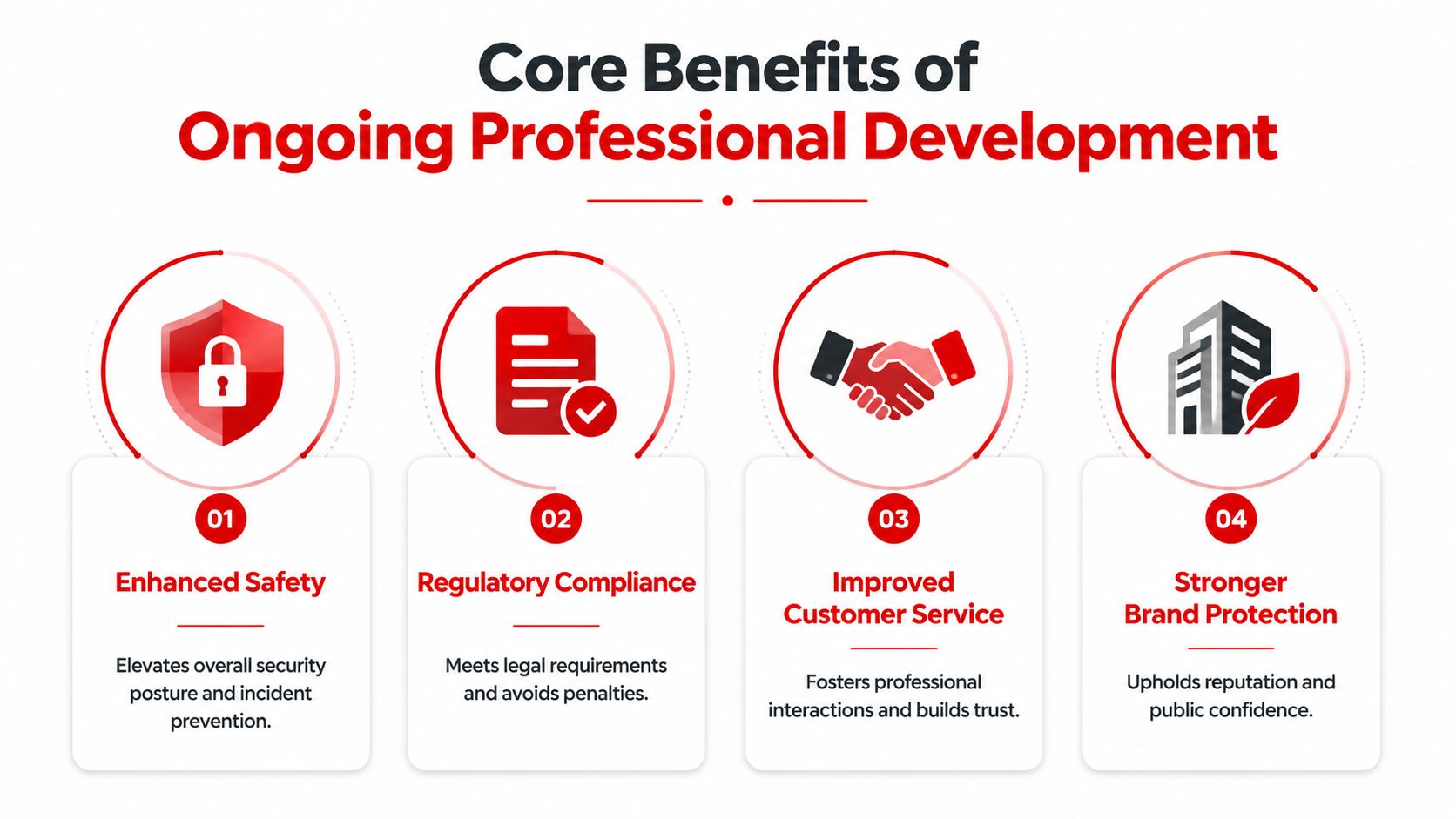
Four benefits managers notice first
Enhanced safety
Teams that practise de-escalation, radio discipline and incident coordination are usually more controlled when pressure rises. At events, that can mean earlier intervention at entry points, cleaner handovers and fewer avoidable confrontations.Regulatory compliance
Training supports more than knowledge. It supports evidence. When licensing, RSA-linked duties and incident records are reviewed, managers need proof that staff were briefed, refreshed and assessed properly.Improved customer service
Security officers often shape a guest's first and last impression. Short coaching sessions on greetings, directions, refusal language and conflict tone can improve how staff protect people without sounding hostile.Stronger brand protection
One poor interaction can travel fast. Professional conduct helps venues and organisers protect trust, especially in public-facing environments such as festivals, clubs, hotels and corporate events.
How to measure value without guessing
Managers often ask how to prove the return on development. Start with observable operational indicators rather than inflated promises.
Use a simple review cycle:
- Track incident themes such as recurring entry disputes, intoxication conflicts or reporting errors.
- Match training topics to those themes rather than choosing generic modules.
- Review supervisor observations after shifts to see whether behaviour changed.
- Check documentation quality for consistency, detail and timeliness.
- Look at client feedback for mentions of professionalism, communication and crowd handling.
Manager's note: Good professional development should make the next shift easier to run, not just produce another certificate.
That's the practical benefit. The team becomes easier to deploy, easier to supervise and easier to trust.
Regulatory Requirements and RSA Implications
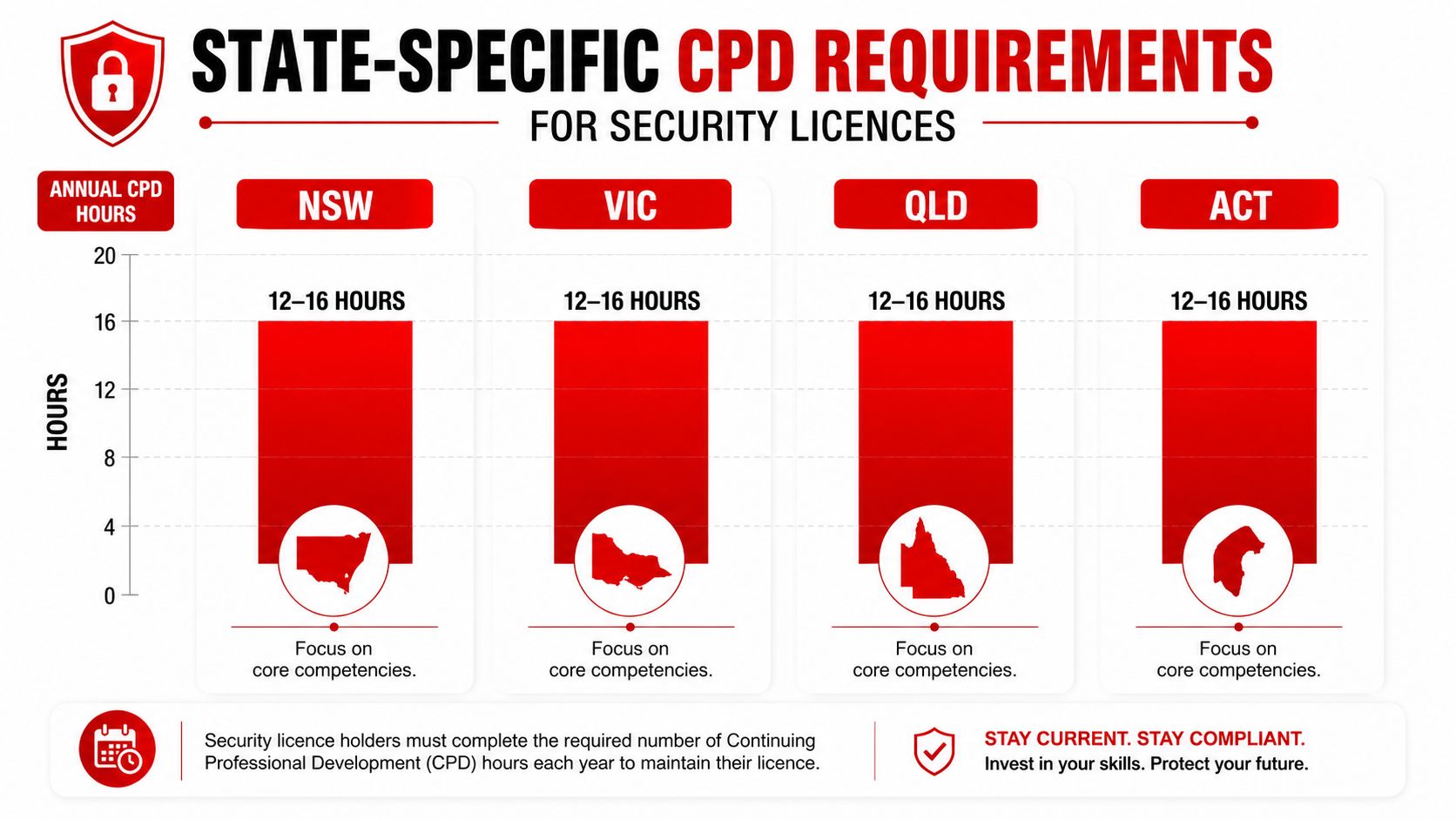
For security managers in New South Wales, Victoria, Queensland and the ACT, ongoing professional development is not just a best-practice idea. It has direct licensing consequences. In these jurisdictions, security officers must complete 12 to 16 hours of annual refresher training to maintain RSA competency, and failure to meet that requirement can lead to licence suspension, according to the Australian Security Academy refresher training information.
What the requirement means in practice
Managers sometimes hear “annual hours” and think only in terms of booking a single refresher block. That can work, but it's often the hardest operational option. A better approach is to map mandatory content across the year and connect it to actual deployment patterns.
For example:
- Before festival season focus on crowd movement, communication and conflict reduction.
- Before major hospitality periods refresh intoxication management, refusal procedures and venue interaction standards.
- Before high-profile corporate events review access control, reporting and VIP movement protocols.
This approach still supports formal compliance, but it also helps the learning land closer to real tasks.
The risk of treating compliance as paperwork
Licence suspension doesn't just affect the individual officer. It affects rostering, contract delivery and client confidence. If a guard can't legally work, the manager now has a coverage problem. If several guards lapse at once, a venue or event can lose continuity at the worst time.
Keep one rule simple. Never separate licence tracking from roster planning.
A compliance-ready manager keeps a live register of training status, upcoming expiry windows, completed refreshers and evidence records. That register should sit alongside workforce planning, not in a forgotten folder.
A simple state-ready checklist
Use this checklist when aligning training with RSA-linked obligations:
- Verify licence-linked learning windows early enough to avoid last-minute booking pressure.
- Confirm refresher content covers situational awareness, de-escalation and legal compliance relevant to the role.
- Store proof of completion in a format supervisors can access quickly during audits or client reviews.
- Brief site leaders on who is current, who is booked and who must not be deployed without updated status.
Managers who build that discipline usually avoid the compliance scramble that causes most preventable disruptions.
Implementing a Sample Professional Development Programme
A workable ongoing professional development programme starts with the roster, not the training catalogue. If you build the programme without checking peak periods, supervisor coverage and licence dates, it won't last. Start by asking a narrower question: what do officers on this site need to do well, repeatedly and under pressure?
Budget matters too. In 2023, 86% of Australian employees who undertook work-related training said their most recent session was fully employer-sponsored and conducted during paid work time, according to new insights on work-related training in Australia. For security managers, that's a practical signal. If you want consistent participation, put training into paid work structures and budget for it properly.
Build the programme in five steps
Map operational risk
List your most common pressure points. Crowd surges, intoxicated patrons, access disputes, after-hours entries, contractor movement and incident reports are common examples.Separate mandatory from developmental topics
Mandatory items cover licence, legal and policy obligations. Developmental items improve judgement, communication and site performance.Choose the learning format carefully
Not every topic needs a classroom. A legal update may suit a workshop. Queue communication may be better as a pre-shift scenario drill. Report writing may need a marked example and supervisor feedback.Assign who owns follow-through
If everyone owns it, no one owns it. Nominate a manager for scheduling, a supervisor for observation and an administrator for records.Review after live operations
Use incident reviews and supervisor notes to adjust the next month's topics.
A strong programme is rarely complicated. It's scheduled, assigned and checked.
Sample PD Programme Overview
| Training Topic | Frequency | Assessment | KPI |
|---|---|---|---|
| Legal compliance and licence refreshers | Annual cycle with scheduled checkpoints | Completion record and short knowledge check | Current training records maintained |
| De-escalation and conflict resolution | Regular scenario sessions | Supervisor observation during drills | Improved consistency in handling difficult interactions |
| Incident reporting | Periodic workshop plus real report review | Written sample and feedback | Clearer, more complete incident records |
| Situational awareness | Short shift-based refreshers | Scenario discussion | Better hazard identification by staff |
| Customer service in security settings | Integrated into team briefings | Role-play and supervisor feedback | More professional guest interactions |
| Emergency response and evacuation support | Scheduled practical drills | Participation and debrief | Faster, more coordinated team response |
Make the programme realistic
A venue team might run short pre-shift refreshers during busy trading periods and reserve longer sessions for quieter roster windows. A festival operator may cluster formal workshops in the lead-up period, then use on-site debriefs for micro-learning during the event run.
If you want a broader management perspective on planning and reinforcement, these staff development strategies are useful for connecting team capability with daily operations.
Auditing Programmes and Choosing Providers
A training programme can look solid on paper and still fail in practice. That's why ongoing professional development needs periodic audits. The audit should test whether the content is current, role-relevant and delivered by people who understand live security environments.

What to ask during an internal audit
Use practical questions, not vague impressions:
- Does the content match the site? A bar, festival gate and construction entry point need different examples and risks.
- Can supervisors see behaviour change? If not, the learning may be too generic or too disconnected from the job.
- Are records easy to retrieve? During an audit or client review, delays create doubt.
- Is refresher content current? Laws, venue rules and threat patterns change. Slides from years ago won't carry the team.
How to assess external providers
The Australian Skills Quality Authority found that inconsistent licensing requirements across jurisdictions and poor specificity in training packages contribute to weak training quality, and that some providers deliver courses too short to ensure required skills and competencies are gained, according to the ASQA strategic review of security training in Australia. That finding matters because a cheap course can create expensive operational risk later.
Ask providers for:
- Sample curricula that show how they teach de-escalation, legal compliance and reporting.
- Trainer credentials with security-specific experience, not just generic facilitation.
- Assessment examples so you can see whether learners must apply judgement or merely attend.
- Evidence processes for attendance, completion and refresher records.
If a provider can't explain how training transfers to real incidents, keep looking.
Common red flags
- Very short delivery windows for complex competencies.
- No role-specific scenarios for events, venues or site security.
- Weak assessment methods that don't test applied decision-making.
- Poor record-keeping practices that leave managers exposed during compliance checks.
A good provider should make your audit trail stronger, not heavier.
Real-World Case Examples
A festival team noticed repeated confusion at entry during peak arrival windows. Managers introduced short pre-shift refreshers on bag checks, radio calls and queue language. Supervisors then coached officers during live operations. The result was a smoother front-gate rhythm and fewer avoidable escalations.
A hospitality venue had capable guards, but guest complaints often mentioned tone rather than enforcement. The manager added role-play around refusal conversations, greeting language and positioning at the door. Over time, staff kept the same control standard while sounding calmer and more professional.
A corporate event crew struggled with report consistency after incidents. The fix wasn't another long seminar. It was a practical reporting template, sample write-ups and post-shift review from the supervisor. Within weeks, reports became easier to read, easier to verify and more useful for follow-up.
These examples aren't about dramatic transformation. They show what usually works. Small, targeted learning tied to real tasks.
Conclusion and Next Steps
Ongoing professional development protects more than compliance. It protects judgement, consistency and client trust. Managers who treat learning as part of operations usually run steadier teams.
- Secure budget and schedule learning in paid time
- Map state requirements against licence and roster dates
- Blend formal refreshers with short on-shift learning
- Audit providers before problems appear
- Review incidents and turn them into the next training topic
FAQs
What is ongoing professional development in security?
It's a structured approach to continuous learning that helps security officers maintain compliance, refresh practical skills and improve judgement on the job. It includes formal training, short refreshers, coaching and post-incident learning.
Why is ongoing professional development important for event and venue security?
Event and venue work changes quickly. Crowd behaviour, intoxication risks, access control issues and customer service demands all shift from one job to the next. Ongoing learning helps teams stay ready instead of relying on old training.
How do I fit professional development into a busy roster?
Use a blended model. Reserve formal sessions for mandatory topics, then add short pre-shift briefings, scenario drills and supervisor coaching. This reduces disruption and keeps learning close to real work.
Does micro-learning count as professional development?
Yes, if it's purposeful and documented appropriately. Short lessons on de-escalation, reporting, radio use or legal updates can support broader development when tied to role performance.
What should managers track in a professional development programme?
Track training completion, refresher due dates, supervisor observations, incident themes, assessment results and record availability. These indicators help managers see whether learning is improving practice.
How do I choose a security training provider?
Look for role-relevant content, credible trainers, proper assessment methods, clear evidence processes and practical examples linked to live operations. Avoid providers that rely on overly short delivery or generic material.
If your organisation needs a security partner that takes training, supervision and compliance seriously, GM GROUP Services supports events, venues and businesses across NSW, VIC, QLD and the ACT with licensed, fit-for-purpose security teams focused on safety, service and ongoing professional development.