



Mobile Security Patrols Brisbane are usually called after the moment a business realises its cameras aren't enough. A construction manager finds copper missing from a compound, a venue receives an alarm after closing, or a retail operator discovers a roller door left unsecured. The question isn't whether a marked vehicle looks reassuring. It's whether the patrol has a licensed officer, a defined route, a reliable reporting system, and a clear escalation plan behind it.
I've deployed patrols around Brisbane retail sites, construction compounds, industrial yards and venues for more than a decade. My view is straightforward. Mobile patrols work when the risk is intermittent, the site is spread out, and the buyer needs physical checks with evidence. They fall over when the buyer expects a passing vehicle to replace continuous observation.

What Mobile Security Patrols in Brisbane Actually Do
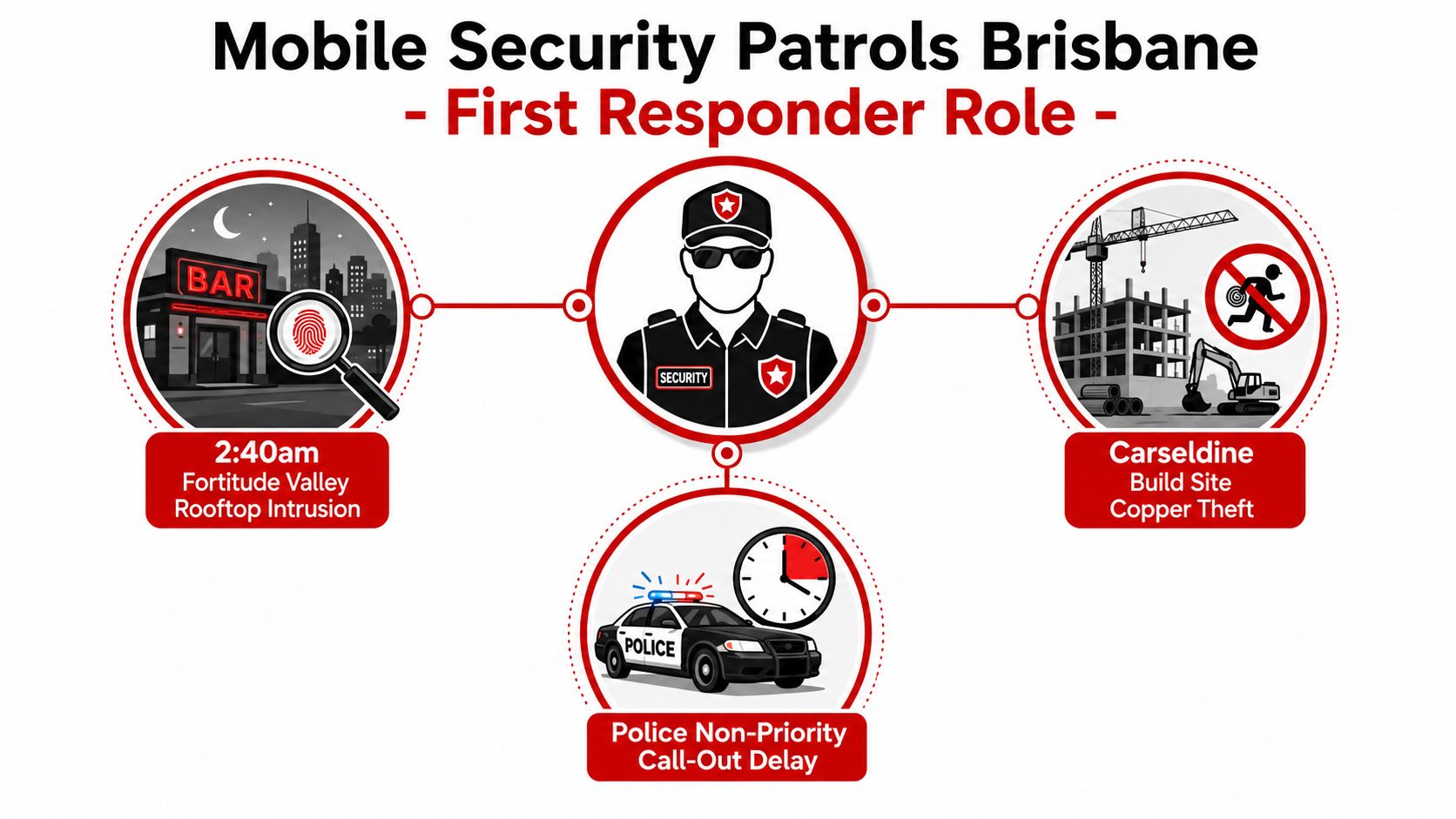
At 2:40am, a patrol officer arriving at a Fortitude Valley rooftop venue may be the first person physically checking the property after an alarm. The officer isn't there to conduct a cinematic chase. The job is to approach safely, inspect access points, identify signs of forced entry, preserve information for police, and follow the client's escalation procedure.
That same principle applies at a Carseldine construction site. A marked vehicle moves through the compound, checks gates, fencing, plant storage and site buildings, then records what was inspected. If something has changed since the last visit, the report needs to show what changed, where it was found and who was notified.
The patrol function in plain terms
Mobile security patrols are licensed security officers travelling between multiple client sites in branded vehicles on rotating schedules. Depending on the contract, an officer may perform external perimeter checks, internal walk-throughs, alarm verification, lock-and-key services, lighting checks, gate checks and incident attendance.
That differs from a static guard, who remains at one post for a defined shift. It also differs from a remote CCTV operator, who can watch feeds and assess alerts from a control room but can't physically inspect a damaged fence or secure an open door.
Brisbane makes this model useful because businesses are spread across residential suburbs, commercial centres and industrial belts around places such as Lytton and Wacol. A site may need a real physical presence overnight without needing someone stationed there continuously. A venue, warehouse or construction compound can share the cost of patrol coverage across a route, provided the route and attendance standard are properly designed.
What patrols can and can't prove
Visible vehicles can make opportunistic offenders reconsider an easy target. Queensland Police's Brisbane North Mobile Police Beat trial targeted micro crime hot spots from Brisbane City and Fortitude Valley through to Indooroopilly and Brighton and Sandgate, showing the value of concentrated, visible presence in specific areas rather than vague claims about blanket coverage. Queensland Police's account of the Brisbane North Mobile Police Beat trial is useful context, but a commercial patrol isn't a police beat and shouldn't be sold as one.
A patrol provides presence, inspection and documentation. It doesn't guarantee that an incident won't occur between visits. For businesses that need a permanent customer-facing presence, access control or continuous observation, static guarding or monitored CCTV may be the better fit.
For specialist property needs, businesses may also need a separate resource, such as memorial and industrial engraving when durable identification or site-specific marking is part of an asset-protection plan. That isn't a substitute for patrols, but clear asset identification can support investigation and recovery work.
Real Benefits and Honest Limitations to Expect
The strongest case for mobile patrols is practical, not dramatic. A marked vehicle checks the property, an officer touches the physical risk points, and the client receives a record showing what happened. That combination helps a business manage overnight exposure without paying for a guard to occupy a post that doesn't require constant attendance.
Benefits that hold up
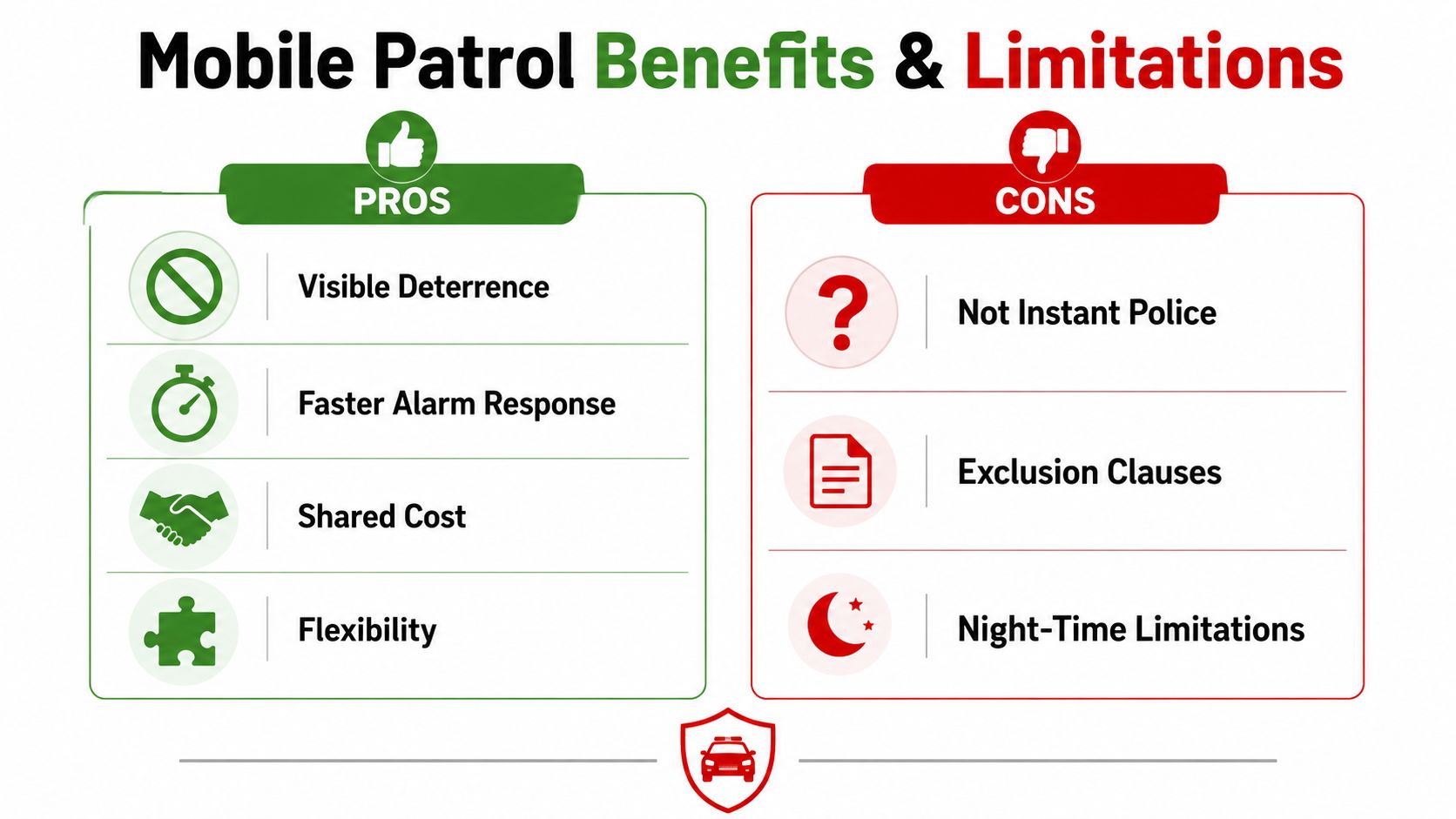
Visible deterrence: A marked patrol vehicle arriving at a site creates uncertainty for someone testing a gate, fence or vehicle compound. That matters most at isolated premises and during shutdowns.
Physical alarm response: A patrol can verify an activation, inspect the premises and escalate according to instructions. It won't replace police, particularly where an offence is in progress or people are at risk, but it can provide a physical assessment for non-priority activations.
Shared coverage: One patrol unit can service multiple nearby properties. The buyer gets physical attendance without maintaining a dedicated post at every location.
Operational flexibility: Patrol frequency can be adjusted for a construction shutdown, a venue event, a holiday closure or a period of increased concern. That flexibility is one reason patrols suit changing site conditions.
Evidence: A well-written incident report includes times, locations, observations, photographs where appropriate, actions taken and notifications made. That record can support internal investigations, insurer discussions and police handover.
Queensland's published crime reporting gives operators a better starting point than anecdote. The 2023–24 Queensland crime report includes fine geographic breakdowns such as Brisbane East, where a recorded figure is 49 incidents at a rate of 21.5, and the 2024–25 report continues annual reporting across Brisbane-relevant statistical areas. The Queensland crime report for 2024–25 supports using local patterns when deciding where checks should concentrate.
Where patrols fall over
Random sweeps still leave periods with no officer on site. A patrol unit can also be held at one property during a prolonged incident, leaving other locations waiting. That's why a contract that promises frequent-sounding service but spreads two visits across twelve sites is a poor control, not a bargain.
Patrols are strongest against external perimeter issues, after-hours trespass, plant and vehicle exposure, fuel concerns and signs of forced entry. They aren't a substitute for a concierge-grade guard at a busy retail centre, an access-control officer at a sensitive facility or a continuous presence in aged care.
Operational rule: Never use patrols to compensate for broken fencing, failed lighting or an alarm system nobody maintains. Fix the physical weakness first, then use patrols to test and reinforce the controls.
How Patrols Are Scheduled and Reported on Site
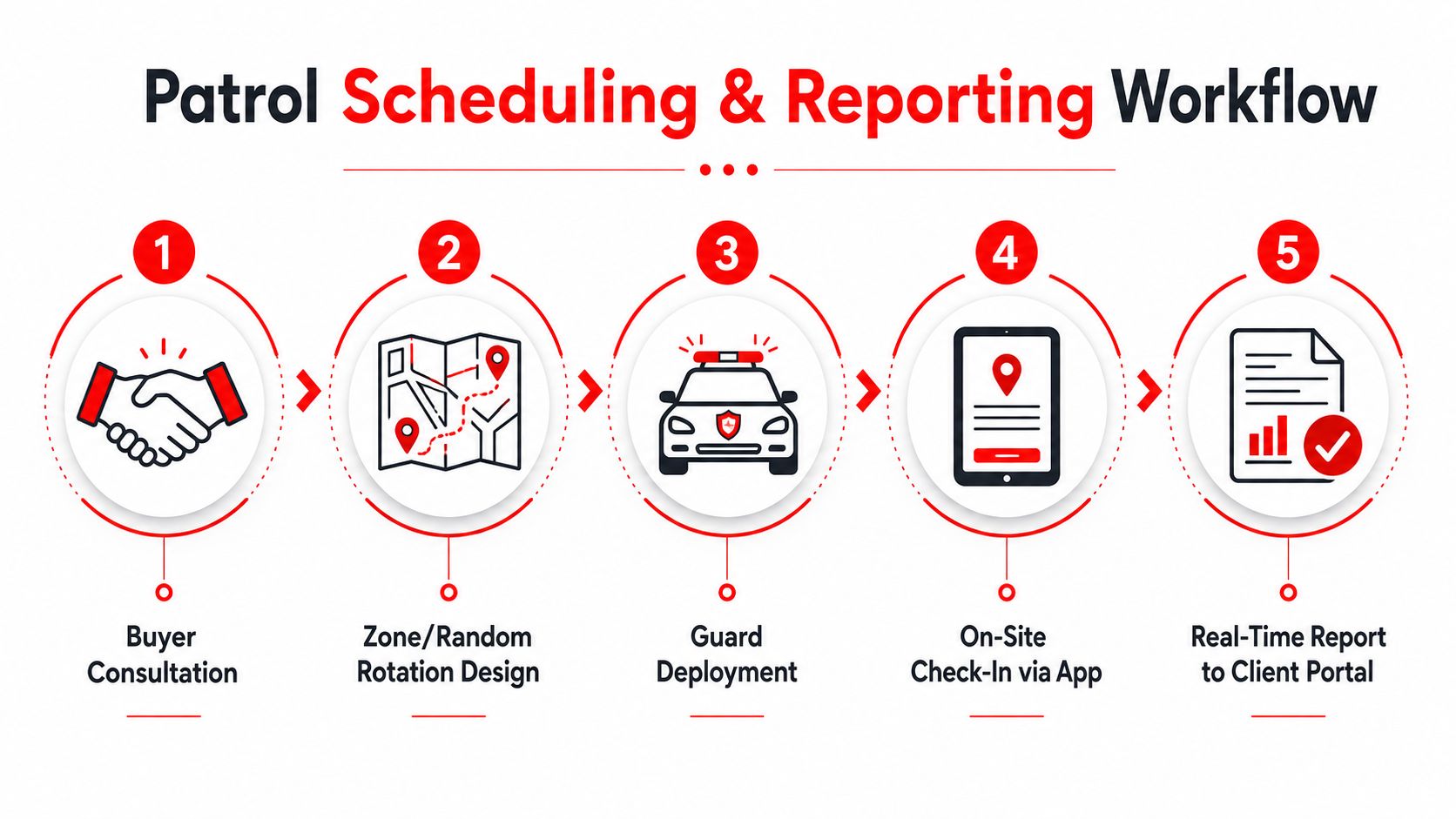
A good patrol schedule is designed around what an offender must learn in order to exploit the site. If every visit happens at the same time, the patrol becomes a predictable appointment. Randomised rotations, zone-based routing and varied arrival patterns make the attendance harder to anticipate while keeping the service manageable for the operator.
Before signing, ask how the company proves attendance. That proof may come from QR scans, NFC tags or GPS-pinged guard tour devices. The method matters less than whether the system records the actual location, time and officer attached to the visit.
What happens during a normal visit
The officer should work from a site-specific checklist, not memory. Typical checks include:
- Perimeter access: Gates, boundary fencing, pedestrian doors and vehicle entrances.
- Building security: Roller doors, windows, emergency exits and signs of forced entry.
- Asset areas: Plant, vehicles, fuel points, storage compounds and high-value materials.
- Environmental risks: Lighting failures, water leaks, unsafe obstructions or exposed equipment.
- Client hotspots: Locations identified during the risk assessment, such as a rear laneway or isolated loading area.
At a Fortitude Valley venue, the critical task may be lock-up verification and a check of service doors after the last staff member leaves. At a construction site, it may be the integrity of temporary fencing and the condition of the plant compound after a weekend closure.
Alarm attendance and reporting quality
When an alarm triggers, the officer receives the dispatch and attends within the contracted response arrangement. Avoid treating a response window as a guaranteed arrival time in every traffic condition. Brisbane congestion, road closures, simultaneous call-outs and the location of the patrol unit all affect attendance.
The final report should contain timestamps, checkpoint evidence, photographs where safe and permitted, clear observations, actions taken and the name or role of anyone contacted. “Site checked, all secure” is a weak entry if the client can't tell which doors were inspected or whether the officer found a recurring problem.
A repeatedly propped-open fire door is a good test. A rubber-stamp report logs the door and leaves. A useful service records the pattern, notifies the site supervisor and recommends corrective action. The report should help the manager prevent the next incident, not merely prove that a vehicle visited.
Brisbane and Queensland Licensing Rules Buyers Must Check
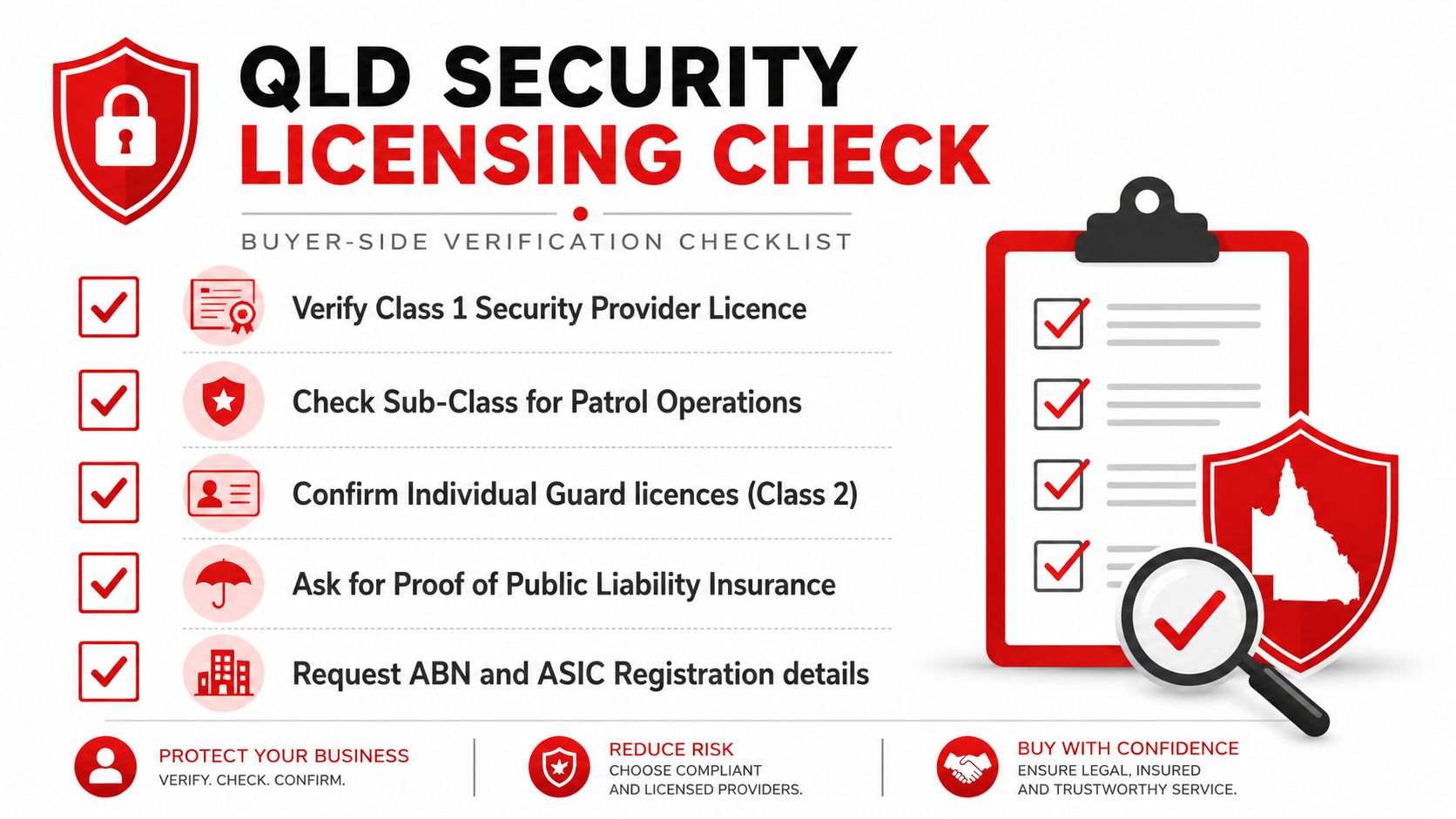
Licensing is the first buyer check, not a footnote at the end of a quote. Queensland treats security work as a regulated activity, and the state provides separate licensing pathways for unarmed, monitoring and dog patrol security officers within the class 1 security provider structure. Queensland's security manpower licence information sets out the formal framework.
For dog patrol work in Queensland, the officer must hold a Queensland security provider class 1 licence, be at least 18, provide fingerprints through police, pass a criminal history check and complete the required training. Mobile patrols aren't informal rounds by a driver with a torch. They're part of a licensed security industry.
Verify the provider and the officer
For unarmed patrol work, Queensland states that the officer must hold a current unarmed security officer licence, complete the required CPP20218 Certificate II training through a registered training organisation and undergo police fingerprinting. Queensland also describes unarmed security officers as people who patrol or watch over property without a guard dog or weapon. The Queensland Government's unarmed security officer licence requirements is the right place to check the baseline.
Before signing, request:
- The provider licence details: Confirm the provider's licence class and the activities it covers.
- Individual licence confirmation: Ask how the company checks each officer's current status.
- Insurance evidence: Request a current public liability certificate and confirm that the policy matches the work being contracted.
- Training records: Check that personnel hold the training relevant to their assigned duties.
- Written escalation procedures: Make sure the contract explains alarm attendance, police notification, client notification and evidence handling.
Queensland's application pathway requires fingerprints, a criminal history check and the required training before applying for an unarmed security officer licence. The Queensland application guidance also reinforces that security officers and other security roles must be licensed.
Don't ignore continuing capability
Training isn't only an entry hurdle. Queensland's training authority lists competencies covering conflict management through negotiation, controlling people using empty-hand techniques and applying first aid. It also identifies ongoing refresher training for bodyguard and crowd-controller licence holders. The Queensland competency information is a useful reminder to ask how a provider maintains capability after recruitment.
Check licence status through the Queensland Government's public register where available, and treat unlicensed subcontractors, expired permissions and vague monitoring arrangements as stop signs. If a quote doesn't clearly identify who is licensed to do the physical patrol work, don't sign it.
What Drives the Cost of Mobile Security Patrols in Brisbane
Comparing patrol quotes by the monthly total is how buyers end up comparing different services as if they're identical. They aren't. A quote reflects the number and type of visits, travel between sites, the complexity of access, alarm handling, escalation requirements and the quality of the evidence delivered afterwards.
The main pricing drivers
Frequency and timing change the workload. Random patrols require route planning, while fixed visits may be simpler but easier to anticipate. Alarm-response attendance has a different operational cost from a planned lock-up check.
Site complexity matters more than the suburb name. A compact commercial building with controlled access is easier to inspect than a large construction compound with multiple gates, temporary fencing and scattered plant.
Travel and grouping affect route efficiency. A provider can generally build a more workable route when several client sites sit within a practical zone. A distant site or difficult access arrangement increases unproductive travel.
Reporting requirements also add work. A basic attendance record isn't the same as a portal report with checkpoint evidence, photographs, incident narratives and management review.
The comparison below shows how the same menu can produce different quotes. It deliberately avoids invented dollar figures. A reputable provider should price each scenario after inspecting the property and defining the service standard.
Brisbane Mobile Patrol Pricing Three Scenarios Compared
| Pricing Factor | Fortitude Valley Retail | Springfield Construction Site | Brisbane CBD Tower |
|---|---|---|---|
| Patrol purpose | Lock-up, external doors, rear access and trading-area checks | Perimeter, plant, materials, gates and temporary fencing | Building perimeter, loading access and after-hours entry points |
| Access complexity | Multiple doors and possible late venue activity | Broad compound with changing site conditions | Controlled building access and shared facilities |
| Travel profile | Dense inner-city route, parking and loading constraints | Suburban route with larger site footprint | CBD congestion and restricted stopping areas |
| Alarm integration | Verification of venue and rear-door activations | Compound, plant or gate alarms | Building and loading-area alarms |
| Reporting expectation | Lock-up confirmation and photos of defects | Detailed asset and perimeter notes | Timestamped building checks and access anomalies |
| Main cost pressure | Late-night access and venue activity | Inspection time and site size | Access logistics and reporting detail |
Negotiation should focus on the service design, not just the rate. Bundling nearby sites can improve route efficiency. A 12-month term may support more stable planning, while a buyer can ask whether after-hours surcharges can be waived during quieter periods. Put every assumption in writing, especially visit frequency, response conditions, exclusions and report delivery.
Choosing Mobile Patrols, Static Guards, or Remote Monitoring
No security manager should choose mobile patrols by default. The correct question is what must happen between one incident and the next. If the answer is “someone must be physically present all the time”, a patrol is the wrong tool. If the answer is “someone must inspect the site, respond to an alert and create a defensible record”, mobile coverage may fit.
The three models side by side
| Requirement | Mobile patrols | Static guards | Remote monitoring |
|---|---|---|---|
| Coverage consistency | Intermittent physical checks | Continuous presence during the shift | Continuous camera or alarm observation where systems operate |
| Deterrence visibility | Strong when vehicles and officers are visible | Strong at the post and entry point | Limited physical visibility |
| Physical intervention | Officer can attend and secure or escalate | Officer is already on site | Operators can't physically intervene |
| Customer-facing presence | Limited | Strong | None |
| Documentation | Patrol logs, photographs and incident reports | Shift reports and access records | Alerts, video clips and operator notes |
| Best operational use | Spread-out sites and overnight checks | Access control, hospitality and customer environments | Camera-backed detection and verification |
Static guards cost more per hour because the client is purchasing continuous human presence. They win at retail entrances, busy venues, gatehouses and environments where staff or customers need an officer immediately.
Remote monitoring can be efficient where cameras cover the right areas and the escalation process is tested. It can identify movement, review footage and notify the response team, but it doesn't inspect a blind corner, close a gate or physically confront an intruder. Businesses comparing camera options may find a practical overview of Premier Broadband business security useful when assessing the technology layer.
Use this decision test
Choose mobile patrols when the site is spread out, the risk rises after hours, and the buyer values physical inspection across multiple properties. Choose static guarding when people, access control or customer interaction sit at the centre of the risk. Choose remote monitoring when the site has reliable camera coverage, a staffed response process and a strong need for continuous visual awareness.
For a Yatala industrial yard, patrols may be the practical baseline with cameras covering gates. For a busy Fortitude Valley venue, a static guard during trading and lock-up patrol afterwards is more credible. For a Brisbane office with good camera coverage and controlled access, remote monitoring combined with physical response may be sufficient.
Assess the site risk profile, traffic pattern, asset value, blind spots and required evidence before choosing. Don't buy a vehicle visit when you need a person at the door.
How GM GROUP Services Patrols Brisbane Sites and FAQs
A workable deployment starts before the first patrol. GM GROUP Services can assess the site, identify access points and hotspots, define the after-hours escalation tree, and establish the reporting standard. At a Yatala industrial yard, that may mean mapping vehicle gates, fuel areas, storage compounds and isolated fence lines. At a Fortitude Valley venue, it may mean documenting the lock-up sequence, rear laneways, service doors and alarm contacts.
Vehicle check-in points and QR-tagged checkpoints give supervisors evidence that the officer reached the required locations. The officer records the condition found, not just the fact that a vehicle arrived. An end-of-shift summary gives the client immediate visibility, while a monthly trend review can identify recurring defects such as poor lighting, open gates or repeated alarm activations.
The model works best when patrols are part of a wider plan. Businesses that need to compare providers should assess licence evidence, report examples, response procedures and exclusions. A structured resource on how to compare security companies Cardiff can also prompt useful questions about service scope and provider verification, even though the local licensing checks must follow Queensland requirements.
Manager's view: Mobile patrols outperform static guards when the risk is distributed and intermittent. Static guards win when continuous presence controls the risk. Remote monitoring adds value when cameras cover the site and someone can respond physically.
Frequently asked questions
How quickly will a patrol arrive in Brisbane traffic?
The contract should state the response arrangement and the conditions that affect attendance. Traffic, road closures, the patrol unit's location and simultaneous incidents can change arrival time, so don't accept an unexplained promise of instant attendance.
What evidence can be handed to police?
A patrol can preserve observations, photographs where appropriate, timestamps, access information and incident notes. The provider should explain how evidence is stored, who receives it and how officers avoid disturbing a scene.
What insurance documents should a buyer request?
Ask for a current public liability certificate and confirm that the policy corresponds with the contracted patrol, alarm-response and site activities. Keep the document with the contract file and request an updated certificate when it expires.
How long should the contract run?
The right term depends on the site and the provider's mobilisation work. Shorter arrangements can help during a temporary construction phase or event period, while a longer term may support stable routing and review. Make termination rights and service changes explicit.
Can patrols integrate with an existing alarm?
They can when the alarm provider, patrol company and client agree on dispatch authority, access instructions, verification steps and escalation contacts. Test the process before relying on it during a real activation.
What happens if an officer finds an intruder?
The officer should follow the risk-based escalation procedure, prioritising personal safety, contacting police where appropriate, notifying the nominated client contact and preserving information. The exact response must be defined in the site instructions, not improvised at 2am.
GM GROUP Services provides licensed vehicle patrols, alarm response, risk assessments and reporting for Brisbane businesses, venues, construction sites and industrial properties. If you need a patrol plan built around your actual gates, hotspots and escalation requirements, visit GM GROUP Services and request a site-specific assessment rather than a generic drive-by quote.