


Loss prevention policies and procedures deserve board-level attention because Australian retailers lose an estimated AUD 5–7 billion annually to shrinkage, with external and internal theft making up roughly 60–70% of that total, and many mid-sized chains seeing shrinkage around 1.2–1.5% of net sales according to Garda's overview of loss prevention strategies.
Most businesses still treat loss prevention as a guard at the door, a few cameras, and a policy folder nobody reads. That approach fails in retail, falls apart in busy venues, and leaves construction sites exposed at shift change, delivery time, and after hours.
Good loss prevention work is more disciplined than that. It joins site risk, privacy compliance, staff behaviour, reporting workflows, access control, and practical supervision. In Australia, especially across events, hospitality, retail, and construction, the strongest programs are the ones that reduce loss without creating legal exposure or turning the customer experience hostile.
SEO title: Fix 7 Flaws in Your Loss Prevention Policies and Procedures
SEO meta description: Loss prevention policies and procedures for Australian retail, events, hospitality and construction. Learn practical steps for compliance, training and shrink reduction.
Suggested URL: /loss-prevention-policies-and-procedures
The True Cost of Ineffective Loss Prevention
The cost of weak loss prevention rarely shows up in one dramatic incident. It appears in missing stock, unexplained voids, unchallenged access, poor handovers, refund abuse, damaged reputation, and staff who aren't sure what to do when something feels off.

Loss prevention is broader than theft
Too many operators define loss prevention as “stopping shoplifters”. That's far too narrow. Effective loss prevention policies and procedures cover:
- Physical assets: stock, tools, equipment, cash, keys, passes
- People: staff safety, contractor conduct, customer interactions
- Information: customer records, rosters, POS access, incident data
- Process integrity: receiving, returns, refunds, cash-ups, stock movements
- Brand protection: how staff intervene, report, and de-escalate
A venue can lose money without a single item being stolen. A comped drink without approval, a side door left unsecured, an unrecorded stock transfer, or a badly handled confrontation can all become loss events.
Practical rule: If a task involves stock, cash, credentials, customer data, or restricted space, it needs a clear procedure.
What weak procedures look like on site
In practice, poor systems have a familiar pattern:
| Weak practice | What usually happens |
|---|---|
| Shared logins at POS | No reliable accountability |
| Informal cash handling | Voids, shortages, disputes |
| Open staff-only corridors | Easy movement of goods and unauthorised persons |
| CCTV with no review workflow | Footage exists, but nobody acts on it |
| Incident reporting by memory | Details are missed and patterns stay hidden |
The mistake isn't only operational. It's financial. A business that tolerates vague procedures is effectively absorbing preventable loss as a cost of doing business.
Why this matters in Australian settings
Australian operations face a specific mix of pressure points: organised retail offending, liquor-licensed environments, temporary event workforces, subcontractor-heavy construction projects, and tighter expectations around safety and privacy.
That means your procedures can't be generic. They need to fit the actual environment. A festival gate, a retail stockroom, and a live construction site each require different controls, reporting lines, and intervention thresholds.
Building Your Foundation on Risk and Compliance
Before writing policy, map the actual risk. Businesses often start with a template, then force the site to fit it. That's backwards. Start with the site, the workflows, the pinch points, and the legal boundaries.
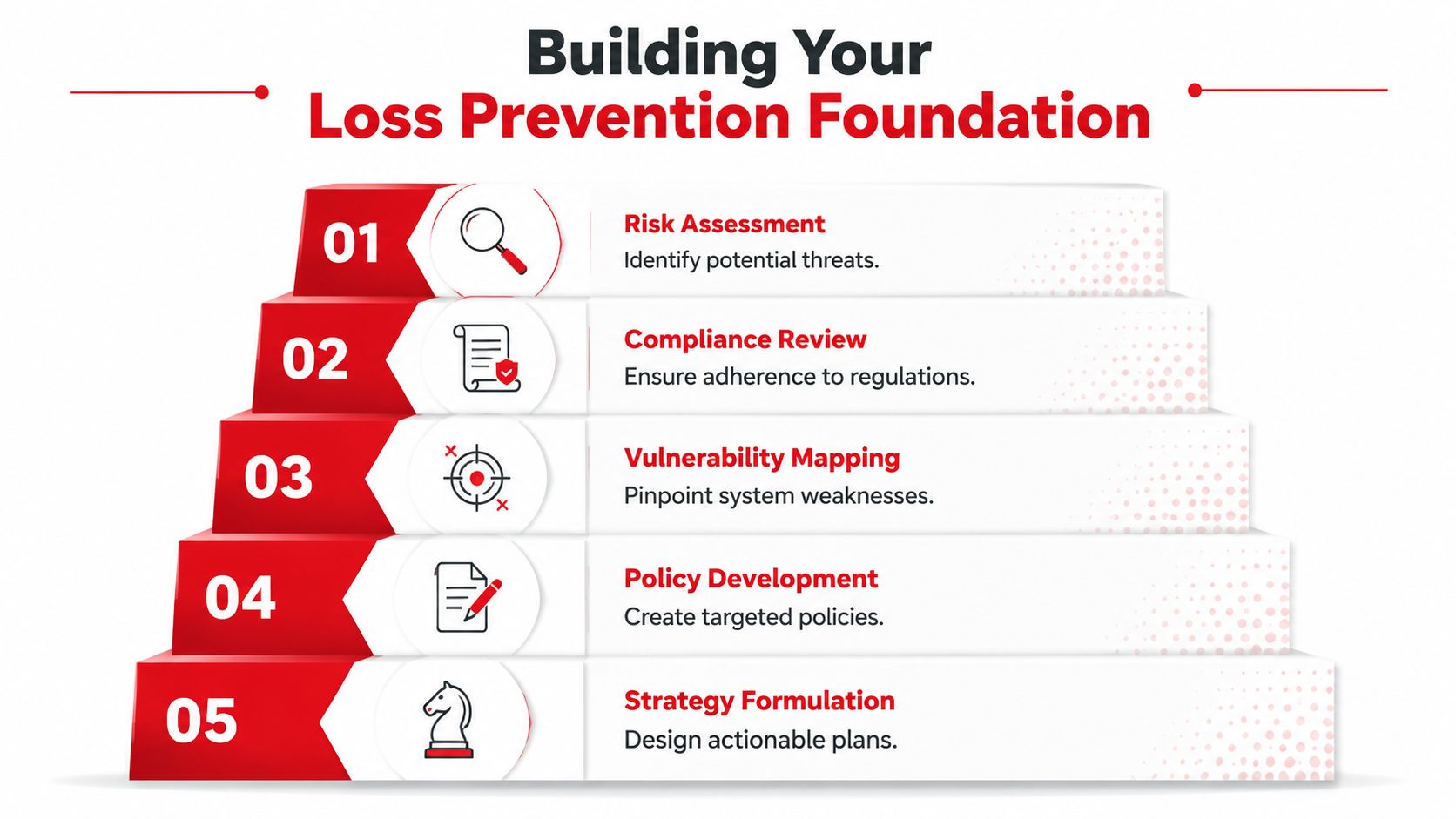
Assess the site before the document
A useful risk assessment asks plain questions:
Where can value leave the site?
Through loading docks, waste exits, staff entrances, bar service points, storerooms, plant yards, contractor gates, or digital exports.Who can move it?
Staff, contractors, patrons, cleaners, vendors, couriers, or anyone with borrowed credentials.When is control weakest?
Shift changes, bump-in and bump-out, delivery windows, close of trade, emergency response, or overnight periods.What evidence exists when something goes wrong?
Access logs, CCTV, POS records, stock movement records, sign-in sheets, radio logs, or nothing useful at all.
For events, include temporary fencing lines, credential checkpoints, artist access, alcohol service points, and cash float transfers. For retail, test refund authority, stockroom control, receiving procedures, and blind spots near exits. For construction, check tool compounds, fuel storage, gatehouse records, after-hours access, and subcontractor sign-on practices.
Compliance isn't separate from operations
Recent Australian regulatory shifts, including the 2023–2024 Privacy Act review and increased OAIC scrutiny of video surveillance, mean organisations must assess the necessity and proportionality of their security measures. If your procedures ignore those compliance needs, you create legal and reputational risk, as outlined in Pelco's discussion of loss prevention and surveillance obligations.
That matters because many operators overreach. They install surveillance or consider facial recognition or covert monitoring without asking whether the measure is justified, documented, and proportionate to the risk.
Covert observation and aggressive surveillance settings can create more problems than they solve if the business can't justify them properly.
A lawful, defensible program usually includes:
- Clear purpose statements: why each control exists
- Restricted access to footage and logs: not everyone needs visibility
- Defined retention and review practices: footage without governance is a liability
- Visible notice where required: especially in public-facing environments
- Escalation thresholds: who reviews suspicious behaviour and when
Turn site findings into policy objectives
Once the risks are mapped, write objectives that staff can effectively follow. “Reduce loss” is too vague. Better objectives are tied to tasks and locations.
Examples:
- Tighten back-of-house access at bars and clubs
- Improve delivery verification on construction sites
- Standardise incident reporting across venue supervisors
- Limit export of sensitive customer records from ticketing systems
- Require approval pathways for refunds, comps, and stock write-offs
If you want a broader planning lens, these strategies for business protection are a useful companion to site-level risk work because they force you to think beyond theft and look at operational exposure as a whole.
A simple foundation checklist
- Map assets: physical, financial, informational
- Review workflows: receiving, serving, storing, closing, reporting
- Check legal fit: privacy, surveillance, workplace procedures
- Identify weak touchpoints: docks, waste doors, storerooms, admin access
- Set practical controls: sign-off rules, access levels, audit points
A strong foundation saves time later. It also stops the common mistake of building a policy that looks impressive on paper and fails on the floor.
Crafting Your Core Loss Prevention Policies and Procedures
A policy should tell people exactly what to do, who approves what, and what happens when something goes wrong. If it reads like a generic compliance file, staff won't use it. If it only threatens punishment, they'll work around it.
Australian research on loss prevention consistently points to a neglected truth: staff perception of safety and ethical behaviour, combined with clear communication, correlates more strongly with reduced shrink than surveillance alone. That's why behavioural design and de-escalation belong inside your operating procedures, not in a separate training folder, as noted in SafetyCulture's loss prevention guidance.
The core modules every policy set should include
Most organisations need five base modules.
Access control and restricted areas
Define who can enter, when, and under what authority. This should cover keys, swipe cards, temporary passes, alarm codes, and escorted access.
Include specifics such as:
- Staff-only zones: storerooms, cash office, server room, liquor cage, tool compound
- Visitor rules: sign-in, escort requirements, pass return
- Credential misuse: no sharing cards, codes, or logins
- End-of-shift checks: locked doors, alarm status, missing keys
If you don't define these clearly, staff invent their own shortcuts.
Cash handling and transaction integrity
Cash procedures must be step-based, not implied. Spell out float issue, till assignment, void approval, refunds, comp authority, reconciliation, and banking handover.
Use a simple structure:
| Task | Minimum control |
|---|---|
| Float issue | Signed handover |
| Refunds | Manager approval threshold |
| Voids | Reason code plus review |
| Cash-up | Dual check where risk is high |
| Safe access | Limited authorised staff |
In hospitality, add rules for comped items, open tabs, and till sharing. In events, define how temporary bars receive and return floats. In retail, make return and exchange handling explicit.
Stock and asset movement
Inventory and equipment don't disappear by magic. They move through weak procedure.
Write down:
- Receiving checks: quantity, condition, delivery match
- Transfers: who records stock leaving one area for another
- Damage and write-off rules: evidence required before adjustment
- Waste handling: supervision for high-risk goods
- Tool issue and return: especially on construction sites
For internal theft risks, Paradigm International on preventing employee theft is a useful reference because it reinforces the value of clear authority lines and documented accountability rather than vague suspicion.
Incident reporting and evidence handling
Many businesses lose the investigation in the first ten minutes. Staff don't know what to note, supervisors delay reporting, and footage isn't preserved.
Your procedure should define:
- what triggers a report
- who gets notified
- how evidence is preserved
- when management, police, or external advisers are contacted
- how follow-up actions are recorded
Field advice: A short, accurate incident report completed promptly is worth more than a detailed report written from memory the next day.
Staff conduct and de-escalation
Many policies improve immediately at this point.
Good conduct rules don't just say “be professional”. They define how staff approach suspicious behaviour, when they observe instead of confront, how they request support, and how they disengage if safety is at risk.
Include language around:
- Respectful communication: no accusatory language without basis
- De-escalation first: calm tone, clear instructions, witness support
- Safety thresholds: when staff step back and call security or police
- Cultural awareness: avoid assumptions based on appearance, age, accent, or dress
- Consistency: same standards for staff, patrons, contractors, and suppliers
That protects people and makes the policy more likely to be followed.
Driving Adoption Through Effective Implementation and Training
A policy doesn't fail because the wording is weak. It fails because nobody translated it into behaviour on the floor.
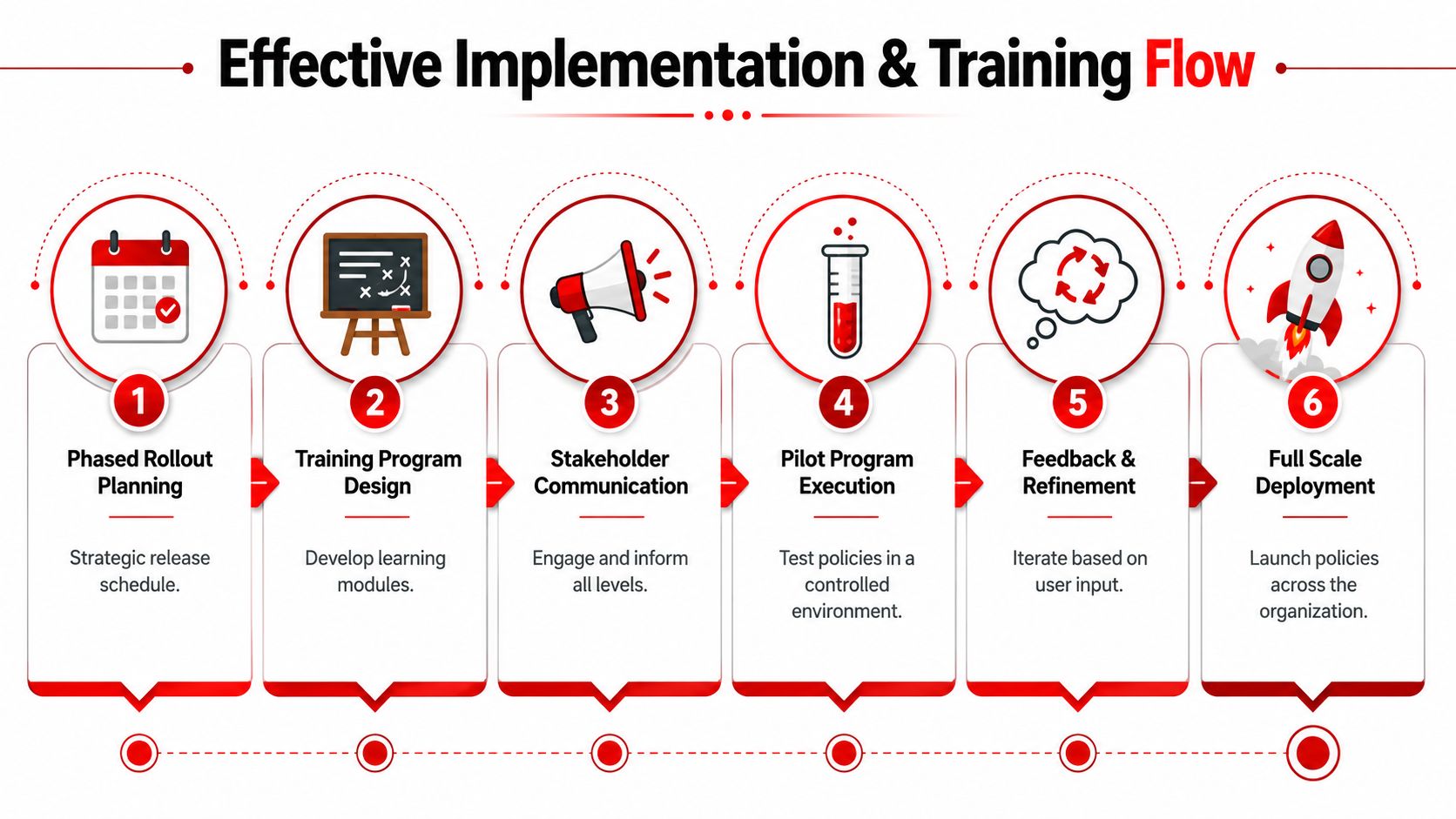
Surveys of Australian security managers show 55–65% of policy violations stem from genuine employee confusion rather than malicious intent, which is exactly why role-based training and clear incident workflows matter, according to Fortra's DLP policy implementation guide.
Emailing a PDF isn't implementation
Businesses often launch new loss prevention policies and procedures by sending a document and asking supervisors to “run through it with the team”. That creates surface compliance and operational inconsistency.
Frontline staff need to know three things:
- What applies to their role
- What changed from the previous process
- What to do under pressure
A bartender doesn't need the same briefing as a stock controller. A gate supervisor doesn't need the same examples as an accounts administrator. Training has to match the task.
Build training around scenarios, not just rules
Use realistic scenarios from your environment.
For example:
- A patron argues over a refused refund at a festival merchandise tent
- A retail worker notices repeated no-sale transactions at one terminal
- A subcontractor exits a construction site with equipment not listed on the docket
- A venue supervisor finds a propped-open fire or service door during trade
Run each scenario through the same sequence:
- what the worker notices
- what action they take immediately
- who they notify
- what they record
- what they must not do
That method builds confidence. It also reduces improvisation.
Use short tools that staff can actually remember
Long manuals belong in the background. The floor needs simpler aids.
Helpful rollout tools include:
- One-page role guides: cashier, duty manager, gate staff, site supervisor
- Visual checklists: opening, closing, cash-up, delivery receipt, tool return
- Escalation cards: who to call for theft, violence, missing stock, data exposure
- Supervisor prompts: what to verify at handover and during patrol
Staff usually don't ignore procedure because they disagree with it. They ignore it because the procedure is buried, unclear, or impractical at the point of use.
Pilot before full deployment
Rolling out everything at once creates avoidable resistance. Test the revised procedure in one store, one bar, one gate, or one work zone first.
Watch for practical friction:
| Implementation issue | What it usually means |
|---|---|
| Staff skip forms | The form is too long or badly timed |
| Supervisors override controls | Approval paths are unrealistic |
| Reports are incomplete | Training didn't include examples |
| Shift teams vary widely | Handover and supervision are weak |
A short pilot lets you refine the language, tighten the workflow, and identify where managers are likely to drift back to old habits.
Management behaviour decides whether policies stick
If managers bypass dual sign-off, share access codes, or fail to complete reports, the rest of the team sees the policy as optional.
That's why adoption depends on visible management discipline:
- Leaders use the same forms
- Breaches are addressed consistently
- Training is refreshed, not one-off
- Feedback from staff leads to adjustment where sensible
Policies become real when supervisors enforce them calmly, consistently, and without theatrics.
Adapting Policies for Retail, Hospitality and Construction
Generic procedure is one of the fastest ways to waste money. Different sites lose assets in different ways, and the controls need to reflect that.
Retail example with high-risk stock and weak back doors
A suburban retailer carries small high-value items near the front and keeps overflow stock in a rear room. Deliveries arrive through a side entrance that's also used by staff and rubbish contractors. On paper, the store has CCTV and a stocktake routine. In practice, cartons sit unattended, waste leaves without checking, and refund exceptions depend on who's managing the shift.
The fix isn't “more security”. It's tighter process.
A better retail procedure might require:
- Delivery verification at receipt: count, damage check, and booking against paperwork
- Segregated waste runs: staff don't remove high-risk packaging without supervisor sign-off
- Refund authority rules: exceptions are documented and reviewed
- Rear-door control: no propped-open access during trade unless actively supervised
That kind of discipline matters because weak touchpoints, especially around delivery and staff-only circulation, are where organised and opportunistic loss often finds space.
Hospitality and event example with speed, cash, and crowd pressure
A licensed venue or festival bar operates under pressure. Staff are serving quickly, handling intoxicated patrons, balancing customer service with control, and often working with casual teams who haven't worked together before. If your loss prevention policy is written like a warehouse manual, it won't survive the first busy hour.
Use procedures that match live service conditions:
- One till, one operator where possible
- Manager approval for comps and unusual voids
- Back-of-house access limits during peak service
- Defined response for disputed transactions
- De-escalation scripts for aggressive or intoxicated patrons
The behavioural side matters here more than most sectors. Staff need to know how to intervene without provoking confrontation. Calm language, witness support, radio escalation, and a clear boundary for when service staff stop and security steps in are all essential.
In hospitality, the best loss prevention response is often the one that lowers tension while preserving evidence and control.
Event gates need similar tailoring. Ticketing disputes, wristband swapping, unauthorised entry, and crowd surges all create loss risks tied to access, not inventory. Gate teams need a simple decision tree, not a thick manual.
Construction example with tools, materials, and subcontractors
Construction sites lose value through routine movement. Tools are borrowed and not logged. Materials arrive but aren't reconciled. Contractors come and go through multiple access points. The issue is rarely one dramatic theft. It's weak chain-of-custody.
A stronger procedure usually includes:
- Gatehouse or digital sign-in rules for staff, subcontractors, and deliveries
- Tool issue registers tied to person, crew, or vehicle
- Delivery reconciliation before materials are accepted into site stock
- Zone-based access controls for high-value plant, fuel, copper, and specialist gear
- End-of-day supervisor checks for compounds, containers, and perimeter breaches
Construction also needs practical escalation rules. If staff discover missing plant or suspicious vehicle movement, they need immediate reporting steps, not vague instructions to “inform management”.
One principle across all three sectors
Procedures work when they match the task tempo of the environment. Retail needs transaction discipline. Hospitality needs de-escalation and shift control. Construction needs asset accountability and access certainty.
If the policy ignores those differences, staff will replace it with habit.
Measuring Performance and Maintaining Vigilance
Most businesses review loss prevention only after a bad incident. That's too late. Performance has to be monitored routinely, and the data has to feed back into the procedure.
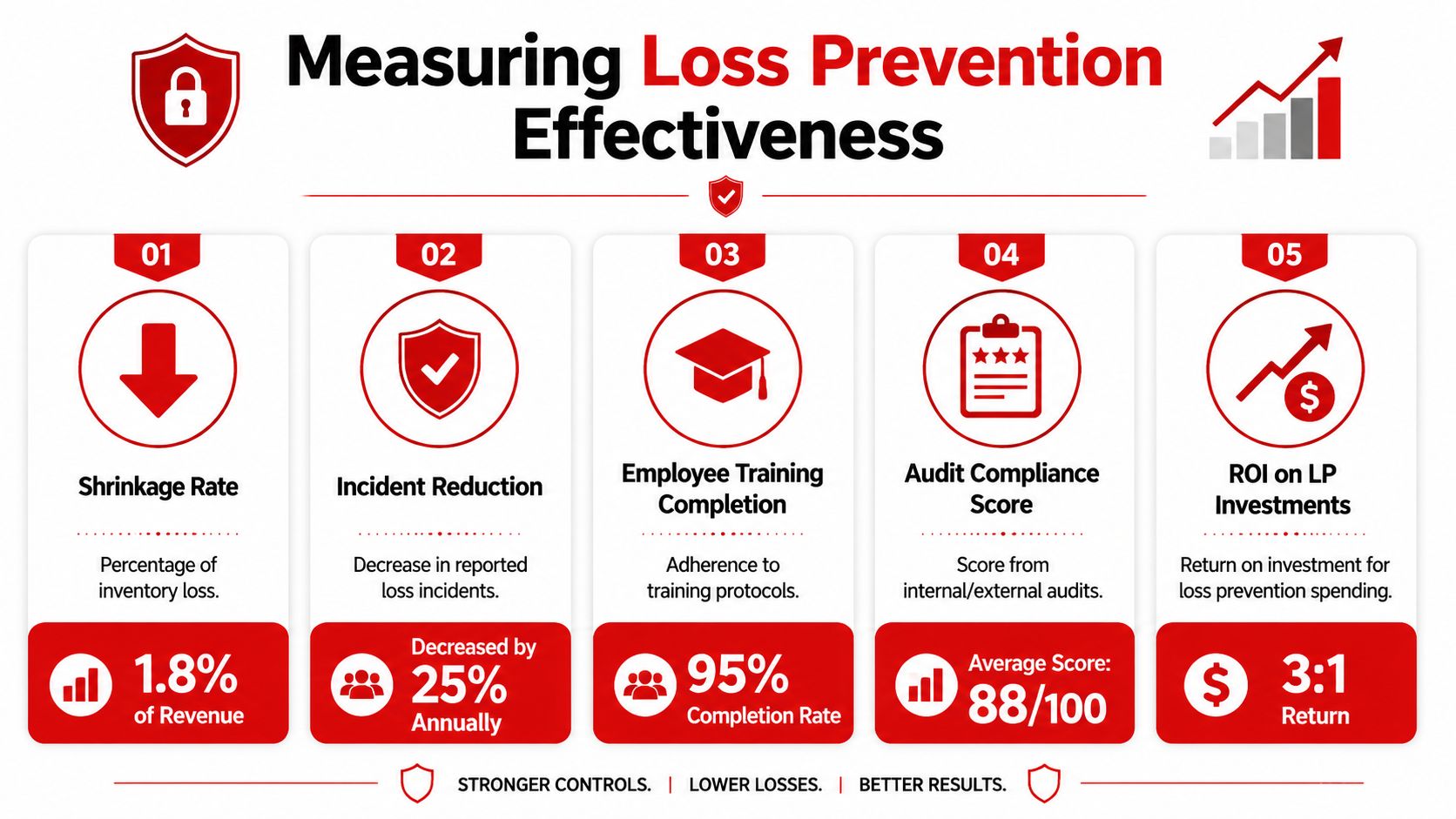
Leading Australian retailers track shrink as a percentage of sales and have seen a 20–30 percentage-point improvement in shrink-to-sales ratios when they combine analytics with targeted procedural controls. In bars and venues, real-time video analytics tied to point-of-sale events can reduce misappropriation-related shrink by up to 35%, according to IntelliShop's analysis of loss prevention controls.
Measure the controls, not just the losses
Shrink is an outcome metric. You also need process metrics that show whether your controls are being followed.
Track items such as:
- Incident reporting quality: are reports prompt, complete, and consistent
- Audit findings: are doors, keys, tills, and stock areas managed properly
- Training completion: have role-specific refreshers been done
- Exception patterns: voids, refunds, write-offs, access overrides
- Supervisor compliance: are handovers and checks being completed
A low incident count isn't always good news. It can also mean under-reporting.
Turn incidents into procedure improvements
Every incident should answer two questions:
- What happened?
- What control failed, or was missing?
That shifts the response away from blame and towards system improvement.
For example:
| Incident type | Procedure review question |
|---|---|
| Missing stock after delivery | Was receipt verification done properly? |
| Repeated till shortages | Are till assignments and approvals clear? |
| Unauthorised site entry | Did access control fail or was it bypassed? |
| Data exported improperly | Were permissions too broad or labels unclear? |
Keep the review cycle active
Good policy maintenance is scheduled, not reactive.
A practical review rhythm includes:
- Routine supervisor checks: daily or per shift where risk is high
- Operational audits: periodic review of records, footage handling, and access logs
- Post-incident updates: revise the procedure when a control proves unrealistic
- Role refreshers: update training when workflows, venue layouts, or systems change
Key takeaway: The best loss prevention programs don't stay static. They learn from real incidents, near misses, and daily friction.
FAQs on loss prevention policies and procedures
What are loss prevention policies and procedures
They're the written rules and daily workflows a business uses to reduce avoidable loss. That includes theft, fraud, stock discrepancies, cash mishandling, unauthorised access, and poor incident response.
What should a loss prevention policy include
At minimum, include access control, cash handling, inventory or asset movement, incident reporting, staff conduct, escalation pathways, and privacy-aware use of surveillance and records.
Why do many loss prevention procedures fail
They fail because they're too generic, too punitive, or too hard to use during real operations. They also fail when managers don't model the rules or when staff receive only one-off training.
How often should policies be reviewed
Review them whenever site conditions, staffing models, systems, or risk patterns change. They should also be checked after meaningful incidents and during routine audit cycles.
Do events and hospitality venues need different procedures from retail
Yes. The principles overlap, but the controls differ. Hospitality and events need stronger de-escalation, crowd-aware access control, and tighter management of comps, tabs, and temporary staff. Retail usually needs stronger transaction review, stock movement control, and receiving discipline.
How do privacy rules affect loss prevention
They affect surveillance, footage access, staff monitoring, customer data handling, and any use of sensitive monitoring tools. Businesses need measures that are necessary, proportionate, and properly governed.
If you need help turning policy into workable site practice, GM GROUP Services supports Australian businesses, venues, events, and construction sites with risk assessments, licensed security personnel, reporting discipline, and fit-for-purpose loss prevention deployment across NSW, VIC, QLD and the ACT.