


Loss prevention audit checklist work starts with the risk, not the form. A manager notices recurring discrepancies, but the cause remains unclear. Is stock leaving through an uncontrolled dock, are staff bypassing procedures, does a camera miss the critical area, or are incidents happening without complete reports? A completed form won't answer those questions unless it records conditions, evidence, exposure and ownership.
A practical loss prevention audit checklist creates a repeatable method. It helps managers, supervisors and security teams inspect the site, test controls, document what they find, score the risk and assign corrective action. The same method can support a retailer, a shopping centre, a hotel, a nightlife venue, a temporary event or a changing construction project, but the checks must reflect how each environment operates.
Australian retail losses make that discipline difficult to ignore. The 2024 ANZ Retail Crime Study reported crime-related loss of about AUD 7.79 billion in the 2023–24 financial year, almost 2% of turnover, with an average external theft incident involving 2 to 5 items worth about AUD 415. Griffith University's summary of the study shows why managers need to examine more than stock counts. The eight resources below apply one audit logic across retail, hospitality, multi-site operations, construction, accommodation, events, nightlife and shopping centres.
1. 8 Essential Loss Prevention Audit Checklist Components for Retail Security
Retail audits fail when they treat every aisle as equal. A strong loss prevention audit checklist ranks exposure first, then tests the controls around merchandise, receiving, cash, staff access, customer movement and incident handling. The Australian Institute of Criminology guidance on retail theft controls recommends examining the full chain, including merchandise, shipping, shoplifting, receiving, employee theft, storage, movement and accounting.
Start at the point where stock enters the business. Check delivery seals, receiving records, dock access, discrepancies between purchase orders and physical quantities, and the separation of receiving duties from stock approval. On the shop floor, inspect high-risk categories, concealment points, fitting-room procedures, sightlines and repeat-loss locations. The NSW Bureau of Crime Statistics and Research recorded 29,552 retail theft incidents in 2024–25. Liquor appeared in 40% of cases, clothing and footwear in 24%, and food in 14%, so category controls should shape the audit rather than sit beneath a generic security heading. BOCSAR's retail theft update provides the basis for that prioritisation.
Retail checks that produce useful evidence
Use a mix of observation, records and controlled tests:
- Inventory integrity: Compare cycle counts with sales, transfers, write-offs and damaged-stock records.
- Access control: Review keys, swipe cards, alarm codes, stockroom permissions and leaver access.
- People procedures: Confirm induction, incident escalation, till accountability and supervisor sign-off.
- Monitoring coverage: Test camera views, recording quality, lighting and alarm response. An independent Australian retail security audit specifically asks whether CCTV covers internal and external areas and whether lighting is sufficient across the premises. The retail security audit PDF offers a practical model.
- Reporting quality: Match incident reports against CCTV, refunds, voids, stock adjustments and security notes.
Practical rule: A checklist answer without evidence is an opinion. Record the location, time, observer, supporting image or report, and the person responsible for correction.
For Australian operators, the financial logic matters. Historical AIC material reported that losing 2% to 3% of sales to shoplifting could consume about 25% of profit. The Australian Institute of Criminology summary explains why a seemingly modest shrinkage issue deserves management attention.


2. 9 Critical Loss Prevention Template for Hospitality Venues and Event Spaces
A hospitality audit follows the money and the product. Bars, clubs, hotels, restaurants and event spaces move cash, alcohol, stock and people through several hands during a shift. The manager needs to know not only what is missing, but when the control failed and whether the record supports a fair investigation.
Build the template around the shift cycle. Before opening, confirm till floats, restricted areas, delivery quantities, cellar or store access, camera status and staff assignments. During service, observe till use, complimentary drinks, voids, refunds, wastage, staff drinks, bottle storage and movement through VIP or backstage areas. At close, require reconciliation, sign-off, secure cash transfer and a review of incidents against CCTV.
The template should separate observations from conclusions. “Bottle count does not match the stock sheet” is evidence. “Bartender theft” is an allegation that requires investigation. That distinction protects staff from premature accusations while preserving the integrity of the audit.
Make the shift record operational
A useful hospitality record gives supervisors prompts they can act on:
- Till control: Identify who opened each till, who accessed it during service and who completed reconciliation.
- Alcohol control: Record deliveries, transfers, wastage, breakage, complimentary service and closing counts.
- Restricted areas: Check VIP rooms, kitchens, stores, cash offices, loading areas and staff entrances.
- Incident matching: Cross-reference reports with CCTV timestamps, point-of-sale activity and witness accounts.
- Briefing discipline: Carry unresolved issues from one shift briefing into the next, with an owner and due date.
A venue manager might find repeated stock variances only on late shifts. Rather than placing more guards everywhere, compare staffing, access, camera coverage, till permissions and closing routines during that period. The trade-off is clear. Broad surveillance costs resources and can frustrate staff, while targeted observation around the failure point produces better evidence and a more proportionate response.
The AIC retail loss prevention guidance supports the same end-to-end principle in a different operating environment. Hospitality teams can apply it to cash handling, receiving, storage, movement and accounting without copying retail procedures word for word.
3. 10 Advanced Loss Prevention Audit Tool Platform for Multi-Site Operations
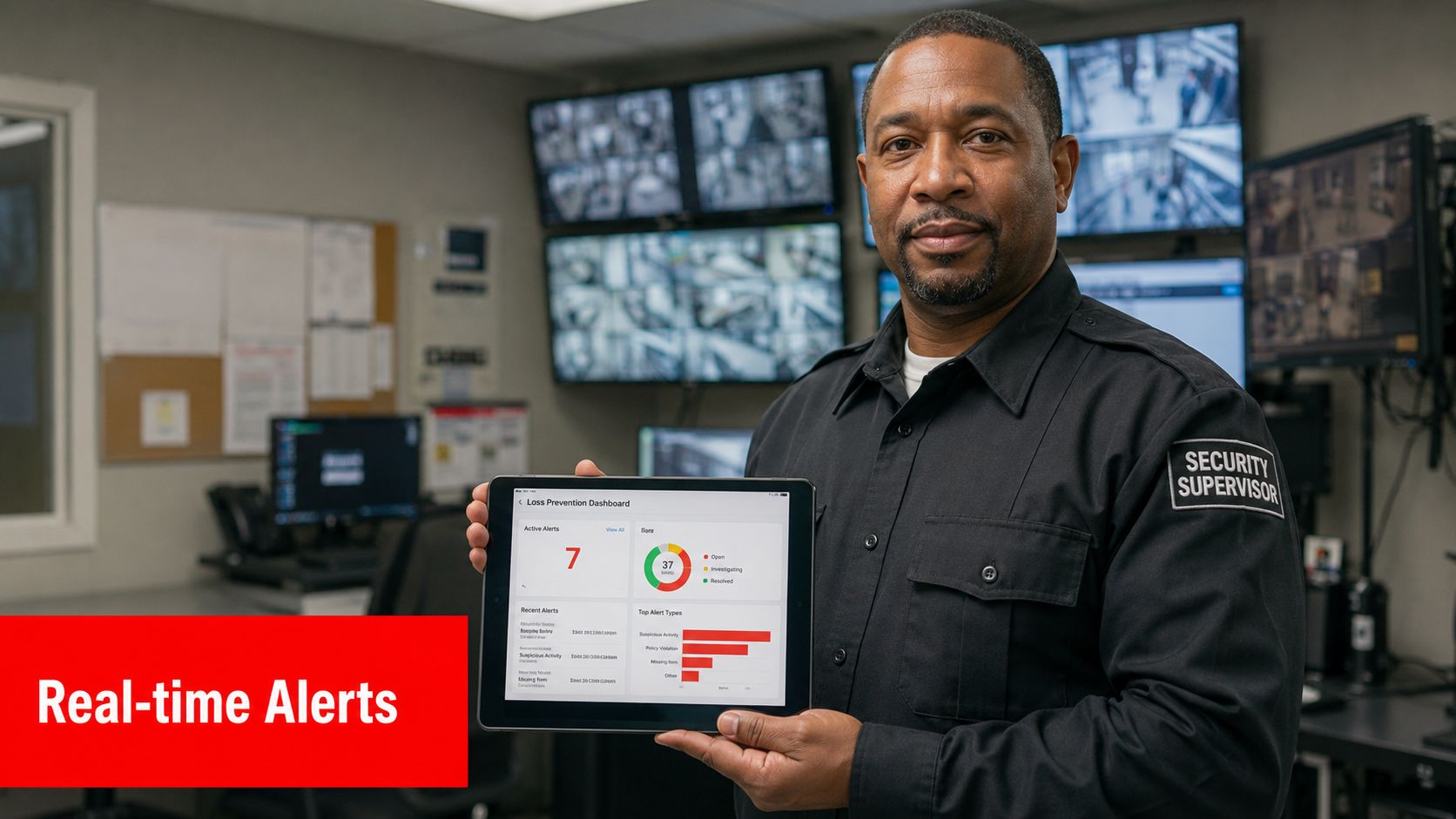
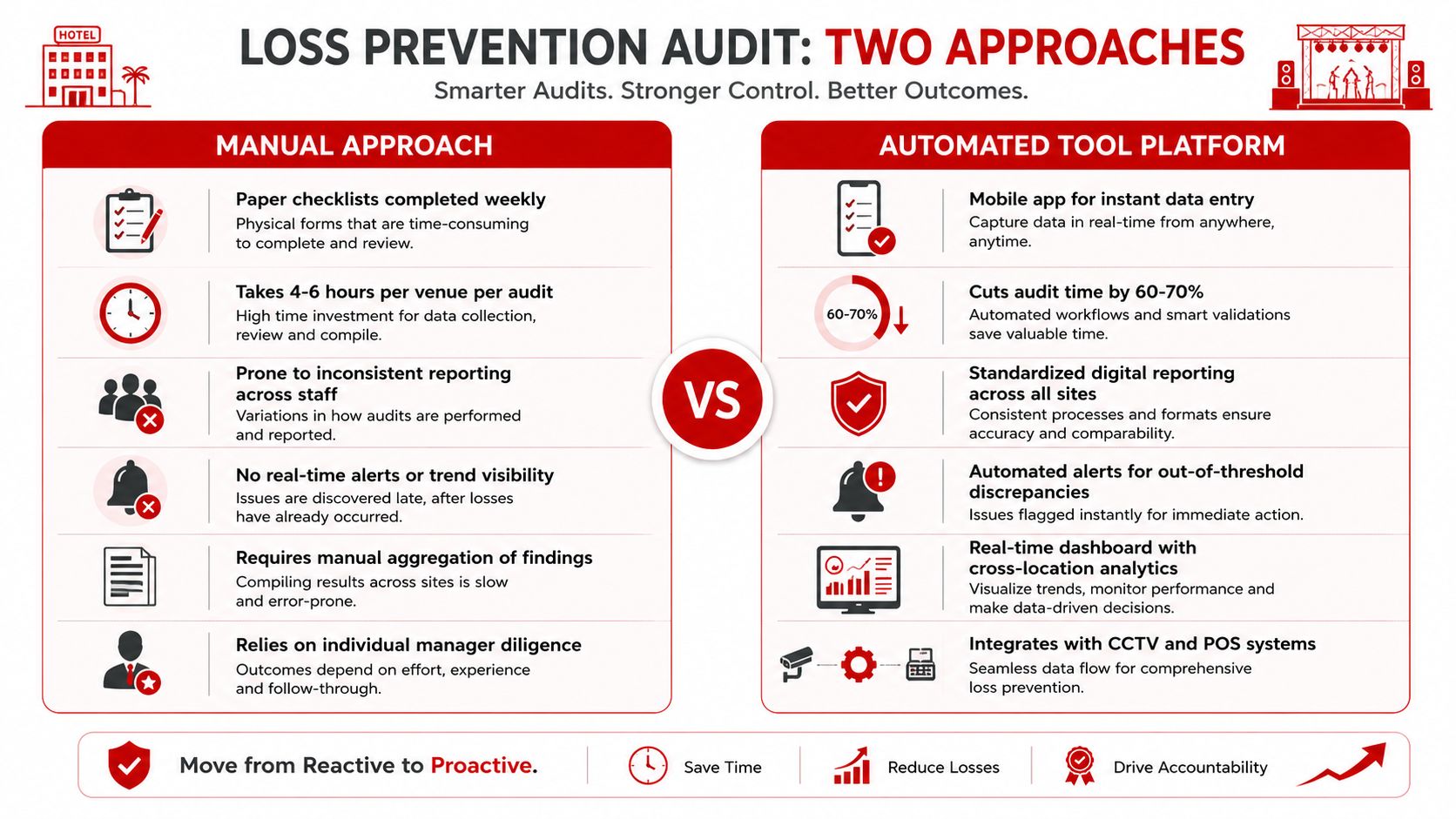
Multi-site operators need consistency without pretending every site has the same risk. A shopping centre, hotel group, construction project and festival portfolio may use the same audit fields, but their thresholds, evidence and escalation paths will differ. A digital platform is useful when it standardises the method while retaining site-specific controls.
The core record should capture the location, control tested, evidence, risk rating, action owner, due date and verification result. Use required fields for high-risk failures so a guard or supervisor can't submit a vague “not applicable” response without an explanation. Store photographs, incident references and follow-up notes with the audit rather than scattering them across email and spreadsheets.
Compare sites by control, not by raw incident count
A site with more incidents isn't automatically the least controlled. It may have better reporting. Compare like with like:
- Physical controls: CCTV, EAS or alarms, lighting, gates, locks and stockroom access.
- Operational controls: Receiving, cycle counts, till procedures, contractor induction and supervisor checks.
- People controls: Training completion, role permissions, handovers and incident escalation.
- Outcome measures: Open actions, repeat findings, unresolved incidents and movement against the relevant shrinkage baseline.
ECR Australasia estimated supermarket stock loss at A$823 million per year, equal to 1.52% of retail turnover, and broader supply chain and store network loss at A$942 million, equal to 1.73% of turnover. The ECR Australasia loss prevention guide shows why a platform should connect checklist results to shrinkage KPIs rather than merely count completed audits.
Automation has a cost. It requires training, device access, data governance and a clear owner for alerts. A paper form may be faster for a small site, particularly when connectivity is unreliable. For a portfolio, however, a shared system makes recurring weaknesses visible and supports monthly security reviews, quarterly trend analysis and targeted deployment of guards, patrols or K9 teams.
4. 7 Proven Loss Prevention Audit Guide for Construction and Industrial Sites
Construction and industrial audits begin outside the building. A missing tool or diverted material may be discovered only after the project team has lost time, so the audit must test perimeter integrity, vehicle movement, staging areas, plant controls and worker credentials before reviewing internal paperwork.
Walk the boundary at different operating stages, not only during a quiet daytime inspection. Check gates, fencing, lighting, access logs, visitor controls, delivery routes, equipment immobilisation and the visibility of storage areas. Photograph defects with location references. Confirm that subcontractor agreements explain who may access materials, where equipment is staged and how incidents are reported.
Adapt the checklist as the site changes
A construction site isn't static. New subcontractors arrive, temporary fencing moves, buildings become enclosed and valuable equipment changes location. The audit should therefore include a change trigger, such as a major handover, shutdown, new work zone or change in access arrangements.
Use these checks to keep the guide practical:
- Perimeter assurance: Confirm patrol routes, gatehouse records, lighting and fence condition.
- Asset accountability: Record serial numbers, custody, storage location, fuel access and movement approvals.
- Credential verification: Match worker and contractor access to current project permissions.
- High-risk periods: Review weekends, shutdowns, deliveries and shift changes for supervision gaps.
- Incident evidence: Require photographs, witness details, time, location and preserved footage.
An hourly perimeter check might help on one project but create false confidence on another. Patrol frequency should follow site layout, lighting, asset exposure and recent findings. A static guard can control a gatehouse effectively, while a vehicle patrol or K9 unit may provide better coverage across a spread-out site. The audit should explain that decision rather than prescribe the same deployment everywhere.
Project managers should review open actions with security supervisors and subcontractors. If a gate remains unsecured, the corrective action isn't “remind staff”. It may require a physical repair, a revised access process, a named supervisor and a verification walk.
5. 6 Comprehensive Loss Prevention Audit Checklist for Hotels and Accommodation
Hotels need a guest-centred audit. A control that protects amenities but makes guests feel watched can damage service quality, while a relaxed process can leave housekeeping, front desk and back-of-house areas exposed. The checklist should test security and hospitality together.
Start with room access, master keys, electronic locks, housekeeping carts, linen stores, minibar processes, lost property and maintenance access. Review whether staff can enter rooms only for legitimate reasons and whether the system records access appropriately. At the front desk, check payment handling, identity verification, key replacement, parcel acceptance, visitor management and incident escalation.
The audit should distinguish between guest property, hotel property and staff property. A minibar discrepancy might result from an unrecorded refill, a billing error, a guest dispute or theft. Each possibility requires different evidence, so managers shouldn't treat every variance as misconduct.
Protect trust while improving accountability
Use plain language in staff briefings. Explain that controls protect employees from inaccurate accusations as well as protecting the property. Train housekeeping teams with visual prompts, clear room-status procedures and an easy route for reporting suspicious conditions or damaged items.
A hotel manager can test the process by tracing one room from checkout to cleaning, minibar review, maintenance access and final status change. Repeat the exercise across guest floors, service lifts and storage areas. Look for shared keys, propped doors, unlogged access, unsecured linen and inconsistent handovers.
The Australian Institute of Criminology's retail theft material describes how relatively small loss can affect profit disproportionately. Hotel managers can apply that reasoning without importing retail terminology, especially when repeated amenity or minibar discrepancies appear harmless individually but remain unresolved across a property.
For VIP or corporate groups, add arrival routes, service-area access, room allocation confidentiality, vehicle movements and emergency communication. Don't automatically add visible guards to every guest area. Depending on the risk, controlled access, discreet monitoring, trained staff and a clear response plan may protect the guest experience more effectively.
6. 8 Critical Loss Prevention Audit Template for Event Security and Festival Management
Temporary events require a compressed audit cycle. The site changes quickly, many workers may be unfamiliar with the venue, and cash, alcohol, merchandise and credentials move through temporary structures. The organiser needs a pre-event control map, live checks and a post-event reconciliation that preserves evidence while memories are fresh.
Before gates open, walk every point of sale, bar, storage area, VIP entrance, backstage route, merchandise location, lost-property point and cash collection path. Confirm who controls each area, who can authorise access, how incidents reach the control room and how staff identify themselves. Include temporary fencing, lighting, radio coverage, emergency exits and contractor handovers.
During the event, supervisors should record exceptions rather than wait for a final report. A blocked camera view, unattended cash bag, unsealed stock cage or unauthorised pass is a live control failure. Correct it immediately, then record who acted and whether the issue recurred.
Give temporary teams simple decision points
A useful event template asks:
- Before opening: Are credentials issued, briefings completed, cameras recording and restricted areas staffed?
- During operations: Are till transfers, alcohol movements, stock counts, lost property and incidents logged?
- At handover: Does the incoming supervisor receive unresolved risks, missing equipment and active incidents?
- After closing: Are cash, alcohol, merchandise, keys, passes and incident records reconciled?
A festival may need visible guards at public access points, covert operations around suspected internal collusion, or K9 deployment during opening and closing. Those choices should follow the pre-event risk assessment, not habit. More visible security can deter opportunistic behaviour, but excessive deployment can create congestion and reduce the welcoming atmosphere.
Schedule a post-event meeting while staff can still identify locations, times and people involved. Preserve CCTV references and written accounts before temporary systems are dismantled. If the same promoter runs recurring events, carry unresolved findings into the next event plan instead of starting with a blank form.
7. 9 Essential Loss Prevention Audit Guide for Bars, Clubs, and Nightlife Venues
Nightlife audits must work at service speed. A club may have several bars, a crowded dance floor, cashless or cash transactions, staff movement, intoxicated patrons and a late closing period. A checklist that assumes a quiet retail environment will miss the moments when accountability is hardest.
Test till permissions, bartender handovers, voids, refunds, complimentary drinks, bottle storage, wastage, breakage and staff consumption. Match stock movement to point-of-sale records where the systems allow it. Check camera views over tills, cellar doors, corridors, loading points and high-risk storage, but also assess whether crowd density, lighting or staff positioning creates practical blind spots.
Make reconciliation fair and immediate
Hourly reconciliation may suit a high-volume venue during peak service, but the trigger should be defined in advance. A variance that requires investigation should generate a documented review of the till operator, transaction history, CCTV, stock movement and supervisor observations. Don't confront an employee with an accusation based on a single unexplained figure.
Use short briefings at opening, during shift change and after close. Cover new incidents, restricted areas, known vulnerabilities, staff welfare concerns and the evidence required for reports. Security staff should understand that observation and documentation are core responsibilities, not secondary tasks after crowd control.
Good nightlife auditing protects the employee who follows the process as much as it protects the venue's stock and cash.
A venue manager may choose static guards near tills, a roaming supervisor across bars, vehicle patrols outside or covert observation in a specific area. Each option has a trade-off. A guard at one till improves visibility there but may leave another bar exposed. A roaming role covers more ground but may record less detail. The checklist should connect deployment to the control failure and require a later review.
For CCTV improvements, map every incident location against camera coverage, lighting, retention and operator response. If a blind spot cannot be removed immediately, add a temporary control such as repositioned stock, restricted access, supervisor checks or visible patrols.
8. 7 Strategic Loss Prevention Audit Checklist for Shopping Centres and Retail Parks
Shopping centres manage a network, not a single shop. Centre management controls common areas, parking, loading zones, communications and emergency response, while tenants control much of their own stock and staff practice. The audit must define shared responsibilities so an incident doesn't disappear between tenancy boundaries.
Begin with the centre map. Mark entrances, exits, service corridors, loading docks, car parks, public transport connections, waste areas, high-risk tenant categories and camera coverage. Review how tenant managers report incidents, how centre security shares alerts, who preserves video, and when police or emergency services are contacted. The ABS report on theft reaching a 21-year high reported that retail locations accounted for 45% of all thefts in 2024, reinforcing the need to examine location patterns and escalation triggers rather than relying only on periodic shop-floor checks.
Victoria recorded 99,114 retail crime offences in the year to June 2025, with total retail crime up 20% year on year and thefts from stores up 26%, according to the Victorian retail crime figures reported by the ABS. Centre managers should use current incident patterns to adjust audit frequency, patrol routes and tenant briefings. That doesn't mean treating every tenant or shopper as a risk. It means directing attention where evidence shows exposure.
Build a cooperative tenant process
Give tenants a concise reporting standard:
- Incident detail: Record time, location, items, behaviour, direction of travel and immediate action.
- Evidence preservation: Note camera numbers, footage times, witnesses and relevant transaction records.
- Communication: Share verified information through an agreed channel, avoiding speculation or unsafe confrontation.
- Follow-up: Assign centre or tenant ownership for each action and confirm completion.
Parking and perimeter controls often need different treatment from internal retail security. Vehicle patrols can improve coverage across large areas, while fixed posts may be better at loading docks or controlled entrances. K9 deployment may be appropriate for targeted risks, not as a blanket response across common areas.
The centre should review anonymised trends with tenant managers and explain what changes are being made. That builds participation without exposing personal information unnecessarily. A checklist becomes strategically useful when it turns scattered tenant observations into a coordinated risk picture, with clear limits on who acts, what evidence is retained and when the issue is escalated.
Loss Prevention Audit Checklist, 8-Resource Comparison
| Resource | Core focus | 👥 Target audience | ★ Quality / Effectiveness | ✨ Unique selling points / 🏆 Highlights | 💰 Implementation & cost |
|---|---|---|---|---|---|
| 8 Essential Loss Prevention Audit Checklist for Retail Security | POS, inventory, CCTV, employee access | 👥 Retail managers, shopping centres | ★★★★ (up to -30% shrink) | ✨ Customisable checklist; 🏆 compliance-ready | 💰 Low–Med; time‑intensive rollout |
| 9 Critical Loss Prevention Template for Hospitality Venues & Event Spaces | Cash reconciliation, alcohol tracking, VIP areas | 👥 Bars, clubs, hotels, event venues | ★★★★ (20–35% alcohol shrink ↓) | ✨ POS integration & incident logs; 🏆 hospitality‑specific | 💰 Low–Med; needs consistent supervision |
| 10 Advanced Loss Prevention Audit Tool Platform for Multi‑Site Ops | Real‑time audits, analytics, integrations | 👥 Multi‑site operators, chains, centres | ★★★★★ (60–70% less manual work) | ✨ API/CCTV/POS integration; 🏆 cross‑site trend analysis | 💰 High upfront; SaaS + training |
| 7 Proven Loss Prevention Audit Guide for Construction & Industrial Sites | Perimeter, equipment tracking, vehicle logs | 👥 Construction managers, site security | ★★★★ (prevents high‑value theft) | ✨ K9 & patrol integration; 🏆 reduces project delays | 💰 Med; needs contractor coordination |
| 6 Comprehensive Loss Prevention Audit Checklist for Hotels & Accommodation | Housekeeping, mini‑bar, guest incidents, VIP | 👥 Hotels, resorts, accommodation operators | ★★★★ (25–40% room loss ↓) | ✨ Guest‑friendly procedures; 🏆 protects brand/reputation | 💰 Low–Med; training focused |
| 8 Critical Loss Prevention Audit Template for Event Security & Festivals | Pre‑event briefings, POS, alcohol control, reconciliation | 👥 Event organisers, festivals, concert venues | ★★★★ (cash discrepancies ↓ significantly) | ✨ Rapid onboarding & hourly briefs; 🏆 festival‑grade controls | 💰 Low–Med; intensive pre‑event prep |
| 9 Essential Loss Prevention Audit Guide for Bars, Clubs & Nightlife | Till recon, bartender accountability, de‑escalation | 👥 Nightlife venues, pubs, clubs | ★★★★ (till losses -40–60%) | ✨ RSA integration & staff‑focused measures; 🏆 proven till recovery | 💰 Low–Med; needs manager buy‑in |
| 7 Strategic Loss Prevention Audit Checklist for Shopping Centres & Retail Parks | Perimeter, tenant coordination, ORC response | 👥 Centre managers, retail park operators | ★★★★½ (ORC incidents ↓ ~50%) | ✨ Multi‑tenant coordination & K9 deterrence; 🏆 protects shopper experience | 💰 Med; complex stakeholder alignment |
Turn Audit Findings Into Safer Operations
A completed checklist isn't the outcome. It's the starting point for a controlled improvement cycle. For every finding, record the condition, the evidence, the affected area, the likely consequence and the immediate control. Add a severity score that your managers understand, then name one owner. “Security team” is too broad. Assign the action to a role or person who can make the change.
Set a due date that matches the exposure. A failed camera covering a cash office needs faster attention than a cosmetic defect in a low-risk storeroom. If the permanent repair will take time, document an interim measure, such as a guard post, restricted access, additional patrol, stock relocation or supervisor check. Schedule verification, because an action marked complete without a follow-up inspection hasn't been proven.
The Australian retail benchmark from ECR Australasia can help operators connect audit results to shrinkage KPIs rather than completion rates. Its loss prevention guide highlights controls such as CCTV, EAS or alarms, stockroom access and cycle counts. Use those fields where they fit, then add site-specific checks for liquor, guest access, temporary fencing, VIP areas or tenant coordination.
Frequently asked questions
How often should a loss prevention audit be conducted?
There isn't one universal interval. Use a routine schedule for stable sites, then increase frequency after repeated incidents, a major operational change, a new contractor, a seasonal trading period, a construction-stage change or an event with temporary infrastructure. The audit should also include trigger-based reviews, not just calendar dates.
Who should conduct the audit?
The person completing the audit should understand the operation but shouldn't be the only person reviewing their own controls. A site manager, security supervisor, department lead and relevant stock, finance or project representative can provide different evidence. Independent review is useful when findings involve senior staff, repeated failures or disputed records.
What should you review when CCTV has blind spots?
First, identify what the camera fails to show, when the gap matters and whether footage is recorded elsewhere. Then add interim controls, such as lighting, a repositioned camera, controlled access, stock relocation, patrols, supervisor presence or improved handover records. Don't assume extra cameras alone will solve a process failure.
How should staff-related findings be handled?
Separate facts from assumptions. Preserve records, check access and transaction data, speak with relevant staff fairly, and follow workplace policies and applicable legal requirements. A checklist should identify a control weakness and an investigation path, not declare guilt.
How do you adapt the checklist for temporary events or changing construction sites?
Keep the core fields consistent, including evidence, severity, owner, due date and verification. Change the operating checks to match the current layout, contractors, access points, stock locations, trading pattern and emergency arrangements. Reissue the site map and briefing whenever the environment changes materially.
For operators that need help translating findings into deployment, GM GROUP Services can support risk assessments and security planning across NSW, VIC, QLD and the ACT. Depending on the evidence, that may include static guards, vehicle patrols, K9 units and handlers, covert operations, back-to-base monitoring, gatehouse control, emergency response or ongoing site supervision. A broader compliance audit framework can also help teams think about evidence, ownership and remediation, as outlined in this guide for enterprise social care teams.
GM GROUP Services provides licensed static guards, K9 units and handlers, vehicle patrols, monitoring, emergency response and risk assessments for retail, hospitality, events, hotels and construction sites. Review your latest audit findings, identify the controls that need support, and visit GM GROUP Services to discuss a deployment matched to your operating environment.