


Insurance and liability sit at the centre of event planning long before the first guest arrives. You book the venue, lock in security, confirm bump-in times, and assume the major risks are under control. Then a patron slips near an entry queue, a contractor damages venue equipment, or a storm forces an evacuation, and the question changes from “who's handling this?” to “who's paying for this?”
That's the moment many new organisers realise insurance isn't admin. It's a financial survival tool. If your contracts are loose, your security provider is underinsured, or your policy wording doesn't match the actual activity on site, a manageable incident can become a legal and commercial problem that follows you long after the event closes.
Your Essential Guide to Insurance and Liability for Events
An organiser in NSW, VIC, QLD or the ACT usually faces the same pressure points. Venue hire is expensive. Timelines are tight. Suppliers promise they're “fully covered”. The temptation is to collect a few certificates, file them away, and move on.
That approach fails when the paperwork doesn't match the risk.

In Australia, the insurance environment is getting larger and more complex. The Australian insurance market was valued at USD 53.6 billion in 2025 and is projected to reach USD 85.6 billion by 2034, driven largely by demand for cyber and liability cover, according to Australian insurance market analysis from IMARC Group. For organisers, that growth reflects a simple reality. More claims pressure and more specialised risks mean tighter scrutiny on what cover you hold and what your contractors hold.
What event organisers usually get wrong
The most common mistake isn't failing to buy insurance. It's assuming one policy covers every loss scenario.
A venue may require public liability. Your security company may also hold public liability. A contractor may have workers compensation. None of that automatically means the event is properly protected. Coverage depends on who caused the loss, what activity triggered it, whether the policy wording includes that activity, and whether the responsible party can respond when a claim lands.
Practical rule: If you can't explain which policy responds to injury, negligence, worker injury, cyber exposure, and cancellation, you're not ready to go live.
A useful outside perspective on why organisers shouldn't treat cover as a box-ticking exercise comes from Liberty Insurance Associates, which outlines how quickly small event incidents can become major uninsured problems.
The working mindset that keeps organisers safer
Treat insurance and liability as part of operations, not procurement. Review it the same way you review ingress, egress, staffing ratios, alcohol service controls, and emergency plans.
That means asking direct questions early:
- Who is carrying the primary risk for crowd control, entry screening, and incident response?
- Which suppliers use subcontractors, and have those subcontractors insured themselves separately?
- Does the policy wording match the actual task, such as festivals, licensed venues, mobile patrols, or crowd management?
- What is excluded, even though everyone assumes it's covered?
That shift in thinking is what protects your budget, reputation, and ability to run the next event.
The 5 Core Insurance Types for Security Operations
Event organisers often hear policy names without understanding how they work on the ground. That's dangerous because the gap between two similar-sounding covers is exactly where claims disputes happen.
Security Insurance Coverage at a Glance
| Insurance Type | What It Covers | Example Scenario |
|---|---|---|
| Public Liability | Third-party bodily injury, property damage, and related liability from operations | A guest trips over a poorly controlled queue barrier and alleges the event setup caused injury |
| Professional Indemnity | Negligence in professional services or failure in the service provided | Security planning misses a key access control issue and the client alleges financial loss from the failure |
| Workers Compensation | Workplace injury exposure for employed staff | A licensed guard is injured while responding to an incident near an entry gate |
| Cyber Insurance | Digital and data-related exposures tied to event systems and operations | A ticketing or reporting platform issue creates a privacy, interruption, or response problem |
| Event Cancellation Insurance | Certain financial losses tied to cancellation, disruption, or postponement | A scheduled event can't proceed after an insured disruption affects delivery |
Public Liability and Professional Indemnity are not interchangeable
Think of Public Liability as cover for physical harm and property damage caused to other people. Think of Professional Indemnity as cover for the consequences of getting the job wrong.
If a guard knocks over a venue fixture and damages it, that points toward public liability. If a security team fails to perform its service with reasonable care and the client alleges negligence, that points toward professional indemnity.
For a practical breakdown of those distinctions, expert advice on choosing business coverage from NW Claims Management is worth reviewing before you sign supplier contracts.
The coverage gap many organisers miss
One of the most misunderstood parts of insurance and liability for events is the difference between organiser fault and accidents where nobody was negligent.
A critical detail is that Public Liability excludes non-negligent accidents. Data shows 30% of event injury claims arise from those incidents, yet only 12% of Australian organisers purchase supplementary group personal accident insurance, according to Flip Insurance's event insurance discussion.
That matters because an attendee can be injured even when your team did nothing wrong. A fall in a dense event environment doesn't automatically mean negligence. If you only hold public liability and assume it covers every injury, you may discover the gap after the incident.
Public liability responds to alleged fault. Personal accident cover addresses a different problem. Don't treat them as the same product.
What works and what doesn't
What works:
- Bundled thinking: Pair public liability with professional indemnity for service risk.
- Role-based review: Match each policy to actual tasks performed on site.
- Supplementary accident cover: Consider whether your event profile creates exposure beyond fault-based claims.
What doesn't:
- Relying on a venue requirement alone: Venue minimums protect the venue first.
- Using policy names as proof of protection: Wording matters more than labels.
- Assuming “standard event insurance” solves everything: It rarely does.
How Insurance and Liability Risks Arise at Venues
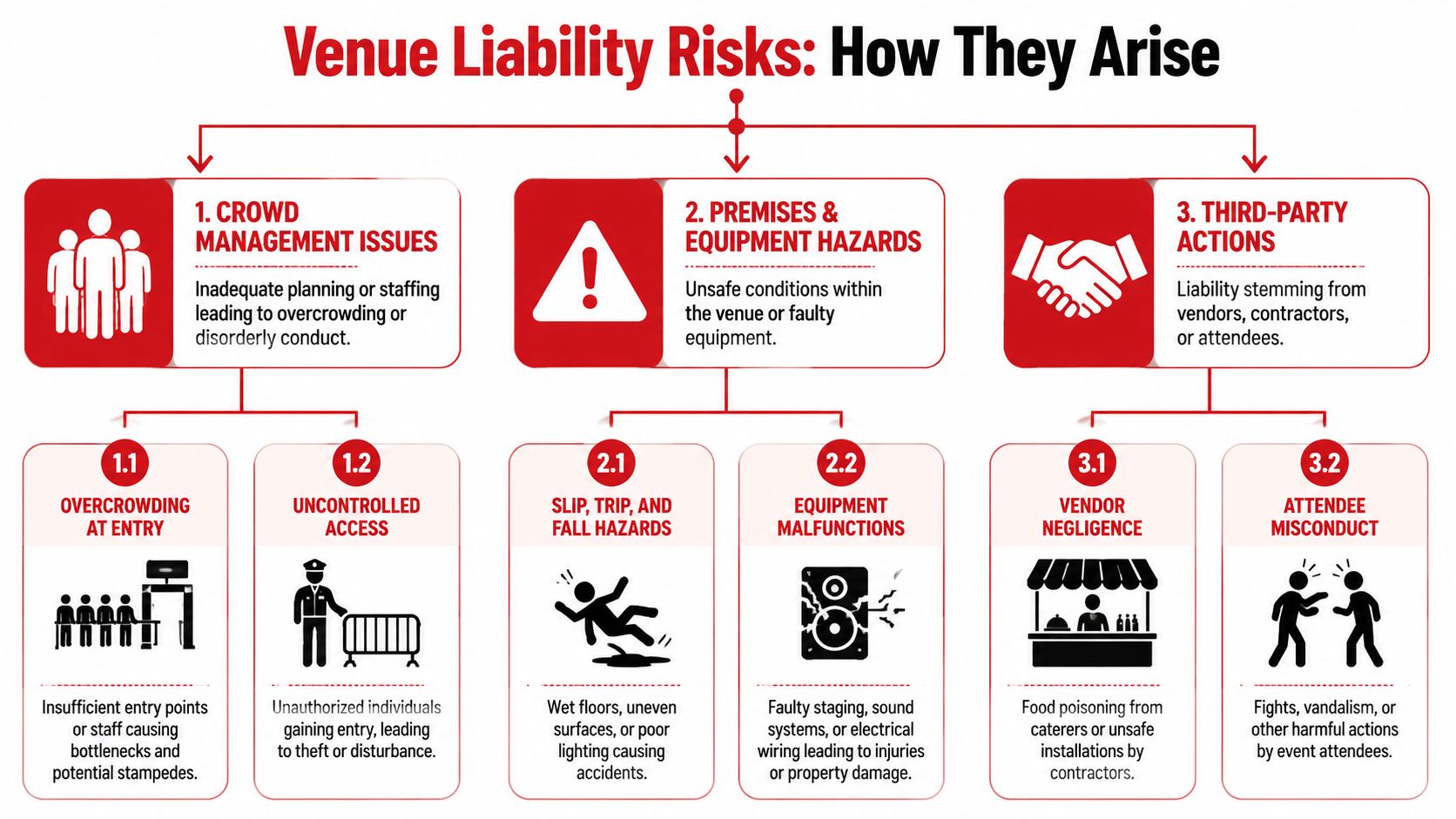
Liability usually starts with an ordinary operational miss, not a dramatic disaster. A gate opens late. A wet patch isn't isolated fast enough. A contractor leaves equipment where patrons walk. Someone gets hurt, property is damaged, or a client alleges your controls were inadequate.
That's how insurance and liability moves from paperwork to live exposure.

NSW festival pressure points
At a music festival in NSW, entry queuing is one of the earliest flashpoints. If bag checks are under-resourced and ticket scanning slows, crowd density builds fast. Patrons push forward, barriers take load, tempers rise, and one fall at the front can become a chain incident.
The legal issue isn't just the fall. It's whether the organiser and security team planned the entry flow properly, staffed it properly, and reacted quickly when pressure built.
VIC corporate events and hospitality venues
In Victoria, I've seen more claims exposure emerge from polished indoor environments than from rough outdoor sites. Corporate functions, awards nights, hotel events, and licensed venues often look controlled, but they combine foot traffic, alcohol service, lighting changes, hired equipment, and supplier movement in tight spaces.
A simple slip near a temporary bar can trigger allegations against multiple parties at once. The venue may point to the organiser. The organiser may point to the hire company. The security contractor may be asked why the hazard wasn't isolated or reported sooner.
The incident itself may be minor. The dispute over duty, notice, and response is what drives cost and stress.
QLD weather and site damage risk
Queensland adds another layer. Severe weather doesn't just damage structures. It changes evacuation paths, ground conditions, electrical safety, and contractor behaviour under pressure.
In 2025, liability-related natural hazard losses in Australia reached $4.46 billion, a 7.6-fold increase from the prior year, with severe storms in Queensland and New South Wales accounting for 69% of those claims, according to KPMG's Australian general insurance insights. For organisers, that isn't abstract market data. It means weather-related liability has become harder to dismiss as a low-probability issue.
Third-party risk is still your problem until contracts prove otherwise
Vendors, caterers, staging crews, cleaners, and digital suppliers all create exposure. Even online accessibility can become part of your risk profile if event registration, ticketing, or public-facing content isn't managed properly. For organisers reviewing digital legal exposure, website ADA compliance lawsuits from ADA Compliance Pros is a useful example of how compliance issues can trigger claims outside the physical venue itself.
Liability doesn't care whether the weak point was physical, operational, or digital. It follows the chain of responsibility.
Vetting Security Partners and Contractual Requirements
If you hire a security provider without checking the detail behind its paperwork, you're taking their word for your solvency. That's not due diligence. That's wishful thinking.
What a Certificate of Currency should tell you
A Certificate of Currency should confirm the insurer, insured entity, policy type, and currency period. It should also line up with the legal entity you are contracting. If the contract is with one company but the certificate names another, stop and clarify it before the event.
Look closely at whether the operational description reflects the actual work. A provider handling crowd control at a licensed event needs cover that fits that work. If the policy is broad in conversation but narrow on paper, you may discover the limitation when a claim is made.
Red flags include:
- Mismatched entity names: The trading name and insured entity don't align.
- Expired or near-expiry periods: The policy may lapse mid-contract.
- Vague activity wording: The certificate doesn't clearly reflect the services being delivered.
- Reluctance to provide updated documents: Serious operators don't resist basic compliance checks.
Subcontractor insurance is non-negotiable
Many organisers get caught; they verify the head contractor and never ask who else is turning up under that contractor.
Australian security industry regulations and insurers require subcontractors to hold their own Public & Products Liability and Workers Compensation policies, which prevents liability from shifting to the principal firm, as outlined by SPAAL on security subcontractor insurance requirements.
If a subcontracted guard causes injury and the subcontractor is uninsured, the organiser and principal contractor can end up arguing over who carries the fallout. That's a terrible position to be in during or after a live event.
Contract clauses worth insisting on
Your contract with a security partner should require:
- Current insurance evidence: Not just at signing, but through the event period.
- Subcontractor compliance: No deployment without separate proof of cover.
- Prompt incident notification: You need notice while facts are still fresh.
- Accurate service description: Crowd control, licensed premises work, patrol activity, and any specialist task should be reflected in the engagement.
If a supplier says “we'll sort that later”, assume the gap will become your problem.
Determining Adequate Coverage Levels and Clauses
The right coverage level depends on the activity, density, and consequence profile of the event. A quiet daytime activation doesn't carry the same exposure as a licensed festival, major concert, or high-turnover hospitality venue.
When higher limits make sense
For Australian security firms, Public Liability cover up to $50 million is the industry benchmark for high-risk operations such as festivals and concerts, according to One Underwriting's security industry liability guidance. That benchmark exists for a reason. High-density crowds, alcohol service, temporary infrastructure, and complex contractor chains can turn a single incident into a major claim very quickly.
For lower-risk environments, some engagements may carry lower requirements under contract. But organisers shouldn't confuse “minimum accepted” with “adequate for the exposure”.
Clauses that matter more than people think
Coverage limits alone don't save you if the activity is excluded. When reviewing a security provider's policy, I'd want to see the operational wording reflect actual site conditions.
Check for explicit inclusion of activities such as:
- Crowd control
- Licensed premises work
- Mobile patrols
- Static guarding
- Event security operations
If those activities aren't clearly contemplated, an insurer may challenge whether the work performed sits inside the intended risk.
A practical way to decide
Ask three questions:
- How many third parties can be affected by one incident?
- How quickly can a localised issue escalate into multiple claims?
- Does the site involve licensed service, dense queues, or moving contractor activity?
If the answer points to broad third-party exposure, higher limits are easier to justify. If the policy wording is generic, ask for clarification before the event, not after the incident.
How GM GROUP Services Proactively Reduces Your Liability
Insurance works best when it sits behind strong prevention. A disciplined operator doesn't rely on a policy to rescue poor planning. Its purpose is to reduce the chance that the claim happens at all.
Risk assessment before boots hit the ground
A professional security team starts with the site, not the roster. The risks at a festival gate differ from the risks in a hotel ballroom, shopping centre, or construction entry point. Good planning maps ingress and egress, blind spots, conflict points, alcohol impacts, cash handling, vehicle movements, and emergency access before the first shift begins.
That matters because liability often follows foreseeable problems. If the risk was obvious and the deployment ignored it, the organiser has a harder time defending the decision.
Fit-for-purpose deployment matters
One of the biggest operational mistakes is treating all guards as interchangeable. They aren't. A strong deployment matches the person to the task. Crowd-facing roles need communication skills and calm under pressure. Licensed environments need staff who understand venue behaviour and RSA-sensitive conditions. Patrol and response roles need judgement, observation, and reporting discipline.
In practice, that means better gate control, better de-escalation, and fewer avoidable incidents.
Strong security doesn't just respond well. It shapes patron behaviour before a problem forms.
Reporting, supervision, and fast escalation
Liability gets harder to manage when facts are missing. A professional provider reduces that problem with clear reporting lines, active supervision, and timely incident records. If something happens, the organiser needs accurate times, actions taken, witness details, and a defensible account of what staff saw and did.
What that looks like on the ground:
- Live communication channels: Staff can escalate issues immediately.
- Supervisor oversight: Problems are reviewed before they spread.
- Structured incident reports: Details are captured while memories are fresh.
- Post-incident review: Teams adjust deployment or controls quickly if conditions change.
The result is practical, not theoretical. Better planning reduces the chance of injury, conflict, and property damage. Better reporting improves the organiser's position if a claim still arises.
Your Essential Insurance and Liability Checklist
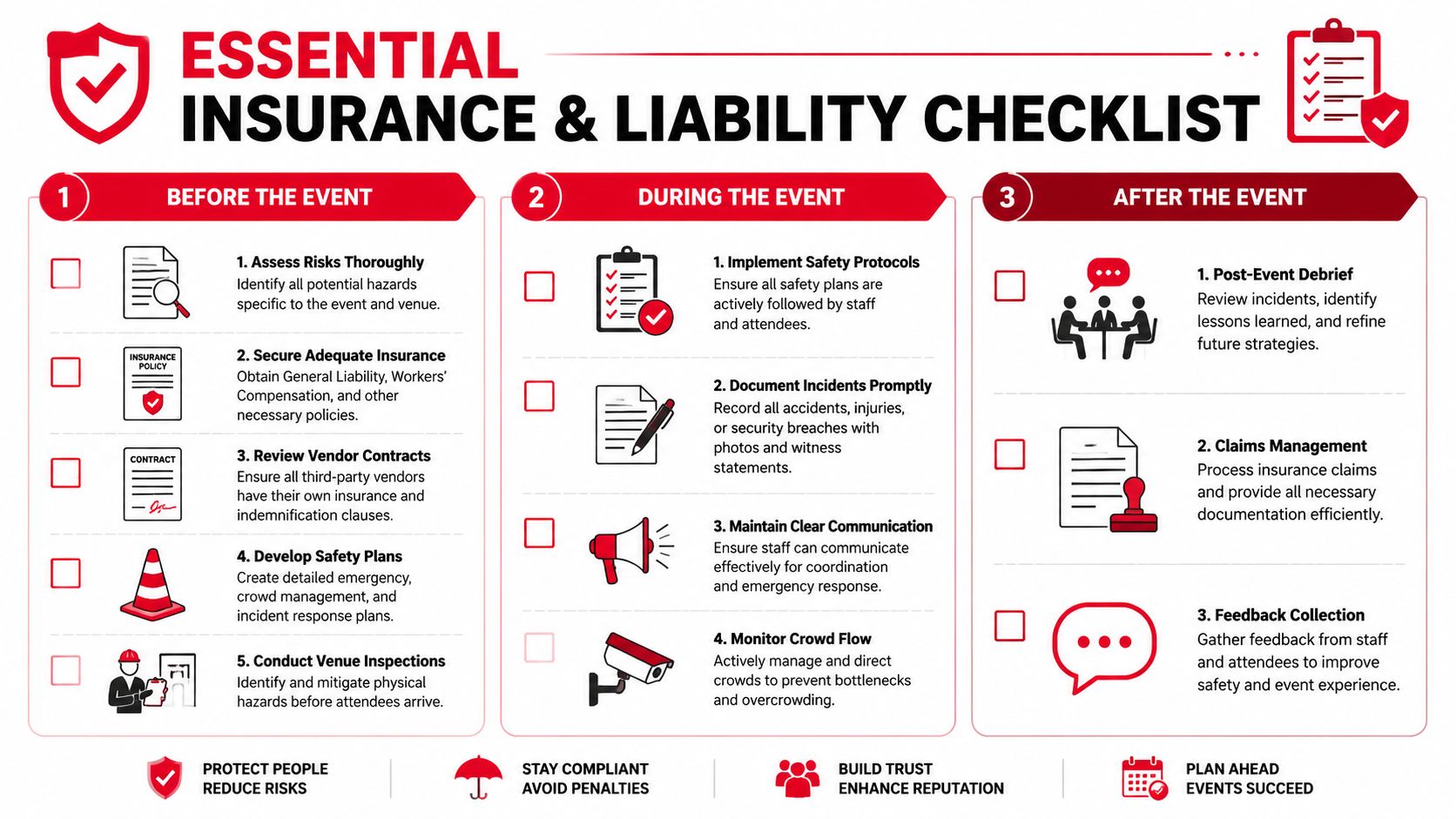
Good organisers don't wait for legal trouble before tightening controls. They work through a repeatable checklist before, during, and after every event.
Before the event
- Verify current cover: Obtain the security provider's Certificate of Currency and confirm the insured entity matches the contract.
- Check operational wording: Make sure the policy aligns with the actual event activity, including crowd work and venue type where relevant.
- Confirm subcontractor compliance: Require proof that subcontractors carry their own cover before they attend site.
- Review contracts carefully: Indemnity, notification, and reporting obligations should be clear.
- Inspect the venue: Identify slip hazards, bottlenecks, lighting issues, access conflicts, and contractor risk points.
During the event
- Monitor entry and crowd flow: Early congestion is often the first sign of broader failure.
- Document incidents immediately: Record what happened, who responded, and what controls were applied.
- Keep communication open: Supervisors and organiser reps should be able to escalate issues without delay.
- Adjust controls when conditions change: Weather, intoxication levels, or supplier delays can alter the exposure profile quickly.
After the event
- Debrief while details are fresh: Review incidents, near misses, and staffing effectiveness.
- Preserve records: Keep reports, photos, emails, and logs organised in case a claim appears later.
- Review whether cover was adequate: If the event exposed gaps, fix them before the next booking.
- Update supplier standards: Don't carry weak procurement habits into the next contract cycle.
The organisers who handle claims best are usually the ones who prepared for them before anything went wrong.
Frequently Asked Questions
Does my venue's insurance automatically cover my event and security staff
Usually not in the way organisers assume. Venue insurance may protect the venue for its own exposure, but it doesn't automatically replace your event cover or your contractors' cover. You need to check who is insured, for what activities, and under what conditions.
What is an indemnity clause and why does it matter in my security contract
An indemnity clause allocates responsibility between parties if a loss occurs. It matters because it can shift risk contractually even before insurance responds. If the clause is broad and poorly drafted, you may accept exposure you didn't intend to carry. Have it reviewed before signing.
What happens if a claim is larger than my security provider's insurance limit
Once the limit is exhausted, the remaining liability may fall on the responsible parties according to law and contract. That can include the organiser. This is why low limits can be a false economy in higher-risk environments.
Is Professional Indemnity the same as Public Liability
No. Professional Indemnity covers negligence in the service provided, such as a guard failing to prevent a theft, while Public Liability addresses bodily injury or property damage claims. Together they form a stronger insurance and liability position, as explained in Security Solutions Media's guide to how the covers fit together.
What should I ask a new security provider before approving them
Ask for current insurance evidence, confirmation of subcontractor compliance, details of incident reporting, and proof that the policy wording reflects the actual work being performed. If they can't answer those questions clearly, keep looking.
If you're planning an event, managing a venue, or reviewing security compliance across NSW, VIC, QLD or the ACT, GM GROUP Services can help you strengthen your insurance and liability position with licensed, fit-for-purpose security support, practical risk assessments, and deployment that's built around real operational exposure.
SEO title: 7 Costly Insurance and Liability Mistakes Event Organisers Must Avoid
SEO meta description: Insurance and liability for Australian events explained clearly. Learn the right cover, contract checks, and security requirements to reduce legal and financial risk.
Suggested URL: /insurance-and-liability-events-australia
Image alt text suggestion: insurance and liability