


Incident prevention starts with a hard truth. Australia's work-related injury rate is 3.5%, roughly one-third of the global average of 12.1%, yet there were 200 work-related fatalities in 2023, up 2.6% from 2022 according to Australian workplace injury and fatality data. Low injury rates don't mean the job is under control. They often mean people are looking at the wrong scoreboard.
A lot of venues and event operators still buy security like furniture. Put guards on doors, add a patrol, maybe a radio channel, and assume the site is covered. That model might satisfy a roster. It doesn't always prevent incidents.
The incidents that damage events, venues, and businesses usually build before they break. They start with poor queue design, unclear authority, mixed messages on radios, untrained bar staff, weak access control, tired patrol staff, or a supervisor who can't read crowd mood early enough. That's where proper incident prevention lives. Not in a static post order alone, but in the decisions made before gates open.
Beyond Guarding the Door an Introduction
Good security isn't a numbers game. It's a judgement game.


The old “guards on doors” model survives because it's easy to explain and easy to invoice. It's also limited. A guard can stop one person entering the wrong area. A prevention-led operation can stop the conditions that create the problem in the first place.
Why reactive security keeps failing
At a venue level, most trouble doesn't arrive as a single dramatic event. It arrives as a chain.
One intoxicated patron isn't always the issue. The issue is often the combination of slow entry, poor line management, weak RSA enforcement, a smoking area with no supervision, and radio traffic so cluttered that the first warning gets missed. By the time security “responds”, the preventable part has already passed.
That matters well beyond healthcare and mining. Human-factor thinking is still underused in many Australian event, hospitality, and commercial environments. Teams often review what happened after an incident, but they don't systematically design the site, staffing mix, and decision-making process to reduce the chance of repetition.
Practical rule: If your plan depends on guards fixing every problem in real time, the plan is already too late.
What proactive incident prevention looks like
A prevention-led operation asks different questions:
- Who creates risk at this site: patrons, contractors, delivery drivers, staff, performers, or all of them?
- Where does pressure build first: gate, bar, loading dock, car park, stage barrier, back-of-house corridor?
- Which errors are predictable: missed IDs, poor handovers, vehicle conflicts, late crowd surges, isolated staff, or unclear escalation?
- What training closes the gap: de-escalation, evacuation, RSA awareness, access control discipline, radio procedure, or incident reporting?
At a major venue, I'd rather have a tighter operating plan and a properly briefed mixed team than extra bodies with vague instructions. That's not a budget argument alone. It's an effectiveness argument.
The real trade-off
Reactive coverage feels visible. Prevention feels quiet.
That's why some operators underinvest in it. You can point to a guard. You can't always point to the argument that never started, the gate crush that never formed, or the unauthorised person who never got near a restricted area because accreditation flow made sense from the outset.
The operators who get this right protect more than safety. They protect trading continuity, staff confidence, guest experience, and brand reputation. That's the part many people miss. Incident prevention isn't separate from event success. It's one of the conditions that makes success possible.
Building Your Foundational Risk Assessment
Before you assign a single post, build the risk picture properly.
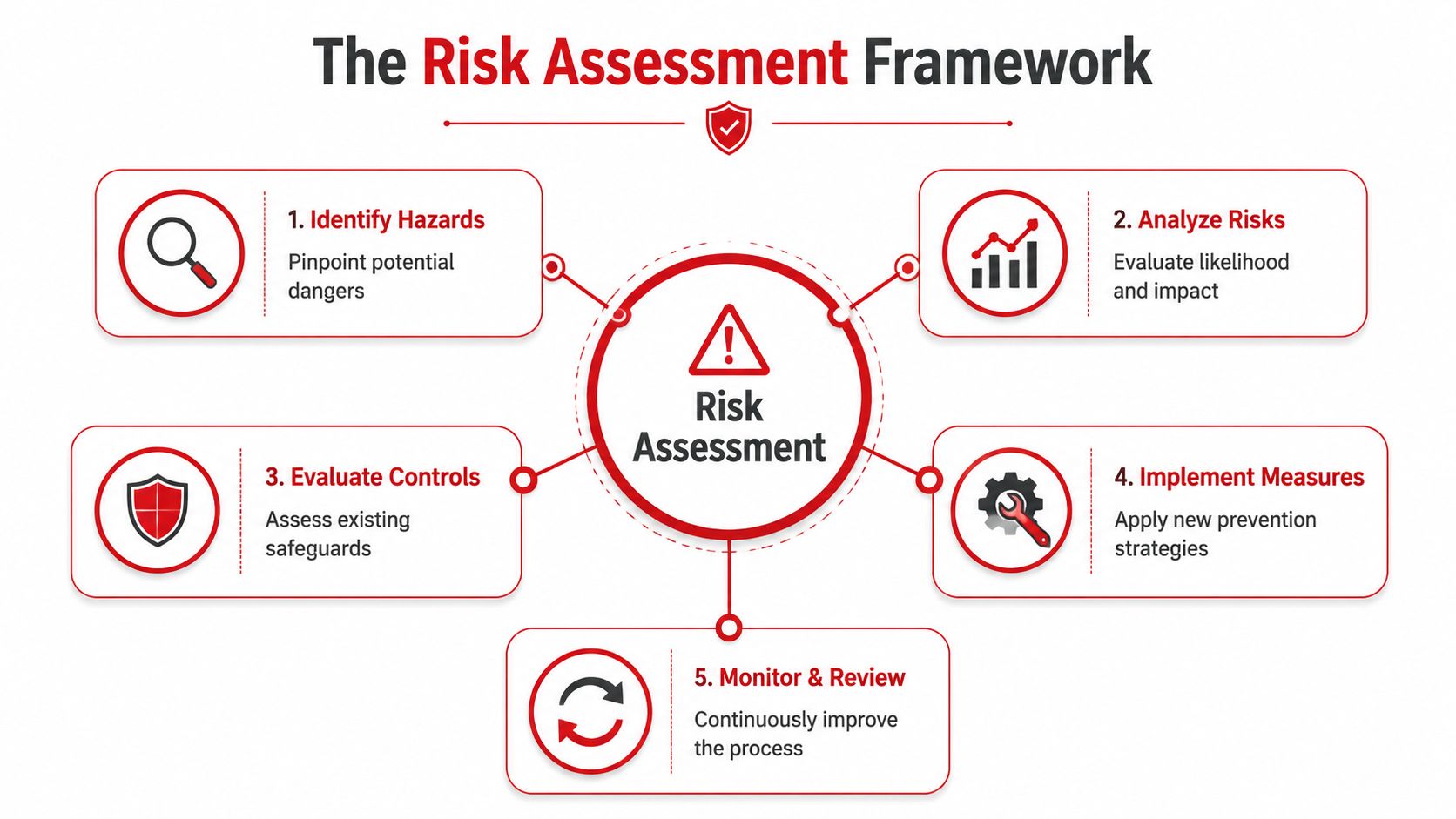
The strongest practical framework I've seen borrows from higher-risk sectors. The NSW Incident Prevention Strategy sets out a three-step methodology: develop a risk-based intervention framework for ongoing risk profiling, research human and organisational factors, and collect and analyse quality data to support intervention decisions, as outlined in the NSW Incident Prevention Strategy.
Start with the operating reality
Forget generic templates for a moment. Start with what happens on your site.
For a festival, that means gates, alcohol service, artist movements, contractor access, egress, and weather exposure. For a construction site, it means plant interaction, delivery schedules, after-hours access, and perimeter weaknesses. For a hotel or club, it means entry refusal, intoxication management, cash handling, and late-night transport queues.
A practical risk assessment should answer:
- What can go wrong here
- Why would it go wrong here
- Who is exposed when it does
- What control already exists
- What still relies too heavily on luck or individual judgement
If your team can't answer those plainly, the assessment isn't finished.
Factor in human and organisational issues
Most risk documents are too focused on physical hazards and not focused enough on behaviour.
Human-factor problems are everywhere in live operations. Staff take shortcuts. Contractors arrive late and pressure gate staff. Supervisors assume someone else has checked credentials. A radio message gets heard but not acted on. None of that shows up well on a basic checklist.
That's why I like using a working document during planning and bump-in. A simple event risk assessment template can help teams structure hazards, controls, and ownership, provided you adapt it to local conditions rather than treating it as a box-ticking exercise.
Risk assessment should read like an operating document, not an insurance appendix.
Use live information, not stale assumptions
The third part is data. In practice, that means collecting useful information before, during, and after the operation.
Use inputs such as:
- Previous incident reports: look for repeated locations, times, and triggers.
- Near-miss observations: they often expose weak controls before a major event does.
- Patron flow notes: queue compression, slow searches, and poor sightlines matter.
- Staff feedback: the quietest post is often where the reporting is weakest, not where the risk is lowest.
A good assessment isn't static. It changes when performer demographics change, site layout changes, liquor conditions change, or road access changes. If the operation changes and the assessment doesn't, the document has already lost value.
Deploying a Fit-for-Purpose Security Team
Safe Work Australia's latest WHS release shows serious harm is concentrated in a small number of industries. Security deployment should follow the same logic. Put capability where the exposure sits, not where the roster has a gap.
That starts with a simple question. What failure are you trying to prevent at each point on site?
A licensed guard at the front gate may be perfectly adequate for credential checks and basic deterrence. The same person may be the wrong choice for a busy loading dock, a volatile ejection point, or an internal theft issue. Different risks need different judgement, licence classes, and operating habits. If the assessment identified contractor non-compliance, crowd pressure, cash exposure, or vehicle conflict, the team should reflect that.
I see the same mistake across venues, projects, and major events. Operators buy headcount and call it coverage. The site looks staffed, but the people on shift are not matched to the behaviour, pressure, or decision-making required in the places where incidents usually start.
| Security Type | Primary Role | Best For Mitigating | Example Deployment |
|---|---|---|---|
| Static guards | Access control and visible presence | Unauthorised entry, restricted area breaches, after-hours access | Main gate, staff entrance, plant room door, concierge desk |
| Crowd controllers | Patron management and conflict handling | Intoxication issues, queue friction, refusal of entry, crowd surge points | Bars, clubs, festival entry lanes, stage front zones |
| K9 units and handlers | Detection and deterrence | Perimeter breaches, search support, high-visibility deterrence | Large event perimeters, transport-adjacent sites, after-dark patrols |
| Covert operatives | Low-visibility observation | Theft, internal misconduct, suspicious behaviour, targeted investigations | Retail floors, cash-handling areas, back-of-house venue zones |
| VIP and bodyguard personnel | Close protection and movement control | Personal threats, unwanted approach, unmanaged crowd contact | Artist arrivals, executive events, media-facing appearances |
| Vehicle patrol and gatehouse staff | Mobile oversight and entry management | Perimeter lapses, delivery conflicts, vehicle movement issues | Industrial sites, business parks, logistics yards, mixed-use precincts |
The human factor matters as much as the post order. A crowd controller who can read intoxication early and speak to patrons with control will prevent more trouble than a larger team that only reacts once tempers are up. A gatehouse officer with poor sign-in discipline can undo a well-written access plan in one shift. A covert operative without clear reporting lines creates intelligence that never reaches the supervisor who needs it.
That is why deployment and training need to be tied together.
For a music festival, the team mix usually needs strong crowd controllers at ingress and bars, supervisors who can reposition staff fast, and back-of-house access control that protects artist, contractor, and public routes from bleeding into each other. For a construction project, the priority shifts to gatehouse procedure, vehicle management, perimeter integrity, and guards who will challenge bad contractor habits without creating unnecessary friction. For hospitality venues, the best operators are usually the ones who can enforce RSA support measures, manage smoking areas, and handle refusals without turning a routine interaction into a use-of-force problem.
The right deployment is the one that puts the right judgement at the right pressure point.
Training should then match the task. Entry screening needs search procedure, incident thresholds, and clear escalation rules. Late-night crowd control needs de-escalation, refusal practice, and coordinated team movement. Back-of-house security needs credential discipline, contractor challenge procedures, and confidence in reporting suspicious conduct. If insider risk is part of the profile, Logical Commander on ethical insider threats is a useful reference for framing the issue without turning every staff member into a suspect.
Provider choice matters here. If you're using a contractor such as GM GROUP Services, ask which licence class, venue experience, and supervision model fit the assessed risk. Ask who briefs the team, who audits performance during shift, and who has authority to adjust deployment once trading conditions change.
That approach usually improves spend as well. Fewer mismatches. Better supervision. Less reliance on sending extra bodies to a post that really needed a different skill set from the start.
Implementing Proactive Site Controls and Training
A capable team still fails on a badly designed site.
Incident prevention works when physical controls, procedures, and training support each other. If one part is weak, the rest ends up carrying too much load. Guards compensate for poor lighting. Supervisors compensate for weak reporting lines. Bar staff compensate for vague RSA enforcement. That's when mistakes multiply.
Build the site to reduce avoidable friction
Start with movement. Most sites have predictable choke points, but many operators accept them as normal.
Look at queue approach, search tables, exits, smoking areas, amenities, taxi ranks, loading areas, and any point where public traffic crosses staff or vehicle traffic. Then tighten the basics:
- Lighting: poor sightlines make identification, monitoring, and de-escalation harder.
- CCTV placement: cameras should support supervision and review, not just exist on a site map.
- Barrier layout: use barriers to guide flow, not just to block people.
- Access control: separate public, staff, contractor, and VIP routes where possible.
- Signage: clear instruction reduces repeated verbal correction and lowers tension.
A lot of incidents disappear when movement makes sense. People become less frustrated, staff become less reactive, and radios become less chaotic.
Use the nine-step action method properly
When a control needs fixing, treat the remedy like an operational task, not a loose intention.
The Aged Care Quality and Safety Commission's prevention guidance sets out nine sequential steps for remedial action, including setting clear roles, assessing barriers, delegating tasks, monitoring success, and recording lessons learned. It also notes that failure to delegate tasks to relevant people or assess barriers is linked to a 30% higher recurrence rate of similar incidents in incident prevention remedial action guidance.
That finding lines up with what happens on event and venue sites. A control fails twice for simple reasons. No owner, no deadline, no check.
Training that actually changes outcomes
I'd prioritise the following modules for most venue and event teams:
- De-escalation: for entry issues, patron conflict, and post-refusal management.
- Emergency response drills: evacuation, shelter, medical escalation, and missing person procedure.
- Radio discipline: concise traffic, correct channel use, and escalation language.
- Access control procedure: credential checks, challenge process, and contractor verification.
- Incident reporting: enough detail for later review, without waffle or guesswork.
- Equipment use: torches, body-worn systems if used, barriers, and search tools.
A strong training program also addresses insider risk. Not every threat comes through the front gate. Staff misuse, access misuse, and ethical boundary issues can create serious operational exposure, which is why resources such as Logical Commander on ethical insider threats are useful reading for managers shaping prevention policy.
Field note: If staff don't know who owns a decision, they'll either delay it or improvise it. Both create risk.
What doesn't work
Three things fail consistently.
First, generic inductions that explain policy without rehearsing the practical situations staff will face. Second, site controls copied from another venue with no adjustment for layout or crowd type. Third, post-incident actions with no follow-up.
Training should be short enough to absorb, specific enough to apply, and repeated often enough to stick. If your brief sounds polished but your team still asks who controls the smoking area, the training hasn't landed.
Navigating Compliance and Communications
Operational strength means very little if the legal and reporting backbone is weak.
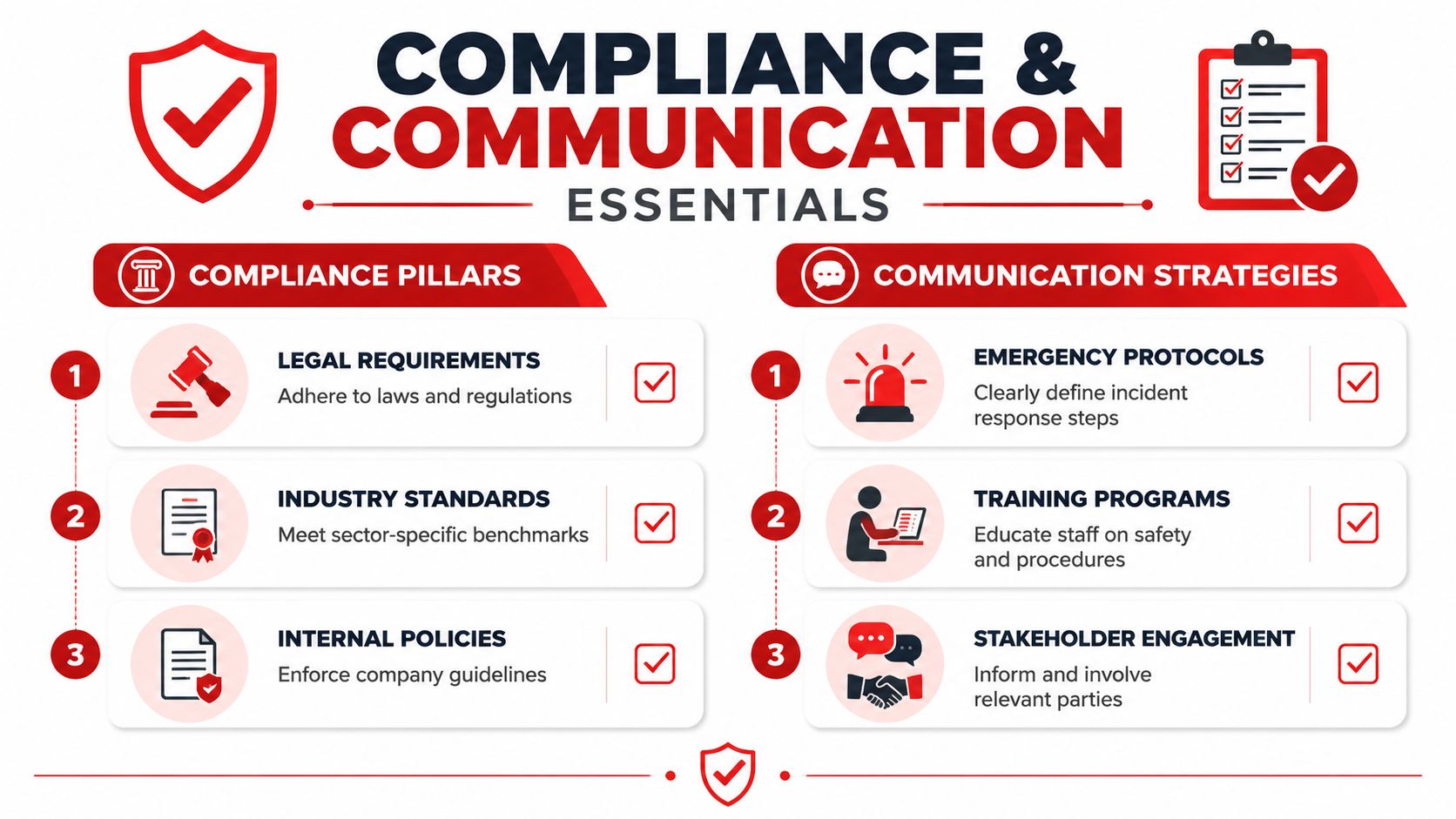
Across NSW, VIC, QLD, and the ACT, event and venue operators need to work with correctly licensed personnel and site procedures that match local regulatory conditions. Hospitality sites also need security planning that aligns with RSA obligations, refusal procedures, and safe patron management. Compliance isn't just about avoiding trouble with regulators. It creates clarity in the moment that matters.
The compliance checks that matter most
In practice, I look for a short list of absolute requirements:
- Licensed personnel: the role on site must match the licence and lawful function required in that jurisdiction.
- Defined authority: staff need to know what they can do, when to escalate, and who takes command.
- Venue-specific procedures: search, refusal, ejection, evacuation, and incident recording shouldn't be improvised.
- RSA alignment: security and bar teams need one shared approach to intoxication and refusal.
- Documentation discipline: reports should be timely, factual, and usable for later review.
The operators who struggle here often have documents, but not integration. Security has one process. Venue management has another. The bar team has a third. That fragmentation causes delay and contradiction.
Communication is a control, not an accessory
A site with poor communication isn't organised. It's exposed.
For cyber-related incidents, the Australian Signals Directorate provides a 24/7 national cyber security hotline, 1300 CYBER1, for reporting cyber incidents, vulnerabilities, or victimisation through ASD cyber security support. For formal cyber planning, Australian response plans should define roles for the Cyber Incident Response Team and Senior Executive Management Team, including who receives initial notifications and who activates incident classification, as set out in the ACSC cyber incident response plan guidance.
Even for physical security operations, that same principle applies. Someone receives the first alert. Someone classifies it. Someone owns the next decision.
Good communications plans remove ambiguity before pressure arrives.
A simple command structure for live operations
Use a chain of command that people can remember under stress:
- First observer reports using plain language.
- Supervisor confirms location, severity, and immediate control.
- Operations lead decides whether to contain, redeploy, escalate, or stop activity.
- Management is notified when the threshold for business or reputational impact is met.
- Incident log is completed while details are still fresh.
That approach sounds basic because it is. Basic done properly wins more often than complicated done badly.
Measuring Success and Driving Improvement
If you only measure incidents after they happen, you're measuring failure late.
The strongest incident prevention programs track both lagging and leading indicators. Lagging indicators include the obvious things: ejections, thefts, injuries, property damage, or emergency interventions. They matter, but they don't tell you enough on their own.
What to measure before a major incident occurs
Leading indicators are usually more useful operationally:
- Near-miss reports: these reveal where a weak control nearly failed.
- Hazards identified and fixed: useful because they show action, not just exposure.
- Briefing quality: whether teams received role clarity and understood escalation.
- Radio errors: repeated confusion often signals command issues or poor site design.
- Patron or staff feedback: recurring comments usually point to friction points.
Use review loops that actually change the plan
After every event, ask three direct questions.
What happened that the plan anticipated? What happened that the plan missed? What did staff have to improvise because the procedure was unclear?
The best review isn't the longest one. It's the one that changes next week's deployment, layout, or training note.
That's how a security plan becomes operationally smarter over time. Not by producing thicker documents, but by tightening decisions, removing ambiguity, and reducing repeated mistakes.
Frequently Asked Questions on Incident Prevention
Is formal incident prevention worth the cost for a small venue
Yes, if the plan matches the site.
Small venues usually do not need a thick manual or a large guard presence. They need the few controls that stop the incidents they face. For a pub, that might mean queue oversight, RSA support, CCTV coverage at pinch points, and staff who know when to call for a licensed crowd controller. For a retail site, it may be better reporting discipline, clear opening and closing procedures, and one trained officer during peak periods.
The expensive option is usually the wrong option. The cheap option is often wrong too. The right option is a targeted mix of people, procedures, and supervision.
What's the biggest mistake venues make
Using the same security model for every job.
A low-risk corporate tenancy, a late-night hospitality venue, and a public event do not need the same personnel profile. Some sites need static presence and access control. Others need crowd controllers with strong verbal skills, incident writing discipline, and experience managing intoxication, refusals, and conflict in public-facing environments. If the risk assessment is generic, the roster will be generic as well, and that is where preventable gaps appear.
Does incident prevention only apply to physical security
No.
A workable prevention plan also covers insider behaviour, contractor access, poor key control, reporting failures, cyber-related disruption, and basic process breakdowns. In practice, many incidents start as human-factor problems before they become security problems. Someone props open a secure door, skips a handover, ignores a near miss, or assumes another team has taken ownership.
That is why training matters as much as headcount.
Are new technologies changing prevention work
Yes, but only when the site team can use them properly.
Analytics, access control alerts, body-worn cameras, visitor systems, and incident reporting platforms can improve visibility and speed up response. They do not replace judgement on the ground. A poor supervisor with good technology still misses early warning signs. A capable team with a clear brief will usually prevent more trouble than a poorly led team with expensive systems.
Use technology to support decision-making, record evidence, and tighten accountability.
Is the security market growing because businesses are taking prevention more seriously
Demand is rising, but growth in the market does not guarantee better prevention.
Some buyers are more mature than they were a few years ago. They ask better questions about licensing, incident reporting, venue experience, and supervisor coverage. Others still buy on hourly rate and assume every guard can do every task. That approach usually creates friction later, especially in Australian venues and events where compliance, patron behaviour, and public liability exposure can shift quickly.
Good procurement starts with risk. Then it selects the right security role, licence class, and briefing standard for the environment.
If you need a practical incident prevention plan for a venue, event, hospitality site, construction project, or commercial property, GM GROUP Services can help you assess risk, define the right security mix, and build a compliant operating model that fits the site rather than forcing a generic roster onto it.