


Hotel security systems usually get urgent attention after a small incident that should have been easy to stop. A missing laptop from a conference room. A contractor wandering into a guest corridor. A late-night argument in the bar that spills into the lobby while reception is trying to check in tired guests.
That's the point where most operators realise they don't have a single problem. They have several systems, several teams, and several assumptions that don't line up.
A modern hotel doesn't run like a sealed building. It runs like a live environment with guests, visitors, suppliers, cleaners, event patrons, bar staff, security, and management all moving through the same footprint. Good hotel security systems don't just record what happened. They control movement, support staff, reduce confusion, and help the venue stay calm when pressure rises.
Beyond the Front Desk A Modern Approach to Hotel Security
Hotel security systems have to do more than protect the reception desk and lock guest rooms. In practice, they have to support the whole operation, from arrival to after-hours trading, without making the property feel hostile.
A common failure point is simple. A guest reports that someone followed them through a side entrance. The camera angle is poor. The access log only shows the staff member who opened the door earlier. No one on shift is sure whether the person was a guest, a delivery driver, or a patron from the bar. Nothing dramatic happened, but the event exposes a fundamental weakness. The hotel isn't short on hardware. It's short on joined-up control.
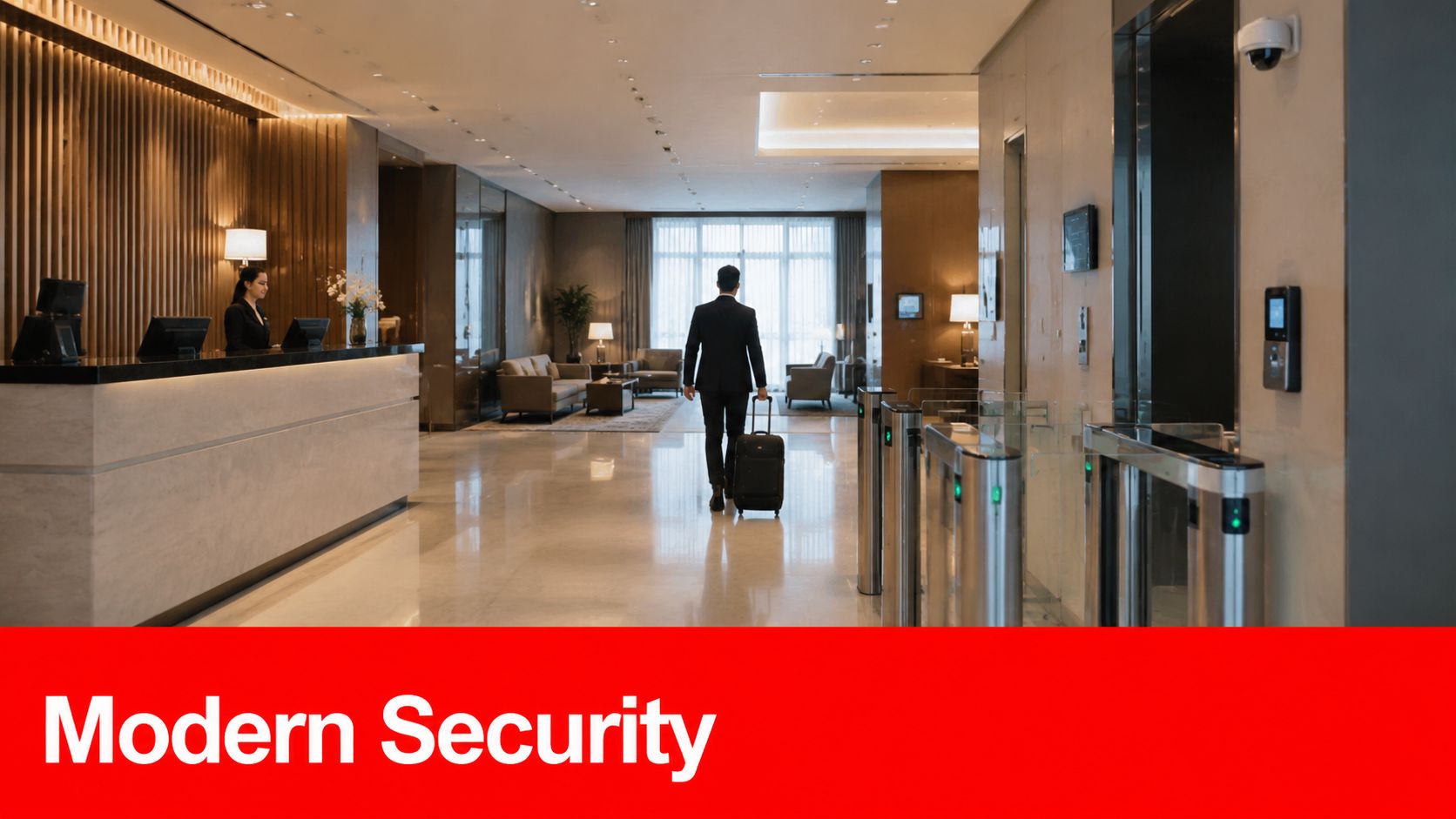

That's why the strongest hotel security systems work as an ecosystem. Cameras, electronic locks, alarms, procedures, and trained people all support one another. If one layer misses something, another layer catches it.
Why the Australian context matters
Australia's accommodation market is broad and operationally diverse. The ABS counted 8,355 short-term visitor accommodation establishments in 2022–23, including 924 hotels and resorts and 4,060 serviced apartments and holiday units, and the same release recorded $11.3 billion in takings from short-term visitor accommodation in 2022–23 according to this overview of hotel security and accommodation market context.
That scale matters because there isn't one hotel profile. A CBD hotel with a rooftop bar has very different pressure points from a regional property with coach tours, or an airport hotel handling constant short-stay turnover. The security design has to match the operating model.
What a modern security posture looks like
In real projects, the most useful shift is moving from isolated devices to integrated response. That usually means:
- Entry points are defined clearly so guests, staff, contractors, and public visitors don't all move through the same path by default.
- Back-of-house areas are controlled with access permissions that match job roles rather than informal habits.
- Incidents are verified quickly because cameras, logs, and staff reports can be checked together.
- Supervision stays consistent after hours when fewer managers are on site and the venue becomes harder to read.
If you're reviewing suppliers or architecture options, Wisenet Security integrated solutions are a useful example of how integrated platforms are framed in practice. The key lesson isn't the brand. It's the model. Separate systems create delay. Connected systems create decisions.
Practical rule: If your team can't answer who entered, where they went, and who was meant to be responsible for that zone, your hotel security systems aren't integrated yet.
The Essential Components of Hotel Security Systems
A robust setup isn't one product. It's a stack of controls, each doing a specific job. Some deter. Some verify. Some delay access. Some support response. The mistake I see most often is overspending on visible technology while underbuilding the supporting layers.
Hotel security systems start with layered control
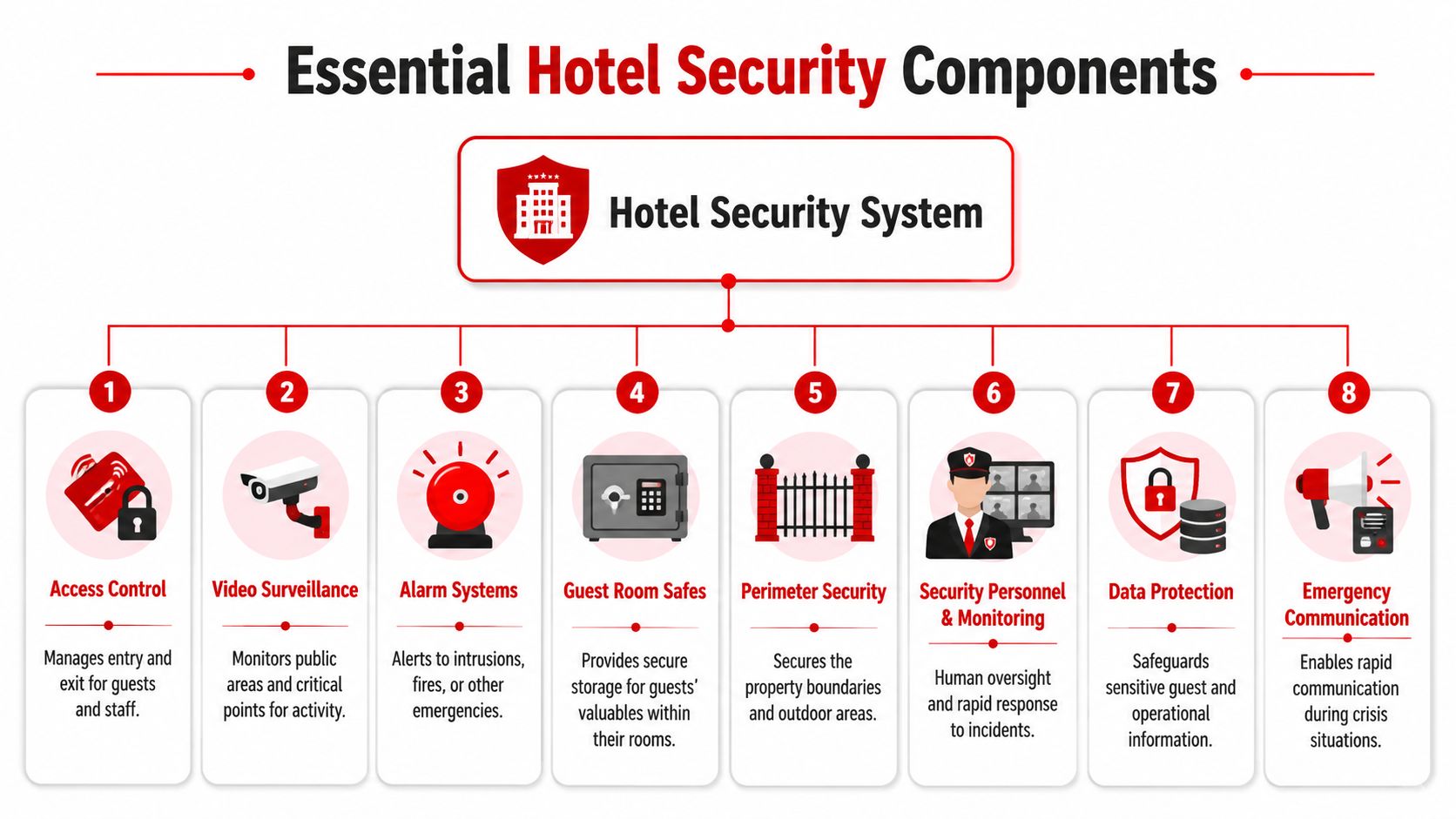
Current hotel guidance emphasises a layered design that combines trained personnel at main entrances, visitor management, clear sight lines, commercial-grade doors and frames, 24/7 video surveillance, emergency call stations, and regular patrols. It also stresses that access control, surveillance, alarms, and staff training work best when they operate as one system, as outlined in this hotel security systems guidance.
That principle matters more than any single device. If your lobby camera sees a problem but no one owns the response, the camera isn't solving much.
The eight components that matter most
Access control
This governs who can go where, and when. In hotels, that means more than room keycards. It includes staff-only doors, service corridors, plant rooms, loading docks, liquor storage, admin offices, and lift controls. Good access control uses role-based permissions. It doesn't give broad access because someone asked for convenience.Video surveillance
CCTV should cover decision points, not just open spaces. Entrances, lift lobbies, corridor intersections, delivery points, and cash-handling areas usually matter more than another wide shot of the foyer. Placement beats quantity.Alarm systems
Intrusion, fire, duress, and technical alarms all serve different purposes. The important question is what happens after activation. An alarm that produces repeated false callouts will get ignored by staff. An alarm tied to a clear response plan becomes useful.Guest room safes
These don't replace broader security, but they reduce friction around valuables and lower the volume of avoidable complaints. The operational detail matters here. Staff need a documented process for master access, disputes, and resets.Perimeter security
Car parks, side gates, smoking areas, and service lanes often become the weak edge of the property. Lighting, fencing, gate control, and camera coverage should match actual use, especially after dark.Security personnel and monitoring
Hardware doesn't intervene. People do. Even where a hotel doesn't maintain a large on-site team, someone must monitor alarms, review alerts, and make decisions quickly.Data protection
Hotel security systems now touch guest data, payment processes, access credentials, and staff records. That means cyber hygiene matters. Restrict admin rights, control shared logins, and separate operational convenience from security discipline.Emergency communication
During an incident, the biggest operational failure is often confusion. Reception, duty managers, housekeeping, bar supervisors, and security need a clear communication path that works under pressure.
What works and what usually fails
Here's the practical difference between a system that helps and one that frustrates the team:
What works
- Cameras linked to action: Operators can pull footage quickly and match it to access events.
- Restricted areas mapped properly: Staff know which doors are public, controlled, or emergency-use only.
- Simple duress options: Reception and lone staff can call for help without escalating a situation visibly.
- Clear ownership: Each alert goes to a specific role, not to “whoever sees it”.
What fails
- Too many permissions: Old cards and broad access rights stay active long after role changes.
- Blind spots at transition points: Especially between bar, lobby, lifts, and event spaces.
- Unverified alarm noise: Frequent nuisance alerts train staff to delay response.
- Standalone systems: Separate screens, separate vendors, separate logs.
Strong hotel security systems don't feel busy. They feel organised.
Conducting a Security Risk Assessment for Your Hotel
Before you buy anything, map the property the way an incident would unfold. Most poor security upgrades start with a shopping list. Better ones start with a site reality check.
Start with movement, not equipment
Walk the venue at opening time, peak check-in, event bump-in, and late trading. The patterns will change. Guests may enter through the front, but contractors, casual staff, musicians, delivery drivers, and bar patrons often create pressure through side entries, loading zones, smoking areas, or lift access points.
Build the assessment around real movement:
- Guest flow through lobby, lifts, corridors, rooms, and amenities
- Public flow into bars, restaurants, gaming, function rooms, and toilets
- Staff flow across back-of-house corridors, docks, stores, offices, and plant areas
- Contractor flow during maintenance, fit-outs, and overnight works
When these flows overlap without control, incidents become harder to prevent and harder to explain.
Review what the incident log is already telling you
A useful risk assessment doesn't focus only on serious events. Repeated low-level issues often show where the system is weak. Lost property disputes, tailgating through staff doors, unauthorised smoking area access, loitering near lifts, and aggressive behaviour at closing time all point to control gaps.
Look for patterns in three places:
- Time of day when supervision drops or public activity changes
- Location where staff visibility is poor or access is ambiguous
- Role confusion where no one is sure who should respond
If the same type of incident keeps reappearing in slightly different places, the process is failing, not just the people on shift.
Compliance has to sit inside the assessment
Hotels can't treat compliance as a separate document. It changes where cameras go, how footage is managed, how licensed areas operate, and how incidents are handled. In mixed-use venues, Responsible Service of Alcohol obligations, door supervision, and staff welfare all intersect.
A practical assessment should answer questions like these:
| Risk area | What to test on site | What good looks like |
|---|---|---|
| Public access | Can non-guests reach lifts or accommodation floors too easily? | Guest paths and public paths are clearly separated |
| Back-of-house | Are staff doors propped open for convenience? | Controlled access and routine checks prevent drift |
| Licensed spaces | Does bar activity spill into guest areas late at night? | Transition zones are staffed, observed, and managed |
| Privacy | Are cameras placed only in appropriate areas with clear purpose? | Coverage supports safety without intruding on private spaces |
| Response | Can supervisors verify an alert quickly? | Logs, footage, and on-ground staff line up |
The outcome should be specific. Not “improve CCTV”. Instead, “control side entry after kitchen close”, “separate event guests from accommodation lifts”, or “add duress coverage at reception and gaming transition points”.
Integrating Technology with Professional Guard Services
At 11:40 pm, a wedding is breaking up, the public bar is still trading, and tired guests are trying to get to their rooms. Reception gets a duress alert. At the same time, access control shows repeated failed attempts at a side entry used earlier by event contractors. In a mixed-use hotel, that is not a technology problem or a staffing problem on its own. It is an integration problem.
Technology detects fast. People decide what the alert means, how to approach it, and how to keep a guest issue from turning into a safety issue. That's the line many hotel operators learn the hard way.
A smart camera can flag unusual movement near a staff corridor. An access control system can show repeated denied entry at a liquor store or loading point. A duress alarm can activate at reception. The system has done its job at that stage. The next step depends on trained personnel who can verify context, intervene safely, and keep the operation calm while they do it.
Why mixed-use venues need both systems and people
Hotels with bars, functions, conferences, weddings, gaming, or public dining areas change character across the day. A lobby that feels controlled at 2 pm can become a transition point between guests, patrons, contractors, and rideshare traffic late at night. Generic hotel security advice often misses that shift.
Guidance for hotel and venue operations reflects that reality. Hotels that overlap with bars, events, and public spaces face added pressure around after-hours access, RSA obligations, staff welfare, and guest comfort, as outlined in this discussion of hotel and venue security nuance.
The practical challenge is balance. Security has to be visible enough to deter poor behaviour and support staff, but measured enough that accommodation guests do not feel they are walking into a conflict zone.
What integration looks like on the ground
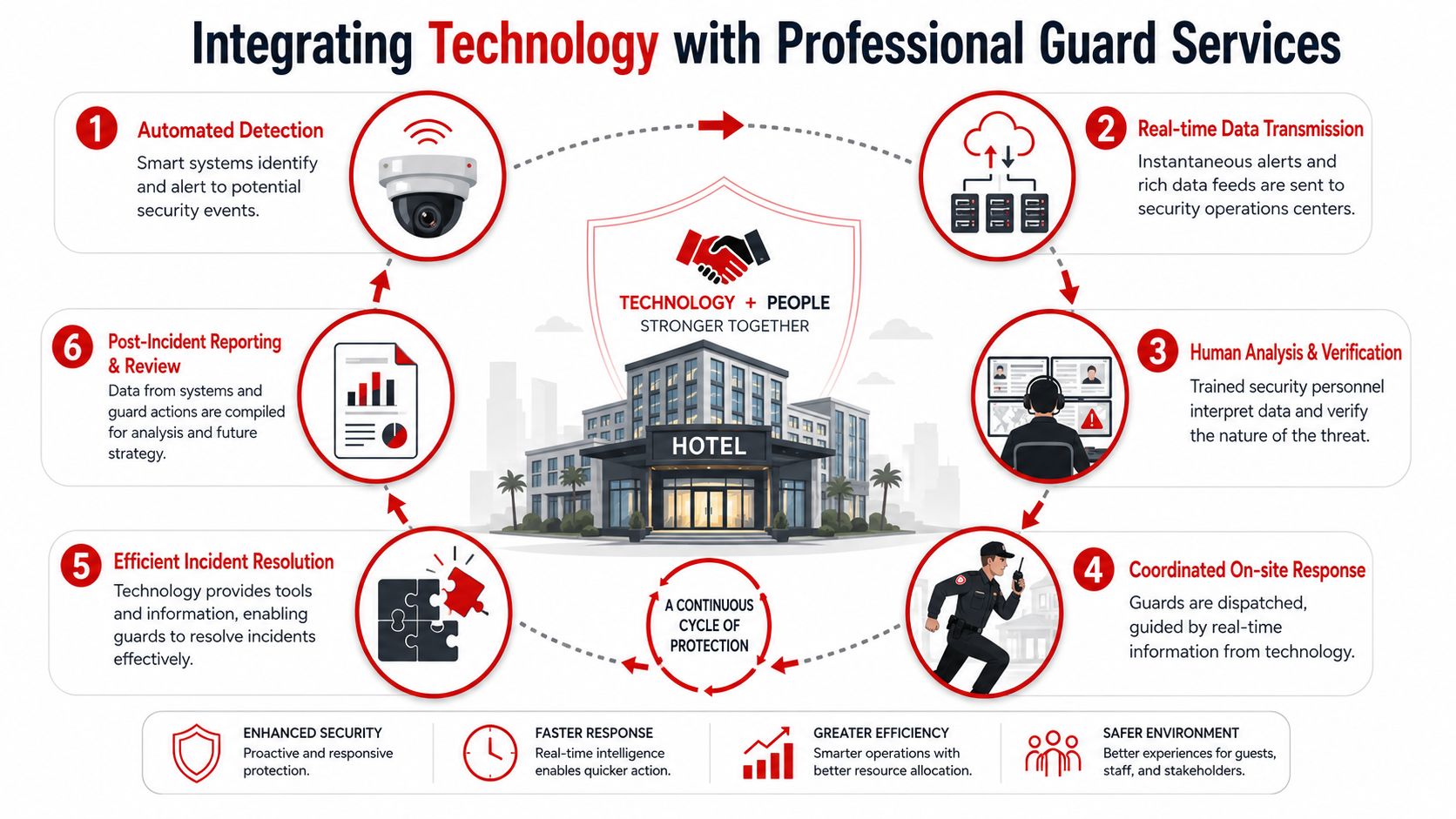
The strongest model assigns a clear job to both the system and the guard team.
Technology detects and prioritises
CCTV analytics, access events, duress alarms, and monitoring platforms surface the incident quickly and show where to look first.Control room or supervisors verify
Someone checks live footage, access history, and site context to decide whether the issue is a wrong door, a confused guest, a removed patron returning, or a genuine threat.Guard services respond at the right level
The response may be a quiet redirection, a welfare check for staff, an escort from a restricted area, support at reception, or police and emergency escalation.Operations closes the loop
Management reviews what happened and adjusts staffing posts, access permissions, patrol timing, event egress plans, or contractor controls.
In practice, providers such as GM GROUP Services are most useful when those roles are already defined. Licensed guards, patrols, event security, and monitoring support add value when the hotel has set clear response thresholds, reporting lines, and handover points between the front office, duty manager, and security team.
The trade-off hotels get wrong
Some properties spend heavily on cameras, alarms, and access control, then leave one person at the desk to sort out the alerts. Others place guards in difficult positions because entrances, lift access, and public-to-private transitions were never designed properly. Both models waste money, and both create avoidable risk.
A camera can confirm that a problem exists. A trained guard can stop it from spilling into the lobby, guest corridors, lifts, and online reviews.
For mixed-use venues, the better question is not whether to buy more hardware or schedule more guards. It is where human judgement needs to sit inside the system, especially at transition points such as bar-to-lobby movement, event pack-down, after-hours entries, and guest floor access.
Your Practical Roadmap for Implementing Hotel Security Systems
Most failed upgrades don't collapse because the equipment is poor. They stall because the project is rushed, operational teams aren't consulted, or no one defines how the finished system should work on a normal Tuesday night.
Phase one assessment and planning
Start with the risk picture, then translate it into operational requirements.
Key actions:
- Map priority zones: Rank guest floors, reception, loading areas, bars, gaming, event spaces, and car parks by risk and business impact.
- Define user groups: Separate guests, staff, contractors, delivery drivers, and public patrons. Each group needs different access and supervision.
- Write response expectations: Decide who responds to denied access, duress alarms, lost child reports, aggressive patrons, and after-hours entry attempts.
- Set procurement rules: Require integration between CCTV, access control, alarms, and reporting before you compare price.
Common pitfall: buying devices before deciding who will monitor them and who owns each alert.
Phase two vendor selection and installation
Choose vendors that can work inside an operating hotel. Technical capability matters, but so does how they stage works, protect guest experience, and coordinate with management.
Use this shortlist when comparing providers:
| Decision area | What to ask |
|---|---|
| Integration | Can the platform connect key systems into one usable view? |
| Usability | Can duty managers and supervisors use it without specialist IT support? |
| Support | Who handles faults, updates, and after-hours issues? |
| Installation method | How will works be staged around occupancy, events, and quiet hours? |
| Reporting | Can the system produce logs the hotel can actually use? |
Don't let installation teams decide camera views in isolation. Security, operations, and venue management should sign off on placement together. A technically correct camera can still be operationally useless if it misses the point where incidents begin.
Phase three training and go-live
Often, many hotel security systems underperform. Staff get a handover, not training. Then everyone assumes the system is working because the screen is on.
Train by role:
- Reception teams need visitor handling, duress use, escalation paths, and privacy awareness.
- Duty managers need incident review, access overrides, reporting discipline, and decision authority.
- Housekeeping and maintenance need door security habits, contractor management, and anomaly reporting.
- Bar and event teams need after-hours movement controls and handoff procedures with security.
Site advice: If staff can't explain the difference between a guest convenience issue and a security issue, they'll escalate the wrong things and miss the real ones.
Before full go-live, run scenario testing. Try a locked-out guest, an unauthorised side-entry attempt, a bar patron moving toward accommodation lifts, and a duress activation at reception. Testing exposes bad assumptions faster than paperwork does.
Phase four early review and correction
The first few weeks matter more than the launch day. Watch for door propping, alert fatigue, bad credential setup, and workarounds invented by staff.
Tighten these quickly:
- Access groups that are too broad
- Camera angles that don't support verification
- Alert routing that goes to the wrong person
- Reporting gaps where incidents are handled but not documented
A measured rollout beats a flashy one. The point is control, not novelty.
Measuring Success Maintenance and KPIs for Your Security Investment
Hotel security systems aren't finished when installation ends. They stay effective only if the property treats them as an operating asset, not a one-off capital job.
What to maintain routinely
The basics matter more than often realized. Dirty lenses, drifting timestamps, expired credentials, broken intercoms, and ignored faults don't look dramatic, but they weaken the whole response chain.
A sensible review cycle usually includes:
- Camera and field device checks: Clean lenses, inspect housings, confirm views still match site use.
- Software and permissions review: Remove stale access, verify admin rights, update user groups after staffing changes.
- Alarm and duress testing: Confirm signals reach the right destination and staff still know the response.
- Incident audit: Compare reported events against footage, access logs, and management notes.
The KPIs worth tracking
Don't measure success only by counting incidents. A busy venue may report more because the team is now spotting and documenting issues properly.
Track indicators that show whether the system is controlled:
- Response consistency: Are alerts acknowledged and acted on the same way across shifts?
- Verification speed: Can supervisors confirm what happened without delay?
- Repeat issue reduction: Are the same doors, spaces, or event periods still generating trouble?
- Staff confidence: Do frontline teams use the system correctly, or bypass it?
- Guest experience: Are controls protecting the venue without creating friction at arrival, check-in, or lift access?
Hotel Security Systems Performance Checklist
| Area | Check Item | Status (OK / Action Required) |
|---|---|---|
| CCTV | Critical camera views are clear and unobstructed | |
| Access control | Former staff and contractor credentials are removed | |
| Reception | Duress devices are tested and understood by staff | |
| Back-of-house | Staff-only doors are closing and locking properly | |
| Licensed areas | After-hours public movement is being controlled | |
| Reporting | Incidents are logged with enough detail to review patterns | |
| Monitoring | Alerts are routed to the correct people on each shift | |
| Training | New starters receive security procedure training |
Good maintenance supports budget conversations too. When management can see fewer workarounds, faster verification, stronger documentation, and cleaner incident handling, future investment becomes easier to justify.
Frequently Asked Questions About Hotel Security Systems
How much should a hotel budget for hotel security systems
There isn't a universal figure that makes sense across all properties. Budget depends on layout complexity, trading hours, public access, existing cabling, room stock, and whether the venue includes bars, events, or gaming. The better approach is to cost the system in layers. Start with risk-critical items first, then expand in stages.
Can older hotels retrofit modern hotel security systems
Yes, but older buildings need more careful planning. Heritage finishes, narrow risers, legacy locks, and awkward sight lines can limit where equipment goes. In those properties, I'd prioritise access control logic, discreet camera placement, monitored staff routes, and practical staff procedures before chasing flashy features.
What's the single biggest mistake hotels make
They install technology without redesigning operations. New cameras and locks won't fix weak handovers, unclear authority, or poor late-night supervision. If the team doesn't know who owns a response, the investment won't perform.
Do hotels with bars and function spaces need a different setup
Usually, yes. Mixed-use venues have different user groups, different operating hours, and a different risk profile after dark. Guest, staff, delivery, and patron movement needs to be separated deliberately. If you treat the whole site as one environment, controls will be either too loose or too intrusive.
Is more visible security always better for guest confidence
Not necessarily. Guests want to feel safe, not managed aggressively. The best result usually comes from discreet technology, clear staff presence, strong incident handling, and controlled access where it matters most. Good hotel security systems support hospitality. They shouldn't work against it.
How often should the system be reviewed
Formally, at regular operational intervals set by the property. Informally, after any meaningful incident, venue change, refurb, tenancy change, or shift in late-night trade. Hotels change faster than their security diagrams. Review has to keep up.
If your venue needs a security upgrade that connects systems, staff, and real on-ground response, GM GROUP Services can support hotels, bars, events, and mixed-use venues across key Australian markets with licensed personnel, monitoring, patrols, and risk assessment support reflecting the site's operational methods.