

When you need to hire security for an event, getting it right is crucial. Before you even think about picking up the phone to a security company, you need to know exactly what you’re protecting against. This all starts with a rock-solid risk assessment. It’s the absolute foundation of your security plan, turning guesswork into a targeted strategy that keeps everyone safe and makes your event a success.
Start with a Bulletproof Event Risk Assessment
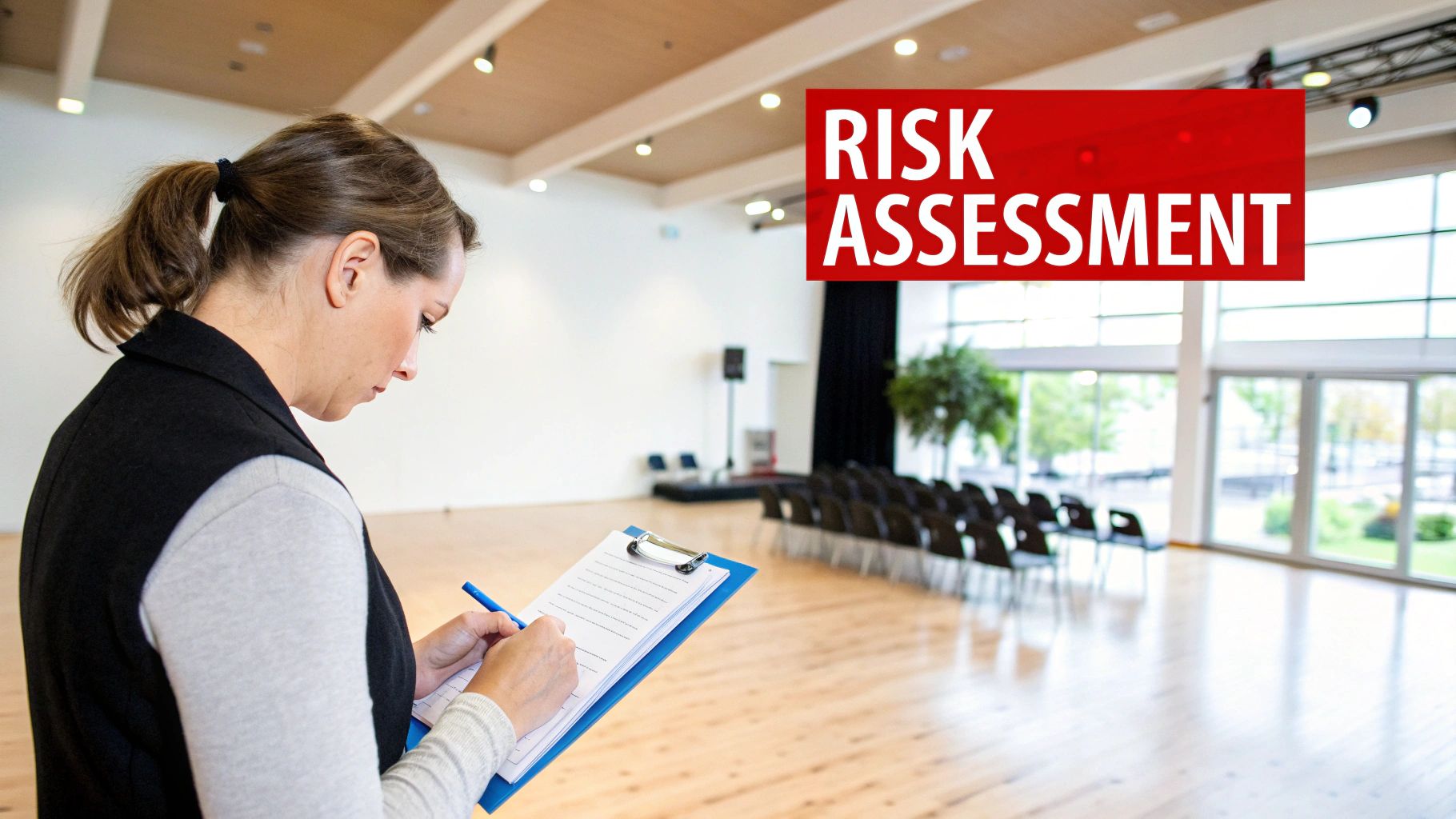
A proper risk assessment is more than just a box-ticking exercise. It's about getting into the nitty-gritty of your event to uncover potential weak spots before they become real problems. This process helps you figure out exactly what kind of security you need, where you need it, and how much of it is necessary.
Think of it as the blueprint for your entire security operation. Without it, you’re just throwing guards at a problem without a clear purpose. A detailed assessment is your best tool for creating a safe environment for your guests, staff, and performers.

Key Factors to Analyse
Every event is different, which means every risk assessment will be unique. A massive music festival's security plan will look completely different to that of an intimate corporate gala. The festival might focus on crowd surges and thorough bag checks, whereas the gala might need more discreet VIP protection and strict access control.
To get started, walk through your event from every angle. Consider these factors:
- Venue Layout: Map out every single entry and exit point. Don't forget the less obvious ones like loading docks, side doors, or even large windows. Pinpoint any areas where crowds might get congested, creating potential choke points. Actionable Insight: Use a venue floor plan to mark potential trouble spots in red. This visual aid is invaluable when briefing your security team.
- Attendee Demographics: Who's coming? A rowdy university crowd brings different challenges than a family-friendly fair or a room full of high-profile executives. The makeup of your audience directly impacts everything from potential alcohol-related issues to the need for medical support.
- Event Type and Activities: If you’re serving alcohol, you automatically introduce a new layer of risk. Is there live music? You’ll need to think about noise levels and the possibility of people trying to get on stage.
- Time of Day: An event that runs into the night has to deal with poor lighting and the increased likelihood of intoxicated guests. A daytime event, on the other hand, might have different concerns, like heatstroke or managing large family groups.
From Identification to Mitigation
After you’ve listed all the potential risks, it’s time to decide how you’re going to deal with them. This is where your plan becomes actionable.
Practical Example: If you've flagged an unsecured service entrance as a major vulnerability during your assessment, your mitigation strategy is simple: station a dedicated guard there for the entire event duration. As you build out your plan, remember to cover all bases. This includes understanding what a fire risk assessment entails, because fire safety is a non-negotiable part of keeping any venue secure.
A well-executed risk assessment is the difference between reactive chaos and proactive control. It provides the intelligence needed to deploy security personnel with purpose, ensuring every guard is positioned for maximum impact.
How to Properly Vet a Company When You Hire Security for an Event
Picking the right security partner is easily one of the most critical decisions you'll make when organising an event. It’s about much more than just comparing quotes. You're searching for a team that can genuinely protect your attendees, your assets, and ultimately, your reputation. The only way to sort the seasoned pros from the cowboys is to put them through a rigorous vetting process.
Your first move is to check the non-negotiables: their licences and insurance. Every state has different rules, and any legitimate company will have this documentation ready to go, no questions asked. Think of this as the absolute baseline—if they can't clear this hurdle, they're not even in the running.
Verifying Essential Credentials
Before you get into the nitty-gritty of costs and staffing, you need to see proof of their licences and insurance. These aren't just bits of paper; they're your safety net. Partnering with an uninsured or unlicensed operator exposes your event to massive liability.
Here in Australia, the licensing requirements change from state to state, so you need to know what you're looking for:
- New South Wales (NSW): The company must hold a current Master Licence.
- Victoria (VIC): You're looking for their Private Security Business Licence.
- Queensland (QLD): They'll need to show you a Security Firm Licence.
- Australian Capital Territory (ACT): A Master Licence is also the key document here.
Once you’ve sighted the company’s licence, ask for their certificate of currency for public liability insurance. Don't settle for anything less than $20 million in coverage, as most venues will demand this as a minimum. You should also confirm that their individual guards hold the right qualifications for their roles, especially a Responsible Service of Alcohol (RSA) certificate if you’re running a licensed event.
Asking the Right Questions
With the fundamentals out of the way, it’s time to find out what they’re really made of. A professional security firm will have clear, detailed answers to your questions about their real-world experience and processes. If you get vague, hand-wavy responses, that’s a huge red flag.
Here are some questions I always ask potential providers to gauge their expertise:
- Event Experience: "Can you talk me through three events you've handled that are similar to mine in scale and style?" You need to know you're not their guinea pig. A team that excels at static retail security might be completely out of its depth at a chaotic music festival.
- Staff Training: "What kind of event-specific training do your guards get on top of their basic licence?" I want to hear about de-escalation tactics, crowd dynamics, emergency drills, and even customer service skills.
- Emergency Protocols: "If we had a medical emergency or a fire alarm, what's your exact procedure?" Their answer should paint a clear picture of their chain of command and how they coordinate with venue staff and first responders.
You can tell a lot about a security company by its processes. A top-tier partner doesn’t just supply bodies in uniforms; they bring a proven system for preparation, communication, and response that’s been battle-tested over years of experience.
By being diligent and asking these tough questions upfront, you can confidently hire security for an event with a partner who has your back. That initial effort is what ensures your event runs smoothly and everyone goes home safe.
How to Calculate Your Event Security Staffing Needs
Figuring out how many security guards you need isn't just about picking a number out of thin air. It's a careful balancing act. Too few guards, and you're gambling with safety. Too many, and you’re just burning through your budget. The goal is to get this right, ensuring every guard on-site has a specific, necessary role.
This isn’t about a magic formula. Instead, it’s about looking at a handful of critical variables that all influence each other. A corporate conference for 500 people has a completely different security profile than a music festival for 10,000. Getting to the right number means taking a hard look at the unique details of your event.
Key Variables That Determine Staffing Levels
To really nail down your numbers, you need to think like a security professional. What are the moving parts of your event that could create risk?
Here’s what I always look at first:
- Headcount: This is your starting point. More people generally means more security, but the ratio isn't always a straight line. The type of crowd matters just as much as the size.
- Venue Size and Layout: Is it a single, contained ballroom or a sprawling outdoor field with multiple entry points and blind spots? You'll need guards for access control, patrols, and to keep an eye on potential choke points.
- Alcohol on the Menu? This is a huge one. Serving alcohol immediately raises the risk profile. Licensed events require guards with Responsible Service of Alcohol (RSA) qualifications to manage intoxicated guests and enforce liquor laws, which almost always means you'll need a higher guard-to-guest ratio.
- What Does Your Risk Assessment Say? Go back to your initial risk assessment. Are there high-profile guests attending? Valuable equipment on site? A history of trouble at similar events? These factors will definitely push your staffing numbers up.
The real secret to effective security isn't just the number of guards you hire; it's where you put them. A well-placed team of five can easily outperform a poorly organised team of ten.
The demand to hire security for an event has never been higher, and for good reason. It’s a crucial part of event management. In Australia, the Investigation and Security Services industry is expected to grow into a massive $13.9 billion market by 2025. This growth is fuelled by the increasing need for professional crowd control and mobile patrols at events across NSW, Victoria, and Queensland. When you bring in a security team, you're partnering with a vital industry focused on public safety. You can read more about the growth of security services on ibisworld.com.
Mapping Out Zones and Ratios
Once you’ve got a handle on the variables, you can start mapping things out. Don't just settle on a total number; think about specific posts and roles. Where do you need static guards, like at entrances or the front of the stage? And where do you need mobile patrols to cover the perimeter or car parks?
This is also where vetting your provider becomes critical. As the diagram shows, a proper vetting process involves checking for current licenses, adequate insurance, and proper training.
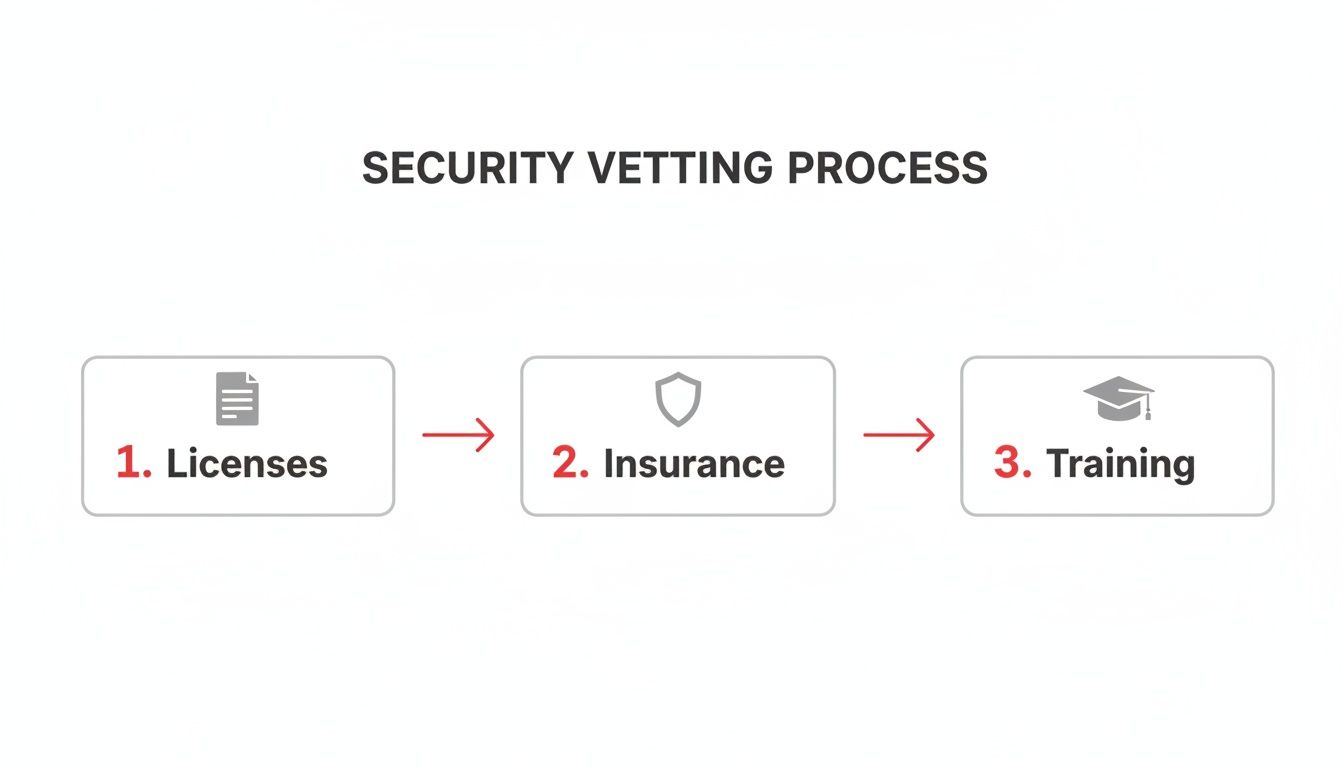

Running these checks ensures the team you bring on board is actually qualified to handle the responsibilities you’re giving them.
The table below provides a general guideline for staffing ratios. Think of it as a starting point to help you frame the conversation with potential security providers.
Sample Security Staffing Ratios by Event Type
| Event Type / Risk Level | Recommended Guard-to-Attendee Ratio | Key Considerations |
|---|---|---|
| Low-Risk (e.g., Corporate Conference, Seminar) | 1 guard per 100-150 attendees | Focus is on access control, professionalism, and asset protection. Alcohol service is minimal or non-existent. |
| Medium-Risk (e.g., Ticketed Concert, Sporting Event) | 1 guard per 75-100 attendees | Alcohol is typically served. Crowd management, bag checks, and stage/field security are priorities. |
| High-Risk (e.g., Large Music Festival, Public Protest) | 1 guard per 50-75 attendees | High potential for intoxication and crowd surges. Requires a robust command structure, perimeter security, and a dedicated response team. |
Remember, these are just guidelines. Your specific venue, audience demographics, and local regulations will all play a part in determining your final numbers.
Real-World Scenarios
To see how this works in practice, let’s look at two very different events.
Corporate Conference Scenario:
Imagine a 500-person tech conference held in a hotel ballroom. The main concerns here are access control and maintaining a professional atmosphere. A solid plan might look like this:
- 2 Guards: Stationed at the main registration desk to check credentials and direct attendees.
- 1 Guard: Patrolling the breakout rooms and common areas to provide a visible presence.
- 1 Supervisor: The central point of contact for you and the venue, overseeing the team.
Music Festival Scenario:
Now, let's scale that up to a 5,000-person outdoor music festival. The complexity jumps significantly. A baseline deployment could include:
- 8 Guards: At the main entrance for comprehensive bag checks and ticket scanning.
- 4 Guards: Positioned at the stage barrier to manage the crowd.
- 6 Guards: Constantly patrolling the site perimeter to prevent unauthorised entry.
- 4 Guards: A dedicated mobile response team, ready to handle incidents anywhere on site.
- 2 Supervisors: Each overseeing different zones to ensure full coverage.
As you can see, the event's context is everything. These examples show how to hire security for an event with a strategy that truly fits the situation, rather than just a one-size-fits-all approach.
Getting a Security Quote You Can Actually Trust Starts With a Great Brief
If you’ve ever tried to hire security with a vague request, you already know the result: a vague, unhelpful quote. To get proposals that you can actually compare, you need to give potential security partners a brief that leaves no stone unturned.
This isn't just about getting an accurate price tag. A solid brief sets the operational standard from day one and becomes the foundation for your entire security plan. It’s your chance to get on the same page about everything—from guard duties to uniforms—long before anyone sets foot on-site. Think of it as the blueprint for a safe event.
What to Put in Your Security Brief
Your brief needs to paint a crystal-clear picture of what you expect. The more detail you provide, the less guesswork for the security company, which means a more precise quote for you.
Here are the non-negotiables to include:
-
Be Specific About Guard Duties: Don't just write "crowd control." Instead, specify exactly what you need. Think in terms of tasks like, "conduct bag checks at the main entrance," "use a clicker to maintain an accurate headcount," or "patrol the back-of-house service corridor every 30 minutes."
-
Map Out Your Post Assignments: A simple venue map with an 'X' marking each security position is invaluable. Label them clearly (e.g., Post 1: Main Entry, Post 2: Green Room Door, Post 3: Roaming Patrol Zone A). This helps the provider visualise the deployment and staff accordingly.
-
Define the Dress Code: The look of your security team matters. Do you need sharp suits for a corporate awards night or high-vis vests and functional attire for an outdoor festival? Be explicit. The uniform should blend in—or stand out—as your event requires.
-
Establish Communication Protocols: How will your team and theirs stay connected? Specify the need for two-way radios on a dedicated channel and outline the chain of command. Who does the security supervisor report to? Make it clear.
Making Sense of the Quote When It Arrives
When quotes start landing in your inbox, you’ll see various line items. Knowing what they mean is key to understanding what you're actually paying for and comparing proposals fairly.
A detailed brief is your best tool for comparing apples with apples. It forces every provider to quote on the exact same requirements, so you can see who offers the best value, not just the lowest price.
You’ll likely come across terms like these:
-
Supervision Fees: This is a common and important one. It usually covers the cost of an on-site supervisor who manages the guard team, serves as your main point of contact, and handles any issues that pop up.
-
Specialised K9 Services: If your event requires a detection dog unit, this will be listed as a separate, higher-cost item. It covers the highly trained handler and their canine partner.
-
Vehicle Patrols: For events spread across a large area, like a festival with sprawling car parks, you might see a fee for a marked patrol vehicle. This is for covering large distances efficiently.
By investing the time to write a comprehensive brief, you're not just asking for a price—you're taking control of your event's security. That clarity is the first step toward a safe and successful event for everyone involved.
Managing On-Site Operations and Post-Event Review
You’ve signed the contract and your security provider is booked. While the bulk of the planning might be done, the real test begins on event day. Getting on-site management right is all about clear communication and a rock-solid command structure.
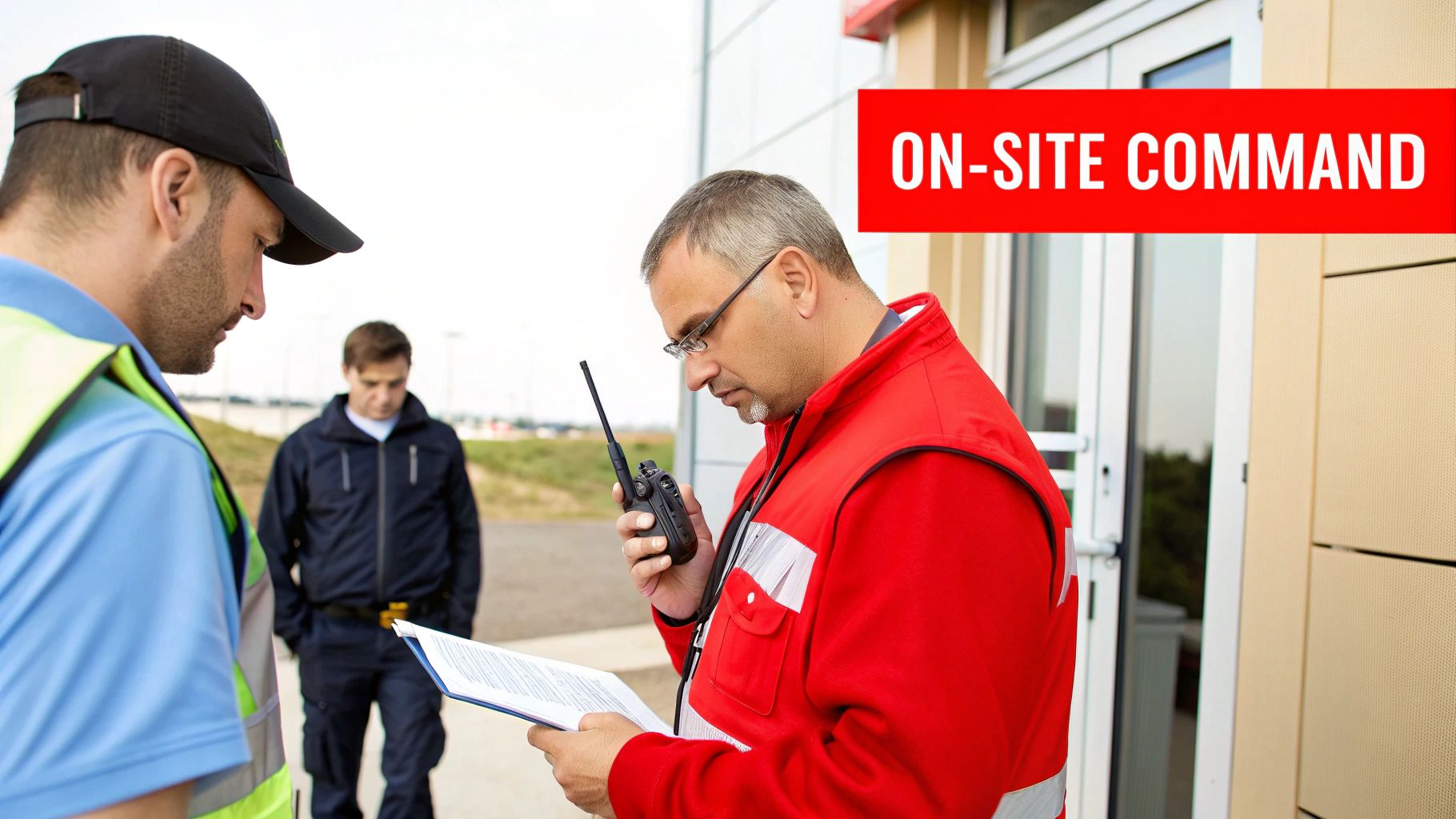
Your security supervisor is your go-to person on the ground. Make it crystal clear to your own event staff who that person is and how to get information to them—fast. No confusion, no mixed messages.
Before a single guest arrives, you need to run a pre-event briefing. This is non-negotiable. It's more than a quick chat; it's where you get everyone on the same page. Walk the team through the venue map, confirm who is stationed where, and double-check that every radio is working. I always like to run through a few "what-if" scenarios, like a medical emergency near the main stage or a sudden downpour causing a rush for shelter. It ensures everyone knows their exact role when things get hectic.
Establishing Clear Command on Event Day
When an incident kicks off, the last thing you want is confusion. A clear chain of command stops that from happening. Your event manager, the security supervisor, and the venue manager should operate as a tight-knit leadership team. All crucial communication needs to flow through them.
Practical Example: If a bar manager notices a patron becoming aggressive, they shouldn't just grab the nearest guard. The report should go to your event manager, who then directs the security supervisor. This structure prevents guards from getting conflicting orders from five different people at once, which can quickly turn a small problem into a big one.
The Importance of a Post-Event Debrief
Once the last guest has filtered out, your work still isn't finished. This is the perfect time to sit down with your security supervisor for a post-event debrief. This is how you transform a one-off hire into a valuable, long-term partnership and gather intel to make your next event even tighter.
The stakes at Australian events are incredibly high. Between 2010 and 2015, music festivals saw a tragic 12 fatalities and more than 100 injuries, a stark reminder of what can happen when security isn't up to scratch. Proactive management is everything, and your post-event review is a massive part of that. You can find more detail about Australian event security challenges on shieldcorporatesecurity.com.
During your debrief, make sure you go through every single incident report. These documents are the official record of everything that went down, from a simple first aid request to a difficult ejection.
An incident report isn't about pointing fingers. It's a data-driven tool for getting better. By analysing these reports, you can spot recurring problems or weaknesses in your security plan that need fixing before the next event.
Start looking for patterns. Were most of the issues happening in one specific zone? Did a new entry policy cause headaches? This kind of feedback is absolute gold. Use it to sharpen your risk assessment, tweak your staffing numbers, and improve your briefing documents for the next time you hire security for an event. This cycle of review and refinement is what separates the pros from the amateurs.
Frequently Asked Questions (FAQ)
When you're planning an event, sorting out the security can bring up a heap of questions. It doesn't matter if you're a seasoned pro or this is your first time at the rodeo – getting clear answers is key to a solid security plan.
Let's cut through the noise and tackle the most common things event organisers ask. Think of this as your cheat sheet for making smart decisions on timing, costs, and all the legal bits and pieces. After all, you're not just hiring guards; you're building a safety net for everyone involved.
How Far in Advance Should I Hire Security for an Event?
Timing is everything. For a large-scale event—like a festival, major corporate function, or public gathering—you should start the process 3-6 months in advance. This provides ample time for comprehensive risk assessments, site visits, and detailed planning with your chosen provider. For smaller events, 4-6 weeks is often sufficient. Actionable Insight: Book early to secure the best providers, especially during peak seasons, and avoid last-minute logistical headaches.
What Licences Should I Be Looking For?
In Australia, security is regulated at the state level, so the paperwork you need to see depends on where your event is. Any professional outfit will have this ready to show you, no questions asked.
Here’s a quick breakdown:
- NSW: The company needs a Master Licence, and every guard on site must have their own Class 1 licence.
- Victoria: You’re looking for a Private Security Business Licence for the company and an Individual Private Security Licence for each guard.
- Queensland: The business must hold a Security Firm Licence, with individual guards carrying a Security Provider Licence.
Always, always check that the company has the right master or firm licence for the state you're in. Just as important is confirming that every single guard they send to your event is individually licensed and qualified.
Checking licences isn’t just ticking a box. It’s your guarantee that the company is operating legally and their people are properly trained and vetted. Don’t even think about skipping this step.
What's the Difference Between Static Guards and Mobile Patrols?
Think of it like building a defence. A static guard is your fixed line of defence, positioned at a key spot like an entrance, the front of a stage, or a VIP area. Their job is to control access, be a visible deterrent, and keep a close eye on that specific zone.
Mobile patrols, on the other hand, are your rovers. They’re constantly moving, covering the entire venue – the perimeters, car parks, and all the spaces in between. They are absolutely crucial for monitoring large areas, getting to incidents quickly, and spotting potential weak points that static guards can't see. A robust security plan will use a strategic mix of both for total coverage.
Can I Ask for Guards with Special Skills like First Aid?
You absolutely can, and you absolutely should. A good security company will have a roster of guards with different qualifications to suit your event's specific risks.
For any event serving alcohol, you should insist on guards who hold a Responsible Service of Alcohol (RSA) certificate. It’s a must for both compliance and safety. Many guards are also trained in First Aid and CPR, which can be a literal lifesaver. If you're hosting high-profile guests, you can even ask for guards with experience in VIP protection or advanced de-escalation training. Just make sure to list these "must-haves" in your initial brief so they can build the perfect team for you.
At GM GROUP Services, we provide multi-award-winning, licensed security solutions tailored to your event's unique needs across NSW, VIC, QLD, and the ACT. From static guards to K9 units, our expert team ensures your event is safe, successful, and secure. Partner with us to protect your people, property, and reputation by visiting https://www.gmgroupservices.com.au.