


It's 6:40 on a Tuesday. Three utes are stacked at the boom gate, a courier is idling behind them with no booking, and the first concrete truck is due at seven. The officer on the post has a clipboard, a radio and a phone that hasn't stopped ringing since the shift started.
That's where gatehouse security gets decided, in a twenty-minute window where every call is made fast and half of them never get written down. Most sites judge the post by whether anyone slipped through. The better question is whether movement stayed controlled when demand spiked. A gatehouse that refuses a dozen people but pushes a queue onto a public road, or blocks a fire route for eight minutes, has failed at the thing it exists to do.
This guide treats the gatehouse as three problems at once: a licensing problem, a privacy problem and a throughput problem. What follows is what each site type needs from its post, how to size staffing against peak volume rather than habit, which tools earn their place, how to process deliveries without strangling the driveway, and the five gaps that cost operators the most.
Gatehouse Security Roles by Site Type
Gatehouse security is a controlled access-and-verification post, and what it verifies changes with the site behind it. A uniform tells you nothing about the job. The table below sets out what each common site type needs from its gate.
| Site type | Core gatehouse duties | Typical staffing model | Main access focus |
|---|---|---|---|
| Construction site | Induction checks, worker and vehicle logs, delivery booking, after-hours patrol | Static gatehouse in working hours, mobile patrol after hours | Induction status and licence checks |
| Residential estate | Resident and visitor verification, vehicle registers, perimeter patrol | Static gatehouse in peak hours, patrol at other times | Gate access tied to the resident register |
| Commercial or multi-tenant office | Tenant and visitor sign-in, reception handover, after-hours access | Staffed reception or gatehouse with on-call relief | Badge access combined with visitor passes |
| Industrial facility | Driver and vehicle verification, dock scheduling, restricted-zone exclusion | Gatehouse covering shift changes and deliveries | Restricted-zone permissions and load checks |
| Event or venue | Entry screening, crowd flow, emergency route protection | Ratio-based crowd controllers at each entry | Entry lanes, overflow area and pass checks |
Four duties sit on every post in that table, whatever the site type:
- Arrival checks. Someone confirms the person, the vehicle and the reason for entry against a record rather than a memory.
- Registration. Visitors, contractors and deliveries get written down, along with the host or work order that authorised them.
- Escalation. The officer knows which supervisor to call and what threshold triggers the call, so the decision doesn't depend on how confident the guard feels at 7 a.m.
- Decision logging. Approvals and refusals are recorded the same way, because after an incident the refusals matter as much as the entries.
Where the jobs diverge is what the post does after the arrival check. Construction posts run on induction records and delivery bookings, so the guard matches a worker to a site induction and a truck to a slot. Estate posts run on a resident register, which makes the visitor pass the central artefact. Commercial buildings run on badge data and a reception handover, while industrial sites run on restricted-zone permissions and load checks at the dock. Venue posts run on lanes, passes and crowd flow, and they carry the tightest staffing arithmetic of the five.
Where the licensed duties stop
Queensland draws the line clearly, and it's worth reading even if you operate elsewhere because the logic travels. The Queensland Government's guide to crowd controller duties confirms a crowd-controller licence covers screening entry, monitoring or controlling behaviour and removing people for bad behaviour at licensed premises, public sporting events, restaurants and shopping centres. The same licence does not authorise the worker to carry firearms, handcuffs or batons.
That's a practical limit on how the post enforces anything. Control comes from identification checks, visitor registers, radio communication, barriers, lighting, CCTV and a documented escalation path, not from equipment. A guard verifying a worker's identity and induction status, recording the vehicle and destination, and calling the site manager when access conditions aren't met is doing the licensed job exactly as intended.
The question to settle before the next shift is simple. Which of these duties does my site need, and which post covers them when the gate officer takes a break?
Staffing Models and Rostering Ratios
Ratios end an argument about headcount faster than any staffing review. The only Australian ratio I'd quote with confidence is Queensland's, and only for the venues it governs.
| Patron numbers | Crowd controllers required |
|---|---|
| 1-100 patrons | 1 |
| 101-200 patrons | 2 |
| 201-300 patrons | 3 |
| 301-400 patrons | 4 |
| 401-500 patrons | 5 |
| Over 500 patrons | 5, plus 1 for every additional 250 patrons or part thereof |
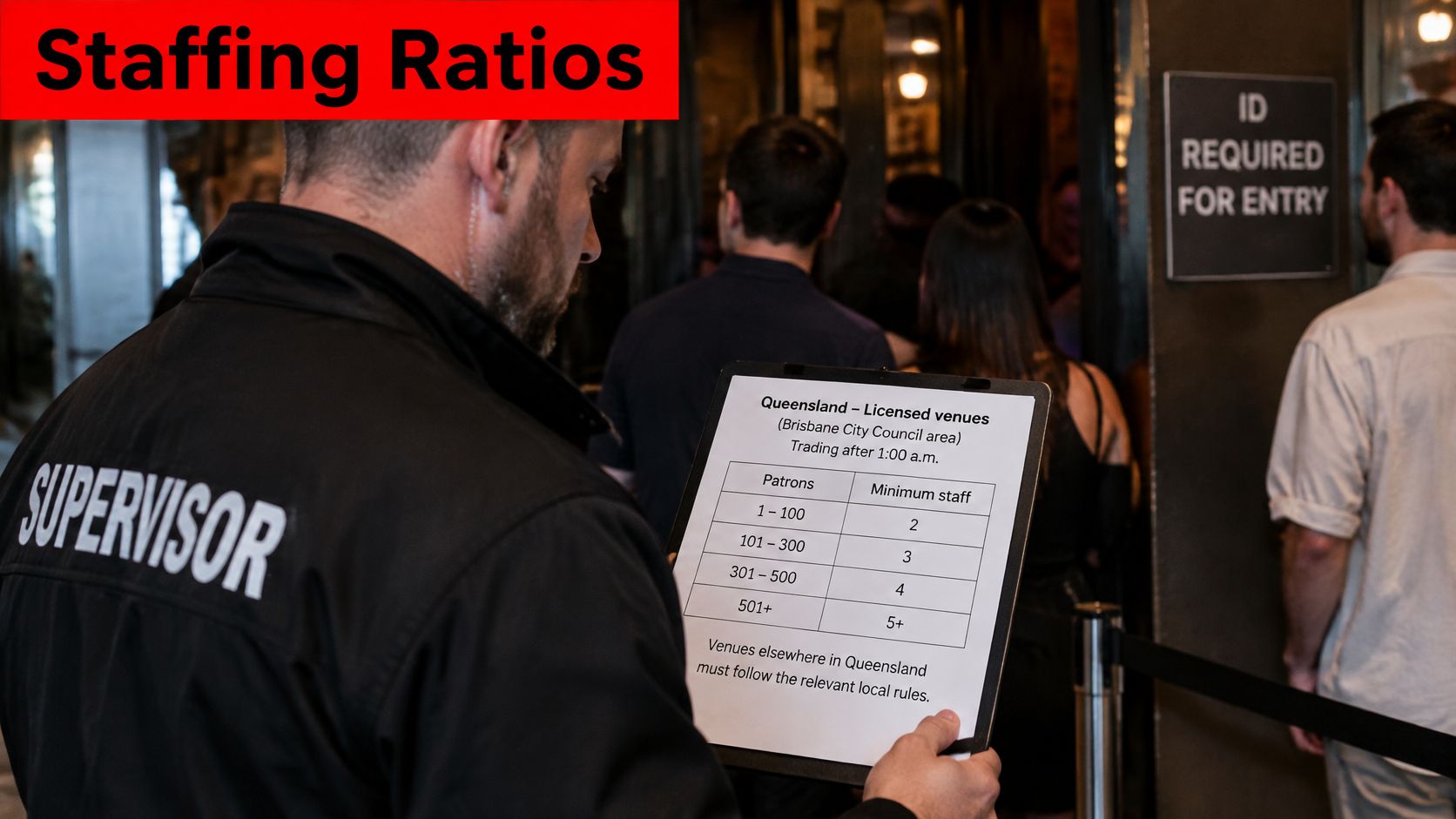
Those figures come from Queensland's liquor licensing guidance on security staff, which applies to licensed venues in the Brisbane City Council area trading after 1:00 a.m. The same guidance requires crowd-controller surveillance from 11:00 p.m. until at least one hour after closing, including the 30-minute closing grace period. Venues outside Brisbane follow the conditions attached to their own liquor licence, which may be tighter or looser than the table.
Then apply the numbers to peaks, not averages. A venue expecting 350 patrons at peak needs four controllers under that table, and a supervisor who rosters exactly four has left nobody to cover a meal break or a walkout. The fifth body is the relief.
Cross a border and the arithmetic moves. Western Australia's security licensing conditions set a different benchmark for nightclubs trading after 1 a.m.: two crowd controllers for the first 100 patrons, plus one for each further 100 patrons or part thereof, monitoring patrons entering and leaving from around 8 p.m. until an hour after trading ends. Same country, different sums. Never carry a ratio across a state line.
A supervisor should be able to recite the ratio that governs the venue without looking it up, and know where the printed copy sits.

Sizing posts that no ratio covers
Nothing in Australian regulation sets a ratio for a construction gatehouse or a residential estate entry, so you size those from throughput. Count vehicles or workers per hour, find the arrival window that matters and count the entry lanes.
Say a site receives 60 vehicles in a 30-minute morning peak across two lanes. That's a vehicle every 30 seconds, which is only achievable with both lanes staffed and a relief officer who can step in without closing one. One officer on one lane at that volume either waves people through unlogged or builds a queue on the street.
Building a roster that survives a shift change
The structure that works is dull. A static post covers arrival and departure peaks, a relief officer absorbs breaks, a 15-minute overlap at shift change lets the outgoing and incoming officers speak in person, and a signed handover log records open items rather than just a signature.
Handover is where most gatehouse procedures quietly die. Two officers who never overlap produce two versions of the rules, and the version that runs at 3 a.m. is the one nobody wrote down.
The handover log should carry the same fields as the register, so a supervisor can check the roster against the record at the end of the week. A scheduled shift with no matching entry is a conversation, not a paperwork gap.
Gatehouse Security Tools Compared
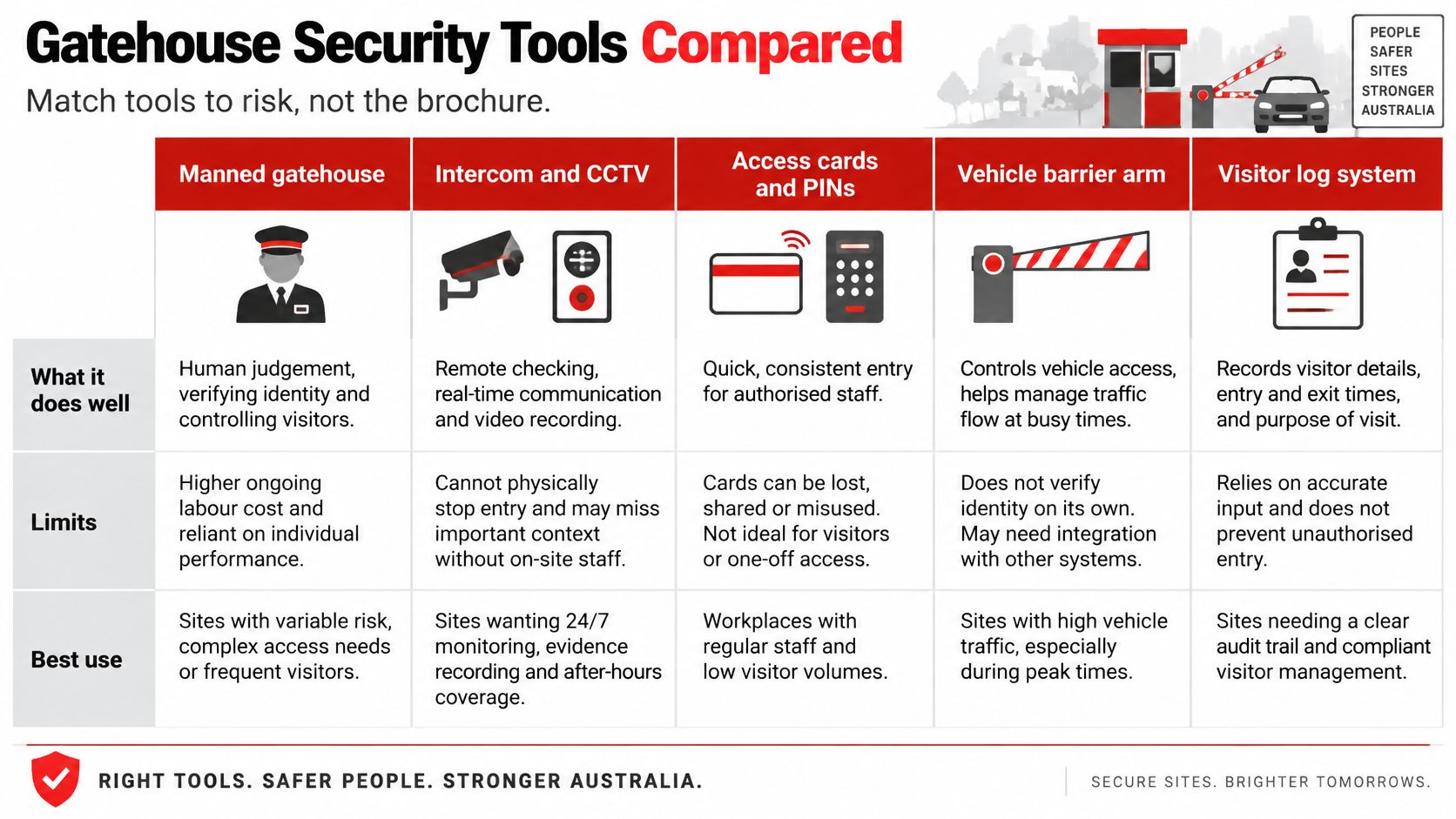
Match tools to risk, not to the brochure. A barrier arm, a visitor log and a working radio solve a great many construction gates. Adding a biometric lane to that same gate introduces a sensitive-information obligation the site manager never asked for, and it still doesn't fix a missing delivery booking.
The comparison below puts the common options side by side on the same criteria, so you can see where each one earns its place.
| Option | Best use | Privacy cost | Staff time | Fit |
|---|---|---|---|---|
| Photo ID check | Construction and visitor flows | Low | Moderate | Lowest-intrusion default |
| Temporary pass | Visitors and contractors | Low | Low | Expires at a set time |
| Vehicle register | Residential estates | Low to moderate | Low | Ties vehicles to residents |
| Escort rules | Restricted zones | Low | High | Limits movement beyond the gate |
| Targeted CCTV | Gate, delivery bay, pedestrian lane | Moderate | Low | Covers entry points, not the whole site |
| Card or PIN access | Staff and tenant areas | Moderate | Low | Needs a log deletion schedule |
| Biometric entry | High-volume controlled sites | High | Moderate | Needs necessity test, notice and privacy-impact assessment |
Read across the rows rather than down the columns. Photo ID checks and temporary passes keep privacy cost low and put the work where a gate officer can do it, which is why they remain the default for visitor and contractor flows. A vehicle register only earns its keep when a plate ties back to a resident or a booking; otherwise it's a list of strangers' cars. Escort rules buy the strongest control over restricted zones at the highest staff cost, because somebody has to walk with every visitor. Targeted CCTV on the gate, delivery bay and pedestrian lane delivers most of the evidential value without recording the whole site.
Card and PIN access sits in the middle. It suits staff and tenant movement, but the log it generates needs a deletion schedule or it becomes a permanent record of who entered a building and when. Biometric entry needs its own scrutiny. The Office of the Australian Information Commissioner classifies biometric templates and facial images used for automated identification as sensitive information under the Privacy Act, and notes that facial-recognition systems can collect information about every person scanned, including non-matches.
The four questions to answer before you buy
- Necessity and proportionality. Can the gatehouse do this job with a photo ID and a pass, and if not, why not?
- Notice. Does a person arriving at the gate know what's being collected and why, in plain language, before it happens?
- Assessment. Has a privacy-impact assessment been completed and documented, with accuracy and bias controls for any automated matching?
- Deletion. What gets deleted after an incident, and what happens to a contractor's data when the job ends?
If CCTV is part of the mix, specify it for the gate, the delivery bay and the pedestrian lane, and compare models on low-light performance and retention before you commit. This roundup of the best Dahua security cameras 2026 is a reasonable starting point for that fixed-coverage comparison.
The rule of thumb I'd give any site manager is boring but reliable: start with the lowest-intrusion option that solves the problem, and add technology only when the gatehouse can justify the collection and govern what it holds.
How to Process Deliveries and Contractors
Deliveries break gatehouses more often than intruders do. They arrive when the site is busiest, the booking lives in a project manager's inbox, and the driver has nowhere to wait except the street.
The flow below is the shape a delivery procedure should take, and the steps underneath it are what the gatehouse does.
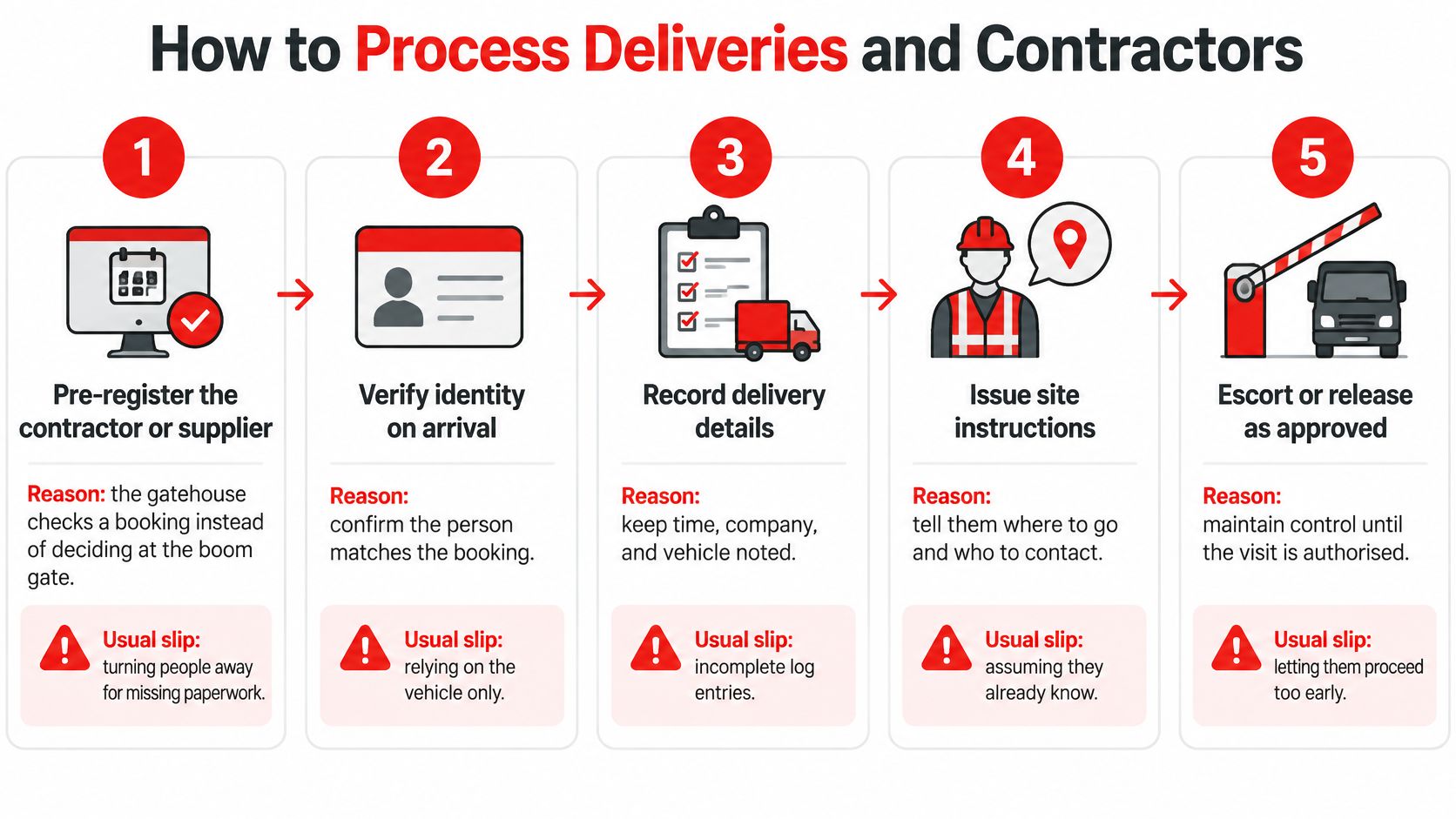
- Pre-register before arrival. The gatehouse should be checking a booking, not deciding at the boom gate whether a truck looks legitimate. The usual slip is a booking that never reaches the gate, which parks the driver on the public road while somebody rings around to confirm.
- Verify identity against the register. Name, company, photo ID where the site requires it, and for contractors the induction status. The slip is accepting a verbal name because the driver is in a hurry and the queue is building behind him.
- Check the vehicle, load and destination. Plate, company signage, what's on board and where it's going. A mismatch between the booking and the vehicle is the earliest warning you'll get, and it's cheap to check.
- Issue a pass that states the area and the time. A pass without an expiry is a permanent key, and it will still be in someone's pocket next month.
- Route to the correct lane. Keep worker, supplier and public flows apart, with protected pedestrian paths and fencing that closes the bypass routes.
- Log the decision while it's fresh. Time, reference, decision, escort destination, and the reason for any refusal or delay, in a live exception log rather than a notebook at the end of the shift.
- Reconcile on exit. Close the pass, record departure, and note whether the load left as it arrived. This is the step that turns a sign-in sheet into a register.
Take a site with 40 trucks in a morning delivery window. Pre-booked trucks clear in set slots, and an unbooked truck waits in a marked overflow area until its booking is confirmed rather than blocking the lane. When the overflow fills, the gate stops accepting new arrivals and calls the site manager, which is a procedure, not a crisis.
The NSW Government's event safety and security guidance treats the gatehouse as a controlled access-and-verification point rather than a staffed entrance. It recommends clearly identifying authorised personnel, controlling vehicle access during road closures or restricted parking, and preventing access to high-risk zones such as cash-handling, food-preparation and hazardous-material areas. The layered approach it describes is pre-registering staff, contractors and suppliers, issuing role- or zone-specific credentials, verifying identity and vehicle details at arrival, maintaining a live exception log, and closing bypass routes with fencing, signage and trained personnel.
For large events, the same guidance draws on Safe Work Australia's expectation of separate entries and exits for workers and participants, sufficient gates, clearly marked exits, timely gate opening, adequate security staffing and designated areas for bag or identification checks.
Set a queue target and hold it
Stricter screening can make a site less safe when it piles people into a dense queue outside the controlled perimeter. The objective isn't maximum friction, it's safe throughput matched to the threat level. Set a target queue time, an overflow area and a rule for when the gate slows intake, then measure queue length by five-minute interval during peaks.
A queue that spills onto a road or across an emergency route trades one risk for a worse one. Screening has to fit inside the layout you've got.
A healthy gate at peak looks unremarkable. No queue on the public road, every vehicle logged, emergency routes clear, and a gate officer who can tell you which trucks are still on site without leaving the post.
Licensing, Records and Compliance Obligations
A gatehouse becomes an auditable function the day you can show who was on the post, what they were authorised to do and what they recorded. Everything below produces something you can hand to an inspector, a client or a coroner.
Licensing is still a state-by-state question
Australian security licensing didn't arrive in one piece. The Australian Institute of Criminology's review of private security regulation records that Victoria's licensed security firms and guards almost doubled between 1980 and 1990 while licensed inquiry agents tripled, that NSW introduced expanded selective licensing in 1985 with Victoria and Queensland following in the early 1990s, and that Western Australia, South Australia and NSW moved toward broader frameworks in the mid-to-late 1990s.
The practical consequence is that an officer licensed for a Queensland venue post isn't automatically compliant on a Victorian construction gate. Verify the category, the training and the supervision rules in each state or territory before a procedure gets written, and keep the check on file.
What the identification and training rules require
Queensland's guidance on ongoing requirements for crowd controllers sets a visible standard worth copying anywhere. Venue-issued identification is worn at chest level and can't be an armband or lanyard, it must show the word SECURITY in capital letters at least 10 millimetres high and 2 millimetres thick, plus a unique number with characters at least 30 millimetres high and 4 millimetres thick. Training continues after licensing too: conflict and security-risk negotiation, empty-hand control techniques, and standard or advanced first aid every three years, with evidence submitted at least two months before licence expiry.
That translates directly into a start-of-shift check: ID visible and correct, licence current, radio tested, emergency contacts confirmed, first-aid cover named on the post. If any line fails, the officer doesn't work the gate unsupervised.
The register that survives an inspection
Queensland's requirements for security and incident registers apply to licensed venues that employ crowd controllers. The register records the controllers employed and incidents involving controllers and patrons, uses sequentially numbered pages, is written in ink and stays legible, controllers sign in and out for each shift, and the records may be requested during a compliance inspection.
A gatehouse register following that model should capture the guard's name or unique ID, arrival and departure times, assigned post, significant access events, refusals, incidents and handover notes. Store it securely, and have a supervisor review it before the shift closes rather than at month end.
Costly Gatehouse Gaps and How to Close Them
Gatehouse failures usually come from gaps nobody was measuring, not from too few guards on the gate. Five show up again and again.
- Cameras with no live exception log. Footage proves something happened, but it can't tell you why the officer made the call. The fix is a log written at the time, with a field for the reason, reconciled against footage after each shift.
- Headcount set by habit. Two guards on a gate carrying a heavy morning peak, and two on a gate that sees a handful of vehicles all day, is a budget decision dressed up as a staffing plan. Size the post from peak volume and lane count.
- Unlicensed or untrained people on a licensed post. The licensed workforce keeps growing: individual licence numbers rose 6.10% to 167,530 in the year to 2024, and individual security licence holders nationally increased by 19,801, or 13.4%, between 2019 and 2024, according to the ASIAL security industry licensing report. A large pool of licence holders is not a national standard, because categories and requirements still differ between jurisdictions. The fix is a start-of-shift licence check, not a photocopy in a drawer.
- Visitor data with no retention schedule. Every name, plate and scan you hold is an obligation. Decide what's deleted after an incident and after a contractor's job ends, and document who can access records while they exist.
- Success measured by refusals. A gatehouse that turns away a steady stream of people while a queue builds onto the road hasn't had a good shift. Controlled throughput is the measure.
What to track instead of refusals
| Metric | What it reveals | How to capture it |
|---|---|---|
| Queue time by five-minute interval | Whether screening is creating a hazard outside the perimeter | Timed counts at the entry lane during peaks |
| Time to authenticate a replacement contractor | How long the register takes to use under pressure | Timestamp at arrival against approval time |
| Share of emergency routes kept clear | Whether access control is compromising egress | Walk the routes each shift and note blockages |
| Radio acknowledgement time | Whether the post can reach a supervisor when it matters | Spot checks during peak periods |
| Tailgating attempts | Whether the physical layout defeats the screening | CCTV review at the lane, weekly |
| Time from alarm to lockdown or controlled reopening | Whether the procedure works when it's tested | Timed drill, with the result recorded |
The test I'd apply to any gatehouse is this. When a surge, an evacuation or a hostile vehicle concern lands on the post, does the officer know which lane to close, who to call and how quickly they can reopen under control?
Each of the five gaps has a fix that costs less than a guard shift: a log field, a peak count, a licence check, a deletion date and a new metric. Run the table above for a fortnight before you spend anything. The numbers will tell you which of the five is yours, and most sites find the expensive problem is not the one they assumed.
Gatehouse Security Questions Answered
Does a gatehouse always need a licensed guard?
It depends on the duties rather than the title. Screening, crowd control, access decisions and removing people usually need licensed staff, while pure reception work may not. Check the state rule for the specific task, then write the task list before you write the roster.
Can a gatehouse refuse entry?
Yes, when the access conditions aren't met, and the refusal should be logged and escalated to a supervisor the same shift. Stay inside lawful powers, which means no detention, no restraint and no equipment the licence doesn't cover. Confirm your escalation threshold with the site manager before it's needed.
Is biometric access allowed at a gatehouse?
It can be lawful, but only with documented necessity and proportionality, clear notice, a privacy-impact assessment and a retention schedule, as the OAIC factsheet on facial recognition technology and privacy sets out. Start with lower-intrusion options first. If a photo ID and a pass solves it, the biometric system is an unnecessary risk.
How many guards does a site with one gate need?
The count follows volume, not gate numbers. Size the post from peak arrivals and the ratio or throughput figure that applies to you, then add relief so breaks don't close a lane. Recheck the calculation whenever the site's peak changes, because most rosters are sized once and never revised.
Confirm Your Gatehouse Security Plan Before the Next Shift
Four checks close most of the distance between a gatehouse that looks staffed and one that functions.
- Map the site type and its duties. Use the first table, name the duties your post performs and put them in post orders the incoming officer can read.
- Calculate peak volume and set the post count. Apply the ratio that governs your venue, or the peak arrival count for posts with no ratio, then add relief for breaks.
- Choose the lowest-intrusion tools that close each gap. Confirm the privacy test has been applied before any biometric or visitor-data system goes live, including its deletion schedule.
- Confirm the paperwork is current. Licences, visible ID, training records and a register that a supervisor reviews before the shift closes.
If that review points toward outsourcing, GM GROUP Services provides gatehouse security across New South Wales, Victoria, Queensland and the ACT, and we work closely with clients to understand their sites, their customers and their security requirements. We hold a NSW master security licence as required by law, along with licences in Queensland, Victoria and the ACT. You can request a quote or call 1300 14 14 41 or 0499 020 304 to discuss requirements, or ask for a confidential discussion about your needs.
Run the gatehouse in-house or outsource it, whichever you choose, settle it with evidence. The register, queue-time data and licence records will tell you within a fortnight which model is controlling movement.
GM GROUP Services delivers gatehouse security across New South Wales, Victoria, Queensland and the ACT, matching licensed officers and site-specific procedures to the way your site operates, from construction inductions and delivery lanes to venue entry points. If you're weighing in-house coverage against a managed post, we can review staffing against your peak volumes and put the licensing and record-keeping in order before the next shift. Visit GM GROUP Services to start the conversation.