


Exhibition security services become difficult the moment a busy hall stops behaving like a simple room with staffed doors. Delegates arrive while contractors are still moving equipment, exhibitors need access to restricted areas, alcohol service changes the risk profile, and venue management expects every incident to be handled consistently and documented properly.
The practical mistake is to buy a number of guards before deciding who controls each door, which roles require licensing, how alcohol-related behaviour will be managed, how emergency decisions will be made, and what evidence will be recorded. In Australia, exhibition security operates within a mature, licensed private-security sector shaped by state laws, venue rules and special-event powers, not an informal exhibition-only workforce. ASIAL's national security industry publication describes that state-based regulatory environment, while GM GROUP Services cites a private security market generating more than $11 billion in annual revenue and employing over 180,000 people, a workforce base that supports events across NSW, Victoria, Queensland and the ACT.
The right buying decision is therefore an operating-model decision. Guard numbers matter, but they sit inside a wider system of authority, access control, crowd movement, alcohol coverage, emergency coordination, incident evidence and post-event reporting.
Why Exhibition Security Services Need a Complete Operating Model
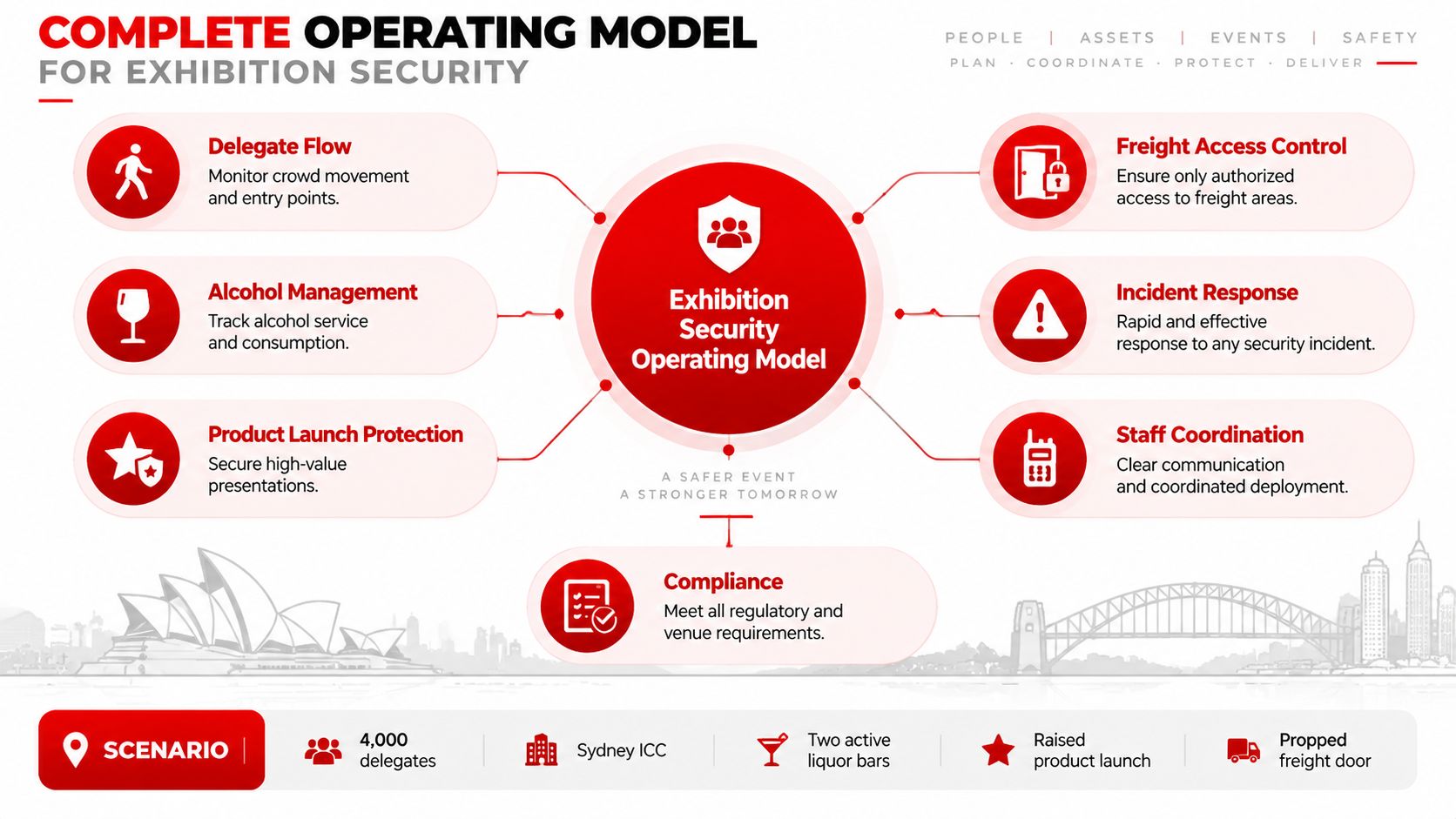
A trade show at Sydney ICC is moving 4,000 delegates through a hall. Two liquor bars are active, a high-value product launch is taking place on a raised platform, and a freight door has been propped open during exhibitor move-in. An organiser who has bought security by headcount may see a staffed public entrance and assume the main problem is solved.
The gaps appear quickly. Contractors enter through an unmanaged freight route, patron flows conflict near the product launch, an intoxicated visitor causes a disturbance without a documented response, and the venue duty manager later asks for an after-action report that nobody has prepared. The visible guard presence hasn't created control because the team lacks defined authority, escalation rules and evidence procedures.

What the operating model contains
A complete model combines:
- Authority: Who can refuse entry, remove a person, close a route or escalate to venue management?
- Licensed roles: Which personnel are crowd controllers, access-control officers, guards, supervisors or RSA-focused staff?
- Alcohol management: How will staff identify intoxication, support responsible service and manage a refusal or disorder?
- Emergency coordination: Which radio channel, control point and escalation pathway will operate during a medical event, evacuation or security threat?
- Incident evidence: Who records times, locations, witnesses, actions, CCTV references and near misses?
- Post-event reporting: Who receives the report, what decisions require review, and how will the next event be adjusted?
That structure also explains why Australian exhibition security has become more formalised. NSW's Security Industry Regulation 2016 covers functions such as ticket inspection, entry screening and crowd control, while the ACT's Security Industry Act 2003 provides a legislative basis for licensing and regulating security work. The 2024 Security Exhibition & Conference reported 11,330 combined total attendance and 4,781 security-specific attendance, with visitor figures audited by the Audited Media Association of Australia, reflecting a market where security is treated as a specialist function involving access control, risk and compliance. The event's post-show report provides that audited context.
Practical rule: Ask what the security team must control, decide and document before asking how many people it needs.
Organisers also need to understand the wider exhibition operation. A specialist resource such as exhibition services can help coordinate the event environment, but security authority still needs to be agreed with the venue, organiser and appointed provider. The venue, insurer and regulator will ultimately evaluate whether the controls were appropriate, authorised and documented, not whether the quote contained an impressive guard count.
Core Exhibition Security Services and Their Roles
Effective exhibition security services work as connected functions rather than a flat list of uniformed posts. Start with the movement of people, then add protection for restricted areas, assets, staff and emergency response.
Crowd controllers set the public rhythm
Crowd controllers manage queues, entry approaches, aisle congestion and behavioural incidents. Their value isn't limited to standing at a door. They watch how people move, identify a bottleneck before it becomes a pressure point, and keep emergency routes clear while maintaining a welcoming experience.
Victorian public-event guidance links crowd control with preventing overcrowding, managing access and exits, and supporting first aid and evacuation. For licensed events, it recommends at least two crowd controllers for the first 100 patrons and one additional controller for each extra 100 patrons, while lower-risk events may sometimes use one controller per 200 patrons. The Victorian public-event guidance should be treated as a planning reference, not a substitute for a site-specific assessment.
Licensed security officers add depth at access points, contractor entrances and loading docks. They validate credentials, separate public and back-of-house movement, manage inductions and respond when an exhibitor or contractor attempts to enter an unauthorised zone.
Static, mobile and specialist roles add control
Concierge-style static guards suit VIP areas, high-value booths and meet-and-greet zones where a visible but courteous presence protects people and brand reputation. Mobile patrols cover back-of-house corridors, plant rooms, storage cages and perimeter routes, particularly during move-in, move-out and overnight periods.
K9 detection teams can support pre-open sweeps, exhibitor move-in and move-out, or high-density screening where the risk assessment justifies that capability. They shouldn't be added as theatre. The handler, search scope, timing and escalation process must be written into the plan.
| Service Component | Primary Function | Typical Deployment Zone | Authority Level |
|---|---|---|---|
| Crowd controller | Manage flow, queues and behaviour | Public entrances, aisles and choke points | Entry and conduct control within the agreed scope |
| Licensed security officer | Control credentials, contractors and assets | Entrances, loading docks and back-of-house areas | Access, guarding and escalation authority |
| Static guard | Protect people, displays or restricted zones | VIP spaces, product launches and high-value booths | Post-specific control and reporting |
| Mobile patrol | Detect irregularities and support posts | Corridors, storage, plant and perimeter routes | Interception and supervisor escalation |
| K9 team | Conduct authorised detection or sweeps | Pre-open areas, freight routes and selected crowd zones | Specialist search function |
| Response officer | Coordinate incidents and preserve information | Control point or roving response position | Incident leadership under the event plan |
The roles connect in real time. An access controller flags an exhibitor without the required credential, a mobile patrol intercepts the person before they reach a restricted storage area, and the response officer records the incident, checks available evidence and informs the supervisor. The uniform matters less than the function, licence, communication method and authority assigned to that person.
Planning Exhibition Security Through Risk and Venue Constraints
A useful risk assessment should change the deployment plan. If it only produces a generic document, it hasn't done its job.
Start with the event profile
Record the conditions that shape behaviour and exposure:
- Attendance and demographics: Consider expected volume, delegate familiarity with the venue and any accessibility requirements.
- Alcohol service: Identify bars, service periods, RSA responsibilities and routes between licensed areas and public spaces.
- People requiring additional protection: Note VIPs, government representatives, speakers, demonstrators and controversial exhibitors.
- Exhibitor and asset profile: Separate ordinary displays from cash-handling stands, valuable technology, prototypes or sensitive information.
- Operating windows: Map public opening, contractor access, freight movement, bump-in, bump-out and after-hours periods.
Translate those details into a threat profile. Ask where crowd density will rise, when intoxication risk will increase, how theft could occur, whether protest activity is plausible, and where medical demand is most likely to present. Don't assume that a quiet daytime trade show has the same needs as an evening launch with alcohol.
Add the venue before choosing posts
Venue constraints often determine the model more strongly than the attendance forecast. Review entry and exit locations, sterile zones, fire-rated egress, loading-dock separation, CCTV coverage, control-room arrangements and existing venue security. The NSW Government event safety and security guidance treats security licensing and emergency planning as connected responsibilities, not separate paperwork exercises.
Use the Australian National Construction Code and AS/NZS risk principles at a high level, then confirm venue-specific requirements with the venue manager and competent advisers. Don't position a post where it obstructs egress, duplicates a venue function without agreement or leaves a freight route outside the control boundary.
Convert the assessment into deployment
A practical starting point is one licensed guard per 250 attendees, but that ratio is a planning baseline, not a fixed rule. Adjust it for alcohol service, VIP exposure, venue complexity, multiple access zones, overnight operations, freight activity and the presence of specialist roles.
Document the resulting staffing numbers, shift coverage, briefing structure, radio channels, escalation paths and supervisor-to-guard ratios. Victorian guidance demonstrates why density and flow matter, particularly at entrances, exits and choke points, while a venue with efficient segregation and strong CCTV may need a different distribution from a venue with open movement between halls.
The question isn't whether the ratio looks efficient. It's whether every critical decision point has an accountable person and a workable escalation path.
Comparing Exhibition Security Service Packages
A quote that only says “security guards, event hours” isn't enough for a serious exhibition. Compare packages by operating requirement, authority and evidence obligations.
| Package | Typical inclusions | Best suited to |
|---|---|---|
| Baseline | Pre-event planning, licensed access control, roving patrols, emergency escalation and a post-event incident report | Controlled daytime exhibitions with standard entrances, low-risk content and limited alcohol concerns |
| Controlled access | Registration validation, badge or credential checks, exhibitor controls, back-of-house segregation and closer venue coordination | Trade shows, VIP zones, restricted demonstrations and events with multiple access areas |
| High-risk or complex | Static posts, dedicated supervisors, justified K9 capability, rapid response, queue management, crowd control and detailed evacuation coordination | Large crowds, cash-handling exhibitors, political or controversial displays, alcohol service and overnight operations |
The baseline model often fails when an organiser treats contractor access as someone else's problem. The controlled-access package becomes worthwhile when exhibitor credentials, demonstrations or restricted rooms create distinct permissions. The complex model adds supervision and specialist capability where a delayed response, disorder event or unauthorised access would have serious consequences.
Build the quote around hours, posts, responsibilities, equipment, supervision, travel, minimum shifts and after-hours call-out terms. Clarify whether the provider handles initial incident response, requests CCTV preservation, identifies witnesses and produces a written report.
Ask each provider to mark the venue plan. A post list without a deployment map can hide duplicated coverage at public doors while leaving freight, storage or VIP routes exposed. The right package aligns authority and escalation with the exhibition's actual operating conditions, rather than buying unnecessary headcount.
Licensing and Compliance Across Four Australian Jurisdictions
Exhibition security services should be planned as a jurisdictional compliance issue from the first briefing. NSW guidance states that security licensing is mandatory for activities including crowd control, venue control, guarding assets and protecting infrastructure. The NSW event safety guidance also reinforces the need to use licensed personnel and integrate security with emergency planning.
| Jurisdiction | Primary verification focus | Organiser action |
|---|---|---|
| NSW | Provider status, individual authority for each role, crowd-control and alcohol-related requirements | Obtain licence details, verify independently and record role assumptions |
| Victoria | Individual and business registration, with properly authorised crowd-control functions | Confirm registration and match every duty to the person's authority |
| Queensland | Provider and individual licences, correct duty classification, crowd-controller and workplace safety obligations | Use the Queensland security licensing register and guidance before mobilisation |
| ACT | Occupational licensing for the business and relevant personnel, plus event, venue and crowd-management approvals | Confirm approvals and document responsibilities with the venue and provider |
These are planning prompts, not legal advice. Licence names, classes and requirements can change, so confirm current obligations with the relevant regulator, venue and insurer.
Before appointment, obtain licence numbers, verify them independently, review public liability and workers' compensation documents, and record assumptions in the event safety plan. Also confirm police checks, training records, incident escalation procedures and responsible service of alcohol coverage where alcohol is served.
The ACT requires particular attention to prohibited items and interference with events. The ACT crowd-management legislation includes offences connected with crowd management, so an ACT exhibition should define bag-screening procedures, item seizure or escalation pathways and incident reporting.
Venue rules can override a buyer's preferred staffing arrangement. Melbourne Exhibition Centre requires organisers to contract security for some exhibition bays, requires RSA guards where alcohol is served and applies security during move-in and move-out. Adelaide Convention Centre states that it has sole rights to provide all security unless it expressly consents otherwise. The MCEC operations manual captures the kind of venue-specific condition organisers must check before seeking comparable quotes.
Exhibition Security Use Cases and Practical Examples
A three-day trade exhibition with 4,000 registered visitors, two public entrances and controlled loading access needs a different balance from a consumer expo. The first model would usually centre on a supervisor, credential-checking teams, roving coverage, exhibitor liaison and documented after-hours checks. The team should monitor entrance bottlenecks, protect restricted areas and record incidents without turning ordinary exhibitor activity into a barrier.
A consumer expo with 8,000 attendees, family attractions and several alcohol outlets creates a different operating problem. Queue management, visible patrols, first-point incident response, responsible service of alcohol coordination and a clear lost-child process matter more than placing identical posts at every entrance. A supervisor should be able to move coverage as crowd behaviour changes.
For organisers evaluating vehicle-based patrol options around large sites, loading areas and external perimeters, information about security golf carts may help when deciding whether mobile coverage is practical. The vehicle doesn't replace licensed personnel or a control procedure. It can support movement between zones when the site layout makes foot patrols slow or physically demanding.
A high-value technology showcase needs access zoning, demonstrator supervision, overnight patrols and asset-control arrangements. Guards alone won't prevent every internal theft risk, so exhibitors should define who can open storage, move prototypes and approve equipment removal.
A ticketed evening launch with alcohol prioritises licensed coverage, transport-interface controls, identity checks, guest-list exceptions and escalation for intoxication or disorder. A political, cultural or protest-sensitive exhibition may require discreet observation, evidence preservation and liaison with venue management or police where appropriate.
Each scenario should produce a deployment map, authority matrix, briefing pack and reporting template. After the event, review guard placement, briefing content, emergency arrangements and incident patterns. That feedback is more useful than ordering more personnel for the next show.
Procuring and Managing an Exhibition Security Provider
Procurement should begin with a written scope, not a request for an hourly rate. Define the exhibition footprint, public and contractor access, operating hours, move-in and move-out periods, alcohol service, restricted zones, reporting requirements and the venue's own security responsibilities.
Use a documented selection process
Request proposals that identify each role, post, shift, supervisor, equipment requirement and escalation duty. Then check:
- Scope: Does the proposal cover the whole operating model or only visible guarding?
- Credentials: Can the provider supply and independently verify relevant licences and insurance?
- Experience: Has the team worked in comparable exhibition, conference, venue or trade-show environments?
- Supervision: Who briefs staff, manages relief, handles redeployment and speaks with the venue duty manager?
- Reporting: What happens to incident notes, CCTV requests, witness details, near-miss records and the final report?
- Commercial terms: Are minimum shifts, travel, equipment, overtime and after-hours call-outs clear?
Mobilise before opening day
A provider becomes an operational partner through preparation. Schedule a site walk, review the venue emergency plan, mark posts and routes, test radio coverage, inspect uniforms and equipment, confirm control-room contacts and run a joint briefing with venue staff and organisers.
The contract should set expectations for supervisor presence, response times as operational targets, report delivery, incident escalation and debrief participation. It should also state who can change deployment during the event and how that decision is recorded.
Avoid the cheapest proposal when it removes the supervision, documentation or coordination that makes the other posts effective. A low hourly rate can become an expensive choice if venue management receives no usable report or if staff don't know who has authority during an emergency.
Working With Your Provider and Key Questions Answered
Daily briefings should be short, specific and site-led. Confirm the opening conditions, expected crowd movement, exhibitor changes, VIP movements, alcohol arrangements, restricted doors, radio channels, emergency routes and the person authorised to approve redeployment.
What evidence should an incident record contain?
Record the time, location, people involved, observed behaviour, immediate actions, witnesses, notifications, CCTV reference and outcome. Include near misses, not only injuries or police-attended events. NSW guidance for event safety calls for systems that record incidents, accidents and near misses, and says serious injuries or deaths must be notified to SafeWork NSW. The Greater Sydney conference-centre safety guidance also connects security documentation with licensed personnel and site risk planning.
When should a supervisor be present?
A supervisor should be available when the event opens, during major crowd transitions, during alcohol service, throughout move-in or move-out and whenever multiple teams or access zones operate at once. The exact coverage depends on the plan, but a supervisor who can't reach the posts, venue control or organiser quickly isn't providing meaningful oversight.
Who handles alcohol, after-hours access and police liaison?
Name the responsible person in writing. RSA coverage must be clear where alcohol is served, after-hours access should use a credential and approval process, and police liaison should sit with the organiser, venue or security supervisor according to the event plan. Don't leave these decisions to whichever guard happens to be closest.
The strongest arrangements share information rather than exchange invoices. The organiser supplies the event changes, the venue explains its authority and systems, and the provider supervises staff, records decisions and produces a report that can improve the next exhibition.
GM GROUP Services provides licensed security for exhibitions, conferences, trade shows and corporate events across NSW, Victoria, Queensland and the ACT, including static guards, K9 teams, access control, mobile patrols, emergency response and risk assessments. Visit GM GROUP Services to discuss your venue layout, licensed-role requirements, alcohol coverage and reporting expectations before your next exhibition.