


Event security work is probably on your checklist right now because gates open in a few weeks, the council wants a safety plan, and a contractor has quoted a number of guards without explaining where they'll stand or what they'll do. That's the risky part. A headcount isn't a plan. You need licensed people matched to specific duties, clear triggers for when a supervisor acts, and posts that follow how crowds move through your site.
What Event Security Work Involves in Practice
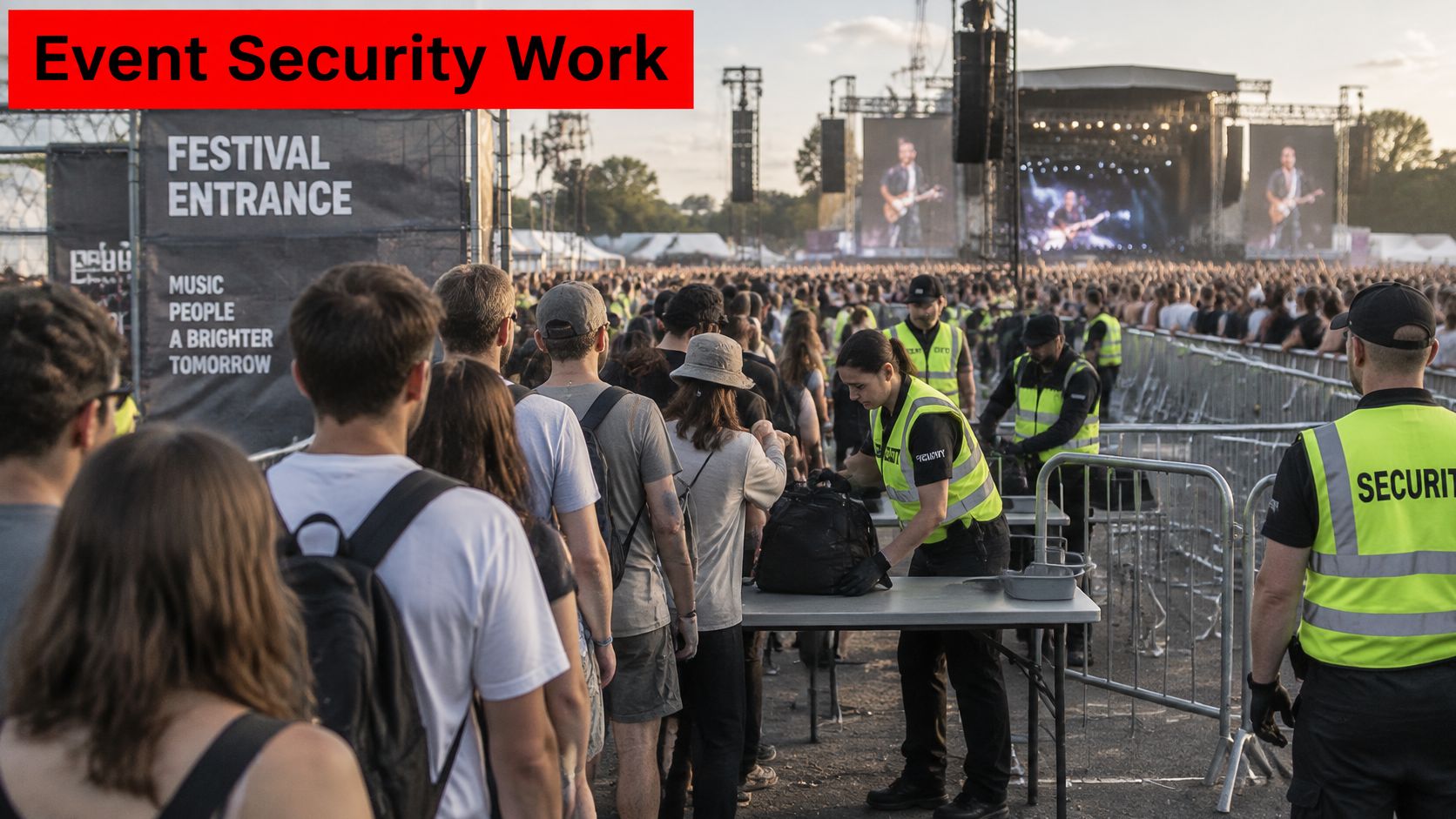
It's 5 pm at a festival gate. The queue is spilling onto the footpath, bag checks are backing up, and down at the main stage the front rows are already pressing toward the barrier.
That's event security work in one scene. It's the planning, staffing, screening, crowd control, welfare checks and incident response that keep an event running safely. Think of the team less as doormen and more as traffic controllers for people. They manage flow, density and timing across the whole site, not just one door.

Australia's most prominent warning is still the 2001 Big Day Out crowd crush in Sydney, where 16-year-old Jessica Michalik died during a Limp Bizkit performance, as recounted in UNSW reporting on global crowd accidents. That UNSW research examined 281 major crowd accidents worldwide between 1900 and 2019 and found serious incidents rose from approximately 3 per year during 1990 to 1999 to nearly 12 per year during 2010 to 2019.
Australia has had comparatively few documented incidents. That doesn't remove the need for planning. It means you can't rely on experience of a disaster to teach your team what early pressure looks like.
The same flow thinking applies beyond festivals. If you're comparing event posts with routine site coverage, security patrols for commercial premises show the patrol side of the job, checking zones on a cycle rather than holding one crowded point. At an event, both skills matter, but managing movement and density comes first.
Roles and Responsibilities in Event Security Work
Job titles vary between companies, so don't roster by the name on the shirt. Roster by duty. If a person controls entry, refuses entry, checks bags as a condition of entry, or manages disorder, treat that as regulated work until you've confirmed otherwise.
Event security roles, duties and licence status in New South Wales
| Role | Core duties | Licence needed (NSW) | Typical posting |
|---|---|---|---|
| Crowd controller | Monitor crowd density, manage queues, control entry and exit, respond to disorder | Yes, crowd controller licence | Gates, queues, barriers |
| Venue controller | Control access to licensed venue, run bag checks, refuse entry | Yes, venue controller licence | Main entrances, bar entries |
| Bouncer | Remove patrons, manage disorder at doors and on the floor | Yes, bouncer licence | Doors, late-night areas |
| Marshal or wayfinder | Direct patrons, guide traffic, answer questions | No, provided duties stay at wayfinding only | Car parks, pathways, queues |
| Security supervisor | Brief staff, run radio, log incidents, escalate to police or medical | Yes, plus supervisory experience | Roving or control point |
| Patrol or static guard | Watch assigned zones, respond to alarms, record observations | Yes | Perimeter, backstage, car park |
| VIP or close protection officer | Protect individuals, control access to VIP and green rooms | Yes, plus close protection requirements | VIP areas, artist routes |
| First aid liaison | Coordinate with medical providers, call ambulance | No security licence; first aid certificate | Medical zone |
The boundary that catches organisers out is the marshal who drifts into crowd control. A wayfinder pointing people to toilets is doing customer assistance. The same person holding a gate closed, turning people away, or pulling someone out of an argument is doing something different, whatever the roster calls them.
Practical rule: Write the duty first, then the role name. If the duty changes on the night, the licence check has to change with it.
Supervisors are not spare guards. Their job is briefing, radio discipline, incident logging and escalation. If your supervisor is stuck checking bags for three hours, nobody is watching the whole site.
First aid and medical staff sit outside security, but security has to know exactly how to reach them. Put the medical call sign, location and access route in every briefing. A guard who has to ask where the medics are during a collapse has already lost time.
Use the table as a working tool:
- List every duty: gates, bars, stage pit, backstage, car park, exits, dispersal.
- Match each duty to a role: don't leave shared or assumed coverage.
- Check the licence column: confirm the named person, not just the contractor, holds it.
- Name the supervisor: one person owns escalation for each shift.
That sequence turns a quote for guards into a defensible deployment plan.
Typical Duties in Event Security Work by Event Type
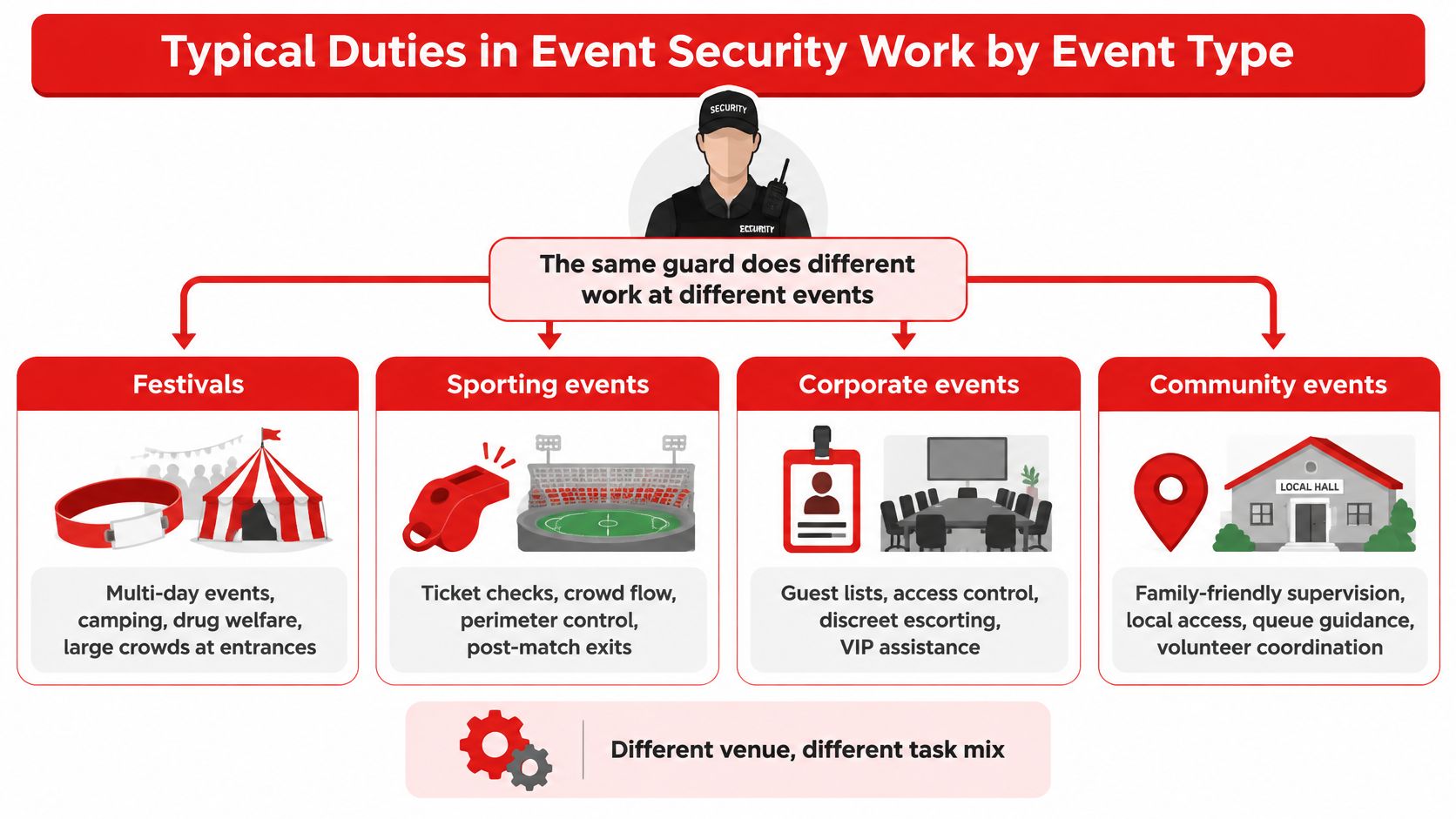
The same guard does different work at different events. A person who's excellent on a corporate door may be lost in a festival pit, and a strong crowd controller may be too blunt for a sponsor function. Match the task mix to the event type.
Festivals and concerts
Festivals bring multi-day fatigue, camping areas, drug and alcohol welfare, and very large crowds surging toward stages at set times. Duties centre on gates, wristbands, stage barriers, roving welfare checks and late-night camping patrols.
Concerts and stadium shows are shorter but sharper. Ticket checks, barrier monitoring, queue control and exit planning dominate. The pressure point is predictable, the minutes before the headliner and the minutes after the encore, so staff should be in place before both.
Corporate and hospitality events
Corporate events and conferences run on accreditation, guest lists and discretion. The risks are uninvited access, equipment theft, after-hours entry and reputational damage from a heavy-handed refusal. Guards need polished communication and clear instructions on who can authorise exceptions.
Bars, clubs, hotels and restaurant functions turn on intoxication. Security supports RSA decisions, manages refusals calmly, watches bar queues and dance floors, and separates people early. Most incidents here start as verbal friction that nobody interrupted soon enough.
The density trigger every team needs
Crowd density gives you a measurable trigger instead of a feeling. UNSW crowd-safety guidance reports that once density exceeds approximately 7 to 8 people per square metre, a large crowd can enter "crowd turbulence" where attendees lose meaningful control over their movement.
Do the maths on a worked example. A 10 m by 10 m zone at the front of a stage is 100 square metres. At that threshold it would hold about 700 to 800 people. Your team must act well before that point, because once people can't move sideways, instructions and good intentions won't create space.
Practical controls include counting occupancy by zone, watching compression at barriers and bottlenecks, keeping emergency routes clear, regulating inflow, and giving supervisors authority to order staged entry, diversion or a show pause request through event control.
Set escalation points in advance:
- Queue growth: the line reaches a marked point or blocks a footpath.
- Lost lateral movement: patrons can't move sideways or raise their arms freely.
- Barrier pressure: sustained leaning, climbing, or people being lifted off their feet.
- Crowd waves: abnormal surging or swaying moving through a dense area.
Link each point to a radio call, a named supervisor decision and a log entry. Static presence alone isn't a control system. Observation without a trigger is just watching a problem develop.
Licences, Training and Certifications for Event Security Work
Event clothing doesn't confer authority. That's the compliance mistake I see organisers set up most often, usually with good intentions and a tight budget.
In New South Wales, the NSW Government event starter guide on safety and security identifies crowd controllers, venue controllers and bouncers as security activities requiring the relevant licence. It also warns the requirement may apply even when a person is described informally as event staff.
That means a festival can't assume volunteers or unlicensed hospitality staff may lawfully conduct bag checks, refuse entry or work as crowd controllers because they're wearing an event shirt. Marshals and wayfinders aren't necessarily treated the same way, but only while their actual duties stay outside access control and disorder management.
Licence and training requirements by Australian jurisdiction
| Jurisdiction | Licence for crowd control | Training and compliance notes |
|---|---|---|
| New South Wales | Crowd controller, venue controller and bouncer licences | RSA for alcohol-serving events; licensing applies even when staff are described as event staff |
| Victoria | Private security licence for crowd control | Confirm training and licence class with the regulator; staff must report suspicious behaviour |
| Queensland | Crowd controller licence; Class 1 unrestricted licence for full duties | Liquor licensee keeps register of persons engaged for reward; approved training course required |
| Australian Capital Territory | Security licence covering crowd control, class to confirm with Access Canberra | Verify licence class and conditions with the territory regulator before contracting |
Queensland adds a paperwork duty venues sometimes miss. Under Queensland's Security Providers Regulation 2008, a liquor licensee must keep a register of people engaged for reward to perform crowd-controller functions at the licensed public place. Keep licence details, engagement dates, shift times, assigned functions and supervisor information with that register. A contractor invoice doesn't prove who stood on your door.
Training beyond the licence card
A licence is the floor, not the finished product. For alcohol-serving events, brief and roster for RSA competence. Guards don't serve drinks, but they enforce the consequences of service decisions, so they need to recognise intoxication and support refusals without inflaming them.
Build these skills into induction and briefing:
- Radio language: short location first, then problem, then what's needed.
- De-escalation: calm voice, space, one speaker, clear choices.
- Welfare handling: intoxicated, distressed, lost or vulnerable patrons go to a defined pathway, not just out the gate.
- First aid awareness: recognise collapse, protect the person, call medical early, clear access.
- Customer service: directions, accessibility help and complaint handover.
A friendly, well-briefed guard gets problems reported sooner. Patrons approach someone who looks approachable, and early information prevents larger incidents.
Before contracting, sight licences against the role matrix, confirm expiry dates, and check any cell in your plan you can't verify with the relevant state regulator. Do it again if agency names change close to doors. They often do.
Staffing Levels for Event Security Work by Crowd Size
Start with a formula, then test it against your site. Victoria's code of practice for safer music festivals and events specifies two crowd controllers for the first 100 patrons, plus one crowd controller for each additional 100 patrons or part thereof. On that formula a 500-patron event needs six controllers, and a 250-patron event lands between four and five depending on how you count the part-hundred.
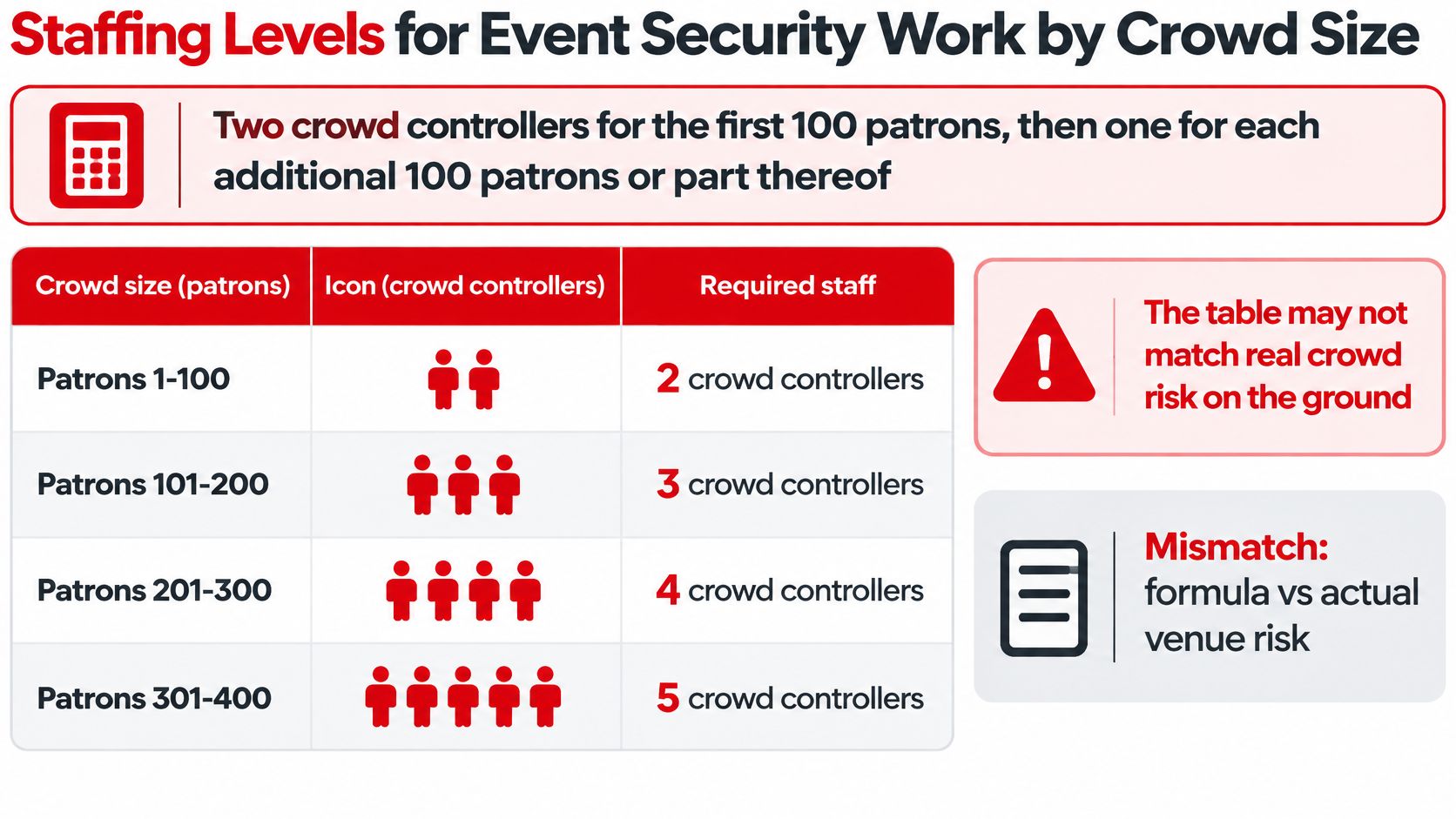
Crowd controller numbers by expected patron count
| Expected patrons | Baseline crowd controllers |
|---|---|
| 100 | 2 |
| 250 | 4 to 5 |
| 500 | 6 |
Where the count falls between two figures, roster the higher one. I'd plan a 250-patron event at five: the extra shift is cheap insurance against a post left uncovered, and understaffing reads badly if an incident puts your numbers under scrutiny.
Some councils set their own ratios in consent conditions, and those ratios may exclude volunteers and support staff from the count. A roster that looks compliant on paper can fall short once only licensed crowd controllers count toward the total.
Why the number alone is not enough
Take a 250-patron bar event with two entries, one bar and a car park. Five controllers sounds comfortable until you post them: two on the main entry for ID and bag checks, one on the second entry, one on the bar queue and floor, one roving exits and the car park. Nobody is spare for a toilet corridor argument, a welfare escort or a meal break.
That is why staffing works as zone design, with headcount only as the starting point. Entrances and exits, stage and barricade layout, alcohol service, crowd profile, weather, accessibility routes, transport after closure and closing-time dispersal all change what each post demands. Fixed posts at gates, stages, bars and emergency exits cannot be covered by one person walking faster.
Build crowd density triggers into the plan rather than relying on totals alone. A queue backing into an exit lane, a packed front-of-stage area or a bar line spilling across walkways should each pull the rover to that zone before it becomes a problem. More guards also will not fix unsafe density or poor egress. Queue design, signage, lighting, water points, programming gaps, transport coordination and radio escalation can cut risk as much as an extra post. Use the formula as a baseline, then adjust by zone and by time of night.
Shift Patterns and Pay Scopes in Event Security Work
Event security work is shift-based, and each phase of an event needs a different roster shape. If you roster only for the show, you'll be short during set-up checks and dispersal, which is when tired patrons, dark car parks and transport queues create problems.
Typical shift structures in event security work
| Shift type | Typical length | Pay structure | Planning note |
|---|---|---|---|
| Pack-in and set-up | 4 to 6 hours | Hourly; rate per award or contract | Start before doors to check barriers and exits |
| Event day, doors to close | 8 to 10 hours with breaks | Hourly plus penalty rates; check award | Schedule breaks and relief posts |
| Pack-out and dispersal | 2 to 4 hours after close | Hourly; rate per award or contract | Stay until patrons have left |
| Multi-day festival rotation | 10 to 12 hours, rotating | Hourly plus penalties per award or contract | Rotate posts to limit fatigue |
Pack-in staff check barriers, signage, emergency exits, lighting and radio coverage before patrons arrive. Event-day shifts need scheduled breaks and relief posts built into the roster, assigned to named staff rather than left to whoever can be spared. Pack-out staff stay until the last patrons have left the site and surrounding streets, because the event isn't over while dispersal is still unmanaged.
Multi-day festivals need rotation. Long shifts in the same high-pressure post erode attention, patience and judgement. Rotate barrier, gate and roving duties, and plan sleep time for staff working consecutive days.
Every roster should include a written handover briefing covering incidents so far, patrons refused or ejected, faulty barriers, blocked exits and any person of concern. Verbal handovers in a noisy gate area lose detail.
Pay and rostering rules
Casual hourly rates, penalty rates for nights, weekends and public holidays, and agency margins all move with the applicable award, contract and state arrangements, so figures quoted for last year's event may already be out of date. Confirm current award classifications, contract terms and penalty rates with your provider in writing before you lock a budget, and build the penalty loadings for night and weekend work into the quote rather than discovering them on the invoice.
If you're comparing Australian casual arrangements with overseas flexible models, the HR Management 365 zero-hours contract guide explains that UK concept, but it doesn't replace Australian award and licensing checks for your roster.
Two planning rules protect you:
- Hold reserve capacity: keep relief staff for peaks, breaks, escorts and late cancellations.
- One guard, one post: don't roster one person to cover two posts in the same period.
Cheap rosters usually fail on relief first. Then breaks disappear, posts go empty, and supervisors stop supervising.
Engaging and Managing Event Security Work Teams
Organisers, treat security as part of one incident-management system, not a standalone guarding purchase. Police, medical, venue staff and security need the same plan, the same map and compatible radios.
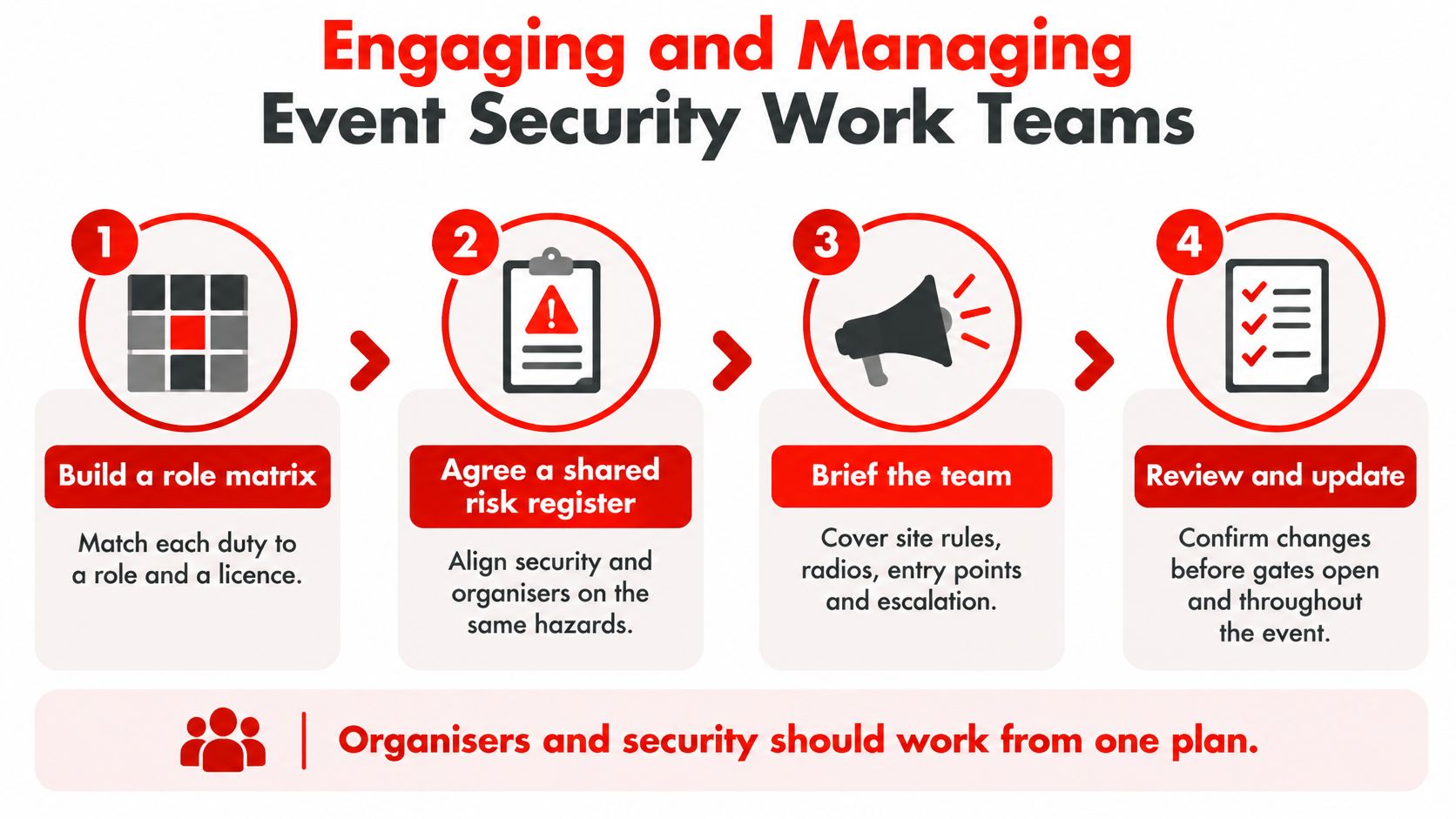
Australian mass-gathering research accessible through Western Sydney University's research dataset on safety at mass gathering events identifies inadequate risk assessment, weak communication, unclear ownership of risk and poor planning as recurring contributors to safety problems. The fix is documented ownership before doors open.
Follow this process:
- Build a role matrix. Match each duty to a role, a post, a licence and a named person.
- Agree a shared risk register. Cover crowd density, intoxication, violence, weather, access control, medical response, missing persons, fire and evacuation. Give each hazard an owner, likelihood and consequence rating, preventive controls, response actions and an escalation threshold.
- Verify licences and keep a register. Record each person, licence, shift times, assigned functions and supervisor. Recheck late substitutions.
- Brief the whole team. Cover escalation points, radio language, welfare pathways, lost child procedure, accessibility assistance and who can authorise entry exceptions.
- Run one radio structure and incident log. Time-stamp observations, decisions, handovers and unresolved hazards.
- Debrief and update. Feed findings into the next risk assessment while memories are fresh.
Measure more than ejections. The NSW Parliament review of the Music Festivals Act compared nine high-risk festivals and recorded deaths falling from 2 to 0 between the 2018 to 19 and 2019 to 20 seasons, while intensive-care admissions remained at 14 in both seasons. Hospital transports and assaults matter too. One indicator can improve while serious harm stays flat.
When comparing providers, ask for licence records, supervisor ratios, incident report samples, briefing documents and debrief processes. Providers such as GM GROUP Services offer event security including crowd management, access control and front-of-stage coverage, but assess any provider on the same evidence. Price alone tells you nothing about supervision at 11 pm.
Event Security Work Questions Organisers Ask
Do volunteers need a licence for event security work?
If they're performing regulated duties such as bag checks, refusals or crowd control in NSW, yes, they need the relevant licence whatever they're called. Volunteers doing genuine wayfinding or general assistance sit in a different category, so keep their duties clearly limited.
How many guards does a 500-patron event need?
Use six crowd controllers as the Victorian baseline, then test that number against your posts. Separate gates, bars, stage areas, exits, breaks and dispersal can push the roster higher.
Can a single guard refuse entry at a licensed bar?
A refusal is a regulated, high-friction duty and needs the right licence and authority. I wouldn't roster one person alone for it. Pair door staff so one can communicate while the other observes, records and calls the supervisor.
How early should staff be booked?
Book several weeks ahead for festivals and concerts, confirm named licences when you book, then check again before doors. Agency personnel change at short notice, and a late substitute still needs the correct licence for the assigned post.
How much do event security staff earn?
There's no single safe figure to copy into a budget. Pay depends on the industry award, contract terms, casual loading and penalty rates for the actual hours worked. Confirm current rates with the provider and award before approving costs.
What's the first document to prepare?
The role matrix. It forces you to name every duty, post and licence before price negotiations turn the plan into a simple guard count.
If you're planning a festival, concert, corporate function or licensed venue event in NSW, Victoria, Queensland or the ACT, GM GROUP Services can help you build a licensed, fit-for-purpose team covering crowd management, access control, static guards, VIP protection, patrols and emergency response. Visit the team to discuss your site, crowd profile and risk assessment before you lock in a roster.