


Event security guard planning starts long before the first guest reaches the gate. You may be finalising a festival site map, chasing a security quote, and wondering whether the provider's roster matches the risks on the ground. That uncertainty becomes expensive when the wrong licence class is assigned to a post, a queue blocks an emergency route, or a supervisor can't produce the incident records an insurer or regulator requests.
An event security guard isn't a uniformed person standing at an entrance. The role combines licensed crowd control, access management, observation, communication, de-escalation, emergency support and accurate reporting. Australian promoters need a plan that matches each task to the right person, licence, deployment model and level of supervision.
What an Event Security Guard Actually Does
At 4:30pm on a Saturday, two hours before gates open at a 3,000-capacity outdoor festival in Western Sydney, the security team should already be working. The supervisor walks the perimeter, checks fences and identifies hazards around temporary structures. Guards confirm muster points, test radios with the controller and help gate volunteers understand where ticketing, bag checks and restricted access begin.
The controller also checks the licence paperwork for every licensee on shift. That matters because NSW requires people carrying out security activities such as crowd control, venue control, bouncer work or asset protection to hold the appropriate licence. The NSW Government event safety and security guidance makes the distinction operational, not academic.
Before the first guest arrives
A capable event security guard should know their post, radio call-sign, escalation route and emergency responsibility before doors open. Practical preparation includes:
- Site inspection: Identify trip hazards, blocked exits, unstable fencing, dark areas and vehicle conflict points.
- Access setup: Check barriers, wristband stations, screening points and staff-only routes.
- Radio confirmation: Test batteries, channels and contact with the security controller.
- Team coordination: Brief volunteers, ticketing staff, bar teams and medical personnel on how incidents will be escalated.
- Licence verification: Confirm each guard's individual licence and assigned duties.
During the event
At the gate, guards manage entry flow, check wristbands and IDs where required, identify prohibited items and prevent unauthorised access. Inside the venue, they watch crowd movement around bars, stages, toilets, exits and restricted areas. They also provide a visible point of contact for lost guests, distressed patrons and staff who need immediate help.
A good guard uses communication before physical intervention. They recognise rising tension, separate competing parties where safe, request a supervisor early and call police or emergency services when the situation exceeds the event team's authority or capability.
Practical rule: Assign guards to decisions and zones, not just to a total headcount.
After the final performance, the work continues. Guards support orderly egress, protect equipment during pack-down and record incidents in factual language. The post-event log should show what happened, where it happened, who responded and what outcome followed. That record helps the organiser identify weaknesses before the next event.
Licensing and Compliance Across Australian States
The first hiring decision is the post, not the person. A promoter must decide whether the work involves crowd control, asset protection, or another regulated security activity, then confirm that every rostered guard holds the relevant state licence.
In NSW, the Security Industry Act 1997 requires a licence application to use the approved form, include the prescribed fee and provide the information required by regulation. NSW Class 1 eligibility includes being at least 18, being a fit and proper person, completing approved training and assessment, and meeting citizenship or visa requirements, as summarised by the Australian Business Licence and Information Service.
Victoria treats crowd controller and security guard as specific private security activities. Victoria Police also states that an armed guard or cash-in-transit firearm holder needs a current firearms licence in addition to a private security licence, which is separate from ordinary event crowd control. In Queensland, security licensing is administered through the state government system, with the Security Providers Crowd Controller Code of Practice Regulation 2008 commencing on 1 July 2008. ACT organisers should verify the relevant Access Canberra licence and task authority before deployment.
Match the licence to the post
| State / Territory | Licence Class | Issued By | Permitted Duties at Events |
|---|---|---|---|
| NSW | Class 1 crowd control, Class 2 security activities | NSW Security Licensing and Enforcement Directorate | Patron management, entry control and asset-related duties only where the licence permits |
| VIC | Crowd controller or security guard activity | Victorian private security licensing system | Crowd control or guarding duties according to the endorsed activity |
| QLD | Crowd controller or security officer licence | Queensland security licensing system | Crowd management or security officer duties within the licence authority |
| ACT | Relevant crowd control or security activity licence | Access Canberra | Event duties matching the authorised activity |
A general guard shouldn't be placed at a bar entrance to manage patron behaviour because the roster has a vacancy. Separate asset-protection posts from patron-handling posts, especially where alcohol, controlled entry or removals are involved. Ask to see licence cards, confirm expiry details, require compliance with venue alcohol policies and retain the verification record with the event file.
Deployment Models and Where Each One Works
Your site plan should show where each guard works and what decision they can make. Headcount alone doesn't tell a provider whether you need a fixed post, a mobile patrol, an entry team or a dedicated protective detail.
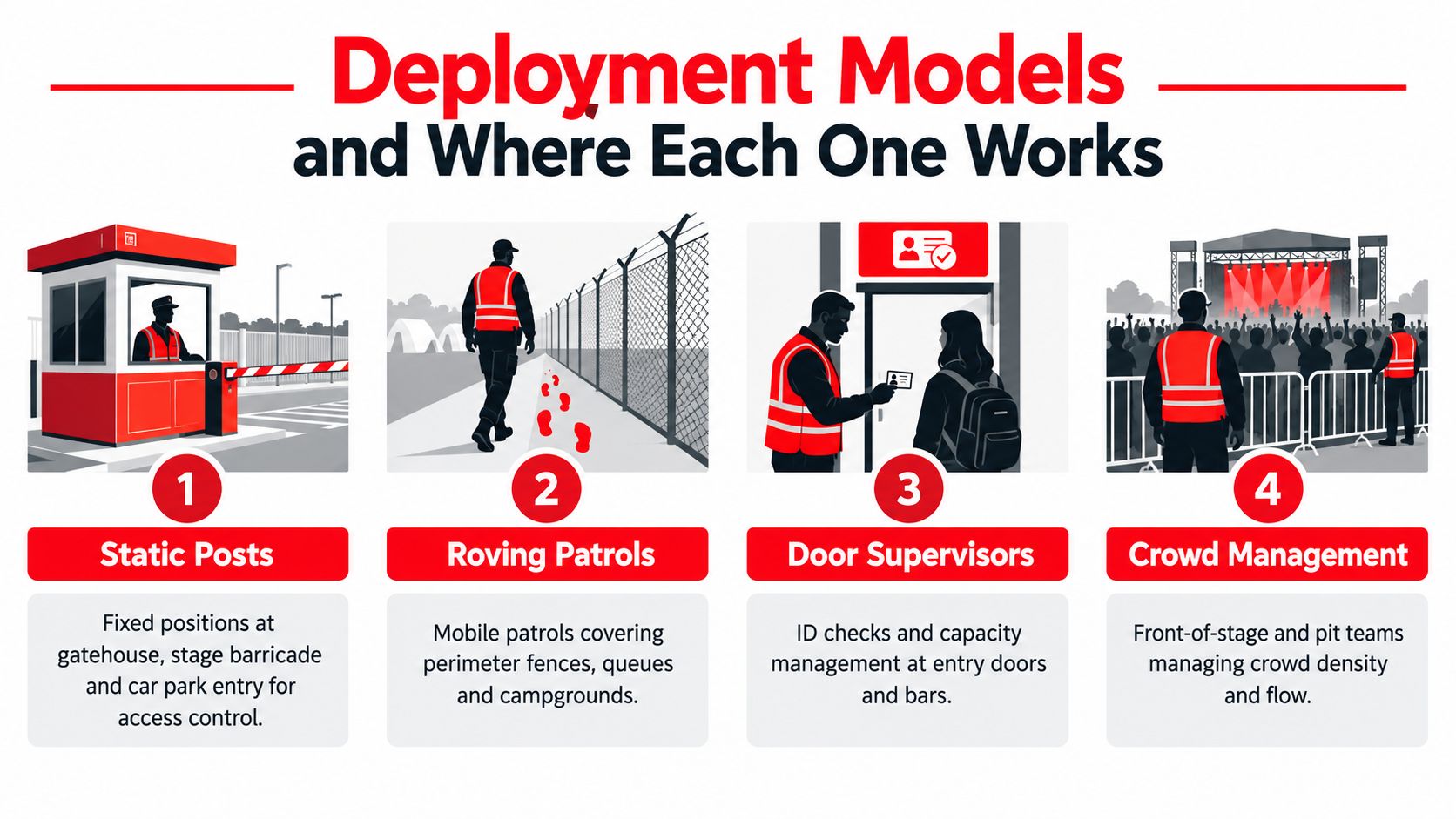

Static posts
Static guards suit gatehouses, stage barricades, car park entrances, equipment stores and restricted backstage doors. They provide continuity and a clear point of accountability. The model fails when one person is left to cover several disconnected areas, such as an entire loading dock without relief or radio support.
Roving patrols
Rovers work across perimeter fences, queues, campgrounds and low-traffic areas. Their value comes from movement and observation, not from pretending to provide fixed coverage everywhere. Two staff cannot reliably cover a 400-metre perimeter while also responding to incidents at the main gate. Give rovers defined routes, check-in points and a controller who can redirect them.
Door control
Door supervisors manage ticket scanning interfaces, ID checks, bag-screening processes, capacity information and entry queues. They need a clear relationship with ticketing staff and venue management. If they're expected to screen, answer customer questions, resolve ticket disputes and control a growing queue without extra support, the gate will become the event's first bottleneck.
VIP and close protection
VIP or close-protection personnel support green rooms, artist movements, corporate boxes and controlled vehicle transfers. This is a specialist function, not a spare crowd-control post. A guard who is effective at a public gate may not be the right person to manage confidential movements, personal space or a high-profile guest.
For events above 500 attendees, use a mixed deployment model rather than assigning every guard to an undifferentiated pool. That threshold aligns with Australian crowd-controller planning guidance discussed by the Australian Institute of Criminology crowd-controller ratio monograph, but the operational point is broader. Divide the site into zones, then specify fixed coverage, mobile coverage, entry responsibility and supervisory ownership for each zone.
Crowd Ratios and How to Staff Your Event
Staffing ratios are a starting point, not a substitute for risk assessment. Australian guidance commonly uses 2 crowd controllers for the first 100 customers, followed by 1 additional controller for every extra 100 customers or part thereof, with lower-risk events sometimes using 1 controller per 200 patrons, as outlined in the WA health events guideline.
The Australian Institute of Criminology material also identifies a proposed minimum of 1 crowd controller per 250 patrons for crowds above 500, following an earlier threshold of 5 controllers for 400 to 499 patrons. Treat these benchmarks as a planning floor, then increase coverage when alcohol, crowd density, staged performances, difficult egress or multiple access points add pressure.
A worked roster example
For a 1,500-person regional festival, the commonly used baseline of 2 for the first 100, plus 1 for each additional 100 or part thereof, produces 16 controllers. That number still needs structure. You'll need a controller or supervisor, dedicated entry staff, stage-front coverage, rovers and relief arrangements.
A different arrangement might place guards at the main entrance, a second access point, the bar area, the stage barricade and the perimeter, with the supervisor retaining enough mobility to coordinate rather than becoming another static post.
| Risk Profile | Attendees per Controller | Example Event |
|---|---|---|
| Lower-risk event | 200 patrons per controller | Controlled, low-density community gathering |
| General benchmark above 500 patrons | 250 patrons per controller proposed minimum | Large event with manageable crowd conditions |
| Higher-risk licensed event | Use the stricter state or venue requirement, then add risk-based coverage | Alcohol service, dense stage-front crowd or difficult egress |
Check the applicable NSW, Victorian, Queensland or ACT overlay before finalising the roster. If the lineup, bar operation, venue layout or audience profile has changed but your controller count hasn't, your plan is probably no longer fit for purpose.
Qualifications and Training to Verify Before You Hire
Don't accept a provider's marketing profile as proof of competence. Request evidence against the actual duties in your site plan, then keep that evidence with the event records.
The first check is the individual licence. In practical terms, verify the relevant NSW Class 1 or Class 2 authority, Victorian crowd-controller activity, Queensland crowd-controller licence or ACT authorisation. The national training pathway may include a Certificate II or Certificate III in Security Operations, but the state licence remains the decisive authority for lawful deployment.
Build an evidence checklist
- Licence details: Ask for the individual card, licence class, expiry and identity match.
- First aid and CPR: Confirm current currency for guards expected to support medical response.
- Alcohol environment: Where alcohol is served, ask whether guards have RSA cross-training and understand the venue's responsible service procedures.
- Venue-specific skills: Relevant venues may need responsible service of gaming awareness or comparable role training.
- Temporary structures: Events near staged structures may require appropriate white-card or construction induction evidence.
A training matrix should show which guards can perform which functions. It should distinguish a gate screener from a stage-front crowd controller, a roving patrol officer from an asset-protection guard, and an ordinary guard from a specialist close-protection operative.
Hiring standard: Ask for the provider's training matrix and a sample roster run sheet before signing.
Also request the provider's induction process, supervision arrangements and incident-reporting template. A company that can't produce reasonable evidence within 24 hours isn't ready to manage your event. You're not buying uniforms. You're hiring a documented capability that must work under pressure.
Briefing Guards Before Doors Open
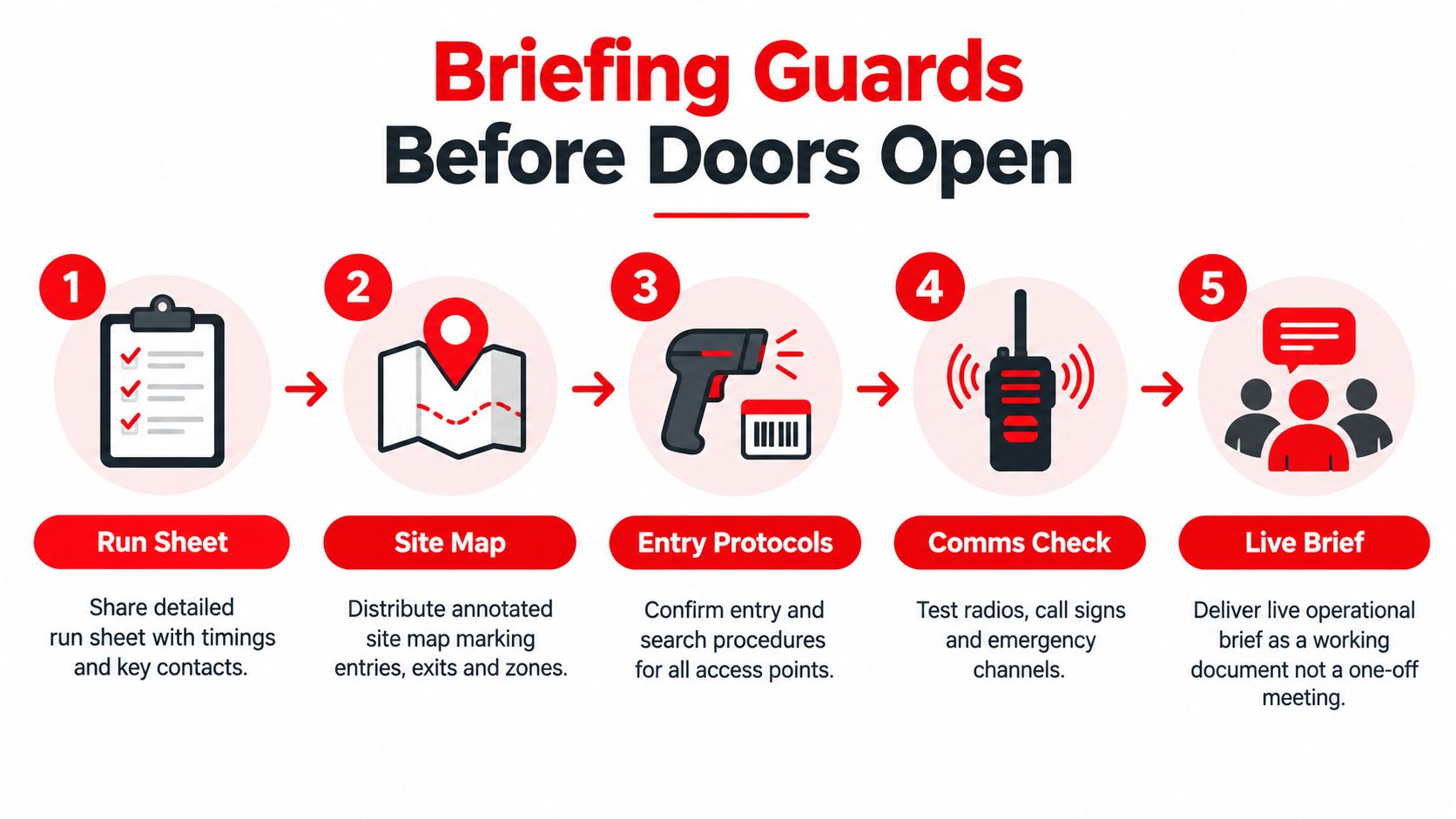
A ten-minute huddle isn't an operational brief. It may confirm the start time, but it won't explain the site, the risks, the radio structure, the access rules or the threshold for emergency escalation.
Treat the brief as a live document that changes when the weather, performance schedule, site layout, licence conditions or crowd behaviour changes. Give every guard the run sheet, site map, entry and egress plan, alcohol boundaries, emergency assembly points and radio call-sign structure before they take their post.
Make escalation unambiguous
Use plain incident levels that every guard understands:
- Nuisance behaviour: Observe, communicate and report through the supervisor.
- Aggressive conduct: Create space, use de-escalation and request support.
- Physical altercation: Separate only where safe and within training, then escalate immediately.
- Medical incident: Protect the area, call the medical response and guide responders in.
- Evacuation: Follow the event plan, keep exits clear and direct patrons to assembly points.
The controller must also state when guards stop managing an issue internally. Weapons, serious violence, a threat to life, a major fire or a situation beyond the team's capability requires police, fire or ambulance involvement. Guards shouldn't improvise authority they don't have.
After the event, require a documented debrief and incident report within 48 hours. Under the model WHS framework, venue operators and security contractors can both carry primary health and safety duties in jurisdictions including NSW, Queensland, South Australia, Tasmania, the ACT, the Northern Territory and Western Australia, while Victoria uses its own OHS framework, as described in this Australian WHS crowd-controller compliance resource. Keep the brief updated during the event, not filed away after the opening meeting.
Choosing the Right Provider for Your Event
Choose the provider that can demonstrate operational control, not the one that sends the lowest hourly quote. A low price won't compensate for an incomplete risk assessment, the wrong licence class or a supervisor who can't manage a changing crowd.
Start with the business credentials. In NSW, verify the firm's master licence. In Victoria, check the private security business registration. In Queensland, confirm the security provider licence, and in the ACT, verify the equivalent registration. Then check that the guards supplied hold individual licences matching the duties on your roster.
Ask for evidence before you compare prices
- Insurance documents: Request public liability cover suitable for the event and workers compensation clearance.
- Risk documentation: Require a written risk assessment linked to the site plan and relevant WHS or OHS guidance.
- Comparable experience: Ask for three recent events with similar crowd type, venue complexity and operating conditions.
- Named supervision: Get the names and contact details of the supervisor and security lead who will attend.
- Continuity plan: Ask how the provider handles fatigue, no-shows, late arrivals and relief coverage.
- Reporting standard: Review a redacted incident report and confirm the delivery timeframe.
- Service agreement: Include response expectations, escalation contacts, indemnity allocation and post-event reporting.
The Australian market contains a substantial pool of licensed security personnel. NSW reported 40,837 licensed crowd controllers in 2017, 42,703 in 2019 and 43,562 by 29 June 2022, while a later NSW industry roundtable paper referred to more than 63,000 issued security licences by mid-2022. Nationally, a 2020 industry profile estimated more than 31,000 approved individual security licences, including over 22,000 Security Officer or Crowd Controller licence holders, and suggested around 15,000 people were licensed to work for 1,679 security firm or master licence holders, according to the NSW security and staffing industry roundtable report.
That established labour pool doesn't remove the need for fit. It makes role matching more important. For example, GM GROUP Services provides event security and crowd-control coverage, including uniformed guards, supervision and related protection services across Australian event environments. Price should be your sanity check, not your selection criterion.
Frequently Asked Questions About Event Security
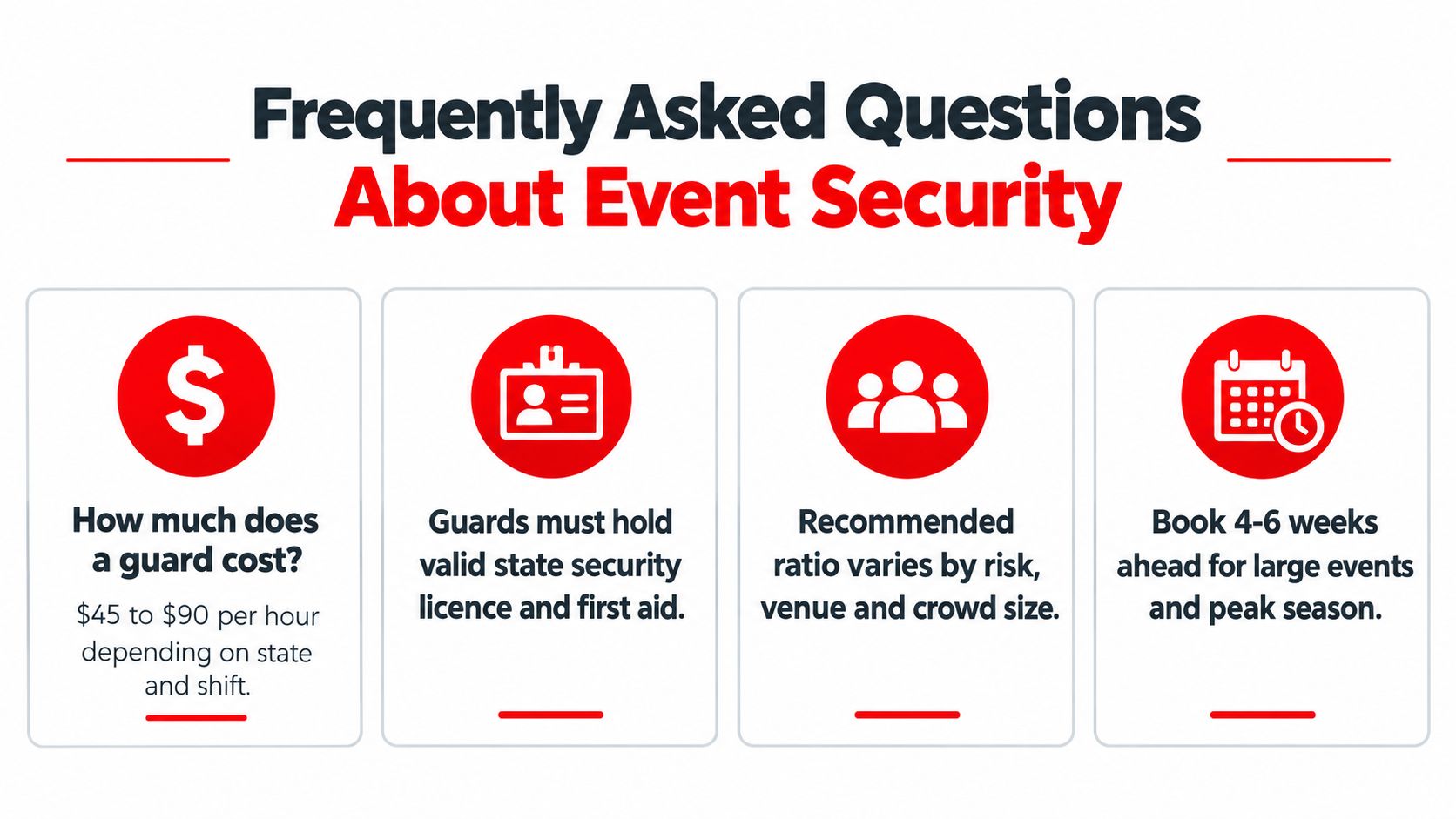
How much does an event security guard cost in Australia?
A reliable national price cannot be stated from the verified material available here. Rates vary according to state, licence class, shift length, weekend or public-holiday conditions, supervision, venue complexity and whether the provider is supplying a complete operational plan rather than isolated guards.
Ask for an itemised quote. It should separate ordinary guard hours, supervisors, specialist protection, equipment, travel, relief coverage and reporting. Compare like with like, because two apparently similar quotes may describe very different levels of coverage.
Can event security be armed in Australia?
Ordinary civilian event security should be planned as unarmed security. Victoria Police makes clear that an armed guard or cash-in-transit firearm holder needs a firearms licence as well as the relevant private security licence, so a promoter should never accept vague claims about “armed cover”.
Any credible firearms-related requirement must be verified through the applicable state law and authorities. For a normal festival, concert or corporate function, use licensed unarmed guards, clear access control and a defined police escalation pathway.
Does an RSA-qualified security guard replace liquor-service staff?
Generally, no. RSA training supports responsible service of alcohol, but it doesn't automatically authorise a guard to serve drinks, perform every liquor-licence function or replace a dedicated venue marshal.
Define the boundary between security and bar operations in the brief. Security can support safe patron management and escalate intoxication or disorder, while venue staff remain responsible for liquor-service duties assigned under the venue's licence.
What WHS paperwork should you keep?
Keep the event safety plan, risk register, signed roster, licence checks, induction records, incident log and post-event debrief. The compliance resource cited earlier states that the WHS Regulation 2025 is legally binding from 1 July 2026 and discusses documentation for non-construction high-risk work such as crowd control, with record retention extending to 2 years, or 5 years after a notifiable incident, under the stated framework.
Confirm retention obligations for your jurisdiction and event. For practical planning questions beyond security, including temporary structures and guest-facing logistics, marquee rental questions answered can help organisers identify related supplier questions early.
Speak with GM GROUP Services before you lock the roster, so your event security guard deployment matches the licence class, crowd risk, site zones and reporting requirements. Visit GM GROUP Services to discuss licensed event security, crowd control and a practical risk-led plan for your next Australian event.