


Using an event risk assessment template is your critical game plan for a safe, successful, and legally compliant event. It’s a dynamic tool that helps you proactively identify potential problems, analyse their likelihood and impact, and implement robust controls before they can cause catastrophic harm. An event risk assessment template isn’t just about ticking boxes; it’s about foresight and prevention.
For any event organiser in Australia—from a small corporate get-together in Sydney to a massive music festival in the outback—this isn’t just good practice; it’s an absolute necessity. Neglecting this crucial step is a gamble with attendee safety, your budget, and your entire professional reputation.
Why You Can’t Afford to Skip Your Event Risk Assessment Template
A solid risk assessment is the bedrock of any well-run event in Australia. It shifts your mindset from reactive fire-fighting to proactive, strategic risk management. Going without one isn’t just wishful thinking; it’s a direct path to potential disaster.
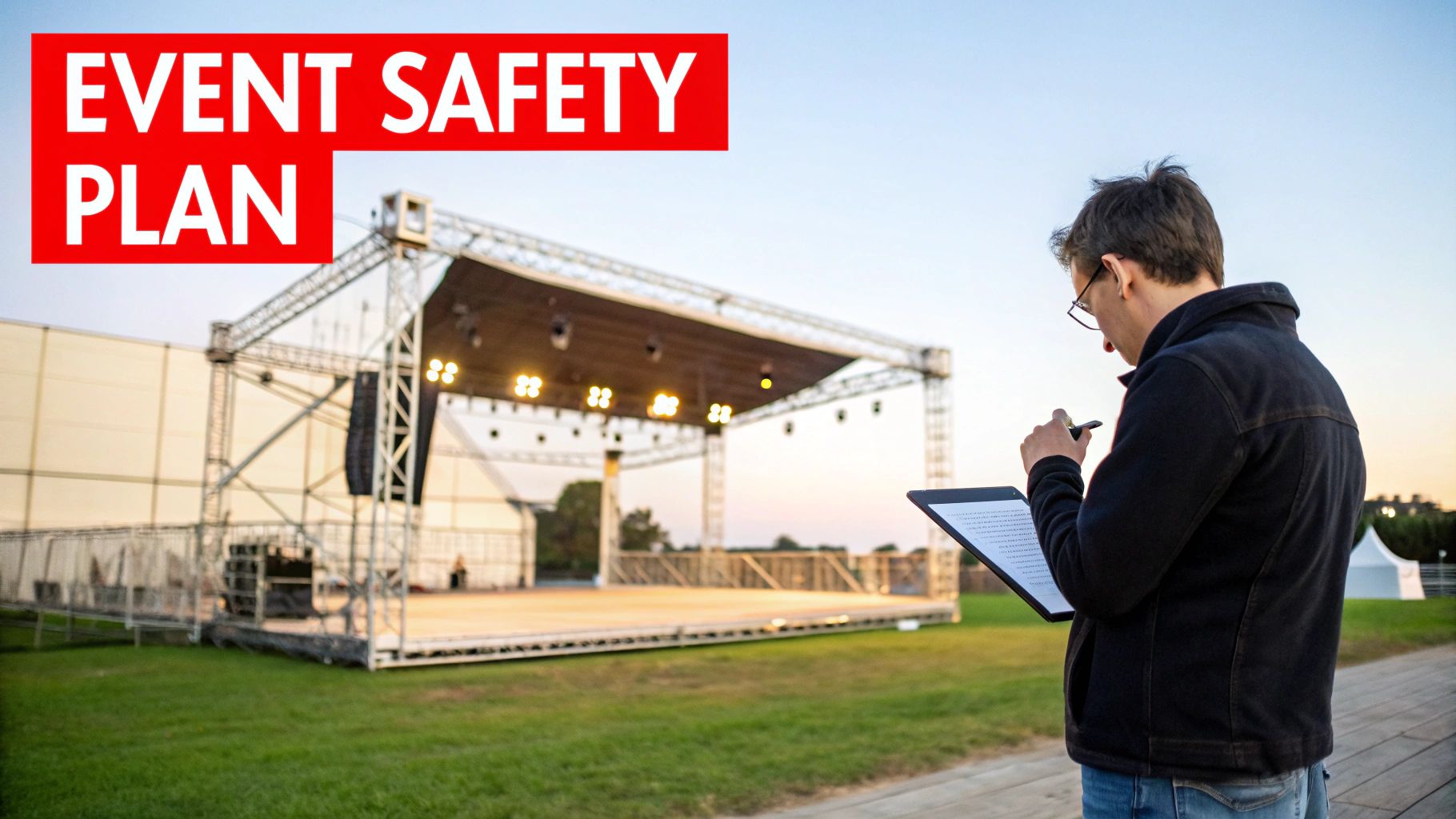
This guide will walk you through the process, step by step, using practical examples. I’ll show you how a properly used event risk assessment template acts as your first and best line of defence. From a music festival in Byron Bay to a corporate launch in Melbourne, Australian regulations and your duty of care demand this level of foresight.

The Real-World Cost of Cutting Corners
What happens when you don’t do a proper risk assessment? The consequences can be brutal and extend far beyond the day of the event.
- Financial Hits: An incident can trigger massive insurance claims, not to mention legal fees and potential fines from regulators like Safe Work Australia.
- Reputation Damage: It only takes one safety mishap to spark a firestorm on social media and in the news, seriously damaging your brand and killing future ticket sales.
- Legal Trouble: As an organiser, you have a legal duty of care. If you’re found negligent, you could face severe legal action.
This is where understanding a broader risk management framework is so valuable. It gives context to why an event-specific template is more than just paperwork—it’s a formal commitment to keeping people safe.
First Things First: Hazard vs. Risk
To get the most out of any event risk assessment template, you need to be crystal clear on two fundamental terms: hazards and risks. People often use them interchangeably, but they mean very different things.
- A hazard is anything with the potential to cause harm.
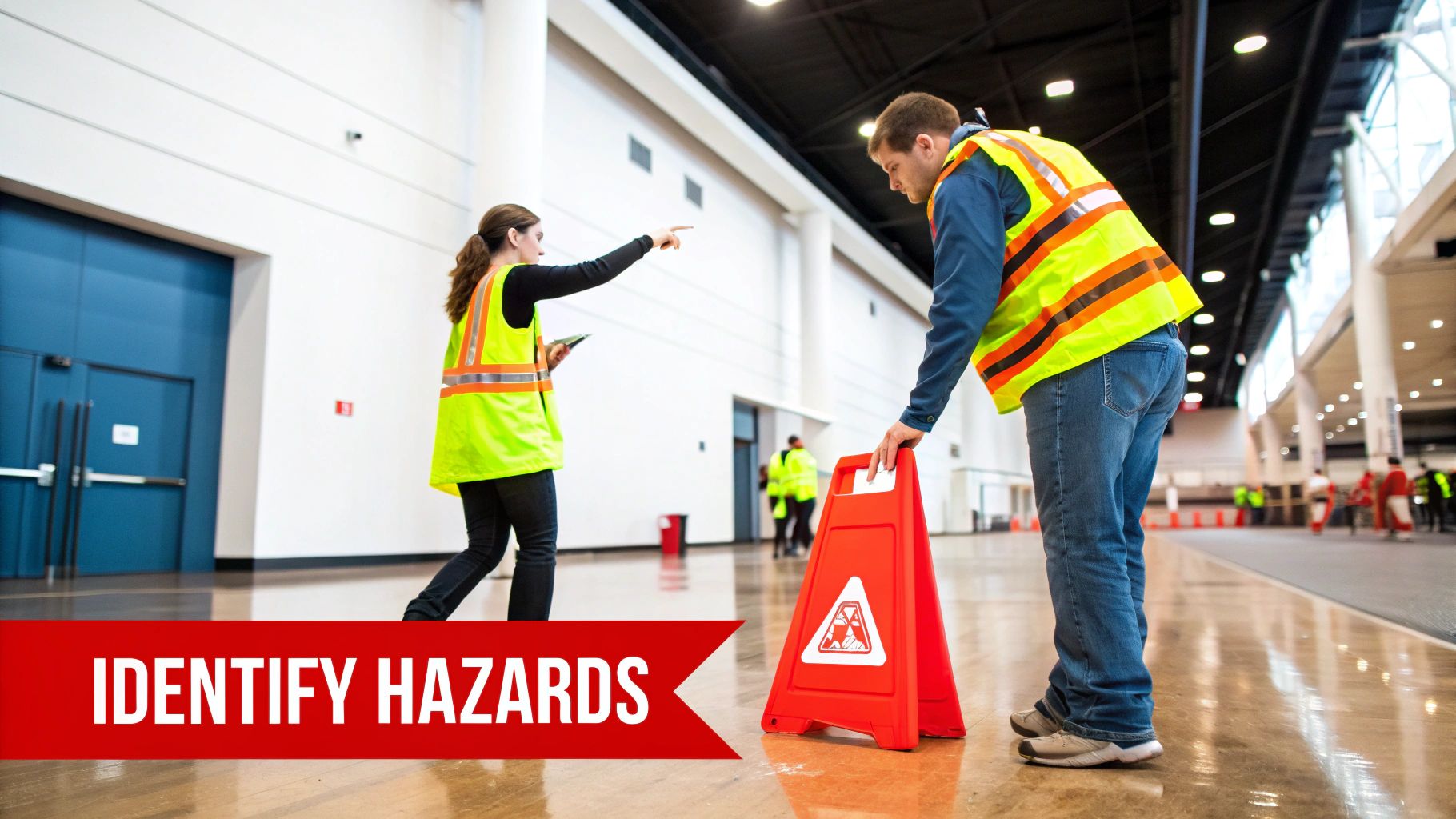
- Practical Example: A large puddle of water on a polished concrete floor at an indoor expo.
- A risk is the likelihood of that hazard actually causing harm, combined with how severe that harm could be.
- Practical Example: The risk is that an attendee slips on the water, falls, and suffers a concussion or broken bone. The likelihood is high in a crowded area.
Actionable Insight: Frame it this way: You identify hazards so you can analyse and control the risks they create. Grasping this simple distinction is the secret to effective safety planning.
Finding the Risks Before They Find You
The best event risk assessment starts with a bit of healthy pessimism. Your job is to think about everything that could possibly go wrong, from the mundane to the major. This isn’t about creating panic; it’s about being prepared. A truly effective plan is built on a thorough and honest search for every potential hazard.
The trick is to stop seeing your event as one big thing. Instead, break it down into smaller, moving parts—the setup, the entry, the performances, the food service, the pack-down. Each phase and location has its own unique set of risks. Thinking this way makes the whole process less daunting and ensures you don’t miss the little details that can cause big problems.
Different Events, Different Dangers
You can’t just copy and paste a hazard list from one event to another. The risks at a corporate drinks night in a bustling Sydney bar are worlds away from those at a three-day music festival in regional Victoria. You have to get specific.
Think about these real-world scenarios:
- Music Festival: Here, the scale is massive. You’re worried about the structural integrity of the main stage, the potential for crowd crush near the barriers, dodgy electrical hookups for the lighting rigs, and what happens if a sudden thunderstorm rolls in.
- Corporate Function in a Bar: The focus shifts. Now it’s about responsible service of alcohol (RSA), slippery floors from spilled drinks, ensuring emergency exits aren’t blocked when the room is packed, and keeping noise levels reasonable for the neighbours.
- Construction Site Launch Event: This is a high-risk environment from the get-go. Your checklist must include trip hazards from uneven ground, unsecured materials, airborne dust, and vehicle movements. A key priority is creating a rock-solid barrier between your guests and any active work zones.
Sorting Hazards into Actionable Groups
Once you’ve brainstormed a long list of potential problems, you need to bring some order to the chaos. Grouping similar hazards together makes it much easier to analyse them in your event risk assessment template and assign people to manage them.
Here’s a practical way to categorise them:
- Physical: These are often the most obvious. Think trailing cables, wobbly stage decking, faulty temporary power boards, or marquee poles that aren’t secured properly for high winds.
- Environmental: This is all about the surroundings. We’re talking about extreme weather—heatwaves, torrential rain—but also noise complaints from nearby residents or overflowing bins.
- Security: This category covers risks caused by people. It could be anything from gatecrashers getting into restricted areas and petty theft to disorderly behaviour from intoxicated guests or bigger crowd management issues.
- Health & Safety: This focuses directly on the wellbeing of everyone on site. Think about having enough first aid responders, potential food poisoning from caterers, or simply not providing enough free drinking water on a hot day.
In Australia, we can’t ignore the weather anymore. The National Climate Risk Assessment shows that extreme events are on the rise. Under a 3°C warming scenario, some coastal venues could face over 1,700% more flood days annually. By 2050, the number of Aussies exposed to coastal hazards is set to more than double, which has huge implications for event planning. You can read the full briefing paper on the National Climate Risk Assessment for the detailed projections.
Get More Eyes on the Problem
You can’t do this alone. No matter how experienced you are, you will miss things. The best hazard identification comes from a collaborative effort.
Actionable Insight: Conduct a “pre-mortem” meeting. Get your key people in a room—the venue manager, head of security, lead caterer, AV tech—and ask one question: “Imagine this event was a total disaster. What went wrong?” This encourages everyone to voice potential problems without fear, generating a comprehensive list of hazards you might have otherwise missed.
How to Score and Prioritise Risks in Your Event Risk Assessment Template
So, you’ve brainstormed a solid list of potential hazards. Now what? Your event risk assessment template needs to help you figure out what to tackle first.
Not all risks are created equal. A sound system glitching for a few minutes is an annoyance. A stage structure collapsing is a genuine catastrophe. This is where a good risk scoring system cuts through the noise and brings much-needed clarity. By giving each risk a score, you’re creating a data-driven priority list that tells your team exactly where to focus their time, budget, and energy.
Getting to Grips with Likelihood and Consequence
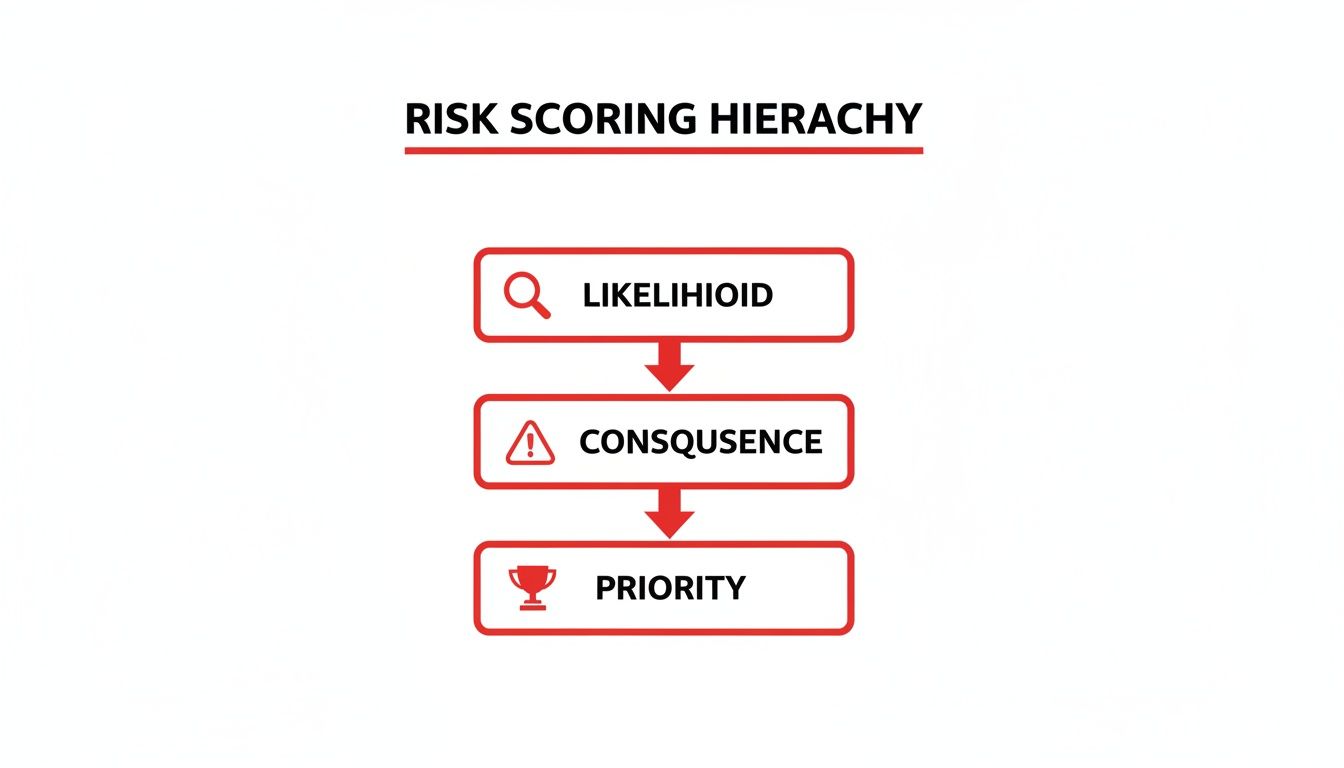
The most reliable way to score risks is with a formula that’s as simple as it is powerful: Likelihood x Consequence = Risk Rating. This little equation is the engine of any professional risk matrix.
Likelihood is just a common-sense way of asking, “How likely is this to actually happen?”
- Almost Certain (5): Guaranteed to happen, possibly multiple times.
- Likely (4): Will probably happen at some point.
- Possible (3): Could happen, but not a given.
- Unlikely (2): Not expected, but you can see a scenario.
- Rare (1): Highly improbable.
Consequence is about the fallout if the incident does happen. What’s the potential damage?
- Catastrophic (5): Multiple fatalities, huge financial losses.
- Major (4): A single fatality or life-changing injuries.
- Moderate (3): Serious injuries needing professional medical treatment.
- Minor (2): First-aid level injuries (e.g., cuts, sprains).
- Insignificant (1): No real harm done.
The Risk Matrix in Action
Putting it all together gives you a risk matrix. This tool is your best friend for visualising and calculating your risk scores quickly and consistently.
A Practical Risk Matrix: Likelihood vs Consequence
Here’s a standard 5×5 matrix we use all the time. To get your final risk rating, you simply find where your likelihood and consequence scores intersect.
| Likelihood ↓ / Consequence → | 1 – Insignificant | 2 – Minor | 3 – Moderate | 4 – Major | 5 – Catastrophic |
|---|---|---|---|---|---|
| 5 – Almost Certain | 5 (Medium) | 10 (High) | 15 (High) | 20 (Extreme) | 25 (Extreme) |
| 4 – Likely | 4 (Low) | 8 (Medium) | 12 (High) | 16 (Extreme) | 20 (Extreme) |
| 3 – Possible | 3 (Low) | 6 (Medium) | 9 (Medium) | 12 (High) | 15 (High) |
| 2 – Unlikely | 2 (Low) | 4 (Low) | 6 (Medium) | 8 (Medium) | 10 (High) |
| 1 – Rare | 1 (Low) | 2 (Low) | 3 (Low) | 4 (Low) | 5 (Medium) |
This simple grid instantly turns abstract worries into tangible numbers that you can actually work with and prioritise.

Putting It All to Work: A Real-World Example
Let’s see how this works. Imagine you’re running an outdoor food and wine festival. In your event risk assessment template, you’ve flagged two hazards: ‘Trip hazard from temporary power cables’ and ‘Bushfire in adjacent parkland’.
Scenario 1: The Trip Hazard
- Likelihood: With thousands of people, it’s pretty Likely (4) someone will trip if cables aren’t properly secured.
- Consequence: The impact would probably be Minor (2). A scraped knee or a twisted ankle.
- Risk Score: 4 (Likely) x 2 (Minor) = 8 (Medium Risk)
Scenario 2: The Bushfire
- Likelihood: It’s summer, but conditions are mild. You rate it as Rare (1).
- Consequence: A bushfire would be Catastrophic (5), a direct threat to life.
- Risk Score: 1 (Rare) x 5 (Catastrophic) = 5 (Medium Risk)
This quick calculation instantly tells a story. While the thought of a bushfire is terrifying, the everyday trip hazard actually scores higher and requires more immediate, hands-on management to prevent a likely incident.
From Score to Action: Making It Count
The final step is turning scores into a clear plan. Your risk rating should directly trigger a specific level of response.
- Extreme Risk (16-25): Stop. Activity cannot proceed without significant changes. Requires senior management sign-off.
- High Risk (10-15): Urgent action. Top priority. Controls must be implemented and verified before opening.
- Medium Risk (5-9): Action required. Implement controls and assign clear responsibility.
- Low Risk (1-4): Monitor. Manage with standard procedures.
Following a system like this ensures you’re systematically dealing with the risks most likely to cause harm, making your event safety planning both efficient and incredibly effective.
Developing Control Measures That Actually Work
An event risk assessment template full of high-risk scores is just a list of problems. The real value comes from turning those scores into concrete actions. This is where we shift from identifying risks to actively controlling them, using a proven framework to choose the most effective safety measures.
The best approach is the internationally recognised Hierarchy of Controls. Think of it as a playbook that ranks safety measures from most effective to least effective.
This framework pushes you to aim for the strongest controls first, like eliminating a hazard completely, before falling back on weaker options.
Putting the Hierarchy of Controls into Practice at Your Event
Let’s walk through each level with some practical event examples. Always start at the top.
- Elimination (Most Effective): Remove the hazard entirely.
- Practical Example: Instead of using temporary generators (a source of noise, fuel spill, and cable hazards), book a venue that has sufficient mains power. Hazard eliminated.
- Substitution: Replace the hazard with a safer alternative.
- Practical Example: Instead of a spectacular but high-risk pyrotechnics display, substitute it with a high-impact laser light show.
- Engineering Controls: Physically isolate people from the hazard.
- Practical Example: Instead of just laying power cables on the ground, use heavy-duty rubber cable ramps to cover them or run them through an overhead gantry.
- Administrative Controls: Change the way people work or behave.
- Practical Example: Place clear “Caution: Slippery Surface” signs around a drinks station and schedule staff to mop the area every 30 minutes.
- Personal Protective Equipment (PPE) (Least Effective): Protect the worker with equipment.
- Practical Example: Require all setup crew to wear steel-capped boots and high-vis vests during bump-in and bump-out.
Actionable Insight: An Engineering control (cable ramp) is far more reliable than an Administrative control (warning sign). The ramp works whether people are paying attention or not; the sign is entirely dependent on human behaviour. Always aim higher up the hierarchy.
Assigning Clear Roles and Responsibilities
For every control measure, your event risk assessment template must specify who is responsible and by when.
- Vague: “Security team to monitor exits.”
- Actionable: “Jane Doe (Head of Security) to ensure all fire exits are clear and unlocked by 8:00 AM, 15/10/2024.”
This creates clear accountability. Many event management software features can help track these tasks and deadlines automatically.
Meeting Australian Regulatory and Compliance Standards
Your control measures must comply with regulations like the Responsible Service of Alcohol (RSA) and Work Health and Safety (WHS) legislation. The latest data from Safe Work Australia shows there were approximately 146,700 serious workers’ compensation claims filed, a sobering reminder of what can happen when things go wrong. Documenting compliant, well-thought-out controls proves you’ve done everything reasonably practicable to meet your legal obligations.
Thinking Beyond Slips and Trips: Protecting Your Event from Modern Digital Threats
A modern event risk assessment template has to go beyond physical hazards. Digital vulnerabilities are a massive, and growing, danger. Ignoring them is like locking the front door but leaving all the windows wide open. A denial-of-service (DDoS) attack could crash your ticketing website, or a payment system failure could cause chaos at food stalls.
Weaving Cybersecurity into Your Risk Planning
Formally acknowledge digital threats in your risk assessment. Create a dedicated category for “Cyber/Technology” alongside “Physical” and “Environmental.”
Actionable Insight: When vetting a new ticketing or Wi-Fi provider, ask them for a copy of their own risk assessment and data breach response plan. Their preparedness is now part of your preparedness. Don’t take their word for it; ask for proof.
Protecting Your Event’s Digital Backbone
Redundancy is non-negotiable.
- Power: Have backup generators fuelled, tested, and ready for critical systems.
- Ticketing: Your ticket scanners must have an offline mode. Have a manual check-in process ready as a final backstop.
- Comms: Mobile networks get overloaded at big events. Equip key staff with two-way radios for a reliable, independent communication channel.
The Australian Government’s security agencies are sounding the alarm. They’ve highlighted an elevated threat environment where cyber-attacks and sabotage are serious national concerns. If it’s on their radar, it needs to be on yours. You can read the full ASIO annual threat assessment to get the bigger picture.
Keeping Your Risk Management Plan Alive and Effective
Your event risk assessment template is a live playbook, not a static form. It must be dynamic, adapting to what’s happening on the ground. A plan that gathers dust is completely disconnected from the reality of a live event.
Your Risk Plan Must Be a Living Document
Use the “Plan-Do-Check-Act” cycle. You’ve planned and you’ve done. Now comes the crucial part: checking and acting.
- Before the Event: Conduct a final on-site walkthrough with key team leaders, using your assessment as a checklist. This is your last chance to spot gaps between the plan and the reality.
- During the Event: Empower your team leaders to be active observers. They should be familiar with the risk assessment to monitor known risks and identify new ones as they emerge, like an unexpected crowd bottleneck forming.
Conducting Effective Post-Event Debriefs
The moment the last guest leaves, the learning starts. A structured post-event debrief is essential.
Actionable Insight: Don’t just discuss what went wrong. Analyse your “near misses” and your successes. A near-miss is a free lesson on how to fix a problem before anyone gets hurt. Understanding why a specific control measure worked perfectly is just as valuable, as it validates your process for future events.
This feedback loop is what turns a generic template into a powerful, battle-tested tool that’s been refined by your own experience. Every event you run makes the next one safer.
Frequently Asked Questions About Using an Event Risk Assessment Template
Here are straight answers to some of the most common questions from event organisers.
What is an event risk assessment template?
An event risk assessment template is a structured document used by event planners to systematically identify potential hazards (e.g., trip hazards, bad weather, security threats), analyse the associated risks (the likelihood and severity of harm), and implement control measures to mitigate them. It is a fundamental tool for ensuring the safety and success of any event.
How often should I update my risk assessment?
Your risk assessment is a living document. It must be reviewed and updated for every single event, as each venue, crowd, and setup has unique risks. A significant change, such as a new major supplier or a different time of year, absolutely requires a full review. At a minimum, perform a comprehensive overhaul of your base template annually.
What’s the difference between a risk assessment and a safety plan?
They are two sides of the same coin:
- The risk assessment is the analysis. It identifies and scores the “what if” scenarios (e.g., “What if a fire breaks out in a food tent?”).
- The safety plan is the action. It details the practical response to those scenarios (e.g., “Fire extinguishers will be placed every 10m, and staff will be trained in their use”).
Your assessment informs your plan.
Who is legally responsible for event safety in Australia?
The primary duty of care falls on the event organiser, legally defined as the Person Conducting a Business or Undertaking (PCBU). While you can hire specialist contractors (security, medical), you cannot delegate your core responsibility. You are ultimately accountable for ensuring all reasonable steps have been taken to ensure safety. A thorough event risk assessment is your primary evidence of having done so.
A solid risk assessment is the cornerstone of a safe event, but it’s the execution on the ground that truly counts. GM GROUP Services provides licensed, experienced security professionals who can bring your safety plan to life. From expert risk consultations to deploying static guards, we make sure your event is in safe hands.
Learn how our expert security teams can support your next event