


Emergency response team structure becomes critical the moment a routine venue problem stops being routine. A guest collapses near a crowded stage, staff call for help on different radios, a supervisor sends people in without checking the hazard, and nobody knows who should speak to the ambulance crew. The medical issue may be manageable, but poor coordination can turn it into crowd movement, conflicting instructions and unnecessary reputational damage.
The right structure gives people authority, defined duties and a reliable escalation path before pressure takes over. It must suit the site, the operating hours, the available staff and the way external emergency services will assume control. A small office, a licensed venue, a festival ground and a construction project shouldn't use the same chart.
Why a Solid Structure Is Your First Line of Defence
A guest collapses beside a crowded stage. The floor supervisor spots the incident, security creates space, a first aider starts treatment and a radio operator contacts the control point. Those actions protect the guest only if everyone knows who directs the scene and which decisions they can make without approval.
A defined emergency response team structure prevents several people from taking control at once. Without one, staff may crowd the patient, block an emergency access route or direct the public towards a hazard. Workers may also argue over radio channels or wait for an unavailable manager, turning a manageable incident into a visible failure of site management.
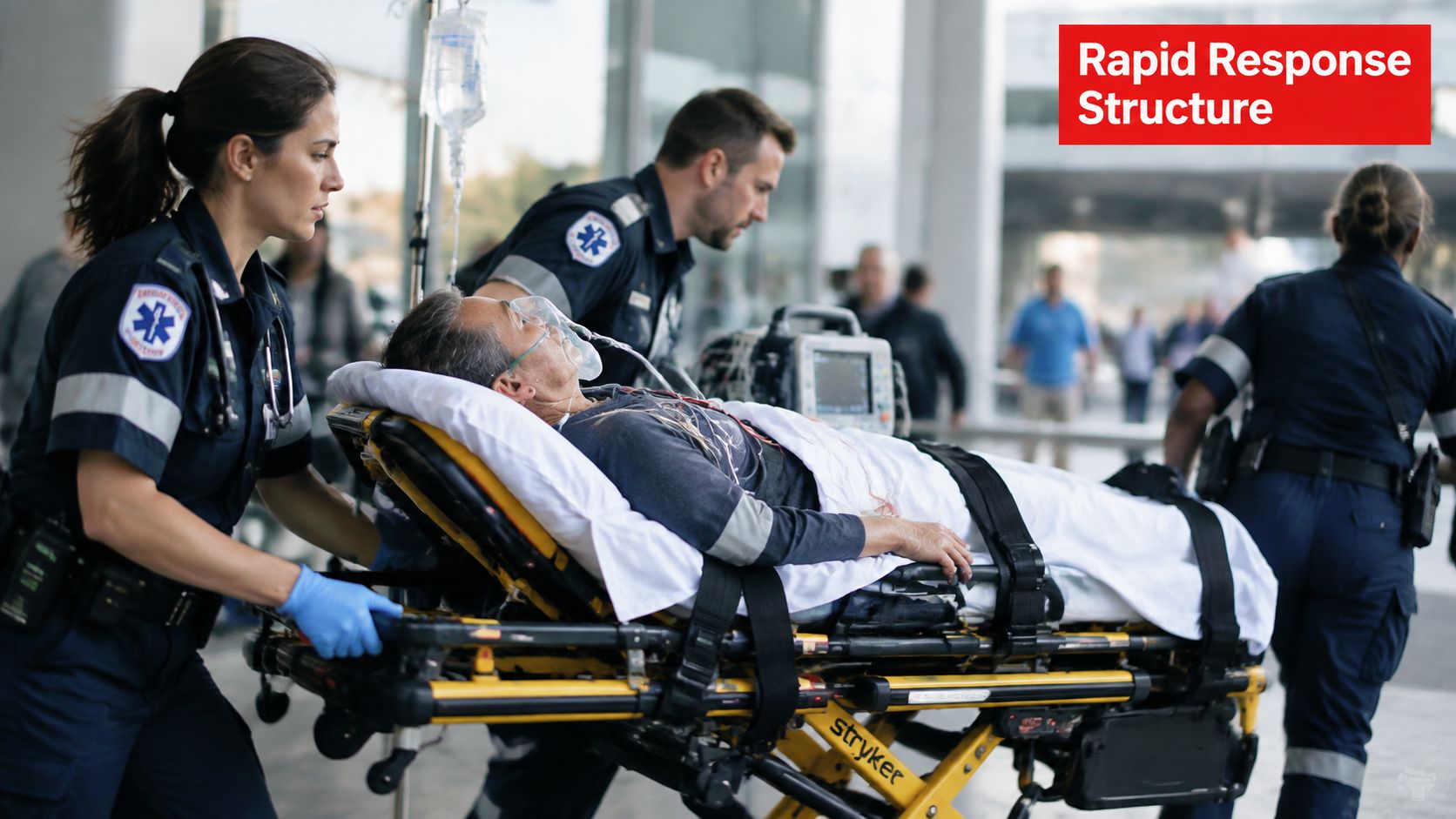

What a planned structure prevents
A formal structure gives staff a working system under pressure. It protects:
- People: Staff can isolate hazards, direct occupants and arrange first aid without competing instructions.
- Time: The person receiving the first report knows who to notify and which details to pass on.
- Accountability: Supervisors can confirm which areas were checked, which resources were sent and what remains unresolved.
- Reputation: Guests and workers see an organised response rather than public improvisation.
- Handover: Fire and Rescue, Police or Ambulance crews can identify the site controller, receive a concise briefing and take command when appropriate.
The structure must fit the site rather than copy a generic chart. A venue manager should account for each shift, available supervisors, radio coverage, restricted areas, public access points and the likely arrival route for emergency services. The same arrangement may not work across a festival ground, licensed venue, office or construction project.
A practical plan answers these questions before an alarm sounds: Who is the controller on each shift? Who takes over when that person is off-site? Which warden covers each zone? Who meets arriving responders? Who records decisions and preserves information for the post-incident review?
Practical rule: If two people can issue competing instructions during one incident, the structure is not clear enough.
The strongest structure is the one staff can activate immediately, understand under stress and hand over cleanly to external emergency services. Keep authority visible, assign backups and test the arrangement during drills, not for the first time during a real event.
Core Principles of an Effective Team Structure
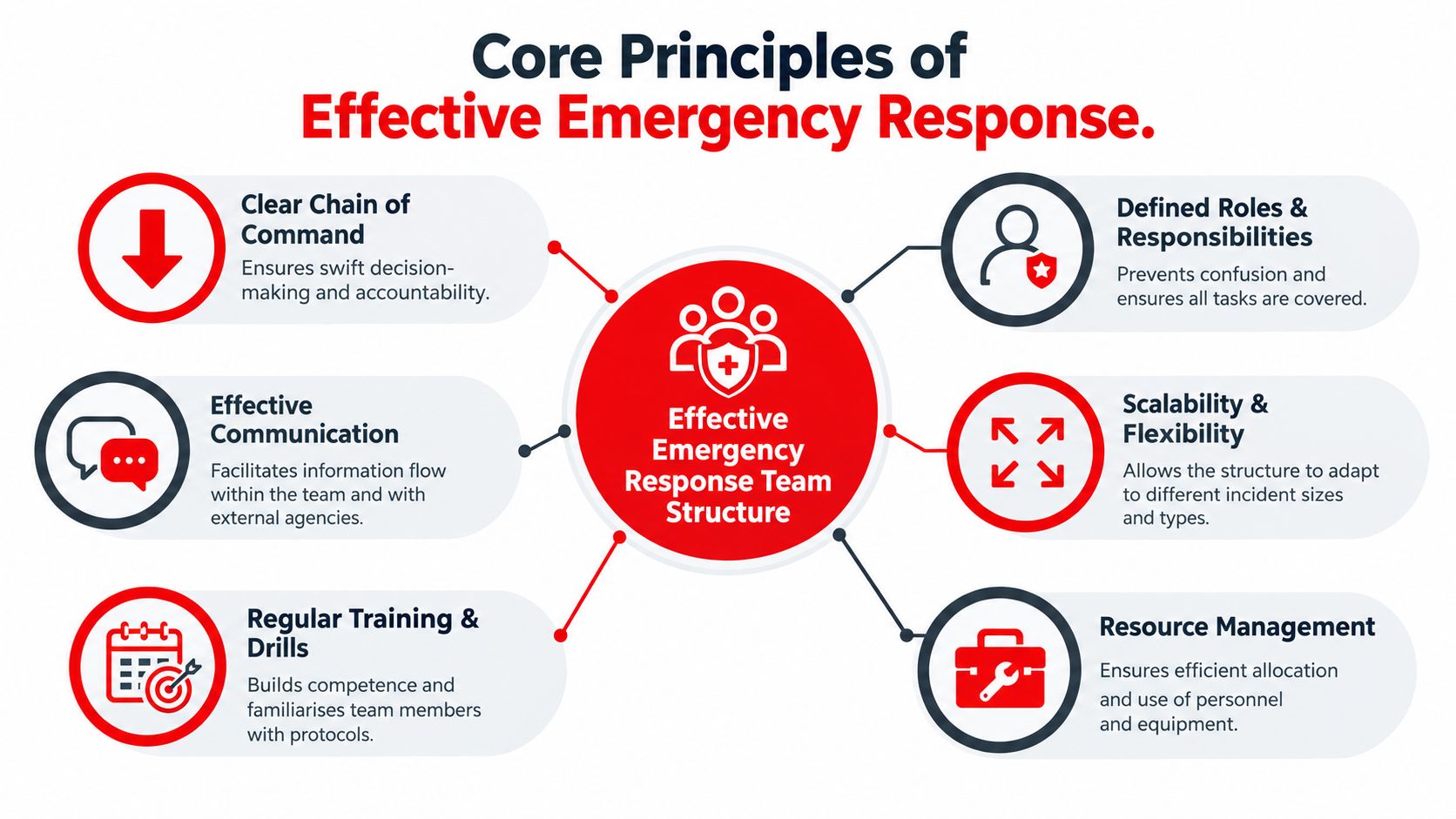
A structure that works at a festival may fail at a licensed venue or construction site. Build the arrangement around the site, the shift roster and the incident risks, then connect it clearly to external emergency services. Job titles matter less than knowing who can make decisions, who carries out instructions and who takes over when conditions change.
Build one line of authority
Use a clear chain of command supported by four functions: control, planning, operations and logistics. This arrangement lets a small team expand as an incident becomes more complex, while keeping responsibilities distinct.
The Incident Controller sets objectives, approves priorities and coordinates the response. That person should not also be sweeping floors, managing radio traffic, sourcing equipment and briefing arriving responders. Delegation keeps decisions at the right level and prevents one manager from becoming the point of failure.
- Control: Sets objectives, priorities, authority and overall direction.
- Planning: Collects information, monitors conditions and prepares the incident action plan.
- Operations: Directs field activity, including evacuation, isolation, access control and specialist response.
- Logistics: Provides people, radios, lighting, barriers, keys, vehicles, welfare and other resources.
At a small site, one person may hold more than one function. Keep that arrangement only while the workload is manageable and the duties do not conflict. As complexity grows, split functions and appoint additional people.
Protect the span of control
The AIDR incident management companion case studies describes a defined span of control in which one person supervises up to five people. The principle gives supervisors enough capacity to receive information, make decisions and confirm that instructions were understood.
Apply it in practical terms:
- Give each warden or team member one direct supervisor.
- Group assignments by location or function.
- Add a supervisor when oversight becomes unreliable.
- Avoid titles that carry no clear authority.
Design for change
The structure must expand, contract and transfer authority as the incident develops. A local medical incident may need a controller, operations lead, first aider and communications contact. A fire, crowd surge or hazardous-material event may require planning, logistics, safety, liaison and specialist teams.
Document the trigger for each change. If the venue manager leaves, the deputy assumes control. If multiple agencies attend, the site team provides a structured briefing and follows the relevant authority's lead. If several locations are affected, tactical teams should report through an operational layer instead of directly to one overloaded manager.
Test those changes during drills. Staff should be able to switch roles, use available equipment and hand over information without relying on a generic chart.
Defining Key Roles and Responsibilities
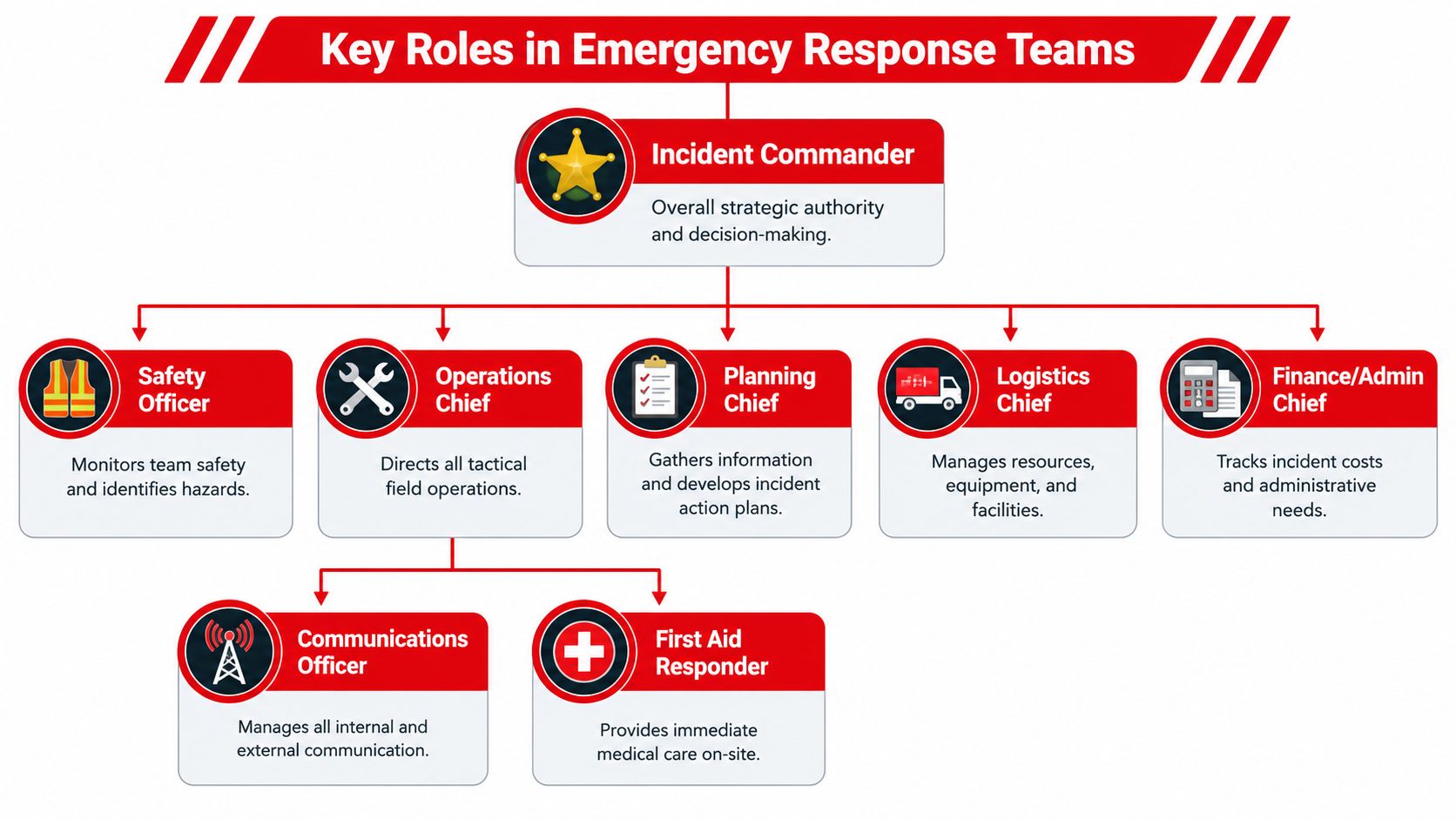
A role description should tell a person what to do, what they can decide and when they must report. Titles alone won't achieve that. Your emergency response team structure should also identify the nominated person, the deputy, the radio call sign or contact method, the area covered and the handover process.
The Australian approach under AS 3745 practice uses a Chief Warden to lead the Emergency Control Organisation, supported by deputies, a Communications Officer and Area or Floor Wardens. Victorian emergency doctrine also recognises the Incident Controller's overall responsibility for incident resources and the performance of incident-management functions. The Victorian emergency management fundamentals guidance provides the relevant framework.
Incident Controller or Chief Warden
This is the person with overall authority for the immediate response. At a venue, the role may be called Chief Warden during routine evacuation operations and Incident Controller during a broader incident.
The controller:
- Confirms the nature and location of the incident.
- Sets priorities, such as life safety, hazard isolation, evacuation or access.
- Authorises site-wide instructions and escalation.
- Assigns resources and confirms progress.
- Establishes the safe access point for emergency services.
- Hands over relevant control when an external agency assumes command.
The controller doesn't need to perform every task. Their value comes from maintaining the overall picture and preventing conflicting decisions.
Deputy and Safety Officer
A deputy provides continuity when the controller is unavailable, fatigued or required elsewhere. A Safety Officer monitors hazards affecting responders, such as smoke, electricity, unstable structures, aggressive behaviour or vehicle movement.
For a construction site, the Safety Officer may restrict access around an unstable excavation. At a festival, the officer may stop staff entering a congested area before a crowd movement problem worsens. Safety authority must be explicit, especially where the person can pause an unsafe action.
Communications Officer
The Communications Officer controls information flow. They receive reports, record key times, maintain the incident log, issue approved messages and keep internal channels usable.
A useful report includes the exact location, what happened, immediate hazards, people affected, actions already taken and resources required. Staff should avoid speculation and use plain language. The Communications Officer also prepares the arrival briefing for emergency services, rather than sending several uncoordinated accounts.
Operations and Area or Floor Wardens
Operations directs field activity. Area and Floor Wardens carry out local checks, guide occupants, report conditions and prevent re-entry when instructed.
Zone ownership matters. A warden should know the boundaries of their area, alternate route, assembly point, high-risk rooms, accessible evacuation needs and the person receiving their status report. Local wardens should report facts, not make uncoordinated site-wide decisions.
First Aid, Medical and Liaison functions
First aid or medical staff provide immediate care within their training and equipment. They need a clear route to the patient, privacy where possible, protection from crowd interference and a method for requesting additional support.
The Liaison Officer coordinates with Police, Fire and Rescue, Ambulance, venue owners, contractors and other agencies. This role is particularly valuable at multi-agency events because it keeps the controller informed while giving arriving responders one reliable contact.
Scalable Emergency Response Team Structure Examples
A small office and a multi-stage festival require different staffing, even when both use the same principles of authority, reporting and risk control. Treat the three models below as starting points. The final structure must reflect the site layout, operating hours, workforce, contractors, hazards and access arrangements for emergency services.
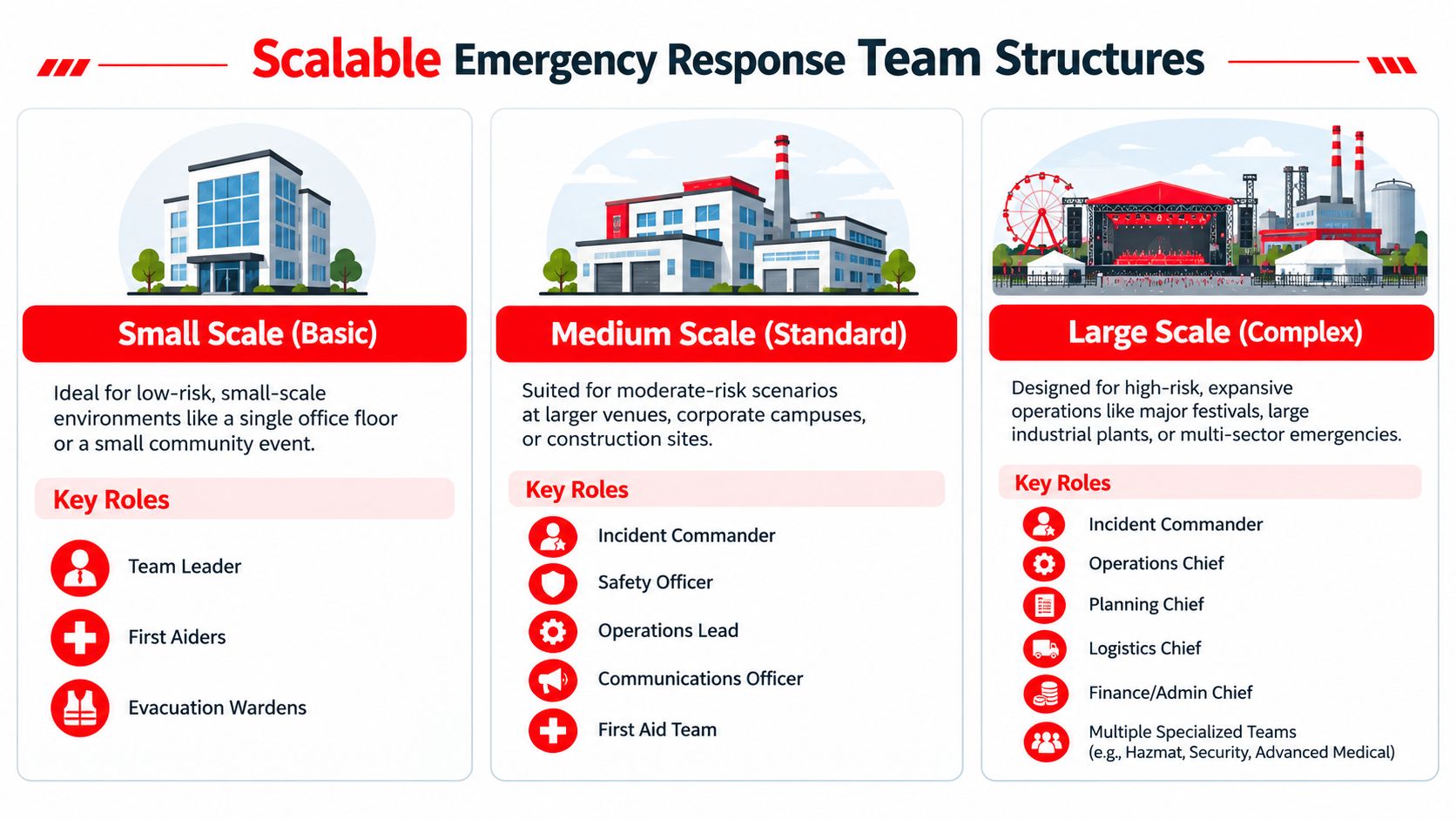
Model one, the basic warden structure
Typical chart
Team Leader or Chief Warden
→ Deputy
→ Area or Floor Wardens
→ First Aiders
This model suits a small office floor, modest retail tenancy, low-risk community activity or compact venue with predictable occupancy. It is effective when staff can cover the site without complex operational branches, hazards are understood and the incident can be managed through a direct chain of command.
The Team Leader decides whether to investigate, isolate, evacuate or escalate. The Deputy confirms attendance and assumes control if the leader is unavailable. Wardens cover nominated zones, direct occupants and report areas that are clear, blocked or affected. First aiders provide care within their training and request ambulance support when required.
Simplicity is the advantage. Availability is the risk. A warden may be on leave, serving a customer, working another shift or away from the building when an incident starts. Include alternates, define minimum shift coverage and train staff to operate the structure without relying on one named person.
Model two, the event Incident Management Team
Typical chart
Incident Controller
→ Operations Officer
→ Planning Officer
→ Logistics Officer
→ Communications, Medical, Security and Warden teams
This model fits festivals, concerts, large hospitality venues, corporate events and public gatherings where crowd conditions and hazards can change quickly. Operations manages crowd movement, access, evacuation and tactical teams. Planning maintains the incident picture, records decisions and supports forward planning. Logistics sources barriers, radios, lighting, transport and relief staff.
Start with only the functions the incident requires. A medical incident may activate the controller, operations, communications and first aid functions. Fire, serious assault, severe weather or evacuation may require planning, logistics, safety and liaison support.
Use a written activation matrix. It should identify who opens the incident log, contacts emergency services, controls public messaging and meets responders at the nominated access point. Keep contractors out of the command channel unless their role requires direct access. Give each contractor group a supervisor, then route status reports through the agreed structure.
The event model must also work across shifts and during contractor handovers. Record who holds each role, where they are stationed and how the incoming person receives the current incident picture.
Model three, the tiered multi-site structure
Typical chart
Strategic Executive Team
→ Operational Incident Management Team
→ Tactical Site or Zone Teams
→ Wardens, security, medical and specialist resources
This model suits shopping centres, large construction projects, industrial properties and events spread across multiple sites. The strategic, operational and tactical arrangement keeps business decision-makers connected to activity in each affected location.
The strategic layer sets business priorities and authorises major support. The operational Incident Management Team coordinates the overall response and manages external agency engagement. Tactical teams work near each affected zone, station, work area or event sector, where they can act on local conditions and report changes promptly.
The trade-off is control versus speed. Extra layers improve supervision and reduce overload, but they can slow decisions when reporting lines are unfamiliar. Write authority boundaries into the plan. Each tactical team should know which actions it can take immediately, which require operational approval and how to request resources or emergency service support.
Choose the model against actual operating conditions:
| Operating condition | Suitable starting model | Main adjustment |
|---|---|---|
| Compact site with stable staffing | Basic warden structure | Add deputies and shift coverage |
| Public event with changing crowd conditions | Event IMT | Add medical, security, communications and logistics capacity |
| Multiple zones or locations | Tiered multi-site model | Establish operational coordination and tactical supervisors |
Test the selected structure during normal operations. A model that looks clear on paper may fail when key staff are absent, radio coverage is poor or an arriving emergency service needs a single reliable contact.
Building Clear Communication and Escalation Protocols
A structure collapses when information moves informally. The first report should reach the controller quickly, and the controller should know what information is reliable, what remains uncertain and which action has already started.
Use radios where the site has poor mobile coverage, noise, crowd density or a need for group communication. Use a controlled messaging application or written incident log for records, task allocation and handover. Don't rely on a single channel. Create a primary operational channel, a method for urgent escalation and a fallback contact process, then test both during normal operations.
Use a disciplined report format
Ask staff to report in this order:
- Location: State the site, zone, level, gate or landmark.
- Incident: Describe what has happened without speculation.
- Hazard: Identify fire, smoke, electricity, violence, traffic, structural or crowd risks.
- People: State whether someone is injured, trapped, missing or at risk.
- Action: Explain what staff have done.
- Request: Name the support required.
The Communications Officer should repeat critical details back to the caller. That simple confirmation catches wrong locations and prevents a vague “send help” message from consuming valuable time.
Set escalation triggers before the incident
Call emergency services immediately for fire or smoke, a serious injury, a threat to life, violence involving weapons, a suspected hazardous substance, a trapped person, a missing vulnerable person or any incident beyond the team's training and equipment. Staff shouldn't wait for internal permission where delay could worsen the threat.
Australian government reporting shows median response times for structure fires ranged from 4.7 minutes to 8.0 minutes across states and territories in 2024–25, excluding call-taking time, as reported in the Australian emergency response planning document. That makes the site's first 5 to 10 minutes operationally important. Your team should protect life, create safe access, isolate immediate hazards and provide accurate information until professional responders take over.
For managers reviewing digital incident workflows and field coordination, the practical question is how to boost field team ROI without adding unnecessary reporting friction. Choose tools that support fast tasking, location clarity and auditable handovers, not tools that force staff to complete lengthy forms during the first response.
Training Drills and State-Specific Compliance
A team chart that hasn't been practised is an assumption. Staff may know their titles but still fail to recognise the alarm, use the wrong radio channel, direct people to an unsafe assembly point or wait for a manager who isn't rostered.
Training should progress from discussion to action:
- Tabletop exercise: Walk through a medical, fire, violence or evacuation scenario. Test decisions, contacts and escalation rules.
- Communications exercise: Send realistic reports through the agreed channels. Check whether the controller receives the location, hazard, people, action and request.
- Functional drill: Activate wardens, first aid, operations and logistics in a controlled exercise. Observe movement, accountability and access.
- Full operational exercise: Coordinate the site with relevant contractors, event staff and external stakeholders where appropriate. Record gaps without creating unnecessary risk.
After every exercise, assign an owner to each corrective action. Update the site plan, role cards, contact list and roster. A drill that produces observations but no changes is theatre.
Align with the jurisdiction
Australia's emergency-management arrangements are primarily state and territory led. The Australian Government Crisis Management Framework explains that state and territory governments hold primary responsibility within their jurisdictions, while Commonwealth arrangements support national coordination.
For a venue operating in New South Wales, Victoria, Queensland or the ACT, confirm the applicable emergency-management, WHS or OHS requirements, building obligations, fire provisions, licensing conditions and local responder expectations. Don't assume a plan accepted in one state transfers unchanged to another.
Your plan should document how command transfers when Police, Fire and Rescue or Ambulance arrives. Include the site access point, hydrant or fire indicator information where relevant, hazardous-area details, occupant status, known missing people, actions completed and the name of the person providing the briefing.
The Victorian framework uses incident, regional and state tiers, while Australian incident guidance requires clear leadership, reporting and accountability. Where two or more agencies respond, a formal Incident Management Team must be formed, as outlined by Tasmania's incident management guidance. Your private-site structure should therefore include a practical handoff, not just an internal evacuation diagram.
Frequently Asked Questions
What is the best emergency response team structure for a small venue?
Start with a Chief Warden or Incident Controller, a deputy, zone wardens, a Communications Officer and trained first aid support. Add operations or logistics duties when the venue has complex access, crowds, contractors or specialist hazards.
Should a venue use AIIMS or an AS 3745-style warden model?
Use the warden model for routine building evacuation and zone accountability. Use AIIMS-style control, planning, operations and logistics functions when the incident involves multiple teams, agencies, locations or changing objectives.
Who takes command when emergency services arrive?
Your controller provides a concise briefing and follows the direction of the relevant emergency service when that agency assumes command. The plan must identify the handover point and preserve accurate incident records.
How do I test whether the structure works?
Run a tabletop exercise, a communications test and a practical functional drill. Check whether people know their authority, report through one supervisor, reach their zones and escalate without delay.
What should happen when staffing is short?
Prioritise command, communications, immediate life safety and access for responders. Use deputies, cross-trained personnel and external support where appropriate, but don't assign a title without confirming that someone can perform the duty on the rostered shift.
GM GROUP Services can help venues, events, construction sites and businesses review risks, establish practical emergency response coverage and coordinate trained security resources across New South Wales, Victoria, Queensland and the ACT. Discuss your site-specific requirements and response arrangements by visiting GM GROUP Services.