


SEO Title: Emergency Response Services 7 Ways to Stay Safer
URL: /emergency-response-services-stay-safer
SEO Meta Description: Emergency response services are more than fast arrivals. Learn how coordination, handoffs, compliance and planning help events and sites stay safer.
Emergency response services start long before the first siren.
You're finalising an event run sheet, checking contractor arrivals, or opening a venue for a busy night. Then someone collapses near an entry gate, a small kitchen fire trips alarms, or a vehicle blocks an access lane that paramedics would need. In that moment, most organisers ask one question. How fast can help get here?
That matters, but it isn't the whole job.
From a site manager's point of view, emergency response services work like a chain. The first link is what your team sees and reports. The next is how clearly that information reaches control, security, medical staff, and public responders. The last is whether the handoff is clean enough to stop a manageable incident becoming a chaotic one.
For organisers in NSW, VIC, QLD and the ACT, that's the practical challenge. You're not building a plan for a perfect day. You're building one for the first confused minute, when details are patchy, people are moving, and the wrong message can send the wrong resource to the wrong place.
Emergency Response Services at the Start of Your Event or Site Plan
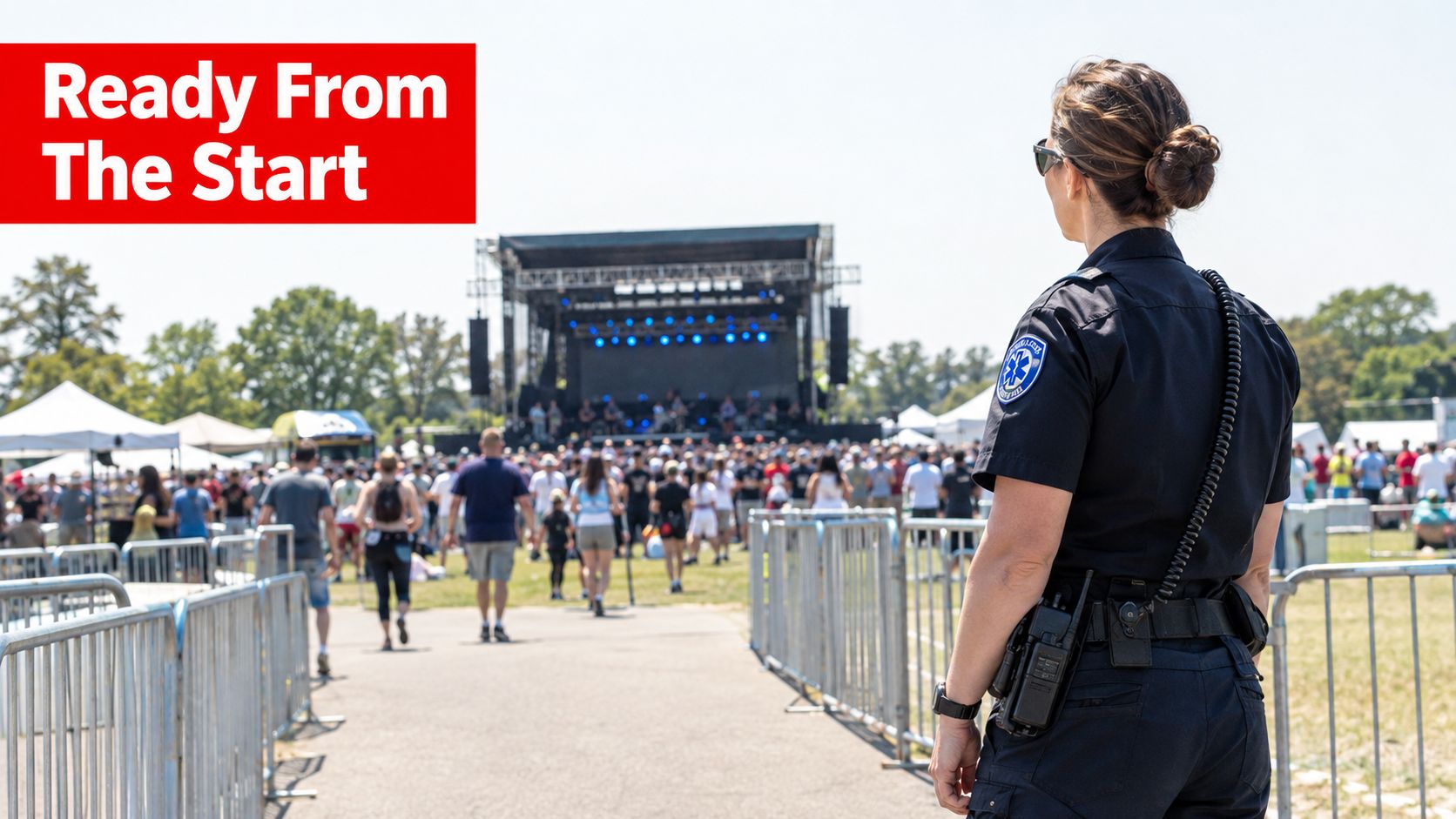
A festival gate opens. Crowd flow is normal. Vendors are trading. Then a patron goes down near a barrier line and two different staff members radio in two different locations. One says “front stage”. Another says “near bar two”. A third person calls an ambulance before the control room even knows whether the patient is breathing, intoxicated, injured, or trapped in a crush point.
That's how trouble starts. Not always with the incident itself, but with unclear early information.

What the first minutes usually decide
At the start of an event or shift, the focus lands on staffing numbers, queue management, and opening checks. Fair enough. But emergency planning belongs at the same starting line because those opening conditions affect every later decision.
If your team can't describe location markers, responders lose time finding the patient. If vehicle access is blocked by staging, waste bins or delivery vans, a straightforward medical call becomes a movement problem. If nobody knows who has authority to escalate, staff hesitate.
Practical rule: The first report should answer four things. What happened, where it happened, who's affected, and what access route is clear right now.
This is why experienced organisers don't treat emergency planning as a document that sits in a folder. They treat it like an operating picture. Everyone needs the same map, the same radio language, and the same trigger points.
Why this matters across Australian sites
Emergency demand in Australia is already substantial. National reporting shows ambulance services handled 4.5 million incidents, delivered 5.9 million responses, and assessed, treated or transported 4.3 million patients in 2024–25, alongside 26,603 registered paramedics and $6.3 billion in ambulance service organisation revenue, according to the Report on Government Services ambulance services data.
For a venue operator, promoter, builder or retail centre manager, that scale means public responders are part of a high-volume system. Your site plan has to help that system work, not add noise to it.
A practical example. On a construction site, the issue may be plant access and clear muster points. In a pub, it may be separating an intoxication presentation from an assault scene. At a conference, it may be guiding paramedics through loading docks instead of the public foyer. Different settings, same principle. Early clarity beats late improvisation.
What Emergency Response Services Really Mean Beyond Rapid Arrival
A common perception is that emergency response is a race. Someone calls, a vehicle moves, help arrives.
That picture is too narrow.
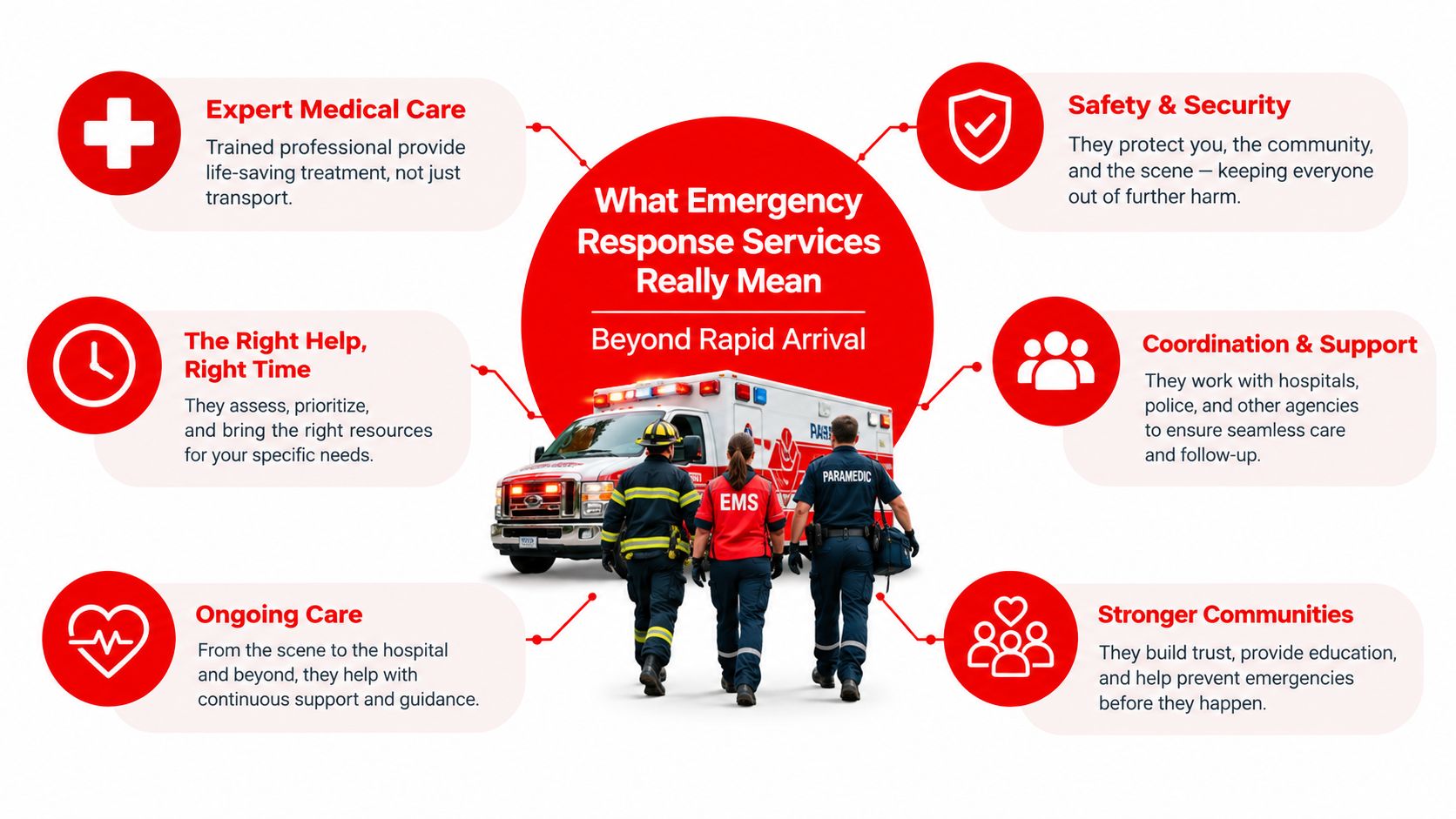
Emergency response services work more like air traffic control. The visible part is the aircraft landing. The harder part is what happens before that. Information has to be sorted, prioritised, routed, confirmed, updated, and handed off without confusion. If one part breaks, the whole system feels slow even when crews are moving quickly.
The system behind the siren
Think about a serious fall at an event bump-out. A guard spots the casualty. Control needs the exact location. A first aider needs safe access. Someone checks whether machinery must be stopped. Another person meets public responders at the nearest open gate. Police may need details if the fall involved a vehicle or unsafe conduct. None of that is “extra”. That is the response.
Australia's emergency management picture makes this broader role clear. In 2024–25, fire service organisations attended 472,361 emergency incidents, with government expenditure for fire services and state and territory emergency services reaching $7.4 billion. The same reporting lists 101,553 fire-related incidents and 101,662 incidents attended by state and territory emergency service organisations outside Queensland, with 71.7% of those classified as storm and cyclone events, according to the Report on Government Services emergency management data.
That matters because many real incidents don't stay in one lane. A weather event at an outdoor venue can become a medical problem, a crowd movement problem, a traffic problem and a communications problem at the same time.
Where readers usually get this wrong
The common misunderstanding is thinking speed alone defines quality. On site, the sharper issue is often whether the right information gets to the right responder early enough.
A 2025 Australia-focused white paper identified “lack of systems integration, information sharing and interoperability” as a key challenge, and the same national discussion notes that 77% of respondents rated services as excellent or good while 84% still expected emergency help within 15 minutes, highlighting the tension between confidence and expectation in the 2025 emergency services reporting overview.
If your staff report “medical emergency near the crowd” and nothing more, you haven't started a response. You've started a guessing exercise.
For hospitality venues, this might mean door staff, venue managers and first aiders all using different terms for the same incident. For retail centres, it might mean CCTV, concierge and security each holding one part of the picture. For festivals, it often shows up during handoff, when on-site teams know what's happening but incoming responders don't know the cleanest route, patient status, or scene risks.
Good emergency response services reduce those gaps. They don't just arrive. They connect.
Key Components That Make Emergency Response Services Work
A reliable response isn't one action. It's several small functions working together under pressure. Miss one, and the whole thing weakens.
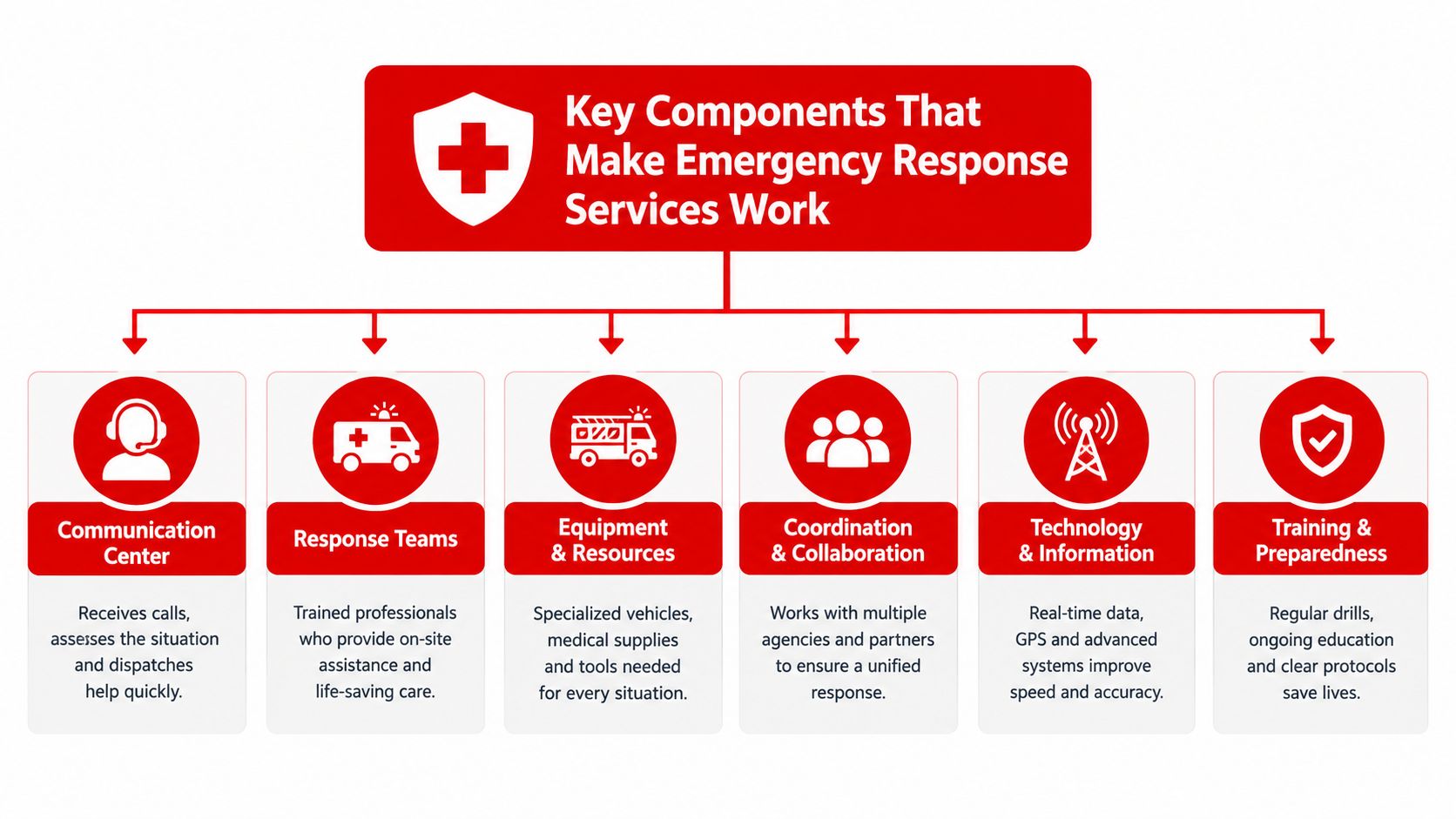
Effective emergency response services are a system of observation, communication, escalation, access, handoff and review.
Six parts that carry the load
On-site first action
The first person on scene sets the tone. At a concert, that may be a crowd controller creating space around an unwell patron. On a worksite, it may be isolating a hazard before anyone else enters the area. Fast doesn't mean rushed. It means calm, controlled, and specific.Clear coordination with external agencies
Private teams don't replace ambulance, fire or police. They prepare the ground for them. A strong site controller can direct a paramedic crew to the exact gate, tell them whether stairs are involved, and confirm whether the scene is safe to enter.Escalation thresholds
Staff need pre-agreed triggers. Chest pain, altered consciousness, smoke in an occupied area, entrapment, escalating violence, and blocked exits should never depend on someone “seeing how it goes” for too long.
The pieces people forget
Communication chains that hold under stress
One person should own the incident log. One person should control outgoing updates. If six people radio fragments at once, control loses shape of the incident.Incident documentation
Good notes protect continuity. They tell incoming responders what changed, when aid started, what witnesses said, and what hazards were present. After the incident, those same notes support insurance, internal review, and compliance records.Post-incident review
Better systems are built here. Did the call go to the right channel? Did responders find the casualty without delay? Did staff use the agreed location names? If not, fix the workflow before the next event.
A practical site check
Use this quick review before opening:
- Access routes: Confirm emergency vehicles can reach priority areas without moving barriers, bins, stock or parked vehicles.
- Role clarity: Make sure supervisors, guards, wardens and first aid staff know who escalates and who meets public responders.
- Shared location language: Use the same gate names, zone numbers and landmarks across radios, maps and contractor briefings.
- Record keeping: Test how incident details are captured while the response is still active.
For organisers reviewing movement and evacuation pathways, the 2026 emergency evacuation guide is a useful companion read because it focuses on how access, exits and navigation affect safe movement during disrupted conditions.
Service Levels Compliance and What Good Performance Looks Like
When a provider says “we respond fast”, that tells you almost nothing.
Good performance is measurable. It separates dispatch, turnout, travel, and arrival. It also adjusts expectations by incident type and geography. A metro venue and a regional site won't perform the same way, and they shouldn't be judged with one blanket promise.
What the benchmarks actually show
In Victoria, a state audit found that 90% of statewide emergency service incidents were reached within a range from 7.8 minutes for metropolitan structure fires to 27.0 minutes for statewide road accident rescues, based on the Victorian emergency service response times audit.
For event and site planners, that's a useful reality check. The nature of the incident changes the achievable benchmark. So does location.
A separate Victorian framework sets explicit road accident rescue standards of 4 minutes for call processing, 8 minutes for volunteer turnout, 1.5 minutes for paid on-station crews, 12 minutes travel time in urban areas, and 32 minutes in rural areas, according to the Victoria emergency service standards report.
Melbourne emergency medical services data tells a similar story. A Monash University study analysing 1,000,458 time-critical lights-and-sirens responses found a median emergency response time of 10.6 minutes, rising from 9.6 minutes in 2009/10 to 11.0 minutes in 2013/14, with performance influenced by distance to scene, activation time, turnout time, workload in the previous hour, and hospital delay time in the Monash research on ambulance response timeliness.
Emergency response services benchmarks by incident type and setting
| Benchmark Area | Example Standard | What It Means for Your Site |
|---|---|---|
| Dispatch timing | ACT Ambulance Service requires dispatch within 45 seconds for Priority 1 and within 2 minutes for Priority 2 in the ACT ambulance audit | Your first report to control must be crisp. Poor caller information wastes precious dispatch time before a vehicle even moves. |
| Call processing | Victorian road accident rescue standard of 4 minutes for call processing in the earlier Victorian standards report | Site staff should know exactly who calls, what script they use, and what details they give first. |
| Crew turnout | Victorian framework lists 8 minutes for volunteer turnout and 1.5 minutes for paid on-station crews in the same standards report | Don't assume all emergency resources mobilise the same way. Your risk plan should reflect local operating realities. |
| Travel time | Victorian framework sets 12 minutes urban and 32 minutes rural travel for road accident rescue in the same standards report | Access roads, gate controls and wayfinding on your property can help or hinder real-world travel performance. |
| Outcome by incident type | Victorian audit range from 7.8 minutes metro structure fire to 27.0 minutes statewide road rescue | Match your controls to the hazard. A high-traffic worksite needs different cover from an indoor gala dinner. |
What to ask providers and internal teams
Ask for measurable commitments, not broad assurances.
- Response model: How is the incident reported, verified and escalated on your site?
- Compliance fit: Are staffing, licensing and venue procedures aligned with current state security regulations and, where relevant, RSA requirements?
- Supervision: Who controls the incident if your normal site manager is busy elsewhere?
- Evidence: What logs, reports and review records will you receive after a serious incident?
One practical benchmark for private planning is whether your provider can explain the full chain clearly. If they only talk about arrival speed, they're skipping most of the operational work.
How Emergency Response Services Integrate With Your Event Plan
The best response plan isn't a separate binder. It sits inside your event plan, your venue procedures, and your daily site routines.
That means emergency response services should appear in the same working documents as crowd flow, contractor access, bump-in schedules, alcohol controls, and after-hours lockup. If those systems don't meet each other, small incidents slip through the gaps.
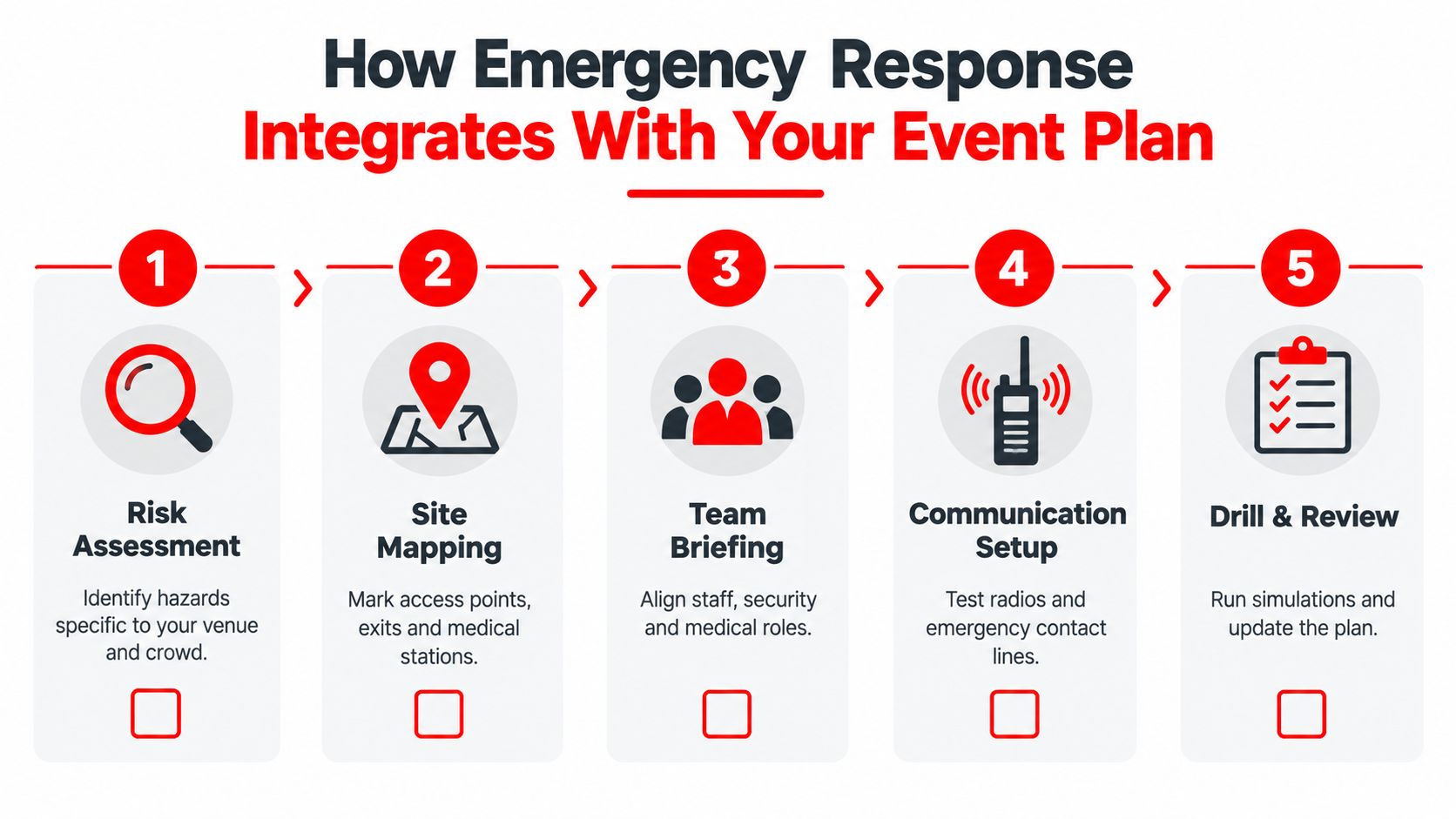
The five integrations that matter most
Start with your site map. Not the pretty version for ticket holders. The working version. Mark vehicle access points, hard stand areas, medical posts, exits, hydrants, isolation points, and any route that becomes unusable during peak crowding or loading activity.
Then line up the people. Security, wardens, first aid, production, venue operations, and contractor supervisors need role clarity before the site gets noisy.
Use this checklist as a practical starting point:
- Risk assessment: Identify likely incidents for your specific environment, not generic hazards copied from another venue.
- Site mapping: Label gates, muster areas, medical rooms and responder approach routes in plain language.
- Team briefing: Make sure front-line staff know who makes decisions and who relays updates.
- Communication setup: Test radios, backup phone contacts, and control room logging before public entry.
- Drill and review: Run short simulations so staff practise the message flow, not just the theory.
Where handoffs usually fail
Handoffs break when on-site teams and public responders work from different assumptions. A medic asks for “north service entry” and your casual staff only know “the loading dock near catering”. That's a preventable problem.
A site is only as organised as its naming system. If your map, radios, signage and contractor brief all call the same place by different names, confusion is built in.
This is also where integrated providers can help. For example, GM GROUP Services lists emergency response support, site-specific evacuation arrangements and risk assessments as part of its operating model across events, hospitality, construction and business environments. That kind of capability is most useful when it's built into site planning early rather than added after the roster is set.
A simple example from hospitality. If a venue expects a late-night surge, the emergency plan should align with RSA controls, entry management, first aid access and taxi or rideshare pickup points. In construction, integration might centre on after-hours patrols, plant shutdown protocols and gate access for incoming responders. Same principle. One site picture, one language set, one escalation path.
Choosing the Right Emergency Response Services Provider With Real Examples
Provider selection often goes wrong for one reason. Buyers compare uniforms and hourly rates before they compare systems.
A capable provider should fit your environment, your trading pattern, your risk mix and your reporting needs. A festival with moving crowds needs something different from a shopping centre, and a shopping centre needs something different from a live construction project with plant, contractors and exclusion zones.
Four practical comparisons
A festival promoter should look for crowd communication, access lane protection, mobile supervision, and clean handoff processes to on-site medical and public responders. If the provider can't explain how they'll manage incident reporting across multiple zones, the deployment is thin no matter how many staff are on the roster.
A hospitality venue should test judgement and de-escalation. The right team can separate intoxication, aggression, and medical distress quickly so the venue manager doesn't treat every problem as a removal issue.
A retail centre needs observation, reporting discipline and liaison across concierge, cleaners, tenants and control. A missing child, slip injury, suspicious package and abusive customer all require different handling even though they arrive through the same front line.
A construction site needs strong perimeter control, after-hours escalation, emergency access awareness and evidence-quality reporting. If a provider talks only about static guarding, they may not be thinking like a response partner.
A simple decision matrix
| Criteria | Strong sign | Warning sign |
|---|---|---|
| Capability fit | They describe site-specific incident types and likely escalation paths | They use the same pitch for every industry |
| Coordination | They explain how security, first aid, management and public responders connect | They talk only about guard presence |
| Compliance | They can speak clearly about licensing, reporting and venue obligations | They stay vague on documentation and procedures |
| Supervision | You know who monitors performance on busy or overnight shifts | “Call us if there's a problem” |
| Reporting | They provide structured incident logs and review processes | Notes are informal or inconsistent |
Selection tip: Ask a provider to walk you through one realistic incident on your site. Not a generic scenario. Your loading dock, your crowd pattern, your access gate, your closing time.
That question exposes whether they understand operations or just staffing.
Your Next Steps to Confident Emergency Response Services Coverage
Emergency response services aren't only about who arrives first. They're about whether the whole chain works when pressure hits. Good planning gives your team a way to recognise, report, escalate and hand over an incident without losing time or clarity.
If you're reviewing your current setup, start with the basics that change outcomes:
- Check your site language: Make sure maps, radios, signs and staff briefings use the same names.
- Test escalation points: Know which incidents require immediate external contact and who has authority to trigger it.
- Walk access routes: Don't assume responders can reach the scene because a path exists on paper.
- Review handoff quality: Ask whether incoming crews would receive clear details on location, casualty status and hazards.
- Demand measurable service levels: Separate dispatch, turnout, travel and on-site coordination in your planning conversations.
- Choose fit over appearance: Pick a provider that understands your environment, not one that promises a visible presence.
For organisers in NSW, VIC, QLD and the ACT, the safest sites usually aren't the ones with the most dramatic emergency plan. They're the ones where ordinary people know exactly what to do in the first minute.
That's the shift worth making. Stop treating emergency response as a waiting game for outside help. Treat it as an integrated information and coordination system that starts with your people, your layout and your procedures. When that system is organised, small problems are more likely to stay small, and major incidents are easier to control.
If you need support building that system into a live venue, event or worksite, GM GROUP Services provides emergency response support, security staffing, risk assessments and site-aligned procedures across NSW, VIC, QLD and the ACT. To see how that fits into your operations, visit GM GROUP Services.