


Do hotels have security guards? Yes, many do, but the model varies. Australia's Security Officers and Guards occupation employed 66,800 people, and accommodation and food services accounted for 2.9% of that occupation's employment, covering hotels, motels, pubs and taverns. You may see a uniformed guard at reception, a concierge-style officer near the lifts, or no visible guard at all while CCTV, patrols and on-call response operate behind the scenes.
You've arrived after a late flight, the lobby is busy, and a function is finishing in the bar. A professional security presence might be checking access near the lifts, helping staff manage a difficult patron, watching the car park or coordinating with reception. At a small boutique property, the same work might be handled through scheduled patrols and trained managers rather than a permanent guard.
The useful question isn't whether a hotel has security guards. It's which security role fits the property, operating hours, guest profile and event risk. The sections below explain what guests usually encounter, how Australian hotels build layered protection, when staffing should increase and how managers can verify a provider.
Do Hotels Have Security Guards and What to Expect on Arrival
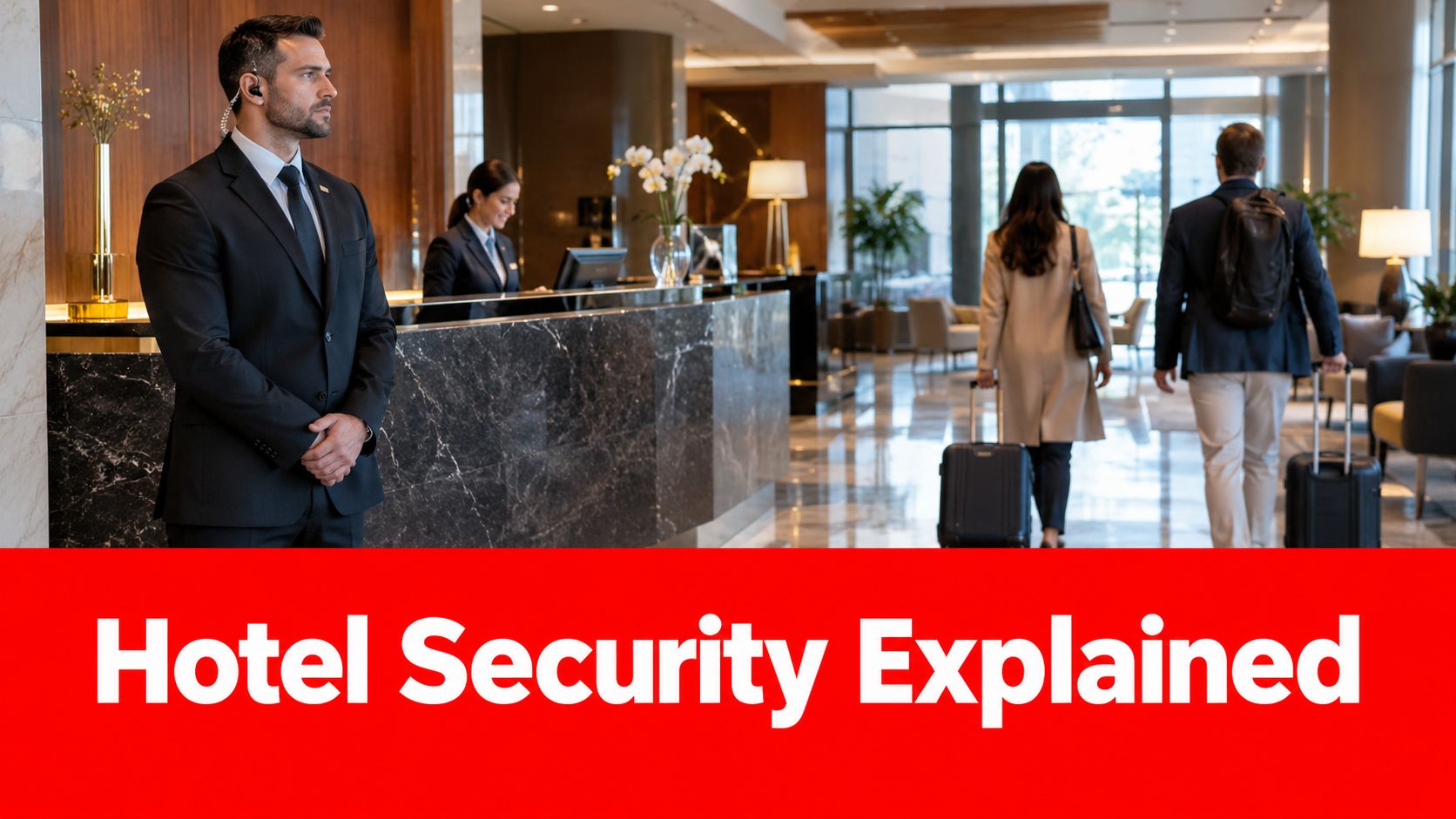
Do hotels have security guards? Often, yes, but their visibility depends on the hotel's risk profile. A large CBD hotel with a late-night bar, function rooms and heavy visitor movement may use a static guard in the lobby during busy periods. A smaller hotel might rely on front-of-house staff, access-control systems, CCTV and a roaming patrol that attends when needed.
The distinction matters because a security officer doesn't always look like a traditional “door guard”. Some officers greet guests, observe movement around reception and help staff manage access. Others patrol guest floors, loading areas, stairwells or parking spaces without remaining in one prominent position.

Why one hotel looks different from another
Hotel security usually reflects several practical conditions:
- Late-night trading: A venue serving alcohol after dark may need crowd-control capability and stronger incident response.
- Functions and events: Weddings, conferences, launches and private parties can bring more visitors who aren't staying overnight.
- Property layout: A resort with multiple buildings and open grounds may benefit from roaming patrols, while a compact hotel may concentrate cover at the lobby and lifts.
- Location and surrounding activity: City-centre properties often manage more pedestrian traffic and public access than secluded accommodation.
- Guest expectations: A luxury property may favour a discreet, concierge-style presence that protects privacy while maintaining a welcoming arrival.
Australian occupation data supports the practical reality that hotels are a visible end-user segment for licensed guards, rather than an unusual exception. The Jobs and Skills Australia profile for Security Officers and Guards identifies accommodation and food services as part of the industry mix, including hotels, motels, pubs and taverns.
What guests should notice
A professional guard may check a function entrance, observe who enters a restricted lift area, assist during a medical issue or respond to a disturbance. The strongest presence often feels calm and ordinary because the officer is preventing small issues from becoming disruptive incidents.
If you're a guest, look for professional conduct, clear identification and respectful communication, not an intimidating performance. If you're a venue manager, ask what guests should experience at arrival, then design the post around that standard.
How Hotel Security Really Works Beyond the Front Desk
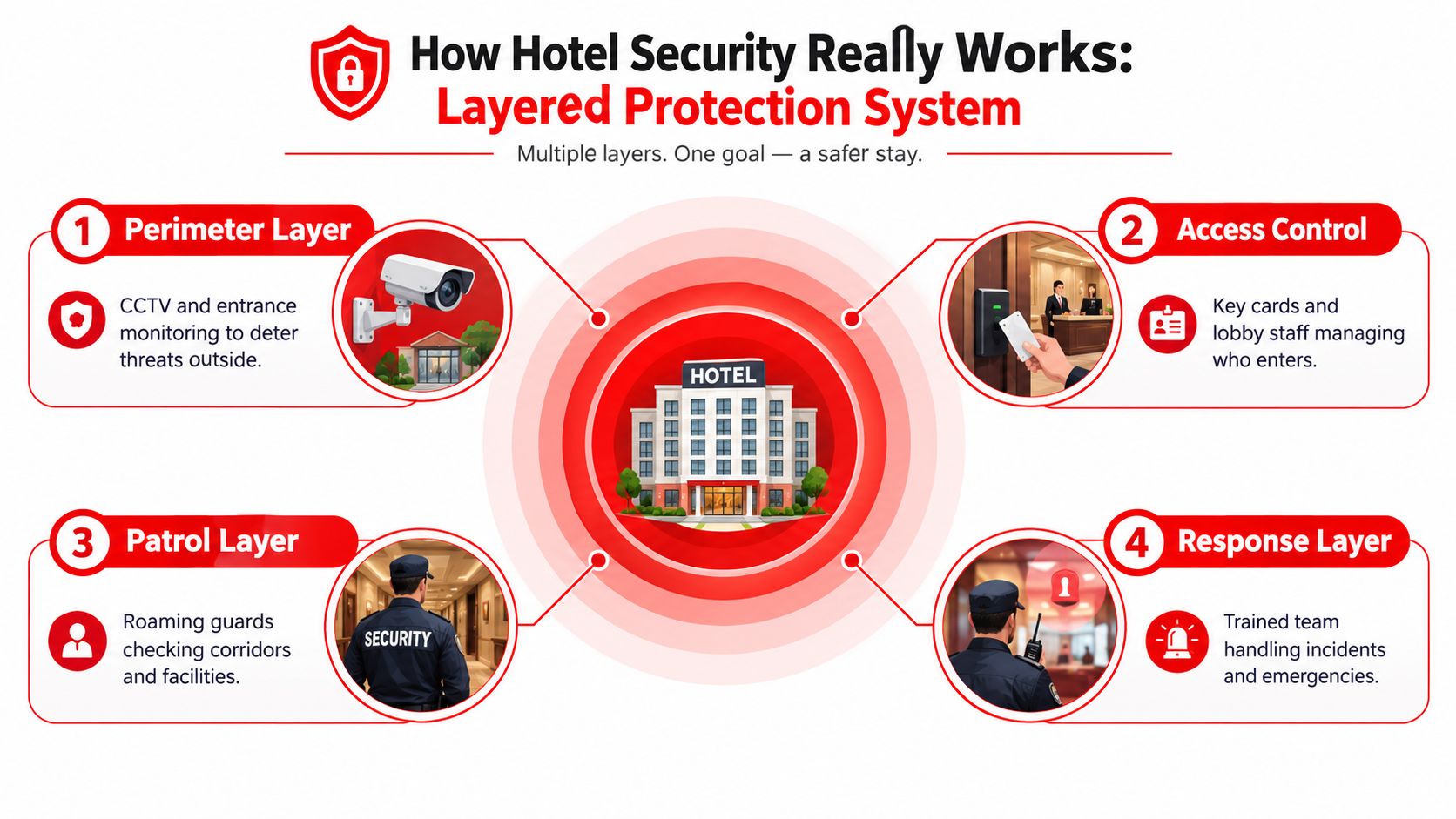
Hotel security works best as a layered system, not as one person standing at the main entrance. A concierge team. One person welcomes guests, another monitors what's happening around the building, another checks less visible areas and a response officer steps in when an incident needs attention.
The outer layer
The first layer covers the hotel's perimeter and approach points. CCTV, lighting, entrance observation and vehicle-area checks help staff identify unusual activity before it reaches reception. A guard doesn't need to challenge every person. Consistent observation and clear escalation procedures usually create a more controlled environment.
The access layer
Access control determines who can move beyond public areas. Staff may use key-card systems, lift controls, visitor procedures and event registers to manage entry to guest floors, staff areas and function spaces. During a busy event, a security officer can support reception by directing visitors to the correct entrance and identifying people who aren't authorised to proceed.
The patrol layer
Roaming officers cover the spaces a fixed post can't see. Their route might include corridors, stairwells, car parks, loading zones, pools or external doors. Patrols also give officers opportunities to notice hazards, unsecured access points, suspicious behaviour and guest concerns that wouldn't appear on a reception desk camera.
The response layer
When a disturbance, injury, access breach or evacuation issue occurs, trained personnel follow the hotel's response plan. They communicate with management, protect affected guests and staff, preserve information for reporting and contact emergency services when the situation exceeds the security team's lawful role.
Technology extends coverage, but it doesn't replace judgement. CCTV can show movement, while a trained officer decides whether a conversation, patrol, management notification or emergency escalation is appropriate. Australia's licensed security workforce is substantial. ASPI reported in 2025 that Australia had more than 120,000 licensed security guards, a workforce larger than the country's combined police agencies and permanent ADF personnel, as referenced in the Australian Hotels Association hotel industry report.
Practical rule: Choose layers that address the property's actual risks. Adding a visible guard without defined patrols, reporting and escalation can create the appearance of control without reliable coverage.
Types of Hotel Security Guards You Will See in Australia
Hotel security roles differ by visibility, mobility and specialist capability. A manager deciding between them should start with the job to be done, not the uniform.
Static guards
A static guard remains at a defined post, commonly the main entrance, reception area, function entry or late-night venue door. This model suits hotels that need visible deterrence, access management and an immediate point of contact for guests and staff.
For example, during peak check-in, the officer might monitor movement around reception and help separate hotel guests from event visitors. During a late function, the same post can support entry procedures and respond quickly to emerging behaviour issues.
Roaming patrols
A roaming patrol moves through the property instead of staying in one location. The officer checks corridors, parking areas, stairwells, external doors and other risk points according to a planned route.
This model works well for a resort, spread-out property or hotel where the main concern is visibility across several areas. It also gives management a way to vary coverage when guest activity changes.
Concierge-style security
Concierge-style officers combine hospitality awareness with security duties. They may greet visitors, provide directions, monitor access and recognise when a guest needs help. Their success depends on judgement and communication, because the role must protect people without making ordinary arrivals feel confrontational.
This approach suits hotels where brand presentation and guest privacy matter. The officer still needs clear authority and escalation procedures, but their first interaction may sound more like assistance than enforcement.
K9 and specialist event teams
K9 units and handlers can provide a highly visible deterrent for selected events, larger sites or specific search requirements. They aren't a default choice for every hotel. A risk assessment should determine whether the presence is appropriate, what the handler's responsibilities are and how the team will coordinate with venue management.
Event and VIP security may also include close protection, discreet officers, vehicle support or additional crowd-control personnel. These roles are separate from routine lobby coverage and should be briefed around guest privacy, arrival routes and emergency procedures.
Monitoring and back-to-base support
Some hotels use CCTV operators, alarm monitoring and back-to-base response to supplement on-site staff. This model can extend oversight beyond a single post, particularly when combined with scheduled vehicle patrols and clear response instructions.
Jobs and Skills Australia reports 66,800 employed Security Officers and Guards nationally, median weekly earnings of $1,818 and annual employment growth of 2,600, while accommodation and food service employs 946,500 people. The Jobs and Skills Australia occupation information also identifies the role of security managers in hotel and pub operations, including guest safety and compliance.
Hotel Size Event Needs and Typical Staffing Models
A staffing plan should begin with risk concentration, not room count. A boutique hotel may have fewer people on site but still face a serious overnight issue if one staff member works alone. A large hotel may need several coordinated roles because guests, contractors, event attendees and venue patrons use different parts of the property.
The following matrix provides a practical starting point. It describes typical models, not a universal staffing rule.
| Property Type | Typical Security Mix | When to Scale Up |
|---|---|---|
| Boutique hotel | Front-of-house awareness, scheduled patrols, CCTV and on-call response | Late arrivals, isolated areas, complaints, local disturbances or private functions |
| Mid-size business hotel | Concierge-style officer during busy periods, roaming patrols and access monitoring | Conferences, evening functions, increased alcohol service or repeated incidents |
| Large CBD hotel | Static lobby or venue coverage, patrols, CCTV monitoring and a supervisor-led response plan | High-volume events, late-night trading, VIP movements or multiple simultaneous functions |
| Resort or spread-out property | Vehicle or foot patrols, perimeter checks, access control and response support | School or group bookings, weddings, outdoor events, remote parking or seasonal activity |
| Hotel with a late-night function | Licensed crowd controllers, entry management, internal patrols and incident reporting | Higher attendance, alcohol-related risk, contentious guests or extended operating hours |
A wedding illustrates the scaling logic. During ordinary daytime operations, reception staff and routine patrols may be sufficient. Once the bar opens, external guests arrive and music continues into the evening, the hotel may need a dedicated entrance officer, an internal patrol and a clear handover process between security, the function manager and the duty manager.
NSW hotel operating documents show how coverage can be tied to operating patterns. One plan required at least one licensed security guard on-site every night, while another required security presence from 10 pm until 5 am on Thursday through Sunday. These examples appear in the relevant NSW Planning Portal hotel operating document.
Questions to answer before booking cover
- Where can an incident start? Consider entrances, bars, car parks, lifts, guest floors and loading areas.
- Who needs access? Separate hotel guests, event visitors, contractors and staff movements.
- When does risk rise? Review late-night periods, alcohol service, functions, shift changes and isolated work.
- Who leads the response? Name the duty manager, security supervisor and emergency-service contact process.
- What must be recorded? Set expectations for patrols, incidents, refusals of entry, injuries and handovers.
A historical PwC hotel industry report cited average hotel security expenditure of just over $100,000 per hotel per year, based on survey results, and estimated sector-wide annual spending of about $713 million if extrapolated across the industry. The same report recorded an average Australian hotel of approximately 34.7 employees. These figures are historical context, not a current quote, but they show that security has long been a material hotel operating cost, as detailed in the PwC hotel industry report.
Licensing Compliance and How to Spot Professional Guards
Australian hotel security is regulated state by state, not through one national licence. A provider working across NSW, Victoria, Queensland and the ACT must understand the rules that apply in each jurisdiction and deploy personnel with the appropriate authority for the task.
In NSW, anyone carrying on a security activity in the manpower sector must hold a Class 1 licence. Approval involves age requirements, fit-and-proper checks, relevant competencies and required training and assessment, according to the NSW security industry licensing information.
Victoria also requires private security employees to be licensed or registered for guarding work. Queensland formally regulates hotel-related security work through its security industry framework, and venues can check providers through the official register using the Queensland Government security licence guidance. A broader overview of state requirements is available through Australian security licensing guidance.
What a manager should verify
A licence is the starting point, not the entire service standard. Before deployment, ask the provider to confirm:
- Licence status: Check the relevant state register and ensure the authority matches the duties assigned.
- Visible identification: In NSW, guards working at licensed premises must display their licence while working.
- RSA capability: Crowd controllers at licensed premises should have the required Responsible Service of Alcohol training where applicable.
- First-aid readiness: Confirm who can provide initial assistance and how the team escalates a medical emergency.
- Reporting standards: Require timely incident reports, shift handovers and clear records of refusals, removals and hazards.
- Hospitality behaviour: Officers should remain polite, observant and proportionate when speaking with guests.
A visible licence, calm communication and accurate reporting tell you more about professional practice than a heavily authoritative manner.
During a patron removal, those details matter. A licensed, trained officer can follow the venue's procedures, communicate with management, document what occurred and escalate when the matter exceeds the security team's lawful role. Licensing reduces exposure by requiring competency and compliance before deployment, but it doesn't remove the need for supervision, good briefing and regular review.
Benefits Limitations Costs and Choosing the Right Provider
Hotel security adds value when the provider solves a defined operational problem. A visible officer can deter unwanted behaviour and give staff an immediate point of contact. A patrol can cover areas reception can't see. Monitoring and reporting can help managers identify recurring access, safety or conduct issues.
There are limitations. A guard can't replace working locks, suitable lighting, staff training, emergency plans or reliable communication. Excessive visibility can also affect the guest experience if officers treat ordinary visitors as suspects. The right service balances protection, discretion and hospitality.
A practical selection process
- Start with a site risk assessment. Walk the property at the times when risk changes. Include reception, guest floors, bars, car parks, loading areas, function rooms and staff-only spaces.
- Define the post in writing. Specify whether the officer is static, mobile, concierge-style, event-focused or part of a response arrangement.
- Match credentials to duties. For licensed venues, confirm licensing, RSA training, first-aid capability and any state-specific requirements.
- Set communication rules. Identify who receives urgent calls, who approves escalation and how the officer contacts the duty manager.
- Measure service quality. Review patrol completion, incident reports, handovers, punctuality, presentation and guest feedback.
- Plan for change. Agree how coverage will increase for conferences, weddings, late-night trading, VIP movements or emerging concerns.
Cost should scale with risk rather than follow a fixed template. Steady overnight cover may suit a property with recurring late-night exposure. An event-based model may be more efficient for a hotel whose main risk occurs during occasional functions. A hybrid arrangement can combine a concierge-style presence, scheduled patrols, CCTV and back-to-base response.
For a provider conversation, prepare the event calendar, operating hours, floor plan, alcohol service details, previous incident themes and expectations for reporting. GM GROUP Services offers hotel and hospitality security across NSW, Victoria, Queensland and the ACT, with options including static guards, K9 units and handlers, VIP protection, vehicle patrols, back-to-base monitoring, emergency response and risk assessments. Any provider should be assessed against your property's licensing, supervision and guest-service requirements.
Making Your Hotel Stay Safer With the Right Security Choice
The answer to do hotels have security guards depends on the property's operating pattern, location and risk exposure. Some hotels need a visible officer at the entrance. Others gain better coverage from a concierge-style guard, roaming patrols, CCTV monitoring or an on-call response arrangement.
For guests, a professional security presence should feel reassuring rather than disruptive. The officer may help control access, support staff during a disturbance, monitor a function entrance or respond to an issue in the car park. Much of the work remains invisible because prevention is usually quieter than intervention.
For venue managers, the decision is more deliberate. Assess the site, identify when risk rises, choose the appropriate role mix, verify state licensing and require clear reporting. Review the arrangement after events and incidents, then adjust coverage when the property, guest profile or operating hours change.
A safe hotel doesn't need to feel fortified. It needs trained people, suitable technology, clear authority and hospitality-minded supervision working together.
Ask GM GROUP Services to assess your hotel, event calendar and operating risks, then recommend a fit-for-purpose mix of licensed guards, patrols, monitoring or specialist support. Visit GM GROUP Services to discuss a security plan that protects guests, staff, property and the welcoming experience your venue wants to deliver.