



Customer service excellence starts at the point where your guest first meets your people. If you're running a venue, a festival, a retail precinct, or a construction site with public-facing access, you already know the moment. The line is building, radios are active, a patron can't find the right ticket, another wants to argue about entry rules, and your security staff are the first people blamed for any delay.
That first interaction shapes the whole event.
I've seen good operations get this wrong by treating security as a barrier only. You get stiff posture, short answers, inconsistent directions, and a queue that feels hostile before anyone even steps inside. Guests don't separate that from your brand. To them, the front gate is the brand.
The stronger model is simple. Security must control risk, enforce conditions, and keep people safe, while still making guests feel handled professionally. That's what customer service excellence looks like in high-risk environments. Not softness. Not sales talk. Clear direction, calm authority, fast decisions, and respectful enforcement.
The New Standard of Event and Venue Security
A poor entry experience is easy to recognise. Guests have been standing in line too long. One guard keeps repeating “move forward” without telling anyone why the line has stopped. A patron asks where the express lane is and gets pointed away without eye contact. Another gets turned around at bag check because the rules weren't explained clearly. Tension builds fast.
Now compare that with an organised gate team. One guard is doing visual screening. Another is proactively answering questions before they become complaints. A supervisor is floating, fixing bottlenecks, and making judgement calls quickly. Guests are still being checked, IDs are still being verified, and prohibited items are still being intercepted. But the tone is different. The operation feels controlled.
That difference matters because most Australians are used to responsive, trackable communication in every other part of life. The Australian Bureau of Statistics reported that in 2022–23, 96% of Australian households had access to the internet, which raises expectations for fast and professional service across channels and frontline interactions alike, including at venue entry points, as noted in this customer service metrics overview.
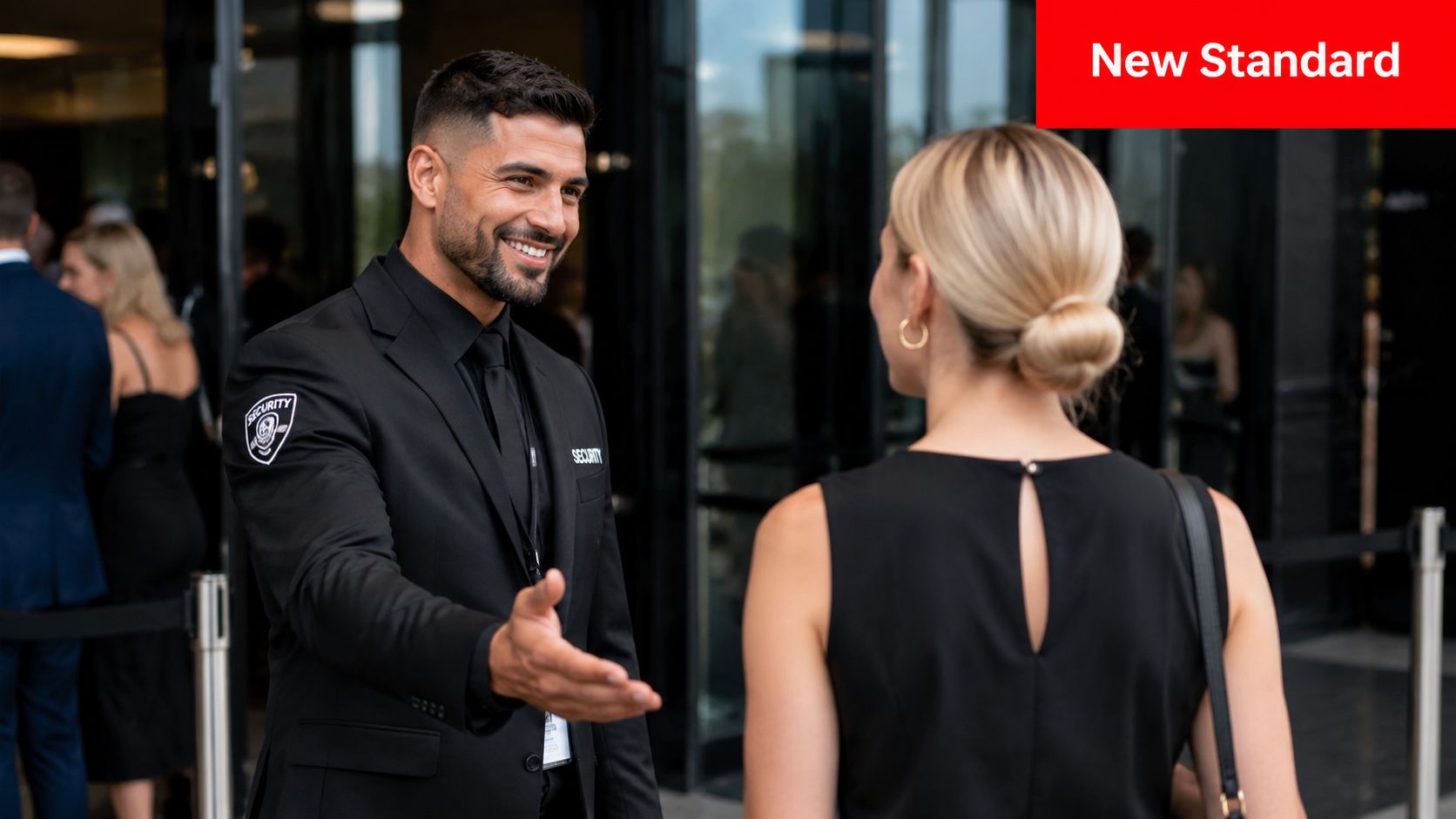

Security is now part of the guest experience
At events and venues, your security team is one of the few functions every guest notices. They see the guard at the barricade, the roving officer near the bar, the person checking credentials, and the staff member who steps in when someone is distressed or aggressive.
If those interactions are clumsy, your operation looks clumsy.
If they are calm, direct, and helpful, the whole venue feels more professional.
Good security doesn't just stop trouble. It lowers friction before trouble starts.
What poor deployment looks like
The common mistakes are operational, not just personal:
- Wrong people on the wrong post. A technically competent guard who can't communicate shouldn't be your first point of contact at a premium event entrance.
- No queue ownership. If nobody is explaining delays, guests invent their own reasons and frustration rises.
- Rule enforcement without explanation. People accept “no” more readily when they understand the reason and the next step.
Customer service excellence begins before an incident. It starts with staffing design, briefing quality, and whether your front-of-house security team understands that safety and hospitality work together.
Defining Customer Service Excellence in High-Stakes Environments
In a security operation, customer service excellence means delivering a secure welcome. Guests should feel safe, respected, and clear about what happens next. They should also understand that rules will be enforced.
That balance is where many operators fail. They train for courtesy but not control, or they train for control but not communication. Neither works well in a licensed venue, a festival gate, or a mixed-use precinct where compliance and crowd mood can change quickly.
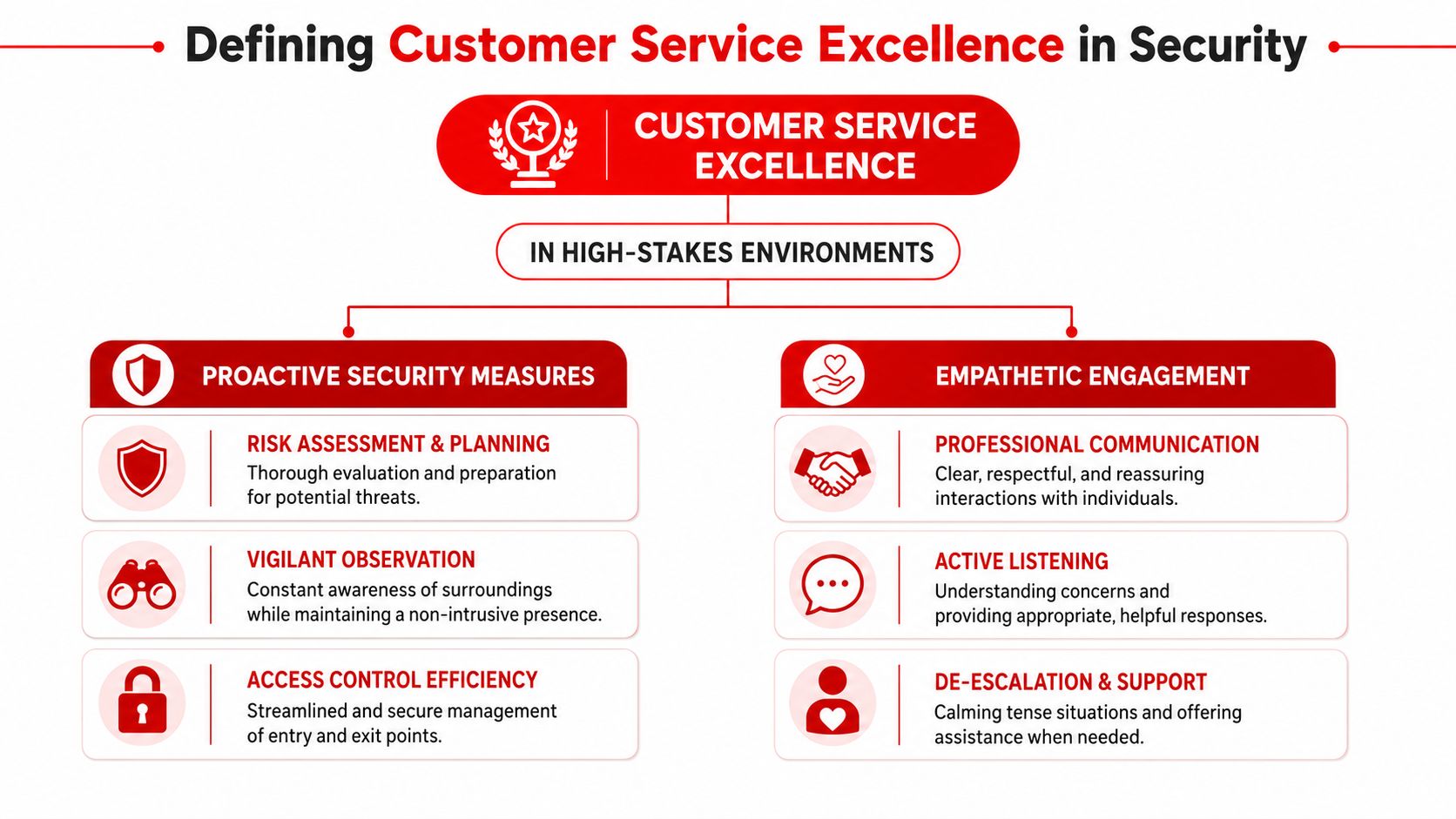
The secure welcome
A secure welcome is not a script. It's a standard of behaviour under pressure. Your team must be able to greet, guide, screen, refuse, redirect, and de-escalate without losing authority.
That matters even more now because self-service has changed what reaches frontline teams. In Australia, 71% of customers want to solve issues themselves, which means the people who do approach staff are often dealing with the exceptions, disputes, and friction points that require judgement, as discussed in this analysis of exceptional customer service pillars.
When a guest finally asks security for help, they're often already annoyed, confused, or in a hurry. Your people need more than manners.
Four working principles
Proactive helpfulness
The best guard at a gate is often the one preventing the next five questions.
That means spotting uncertainty before it turns into congestion. If guests are drifting toward the wrong lane, staff should redirect them early. If bag policy is causing delays, staff should explain it before the checkpoint. If a patron looks overwhelmed, a simple “ticketing line is to your left, entry screening is straight ahead” saves time for everyone.
Calm authority
Being firm doesn't require being abrasive.
In licensed venues especially, staff need to refuse entry, stop escalation, and uphold conditions without sounding personal or emotional. “I can't let you in through this point, but I can show you the correct line” works better than “not here”. The rule still stands. The delivery stays professional.
Practical rule: If your guard sounds offended, sarcastic, or reactive, they're no longer controlling the interaction.
Clear communication
Most conflict gets worse when instructions are vague.
Security teams should use plain language, short sentences, and a clear next step. Avoid jargon. Avoid lecture mode. Tell people what is happening, why it matters, and what they can do now. This is especially important around RSA-related refusals, search procedures, restricted areas, and event re-entry conditions.
Consistent professionalism
Consistency builds trust faster than charm.
Guests notice if one guard explains a rule politely and the next one barks it. They notice if one checkpoint allows an item and another rejects it. Professional appearance, radio discipline, posture, wording, and handover quality all affect whether your operation feels credible.
What customer service excellence is not
It isn't smiling through unsafe behaviour. It isn't letting arguments drag on to avoid complaints. And it isn't turning security into concierge theatre while standards slide.
In high-stakes environments, customer service excellence means people know how to be welcoming without becoming loose, and authoritative without becoming confrontational.
Why Better Service Is Your Best Business Investment
Most clients don't invest in better security service because they want friendlier greetings. They invest because poor interactions cost money, damage reputation, and create operational drag across the whole site.
A rough gate experience affects more than mood. It slows entry, increases complaints, causes staff distractions, and creates avoidable flashpoints. In venues and festivals, that can affect bar trade, patron dwell time, online feedback, and the willingness of organisers to rebook the site.
What strong service changes commercially
A service-focused security team can improve business performance in ways operators feel immediately:
- Better first impressions. Guests start the event in a better frame of mind when entry feels organised.
- Fewer avoidable complaints. Clear explanations at the point of friction stop many issues from escalating later.
- Stronger brand protection. Guests usually remember the treatment more vividly than the process.
- Lower incident exposure. Calm verbal control can stop a disagreement turning into a physical issue.
- Cleaner operations for venue staff. Managers, bar staff, and promoters spend less time firefighting guest frustration.
The venue effect is cumulative
One poor interaction can be recovered. Repeated poor interactions create a pattern.
That's why event organisers should assess infrastructure and contractor choices together, not in isolation. For example, if you're planning an outdoor activation or seasonal event, it helps to find the best marquee company with the same mindset you apply to security. Entry layout, shelter, queuing flow, visibility, and weather protection all shape whether frontline staff can deliver fast, controlled service.
What works and what doesn't
What works:
- Visible supervision so staff get support before tensions rise
- Briefing by audience type because a corporate crowd, a music crowd, and a licensed late-night crowd behave differently
- Clear escalation paths so junior staff don't improvise under pressure
What doesn't:
- Treating all guards as interchangeable
- Assuming experience alone equals customer judgement
- Using complaint volume as the only sign of a problem
A quiet site isn't always a healthy site. Sometimes guests have simply given up trying to engage.
Customer service excellence pays off because it improves the experience while reducing friction, risk, and reputational damage at the same time.
How to Measure What Matters in Security Service
If you want customer service excellence from a security team, you have to measure it the same way you measure compliance, incidents, and staffing coverage. Otherwise, “good service” stays subjective and nobody improves it consistently.
That matters in Australia because complaint systems are active and visible. The ACCC reported that it received around 180,000 reports and complaints in 2023–24, with consumer guarantees among the most common issue types. For service operators, that underlines why measurable standards matter, especially around response, resolution, and complaint prevention, as outlined in this customer service excellence reference.
Start with operational KPIs, not vague impressions
Security managers often hear feedback like “the team was great” or “entry felt slow”. Useful, but incomplete. You need measures that connect service behaviour to site outcomes.
Track a small set consistently first. Expand later if the data is being used.
| KPI | What It Measures | How to Track It |
|---|---|---|
| CSAT | Guest satisfaction after an interaction with security | Use short post-event or post-incident surveys |
| NPS | Willingness to recommend the venue or event after the overall experience | Add one loyalty question to event follow-up surveys |
| First-contact resolution | Whether the guest's issue was solved at the first interaction | Review incident logs, radio notes, and supervisor reports |
| Response time | How quickly staff acknowledge and attend to a request or issue | Timestamp calls, patrol requests, and logged incidents |
| Retention rate | Whether clients, patrons, or attendees return after prior experiences | Compare repeat bookings, repeat attendance, or venue return patterns qualitatively and through client records |
Security-specific ways to use these metrics
First-contact resolution at entry and on the floor
In security, first-contact resolution often means a guest gets the right answer or direction without being bounced between gate staff, ticketing, event crew, and venue management.
If a patron asks about prohibited items, cloakroom options, lost property, or re-entry, your frontline team should know the answer or know exactly who owns it. Multiple handoffs increase irritation.
Response time during low-grade issues
Not every important issue is dramatic. A confused queue, an unattended minor dispute, or a delayed response to a patron who feels unsafe can damage confidence quickly.
Measure how long it takes for staff to acknowledge and act. In a venue, even a prompt verbal acknowledgement can change the tone of an interaction.
Build a review rhythm
Metrics only matter if supervisors review them and coach from them.
Use a simple monthly or post-event review built around:
- Complaint themes rather than isolated anecdotes
- Repeat friction points such as bag checks, ID verification, or access confusion
- Supervisor observations from peak periods
- Training actions assigned to named staff and team leaders
If a KPI can't lead to a roster change, a briefing change, or a training change, it probably isn't the right KPI.
Customer service excellence becomes manageable once you stop treating it like personality and start treating it like performance.
Putting Customer Service Excellence into Action
A Saturday night queue can turn in minutes. One patron argues about ID. Another is upset about a bag check. A third asks for the smoking area and gets three different answers. If the team on the door is under-briefed or unsure of its authority, the crowd feels it straight away.
That is why service in security has to be built into the operation, not left to personality. Good outcomes usually come from clear post design, practical training, supervisor presence, and reporting lines that hold people accountable. In mixed-role environments, where safety, licensing conditions, and guest experience overlap, service quality depends just as much on what happens before the shift as what happens on the floor, as noted in this customer excellence discussion.
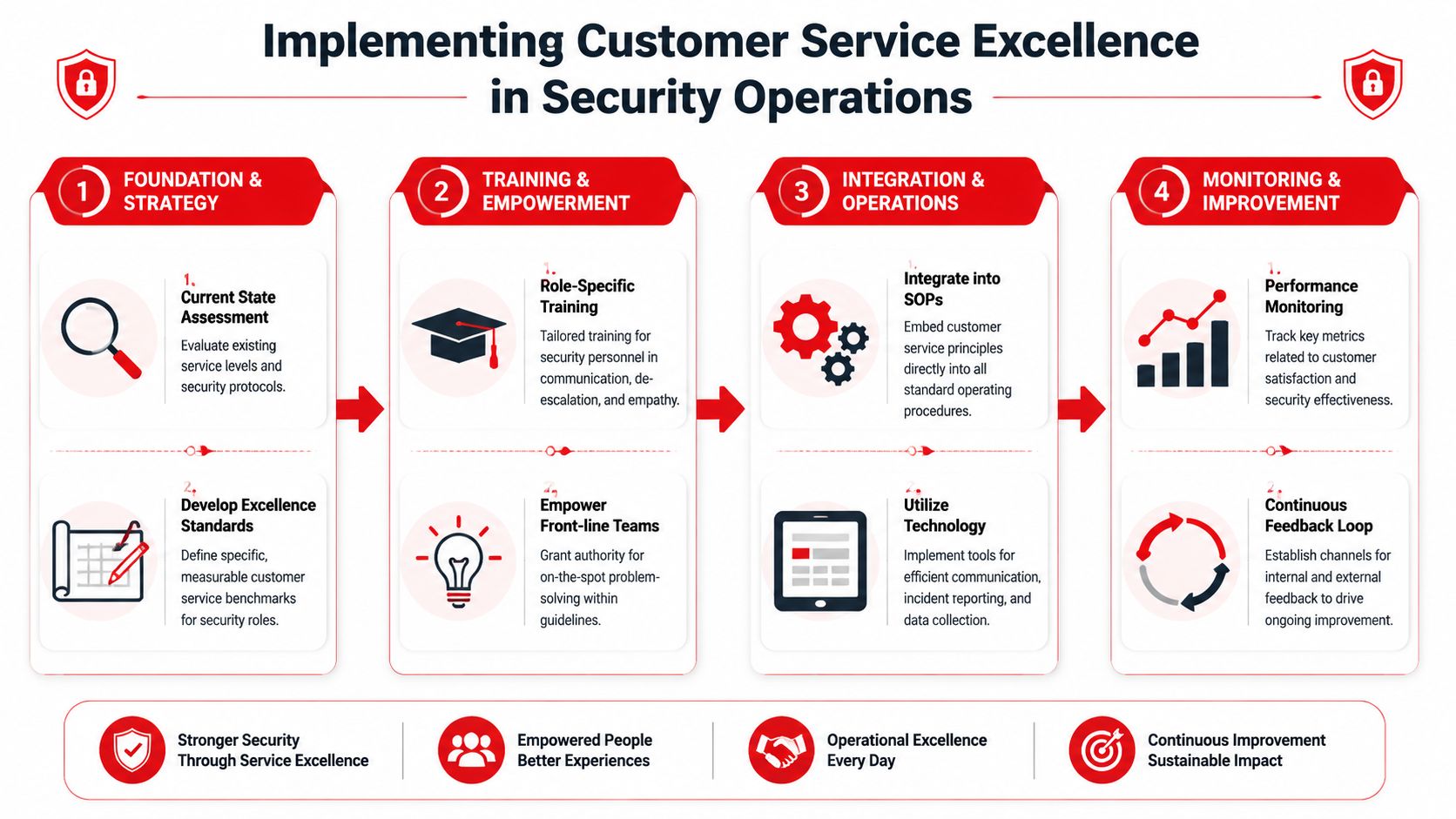
Recruit for fit, not just licence status
A licence gets someone through compliance. It does not tell you whether they can work a premium hotel entrance, a festival search lane, a late-night licensed venue, or a construction gate with constant contractor traffic.
Recruitment and deployment should reflect the job that person will face. Ask candidates how they would explain a refused entry, manage a frustrated queue, or approach a guest who looks distressed but has not broken a rule. Their answer tells you more than a generic customer service statement.
GM GROUP Services operates across events, venues, retail, and construction. That kind of site-specific deployment model is the right standard regardless of provider. Put calm communicators at front-of-house posts. Put detail-focused operators where access control, reporting, or monitoring accuracy matters more than visible guest contact.
Train for pressure points, not classroom theory
Generic training sounds fine in a boardroom and falls apart at the gate.
The best programs use short scenario drills based on the incidents that cause complaints, refusals, and use-of-force risk. At Australian festivals and licensed venues, that usually means bag searches, intoxication disputes, fake or damaged ID, re-entry arguments, and guests filming staff during enforcement. Teams need words they can use under pressure, not slogans they forget by first peak.
A good drill is specific. One staff member plays the patron. One runs the interaction. A supervisor watches for tone, legality, body position, and whether the staff member gave a clear next step. That is how teams learn to stay welcoming without losing control.
Write SOPs that cover conduct as well as compliance
Many SOPs tell staff what box to tick and leave out how to carry out the interaction. That gap is where avoidable conflict starts.
If a bag check is required, the script should make three things clear. The check is a standard condition of entry. The request is polite and direct. Refusal leads to a defined outcome, not an argument. The same principle applies to RSA support, crowd movement, patron welfare checks, and removing someone from a licensed area. Staff should never have to invent their wording in front of a crowd.
Sample SOP for bag checks
- Greet the guest and gain attention before requesting the bag check.
- State the check as a standard entry condition, not a personal suspicion.
- Keep wording short and neutral.
- If the guest objects, explain the available options once. Do not argue repeatedly.
- If tension increases, move the interaction out of the main queue where practical and call a supervisor.
- Document refusal, prohibited items, or escalation according to site procedure.
Give frontline staff room to solve small problems
Frontline teams need limits, but they also need room to act. If every minor issue has to go uphill, queues stall, tension rises, and supervisors spend the whole shift putting out small fires.
Set the boundaries clearly. Staff can redirect guests to another entry, call for a welfare officer, separate a brewing argument, or bring in a supervisor early when a refusal is heading toward a public scene. They should not freelance on policy, improvise conditions of entry, or debate venue rules they do not control.
Communication systems matter here. For phone-based coordination and incident routing, venues that want to enhance FCR with hosted PBX can tighten handovers between security, operations, and customer-facing teams. In practice, that means the guest gets one clear answer instead of conflicting directions from security, bar staff, and event crew.
Coach supervisors to set the tone on shift
Service standards rise or fall with supervision. A team leader who only steps in after a patron is shouting has already missed the important part.
Strong supervisors work the room early. They listen to how staff explain delays, watch how refusals are handled, and fix poor positioning before it creates friction. At a festival entry, that might mean pulling an overly aggressive screener off the lane before complaints stack up. In a licensed venue, it might mean backing a junior guard during an intoxication refusal so the interaction stays calm and lawful.
I have found that teams improve faster when supervisors review short examples from the shift while they are still fresh. What was said, what the crowd saw, whether policy was met, and whether the patron was treated fairly. That is how customer service becomes a repeatable operating standard in security, rather than a lucky outcome tied to one good guard.
Real-World Results at Australian Venues and Festivals
The shift from “guards on site” to “security as part of the experience” is easiest to understand through common venue scenarios.
Festival gate operation
Challenge
A large festival entry can bottleneck quickly when guests arrive in waves, ticket issues stack up, and screening rules aren't explained early. The usual result is a frustrated queue, repeated questions, and staff getting sharper as pressure builds.
Solution
A stronger approach uses layered deployment. One set of staff handles pre-screen guidance, another manages formal access control, and a roaming supervisor resolves exceptions before they jam the line. Messaging is standardised, but delivery stays human.
Outcome
Entry feels faster because guests know what's happening. Staff spend less time repeating themselves. Promoters get fewer complaints about “rude security” because the team is visibly helping while still enforcing the conditions of entry.
Licensed venue operation
Challenge
In bars, clubs, and hotel venues, the hardest moments often aren't major incidents. They're the low-level disputes at the door, frustration over ID checks, arguments around intoxication, and tension created when different staff give different answers.
Solution
Service-led security in hospitality relies on consistent wording, calm refusals, visible supervisor support, and good floor communication between security and venue management. Staff don't try to win arguments. They close them professionally.
Outcome
The venue atmosphere stays steadier. Guests who need to be refused still get refused, but without unnecessary theatre. Regular patrons notice the difference quickly. So do managers, because the floor team can focus on service instead of cleaning up preventable friction at the door.
These results aren't produced by friendliness alone. They come from clear standards, proper staffing mix, and disciplined follow-through.
Your Customer Service Excellence Questions Answered
A Friday night crowd is building outside a licensed venue. One guest has valid ID but is already agitated, another is arguing about dress standards, and a third is filming the interaction on a phone. Here, customer service excellence faces its true test. Not in the easy moments, but in the ones where security has to stay polite, lawful, and in control at the same time.
Can security staff really improve guest experience without losing authority
They can, and the best teams do. Guests read confidence quickly. A guard who gives a clear direction in a steady tone usually gets better compliance than one who comes in hard too early.
At festivals, I have seen search-lane staff reduce tension with one simple change. Instead of barking, "Step aside," they say, "I need to check this item with my supervisor. Wait here for me." The decision stays the same. The guest feels handled, not challenged. That matters, especially in Australian venues where RSA, licensing conditions, and crowd behaviour can turn a minor disagreement into a reportable incident fast.
Where should operators start if they want visible improvement fast
Start with the handoff points, not just the first hello.
Many venues focus on the door greeting and miss the point where trouble starts. A patron gets one message from the queue marshal, another from the scanner, and a third from the guard doing bag checks. That inconsistency creates arguments. The first fix is to map the guest journey from footpath to entry and identify where staff are making judgement calls without shared wording. Tighten those moments first.
What works with guards who know procedure but struggle with communication
Use short scenario coaching on shift, with exact language.
A poor version sounds like this: "No. Can't do that. Move over there."
A better version is: "I can't let you enter with that item. You have two options. Return it to your car or step aside and I'll get the supervisor to confirm the process."
The second version gives a reason, a choice, and a clear next step. It also sounds controlled under pressure. That is what many technically capable guards need. Not a lecture on customer service, but a script they can use at 11:30 pm when the line is long and patience is thin.
Do all officers need the same service style
They need the same standard, but not the same delivery.
A corporate lobby officer may need polished verbal skills and strong visitor management habits. A pit-lane guard at a music festival may need sharp observation, concise instructions, and the judgement to spot rising agitation before it spreads. Trying to make both roles sound identical usually produces flat, unnatural interactions. Set the behavioural standard around clarity, restraint, consistency, and lawful decision-making. Then match the person to the post.
How do you handle refusals without creating a scene
Pick the location carefully, control the audience, and finish the interaction cleanly.
A refusal at the threshold, in front of a packed queue, invites performance from both sides. If the venue layout allows it, move the conversation half a step off the main line with one officer speaking and one observing. Keep the wording short. "You are being refused entry tonight due to intoxication. That decision stands." If there is a legitimate next step, such as collecting a bag from cloak or contacting a friend, offer it once. Then stop talking. Long explanations often turn a lawful refusal into a public debate.
What should a client ask a security provider before appointing them
Ask how they run difficult shifts, not how they describe their culture.
Ask who writes the site brief and how often it changes. Ask what happens when a junior officer freezes during a confrontation. Ask how supervisors record coaching after a poor interaction that did not become a formal incident. Ask whether the provider has a process for matching officers to high-contact hospitality work instead of sending whoever is available. Those answers tell you far more than a generic promise about professionalism.
GM GROUP Services works across events, venues, hospitality, retail, construction, and corporate sites in NSW, VIC, QLD and the ACT. The practical test is simple. Put people in posts they can handle, give them clear authority, coach them in real conditions, and hold the line on standards while treating guests properly.