


Crowd control management training usually gets talked about only after something goes wrong. In real venues, it's the quiet difference between a front barrier that flexes and a front barrier that folds, between a shift that finishes with a report and a shift that finishes with a regulator asking questions. If you're running festivals, clubs, hotels, or mixed-use venues in Australia, the practical issue isn't whether crowd control matters, it's whether your team has been trained to recognise pressure early enough to act before people start pushing, bottlenecks form, or an evacuation turns messy.

That's why training has to be treated as a business control, not a box to tick. The cost lands on the promoter, venue operator, duty manager, and licence holder when staff miss a surge, ignore a blocked exit, or fail to escalate fast enough. It also lands on the brand, because one shaky clip on social media can do more damage than a dozen polished safety statements.
Australian operators have an extra layer of complexity because licensing, RSA, and venue duty of care don't sit neatly in one national rulebook. A crowd controller can't just “know security”, they need the right state pathway, the right event-specific judgement, and the right communication habits under stress. If you're looking at allied planning tasks too, resources such as allergen tracking for stadiums show how crowd work, guest safety, and operational control are often tied together in the same event system.
The seven moving parts that matter are simple to name and hard to execute well, risk assessment, training objectives, licensing and compliance, core curriculum, scenario drills, assessment and recordkeeping, and post-incident review. Get those right and the team behaves differently on the floor. Get one of them wrong and the whole plan gets slower, louder, and more expensive.
Why Crowd Control Management Training Is a Business Decision First
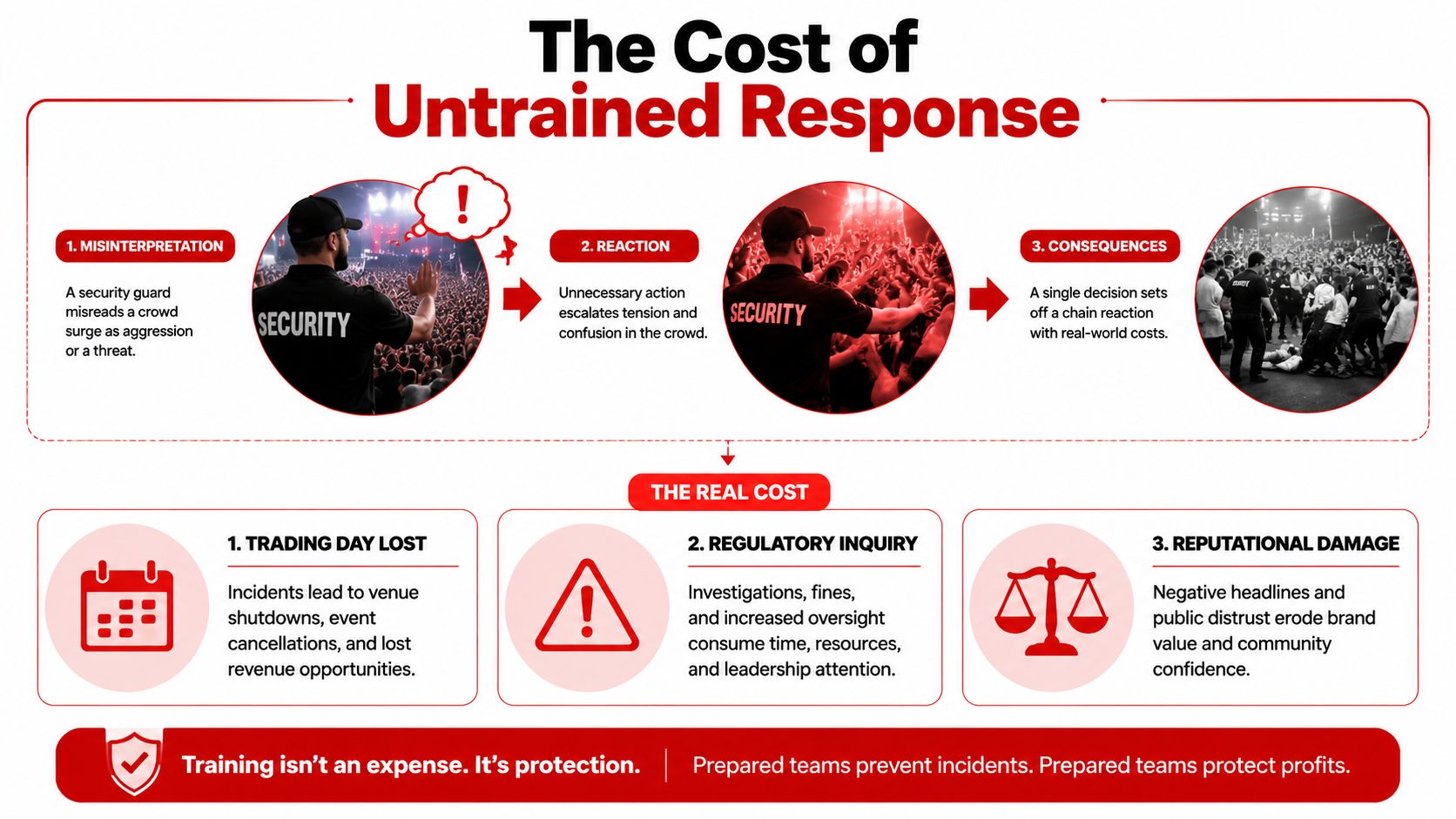
A crowd-control mistake rarely stays in the security lane. A guard misreads a surge at the front barrier, the promoter loses a trading day, and the regulator starts asking for incident notes, staffing records, and evidence of supervision. At that point, training is no longer a line item on a compliance checklist, it is part of how the business limits downtime and protects its licence.
Who actually pays when training is thin
The cost chain is broader than most site managers allow for. Insurers notice poor incident control, licensing teams notice weak supervision, and operations teams spend more time writing explanations than improving the event plan. The venue also takes the reputational hit, because near misses move fast through staff groups, local media, and the audience itself.
The strongest operators look at avoidable friction. If the team does not know how to hold a queue, re-route an exit, or call for back-up early, every small decision gets more expensive in the moment it is made. Training has to be designed around behaviour on the floor, not around what looks neat in a policy folder.
Practical rule: if a staff member cannot explain what they will do when a line compresses, the venue has not trained crowd control, it has only documented it.
Why the Australian context makes this sharper
Queensland gives the clearest example of a hard entry gate. A person cannot apply to be licensed as a crowd controller there until they have completed all modules of a Certificate II in Security Operations through a registered training organisation. That makes formal training a prerequisite, not an optional extra.
The practical reality in NSW, VIC, QLD, and ACT is that crowd work also sits alongside RSA expectations, venue rules, and operational supervision. If the training program does not connect those pieces, staff will know policy words but still hesitate when people are moving, radios are busy, and time is tight. The same event can also pull in related safety tasks, and resources such as allergen tracking for stadiums show how guest safety and crowd operations often sit inside one event system.
Each of those seven parts deserves its own section. Here is the first.
Defining the Objectives Your Training Must Hit
A serious crowd control management training program shouldn't be written as a list of topics. It should be written as outcomes a duty manager can observe, challenge, and record. If the objective can't be tested on the floor, it's too vague to matter.
The four outcome families that change behaviour
The first outcome is simple, staff need to recognise crowd density risk early and respond before it becomes a crush, blocked passage, or panic point. That means they're scanning for pressure build-up, stalled movement, and the first signs of a bottleneck, not waiting for the crowd to become visibly unstable.
The second outcome is communication. Staff need to call egress changes clearly under stress, using the right radio discipline and plain language so people move before a blockage spreads. The third is judgement, especially around reasonable force, which should only be used when legally justified and proportionate to the situation. The fourth is escalation, where staff know exactly when to move an issue up the command chain or out to emergency services.
A good training objective sounds like an action, not a slogan.
How to put each objective on a scorecard
A duty manager can track these outcomes with simple operational checks. Time-to-recognition of a bottleneck tells you whether staff are alert enough. The percentage of staff who can name the primary and secondary exits from their zone tells you whether egress knowledge is real or assumed. The number of radio acknowledgements within 30 seconds of a call tells you whether the team is listening under load.
Accessibility-aware competence belongs on the same scorecard, not in a separate “inclusion” note at the bottom. In NSW, VIC, QLD, and ACT, crowd work increasingly intersects with access needs, mixed-ability audiences, and evacuation decisions that must work for more than one type of guest. If staff can't adjust movement, communication, and support for disabled patrons, they're not ready for a public-facing event environment.
A workable one-page scorecard uses four rows, one for each outcome family, and three columns, standard, evidence, and needs coaching. That keeps the conversation practical. You can look at the sheet after a shift and see whether the team is improving or just attending briefings.
Licensing and Compliance Foundations Across Australian States
A crowd plan can fall apart before the first guest walks in if the licensing piece is wrong. The practical job is to match training to the state rules for the site, then build supervision and roster decisions around those rules rather than around habit or convenience.
The state pathways operators keep tripping over
Queensland is clear on the training side. A person cannot apply to be licensed as a crowd controller until they have completed all modules of Certificate II in Security Operations through a registered training organisation. That means the training has to be done before deployment, not treated as something the team will sort out later.
NSW, Victoria, and the ACT each run their own licensing structure and security industry controls, so one licence class does not automatically cover every event task. A person may be fit for one venue, one duty profile, or one rostered function, while still needing different endorsement, supervision, or site-specific instruction for a higher-risk role. That distinction matters on the floor, because the wrong assumption usually shows up at the point where staff are expected to make quick decisions under pressure.
How RSA sits beside crowd control
RSA does not sit off to the side as an admin item in another folder. In licensed venues, alcohol service decisions affect queue pressure, movement at the bar, and how quickly a minor issue turns into a wider one. When the bar team and the security team train in separate lanes, they often respond in separate lanes as well.
A monthly compliance check keeps that gap visible:
- Licence status: confirm every crowd controller's licence class, conditions, and expiry date.
- Training currency: verify the current crowd module, RSA status, and any site-specific induction.
- Role fit: confirm who is rostered to entrances, floors, exits, and command support.
- Escalation chain: check that supervisors know the call path for venue incidents and emergency services.
- Documentation: keep copies of licence and training records ready for audit or insurer review.
For state-specific screening language, a guide to getting a blue card in NSW is a useful reminder that licensing wording and day-to-day access to work are often not the same thing.
If the monthly check finds a mismatch early, the training plan can be corrected before the next event instead of after a problem. That is the compliance value, because staffing stays aligned with the work being done.
Building the Core Curriculum Module by Module
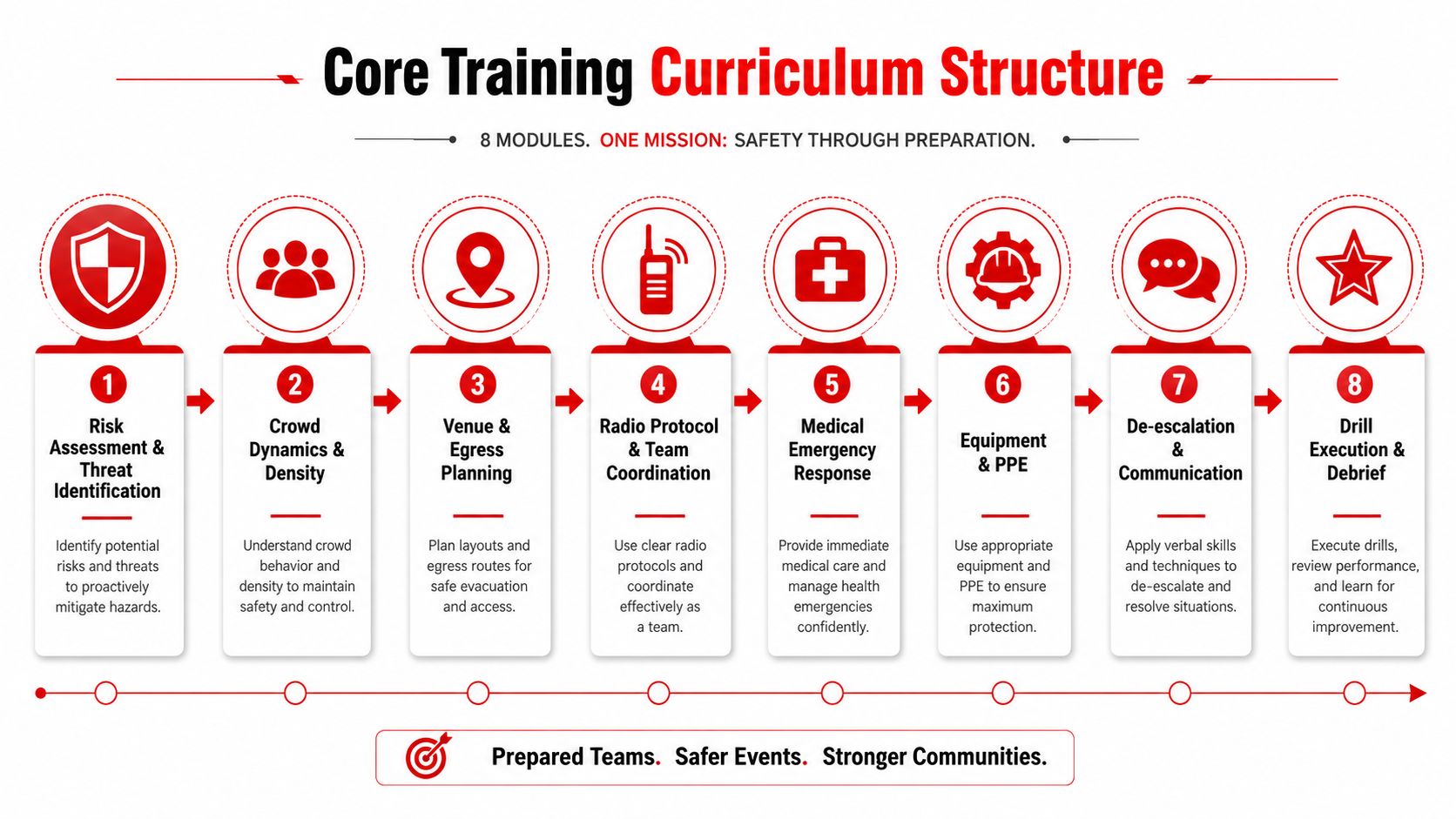
A credible crowd control management training program needs more than a slideshow and a sign-off sheet. On the ground, the teams that hold up under pressure have usually been trained through linked modules that build judgement as well as recall. The structure below follows that approach and matches the module-based public-order guidance set out in the California POST crowd management guidance.
The modules that hold up on the floor
Start with risk assessment and threat profiling, because staff need to know what kind of crowd they are dealing with before the doors open. Then move into crowd psychology and density awareness, communication and radio protocol, and positioning and barrier use. After that, cover egress management and fire system interaction, emergency response and incident command, accessibility and inclusion, and finish with incident debrief and report writing.
That sequence is not academic decoration. It reflects the way crowd work breaks down in practice, especially when the first warning sign is a queue that starts to compress, not a formal incident. A team that understands density pressure, radio discipline, and barrier behaviour can act early enough to keep a small problem from becoming a wider one.
The training guidance also points to a compact skills-based model, with two 45-minute classroom lessons on crowd dynamics plus an optional extra 45 minutes to review real operational imagery and video, as set out in the California POST crowd dynamics module. That is a useful minimum benchmark, because crowd movement is hard to teach through theory alone. Staff need to see density pressure, hear radio traffic, and talk through what changes when the line shifts.
How to schedule it so it sticks
A practical week-long timetable looks like this:
- Day 1, risk, threat, crowd dynamics, and site review.
- Day 2, communication, barrier placement, and egress control.
- Day 3, emergency command, accessibility, and responder coordination.
- Day 4, field visit and venue walk-through.
- Day 5, tabletop exercise and scenario review.
- Day 6, live drills with radio traffic and role-play.
- Day 7, debrief, assessment, and corrective planning.
That kind of sequence gives each topic a place in the room and a place in the field. The California POST crowd management guidance also recommends at least one field-visit day and one tabletop-exercise day. That matters because static classroom teaching does not train people to spot a blocked exit, a vulnerable zone, or the point where a polite queue turns into a pressure line.
If you have to compress the programme into a refresher, keep the order and strip the theory down, but protect the drill time. That is the part that changes what staff do when the crowd starts moving faster than the briefing did.
Scenario Drills That Translate Training Into Behaviour
The fastest way to find out whether a team understands crowd work is to watch what they do when the plan gets noisy. Classroom confidence can look convincing until the radios light up, the queue turns sideways, and the supervisor asks for an exit change. That's where scenario drills earn their place.
One drill that worked, and one that exposed the gap
At a regional music festival, a gate surge was defused because the front-of-house team had already rehearsed a staged-release tactic. They rotated stewards out of the crush zone, kept the barrier line calm, and broadcast an exit-routing change over radio within a short window while the pressure was still manageable. The win wasn't luck, it was repetition. The staff had already practised the language, the sequence, and the handover to the next person in line.
A multi-level venue told the other story. During a fire-system test, a controller failed to brief staff on the lift-as-assisted-evacuation protocol, and a disabled patron was left on a landing while everyone else moved. That's not just a process miss, it's a training miss. The staff knew the alarm existed, but they hadn't rehearsed the inclusive decision path that should have been there before the test started.
The three drills every programme needs
- Tabletop command-post exercises: use these to test decisions, not muscle memory. Staff can talk through threat escalation, egress changes, and command handover without the noise of the floor.
- Live role-play with actors: use these to test communication under pressure, especially the tone, clarity, and timing of radio calls and face-to-face direction.
- Surprise injects during shift handover: use these to see whether staff can keep thinking when their routine gets interrupted.
Useful standard: if the drill didn't force a decision, it probably didn't reveal a weakness.
After each exercise, the supervisor should capture three things, what worked, what didn't, and what needs another run next intake. Keep the notes blunt. The purpose is not to praise effort, it's to identify the exact behaviour that failed and patch it before the next event.
Assessment, Certification and Recordkeeping
Training only counts when competence is proven. Attendance sheets tell you who sat in the room, but they don't tell you who can manage density, call an exit change, or escalate cleanly under pressure. A proper assessment stack gives you evidence, not just optimism.
The four layers that prove competence
The first layer is a written knowledge check covering density risks, egress maths, and incident command basics. The second is a practical observation rubric during a live or simulated drill, where the assessor watches positioning, communication, and judgement. The third is a radio-communication proficiency test, because a staff member who mumbles on the radio can slow down everyone else. The fourth is a refresher cadence tied to role, not just the calendar, so high-risk roles get reviewed more often than low-exposure ones.
The strongest recordkeeping set includes licence numbers, expiry dates, RSA currency, drill scores, debrief notes, and corrective actions. That record becomes the paper trail for the regulator and the insurer, but it's also the manager's early warning system when a person starts slipping.
Internal credential, vocational credential, or both
Operators have three sensible options. They can issue an internal certification aligned to Certificate II outcomes, they can rely on a third-party vocational credential, or they can use both where role and risk justify it. The right choice depends on how complex the site is, how often staff rotate, and how much assurance the client wants in writing.
A certificate is only useful if the floor supervisor knows what behaviour it represents.
A monthly review that takes half an hour
Run a short monthly audit with three questions. Who is current on licence and RSA? Who failed the last drill or radio test? Who has a role change coming up that changes their training need? That 30-minute check catches the weak spots before they show up in front of a crowd, which is where they're hardest to fix.
Continuous Improvement Through Post-Incident Review
The best crowd control management training programs never stay still. Every event, near miss, and quiet shift should feed the next round of training, because the ultimate test is whether the team learns faster than the next problem arrives.
A practical rollout works in 30, 60, and 90 days. In the first 30 days, baseline current competence and gap the curriculum. By 60 days, run two full scenario drills and rewrite the weakest module. By 90 days, publish the refreshed training standard and lock it into onboarding so the next intake starts from a better baseline.
Post-incident review should be ruthless and simple. Reconstruct the timeline, list the contributing factors, and map each failure back to the module that should have taught the response better. If the issue was communication, fix communication. If the issue was egress, fix egress. If the issue was accessibility, fix the inclusion and evacuation section instead of burying the problem in a generic lesson.
The best crowd control management training is the one that changes a guard's instinct on a Friday night, not the one that looks polished on a slide deck. Pick one weak spot in your current program this week, run it through a real drill, and make the first correction before the next roster goes live.
GM GROUP Services can support event and venue operators who need crowd control, security deployment, and practical site supervision across NSW, Victoria, Queensland, and the ACT. If you're tightening your crowd control management training or reviewing how your team handles live event risk, visit GM GROUP Services to see how their licensed security services fit into venue and event operations.