


Corporate security management gets tested when a busy venue's Friday-night shift goes sideways: a guard misses a briefing, an ejection isn't logged, and the CCTV monitor is offline when a manager needs it. The incident report captures the immediate problem, but the deeper failure is a system that didn't connect training, records, escalation and technology.
For a venue or site manager, the job isn't to count uniforms. It's to build a measurable security program that identifies risks, assigns responsibility, prepares people, links physical and digital controls, and learns from incidents. That's what makes security dependable across sites, shifts and suppliers.
What Corporate Security Management Means
Corporate security management sets the operating conditions for every guard post: its purpose, decision-making authority, supervision and review. Treat each post as a control with an owner and a performance check. Buying coverage commits money; managing it requires evidence that the assigned duties address the site's risks.
Australia's security environment has changed alongside public policing. Between 1996 and 2006, security providers grew 41% while police numbers grew 14%, shifting the provider-to-police ratio from 0.95:1 to 1.18:1 (Australian security-industry licensing report). Manage private security as a complement to public policing, focused on prevention and operational continuity. Keep police responsibilities clear in site procedures.
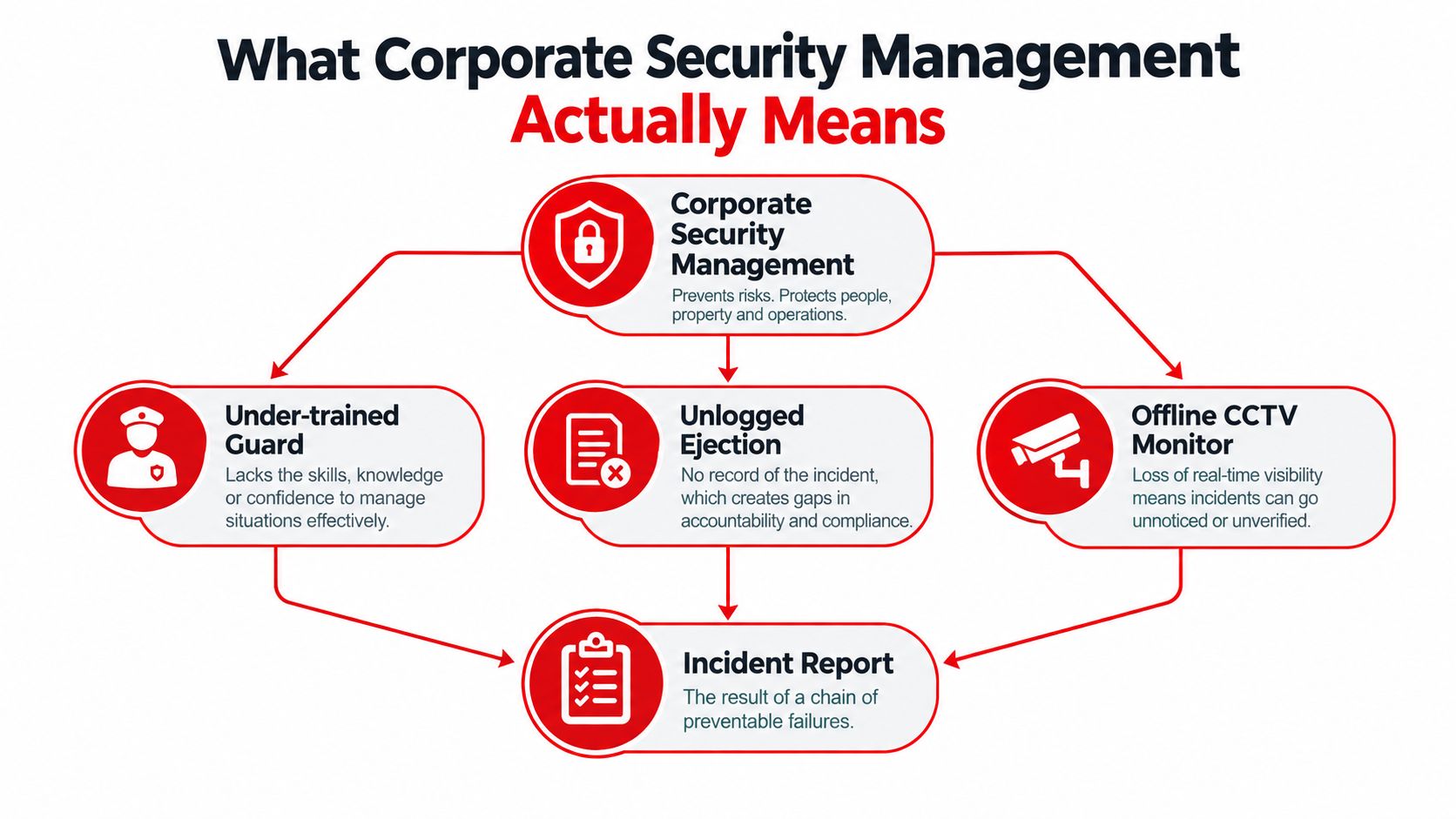

Three records make that management visible: a risk register naming threats and current controls, escalation thresholds specifying when guards call a supervisor, pause entry or request emergency support, and post-incident reviews recording changes to staffing, training, procedures or equipment.
From guard count to management control
Check the handover between people and systems. An incident entered into a reporting tool needs a manager responsible for reviewing it and directing follow-up. A failed camera needs both a technical owner and an operational fallback. Assign those responsibilities before a fault occurs. Otherwise, a repair request can sit unresolved while guards continue working without the coverage their instructions assume.
Use the seven-pillar structure as a measurable management system, with checks at these cyber-physical handover points. For a venue or site manager in NSW, Victoria, Queensland or the ACT, the practical test is the same: ask the team to show which risk each post addresses, who supervises it, where escalations go and what changed after the last review.
Accept records and demonstrated procedures as evidence. A roster alone cannot establish whether those controls work.
The Seven Core Pillars of an Effective Program
A security program needs a clear architecture before it needs more equipment. The seven pillars below are linked: risk assessment sets priorities, governance assigns owners, and the operating controls produce information for review.
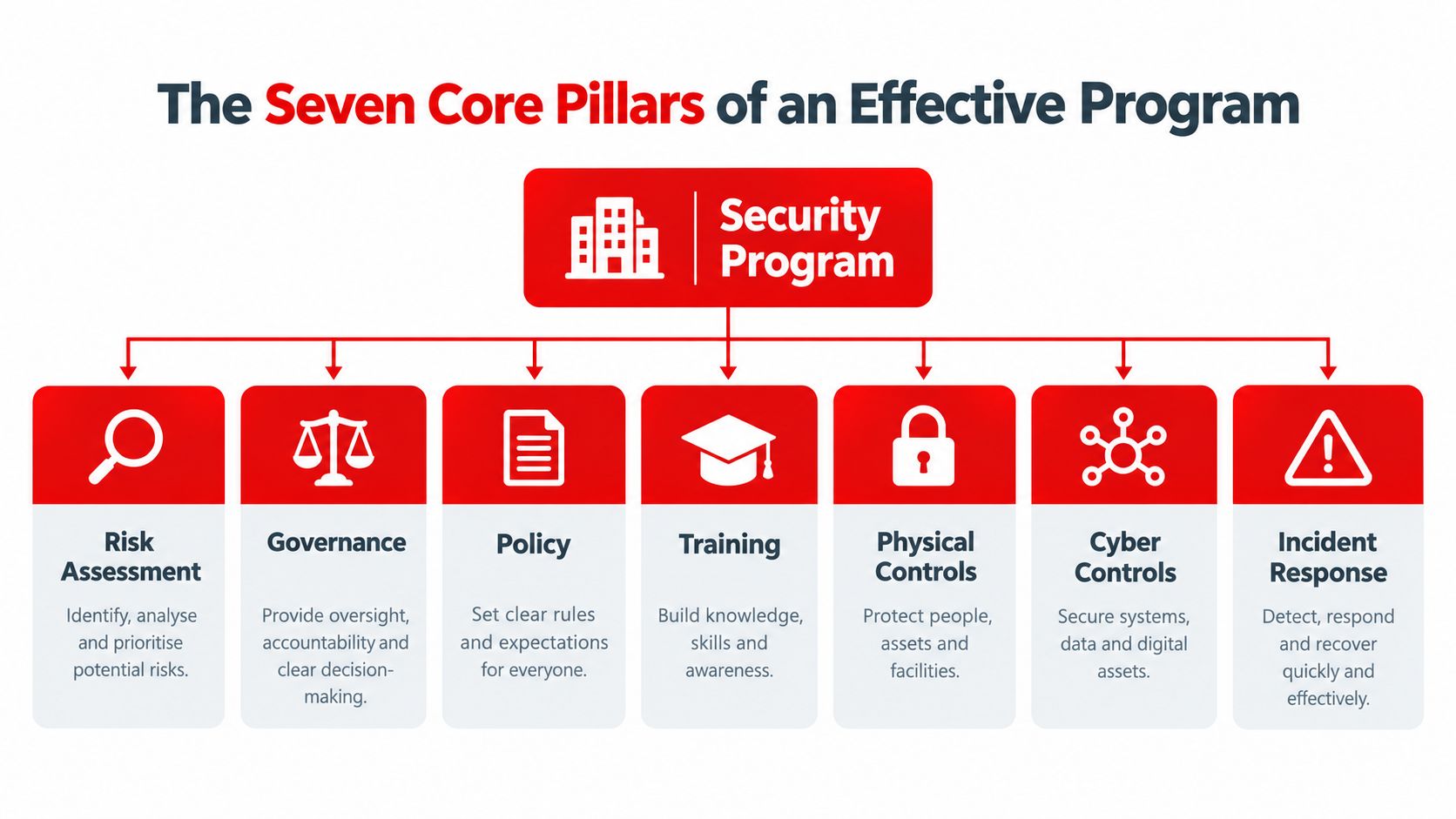
| Pillar | Primary Purpose | Site Self-Check |
|---|---|---|
| Risk assessment | Identify threats, vulnerable assets and priority controls. | Can you name the site's highest-priority risks and their owners? |
| Governance and policies | Set authority, rules and accountability. | Who approves a change to a security procedure? |
| Physical security | Control entry, movement, patrols and protection of property. | Can staff describe the fallback if an access point fails? |
| Personnel security | Put appropriately authorised, capable people in each role. | Does every rostered person fit the duties assigned? |
| Technology and cyber-physical integration | Protect and connect systems that support physical operations. | Who manages access to the monitoring accounts? |
| Incident response | Coordinate escalation, action, communication and recovery. | Can the team state when an incident becomes an escalation? |
| Training and supervision | Build competence and verify work on site. | When was the last practical briefing or debrief? |
The workforce available to support these programs is substantial. The 2025 ASIAL licensing report recorded 167,530 individual security licence holders nationally, up 13.4% from 2019, alongside 13,220 firm or master-licence holders, an 18.36% increase (ASIAL licensing report data). For managers, those figures underline the importance of selecting and supervising personnel against a site's actual operating needs, rather than assuming that a large supplier pool guarantees the right fit.
Treat the pillars as a system
Use the table as a fast site review. Where the self-check produces a vague answer, record the gap, name an owner and set a review point. A venue might find that guards understand entry procedures but don't know who can approve an emergency override; a construction manager might have patrols but no consistent method for recording contractor access.
Technology purchases also need to fit the overall control design. If your team is reviewing how security products combine with communications and site workflows, Premier Broadband's secure product combiner can be a useful resource during that assessment.
No pillar works alone. A risk register without owners is paperwork; training without supervision fades; cameras without a response procedure create footage but not necessarily action. Management must connect those elements through clear responsibilities and measures.
Risk Assessment Governance Policies and KPIs
A risk register is useful only when managers use it to make decisions. Record each credible threat, the assets or people exposed, current controls, remaining gaps and a named owner. Then set review points so a new event, site change or system outage doesn't leave the register describing yesterday's operation.
Violence reporting shows why management can't rely on incident logs alone. Safe Work Australia references more than 1 million work-related violence incidents, while about 46% of workplace incidents were formally reported (Safe Work Australia's workplace violence and aggression data). Under-reporting makes a fixed guard count a poor measure of exposure. Pair formal reports with near misses, verbal threats, refusals of entry, ejections, welfare checks and staff debriefs.
Build a dashboard people can act on
Assign a governance owner who can bring operations, site management and IT together when a control crosses a threshold. Written policies should tell staff what to do, who can authorise a decision and what records to keep. Keep the dashboard small enough to review consistently:
- Incident-log completion: Check whether reports include the required facts, actions and follow-up owner.
- Time to escalation: Track how quickly a serious event reaches the responsible manager.
- Refused-entry and near-miss records: Use patterns to review screening, queue management and supervisor coverage.
- Training completion: Identify posts or shifts where required preparation is incomplete.
- Audit findings closed: Confirm that corrective actions have an owner and documented resolution.
Each measure should lead to a management decision. Repeated near misses at a service entrance may justify a change to access procedures. Slow escalation may point to unclear authority or insufficient supervision. For organisations linking security and IT processes, managed cybersecurity risk solutions may help inform the discussion about responsibilities and controls.
What gets measured gets supervised. If a number never changes a decision, stop collecting it or give it a job.
Cyber-Physical Integration That Works
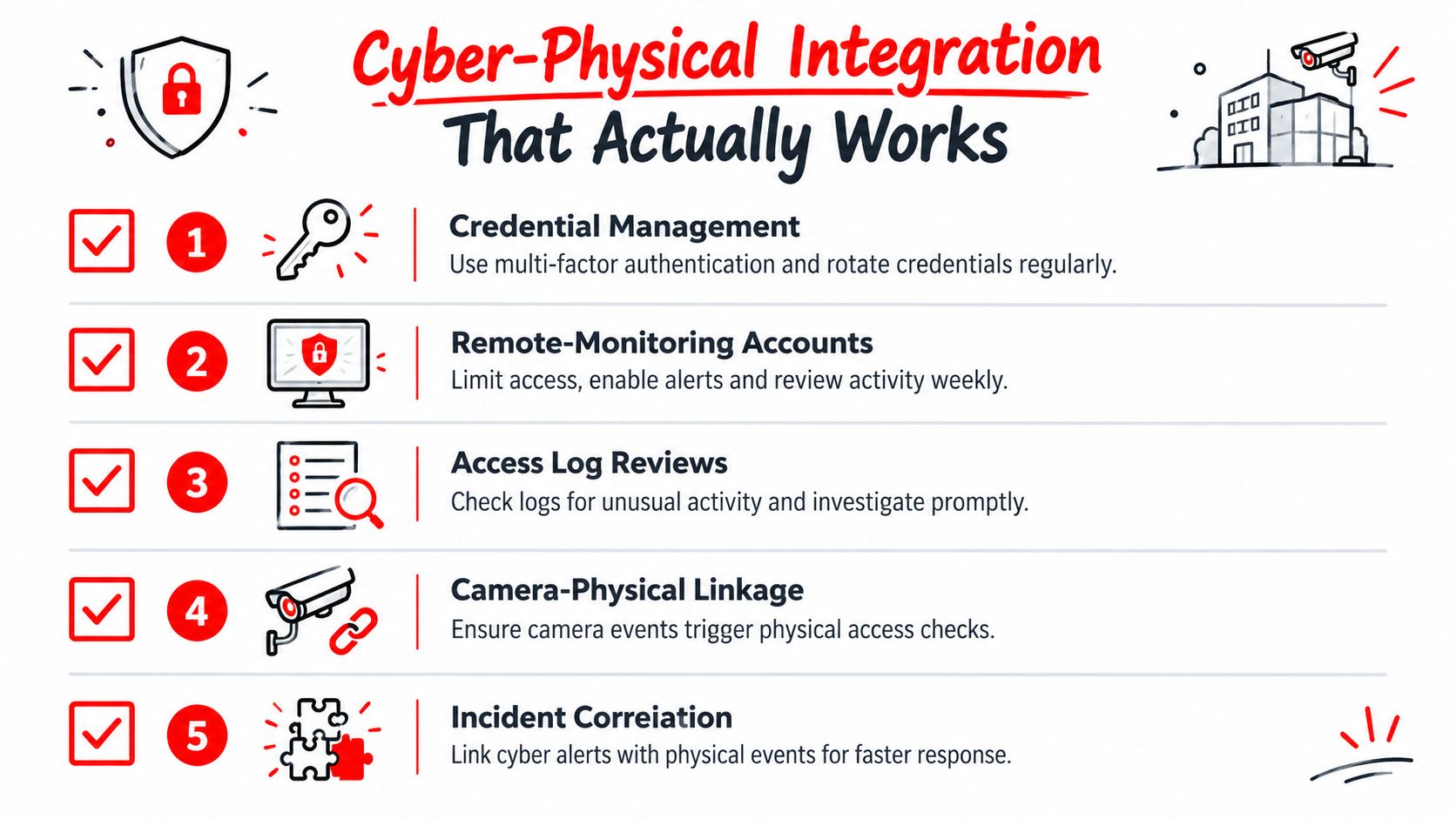
A remote-monitoring account is compromised, and someone changes the gate's access settings. The guard needs an authorised fallback before the next arrival. More cameras or guards won't solve unmanaged credentials or contractor access. Connected access control, CCTV, alarms, radios, cloud monitoring and booking or payment platforms create handover points between IT and physical operations. Build those handovers into the seven-pillar management system.
The Australian Cyber Security Centre received more than 67,500 cybercrime reports in 2020–21, a near 13% annual increase, while a Victorian risk analysis found 84% of reported incidents could have been prevented or significantly minimised by an Essential Eight control (ACSC Annual Cyber Threat Report). Use these controls as shared operating language: restrict system changes, apply updates, protect remote access, back up critical information and test recovery.
Write the handover before the outage
For each site, name who can disable or override electronic access controls and how the manager authorises the decision. Record the conditions for using that authority. Manual entry trades automated checks for staff judgement, so give guards an approved identity-check process that works when booking or ticketing systems fail. Keep incident reports in an approved, role-restricted location, and assign evidence exports an owner responsible for handing them to the investigating manager.
Map each digital control to a physical consequence. Multi-factor authentication reduces the risk of stolen remote credentials being used to change access settings. Application control and patching protect monitoring workstations. Restricted administrative privileges limit who can alter camera or alarm configurations. Protected backups and tested recovery provide a route to restore records and monitoring after disruption.
Test the handovers at least annually:
- Connectivity loss: Confirm patrol, access and escalation procedures when systems cannot communicate.
- Ransomware disruption: Test operations when monitoring workstations or incident records are unavailable.
- Identity-system failure: Rehearse manual verification and entry, including who authorises exceptions.
- Evidence handover: Confirm teams can preserve records and transfer them through an authorised channel.
For each exercise, record whether the fallback worked, where authority stalled and who owns the repair. Apply the same discipline across NSW, Victoria, Queensland and the ACT, with site-specific authorisations and procedures.
The goal is a guard who knows exactly what to do when a digital control stops working.
Sector-Specific Applications Across Australia
A festival queue builds while registration staff resolve a booking problem. The security supervisor needs authority to manage admission, a venue contact and a way to capture the decision. That handover is the practical test of the seven pillars: controls must fit the work, with clear ownership and results managers can review.
Events and festivals should lead with training and incident response. Brief guards on screening, queue pressure, ejections, welfare concerns and authority to pause admission. Assign responsibility for passing registration issues to the gate supervisor. Review admission delays and escalation outcomes alongside incident reports, including records captured when event systems are unavailable.
Hospitality venues need crowd management tied to physical controls and venue procedures. Coordinate security actions with RSA responsibilities, particularly refusals of service, patron welfare and ejections. Define who takes over when a door incident moves inside. Give that manager the incident record and relevant camera reference so recurring problems inform changes to staffing or procedures.
Construction and industrial sites should prioritise physical security and measurable access controls. Gatehouse staff need contractor and visitor checks that reflect current work areas. Assign a site contact to resolve mismatches between access records and contractor approvals. Patrol exposed equipment, boundaries and out-of-hours conditions, then review access exceptions as the workforce and site layout change.
Match the role to the environment
Retail and shopping centres rely on visible service, observation and consistent reporting. Keep responses calm and proportionate. Loss-prevention staff should coordinate with site management and relevant authorities, with an identified owner for linking floor reports to camera records. Review repeat incident locations and unresolved access issues rather than judging performance by confrontation or intervention volume alone.
Corporate offices and conference sites need visitor management and access discipline. At conferences, registration staff should resolve booking discrepancies while security controls entry. In offices, managers and IT owners need a shared process for credential changes, including monitoring accounts. Review unresolved visitor exceptions and access changes that have not reached the physical post.
Check authorised activities before assigning posts across NSW, Victoria, Queensland and the ACT.
The NSW Police Class 1 licence requirements distinguish roles; Victorian private-security regulatory information also sets activity-based boundaries. Assign guards to work their authority covers.
| Sector | Lead Pillar | Supporting Pillar | Management review |
|---|---|---|---|
| Events and festivals | Training and supervision | Incident response | Admission delays and escalation outcomes |
| Hospitality | Physical security | Governance and policies | Recurring incidents and handover gaps |
| Construction and industrial | Physical security | Risk assessment | Access exceptions and changing work areas |
| Retail and shopping centres | Incident response | Governance and policies | Repeat locations and unresolved access issues |
| Corporate offices and conferences | Technology and cyber-physical integration | Personnel security | Visitor exceptions and credential changes |
Compliance Procurement and a Practical Checklist
Procurement turns security requirements into evidence a manager can check. Maintain a compliance register for each deployment, recording the worker, role, authorisation and supporting documents. Review it before confirming a roster or event, and whenever duties or suppliers change.
Verify people, suppliers and duties
In NSW, Class 1 applicants must be at least 18, complete an approved course, pass a language, literacy and numeracy assessment, and hold a current first-aid certificate. Monitoring-centre operators face additional checks. See the NSW Police licensing requirements. Record each worker's licence number, approved activity, expiry date and first-aid currency. Match that authority to the actual post before adding the worker to the roster.
In Victoria, licensing is activity-based, so check that each person holds the authority required for the task. Record the activity category and retain evidence that both the supplier and worker meet applicable requirements. For a labour-hire arrangement, verify the provider's status with the Victorian Labour Hire Authority. Keep a record of the check and repeat it if the arrangement changes.
Camera compliance also needs an owner. Where the Privacy Act applies, personal information collected by cameras must comply with the Australian Privacy Principles, as set out in OAIC guidance on security cameras. Place notices before monitored areas, limit footage access to authorised roles, and document retention and deletion. Assign a manager to handle access requests and incident exports.
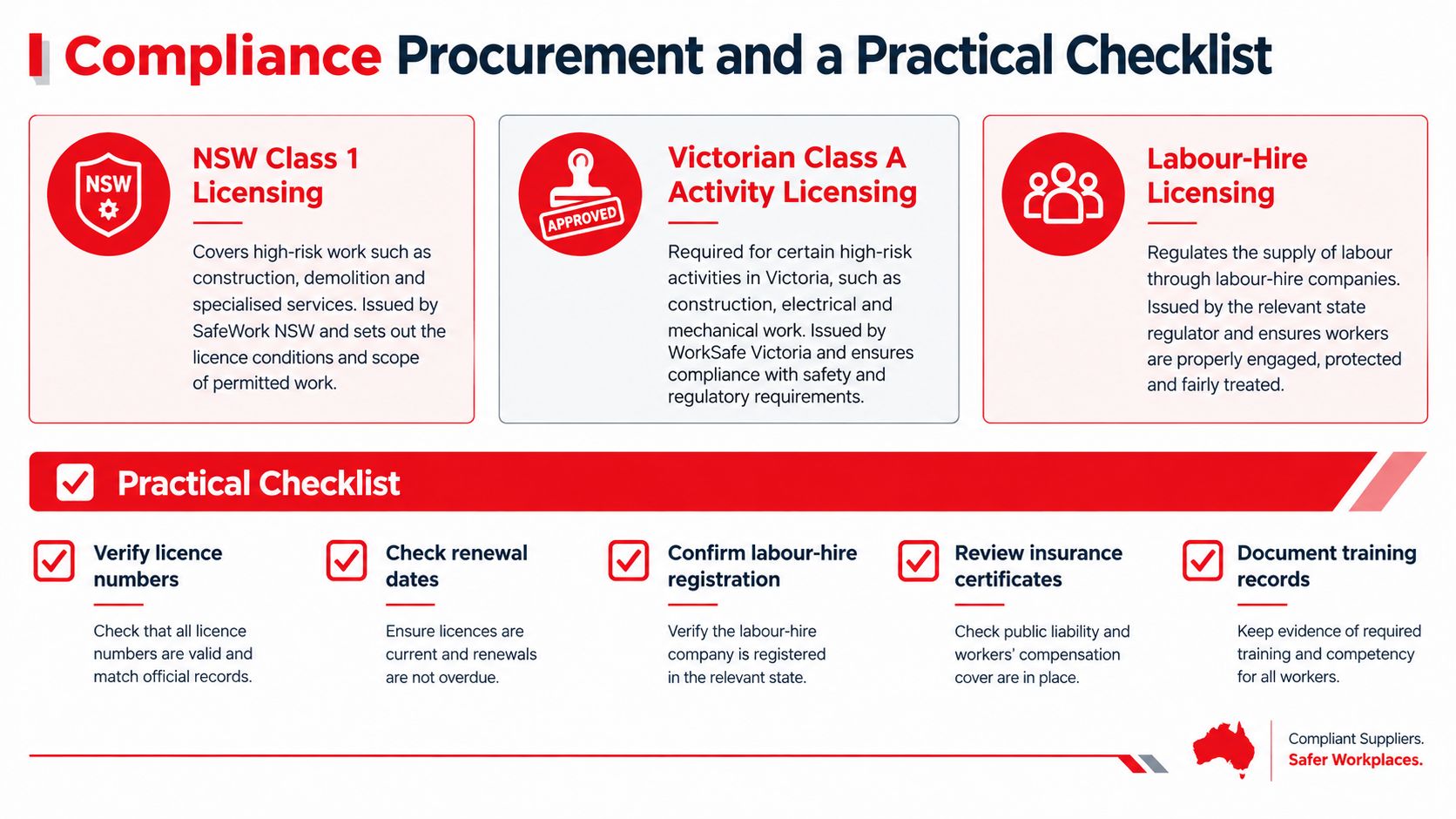

Take this checklist to the vendor meeting:
- Confirm licence fit: Match each assigned role to the worker's authorised activity.
- Record validity: Capture licence identifiers, expiry dates and relevant training evidence.
- Check labour-hire arrangements: Verify provider status where required.
- Set surveillance rules: Record notice placement, access roles, and retention and deletion procedures.
- Agree reporting: Specify incident formats, escalation contacts and review expectations.
The contract should state how the provider reports incidents, notifies you of staffing changes and supports audits. Treat compliance as an operating control, not a folder of documents. A manager should be able to confirm who was authorised, what work they were assigned and whether the agreed controls were followed.
Rolling Out the Program in Your First 30 Days
Start with the opening-shift failures, not a large policy rewrite. In week one, walk the site, build the risk register and establish a baseline for incident reports, near misses and escalation. Name an owner for each gap.
In week two, refresh post orders and escalation rules. Agree with IT who controls access-system overrides, what guards do during a booking or monitoring outage, and where incident records are stored. Use a short briefing to test whether supervisors and guards understand the handover.
In week three, check licence fit, vendor records, camera notices and the reporting process. In week four, run practical training, supervise a live shift and hold the first debrief. Record decisions and assign follow-up owners.
Three failures undermine programs: treating guard numbers as the strategy, ignoring under-reporting, and leaving cyber-physical handovers undefined. Pick one pillar to improve this quarter, document the change and use the dashboard to decide whether it worked before expanding the effort.
GM GROUP Services provides licensed security for events, venues and business sites across NSW, Victoria, Queensland and the ACT, including guards, patrols, gatehouse control, monitoring and risk assessments. If you're reviewing your site's deployment, reporting or supervision arrangements, visit GM GROUP Services to discuss a fit-for-purpose approach.