


It’s easy to think of security as just another cost on a project spreadsheet, but that’s a dangerous oversimplification. In reality, professional security is one of the smartest investments you can make in your project’s success, protecting your assets, your people, and your timeline. It’s less of an expense and more of a core part of managing a modern, high-value construction site.
Actionable Insight: Before your project breaks ground, schedule a meeting with your security provider. Walk the site plans with them to identify high-risk zones (like material laydown areas and fuel storage) and strategise camera placements and patrol routes from day one. This proactive step is far more effective than reacting to a theft later.
Why Construction Site Security Is a Project Essential
If you’ve ever managed a major project, you know that a construction site is a bustling, high-stakes environment. It’s packed with expensive machinery, valuable materials, and a whole lot of inherent risk. Leaving that site unsecured is like leaving the front door of a bank wide open overnight.
It isn’t just organised criminals looking to steal a new excavator or strip copper wiring that you have to worry about. It’s the opportunistic vandals who can cause thousands of dollars of damage for no reason, or even curious trespassers who could get seriously hurt—leaving you with a massive legal and financial headache.
Practical Example: A residential tower project in inner-city Sydney experienced a major setback when thieves broke in over a weekend and stripped all the newly installed copper piping from the first three floors. The direct replacement cost was over $80,000, but the project was delayed by three weeks, incurring an additional $150,000 in labour costs and penalty clauses. This was a direct result of relying solely on perimeter fencing with no active security presence.
The True Cost of a Security Breach
When something goes wrong, the cost isn’t just about replacing a stolen generator. The real damage is in the chain reaction that follows, disrupting your entire operation.
- Project Delays: Work grinds to a halt when critical equipment goes missing or is damaged. That downtime means blown deadlines, frustrated clients, and the potential for hefty penalty clauses to kick in.
- Increased Insurance Premiums: Insurers notice patterns. A site with a history of theft or safety incidents quickly becomes a higher risk, and your premiums will skyrocket, eating directly into your profit margins.
- Legal and Compliance Penalties: Under Australian law, you have a Work Health and Safety (WHS) obligation to prevent unauthorised access. A failure here can lead to crippling fines and stop-work orders from regulators.
A proactive security strategy isn’t about trying to eliminate every single risk—that’s impossible. It’s about intelligently managing those risks. Investing in the right security solution is how you shield your timeline, budget, and company reputation from entirely preventable setbacks.
More Than Just Stopping Thieves
While keeping your assets locked down is crucial, construction site security services play a much bigger role. A visible and professional security presence is fundamental to maintaining a safe work environment for everyone, from your crew to subcontractors and visitors. An unsecured site is a minefield of potential hazards, whether it’s unauthorised people messing with machinery or local kids wandering into a high-risk zone.
The consequences of these safety failures can be tragic. In a recent year, the Australian construction industry reported 45 worker fatalities. That staggering number accounts for 23% of all workplace deaths in the country and represents a 36% jump from the five-year average. Unsecured sites are a direct contributor to these statistics, amplifying dangers like falls from heights or incidents with moving plant. You can read more about the safety risks in Australian construction to get the full picture.
Ultimately, a solid security plan is a cornerstone of good project management. It keeps you compliant with WHS regulations, protects your bottom line, and builds a culture where safety and professionalism are taken seriously.
Exploring Your Construction Site Security Options
Picking the right security for your project is a lot like choosing the right tool for the job. You wouldn’t use a sledgehammer to drive a nail, and in the same way, different security threats need different solutions. The most secure sites use a smart, layered approach, mixing a visible human presence with the right tech to build a solid shield against theft, vandalism, and trespassers.
Getting your head around how each service works is the key to creating a security plan that’s both effective and doesn’t blow the budget. Let’s break down the main types of construction site security services you’ll come across.
To help you weigh up the options, here’s a quick comparison of the most common security services and where they fit best.
Comparing Construction Site Security Services
| Service Type | Primary Function | Best For | Key Benefit |
|---|---|---|---|
| Static Guards | Visible deterrence and access control at a fixed point. | High-traffic entry points, valuable material storage areas. | Constant, authoritative presence that deters opportunistic crime. |
| Mobile Patrols | Randomised, wide-area surveillance and perimeter checks. | Large, sprawling sites with extensive perimeters. | Cost-effective coverage and an unpredictable deterrent. |
| K9 Security | Enhanced detection of intruders using a trained dog’s senses. | High-risk sites, clearing large buildings, or after-hours checks. | Unmatched detection capabilities and a powerful psychological deterrent. |
| CCTV & Monitoring | 24/7 surveillance with real-time response capabilities. | Monitoring blind spots, critical assets, and remote locations. | Continuous oversight and the ability to intervene remotely. |
Each service has its place, and often the best strategy is a combination that covers your specific vulnerabilities.
Static Security Guards: The On-Site Deterrent
Think of a static guard as the ever-present watchman at the castle gate. Their main job is to be a highly visible, authoritative figure who discourages troublemakers just by being there. We typically station them at key choke points—like the main gatehouse or next to a shipping container full of expensive copper wiring—making them your first line of active defence.
Actionable Insight: Don’t just place a guard at the gate. Provide them with a detailed logbook (digital is best) and clear instructions. For example, instruct them to photograph the license plate of every delivery vehicle and verify the driver’s identity against a pre-approved list provided by the site manager each morning. This simple process dramatically reduces unauthorised material removal.
Mobile Patrols: Eyes on the Perimeter
If a static guard is your gatekeeper, a mobile patrol is the scouting party that roams the border. These services are perfect for those big, sprawling sites where a single guard couldn’t possibly keep an eye on the entire fenceline. Patrol vehicles conduct regular but randomised checks at various points around your property.
That unpredictability is their secret weapon. A potential thief can’t just watch the guard walk by and then make a move; they never know when the next patrol car will round the corner. This creates a powerful deterrent across a much wider area than one static guard could ever cover alone.
- Broad Coverage: Mobile patrols are brilliant for efficiently checking long fence lines, multiple laydown yards, and separated work zones.
- Cost-Effective: For large sites, it’s a much more budget-friendly option than trying to station multiple static guards across the property.
- Rapid Response: If an alarm goes off, a nearby patrol unit can often be the first on the scene to see what’s happening.
A single breach can cause a domino effect, leading to much bigger problems than just a missing pallet of materials.

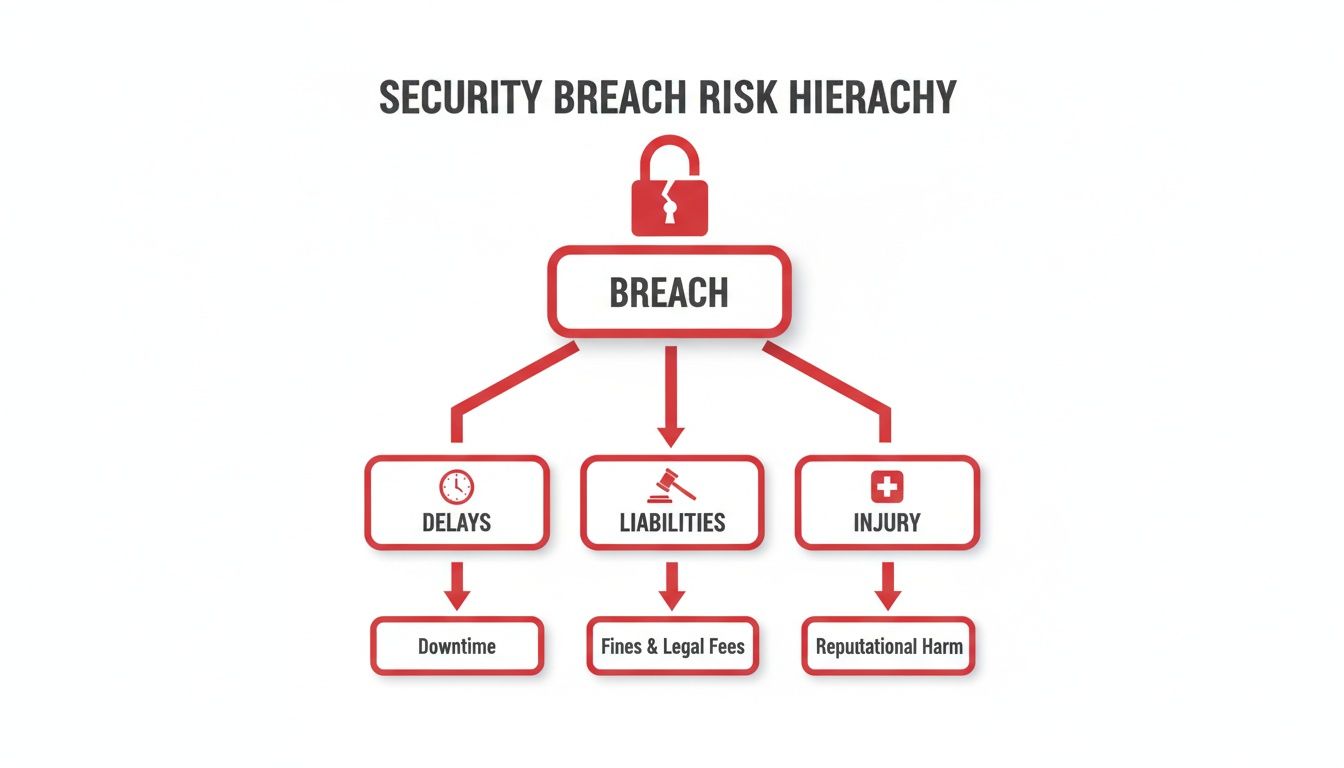
As you can see, a simple security lapse is rarely a minor hiccup. It’s often the trigger for serious operational delays and financial pain.
K9 Security Units: An Enhanced Level of Detection
For sites facing higher risks or dealing with persistent threats, a K9 unit brings something to the table that people and cameras just can’t match. A trained security dog’s senses are off the charts—they can detect an intruder hiding in the shadows or pick up on unusual scents long before a human guard would have any idea.
Practical Example: A large warehouse construction project was experiencing repeated break-ins despite having mobile patrols. The intruders were hiding inside the structure before the final lock-up. By deploying a K9 unit to sweep the building each evening, the handler was able to quickly identify and apprehend a hidden individual, instantly stopping the pattern of theft.
Technology-Driven Solutions: CCTV and Remote Monitoring
These days, good security isn’t just about boots on the ground. Technology acts as a massive force multiplier, giving you eyes on every corner of your site 24/7. Well-placed CCTV cameras, especially when linked to a remote monitoring service, make sure absolutely nothing goes unnoticed.
The best systems don’t just record what happened; they actively stop it from happening. With live monitoring, a remote operator can challenge an intruder over a loudspeaker, trigger sirens, and have the police on the way—all in real-time.
Of course, none of this works without a solid physical perimeter to begin with. For a deeper look at getting your first line of defence right, this a guide to fencing for construction sites is a really valuable resource. By layering these different services, you turn your site into a hard target, encouraging thieves to look for an easier score somewhere else.
Meeting Your Risk and WHS Obligations
On any Aussie construction site, managing risk isn’t just a box to tick—it’s a legal minefield. Every project manager knows the pressure of navigating Work Health and Safety (WHS) obligations. Your duty of care isn’t just about your own crew; it extends to every subbie, visitor, and even the local kids who might see your site as a playground.
Failing to properly secure your site isn’t just a simple mistake. It’s a direct breach of that duty.
Regulatory bodies like SafeWork are cracking down hard on site security. They know that a poorly secured perimeter is an open invitation for accidents, theft, and serious public liability claims. A flimsy fence or an unlocked gate can quickly escalate into massive fines or a project-stopping prohibition notice.
The Foundation of Compliance: A Security Risk Assessment
You can’t manage risks you don’t understand. That’s why a formal security risk assessment is the absolute first step. Think of it as drawing up a detailed blueprint of all your potential weak spots.
This isn’t a simple checklist exercise. A proper, professional assessment digs deep to identify and evaluate specific threats.
- Unauthorised Entry: Where are the gaps in your fence? Can trespassers, vandals, or curious locals get in easily? Practical Example: An assessment might identify that a back fence borders a public park, making it a high-risk area for after-hours trespassers. The recommended action would be to install motion-sensor lighting and a monitored CCTV camera covering that specific fenceline.
- Internal and External Theft: What are your high-value assets? Copper wiring, power tools, heavy machinery—how vulnerable are they, really?
- Public Liability Risks: How could an unsecured site harm a member of the public, leading to injuries and a messy legal battle?
A thorough risk assessment isn’t about creating more paperwork. It’s a strategic tool that becomes the ‘why’ behind your security plan, giving you the documented proof you need to show regulators you’ve done your due diligence.
This isn’t just theory. Recent audits by WorkSafe Queensland across 224 construction sites found eight critical non-compliances for the simple failure to secure sites from unauthorised access. It’s part of a bigger picture where theft and vandalism are crippling job sites, a problem that has only worsened in recent years. You can read the full report on Queensland construction site compliance to see the stats for yourself.
Turning Assessment into Actionable Security
Once you’ve mapped out your risks, bringing in professional construction site security services is how you fulfill your legal duty of care. It’s about turning that risk assessment from a document into a reality on the ground.
For instance, if your assessment flags a high risk of after-hours theft, deploying a mobile patrol or monitored CCTV isn’t just a good idea—it’s a tangible, legally defensible action.
This is where your security partner essentially becomes an extension of your compliance team. They provide the licensed people and proven systems needed to enforce your WHS policies, plugging the very gaps your assessment uncovered. It’s also crucial to vet any third-party providers to meet data protection and WHS obligations, which includes understanding subprocessors used by your security tech partners.
Ultimately, investing in professional security is one of the most direct and effective ways to create a genuinely safe work environment, shield your project from liability, and ensure you’re standing on solid ground when it comes to WHS obligations.
Frequently Asked Questions About Construction Site Security
Q1: What are the most common WHS breaches related to site security?
Hands down, the most frequent breaches are inadequate perimeter fencing, uncontrolled entry and exit points, and a lack of clear signage warning people about site hazards. Regulators jump on sites where the public can wander in, as this creates enormous safety and liability risks.
Q2: Does having security guards on site automatically make us compliant?
Not necessarily. While licensed guards are a fantastic tool, compliance is about your entire security system. You need to be able to show that your overall plan—whether it uses guards, tech, or both—is a reasonable and thought-out response to the specific risks you identified in your assessment.
Q3: How does security contribute to a better safety culture on site?
A visible security presence sends a powerful message: we take rules seriously here. Guards help enforce PPE policies, manage visitor inductions, and often act as trained first responders. All of these things build a stronger, more proactive safety culture for everyone on site.
Q4: Can my site manager just lock the gate at night? Isn’t that enough?
For a very small, low-risk site, maybe. But for most commercial projects, a simple lock is no match for determined thieves. Professional criminals can cut through fences and chains in seconds. Without active monitoring or patrols, a lock only stops the most casual opportunists. It does little to prevent major losses or meet your full duty of care.
Q5: How much do construction site security services cost?
The cost varies widely based on your needs. A single nightly mobile patrol might cost a few hundred dollars a week, whereas a 24/7 static guard presence is a much larger investment. The best approach is to get a tailored quote based on a professional risk assessment, which will balance cost against the value of the assets you’re protecting.
Choosing the Right Security Partner for Your Project
Picking a security provider for your site is one of the most critical procurement decisions you’ll make. This isn’t just about hiring a guard to stand at the gate; it’s about bringing on a genuine partner who understands the unique rhythm and risks of a live construction site.
Get it right, and you can prevent hundreds of thousands of dollars in losses. Get it wrong, and you might find the security team creates more problems than they solve.

It’s tempting to just go with the cheapest quote, but that’s rarely the best value. A low-cost provider might be cutting corners on guard training, proper licensing, or insurance, leaving you exposed to massive liability. A true security partner invests in their people and their systems, giving you a solution that fits right into your daily operations.
Core Evaluation Criteria
When you’re talking to potential security companies, you need to look past the sales pitch and get into the details that actually matter on the ground. Any professional outfit will have no problem giving you straight answers and documentation for these key areas.
- Industry-Specific Experience: Have they actually worked on construction sites before? A provider whose main business is nightclub security won’t get the specific challenges of managing site access, keeping an eye on high-value materials, or enforcing WHS protocols in a construction environment. Actionable Insight: Ask for a case study or a reference from a project manager on a similarly sized construction project they have secured in the last 12 months.
- Proper Licensing and Insurance: This one is absolutely non-negotiable. You must verify their Master Licence and check they hold adequate public liability and professional indemnity insurance. Always ask to see the certificates of currency to make sure their policies are active and cover the scale of your project.
- Quality of Guard Training: What kind of training do their guards get beyond the basic security licence? Ask about their site-specific induction processes, training in conflict resolution, and their understanding of construction safety procedures. A well-trained guard is a proactive asset, not just a passive observer.
Assessing Their Tech Game
These days, a security partner’s technology is just as important as their people. The right tech delivers transparency, speeds up response times, and gives you invaluable data to manage your site better. A modern security provider should be able to show you exactly how they use their systems.
A security company still relying on paper logbooks is a massive red flag. Effective, modern security is built on real-time data and communication, giving you a clear and immediate picture of what’s happening on your site at all times.
Use this quick checklist to see if a provider is up to scratch technologically:
- Real-Time Reporting Software: Can they send you instant incident alerts and digital daily activity logs? Access to a client portal where you can see reports, photos, and guard patrol tracks is now the industry standard for professional services.
- Remote Monitoring Systems: If you’re thinking about CCTV, what are their remote monitoring capabilities? Do they have a 24/7 control room with operators who can respond to alerts, issue audio warnings, and dispatch patrols or police when needed?
- Guard Management and Supervision: How do they keep track of their guards on your site? Look for systems that use GPS tracking and digital check-in points. This ensures patrols are actually being done correctly and provides genuine accountability.
At the end of the day, choosing the right partner comes down to finding a company that acts like an extension of your own management team. Their focus should be on delivering a security solution that’s built for your specific site—one that protects your assets and helps you run a safer, more efficient project.
Making Your On-Site Security Team Work for You
Picking the right security partner is a big win, but the real work starts on day one. How you deploy and manage your security team is what turns them from a line item on your budget into a genuine asset that helps your project run smoothly and safely.
Simply sticking a guard on the gate and hoping for the best isn’t a security plan. It’s a gamble. Real management means giving clear direction, keeping the lines of communication wide open, and providing consistent oversight. This is how your construction site security services provider becomes a proactive part of your operation, not just a reactive cost.
Developing Clear Post Orders
The absolute bedrock of good security management is a set of clear and practical post orders. Think of this document as the guard’s bible—it spells out exactly what they need to do, how they need to do it, and what to do when things go wrong. If the instructions are vague, you’ll get inconsistent, unreliable results.
This isn’t a document you just hand over; it should be developed with your security provider. It needs to be a living document that covers the essentials:
- Access Control Procedures: Who gets in? Who doesn’t? What’s the process for signing in staff, visitors, and deliveries?
- Patrol Routes and Timings: Be specific. Map out the exact routes guards need to walk and how often, ensuring they hit every critical spot.
- Emergency Response Actions: Lay out the step-by-step plan for fires, medical issues, or intruders. Make sure all key contact numbers are right there.
- Reporting Requirements: Define what a good daily activity log looks like and the exact format for an incident report.
Keeping the Lines of Communication Open
Your entire security plan can fall apart if your site managers and the security team aren’t talking. You need direct, reliable ways for information to flow back and forth. This is how you build a partnership where security feels like everyone’s responsibility.
Practical Example: Set up a dedicated WhatsApp group or a specific two-way radio channel for “Site Security.” The site foreman can instantly post a picture of a suspicious vehicle, and the evening security patrol can post a photo of a gate that was left unlocked by a subcontractor, allowing for immediate action and accountability. This real-time flow of information is invaluable.
A well-managed security team doesn’t operate in a silo. They are integrated into the daily workflow, becoming a trusted source of information and a visible symbol of your commitment to safety and order on site.
This integration is also critical for compliance. A recent SafeWork SA audit of 213 sites resulted in a staggering 674 statutory notices. Many of these issues were linked to unsecured sites creating extra risks. Good security management is a direct defence against these kinds of penalties. You can learn more about the SafeWork SA construction compliance campaign to see the full findings.
Supervision and Performance Reviews
Finally, you have to trust but verify. Any decent security provider will have its own supervisors, but you can’t be completely hands-off. Make time for regular check-ins, even if it’s just a quick weekly meeting to go over the reports, discuss any incidents, and give feedback.
These catch-ups are your chance to fine-tune the plan. Are the patrol times still working? Have you just had a delivery of expensive copper piping that needs extra attention? This ongoing conversation keeps your security strategy sharp and relevant as the project changes, delivering real value and giving you proper peace of mind.
Calculating the ROI of Your Security Investment
It’s easy to look at a security line item on a project budget and see it as just another expense. That’s one of the biggest, and most common, mistakes a manager can make. The smart way to think about security is as an investment—one that actively defends your project’s profitability. The real question isn’t “what does security cost?” but “what’s the return on that spend?”
Of course, the price tag for construction site security services will vary. It all depends on what you need. The number of guard hours, the kind of tech you deploy (like monitored CCTV), and your site’s specific risk profile all play a part. An inner-city site stacked with valuable copper is a different beast entirely compared to a low-risk regional project, and the budget will reflect that.
But that initial outlay is only half the story. The real value becomes crystal clear when you start adding up the eye-watering costs that professional security helps you dodge.
Putting a Number on What You Didn’t Lose
The return on your security investment (ROI) comes into sharp focus when you weigh the cost against the potential financial black holes it plugs. Construction sites are magnets for thieves and vandals, with theft alone costing the Australian industry an estimated $1 billion every year.
Let’s get practical and think about the common headaches and their knock-on financial effects:
- The Obvious Hit: The most direct cost is replacing what’s been stolen. A single generator, a laser level, or a small excavator can easily be a five-figure loss right off the bat, and that’s before you even think about the disruption.
- The Domino Effect of Delays: When a crucial piece of gear goes missing, work grinds to a halt. That downtime isn’t free. You’re paying for an idle crew, staring down the barrel of late-completion penalties, and potentially damaging your hard-earned reputation with the client.
- The Lingering Pain of Insurance Hikes: A site with a track record of theft is a red flag to insurers. Make a major claim, and you can expect your premiums to jump significantly for years to come. That’s a direct hit to your company’s overall bottom line, not just the project’s.
- The Sting of Regulatory Fines: Leaving your site open to unauthorised access is a serious WHS breach. If someone gets hurt, you could be facing hefty fines from regulators like SafeWork, adding another completely avoidable expense to the pile.
Don’t think of security spend as a deduction from your budget. See it as a multiplier for your project’s chances of finishing on time and on budget. A smart security plan is a profit protection strategy, plain and simple.
A Quick Back-of-the-Envelope ROI
Let’s run some numbers on a hypothetical mid-sized commercial project. You decide to invest $15,000 in a security package—maybe a static guard covering the high-value materials compound and regular mobile patrols for the perimeter.
Now, imagine that investment prevents just one major incident: the theft of a $50,000 piece of earthmoving equipment. In that one moment, your security spend has already paid for itself more than three times over.
But it gets better. Let’s say that theft would have also caused a one-week project delay, costing you $25,000 in idle labour and contract penalties. Now your initial $15,000 investment has saved you $75,000. Factor in avoiding the inevitable insurance premium spike, and the ROI is staggering.
This simple maths proves that a strategic security budget isn’t a drain on your resources. It’s a shield for your bottom line, protecting it from the very real and preventable losses that can completely derail a project’s financial success.
A secure site is a profitable site. The GM GROUP Services team provides tailored, licensed security solutions that protect your assets, people, and project timelines. Contact us today to arrange a comprehensive risk assessment for your site.