


Construction site security fencing is usually the first thing a project manager gets asked about after a break-in, a complaint from the public, or a regulator's visit. You're often dealing with the same pattern: a site boundary that looked adequate on handover, a gate that didn't stay controlled, materials left too close to the perimeter, and a weekend incident that exposed every weak point at once.
That's why construction site security fencing shouldn't be treated as a hire item you tick off in procurement. It's the foundation of site control. If the perimeter fails, every other control inside the boundary is under pressure.
Your First Line of Defence Starts Here
A stripped spool of cable, damaged amenities, missing tools, graffiti on fresh hoarding. Most construction managers have seen some version of it. The common mistake isn't always the absence of fencing. It's relying on fencing that was chosen for convenience rather than for the site's actual risk profile.
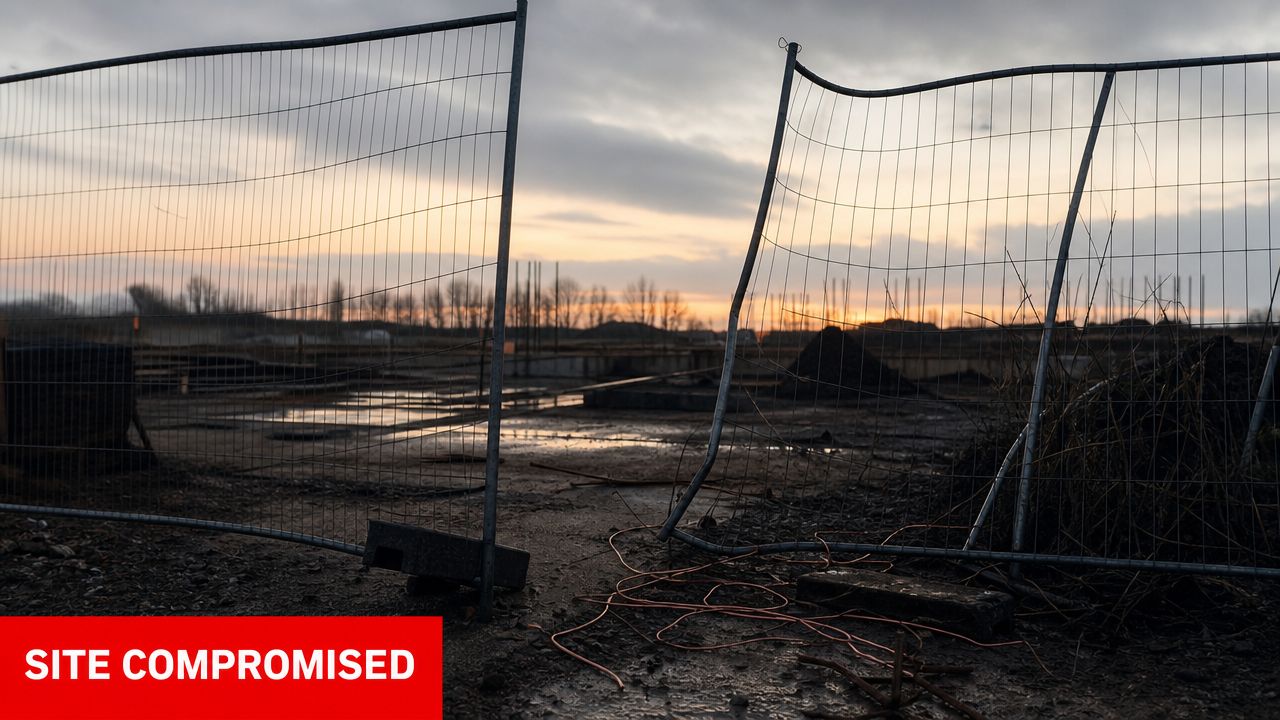

Good construction site security fencing does three jobs at once. It creates a physical barrier, signals controlled access, and buys time when someone tries to get in. That time matters because delay is what gives supervisors, patrols, neighbours, cameras, or guards a chance to detect and respond.
What project managers usually get wrong
Many sites start with a standard temporary fence package and leave it there, even when conditions change. The excavation gets deeper. Copper and switchboards arrive. Public foot traffic increases. A school route runs past the boundary. The original perimeter no longer matches the risk, but the fence stays the same.
Another common issue is treating the fence as separate from site operations. It isn't. Gate management, deliveries, after-hours lockup, lighting, signage, and plant placement all affect whether the perimeter works.
Practical rule: If a person can identify your weak point from the footpath in a few seconds, the site boundary isn't doing its job.
If you need a useful refresher on the basic product side of temporary fencing for construction sites, it helps to compare standard panel solutions with more secure perimeter options before you lock in hire and install.
What works in practice
The better approach is to treat the perimeter as a control layer, not a standalone product. Start with the boundary, then ask four blunt questions:
- Who are you trying to keep out: Opportunistic thieves, children, vandals, trespassers, or organised offenders all test a perimeter differently.
- What are you protecting: Hazard exposure and theft risk aren't the same problem.
- When is the site most exposed: Overnight, weekends, public holidays, and delivery windows create different pressure points.
- What happens after a breach attempt: A passive barrier without detection or response only delays failure.
That's the shift that separates a compliant-looking site from a secure one.
Conducting a Thorough Site Risk Assessment
The biggest gap in many perimeter plans is assuming there's a universal definition of “adequate” fencing. Under Australian WHS expectations, that isn't how site security works. In Western Australia, the regulator makes the point clearly: the issue is whether the site is secured from unauthorised access so far as is reasonably practicable, and even fencing that appears compliant may still not deter children or other members of the public near schools, parks, or shops. That's why a site-specific risk assessment matters more than a generic fence spec, as outlined in WorkSafe WA's guidance on unauthorised access.
Start with exposure, not products
Before comparing mesh, hoarding, or anti-climb systems, assess what the site presents to the outside world. Some risks pull people in. Others create serious harm if someone gets through.
Focus on the conditions that change the adequacy of construction site security fencing:
- Public interface: Sites next to schools, parks, retail strips, transport stops, or dense pedestrian routes need a stronger perimeter strategy.
- Hazard profile: Excavations, temporary electrics, partly built structures, open edges, and stored chemicals raise the consequence of unauthorised entry.
- Asset attractiveness: Copper, fuel, tools, switchboards, appliances, and small plant create theft pressure.
- Project phase: A slab stage site presents different risks from a fit-out stage site.
- Out-of-hours activity: Quiet industrial estates and active mixed-use precincts need different control measures.
A suburban duplex project and a CBD tower fit-out aren't facing the same threat pattern. They shouldn't get the same perimeter.
Ask the right operational questions
A workable risk assessment is practical, not academic. It should tell you what boundary control is needed today, and what needs to change as the job evolves.
Use questions like these during planning and during each major site phase review:
Where will an intruder try first
Usually gates, panel joins, corners with poor sightlines, or areas screened by bins and stacked materials.Can someone climb over or crawl under without much effort
If yes, your problem isn't just fence height. It's geometry, ground condition, anchoring, and housekeeping.What would a child notice from outside the site
Bright machinery, climbable materials near the boundary, visible ramps, and gaps are all invitations.What happens if someone breaches the perimeter after hours
If nobody detects it and nobody responds, the fence is only a temporary obstacle.
A perimeter is adequate only if it prevents access to the hazards that matter on that specific site.
Document the result so procurement and compliance align
Once the risks are clear, convert them into site instructions. That means specifying the boundary type, gate control method, lockup procedure, inspection frequency, and any need for patrols or cameras. If the risk profile changes, update the record and the controls.
A short, disciplined assessment often prevents the expensive mistake of under-securing a high-risk site, then trying to patch the problem with ad hoc extras after the first incident.
Choosing the Right Construction Site Security Fencing
Not all construction site security fencing performs the same way, even when it looks similar from the street. The right choice depends on whether the site needs basic demarcation, serious delay against intrusion, public shielding, or a more controlled permanent perimeter. Security value comes from delay, detection, and anti-climb geometry, not just from enclosing the site. The Chain Link Fence Manufacturers Institute notes that increasing height makes a barrier more difficult and time-consuming to breach, removing the top rail removes a handhold, adding three or six strands of barbed wire increases the time required to broach the fence, and poor material choice or installation can have a dramatic effect on security performance. That guidance is summarised in the security fencing guidelines from CLFMI.
The comparison that matters on site
A project manager usually needs to balance five things at once: speed of install, budget, public interface, theft pressure, and compliance expectations. That's why product selection should be tied directly to likely breach methods.
| Fencing Type | Security Level | Primary Use | Pros | Cons |
|---|---|---|---|---|
| Temporary mesh panels | Basic to moderate | Short-term projects, low to moderate risk sites | Fast to install, easy to relocate, widely available | Often weak at joins, easier to climb, can become unstable if poorly installed |
| Timber hoarding | Moderate | Public-facing sites needing privacy and visual screening | Better privacy, can reduce visual temptation, supports signage | Wind load matters, damage can go unnoticed, not automatically high security |
| Steel palisade | High | Long-duration sites or semi-permanent perimeter control | Strong deterrent, hard to cut through quickly, good visual control | Higher cost, less flexible for changing layouts |
| Anti-climb mesh systems | High | High-risk sites, public interface, asset-heavy projects | Smaller apertures reduce footholds, harder to scale, strong professional finish | Higher upfront cost, may need more planning for gates and interfaces |
Where each option fits
Temporary mesh panels are common because they're fast, familiar, and easy to move as the site changes. They can be acceptable on lower-risk projects if the install is solid, the ground line is controlled, and gate discipline is tight. They become a poor choice when the site holds attractive materials, faces heavy public traffic, or has serious internal hazards.
Timber hoarding works well where privacy reduces temptation and where the public needs a cleaner interface. It can also help with dust and visual containment. The trade-off is that project teams sometimes treat it like a visual screen and forget it's still part of the security perimeter. Once signage, screening, and wind exposure are added, structural performance becomes critical.
Steel palisade suits longer programmes and sites that need a visibly tougher perimeter. It's not subtle. That can be an advantage when you need a strong deterrent and clean lines of sight.
Anti-climb mesh systems are often the better answer for high-value urban sites. They reduce hand and footholds and perform better where climbing risk is a genuine concern.
What works better than chasing features
Don't buy on brochure language alone. Focus on breach points.
- Gate design matters: The best fence on site fails if the gate sags, doesn't latch cleanly, or creates a weak hinge side.
- Panel joins need scrutiny: Intruders test connection points before they test the middle of a panel.
- Ground conditions change performance: Uneven ground creates crawl-under gaps unless the line is adjusted properly.
- Add-ons can weaken a system: Shade cloth, banners, and signs all add load and can change how a fence performs in wind.
Better fencing isn't just harder to cross. It's harder to exploit at the obvious weak points.
A practical selection mindset
For a quiet residential build, standard temporary panels may do the job if the hazards are limited and lockup is disciplined. For a city project with expensive services, public foot traffic, and repeated after-hours loitering, that same setup is often asking too much from a light perimeter.
Choose the system that matches the threat, then inspect the finished install like someone trying to beat it.
Navigating State-Specific Compliance and Signage
Compliance around construction site security fencing isn't only about buying the right panel or hoarding system. Regulators look at whether the perimeter controls unauthorised access, whether it stays stable, and whether the site team has managed the obvious failure points such as gates, joins, and climbable features.
For project managers working across NSW, VIC, QLD, and the ACT, the safest mindset is to treat the perimeter as a WHS control that must be justified by risk, not as a generic hire item copied from the last job.
What Victoria makes explicit
Victoria gives one of the clearest benchmarks. WorkSafe says the most acceptable method for controlling unauthorised entry and exit on a construction site is appropriate temporary site security fencing, with a minimum height of 1.8 metres, according to WorkSafe Victoria's construction site fencing guidance. The same guidance says the fence should be well constructed, stable enough to withstand anticipated loads such as strong winds, difficult to climb, and designed to prevent access from underneath. It also says sheets of reinforcing mesh should not be used as site fencing because they may give children hand and foot holds.
That tells you what regulators care about in practice. Height matters, but performance matters more.
How to apply that across states
Even where guidance isn't framed with the same wording, the expectation is similar. If your site is in NSW, QLD, or the ACT, don't assume a basic perimeter is enough just because the hire company can install it quickly. Check whether the boundary is:
- Stable under expected conditions: Wind, uneven ground, and attached screening all affect performance.
- Difficult to climb or get under: This is especially important where the public passes close to the boundary.
- Secure at gates and panel joins: Weak points count more than the strongest span.
- Supported by clear signage: Warnings, restricted access notices, and contact details help reinforce controlled entry.
If your team also needs a broader planning reference on local fence codes and permits, it can be useful as a general reminder that boundary requirements often vary by location and use case. For construction work, though, the site hazard and state safety expectations should drive the final decision.
Signage and lockup aren't minor details
A compliant perimeter can still fail operationally. That usually happens when the gate is left unsecured during deliveries, signs are missing or unreadable, or materials are stacked beside the boundary and create easy footholds.
Use a simple close-of-day routine:
- Lock every controlled entry point
- Check that signs remain visible from likely approach paths
- Remove temporary footholds near the perimeter
- Inspect corners, joins, and vehicle gates before the last person leaves
If the perimeter only looks controlled during work hours, it isn't controlled.
Creating an Integrated Security Environment
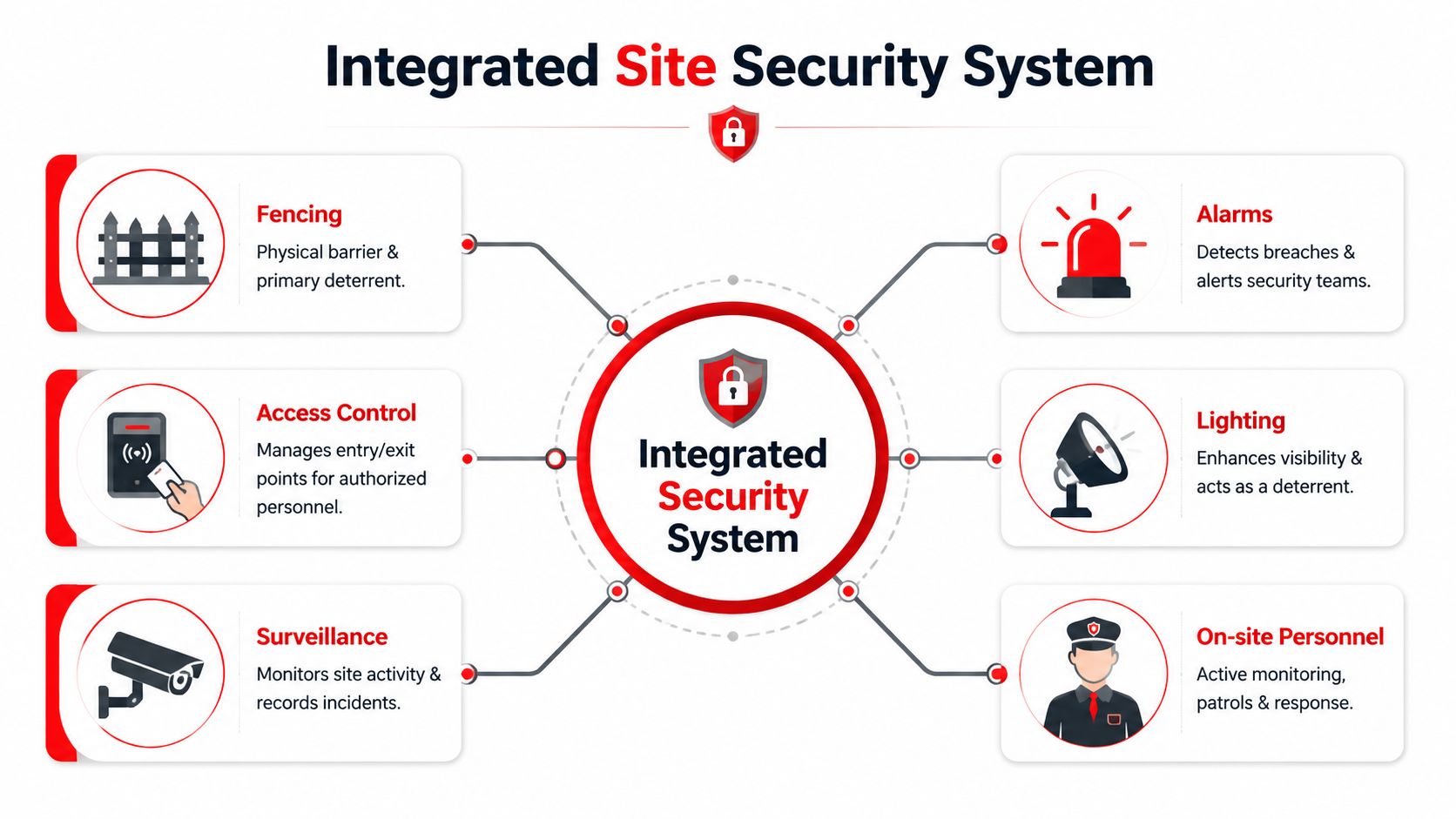
A fence on its own is passive. It doesn't watch, question, record, or respond. Its real value appears when it's part of a wider site security system that combines physical delay with detection and human action.
That matters because most breaches don't happen in ideal conditions. They happen at night, during bad weather, during noisy nearby works, or when a site has developed habits that make intrusion predictable. Construction site security fencing slows people down. The rest of the system decides whether that delay turns into prevention.

Access control turns a boundary into a managed perimeter
A site with one locked gate and no sign-in process often feels secure until a contractor props it open, a delivery arrives early, or multiple trades start using side access for convenience. That's how perimeter discipline erodes.
The more exposed the site, the more important it is to control how people enter and leave.
- Manned gatehouse or gate control: Best for larger sites, heavy delivery schedules, or projects with multiple subcontractors.
- Single controlled vehicle gate: Suitable where traffic is predictable and supervision is consistent.
- Padlock-only access: Acceptable only on lower-risk sites with limited attendance and strong after-hours procedures.
A boundary without access control usually becomes a suggestion.
Surveillance and lighting close the gaps
CCTV should support the fence line, not just watch the site interior. Too many setups leave the perimeter in shadow and point cameras at plant or compounds while the actual breach path sits outside coverage.
Lighting matters for the same reason. It improves visibility for cameras, increases the chance of natural surveillance from surrounding properties, and removes the dark corners intruders look for.
Practical placement beats expensive equipment. Cover:
- Gates and approach paths
- Long fence runs with poor natural sightlines
- Material laydown areas near the boundary
- Blind corners created by sheds, site offices, bins, or stacked product
For teams thinking about remote operations and fewer permanently staffed control points, broader discussions around unmanned building management can still be useful as a planning concept. On construction sites, though, remote tools only work if the perimeter, camera views, and response procedures are all designed together.
Human presence changes offender behaviour
Static guards, roving guards, K9 units on suitable sites, and randomised mobile patrols do something the fence never can. They introduce uncertainty. Offenders are far less comfortable testing a perimeter when they can't predict whether someone is watching or when a patrol may arrive.
This doesn't mean every site needs a guard on every shift. It means human coverage should match the risk.
A practical model looks like this:
| Layer | What it does | Where it helps most |
|---|---|---|
| Fencing | Delays entry and defines the boundary | Every site |
| Controlled gates | Limits casual access and records movement | Sites with regular deliveries and multiple trades |
| CCTV and lighting | Detects approach and supports investigation | Public-facing and higher-risk sites |
| Mobile patrols or guards | Intervenes, verifies alarms, reinforces deterrence | Sites with theft pressure or repeated trespass |
The strongest perimeter is the one that forces an intruder to deal with delay, visibility, and the chance of immediate response at the same time.
Deployment and Maintenance Checklist
Most perimeter failures aren't caused by the original specification alone. They happen because the install wasn't checked properly, the site changed, or damage was left too long. A simple lifecycle routine keeps construction site security fencing effective from mobilisation to demobilisation.
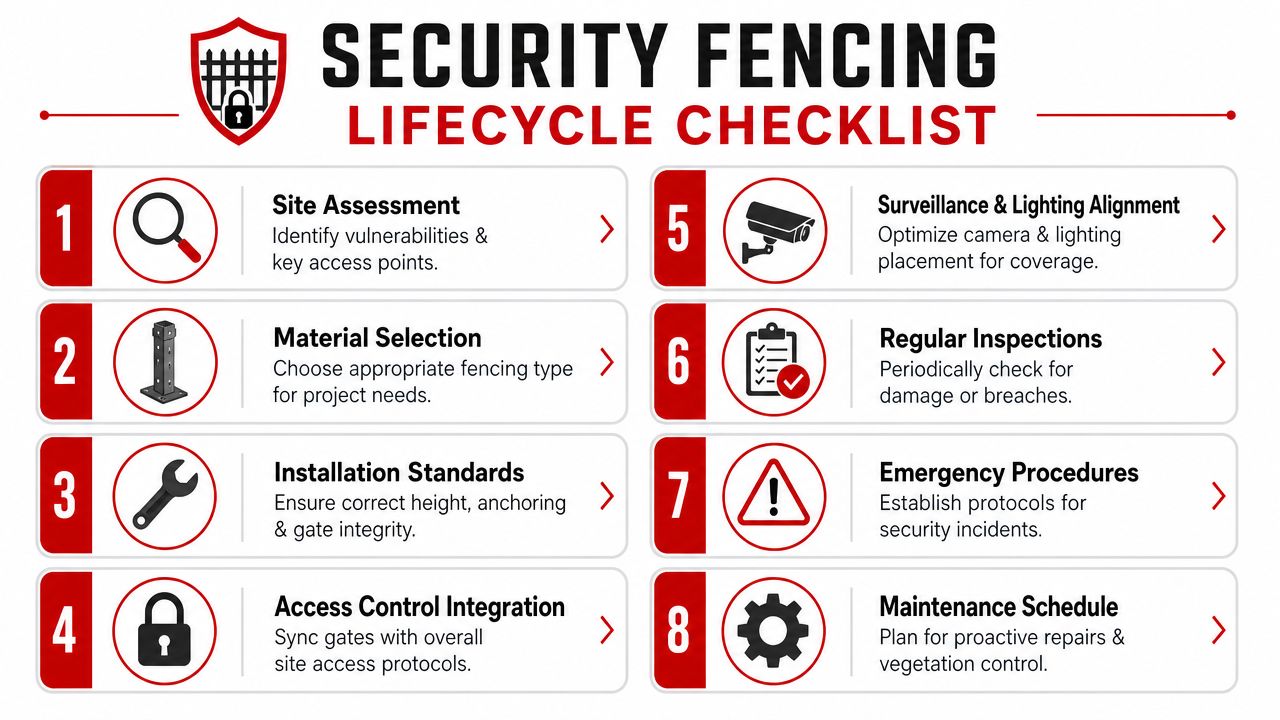
Before installation
- Request itemised quotes: Make sure pricing separates delivery, installation, call-outs, modifications, and removal.
- Match the fence to the site phase: Early works, structure, and fit-out may need different perimeter controls.
- Confirm gate locations early: Don't let convenience create extra entry points that are hard to supervise.
At handover
Walk the full fence line before the installer leaves. Don't inspect from the site office door.
Check for these issues on day one:
- Gaps at ground level
- Loose joins and unstable panels
- Vehicle gates that drag, sag, or don't latch cleanly
- Blind spots created by site sheds, bins, or material stacks
During the project
A perimeter needs routine attention, especially after wind, deliveries, plant movement, or layout changes.
- Run scheduled inspections: Look for leaning sections, lifted panels, tampering, and damaged locks.
- Control added loads: If you attach shade cloth, signs, or screening, reassess stability.
- Keep the boundary clear: Don't stack pallets, scaffold parts, or waste bins against the fence.
- Update controls when risk changes: New assets, new hazards, and public complaints are all triggers for review.
At close of day
Use a short lockup checklist that a supervisor can complete consistently. The goal is to remove assumptions. Gates secured, signs visible, vulnerable materials moved away from the perimeter, and any damage reported before the site goes dark.
Frequently Asked Questions
Is temporary fencing enough for every construction site
No. It can be suitable for lower-risk projects, but it isn't a universal answer. If the site faces heavy foot traffic, holds valuable materials, or contains serious hazards, standard temporary panels may not provide enough delay or control.
Can I rely on fence height alone
No. Height helps, but it doesn't solve weak joins, crawl-under gaps, unstable panels, poor gate design, or easy footholds. A taller fence that's badly installed can still fail quickly.
Does privacy screening improve security
Sometimes, but not automatically. Screening can reduce visual temptation from the street. It can also increase wind load and hide tampering if the fence system and inspection routine aren't strong enough. Treat screening as a structural and operational decision, not just a visual one.
Is DIY installation worth the savings
Usually not on a serious project. Poor installation is where many perimeter failures begin. If the panels aren't secure, the gates don't work properly, or the line leaves obvious gaps, you may end up paying more in repairs, delays, or incident response than you saved upfront.
What should I inspect after bad weather
Check stability, footing, joins, gates, and anything attached to the fence line. Wind can loosen panels, distort gates, and create new gaps at the base. If the site uses hoarding or screening, inspect those areas closely.
How often should the fence line be checked
The answer depends on the site's risk and activity level, but it should be regular and tied to real triggers. Inspect after weather events, after major deliveries, after any reported trespass, and whenever the site layout changes.
What usually causes perimeter weak points
In practice, it's often the small operational issues: gates left unsecured, materials stacked against the boundary, uncorrected panel damage, poor visibility at corners, and temporary access arrangements that become permanent by habit.
Should fencing be paired with guards or patrols
On many sites, yes. Fencing delays entry. Guards and patrols add observation and response. If the site has repeated trespass, valuable assets, or a difficult public interface, human presence can make the difference between a deterrent and a breach.
If you need support designing a practical perimeter strategy across NSW, VIC, QLD, or the ACT, GM GROUP Services can help with risk assessments, gatehouse control, static guards, mobile patrols, K9 units, and integrated site security planning that fits the way your project operates.