


Construction site safety rules and regulations PDF isn't a paperwork topic. It's a harm-prevention topic.
In Australia, Safe Work Australia reported 200 worker fatalities across all industries in 2023, and construction remains one of the highest-risk sectors for deaths and serious claims, as noted in this summary of construction injury statistics in Australia. That should change how you look at every induction form, permit, gate entry log, scaffold handover, and exclusion zone on site.
Individuals searching for a construction site safety rules and regulations PDF want a simple document they can download and hand around. The problem is that a PDF by itself doesn't control risk. A site only becomes safer when the rules are translated into physical controls, supervision, contractor coordination, and reliable site access control.
That's where many projects fall short. They focus on PPE posters and toolbox talks, but they don't lock down who enters site, who has completed induction, who is authorised for hot work, or who is responsible when multiple subcontractors overlap in the same work zone.
Practical rule: If your site can't control access, verify competencies, and track who is doing what, your safety system is weaker than it looks on paper.
The useful version of a construction site safety rules and regulations PDF is one that helps supervisors make decisions in real conditions. Rain coming in. Deliveries arriving early. Public interface works starting beside live pedestrian traffic. Roof work delayed, then compressed into a shorter shift. A visitor turning up without induction. Those are the moments where compliance either holds or falls apart.
Introduction The Critical Need for Robust Site Safety
Construction safety in Australia sits under constant regulator scrutiny because the risk profile stays high. The issue isn't only major incidents. It's also the serious injuries that come from common failures such as poor access, unmanaged edges, weak supervision, rushed sequencing, and bad coordination between trades.
A strong construction site safety rules and regulations PDF should do three jobs at once. It should explain the legal baseline. It should convert that baseline into daily site controls. It should support evidence of compliance when a principal contractor, client, or regulator asks how risk was managed.
Why generic site rules often fail
Many generic PDFs list boots, helmets, gloves, and housekeeping. Those matter, but they don't solve the coordination problems that create real exposure on active sites.
Common failures usually look like this:
- Access without control means workers, drivers, and visitors enter before induction or without confirmation of work area restrictions.
- Permits without follow-up means hot work, isolation, or public protection requirements are signed but not enforced at the workface.
- Shared work zones without coordination means one subcontractor's controls are undermined by another contractor's plant movement, storage, or sequencing.
- Temporary controls left unmanaged means barricades shift, covers are removed, or exclusion zones degrade through the day.
Safety and security work together
Site safety isn't separate from site security. On a functioning project, gatehouse control, patrols, perimeter checks, key management, after-hours monitoring, and visitor management all support WHS outcomes. They help prevent unauthorised access, reduce confusion around site entry, and improve incident response when something goes wrong.
That's the practical lens to use throughout this guide. Not “what does the law say in theory?” but “what must a site do today to stay compliant and protect people?”
Foundations of Australian Construction Safety Law
Australian construction regulation now sits within a structured WHS model rather than a loose duty-of-care approach. That shift matters because it changed safety from a reactive exercise into a planning and control exercise. The change was formalised through the national WHS system adopted across jurisdictions from 2011, as outlined in this overview of construction safety statistics and regulatory development.

What the law means on site
The key legal concept is the PCBU, or Person Conducting a Business or Undertaking. On a construction project, that usually means the business that controls work, engages workers, or manages part of the site operation. Officers have due diligence obligations. Supervisors must actively enforce controls. Workers must follow reasonable instructions and cooperate with safety procedures.
In plain terms, that means:
- Risk must be managed before work starts, not after a near miss.
- Controls must be practical and proportionate, not vague statements like “take care” or “use caution”.
- Consultation matters when multiple duty holders share a site.
- Evidence matters because a good system leaves records, permits, inductions, inspections, and review notes behind.
The hierarchy isn't just theory
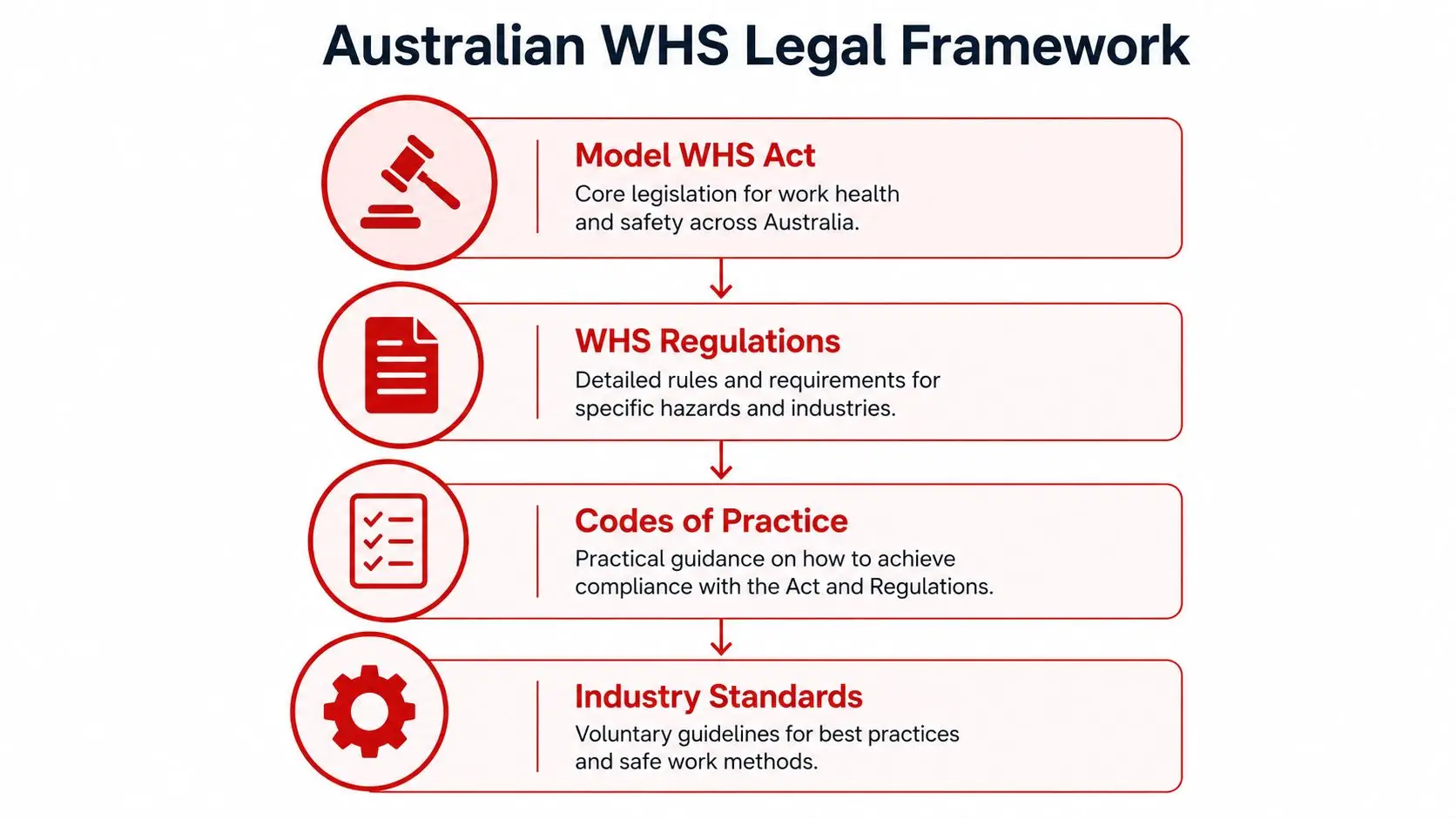
The legal framework works like layers. The Act sets duties. The Regulations add detail. Codes of Practice guide how to comply. Site procedures, permits, SWMS, and supervision bring it to life.
For managers dealing with retaining structures, excavations, or boundary works, Retaining Wall Supplies' legal requirements guide is a useful example of how legal obligations become design, approval, and construction decisions on real projects.
A compliant site doesn't rely on workers remembering rules from induction day. It builds those rules into access, planning, supervision, and physical controls.
What “reasonably practicable” looks like in practice
This standard trips people up. It doesn't mean doing the bare minimum. It means identifying the hazard, judging the level of risk, knowing what controls are available, and implementing controls that are suitable in the circumstances.
On a live construction site, that usually means asking:
| Question | Practical site meaning |
|---|---|
| Who is exposed? | Workers, visitors, delivery drivers, pedestrians, neighbours |
| What can go wrong? | Fall, strike, collapse, ignition, contact with services, unauthorised access |
| What control is strongest? | Eliminate, isolate, engineer, then supervise and document |
| Who owns the control? | Principal contractor, subcontractor, supervisor, permit holder |
That's why a construction site safety rules and regulations PDF needs more than legal summaries. It needs clear ownership of controls.
Controlling High-Risk Work A Core Safety Requirement
When people ask what really drives construction enforcement, the answer is usually high-risk work. Falls, unstable structures, live services, hot work, plant interaction, and public-interface activities all demand tighter planning and stronger controls than general site tasks.
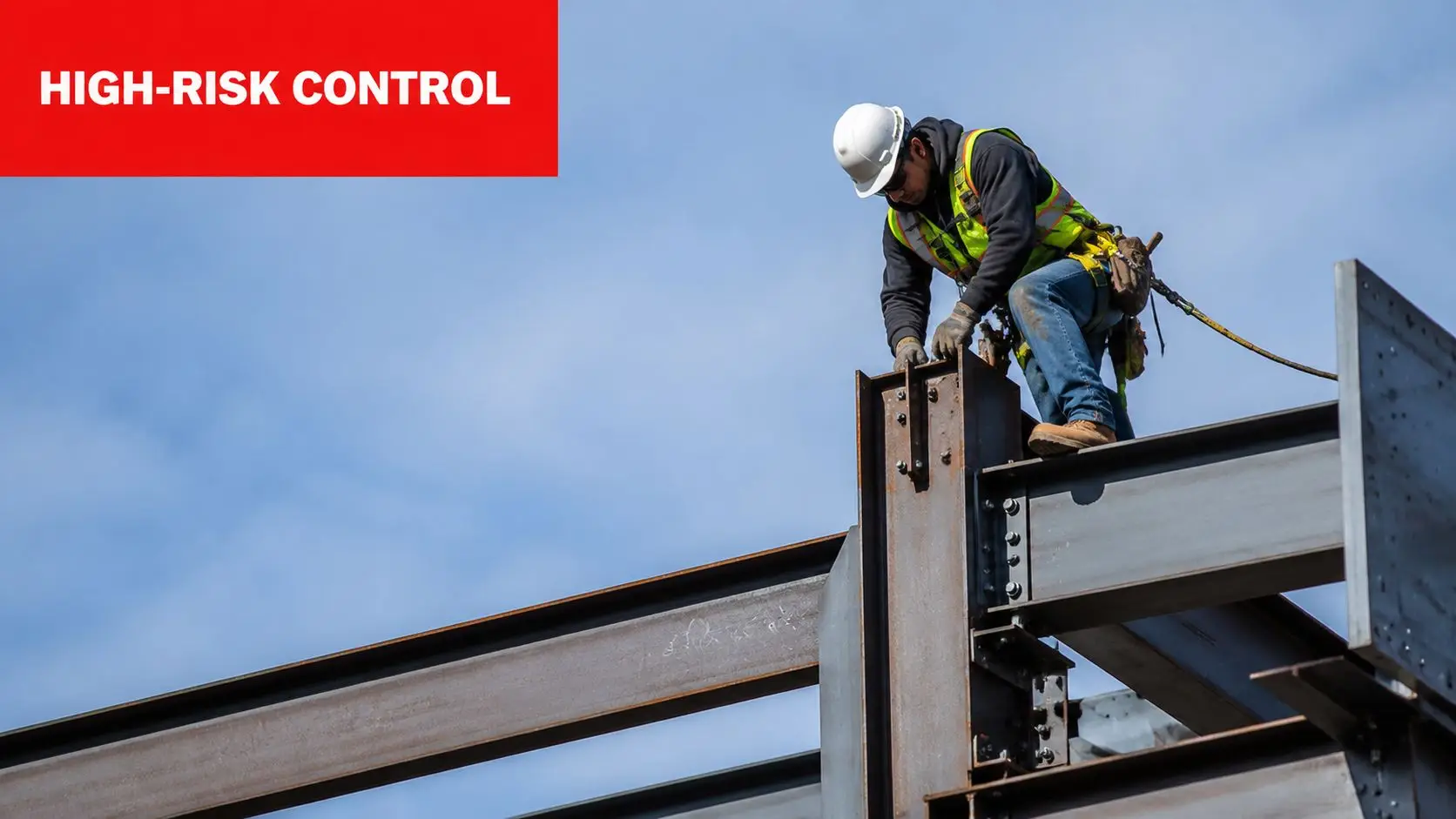
The clearest technical example is work at height. The Australian WHS framework requires a fall-prevention or fall-arrest approach where a worker is at risk of falling, with the practical benchmark commonly set at 2 metres or more in many state guidance documents for high-risk construction procedures, as described in this fall protection guidance reference.
Fall protection before work starts
The weak approach is to tell workers to “be careful” near edges. The compliant approach is to define and install controls before access is granted.
That often includes:
- Guardrails and edge protection for slab edges, penetrations, and roof perimeters.
- Scaffolds with proper access rather than improvised climbs or incomplete platforms.
- Covers over penetrations secured so they can't be displaced easily.
- Harness systems and anchor points where prevention isn't reasonably achievable.
- Restricted access zones so only authorised workers enter exposed areas.
If a crew arrives and the edge protection still isn't installed, the work shouldn't start. That's the decision point supervisors need to be comfortable making.
Other high-risk work that needs hard controls
A good construction site safety rules and regulations PDF should also force discipline around other activities that regularly go wrong.
Excavation and underground services
Excavation work creates overlapping risks. Ground collapse, plant movement, underground service strikes, and public interface issues can all exist in the same trenching task. The fix isn't one control. It's coordinated controls. Service location, permit review, barricading, plant exclusion, spotters where needed, and competent supervision.
Electrical and temporary power
Electrical exposure is often underestimated because temporary systems become “normal” on longer projects. They shouldn't. Test-and-tag routines, protected leads, proper board condition, lockout where applicable, and control of unauthorised interference all matter. For teams reviewing practical ways to identify electrical risks at work, that resource is useful because it frames common electrical hazards in operational terms rather than office language.
Structural changes and partial demolition
Any activity that changes load paths, removes support, or alters sequencing should trigger a more disciplined review. The mistake I see most often is treating temporary conditions like they're low risk. They aren't. Temporary conditions are exactly when structures become least predictable.
Don't assess high-risk work by how routine it feels. Assess it by what happens if the control fails.
State-Specific Safety Regulations for NSW VIC QLD & ACT
The model WHS framework created a common baseline, but site managers still need state-level awareness. Regulator emphasis, guidance style, and enforcement activity differ enough that a single national checklist won't cover every practical issue.
That matters most for businesses running projects across borders. A supervisor who moves between Sydney, Melbourne, Brisbane, and Canberra can't assume that local regulator expectations will be interpreted the same way on every job.
State Regulator Safety Priorities
| Jurisdiction | Regulator | Key Focus Area / Recent Blitzes | Link to Primary Code of Practice |
|---|---|---|---|
| NSW | SafeWork NSW | High-risk construction work, falls, site supervision, contractor coordination, public risk controls | Primary WHS codes and construction guidance from the state regulator |
| VIC | WorkSafe Victoria | High-risk work systems, prevention-focused site controls, contractor management, plant and access safety | Primary WHS compliance codes and construction guidance from the state regulator |
| QLD | WorkSafe Queensland | High-risk construction work, traffic movement, electrical safety, principal contractor duties | Primary WHS codes and construction guidance from the state regulator |
| ACT | WorkSafe ACT | Construction planning, safe access, contractor coordination, duty holder compliance | Primary WHS codes and construction guidance from the territory regulator |
What changes by jurisdiction in practice
The broad legal duties stay familiar. The practical differences usually show up in regulator expectations around evidence, local guidance documents, licensing pathways, and the way inspectors focus their site visits.
A few examples:
- NSW projects often require very clear contractor coordination and visible control of site interfaces, especially where the public or adjoining properties are involved.
- Victoria sites tend to be assessed closely on whether controls are genuinely built into the work method rather than described at a high level.
- Queensland work regularly demands stronger attention to electrical exposure, weather conditions, and moving plant around open sites.
- ACT projects often place a premium on documentation discipline and straightforward proof that site controls are actually being maintained.
The safest approach across all four areas
If you operate in all four jurisdictions, don't maintain four completely different systems. Build one strong core system, then add local regulator notes, permit requirements, and induction references for each state or territory.
That core system should include:
- Jurisdiction-specific induction content for regulator notices, local emergency contacts, and licensing references.
- A live compliance register that tracks permits, SWMS reviews, plant records, and local obligations.
- Supervisor briefing notes so frontline leaders know what local inspectors are likely to examine first.
That method reduces drift and makes multi-state contractor management far cleaner.
Essential Documentation The SWMS and Your Regulations PDF
If the site's most important control document is missing, outdated, or sitting in a ute instead of onsite, your compliance position is already weak. Construction sites must maintain a Job Hazard Analysis or Safe Work Method Statement that breaks work into steps, identifies hazards, and lists controls. It must be kept onsite and is critical for managing risks such as hot work or tasks near public areas, as outlined in this contractor safety requirements reference.
What a usable SWMS looks like
A poor SWMS is generic, copied from another project, and impossible to supervise against. A usable SWMS is specific enough that a supervisor can stand in the work area and compare the document to what's happening.
At minimum, it should cover:
- Task sequence in the order the crew will perform it.
- Hazards at each step rather than one generic hazard list at the top.
- Controls tied to the hazard such as isolation, exclusion, permits, traffic separation, fall controls, or fire response.
- Responsible persons so everyone knows who owns the control.
- Review triggers for changes in access, weather, scope, plant, or workface conditions.
Why document control matters more than people think
Version control becomes a real safety issue on active projects. One subcontractor updates a SWMS. Another team works from the old copy. The permit references the new sequence, but the pre-start discussion used the old one. That's how control gaps open.
For teams tightening their document systems, this guide to preventing document versioning errors is useful because it addresses the practical discipline needed when multiple revisions circulate across a project.
Site discipline: Keep the current SWMS where the work happens, not just in a site folder. If the crew can't access the right version quickly, the document isn't controlling the job.
What to include in your regulations PDF pack
A practical construction site safety rules and regulations PDF pack should include more than legal extracts. It should contain working documents people can use immediately.
A solid pack usually includes:
- SWMS template for high-risk construction work
- JHA template for lower-complexity task planning
- Hot work permit with extinguisher and fire-watch checks
- Visitor and contractor induction form
- Daily pre-start checklist
- Incident and near miss report form
The goal isn't more paperwork. The goal is cleaner planning, clearer supervision, and better evidence that the site took risk management seriously.
A Practical Construction Site Safety Rules Checklist
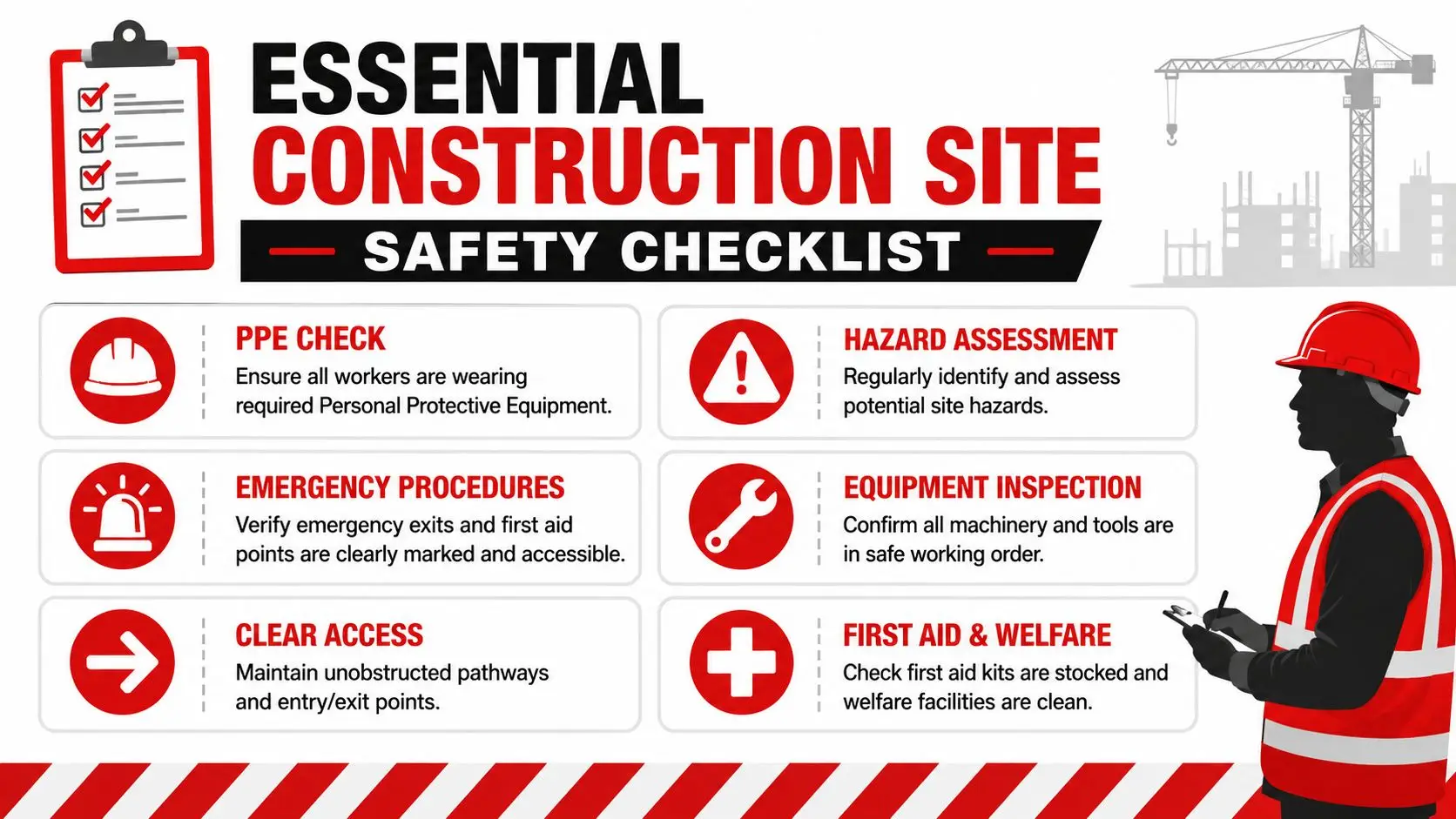
Most supervisors don't need another lecture during a busy shift. They need a checklist they can use in real time. The best construction site safety rules and regulations PDF includes short, repeatable checks that catch site drift before it becomes an incident.
Start-of-day checks
- Access points secure: Confirm gates, fencing, sign-in points, and pedestrian entry routes are controlled and clearly separated.
- Inductions verified: Check that workers, visitors, and delivery drivers have the required site authorisation before entry.
- Emergency readiness: Make sure exits, first aid points, extinguishers, and assembly areas are accessible and marked.
- Weather review complete: Adjust sequencing, supervision, or access if conditions have changed overnight.
Active work area checks
- SWMS available: The current document must match the task underway.
- Exclusion zones intact: Barricades, signage, spotter arrangements, and traffic routes must still reflect actual site movement.
- Plant and tools fit for use: Inspect condition, guarding, access systems, and obvious defects before use continues.
- Housekeeping maintained: Walkways, stairs, access ladders, and material storage should remain clear through the shift.
End-of-day checks
- Hazards left safe: Open edges, penetrations, power tools, and partially completed work must be secured.
- Ignition risks controlled: Hot work areas should be checked, isolated, and left in a safe state.
- Site locked down: Perimeter integrity, keys, lighting, and after-hours access controls need review.
- Records updated: Close out permits, note incidents, and record any changed conditions for the next shift.
This kind of checklist works because it's short enough to use and specific enough to matter.
Integrating Site Security for Superior WHS Compliance
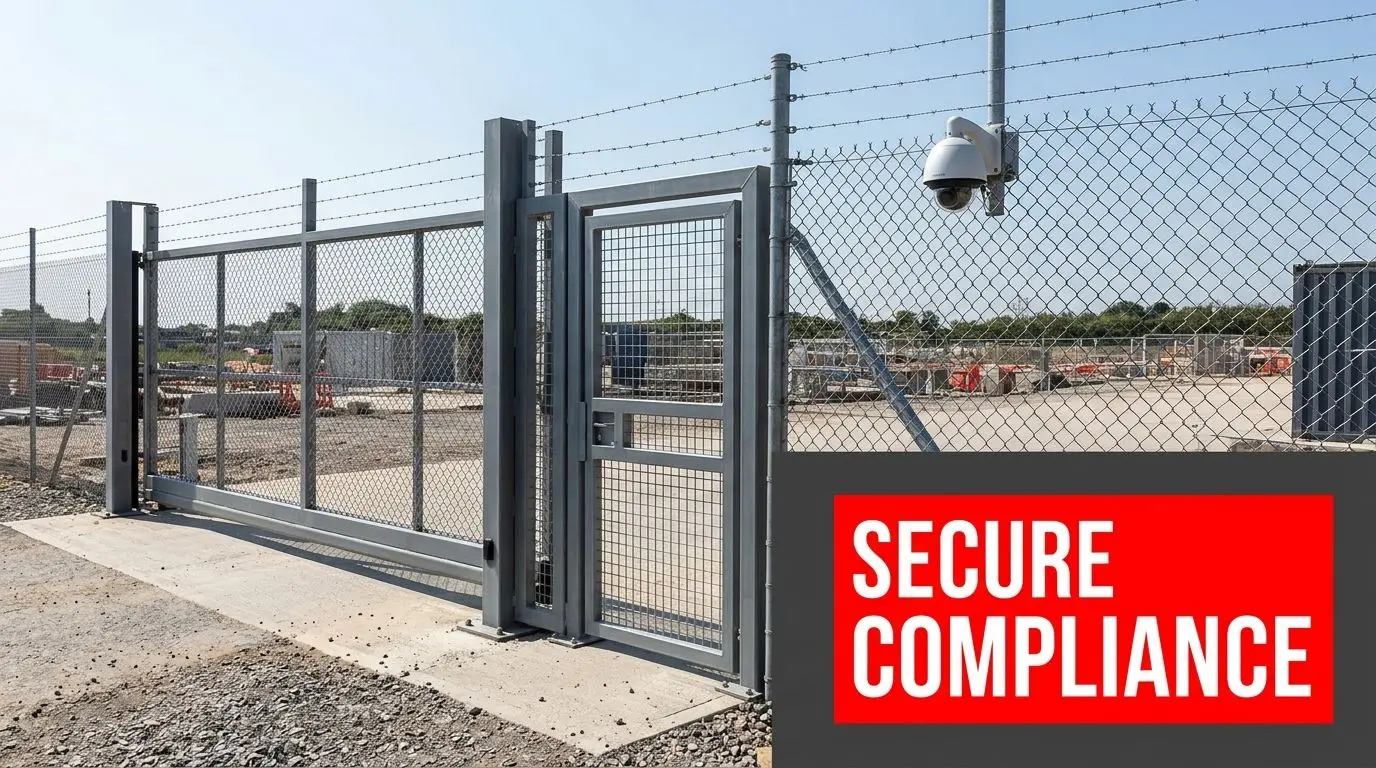
Many construction teams still treat security as a theft-prevention service. That's too narrow. On a functioning project, security is one of the clearest operational supports for WHS compliance because it helps control who enters, what they're doing, where they go, and how incidents are escalated.

Gatehouse control is a safety control
A staffed gatehouse does more than wave vehicles through. It creates a verification point. That matters for induction status, delivery timing, plant entry, visitor escorting, and preventing unauthorised persons from stepping into active work zones.
A good gate process should confirm:
- Who the person is
- Why they're onsite
- Whether they've completed induction
- Which area they're authorised to access
- Whether a permit, escort, or supervisor contact is required
If those checks are missing, the site can't reliably say it controls exposure.
Patrols support hazard identification
Regular patrols can strengthen site safety when they're built into the WHS system rather than treated as separate from it. Patrol staff often spot issues that develop outside formal inspections. Gates left unsecured. Fire doors propped open. Materials stored in egress routes. Temporary fencing moved. Public barriers damaged. Lighting failures near shared access points.
Those aren't minor housekeeping issues. On many sites, they're the start of a more serious event.
Unauthorised entry is a safety issue, not just a security issue. The same is true for poor perimeter control, unmanaged visitor movement, and weak after-hours lock-up.
Mixed-contractor sites need coordination points
Construction gets messy when several subcontractors overlap. One crew arrives early. Another changes access routes. A delivery turns up while a lift is underway. Public works continue beside the boundary. Security personnel can support WHS by acting as a coordination layer for arrivals, visitor direction, perimeter integrity, and escalation of unsafe conditions to site management.
That support is especially useful for:
| Security function | WHS benefit |
|---|---|
| Gatehouse screening | Prevents uninducted or unauthorised entry |
| Vehicle and foot patrols | Identifies perimeter and housekeeping failures |
| Visitor management | Reduces exposure in restricted or active zones |
| Incident escalation | Speeds response to hazards, trespass, or after-hours events |
| After-hours monitoring | Protects incomplete works, stored plant, and temporary controls |
Where security adds the most value
Security has the strongest WHS value on projects with public interfaces, valuable plant, multiple access points, staged works, after-hours exposure, or high contractor turnover. On those sites, access control and patrol reporting become part of the risk management system, not an add-on.
Enforcement Penalties and Incident Reporting
Regulators don't need to wait for a serious injury before taking action. If they find unmanaged risk, they can intervene immediately. In practice, that means site managers need to assume every control may have to be explained and justified under pressure.
What enforcement looks like on site
Enforcement usually starts with visible failures. Missing edge protection. Unclear supervision. Inadequate site access control. Unsafe plant movement. SWMS that don't match the task. Public protection measures that aren't maintained.
The common enforcement tools include:
- Improvement notices where the issue must be corrected.
- Prohibition notices where work must stop because the risk is immediate or significant.
- Formal investigation after a serious incident, dangerous occurrence, or repeated failure.
- Prosecution exposure where reckless conduct or major breaches are involved.
The biggest mistake after an inspector arrives is trying to tidy the story instead of fixing the control. Inspectors usually notice that quickly.
Incident response in the first hour
When an incident happens, the first job is care and control. Get first aid underway. Remove ongoing danger if that can be done safely. Prevent further access to the area. Protect other workers and the public.
Then move through a clean process:
- Stabilise the scene without disturbing critical evidence unnecessarily.
- Notify internal decision-makers such as the principal contractor, project manager, and relevant supervisors.
- Preserve records including permits, SWMS, induction logs, photos, plant details, and witness names.
- Assess whether the incident is notifiable under the applicable WHS requirements.
- Report to the regulator promptly where required and follow any direction about preserving the site.
Reporting discipline matters
Good reporting is factual, time-specific, and restrained. Record what happened, who was involved, what controls were present, what changed, and what immediate actions were taken. Don't fill gaps with assumptions.
A clean incident process usually depends on three things:
- Clear scene control
- Accurate records
- One reporting chain
If the site can't identify who controls the scene after an event, confusion spreads fast.
Modern Challenges Heat Stress Fatigue and Mental Health
Some site safety documents still read like construction risk stopped evolving years ago. They focus on helmets, ladders, and housekeeping, but give almost no operational guidance on heat, disrupted schedules, fatigue, or psychosocial pressure. That gap is no longer acceptable.
Australian WHS regulators now publish specific guidance on heat risk because heat stress is a material hazard that can reduce concentration and increase the likelihood of incidents, and that risk is intensified by climate-related disruption to outdoor work schedules and fatigue, as discussed in this overview of construction safety rules including heat risk.
Heat changes how safe work is planned
Heat isn't just a comfort issue. It affects judgment, pace, hydration, manual handling tolerance, and attention. On construction sites, those effects compound quickly when crews are exposed to reflective surfaces, PPE burden, roof work, steel, concrete, or restricted airflow areas.
Practical controls include:
- Rescheduling heavy tasks to cooler periods where possible.
- Increasing rest and hydration opportunities when conditions become harsher.
- Monitoring workers more actively for slowed responses, confusion, or visible fatigue.
- Adjusting supervision levels when hot conditions coincide with high-risk tasks.
Fatigue often starts in the program, not the worker
When a project runs behind, teams often compress tasks, extend days, or stack trades into narrower time windows. Fatigue then appears as a “worker issue” when the root cause was bad sequencing or unrealistic recovery time.
A more effective approach is to review:
- Shift length and start times
- Travel and commute load
- Stop-start work caused by weather
- High-concentration tasks scheduled late in the day
- Rework that adds unplanned hours
If the schedule forces tired people to do precision work in harsh conditions, the site has a planning problem, not just a behavioural problem.
Mental health sits inside WHS now
Construction leaders also need to treat psychosocial risk as part of site management. Long hours, unstable programs, conflict between trades, abusive behaviour, poor supervision, and uncertainty around work all affect concentration and decision-making.
You don't need to overcomplicate the response. Start with respectful supervision, realistic scheduling, clear escalation pathways, and a site culture where workers can raise concerns before they become incidents.
Frequently Asked Safety and Regulation Questions
Who is legally responsible if a subcontractor's worker is injured?
Responsibility usually isn't isolated to one party automatically. On construction projects, multiple duty holders may carry obligations at the same time. The principal contractor, subcontractor employer, site manager, and others may each need to show what control they had, what they knew, and what they did to manage the risk. That's why overlapping duties and contractor coordination need to be documented clearly.
How often should a SWMS be reviewed on a long project?
Review it whenever the work changes in a meaningful way. That includes changes to sequence, plant, access, weather exposure, surrounding trades, public interface, or identified control failure. If the document no longer matches the task being performed, it needs review before work continues.
Is a construction site safety rules and regulations PDF enough for compliance?
No. A PDF is a reference and evidence tool. Compliance depends on implementation. Inspectors and clients look for what the site did, not just what it said in a document.
What's the biggest documentation mistake on mixed-contractor sites?
Usually it's inconsistency. One contractor works from an outdated SWMS, another hasn't been briefed on changed access, and the permit issuer assumes everyone already knows. The fix is tighter document control, daily coordination, and clear ownership of revised instructions.
How should sites manage visitors and delivery drivers safely?
Don't treat them as casual arrivals. They need controlled entry, direction to safe waiting or unloading points, and clear contact with the receiving supervisor. If they can wander into active work zones, the site has lost control of a known risk.
When should work stop?
Work should stop when the planned controls aren't in place, conditions have changed materially, supervision can't verify safe execution, or site access and exclusion arrangements have broken down. Stopping work early is usually cheaper than managing the consequences of pressing on.
Does security really affect WHS compliance?
Yes. If security controls site entry, patrols perimeters, manages visitor flow, supports after-hours lock-up, and escalates hazards quickly, it directly supports WHS outcomes. If those functions are absent, sites often lose control of induction status, restricted areas, perimeter integrity, and incident response.
If your project needs stronger control of site access, visitor management, perimeter security, patrols, and after-hours response, GM GROUP Services provides licensed security support across NSW, VIC, QLD and the ACT. For construction and industrial sites, that means practical help with gatehouse control, patrol visibility, incident escalation, and safer contractor coordination that supports your broader WHS obligations.