


Company security guard bookings often get signed in the week a site opens, when the only brief on the table is a headcount and the lowest hourly rate. You're lining up a festival gate, a Friday bar roster, or an overnight construction gatehouse, and the first quote looks neat enough to accept.
That shortcut is where the mistakes start. A guard can only be judged against duties you've written down, a licence that matches those duties, and clear rules for when to call you or the police. I would settle those three before I compare rates.
The order below is the one that holds up for venues, retailers, construction sites and corporate functions. Price comes after the controls, not before them.
Defining the Scope of a Company Security Guard
Company security guard performance is only measurable against a one-page scope. Start with the site, its opening hours and the risks that matter most. Then list each duty and the authority limit that sits with it. If a duty can't be observed, recorded or checked on the night, rewrite it until it can.
Before that page is drafted, run a documented risk assessment. Identify hazards and the groups exposed to them, review prior incidents and the site layout, define guard tasks and escalation thresholds, then test those controls in pre-start briefings and supervisor inspections. Safe Work Australia recorded 53,139 accepted workers' compensation claims for assault by another person and 12,721 accepted claims for exposure to workplace or occupational violence over the preceding 10 years. Those figures aren't a guard success rate. They're a reason to plan for violence instead of treating it as a surprise.
Retail, construction, hospitality and functions
A generic post order fails because the work isn't the same from one front door to the next.
A retail store needs opening and closing checks, patrols, shoplifting reports and CCTV liaison. The risk is after-hours entry and theft. Write who may stay back, which doors get locked, and when a theft report goes to the manager rather than into a chase across the car park.
A construction site needs gatehouse sign-in, after-hours patrols, and a watch on plant and materials. Theft, trespass and unsafe access are the risks. The guard logs visitors and stops people walking onto an active deck. They don't operate plant, and they don't wave through a missing induction.
A bar or pub needs entry screening, crowd management, exit control and support when staff refuse service. Intoxication and conflict drive the post. Authority stops at a clear warning and a call up the chain.
A corporate function needs guest list checks, visitor escort and a briefing with event staff. The harm is unauthorised entry and damage to reputation. A name that isn't on the list waits. It doesn't get argued past the door.
| Site type | Core duties | Main risk |
|---|---|---|
| Retail store | Opening and closing checks, patrols, shoplifting reports, CCTV liaison | After-hours entry and theft |
| Construction site | Gatehouse sign-in, after-hours patrols, plant and materials watch | Theft, trespass and unsafe access |
| Bar or pub | Entry screening, crowd management, exit control, support for staff refusing service | Intoxication and conflict |
| Corporate function | Guest list checks, visitor escort, briefing with event staff | Unauthorised entry and reputational harm |
| Festival or concert | Perimeter and entry screening, crowd flow, medical and emergency liaison | Overcrowding, weapons and crowd crush |
A festival row belongs on the same page because crowd crush and weapons aren't solved by extra bodies alone. Perimeter, flow and a named medical liaison have to be duties someone can tick.
Practical rule: If you can't tick the duty on a shift report, it isn't a duty yet. It's a hope.
How to Check a Company Security Guard's Licence
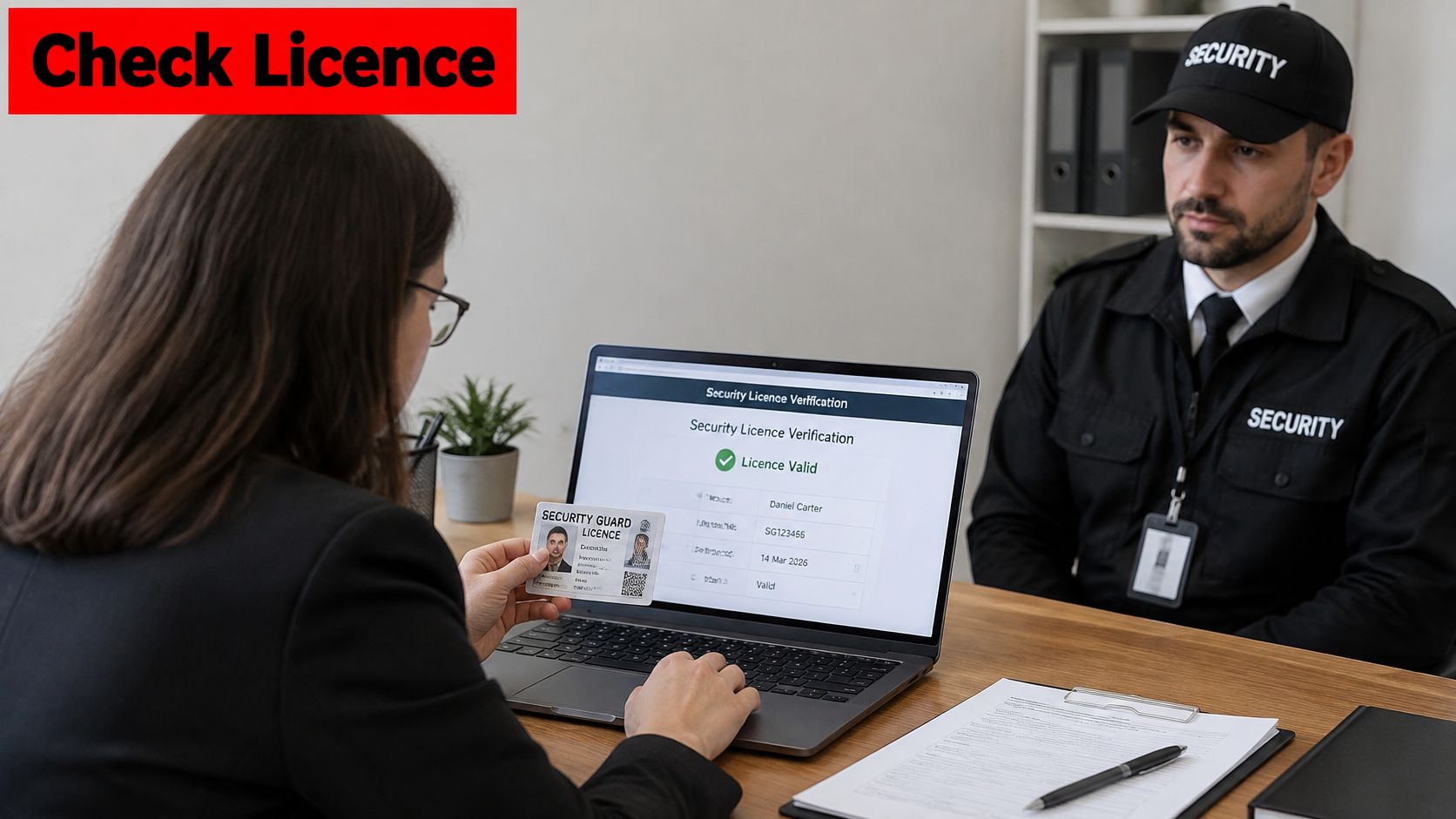
Run the licence check before anyone is rostered. Treat the card as a technical control with a pass or fail outcome, the same way you would treat a site key or an access code.
- Ask for the licence number and class. Confirm it on the state regulator's register, because a photo can be old, cropped or borrowed.
- Match the class to the scope. Guarding, crowd control, bodyguard work and monitoring can need different authorisations, so a pass for one task isn't a pass for every task.
- Check the expiry and diarise 60 days out. A lapsed card on a live shift is an unlicensed deployment, and the reminder is cheaper than pulling the post.
- Verify first-aid currency and the trainer. NSW Police SLED security training requirements state that most Class 1 applicants must complete the approved NSW Security Licence Course, pass a pre-enrolment language, literacy and numeracy assessment, and hold a first-aid certificate issued within the previous three years, with only training from SLED-approved organisations accepted.
- File induction and refresher training. NSW security industry legislation requires approved training for Class 1 and Class 2 licences and permits continuing training, assessment and instruction, so competency doesn't freeze on the day the card is issued.
- Repeat the audit. Run it before each new site and on a set interval, with a supervisor sign-on, because people move between posts faster than folders do.
Licensing rules differ between states, so run the same sequence wherever the guard will work. A card valid for static guarding in one state may not authorise crowd control or monitoring in another.

Two failures that end a roster
The first failure is accepting a certificate copy and never opening the register. A copy proves a printer worked. The register proves the licence did. The second failure is assuming one licence covers crowd control, static guarding, monitoring and investigative work in a single stroke.
The fix is measurement. Track licence-audit pass rate, expired-credential incidents, training completion and supervisor findings, and review them on the same cycle as the audit itself. When a provider's numbers slide, the roster slides with them.
Shortlisting Providers and Costing a Company Security Guard
Shortlist three to five firms and score them on the same evidence, not on who replied first.
Ask every provider for these items before you open the rate:
- Firm licence details: number, class and expiry, not a logo on the quote.
- Public liability: a current certificate of currency, with a limit you can read.
- Professional indemnity or errors and omissions: a claim about how a guard performed can land on your site, so the policy has to exist before the incident.
- References: a site like yours, with a person who will take the call.
- Scope match: static guarding, gatehouse control, vehicle patrols or back-to-base monitoring, named against your one-page scope.
Put the scope and the licence audit in front of every bidder and ask each one to price the same duties. If the provider supplies staff in Queensland, the Queensland Government security firm licence guidance requires a security firm licence when services are provided for payment or reward, including subcontracted work, and states that all supplied staff must hold licences for the type of work they perform. A Class 1 firm may supply unarmed security officers, monitoring security officers and dog patrol security officers. Check the firm and each worker before you compare dollars.
Background screening belongs in the same file. Compare employee screening costs from Digital Footprint Check when you budget the checks a provider should already be running, so a low hourly rate isn't hiding an empty personnel file.
Where quotes hide the real bill
Say two overnight gatehouse quotes look close on the base rate. Only one includes public holiday loadings and back-to-base reporting. The cheaper-looking page costs more once a long weekend lands.
| Cost line | What to confirm | Why it changes the bill |
|---|---|---|
| Base hourly rate | Whether penalty and public holiday loadings are included | Night, weekend and holiday shifts often cost well above the base rate |
| Minimum engagement | Minimum paid hours per visit | Short events and call-outs can be billed at a minimum block |
| Supervision | Supervisor ratio and whether it is billed separately | Supervision is the control that keeps guards on task |
| Equipment and uniforms | Who supplies radios, torches and uniforms | Ownership changes replacement and damage costs |
| Monitoring and reporting | Whether back-to-base and incident reports are included | Per-call charges add up across a month |
| Compliance admin | Whether licence audits and training records are included | Missing records can cost more than the saving |
| Overtime and cover | Overtime rate and the plan for sick calls | Last-minute cover is where budgets blow out |
The lowest hourly rate is not the cheapest guard. Churn, thin site knowledge and overtime move the bill after you've stopped reading the quote.
Interview Questions for a Company Security Guard
Don't interview for reassurance. Interview for a method you can file.
How do you verify each guard's licence before the first shift?
Listen for the state register, then a copy on file. A folder of photos without a register check is a no.
What happens if a guard calls in sick on a 12-hour overnight?
You want a named relief plan and a committed response time. "We'll try to find someone" isn't a plan.
How do you keep guards alert on long shifts?
Shift caps, scheduled breaks and a supervisor check. Energy drinks aren't a fatigue control.
What is the path to my manager and to police?
Names, numbers and the order of calls. Vague language here should end the conversation.
What do you do if a guard uses force beyond their authority?
A written review, then retraining or removal. Pride in "our people handle themselves" is the wrong answer.
Can you give two references from a site like mine, with contact names?
Call them. Ask whether reports arrived and whether the same faces came back.
Walk away from any provider who answers every question with "all our guards are fully licensed" and nothing else. Before you sign, put the scope, the licence audit, these answers and the escalation tree in one folder. The contract should match that folder, not the sales deck.
Escalation Rules for a Company Security Guard Before the First Shift
Write escalation in three tiers, and make every guard recite them before the first shift. Extra people don't help if the second call goes to a phone in a drawer.
- Tier one, the guard handles and logs it. A minor disturbance that stops once asked. Log it within the hour. The guard signs, and the supervisor checks it at handover.
- Tier two, call the supervisor or site manager inside the agreed window. Use this for a refusal to leave after a clear warning, trespass, or a staff member who feels unsafe. The first number is the supervisor's mobile, and someone has to be watching it.
- Tier three, police or emergency services first, then the supervisor. Violence, weapons, a medical emergency or a fire. Don't wait for permission to call 000. The supervisor signs the report the same shift.
Say a venue drill finds the tier two number routes to a line nobody monitors. Move the supervisor's mobile to the top of the card before doors open. Test the tree with a drill before the first live shift, run it again when you add a site or an event, and print one copy for the post.
If the tiers can't be checked on the night, they aren't rules. They're a document in a folder nobody opens.
Onboarding and Site Induction for a Company Security Guard
Onboard in the order the guard will need the information, not the order the paperwork arrives. The visual below is the sequence to follow on site.
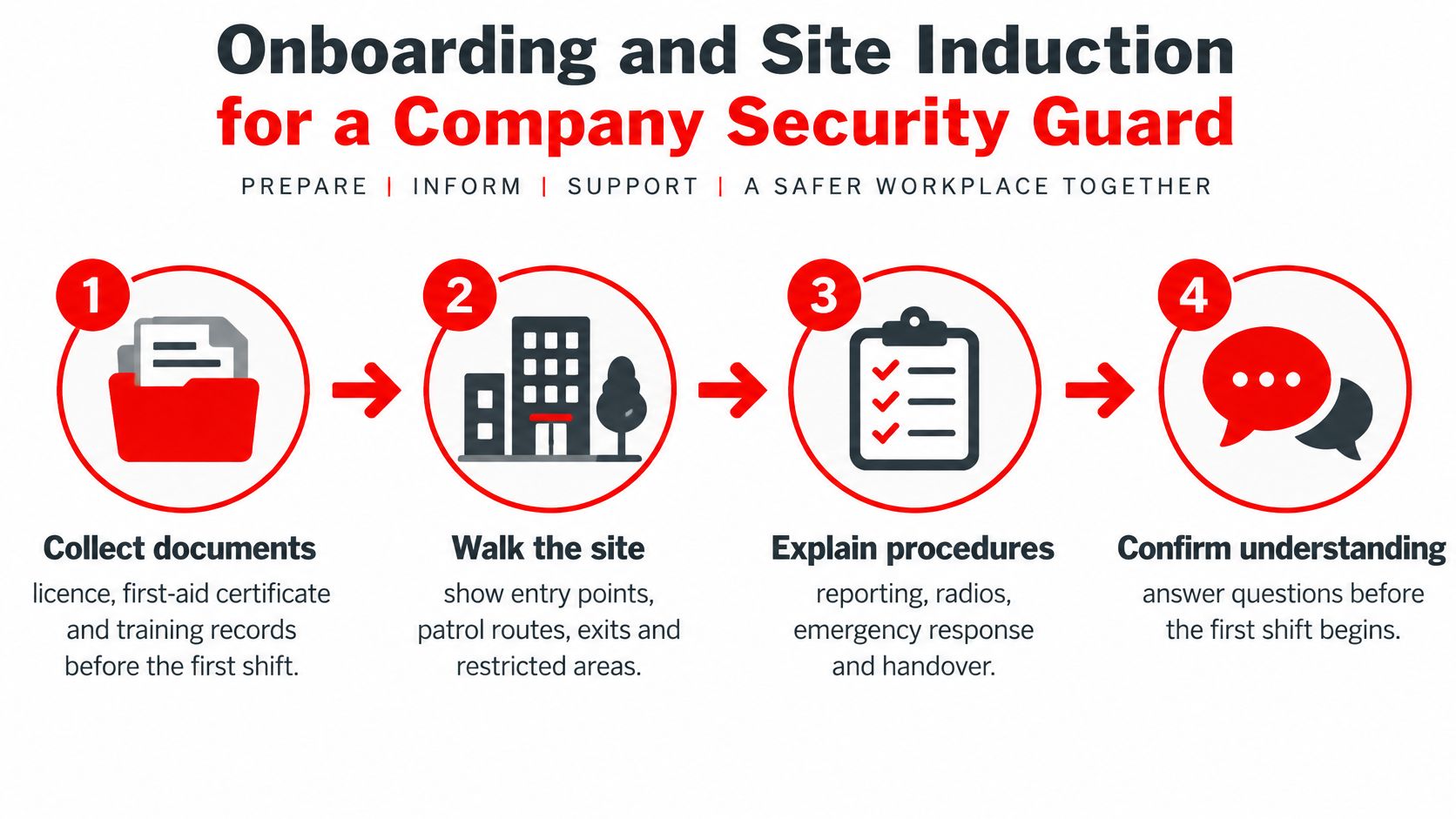
- Collect the documents first. Licence, first-aid certificate and training records land on file before the shift starts. A missing page means the shift doesn't start.
- Walk the site. Mark the patrol route, CCTV coverage, gates and panic points with the guard, or use a recorded walk-through if the building isn't open. A map on a desk misses the door that sticks.
- State the limits. Say what the guard must not do, and how the handover to police or emergency services works. Ambiguous authority is how a small refusal becomes a complaint.
- Set radios and one contact list. The supervisor's number goes first. A second list saved in someone's phone will be the one that gets used, and it will be wrong.
- Define an incident. Say what counts, how fast it is reported, and which form to use. If everything is an incident, the important ones drown.
- Shadow the first shift. A supervisor stays, then signs the induction. The signature is the control, not the welcome email.
- Review at day 7 and day 30. Fix the post while the memory is still fresh.
At a city bar, the first Friday showed one entry gate couldn't hold the queue. The supervisor moved a barrier and the guard logged the change. A desk briefing would have sent that queue into the street.
Rostering and KPIs for a Company Security Guard
Set the headcount from your risk assessment, then check it against a council benchmark rather than a guess.
Sutherland Shire Council's events toolkit recommends two security personnel for the first 50 patrons, then one more for every further 50. Volunteers and general support staff don't count toward that number. On that council's ratio, an event of 150 patrons needs at least four security personnel, 250 patrons need six and 300 patrons need seven. One council's planning figure is not a statewide rule, so confirm the permit and licence conditions on your own site before you treat any ratio as your floor.
Build posts on top of the ratio where the risk sits: entry gates, bars and exits. Where alcohol is served, security staff should be RSA trained, and guards should stay until the last patrons leave. Brief each shift on entries, exits, alcohol service, communications and the risk assessment.
A KPI set you can reuse each month
National figures won't give you a guard-level success rate. Build a baseline from the first event and review it at day 30. Drop any measure nobody opens.
| KPI | Target to set | How to measure |
|---|---|---|
| Response time to reported incidents | Your baseline, then a steady reduction | Log time from report to guard on scene |
| Licence audit pass rate | 100% before each deployment | Document check against the state register |
| Incident reports filed by shift end | 100% the same shift | Count late or missing reports |
| Training currency | All guards current | Training register reviewed monthly |
| Shift handover completion | Every relief signed | Signed handover log |
| Complaints from staff or the public | Downward trend | Complaints register |
| Hours worked against roster | Within agreed limits | Timesheets compared with roster |
Rostering controls sit beside the headcount. Cap shift length, name the relief for sick calls, keep a supervisor ratio across your posts, and record handovers so a hazard found at 2am is still known at 6am. Budgets often go wrong here: a roster trimmed to the lowest cost buys long shifts and thin supervision, and both erode the response time you just set as a KPI. Hours worked against the roster tell you whether the floor you set is the floor you bought.
Frequently Asked Questions About a Company Security Guard
Is a valid licence enough to show a company security guard is competent?
No. A licence is the baseline. NSW security industry legislation makes continuing approved training, assessment or instruction a licence condition, so knowledge has to stay current. Ask for those training records, then watch what the guard does on your site during the first shifts.
Do I still check licences if a provider supplies the guard?
Yes. Check the firm and each worker against the duties on your scope. A company name on an invoice does not authorise the person standing on your gate, and a gatehouse post, a K9 unit and a licensed bar each draw different licence requirements.
How many guards does a 150-patron event need?
At least four security personnel on the Sutherland Shire Council benchmark, with volunteers excluded. Put extra cover on high-risk gates and bars rather than stretching the same headcount across every entry point.
Why does shift length matter?
Jobs and Skills Australia reports average full-time hours of 45 per week for security officers and guards, compared with 44 across all occupations. Fatigue is a roster problem before it is a guard problem. Judge alertness on overnight posts, not just the paperwork.
Should a venue wait for the first incident before writing escalation rules?
No. Write the three tiers and drill them before you open. The first time a guard reads those rules should be in a drill, not at the door with a crowd building.
GM GROUP Services supplies licensed static guards, gatehouse control, vehicle patrols and event security for venues, construction sites and corporate functions across NSW, Victoria, Queensland and the ACT, with supervision and reporting built into the roster. If you want coverage matched to a written scope rather than a headcount, contact the GM GROUP Services team before you lock the quote to outline your site and the duties you need covered.