

Effective cctv monitoring security is about more than passively recording events to review after something has gone wrong. That’s a reactive approach. The real power of modern security lies in stopping incidents before they escalate. For example, a system that detects a trespasser at 2 AM and alerts a live operator can prevent a theft, whereas a simple recording only documents the loss.
Think of your CCTV system less like a passive camera and more like an active, intelligent guard that never sleeps. It’s a formidable shield for your business, event, or venue.
Why Proactive CCTV Monitoring is Your Best Defence

The old 'set and forget' mindset just doesn't cut it anymore. Managers running events, hospitality venues, retail stores, and construction sites across Australia are facing bigger challenges than ever. A passive system only gives you evidence of a theft, vandalism, or safety breach after the damage is done, leaving you to pick up the pieces.
Proactive monitoring flips this script entirely. By combining smart technology with human expertise, it creates a security system that actually responds. Imagine your CCTV as a 'digital watchdog' that’s constantly scanning for threats. The moment it spots something out of the ordinary, it alerts a dedicated team of security professionals who can step in, right then and there. This synergy is what modern cctv monitoring security is all about.
The Shift from Reactive to Preventative Security
For too long, security cameras were just a tool for post-incident review. We now know their true value lies in prevention. This shift is critical for protecting not just your assets, but your people and your hard-earned reputation.
Just think about the common security headaches businesses deal with every day:
- Unauthorised Access: Keeping intruders out of restricted areas on a construction site or backstage at a concert.
- Theft and Vandalism: Spotting and deterring potential criminals in a retail store or licensed venue before they make a move.
- Crowd Management: Identifying potential flashpoints like overcrowding or arguments at a festival before they turn into a real problem.
- Staff Safety: Making sure there's a rapid response on hand for employees working late or in isolated parts of a building.
A professionally monitored system tackles these issues head-on. It’s not just about watching screens; it’s about taking immediate, decisive action based on what those cameras are seeing.
This proactive stance is more critical than ever. Growing security concerns are fuelling the Australian CCTV camera market, which was valued at USD 0.91 billion in 2023 and is expected to hit USD 1.64 billion by 2029. This growth highlights a clear need for better security solutions, particularly as urbanisation brings increased risks of burglary and vandalism to dense areas in NSW, VIC, QLD, and the ACT. You can learn more about these market trends.
In this guide, we’ll walk you through everything you need to know about professional CCTV monitoring, from the different types available to figuring out its true value for your business.
Choosing the Right CCTV Monitoring Security Model
Thinking about cctv monitoring security isn't a simple case of "one size fits all." It’s a common and costly mistake to pick a setup that doesn’t actually match what your site needs. For any Australian business, the first real step towards solid security is getting to grips with the main ways monitoring is done. Choosing the right one means your investment stops being a passive recording device and becomes a genuine tool for stopping trouble before it starts.
The market is certainly reflecting this shift towards smarter security. The Australian video surveillance market pulled in USD 2,644.7 million in 2024 and is on track to hit USD 4,872.7 million by 2030. While new cameras are a big part of that, the real growth is in services like professional monitoring. You can dig into the full Australian video surveillance market research from Grandview Research to see these trends up close.
This trend sends a clear message: businesses are looking for more than just hardware; they need an expert eye watching over it. Let's break down the main models so you can figure out what’s best for your operation.
Live Monitoring for Real-Time Intervention
Live monitoring is exactly what it says on the tin. You have trained security professionals watching your camera feeds as things happen, ready to jump into action at a moment's notice. This is the most hands-on approach you can get, perfect for high-risk, busy places where a quick response can make all the difference.
Actionable Insight: For a large music festival, live monitoring allows an operator to keep an eye on crowd flow, spot someone in distress, or see a troublemaker trying to get into a restricted area. The moment they spot something, they can radio the on-site guards and direct them to the exact spot, turning a potential disaster into a non-event.
Recorded Monitoring for Post-Incident Investigation
Recorded monitoring is the backbone of most security setups. The cameras are always rolling, and you can go back and review the footage after something has happened. It’s not about stopping an incident in its tracks, but it’s an absolutely vital tool for piecing together what happened, gathering evidence, and figuring out how to prevent it from happening again.
Actionable Insight: A retail manager can pull up footage from the day before to confirm a shoplifting incident and hand undeniable proof to the police. On a construction site, it could be used to investigate a safety breach, providing a clear, unbiased account of the event. This footage can also be used to train staff on security protocols.
The real difference comes down to timing. Live monitoring is about acting during an event, while recorded monitoring gives you clarity after the fact. A truly robust security plan often finds a way to use both.
Back-to-Base Monitoring The Professional Standard
Back-to-base monitoring is the gold standard for round-the-clock professional security. It links your CCTV system directly to a remote monitoring centre staffed with licensed security experts. It’s a powerful, proactive shield that often works hand-in-glove with alarms and smart analytics.
Imagine a construction site after hours. Someone crosses a virtual tripwire you've set up around the perimeter. An alert instantly pops up at the monitoring station. An operator immediately pulls up the live camera feed to see exactly what's going on.
This quick verification is the game-changer. It means the operator can:
- Filter out false alarms—no more paying for call-outs because a stray cat or a gust of wind set off a sensor.
- Use a loudspeaker on-site to tell the intruder they're being watched and that a response team is on its way.
- Call the police with verified information about a break-in happening right now, which usually means a much faster response.
This model is incredibly effective for protecting your assets when no one is around. It transforms your cameras from a passive system into an active, vocal deterrent, making it a cornerstone of modern cctv monitoring security.
To make the choice clearer, it helps to see these models side-by-side. Each has a specific role to play, and understanding their strengths will guide you to the right solution for your business.
Comparing CCTV Monitoring Security Models
| Monitoring Type | Best For | Key Benefit | Example Scenario |
|---|---|---|---|
| Live Monitoring | High-traffic venues, critical infrastructure, and events where immediate response is key. | Proactive Intervention: Stops incidents in real-time before they escalate. | A shopping centre operator spots a medical emergency and dispatches first aid to the exact location within seconds. |
| Recorded Monitoring | Retail stores, offices, and sites needing evidence for post-incident analysis. | Evidence & Accountability: Provides an irrefutable record for investigations and compliance. | A warehouse manager reviews footage to identify the cause of an accident and improve safety protocols. |
| Back-to-Base | Unattended sites like construction yards, warehouses, and commercial properties after hours. | 24/7 Professional Response: Verified alerts lead to faster, more effective emergency action. | A remote operator verifies an intruder at a car dealership, warns them off via loudspeaker, and dispatches a patrol. |
Ultimately, the best model depends entirely on your risk profile and operational needs. Some businesses might rely solely on recorded footage, while others need the constant vigilance of a back-to-base system to protect high-value assets.
Integrating Technology with On-Site Security Teams
Truly effective cctv monitoring security isn't just about having great cameras. Its real power is unlocked when you seamlessly combine that technology with your on-the-ground security personnel. This creates a single, fast-reacting security force that’s far more effective than either part working alone.
When your tech and your team work in concert, your security becomes proactive, not just reactive. Think of your back-to-base monitoring team as the "eyes in the sky," providing constant vigilance. Your mobile patrols and static guards are the immediate "boots on the ground." This combination ensures that every alert isn't just seen—it's acted upon, quickly and decisively.
It's no surprise that demand for these integrated solutions is on the rise. In 2024, the Australian CCTV market hit a valuation of USD 1.16 billion, with projections soaring to USD 6.02 billion by 2033. This incredible growth underscores just how much businesses across NSW, VIC, QLD, and the ACT are relying on sophisticated security systems. You can read more about this market trend on imarcgroup.com.
From Digital Alert to Physical Response
So, how does this work in the real world? It's simple, really. A remote operator can spot a genuine threat, verify it in seconds, and have a mobile patrol unit on its way in minutes. This turns a potential disaster into a managed situation.
The process below shows how a professional monitoring setup moves from live detection to a coordinated response.
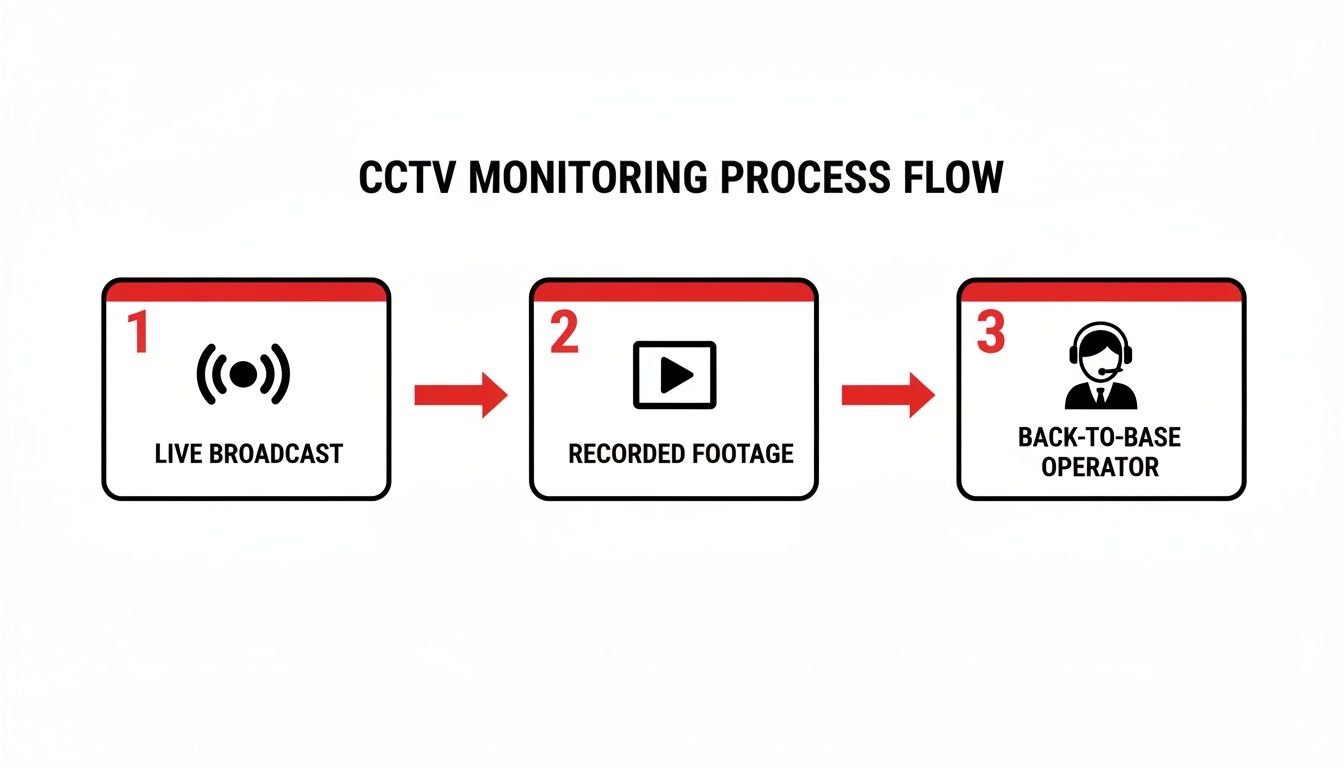

As you can see, this isn't about passively recording footage for later. It’s an active process that ends with a decisive intervention from our monitoring centre.
A camera can't make an arrest, and a guard can't be everywhere at once. Integrating them means alerts are instantly verified and patrols are dispatched with precision, drastically reducing false alarms and ensuring faster, more accurate response times.
A Live Incident Unpacked: A Step-by-Step Scenario
Let’s put this into a practical context. Picture a large construction site in Sydney after midnight—a magnet for thieves targeting expensive equipment. Here’s how an integrated cctv monitoring security system shuts down an intrusion:
-
AI Detection: At 2:15 AM, a smart camera with AI analytics picks up human movement near a container full of copper wiring. It knows to ignore a passing fox but instantly flags the human shapes as a potential threat. An alert is sent straight to the GM GROUP Services monitoring centre.
-
Remote Verification: A trained operator accesses the live feed within seconds. They see two people using bolt cutters on the container's lock. It's a confirmed threat, not a false alarm.
-
Direct Intervention and Dispatch: The operator hits a button, activating the on-site two-way audio. A loud, clear voice booms across the site: "You are trespassing on private property and are being recorded. Security has been dispatched." At the exact same moment, the operator dispatches the closest mobile patrol unit, giving them the intruders' precise location and description.
-
Coordinated Action: While the patrol car is en route, the remote operator keeps their eyes on the intruders, feeding live updates to the responding guards about their movements. This real-time intelligence means the patrol team arrives fully prepared and knowing exactly where to go.
-
Incident Resolution: Startled by the voice and the news that security is on the way, the would-be thieves drop their tools and flee. The mobile patrol arrives just minutes later to secure the perimeter, check the container for damage, and file a detailed incident report—complete with time-stamped video evidence.
This integrated approach didn't just prevent a major financial loss; it established a powerful deterrent against anyone thinking of trying again.
Building Your Standard Operating Procedures
Even the most advanced cctv monitoring security system is just a collection of cameras without a clear plan. That plan is your Standard Operating Procedures, or SOPs. Think of them as the essential playbook for your security team, taking all the guesswork out of the equation.
When an incident kicks off, you don't want your team wondering what to do next. A solid set of SOPs ensures every operator and on-site guard knows exactly how to react—whether it’s a minor disturbance or a full-blown emergency. They turn passive observation into decisive, effective action.
This isn't just about ticking boxes. It's about creating a bulletproof framework for professional and consistent security responses. For places like festivals, construction sites, or licensed venues where things can change in a heartbeat, this is non-negotiable. Well-written SOPs keep your team’s actions aligned with your security goals and, just as importantly, your legal obligations.
If you're starting from scratch, there are some great guides on how to write a standard operating procedure that can give you a solid foundation.
Key Components of a Site-Specific CCTV Plan
A generic security plan is a recipe for disaster. Every site is different, with its own unique layout, risks, and operational quirks. Your SOPs have to be tailored to your specific environment; a one-size-fits-all approach just leaves you exposed.
Your site-specific plan should be built on a few core pillars:
- Strategic Camera Placement: You need to document the exact location and field of view for every single camera. The goal is simple: eliminate blind spots in high-risk areas like entry and exit points, cash-handling zones, and isolated perimeter fences.
- Incident Classification: Define what you're looking for. A clear system helps everyone understand the difference between a low-level event (like someone loitering), a moderate risk (a heated argument), and a high-priority threat (like a break-in or violence).
- Escalation Protocols: This is the heart of your SOP. For every type of incident, you need a step-by-step response guide. Who verifies the alert? When does the on-site patrol get the call? At what point do you escalate to emergency services?
- Evidence Handling: It's crucial to outline the correct process for saving, storing, and handing over footage. This ensures the video evidence holds up for internal reviews or as evidence for the police, all while complying with Australian privacy laws.
The real strength of your cctv monitoring security isn't in the hardware. It's in the clarity of the instructions your team follows when the pressure is on.
Your CCTV SOP Development Checklist
Putting together a comprehensive SOP from the ground up can feel like a massive task. This checklist breaks it down into manageable steps, helping you build clear, compliant, and effective monitoring protocols for your venue or worksite.
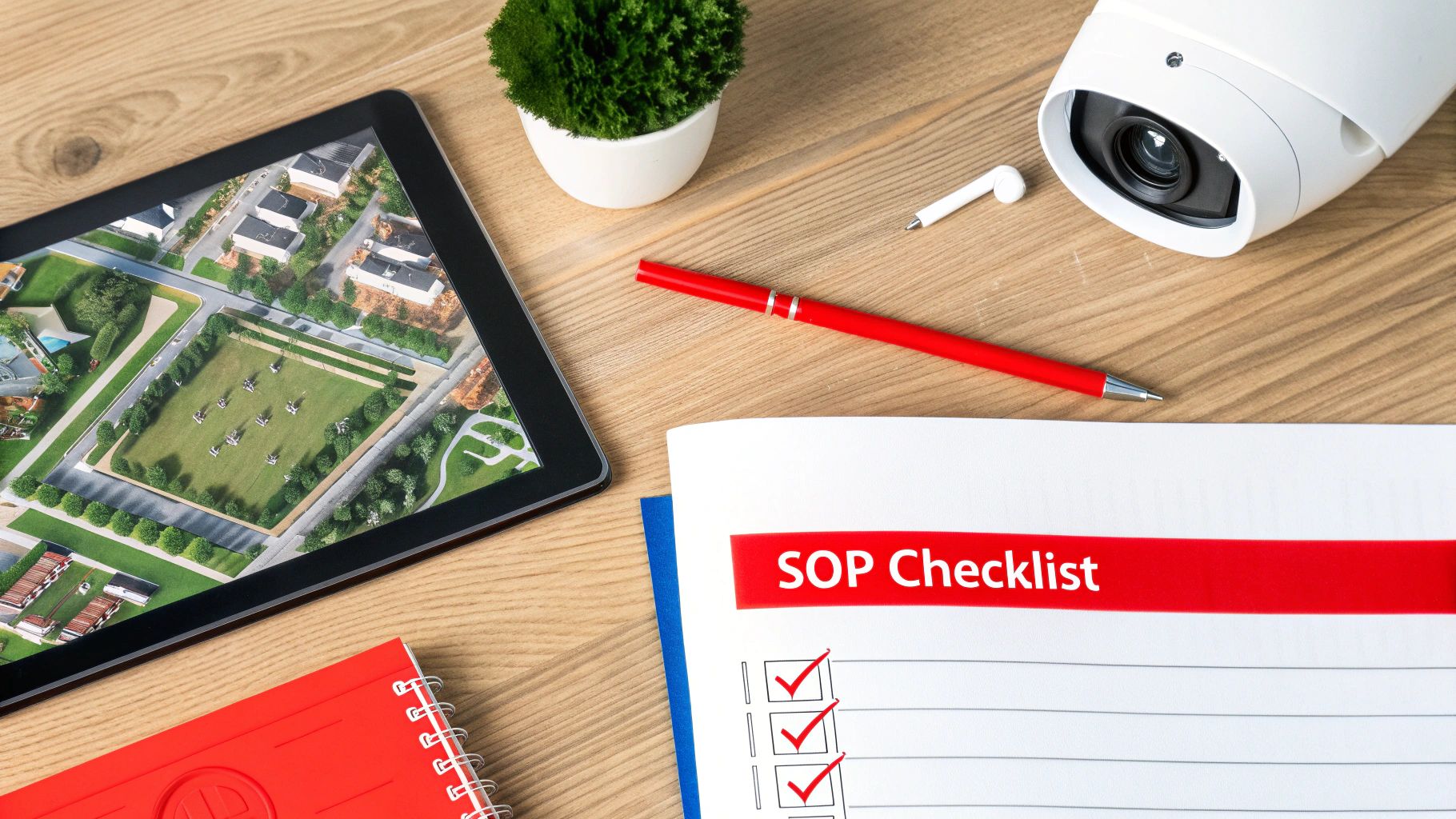
Think of this as your guide to making sure all the essential bases are covered.
- Site Risk Assessment: Have you walked the site and identified all potential security weak points and vulnerable areas?
- Camera Mapping: Do you have a detailed map showing every camera's location, what it can see, and where the blind spots are?
- Operator Responsibilities: Are the day-to-day duties for your monitoring staff clearly spelled out? No grey areas.
- Incident Response Flowchart: Have you created a simple, visual guide for escalating different types of alerts?
- Communication Protocols: How do your remote operators talk to on-site guards? What's the protocol for contacting emergency services?
- Footage Retention Policy: Does your SOP state exactly how long footage is kept, in line with state-specific laws (e.g., in NSW or VIC)?
- Privacy Compliance: Are the procedures clear for handling requests for footage and protecting people’s personal information?
- Regular System Audits: Is there a schedule in place to regularly check that all cameras are working and that your SOPs are still relevant?
By working through these points methodically, you’ll build a robust cctv monitoring security plan that not only protects your assets but also stands up to legal scrutiny.
Navigating Australia's Privacy and Legal Maze
Running a cctv monitoring security system in Australia is about much more than just putting up cameras. You're stepping into a world of serious legal obligations that change from one state to another. If you get it wrong, you could be facing hefty fines and a damaged reputation. Understanding the rules isn't just good practice—it's essential.
At the heart of it all is the Federal Privacy Act 1988, but that's just the starting point. Each state and territory layers its own surveillance laws on top, meaning what’s fine in NSW might land you in hot water in Victoria. The real challenge is finding the sweet spot between protecting your assets and respecting people's right to privacy.
The Ground Rules for Lawful Surveillance
The legal side of things can feel like a tangled web, but it really comes down to a few core ideas. Your cctv monitoring security has to be out in the open and done for a good reason. Secretly recording people is a massive no-go, and pointing cameras into private spaces like bathrooms or changing rooms is absolutely off-limits.
You need to be able to answer the question: why are we recording? Is it to stop theft? To keep people safe at an event? To protect expensive gear on a construction site? Having a clear, documented reason is your first and best line of legal defence.
The golden rule is transparency. People have a right to know they are being recorded. This principle is the foundation of nearly all state-based surveillance laws and is the easiest way to ensure your operations remain on the right side of the law.
State-by-State Rules You Can't Ignore
While the big ideas are similar everywhere, the details are what count. Knowing the specific rules for your state is non-negotiable.
-
New South Wales (NSW): The two big ones here are the Workplace Surveillance Act 2005 and the Surveillance Devices Act 2007. In NSW, you absolutely must have clear signs telling people CCTV is in use. If you’re monitoring employees, you have to give them 14 days' written notice before the cameras are switched on.
-
Victoria (VIC): The Surveillance Devices Act 1999 is the key piece of legislation. Like in NSW, consent is a huge deal. You generally can't record a private conversation or activity without everyone's permission, whether it’s spoken or implied. Obvious signage is often considered a form of implied consent in public-facing areas.
-
Queensland (QLD): Here, the Invasion of Privacy Act 1971 still holds weight. The main focus is on not recording someone in a situation where they’d reasonably expect to be private.
-
Australian Capital Territory (ACT): The Workplace Privacy Act 2011 deals directly with workplace surveillance. Just like in NSW, employers must talk to their staff and give them plenty of notice before bringing in cameras.
Getting a handle on general privacy policies is a smart move for any organisation, as it complements these specific state laws. For a wider view on how data should be handled, looking at an example like resgrid's Privacy Policy can offer some helpful insights.
Your Practical Compliance Checklist
Let's break it down into some simple, actionable steps for your cctv monitoring security program.
DO:
- Put Up Clear Signs: Place highly visible signs at every entrance and throughout monitored areas. They should clearly state that CCTV cameras are operating.
- Write a Privacy Policy: Create a simple document that explains why you're using CCTV, how you store the footage, and who gets to see it.
- Angle Cameras Carefully: Make sure your cameras only capture what they need to—public spaces or key work zones. Avoid pointing them at neighbouring homes or private areas.
- Lock Down Your Data: All footage needs to be stored on a secure, encrypted server with very tight access controls. Don't let just anyone view it.
DON'T:
- Record Audio: Recording private chats without permission is illegal in most places. Turn the audio function off on your cameras unless you have a rock-solid legal reason to use it.
- Use Hidden Cameras: Covert surveillance is a legal minefield and almost always illegal without a court order or specific authority.
- Hoard Footage: Only keep recordings for as long as you genuinely need them. For most incident reviews, 30 days is a good rule of thumb. After that, delete it securely.
- Share Footage Casually: Only hand over footage to the police if they show you a valid warrant or subpoena. No exceptions.
Calculating the True ROI of Your Security Investment
When we talk about professional cctv monitoring security, it’s easy to get fixated on the numbers on an invoice. But treating it as just another business expense misses the whole point. Think of it as a strategic investment. The real value isn't just in what you spend; it’s in what you save and what you gain.
For many of our clients, the return on investment (ROI) is incredibly direct. We’ve seen cases where stopping a single major theft of machinery from a construction site has paid for the entire year's monitoring service. It's that simple. The system pays for itself the first time it successfully protects your high-value assets.
Beyond Preventing Theft: The Hidden Financial Gains
But the real magic happens when you look past the obvious wins like stopping a break-in. A well-monitored security system quietly adds value to your business in ways that aren't always immediately apparent but have a huge impact on your bottom line.
Here’s where you’ll really see the returns stack up:
- Reduced Insurance Premiums: Insurers love seeing professionally monitored security. It shows them you're serious about mitigating risk, which often translates into significantly lower annual premiums for you. That’s a direct, recurring saving.
- Avoidance of Costly Litigation: Proactive monitoring is fantastic for preventing incidents that can lead to public liability claims, like a slip and fall or a heated dispute at a licensed venue. And if a claim does arise, clear video evidence is your best defence against baseless accusations, saving you from a world of legal headaches and fees.
- Enhanced Brand Reputation: A safe environment builds trust. If you run a pub, a festival, or a retail store, a reputation for safety is priceless. It encourages people to visit, stay longer, and come back—all of which directly boosts your revenue.
A Practical ROI Scenario: A Hospitality Venue
Let's put this into a real-world context. Imagine a popular pub in Melbourne that invests in a back-to-base cctv monitoring security service.
At first, the venue manager just sees the monthly fee going out. But fast forward six months. The system has helped thwart two after-hours break-in attempts, pinpointed an internal theft issue in the storeroom, and provided crystal-clear footage to resolve a patron dispute before it could escalate into a lawsuit.
When you add up the value of the prevented theft and the legal costs that were completely avoided, it easily dwarfs the annual monitoring fee. This is the moment the perspective shifts. Professional monitoring stops being an expense and becomes an investment in profitability and peace of mind.
By looking at your security from this value-driven angle, you'll see it’s not just about protecting what you have. It’s about building a stronger, more resilient, and ultimately more profitable business.
FAQ: Your CCTV Monitoring Security Questions Answered
Even when you have a good grasp of the technology, practical questions always come up. We get a lot of the same queries from business owners and event managers, so we've put together some straight answers to help you feel confident about your security decisions.
How Long Must I Legally Keep CCTV Footage in Australia?
This is a tricky one because there’s no single, nationwide rule. The regulations change quite a bit depending on your state, council, and even your industry. For example, licensed venues in New South Wales often have a legal requirement to hold onto their footage for at least 28 days.
Actionable Insight: As a general rule of thumb for liability and evidence, keeping footage for a minimum of 30 days is a solid professional benchmark pretty much anywhere in Australia. The key takeaway? Always check the specific rules tied to your business licence or event permit to be sure you're compliant.
Can AI Analytics Actually Prevent Crime?
Absolutely. Modern AI is a game-changer for moving from reactive to proactive security. Think of it this way: instead of one person trying to watch twenty screens at once, hoping to spot trouble, AI analytics can be programmed to look for specific threats. This could be anything from someone lingering in a restricted area after hours to a vehicle driving into a no-go zone. The moment the AI spots something that breaks a pre-set rule, it sends an immediate, verified alert to a monitoring team. This provides the crucial lead time needed to intervene and often stop an incident before any real damage is done.
Is Back-to-Base Monitoring Better Than an On-Site Guard?
In many situations, yes. A back-to-base team provides a dedicated, 24/7 service from trained professionals whose only job is to watch your site. An on-site guard, on the other hand, often gets pulled into other duties. They can also face distractions, fatigue, or even direct threats that get in the way of their effectiveness.
The gold standard, however, isn't an either-or choice. The most powerful solution is an integrated one where back-to-base monitoring supports the on-site guard. This creates a rock-solid, multi-layered system that combines constant technological vigilance with the ability to respond on the ground instantly.
What Is the Biggest Mistake Businesses Make with CCTV?
By far, the most common mistake is the ‘set and forget’ mentality. So many businesses spend good money on quality cameras but then skip the professional monitoring. Without someone actively watching, your CCTV system is just a tool for figuring out what went wrong after you've already suffered a loss. Proactive cctv monitoring security turns your cameras from a passive recorder into a genuine preventative asset.
Another classic error is poor camera placement that creates obvious blind spots. This is exactly why getting a professional risk assessment and installation done from the start is so important. It’s the only way to get real security and true peace of mind.
Ready to put a proactive security solution in place to protect your people, assets, and reputation? The experts at GM GROUP Services design and deliver security strategies for events, venues, and businesses across Australia. Contact us today for a comprehensive risk assessment.